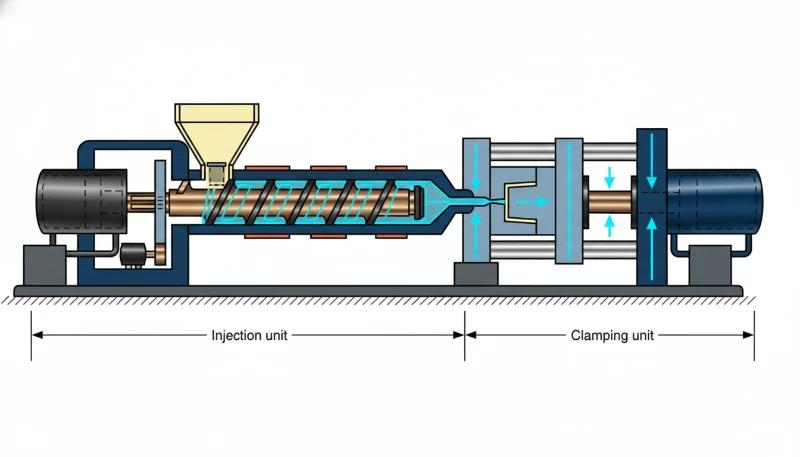
Uw productiemanager vroeg net waarom een eenvoudig dekselonderdeel 45 seconden per schot kost, terwijl de concurrent 18 seconden opgaf. Het antwoord komt bijna altijd neer op één ding: hoe goed u de spuitgietcyclus begrijpt—en optimaliseert.
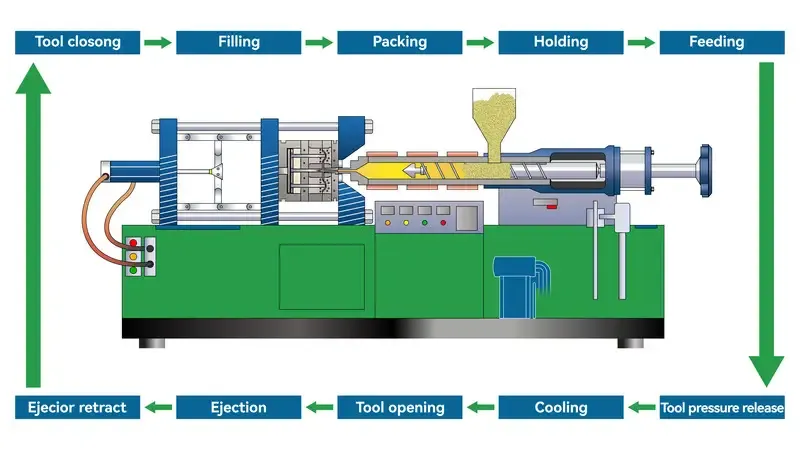
De spuitgietcyclus is de volledige reeks van matrijs sluiten tot onderdeeluitstoting. Het is de grootste drijvende factor voor de kosten per onderdeel bij grootschalige productie. Doe je het verkeerd, dan brand je winst bij elke cyclus. Doe je het goed, dan win je capaciteit zonder ook maar één nieuwe machine aan te schaffen.
- De spuitgietcyclus omvat de fasen: injectie, nadrukken, koelen en uitwerpen.
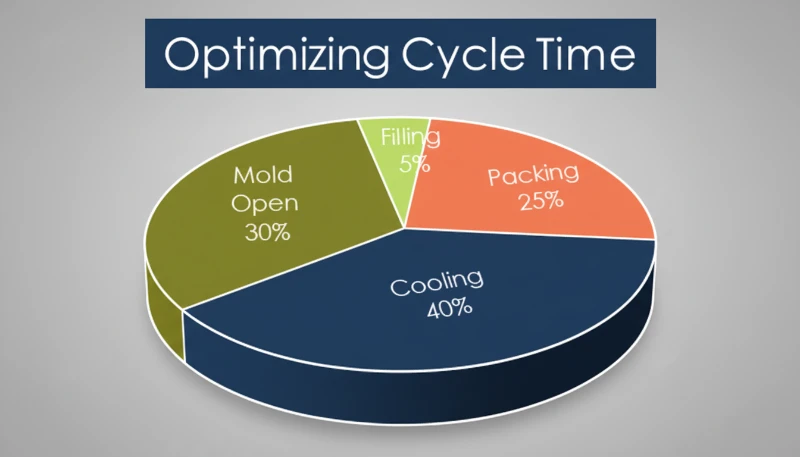
- Koelen verbruikt doorgaans 50–80% van de totale cyclusduur.
- Cyclusduur bepaalt direct uw kosten per onderdeel en machinebenuttingsgraad.
- Wanddikte, matrijskoelontwerp en materiaalkeuze zijn de drie grootste hefbomen.
- Zelfs een verkorting van 2 seconden op een matrijs met veel holtes kan duizenden per maand besparen.
Wat is de spuitgietcyclus?
De cyclus bij het spuitgieten is de totale verstreken tijd vanaf het sluiten van de matrijs tot het uitwerpen van het onderdeel op een spuitgietmachine.
Als u leveranciers vergelijkt of een inkoop plant, behandelt onze gids voor het selecteren van een spuitgietleverancier de voorbereiding van de offerteaanvraag, kwalificatie en controles op commerciële risico’s.
Deze cyclus is belangrijk omdat hij uw doorvoerplafond bepaalt. Als uw cyclusduur 30 seconden is en u een 4-holtes matrijs gebruikt, produceert u 480 onderdelen per uur. Haal daar 5 seconden af, en u springt naar 576 onderdelen per uur – een capaciteitsverhoging van 20% zonder kapitaaluitgaven.
In onze fabriek in Shanghai hebben we 47 spuitgietmachines van 90T tot 1850T. Met meer dan 20 jaar productie-ervaring hebben we de cyclusduren voor duizenden matrijsprogramma's geoptimaliseerd. Ons technisch team houdt de cyclusduur van elke opdracht bij en werkt terug van de gewenste stuksprijs om de optimale cyclusparameters te bepalen.
In onze fabriek houden we de cyclusduur van elke opdracht bij. Wanneer een klant ons vraagt een bepaalde stuksprijs te halen, is het eerste getal waar we van terugrekenen de cyclusduur, omdat deze de machine-uurkosten per onderdeel bepaalt.
Wat zijn de vier fasen van de spuitgietcyclus?
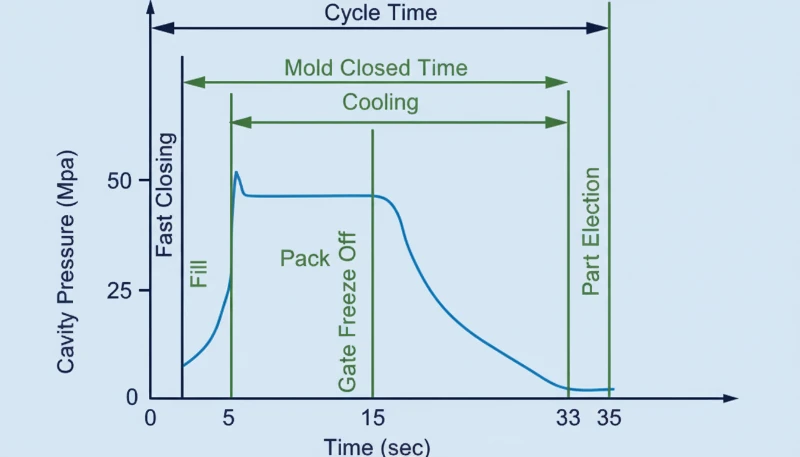
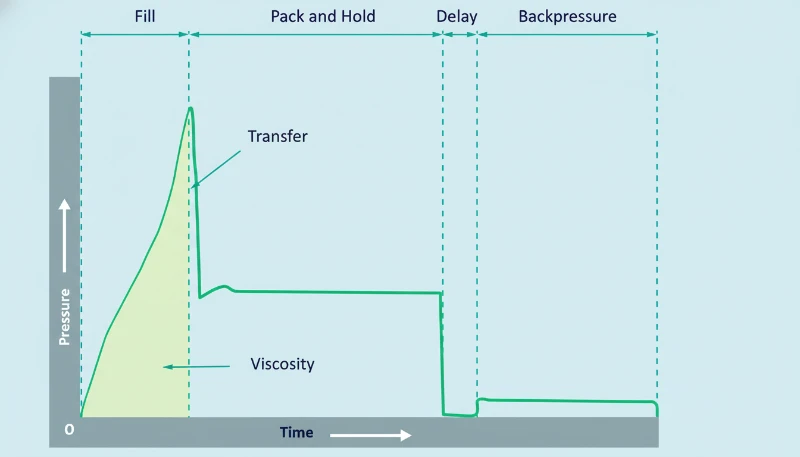
De spuitgietcyclus bestaat uit vier fasen: inspuiten, nabranden, koelen en uitwerpen, elk bepaald door de geometrie van het onderdeel en het materiaal.
1. Injectie (Matrijsvulling)
Voor de meeste standaardonderdelen (wanddikte 2–3 mm, standaard kunststof) duurt het inspuiten van de holte 2–5 seconden. Grote constructieonderdelen met dikke wanden kunnen 8–12 seconden duren. Het inspuitsnelheidsprofiel wordt meestal in fasen geprogrammeerd—langzaam bij de ingang om straalvorming te voorkomen, snel door de hoofdholte, en dan weer langzaam aan het einde om overvulling te voorkomen.
2. Nadrukken (Druk vasthouden)
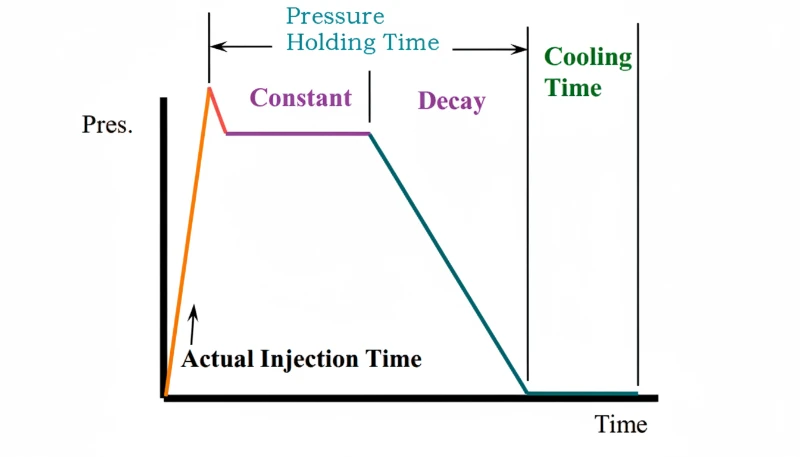
Nadruktijd duurt meestal 5–30 seconden. Nadat de holte nominaal vol is, handhaaft de schroef druk om volumetrische krimp te compenseren terwijl het plastic afkoelt van smelttemperatuur naar stollingstemperatuur.
Deze fase voegt 5–25% meer materiaal toe aan de holte na de initiële vulling. De nadrukkingsdruk moet worden aangehouden totdat de ingang bevriest – zodra de ingang stolt, heeft extra druk geen effect meer op het onderdeel. Daarom zijn ingangsgrootte en -locatie kritieke ontwerpbeslissingen. Een ingang die te vroeg bevriest, leidt tot overmatige krimp; een die te laat bevriest, verlengt de cyclus onnodig.
De optimale houdtijd wordt bepaald door onderdelen bij toenemende houdtijden te wegen totdat het onderdeelgewicht stabiliseert. Bij ZetarMold voeren we deze poortsluitingsstudie uit op elke nieuwe matrijs tijdens de T1-steekproef.
3. Koeling
Koelen is vrijwel altijd de langste fase en beslaat 50–80% van de totale cyclustijd. Gebruikelijke koeltijden liggen tussen 10 en 120 seconden en worden voornamelijk bepaald door de wanddikte en de thermische diffusiviteit1 van het materiaal.
De vuistregel voor de koeltijd is ongeveer evenredig met het kwadraat van de wanddikte. Verdubbel de wanddikte, en de koeltijd verviervoudigt ongeveer. Daarom raden we vaak wanddikte-optimalisatie aan tijdens de DFM-beoordeling – van 4 mm naar 3 mm gaan in een niet-kritiek gebied kan de koeltijd met bijna 40% verminderen.
Het ontwerp van koelkanalen is de technische beslissing met de grootste invloed op de cyclustijd. Conforme koelkanalen2, die de contour van het onderdeel volgen, kunnen de koeltijd met 20–40% verkorten ten opzichte van conventionele recht geboorde kanalen. Bij massaproductie kan dit alleen al de hogere matrijskosten rechtvaardigen.
4. Uitwerpen en matrijs openen
Uitwerptijd duurt doorgaans 2–10 seconden. Deze fase omvat het openen van de matrijs, het uitwerpen van het onderdeel (via uitwerppennen, stripperplaten of luchtstoten) en eventuele robot- of operatorverwijderingstijd, gevolgd door het sluiten van de matrijs voor de volgende cyclus.
Voor geautomatiseerde productie met robotmatige onderdeelverwijdering, reken op 3–6 seconden. Handmatige verwijdering voegt 1–3 seconden toe. De matrijsopeningsafstand, uitstootsnelheid en de aanwezigheid van zijacties (lifters, schuiven) beïnvloeden allemaal deze tijd.
De machinegrootte speelt ook een rol: een 80T-machine opent en sluit mogelijk in 4 seconden, terwijl een 1000T-machine 10–15 seconden nodig heeft voor dezelfde handeling vanwege een grotere plaatbeweging en zwaarder matrijsgewicht.
Hoe lang duurt een typische spuitgietcyclus?
Een typische spuitgietcyclus ligt tussen de 10 en 60 seconden voor de meeste productieonderdelen. Dunwandige verpakkingen kunnen onder de 5 seconden draaien, terwijl grote, dikwandige constructieonderdelen meer dan 120 seconden kunnen overschrijden.
| Onderdeeltype | Wanddikte | Typische cyclus | Belangrijkste knelpunt |
|---|---|---|---|
| Dunwandige verpakking | 0.5–1.0 mm | 3–8 seconden | Injectiesnelheid |
| Behuizing voor consumentenelektronica | 1.5–2.5 mm | 12–25 seconden | Koeltijd |
| Auto-interieur | 2.0–3.5 mm | 20–45 seconden | Koeltijd |
| Medisch apparaatonderdeel | 1.0–3.0 mm | 15–35 seconden | Nadrukken + koelen |
| Groot constructieonderdeel | 4.0–8.0 mm | 60–120+ seconden | Koeltijd |
De bovenstaande tabel maakt één ding duidelijk: koelen domineert. Voor onderdelen met een wanddikte boven 2 mm is koelen waar u eerst op moet focussen bij optimalisatie-inspanningen.
Hoe berekent u de totale cyclusduur?
De totale cyclusduur is de som van inspuittijd, nawijltijd, koeltijd en matrijsopen-/sluit- plus uitstoottijd. In de praktijk overlapt schroefterugwinning (plasticering) met koelen, dus de effectieve cyclus wordt gedomineerd door de langste niet-overlappende fase.
De basisformule:
Cyclustijdformule:Tcyclus = Tinjectie + Tnadruk + max(Tkoelen, Tschroefherstel) + Tmatrijs openen/sluiten + Tuitwerpen
Voor een snelle schatting van de inspuit tijd:
Inspuit Tijd Schatting:Tinjectie = Vshot / (0,20–0,50 × Vmax) + tbasis
Als een praktisch voorbeeld, beschouw een standaard PP-behuizing met een wanddikte van 3 mm, geproduceerd op een 200T-machine. Het inspuiten vult de holte in ongeveer 3 seconden, het naspuiten duurt 8 seconden, de koeling vereist 18 seconden, en het openen/sluiten van de matrijs plus uitwerpen kost 5 seconden. Totale cyclustijd: ongeveer 34 seconden per schot, wat ongeveer 106 onderdelen per uur oplevert uit een eenholte-matrij.
Welke factoren hebben de meeste invloed op de cyclusduur?
Wanddikte, matrijskoelontwerp en thermische materiaaleigenschappen hebben de grootste impact op de cyclustijd. Secundaire factoren zijn poortontwerp, machinecapaciteit en complexiteit van onderdeeluittrekking.
De terugwinningstijd van de schroef overlapt vaak met de koeling en moet in de totale berekening worden meegenomen. Als de schroef niet volledig kan terugwinnen (herladen) voor de volgende schot gesmolten materiaal voordat de koelfase eindigt, wordt de terugwinningstijd het knelpunt, waardoor de totale cyclustijd aanzienlijk langer wordt dan wat de koelberekening alleen zou suggereren.
Wanddikte
Wanddikte is de meest invloedrijke factor omdat de koeltijd toeneemt met het kwadraat van de dikte. Het verminderen van een 4 mm wand naar 3 mm kan de koeltijd met ongeveer 44% verkorten. Dit is waarom DFM-feedback over wanddikte niet alleen een leuk extraatje is—het beïnvloedt direct je kosten per onderdeel.
Matrijs Koelontwerp
Het aantal, de diameter en de nabijheid van de koelkanalen tot het holteoppervlak bepalen hoe snel warmte wordt afgevoerd. Een goed ontworpen koelcircuit houdt een temperatuurverschil tussen inlaat- en uitlaatwater van minder dan 3°C. Als uw delta-T 8°C is, heeft u een koelstroom probleem.
Materiaalkeuze
Kristallijne polymeren (PP, POM, PEEK) geven tijdens het stollen latente kristallisatiewarmte3 af, waardoor de koeltijd bij gelijke wanddikte 30–50% langer is dan bij amorfe polymeren (ABS, PC, PMMA). Gevulde materialen, zoals glasvezelversterkt nylon en mineraalgevuld PP, geleiden warmte beter en koelen vaak sneller.
Voor matrijzen met meerdere holtes beïnvloedt ook het loopstelsel de cyclus tijd. Een uitgebalanceerd loopstelsel zorgt ervoor dat alle holtes gelijkmatig vullen en worden gevuld, waardoor overgevulde holtes die overmatige koeling vereisen worden voorkomen. Uitgebalanceerde loopstelsels kunnen u dwingen om de koeltijd te verlengen om de langzaamst vullende holte te accommoderen.
Poortontwerp en spruitstelsel
Geavanceerde simulatie tools (Moldflow, Moldex3D) kunnen de cyclus tijd voorspellen voordat staal wordt gesneden, waardoor matrijs ontwerpers het koelontwerp en de plaatsing van de poort virtueel kunnen optimaliseren. Dit vermindert het aantal fysieke iteraties dat nodig is tijdens het bemonsteren.
Poortgrootte bepaalt hoe lang de naspuitdruk effectief is voordat de poort bevriest. Een heetspruitstelsel elimineert spruitafval en verkort vaak de cyclustijd omdat er geen koude spruitmassa is om te koelen en uit te werpen. Koude spruitmatrijzen, vooral drieplaatontwerpen, voegen zowel koel- als matrijsopeningstijd toe.
Machinecapaciteit
Inspuitsnelheid, klemkracht en plaatensnelheid dragen allemaal bij. Een moderne servogestuurde machine kan de matrijs 15–20% sneller openen en sluiten dan een verouderde hydraulische machine van hetzelfde tonnage. Als je cyclus machinebeperkt is, kan upgraden naar een snellere machine of een machine met betere plastificeercapaciteit kosteneffectiever zijn dan matrijswijzigingen.
Hoe kunt u de cyclusduur verkorten zonder kwaliteit op te offeren?
De meest effectieve manieren om de cyclusduur te verkorten zijn het optimaliseren van koelkanalen, het verminderen van wanddikte en het correct afstellen van de poortsluitingstijd.
Optimaliseer Eerst Koeling
Aangezien koeling 50–80% van de cyclus tijd uitmaakt, liggen hier de grootste winsten. Gebruik thermische simulatie (matrijzen stromingsanalyse) om hotspots te identificeren voordat staal wordt gesneden. Overweeg conformale koelkanalen voor hoogvolumematrijzen—deze kunnen de koeltijd met 20–40% verminderen.
Zorg voor voldoende koelmiddeldebiet. Het doel is turbulente stroming (Reynoldsgetal > 4000) in elk kanaal. Als uw bedrijf in de zomer leidingwater zonder koelmachine gebruikt, stijgt de watertemperatuur en neemt het koelrendement aanzienlijk af.
Stel de Persdrukfase Correct Af
Veel spuitgieters stellen de naspuitduur te lang in als veiligheidsmarge. Voer een poortafdichtingsstudie uit: weeg onderdelen bij 5, 10, 15, 20 seconden naspuiten. Wanneer het onderdeelgewicht stopt met toenemen, heb je de minimale effectieve naspuitduur gevonden. Alles daarboven is verspilde tijd.
Gebruik Robot Gelijktijdige Operaties
Als u een robot gebruikt voor onderdeel verwijdering, programmeer deze dan om tijdens het openen van de matrijs te beginnen met verwijderen in plaats van te wachten op volledige opening. Dit kan 1–3 seconden per cyclus besparen. Op een matrijs met veel holtes die 24/7 draait, betekent dit duizenden extra onderdelen per maand.
Overweeg Materiaal Substitutie
Als de toepassing het toelaat, kan het overschakelen van een langzaam koelend kristallijn materiaal naar een sneller koelend amorf alternatief de cyclus tijd met 20–30% verminderen. Bijvoorbeeld, het vervangen van POM door ABS in een niet-kritieke beugeltoepassing. Controleer altijd de mechanische eisen voordat u deze wijziging doorvoert.
Waar of onwaar: test uw kennis van de spuitgietcyclus?
"“De koeltijd vormt het grootste deel van de spuitgietcyclus.”"True
Koeling vertegenwoordigt typisch 50–80% van de totale cyclustijd. Dit is waarom koelkanaalontwerp meer impact heeft op cyclustijdvermindering dan enige andere enkele factor.
"“Een kortere cyclustijd betekent altijd lagere kosten per onderdeel.”"False
Als je de cyclustijd verkort door de koeling te veel in te korten, krijg je vervormde onderdelen, dimensionele afkeur of vastzittende onderdelen tijdens het uitwerpen. De kosten voor herwerking, afval en sortering kunnen de besparingen op machinetijd overtreffen. Cyclusoptimalisatie moet eerst de kwaliteit waarborgen.
Inzicht in deze veelvoorkomende misvattingen is essentieel voor iedereen die betrokken is bij productieplanning of matrijsontwerp. De volgende stellingen gaan verder in op de wisselwerking tussen beslissingen over cyclustijd, materiaalgedrag, matrijsontwerp en praktische productiebeperkingen waarmee technici dagelijks op de werkvloer te maken hebben.
Veel ervaren spuitgieters hebben situaties meegemaakt waarin de theorie uit het boekje en de praktijk op de werkvloer uiteenlopen. Een cyclus die op papier optimaal lijkt, kan inconsistente resultaten opleveren door variaties in materiaaleigenschappen per batch, schommelingen in de omgevingstemperatuur of subtiele veranderingen in de matrijs-oppervlakteconditie tijdens een lange productieserie. Dit is waarom continue monitoring en periodieke cyclusaudits standaardpraktijk blijven in goed geleide spuitgietbedrijven.
In hoogvolume productieomgevingen leveren zelfs kleine verbeteringen in cyclusduur snel samengestelde voordelen op. Een verkorting van twee seconden op een matrijs die 24 uur per dag draait, vertaalt zich in honderden extra onderdelen per week. Elke aanpassing moet echter worden gevalideerd met dimensionale gegevens en defecttracking voordat deze wordt vastgelegd in de standaardprocesparameters. Ervaring leert dat de veiligste optimalisaties eerst gericht zijn op koelrendement, gevolgd door verkorting van de naspuitijd en daarna verbeteringen van uitstootsnelheid.
"“Hotrunnersystemen kunnen de cyclustijd verkorten doordat de runner niet hoeft af te koelen.”"True
Heetkanaalsystemen houden het plastic in het kanaalsysteem gesmolten tussen de schoten, dus er is geen koude kanaalmassa om te koelen en uit te werpen. Dit elimineert kanaalgerelateerde koel- en uitwerptijd en vermindert ook materiaalverspilling.
"De injectietijd is doorgaans de langste fase van de cyclus."False
Injectietijd is typisch de kortste fase van 1–10 seconden. Koelen is de langste fase, vaak 50–80% van de totale cyclusduur. Injectiesnelheid is belangrijk voor onderdeelkwaliteit, maar domineert zelden de cyclusduur.
Wat Zijn de Meest Gestelde Vragen Over de Spuitgietcyclus?
Wat is de gemiddelde spuitgietcyclusduur?
De gemiddelde spuitgietcyclusduur voor productieonderdelen varieert van 15 tot 45 seconden. Dunwandige verpakkingen kunnen in minder dan 5 seconden worden geproduceerd, terwijl grote constructieonderdelen meer dan 120 seconden kunnen duren. Koeltijd is de dominante factor in de meeste cycli.
Hoe wordt de spuitgietcyclusduur berekend?
Cyclusduur = inspuitijd + naspuitijd + max(koeltijd, schroefhersteltijd) + matrijs openen/sluiten tijd + uitstoottijd. De max()-functie houdt rekening met de overlap tussen koelen en schroefherstel.
Welk percentage van de cyclusduur is koeling?
Afkoeling beslaat 50–80% van de totale spuitgietcyclusduur. Voor dikwandige onderdelen (4 mm+), kan afkoeling meer dan 80% van de totale cyclus bedragen.
Kun je de spuitgietcyclusduur verkorten nadat de matrijs is gebouwd?
Ja. Optimalisaties na de bouw omvatten het aanpassen van procesparameters (injectiesnelheid, naspuitijd, matrijstemperatuur), verbeteren van koelvloeistofstroming, toevoegen van externe koelinrichtingen en in sommige gevallen het aanpassen van koelkanalen of installeren van heetkanaalnozzles.
Beïnvloedt cyclusduur de onderdeelkwaliteit?
Ja. Onvoldoende koeltijd veroorzaakt vervorming, dimensionale instabiliteit en uitwerpsporen. Overmatige naspuitijd kan leiden tot overvulling en uitstulpingen. Elke fase moet geoptimaliseerd worden voor het materiaal en de onderdeelgeometrie.
Wat is het verschil tussen cycletijd en levertijd in spuitgieten?
Cyclusduur is het aantal seconden per schot op de machine (typisch 10–60 seconden). Doorlooptijd is de totale tijd van bestelling tot levering (typisch 4–12 weken), wat matrijsbouw, proefstukken, productieplanning en verzending omvat.
Hoe beïnvloedt de wanddikte de cyclusduur?
Koeltijd schaalt ongeveer met het kwadraat van de wanddikte. Het verdubbelen van de wanddikte verviervoudigt ruwweg de koeltijd. Dit is waarom optimalisatie van wanddikte tijdens DFM-beoordeling de meest impactvolle cyclusduurverlagingsstrategie is die beschikbaar is voordat de gereedschapsbouw begint.
Hulp nodig bij het optimaliseren van uw spuitgietcyclus? Ons engineeringteam kan uw matrijsontwerp beoordelen op cyclusoptimalisatie, een matrijsstroomsimulatie uitvoeren en vóór de staalbewerking een gedetailleerde schatting van de cyclustijd leveren. Met 45 machines (90T–1850T) en meer dan 20 jaar productie-ervaring hebben we de meeste uitdagingen rond cyclustijd al gezien én opgelost. Vraag een gratis offerte aan →
thermische diffusiviteit: Thermische diffusiviteit geeft aan hoe snel warmte door een materiaal beweegt en is gedefinieerd als de warmtegeleidingscoëfficiënt gedeeld door de dichtheid en soortelijke warmte, gemeten in mm2/s. ↩
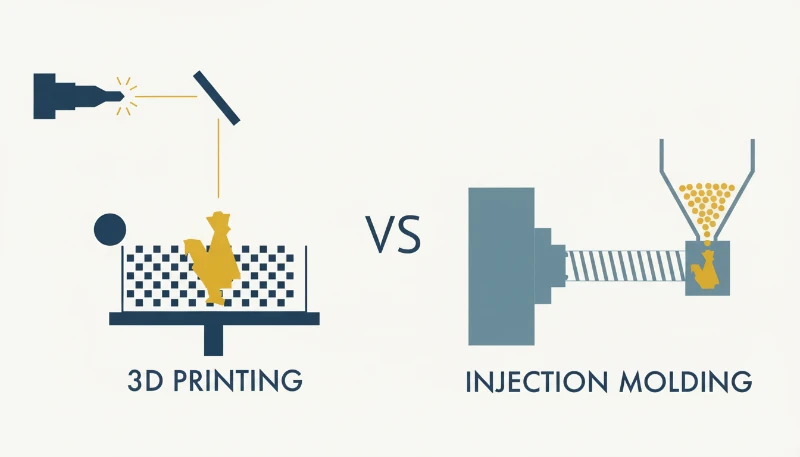
conforme koelkanalen: Conforme koelkanalen zijn koelkanalen in een matrijs die de contour van de productcaviteit volgen. Ze worden doorgaans met 3D-printen vervaardigd en koelen gelijkmatiger dan conventionele recht geboorde kanalen. ↩
latente kristallisatiewarmte: Latente kristallisatiewarmte is de thermische energie die vrijkomt wanneer een kristallijn polymeer overgaat van een ongeordende smelt naar een geordende kristallijne vaste stof, doorgaans gemeten in J/g. ↩