Перейти к содержанию
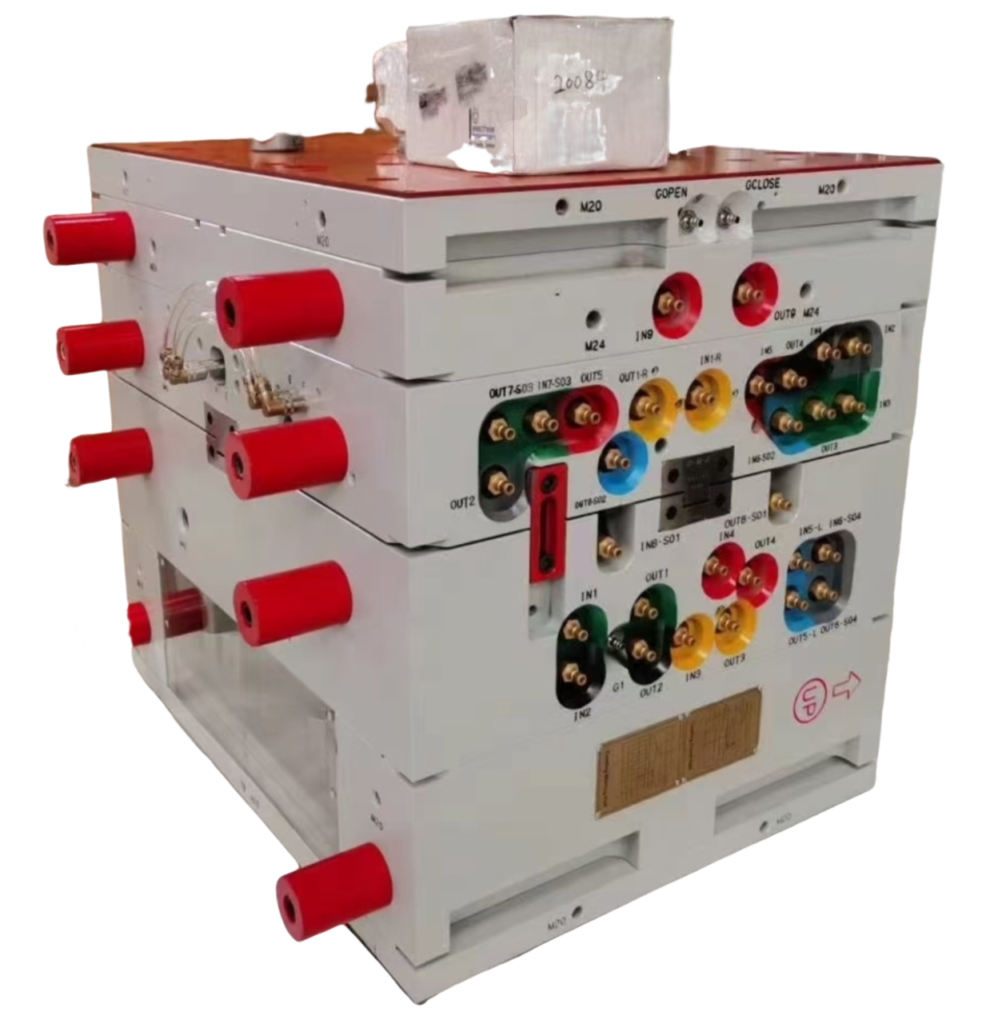
У каждой детали, полученной методом литья под давлением, есть одна — та тонкая линия, проходящая по поверхности, где сходятся половинки формы. линия разделения1 не является дефектом; это неизбежная особенность литьё под давлением процесс. Но то, где вы её разместите и как спроектируете вокруг неё, может стать разницей между готовой к производству деталью и дорогостоящей переделкой.
В нашей мастерской по изготовлению форм мы видели, как инженеры ошибались с линией разъема больше раз, чем можем сосчитать. Кажется, все просто — просто разделить форму пополам — пока не осознаешь, что линия разъема определяет, где именно вспышка2 появляется, какие размеры выдерживаются с высокой точностью, может ли деталь вообще быть правильно извлечена из формы и сколько будет стоить оснастка. Это руководство охватывает все, что инженерам нужно знать о поверхностях разъема и линиях разъема, чтобы вы могли сделать все правильно с первого раза.
- Линия разъёма — это физический след, оставшийся там, где две половинки формы встречаются во время литья.
- Конструкция поверхности разъема напрямую влияет на качество детали, стоимость формы и эффективность производства.
- Пять основных типов: плоская, ступенчатая, наклонная, криволинейная и комбинированная поверхности разъёма.
- Анализ DFM до изготовления оснастки может предотвратить 80% производственных проблем, связанных с линией разъема.
- Заусенец на линии разъема контролируется точностью формы, усилием смыкания и выбором материала.
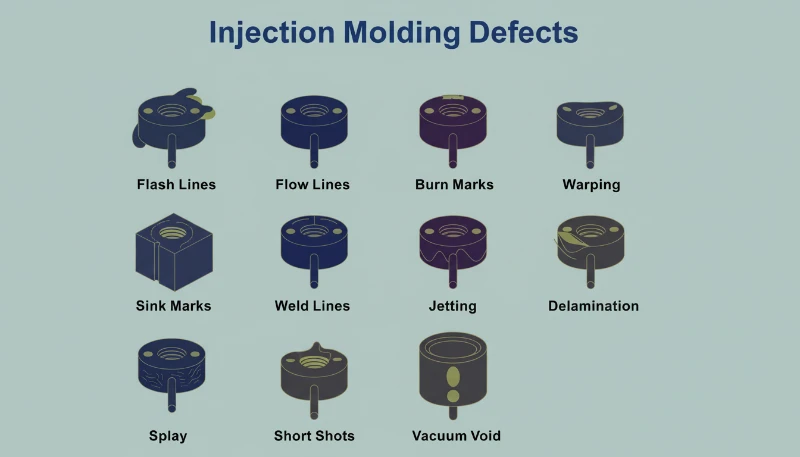
What Is a Parting Surface in Injection Molding?
Поверхность разъёма — это плоский или профилированный интерфейс, где две половинки формы встречаются и герметизируются во время литья. Если вы сравниваете поставщиков или планируете закупку, наш injection molding supplier sourcing guide covers RFQ prep, qualification, and commercial risk checks.
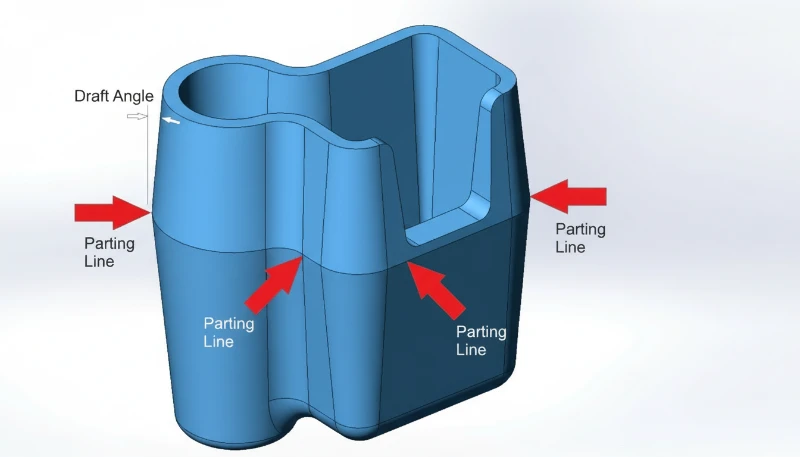
Поверхность разъёма — это контактный интерфейс между двумя половинками формы — стороной полости (сторона A) и стороной сердечника (сторона B). Когда форма закрывается, эти две поверхности прижимаются друг к другу под усилием смыкания в тонны. Линия разъёма — это узкий след, который этот интерфейс оставляет на готовой пластиковой детали.
В узком смысле поверхность разъема относится конкретно к основной плоскости разделения на наибольшем контуре детали — поверхности, которая разделяет полость и сердечник. В более широком смысле она включает все контактные поверхности между модулями формы: грани ползунов, интерфейсы подъемников, стыки вставок и посадочные места толкателей. Каждый из этих интерфейсов может оставить видимую линию на детали.
Профессионалы отрасли часто называют её «поверхностью разъёма» или сокращённо «линией разъёма». Толщина и видимость этой линии зависят от точности формы, усилия смыкания, вязкости материала и условий обработки. Хорошо спроектированная поверхность разъёма с жёсткими допусками формы создаёт линию настолько тонкую, что она едва заметна — обычно шириной от 0,01 до 0,05 мм. Плохо спроектированная поверхность приводит к видимым облоям, несовпадению или ступенчатым следам, требующим дополнительных операций обрезки.
Как формируется линия разъема в процессе формования?
Линия разъёма образуется, когда две половинки формы смыкаются под усилием сжатия, создавая физический шов на готовой детали. литьевая форма состоит как минимум из двух половин — неподвижной половины, закреплённой на неподвижной плите, и подвижной половины, закреплённой на подвижной плите. Когда литьевая машина закрывает форму, две половины встречаются на поверхности разъёма.
Во время литья расплавленный пластик под высоким давлением (обычно 500–2000 бар) заполняет полость. Часть этого давления действует непосредственно на поверхность разъёма. Даже при точно шлифованных поверхностях формы между половинками существует микроскопический зазор. Если давление впрыска превышает то, что может удержать усилие смыкания, материал проникает в этот зазор — это и есть облой.
После охлаждения и отверждения форма раскрывается по плоскости разъёма. Деталь остаётся на стороне сердечника (благодаря усадке, которая удерживает её на сердечнике), и система выталкивателей освобождает её. Шов, где встречались две половинки формы, теперь постоянно запечатлён на поверхности детали в виде линии разъёма.
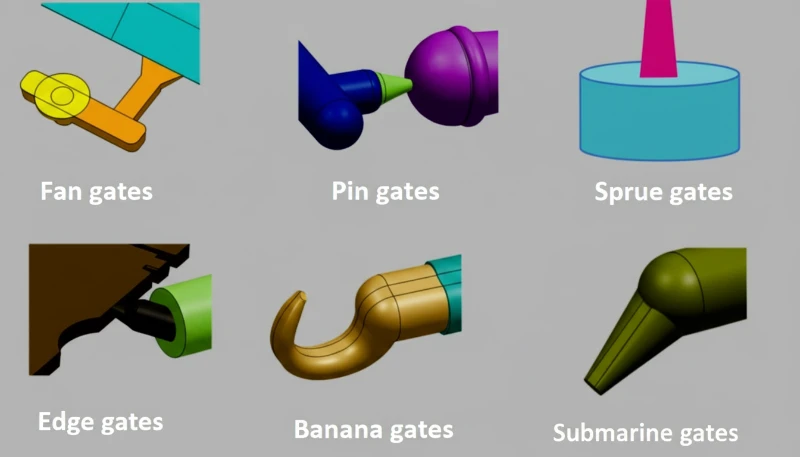
В большинстве случаев линия разъема проходит перпендикулярно направлению раскрытия формы. Однако для сложных геометрий — деталей с поднутрениями, боковыми элементами или асимметричными профилями — поверхность разъема может включать ступенчатые, наклонные или изогнутые участки. Эти многоплоскостные поверхности разъема требуют дополнительных механизмов формы, таких как слайдеры, лифтеры или наклонные толкатели, для правильного функционирования.
«Ширина линии разъёма 0,01 мм считается приемлемой для большинства декоративных деталей.»Правда
Для видимых/декоративных поверхностей линии разъёма менее 0,05 мм, как правило, приемлемы. Высокоточные формы могут обеспечить 0,01 мм или менее, что почти невидимо невооружённым глазом.
«Линия разъёма — это дефект, вызванный плохим изготовлением формы.»Ложь
Линия разъема — это неизбежная особенность любой двухкомпонентной формы. Она присутствует на каждой детали, отлитой под давлением, независимо от качества формы. Различается лишь видимость линии — точная форма создает едва заметную линию, тогда как изношенная или плохо спроектированная форма приводит к видимым заусенцам.
Какие бывают типы поверхностей разъёма?
Пять типов поверхностей разъёма: плоская, ступенчатая, наклонная, криволинейная и комбинированная. Выбор правильного типа — одно из первых и наиболее важных решений в проектировании формы. Вот пять основных категорий:
Плоская (прямая) поверхность разъема
Самый простой и распространенный тип. Поверхность разъема представляет собой единую плоскую плоскость, перпендикулярную направлению раскрытия формы. Это хорошо подходит для чашеобразных деталей, плоских панелей и любой геометрии, где наибольшее поперечное сечение представляет собой чистую горизонтальную плоскость. Плоские поверхности разъема легче всего обрабатывать, герметизировать и обслуживать — что напрямую ведет к снижению стоимости формы и более стабильному качеству деталей.
Ступенчатая поверхность разъема
Когда деталь имеет элементы на разной высоте, которые невозможно разместить на одной плоской плоскости, поверхность разъема поднимается или опускается ступенями, следуя контуру детали. Ступенчатые поверхности разъема создают боковые силы во время впрыска, которые форма должна выдерживать — обычно с помощью замковых элементов или клиновидных вставок. Если высота ступени чрезмерна, конструкторы добавляют компенсационные прокладки, чтобы частично выровнять поверхность, сохраняя необходимый зазор.
Наклонная поверхность разъёма
Для деталей с угловыми элементами или асимметричными профилями поверхность разъема следует по наклонной плоскости. Наклонная поверхность включает уплотнительный участок вдоль склона (для удержания пластика) и плоский опорный участок (для обработки, выравнивания и измерения). Этот тип требует тщательного внимания к управлению боковыми силами — давление впрыска создает боковую нагрузку, которую необходимо сбалансировать.
Криволинейная (профилированная) поверхность разъёма
Сложные потребительские товары — например, корпуса электроинструментов, внутренняя отделка автомобилей или корпуса медицинских устройств — часто требуют поверхностей разъёма, следующих криволинейным контурам детали. Поверхность формы обрабатывается на станке с ЧПУ в соответствии с 3D-профилем. Криволинейные поверхности разъёма требуют высокой точности обработки и тщательного проектирования уплотнительной поверхности, чтобы предотвратить облой по всему контуру.
Композитная (комбинированная) поверхность разъема
Многие реальные детали сочетают два или более из вышеперечисленных типов. Одна форма может иметь плоский участок в одной области, ступеньку в другой и изогнутый участок в третьей. Композитные поверхности разъема требуют дополнительного внимания в зонах перехода — острые углы на стыке различных типов поверхностей должны быть сглажены, чтобы избежать ослабления стали формы и предотвратить образование заусенцев.
Каковы ключевые принципы проектирования поверхности разъема?
Хороший дизайн поверхности разъема определяется набором практических принципов, которые балансируют качество детали, стоимость формы и надежность производства. За более чем 20 лет изготовления форм мы убедились, что именно эти правила отличают гладкий производственный процесс от недель доработок формы.
Принцип 1: Обеспечение правильного извлечения из формы
Основная поверхность разъема должна располагаться на наибольшем поперечном сечении детали в направлении раскрытия формы. Это фундаментальное правило. Размещение линии разъема в любом другом месте означает, что потребуются боковые действия (ползуны, подъемники) для освобождения детали — что добавляет стоимости, сложности и точек обслуживания форме. Каждое дополнительное боковое действие — это еще один потенциальный источник заусенцев, износа и простоев.
Принцип 2: Удержание детали на правильной стороне
Поскольку система выталкивания находится на подвижной половине формы (сторона B), поверхность разъема должна быть спроектирована так, чтобы деталь оставалась на сердечнике после раскрытия формы. Если деталь прилипает к полости (сторона A), потребуется специальный механизм выталкивания на неподвижной половине — что увеличивает стоимость и сложность. Углы уклона на стороне сердечника и элементы поднутрения помогают обеспечить надежное удержание детали.
Принцип 3: Сохранение точности размеров
Любой размер, пересекающий линию разъема, подвержен вариациям из-за выравнивания формы, прогиба при смыкании и образования заусенцев. Для критических размеров — особенно тех, которые требуют высокой соосности или позиционного допуска — размещайте все связанные элементы на одной стороне формы. Ступенчатое отверстие, требующее соосности ±0,02 мм, должно быть сформировано единым сердечником на одной половине формы, а не разделено между обеими.
Принцип 4: Оптимизация вентиляции
Trapped air in the cavity causes burns, short shots, and weak weld lines. The parting surface should be positioned so that the melt front reaches the parting line last — allowing air to escape through the natural gap between mold halves. If the parting surface seals before the cavity is full, air gets trapped in dead-end regions with no escape path.
Principle 5: Simplify Mold Construction
Every additional complexity in the parting surface adds machining time, inspection cost, and maintenance risk. If the part geometry allows it, a flat parting surface is always preferable. When complexity is unavoidable — like stepped or curved surfaces — try to combine multiple features into shared surfaces to reduce the total number of parting transitions.
“Dimensions that cross the parting line have more variation than dimensions on one mold half.”Правда
Any dimension spanning both mold halves is affected by mold alignment accuracy, clamping force consistency, thermal expansion differences, and flash thickness. Holding tight tolerances (±0.05 mm or better) across the parting line is significantly harder than on a single mold half.
“A stepped parting surface always requires side-core pulling mechanisms.”Ложь
Stepped parting surfaces follow height changes in the part geometry but still open in the main mold direction. Side-core pulling (sliders) is needed for undercuts — features that are perpendicular to the mold opening direction. A step can exist without any undercut.
Как расположение линии разъема влияет на качество детали?
The parting line location is arguably the single most impactful decision in mold design. It directly affects four quality dimensions: appearance, dimensional accuracy, surface finish, and tooling longevity.
Внешний вид: On cosmetic surfaces, the parting line is a visible seam. For consumer products, this means the parting line must be hidden in a non-visible area, disguised along a feature edge, or finished to near-invisibility. If your part has a visible Class A surface, the parting line needs to be on the back or along a natural break line. We’ve worked with automotive clients who rejected entire production batches because the parting line shifted 0.2 mm from the agreed position.
Dimensional accuracy: As discussed above, cross-parting-line dimensions inherit the alignment tolerance of the mold. For parts with ±0.1 mm general tolerances, this is usually manageable. For precision components with ±0.02 mm requirements, you need to avoid splitting critical features across the parting line entirely.
Отделка поверхности: The parting line area typically has a different surface texture than the rest of the part. Even with polished molds, the junction where the two halves meet creates a slight step or witness line. If the part requires a specific SPI finish (like SPI A-2 for lens-quality surfaces), the parting line area will never match the surrounding finish perfectly.
Tooling longevity: Parting surfaces bear the full brunt of clamping force cycle after cycle. A well-designed parting surface with proper support and sufficient bearing area will last hundreds of thousands of shots. A poorly designed one — with sharp edges, insufficient sealing area, or excessive overhang — will wear, dinge, and develop flash within tens of thousands of cycles.
Когда следует использовать ступенчатые или изогнутые поверхности разъема?
Stepped parting surfaces are used when a part has features at different heights, and curved surfaces are needed for non-planar geometry. Here is when to use each type and what trade-offs you accept.
Use a stepped parting surface when: The part has features at significantly different heights that cannot be demolded with a single flat plane. Electronics housings with connector cutouts at different heights, enclosure halves with stepped mounting bosses, and pump components with multiple sealing levels are typical candidates. The key engineering concern with stepped surfaces is managing lateral injection forces — the melt pressure pushes sideways on the step, and without proper interlocks or wedge supports, the mold halves can shift, causing dimensional drift and flash.
Use a curved parting surface when: The part has organic, non-planar geometry — think consumer product housings, automotive trim, or ergonomic grips. The parting surface follows the 3D contour of the part to hide the line along a natural edge or feature boundary. This approach produces the best cosmetic results but demands high-precision CNC machining and careful mold texturing to ensure the surface finish is consistent across the curved interface.
Trade-off analysis: Going from flat to stepped to curved parting surfaces, each step roughly adds 15–30% to mold construction cost. Stepped surfaces require additional interlock machining and potentially larger mold bases. Curved surfaces demand 5-axis CNC work and extended fitting time. The production penalty is real too — complex parting surfaces wear faster, need more frequent maintenance, and are more sensitive to process parameter drift.
“Curved parting surfaces are always more expensive to manufacture than flat ones.”Правда
Curved parting surfaces require 5-axis CNC machining, extended fitting/spotting time, and more complex inspection. A flat parting surface can be surface-ground to tolerance quickly, while a curved one must be machined and hand-fitted along the entire contour. The cost premium is typically 20–40% over a comparable flat design.
“You can eliminate the parting line entirely by using insert molding.”Ложь
Insert molding still uses a two-part mold and therefore still produces a parting line. The insert is placed in the mold before injection, but the mold still opens and closes along a parting surface. The only way to avoid a parting line is to use a process without a split mold, such as machining from solid stock.
Как анализ DFM может оптимизировать вашу линию разъема?
Design for Manufacturing (DFM3) analysis is your best tool for getting the parting line right before any steel is cut. In our factory DFM workflow, we map the parting decision against the steps of injection molding so the split line supports filling, packing, cooling, ejection, and inspection. A thorough DFM review evaluates the part geometry, identifies the optimal parting line location, flags potential demolding issues, and estimates the mold complexity required.
At ZetarMold, our 8 senior engineers each bring 10+ years of mold design experience to every DFM review. In our tooling trials, our process engineers also compare parting-line flash with melt consistency from the screw injection molding machine, because an unstable melt front can make a marginal parting surface look worse than it really is. Here is what a proper parting line DFM analysis covers:
1. Undercut identification: Every undercut feature is catalogued. For each one, we determine whether it needs a slider, lifter, collapsible core, or can be resolved by simply relocating the parting line. In many cases, a slight redesign of the undercut feature eliminates the need for a side action entirely — saving significant tooling cost.
2. Draft angle verification: All surfaces perpendicular to the parting line need adequate draft — typically 1–3° depending on material and surface finish. Zero-draft or negative-draft walls near the parting line will cause sticking, scoring, or ejection failures.
3. Flash risk assessment: We evaluate which areas of the parting surface will see the highest melt pressure and whether the mold has sufficient bearing area to contain it. Thin-wall sections near the parting line are high-risk zones for flash.
In our Shanghai factory, we operate 47 injection molding machines ranging from 90T to 1850T, supported by an in-house mold manufacturing facility. Every tool we build goes through rigorous parting line verification — because even a 0.05 mm mismatch can cause visible flash on the final part.
“Nylon (PA) requires tighter parting line tolerances than polycarbonate (PC) due to its lower melt viscosity.”Правда
Nylon has a much lower melt viscosity than polycarbonate, meaning it flows more easily into microscopic gaps at the parting surface. This makes nylon parts more prone to flash, requiring tighter mold fits (typically 0.02 mm or less) compared to polycarbonate (0.05 mm or less).
“A DFM analysis is only necessary for complex or high-volume parts.”Ложь
DFM analysis is valuable for every injection molded part, regardless of complexity or volume. Even simple parts can have parting line issues that are cheap to fix in the design stage but expensive to correct after the mold is built. A 30-minute DFM review can save thousands in mold modifications.
Часто задаваемые вопросы
What causes visible flash along the parting line?
Flash forms when molten plastic escapes through the gap between mold halves at the parting surface during the injection phase. Common causes include insufficient clamping force relative to injection pressure, worn or damaged mold faces that no longer seal tightly, poor mold alignment causing uneven bearing pressure, excessive packing pressure held too long, and low-viscosity materials like nylon that flow easily into small gaps. Regular mold maintenance — including re-spotting parting surfaces every 50,000–100,000 shots — combined with proper process parameter control and adequate machine tonnage are the primary defenses against flash at the parting line.
Can a parting line be completely eliminated from an injection molded part?
Нет, это невозможно. Каждая деталь, изготовленная методом литья под давлением с использованием традиционной двухкомпонентной формы, всегда будет иметь линию разъёма в месте соединения полостей и сердечников. Цель состоит не в устранении, а в минимизации — за счёт прецизионного изготовления формы со шлифованными поверхностями разъёма, стратегического размещения линии разъёма на некосметических поверхностях и оптимизации технологических параметров. Для применений, где любая видимая линия соединения неприемлема, альтернативные производственные процессы, такие как фрезерование с ЧПУ из цельной заготовки или аддитивное производство, могут создавать бесшовные детали, хотя и со значительно более высокой стоимостью за единицу и меньшей производительностью.
Насколько тонкой можно сделать линию разъёма?
При использовании прецизионно-шлифованной формы из закалённой инструментальной стали (HRC 48–52) линии разъёма можно уменьшить до ширины 0,005–0,01 мм — они практически невидимы невооружённым глазом и неощутимы на ощупь. Стандартные производственные формы обычно создают линии шириной 0,02–0,05 мм, которые видны, но приемлемы для большинства некосметических применений. Достижимая тонкость зависит от нескольких факторов: точности обработки формы (шлифование поверхности против фрезерования), твёрдости и износостойкости стали, достаточности усилия смыкания, профиля давления впрыска и вязкости расплава формовочного материала. Более точные формы стоят дороже, но обеспечивают стабильно более тонкие линии разъёма на протяжении длительных производственных циклов.
В чём разница между поверхностью разъёма и линией разъёма?
Поверхность разъёма — это вся сопрягаемая поверхность между двумя половинами пресс-формы, представляющая собой 2D или 3D поверхность в самой оснастке. Линия разъёма — это узкий 1D след, который оставляет этот интерфейс на поверхности отлитой пластиковой детали после извлечения. Другими словами, поверхность разъёма — это особенность конструкции пресс-формы, существующая в инструментальной стали, в то время как линия разъёма — это видимое проявление этой поверхности на готовой детали. Одна поверхность разъёма может создавать сложную, извилистую линию разъёма, если геометрия пресс-формы включает ступенчатые, наклонные или криволинейные участки.
Влияет ли расположение линии разъёма на стоимость литья под давлением?
Да, значительно. Простая плоская поверхность разъёма наиболее экономична в изготовлении, обработке и обслуживании. Каждое усложнение — создание ступеней, добавление кривых или введение дополнительных поверхностей разъёма — увеличивает время механической обработки, трудозатраты на подгонку, требования к контролю и долгосрочные затраты на обслуживание. Переход от плоской к составной поверхности разъёма обычно увеличивает стоимость пресс-формы на 30–50%. Линии разъёма, требующие применения боковых механизмов, таких как слайдеры, лифтеры или наклонные толкатели, увеличивают стоимость ещё больше, так как каждый боковой механизм требует своей собственной направляющей системы, износостойкой плиты и механизма возврата, а также дополнительной подгонки и испытаний при запуске пресс-формы.
Какой угол уклона необходим вблизи линии разъёма?
Для всех поверхностей, перпендикулярных линии разъёма, в стандартном производственном литье рекомендуется минимальный уклон в 1° на сторону. Для деталей с текстурированными поверхностями (такими как отделка MT, VDI или электроэрозионная обработка) требуется 1,5–3° на сторону — более глубокая текстура требует большего уклона для предотвращения повреждения текстуры при извлечении. Полированные или зеркальные поверхности могут обойтись уклоном всего в 0,5°. Стенки с нулевым или отрицательным уклоном вблизи линии разъёма рискуют привести к залипанию детали, повреждению поверхности при извлечении, увеличению следов от толкателей и нестабильности размеров от цикла к циклу. Уклон должен быть определён на этапе проектирования детали, а не обнаружен как проблема при пробном запуске пресс-формы.
Как усилие смыкания влияет на качество линии разъёма?
Усилие смыкания литьевой машины должно превышать общее усилие раскрытия, создаваемое давлением впрыска, действующим на проекционную площадь поверхности разъёма. Если усилие смыкания недостаточно, пресс-форма слегка раскрывается во время фаз впрыска и дожатия, создавая зазор, который позволяет пластику вытекать в виде облоя вдоль линии разъёма. Необходимое усилие смыкания рассчитывается как: давление впрыска × проекционная площадь полости × коэффициент безопасности (обычно 1,1–1,2). Использование пресс-формы на машине с недостаточным усилием смыкания — самая распространённая причина появления облоя на линии разъёма в производственных условиях. Выбор машины с правильным тоннажем на этапе планирования производства крайне важен для стабильного качества линии разъёма.
Наша инженерная команда ZetarMold привносит в каждый проект более чем 20-летний опыт проектирования пресс-форм, 8 старших инженеров и собственное производство оснастки. От анализа технологичности конструкции (DFM) до производства мы оптимизируем линию разъёма для качества, стоимости и производительности. Имея 47 машин для литья под давлением (от 90 до 1850 тонн) и более 400 видов пластиковых материалов, мы производим всё: от прецизионных оптических компонентов до крупных конструкционных деталей.
Request a Free Quote →
-
линия разделения: линия разъёма — это видимая линия на формованной детали, где две половины формы встречаются в процессе литья под давлением. ↩
-
вспышка: облой — это избыточный материал, который во время впрыска вытекает из полости формы по линии разъёма, образуя тонкие нежелательные края. ↩
-
DFMDFM означает дизайн для производства — практику создания деталей, которые легче и экономически эффективнее производить. ↩





 EN
EN  ES
ES  FR
FR  DE
DE  PT
PT  AR
AR  RU
RU  JA
JA  KO
KO  IT
IT  NL
NL  TR
TR  PL
PL