Het ontwerpen van spuitgietproducten is het werk van het omzetten van een nuttig productidee in geometrie die kan worden gevuld, gekoeld, uitgeworpen, gemonteerd en herhaald in productie. Een onderdeel kan er eenvoudig uitzien in CAD, maar toch zinkmarkeringen, sleepkrassen, ingesloten gas, uitstulpingen, gebroken uitwerperpennen of matrijsherwerking veroorzaken als het ontwerp de gereedschaps- en proceslimieten negeert.
Deze gids benadert de ontwerpprincipes voor spuitgietproducten vanuit de productiepraktijk. De nadruk ligt op wanddikte, ribben, lossingshoek1, afsluitvlakken, toleranties, materiaalgedrag en een gedisciplineerde beoordeling, omdat deze keuzes bepalen of een matrijs na de staalbewerking stabiel produceert.
Gebruik het vóór ontwerpbevriezing, niet na eerste shots. Wanneer onze fabriek een nieuw kunststofonderdeel beoordeelt, proberen we het matrijsrisico te vinden terwijl het nog een CAD-beslissing is, omdat een geometrische wijziging van 0,3 mm vóór gereedschap veel goedkoper is dan een gelaste insert of een noodstalen modificatie later.
- Ontwerpen voor spuitgieten begint met uniforme materiaalstroom, voorspelbare koeling en veilige uitwerping.
- Wanddikte, ribben, penanten en hoeken moeten worden gedimensioneerd als één verbonden systeem.
- Ontwerphelling en scheidingsstrategie moeten vóór gereedschap worden beoordeeld omdat ze het vrijkom- en uitstulpingsrisico beheersen.
- Tolerantie moet worden toegewezen op basis van functie en procescapaciteit, niet gekopieerd van gefreesde metaaltekeningen.
- Een korte DFM-beoordeling vóór de matrijsbouw voorkomt veel defecten in een laat stadium en kostenverrassingen.
Wat zijn de kernontwerpprincipes voor spuitgietproducten?
De kernontwerpprincipes voor spuitgietproducten zijn de belangrijkste categorieën of opties die in deze sectie worden uitgelegd. De kernontwerpprincipes voor spuitgietproducten zijn uniforme wanddikte, gebalanceerde stroomlengte, gecontroleerde koeling, betrouwbaar uitwerpen, realistische tolerantie en gereedschap-veilige geometrie. Deze principes werken samen omdat kunststof krimpt tijdens het afkoelen en omdat de matrijs het voltooide onderdeel moet kunnen vrijgeven zonder slepen of vervorming.
Begin door het onderdeel als een stroom- en koelprobleem te behandelen. Een poort kan gesmolten materiaal maar tot een bepaalde afstand duwen voordat druk, afschuiving en koeling het vulpatroon veranderen. Als één zone veel dikker is dan de rest, blijft die zone langer heet, krimpt later en veroorzaakt vaak zinkgaten, holtes of lokale vervorming.
De veiligste vroege beoordeling verbindt productfunctie met productiegrenzen. Een nuttige productspecificatie geeft aan welke oppervlakken cosmetisch zijn, welke afmetingen de montage beheersen, welke gebieden uitwerppunten kunnen accepteren en welke belastingen het onderdeel moet kunnen weerstaan. Die informatie stelt de ontwerper en matrijzenmaker in staat om geometrie, poortlocatie en materiaal af te wegen voordat de gereedschapslay-out vaststaat.
Gebruik voor een bredere procesbasis de spuitgietprocesgids van ZetarMold. Koppel de beoordeling voor gereedschapsbeslissingen over onder meer deellijnen, schuiven, lifters, koeling en staalveilige wijzigingen aan de gids voor spuitgietmatrijzen. Als de inkoper een fabriek selecteert, helpt de gids voor leveranciersselectie om deze controles in inkoopvragen om te zetten.
"Een gevormd onderdeel moet rond smeltstroming, koeling en uitwerpen worden ontworpen voordat de cosmetische vormgeving wordt vastgelegd."True
Dit is waar omdat de matrijs niet elk geometrieprobleem kan corrigeren na het stansen van staal. Styling, ribben, penanten, clips en tolerantieopstapelingen beïnvloeden allemaal drukverlies, krimp, ontwerphelling en ontwerpkracht.
"Elk kunststofonderdeel kan dezelfde geometrie behouden als een CNC-bewerkt onderdeel als het materiaal sterk genoeg is."False
Dit is onjuist omdat spuitgieten krimp, koelgradiënten, uitstootkrachten, scheidingsbeperkingen en poortresten toevoegt. Materiaalsterkte elimineert de noodzaak voor spuitgiet-specifieke geometrie niet.
| Principe | Wat te controleren | Risico indien genegeerd |
|---|---|---|
| Wandbeheersing | Houd overgangen geleidelijk en vermijd geïsoleerde massa | Inzinking, holtes, vervorming |
| Matrijsontsmetting | Voeg trekkegel toe en vermijd ingesloten ondertappen | Sleepsporen, vastzittende onderdelen |
| Functionele tolerantie | Beperk strakke toleranties tot kritieke interfaces | Hoog schroot en matrijsrevisie |
| Timing beoordelen | Voer DFM uit voor gereedschapsbouw | Late ontwerpwijzigingen |
Een praktische DFM-beoordeling moet nagaan of de nominale wanddikte2 gelijkmatig genoeg is voor de gekozen hars, of het langste stroompad zonder overmatige nadruk kan worden gevuld en of het zichtvlak vrij kan blijven van aanspuit- en uitwerpmarkeringen. Onze engineers markeren doorgaans eerst de zones met het hoogste risico en rangschikken vervolgens elke aanpassing op kosten, doorlooptijd en effect op de productfunctie.
Hoe moeten wanddikte, ribben en penanten worden ontworpen?
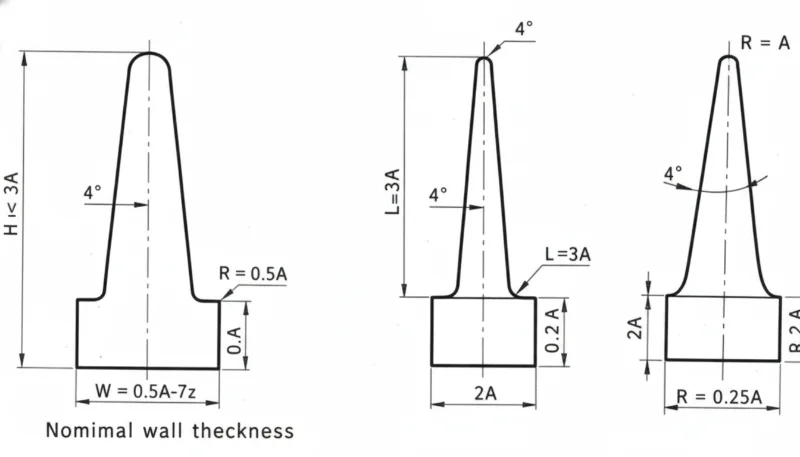
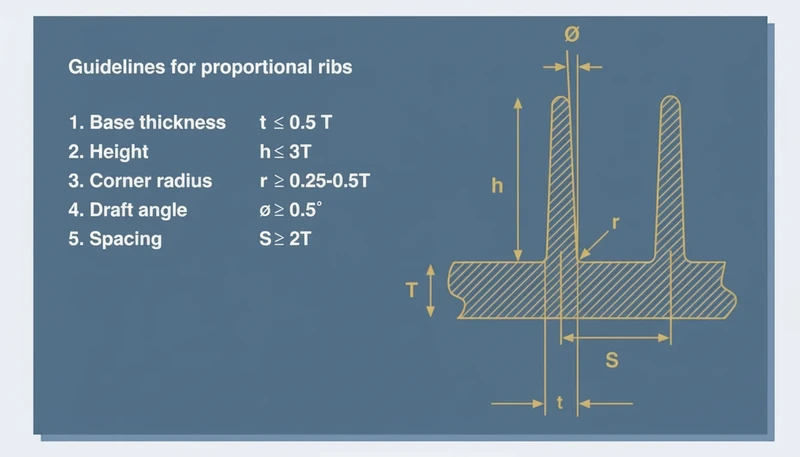
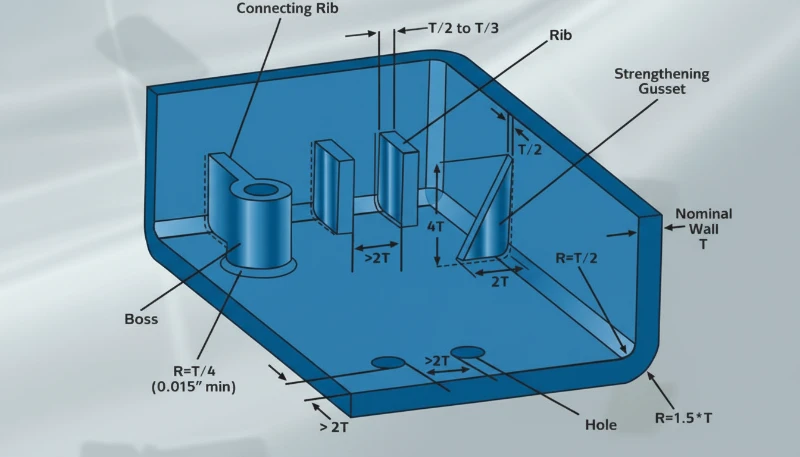
Wanddikte is de belangrijkste controle voor koeltijd, krimp en lokale spanning in een gespoten onderdeel. Het moet zo uniform zijn als de productfunctionaliteit toelaat, omdat dikte de koeltijd, krimp en lokale spanning bepaalt. Een nominale wanddikte is een doelwandwaarde die over het hele onderdeel wordt gebruikt, zodat stroming en koeling voorspelbaar blijven in plaats van sterk te veranderen van het ene naar het andere gebied.
Voor veel technische thermoplasten beginnen vroege concepten vaak met wanden van ongeveer 1,5 mm tot 3,0 mm, en worden aangepast nadat hars, stromingslengte, stijfheid en valtestbehoeften bekend zijn. Dunne secties kunnen bevriezen voordat de holte gevuld is, terwijl dikke secties warmte kunnen vasthouden en zichtbare zinkmarkeringen aan de cosmetische kant kunnen veroorzaken.
Ribben verhogen de stijfheid zonder het onderdeel tot één dik blok te maken. Een gebruikelijke streefwaarde voor de rib-wandverhouding3 is ongeveer 40% tot 60% van de aangrenzende wand, met ruime wortelradiussen en voldoende tussenruimte voor de sterkte van het staal. Een te dikke rib kan aan de buitenzijde inval veroorzaken; een te hoge en dunne rib maakt vullen en uitwerpen instabiel.
Pennen vereisen dezelfde discipline. Een schroefpen moet verbonden zijn met ribben of steunribben, niet met een zware cilinder die op een dunne wand rust. De buitendiameter van de pen, de sterkte van de kernpen, de schroefinrijging en de uitwerprichting moeten samen worden beoordeeld, zodat het ontwerp geen kortschieten, brandsporen of gebroken kernpennen veroorzaakt.
Bij onze DFM-beoordelingen in de fabriek wordt een overgang in wanddikte van meer dan circa 30% ten opzichte van de aangrenzende wand gewoonlijk ter bespreking gemarkeerd. Na de eerste proefspuitingen inspecteren we ook de ribvoeten onder vergroting, omdat een kleine inval op een zichtbehuizing commercieel lastiger kan zijn dan een kleine matrijswijziging.
Hoeken moeten afgerond zijn. Binnenradii verbeteren de stroming en beperken spanningsconcentraties; buitenradii houden de wanddikte rond de hoek constant. Een scherpe binnenhoek oogt strak in CAD, maar dwingt het polymeer abrupt van richting te veranderen en kan bij schokken of trillingen een zwakke plek vormen.
Als het onderdeel stijf moet blijven, combineer dan ribben, materiaalkeuze en lokale geometrie. Het beste ontwerp is zelden het dikste ontwerp. Het plaatst materiaal waar de belastingspaden dit vereisen en houdt het koelprofiel gelijkmatig genoeg voor herhaalbaar spuitgieten.
Hoe verminderen ontwerphelling, scheidingslijn en afsluitingen het gereedschapsrisico?
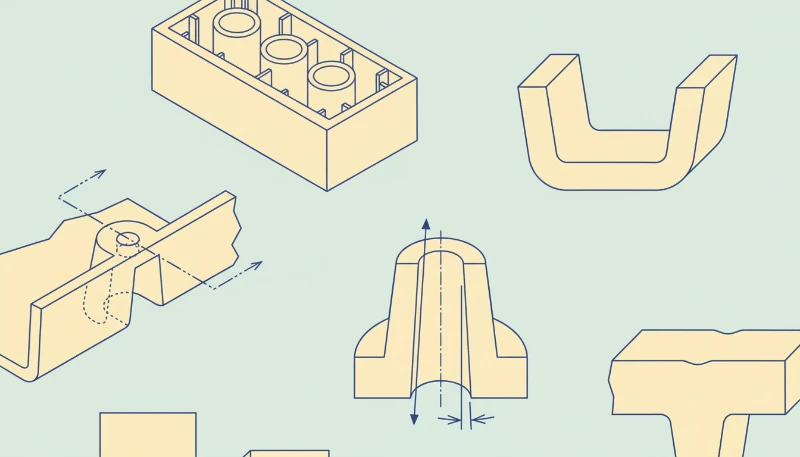
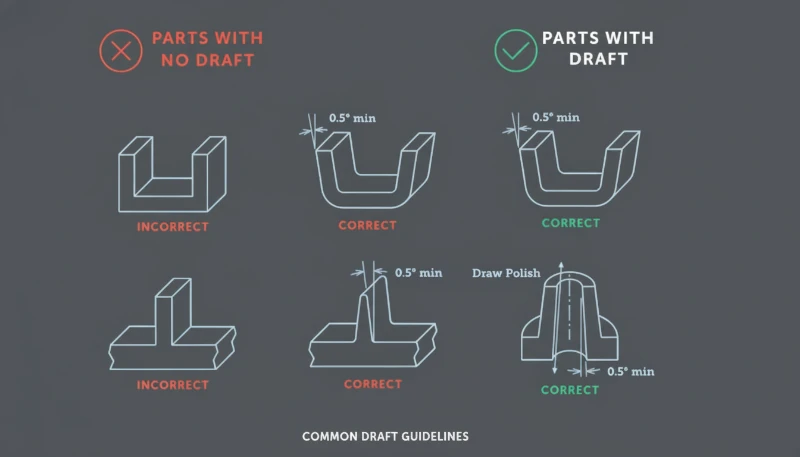
De lossingshoek is de vrijloop die ervoor zorgt dat een gevormd onderdeel uit de caviteit of van de kern kan komen. Deze verkleint het gereedschapsrisico door het gevormde onderdeel vrijloop te geven wanneer het de caviteit of kern verlaat. Zonder voldoende lossingshoek kunnen getextureerde oppervlakken, diepe ribben en hoge wanden tijdens het uitwerpen langs het staal schuren, met sleepstrepen, witverkleuring, vervorming of vastzittende onderdelen als gevolg.
Een gebruikelijke eerste richtwaarde voor veel gladde verticale vlakken is 1.0 graden tot 2.0 graden per zijde, met een grotere lossingshoek voor textuur of diepe kenmerken. De uiteindelijke waarde hangt af van de materiaalkrimp, oppervlakteafwerking, trekdiepte, matrijspolijsting en de vraag of het oppervlak aan de caviteits- of kernzijde ligt.
De strategie voor de deelnaad moet worden gekozen voordat het zichtoppervlak definitief wordt vastgelegd. De deelnaad bepaalt waar braamvorming kan optreden, waar afsluitvlakken samenkomen en of schuiven of lifters nodig zijn. Een fraaie productscheiding kan duur worden als deze een onvermijdelijke ondersnijding verbergt of zwak staal voor het afsluitvlak afdwingt.
Afsluitvlakken hebben voldoende hoek en draagvlak nodig om herhaalde cycli te doorstaan. Zeer dunne staalranden kunnen na de productiestart afbrokkelen, slijten of bramen veroorzaken. Als een clip, venster, ventilatieopening of klikverbinding een afsluitvlak vereist, moet de DFM-beoordeling de staaldikte, toegankelijkheid voor polijsten en een mogelijk herontwerp voor een veiligere matrijsbeweging controleren.
"De keuzes voor lossingshoek en deelvlak moeten in de DFM-beoordeling zichtbaar zijn voordat de matrijsindeling wordt goedgekeurd."True
Dit klopt omdat deze keuzes de openingsrichting, het aantal schuiven, slijtage van afsluitvlakken, cosmetische markeringen en uitwerpbetrouwbaarheid bepalen. Late wijzigingen vereisen vaak herontwerp van staal.
"Een wand zonder lossingshoek is aanvaardbaar wanneer het CAD-model een gladde oppervlakteafwerking heeft."False
Dit is onjuist, omdat zelfs een glad oppervlak na krimp aan staal kan vastgrijpen. Een lossingshoek van nul verhoogt de uitwerpkracht en kan het onderdeel tijdens het lossen markeren of vervormen.
Gebruik de openingsrichting van de matrijs als ontwerpvoorwaarde, niet als bijzaak. Markeer kernzijde, matrijsholtezijde, schuiftrekrichtingen, lifterbewegingen en verwachte afdruklijnen op het model. Wanneer onze ingenieurs een behuizing beoordelen, kleuren ze deze zones vaak zodat de klant kan zien waar functie, uiterlijk en gereedschapskosten met elkaar concurreren.
Ook hier is communicatie tussen koper en leverancier belangrijk. Een leverancier die alleen de tekening offreert, kan verborgen gereedschapsrisico’s missen; een leverancier die de trekrichting, staalveiligheid en risico’s bij de eerste proefspuiting uitlegt, geeft de koper een betere beslissingsbasis. Daarom moet de ontwerpbeoordeling deel uitmaken van het commerciële RFQ-proces en niet pas na vrijgave van de inkooporder plaatsvinden.
Hoe moeten toleranties, materiaalkeuze en montagekenmerken in balans worden gebracht?
Tolerantiebalans is het proces waarbij afmetingen, harsgedrag en assemblagerisico worden afgestemd op de werkelijke spuitgietcapaciteit. Tolerantie, materiaalkeuze en assemblagekenmerken moeten op basis van functie in balans worden gebracht, omdat elke nauwe maat procesrisico toevoegt. GD&T is een tekentaal die toegestane variatie in vorm, oriëntatie, locatie en rondloop definieert, zodat leveranciers weten welke afmetingen de assemblage werkelijk bepalen.
Bij een tolerantie voor een spuitgegoten kunststof moet rekening worden gehouden met harskrimp, matrijstemperatuur, vocht, vulstofgehalte, onderdeelgeometrie en meetmethode. Een tolerantie van 0.05 mm kan redelijk zijn voor een kort stalen kenmerk in een verspaand onderdeel, maar onrealistisch over een lange spuitgegoten overspanning die ongelijkmatig afkoelt.
De materiaalkeuze verandert de ontwerpregels. Glasgevuld nylon kan sterker gereedschapsstaal en meer aandacht voor de vezelrichting vereisen, terwijl PC, ABS, PP, POM, PPSU en PEEK elk andere krimp, stijfheid, temperatuurbestendigheid en gedrag van laslijnen hebben. Beoordeel voor vroege vergelijkingen zowel productprestaties als vormstabiliteit.
Montagekenmerken moeten waar mogelijk tolerant zijn. Klikverbindingen vereisen een invoerafschuining, beheersing van de rek en testbare grenzen voor de doorbuiging. Schroefbussen vereisen ondersteuning door een kernpen en geometrie die splijten voorkomt. Filmscharnieren, clips, afdichtingen en ribben voor ultrasoon lassen vereisen allemaal processpecifieke details, geen algemene toevoegingen aan de wand.
| Ontwerpafdeling | Aanbevolen beoordeling | Fabrieksrisico |
|---|---|---|
| Kritische passing | Definieer referentie en meetmethode | Inspectiegeschil |
| Klikverbinding | Controleer de vervorming en lossingsrichting | Scheurvorming of zwakke bevestiging |
| Baas | Controleer kernpen- en schroefbelasting | Onvolledige vulling of gescheurde bossage |
| Zichtzijde | Beschermen tegen aanspuit- en uitwerpmarkeringen | Zichtbaar defect |
Vergelijk bij trajecten van prototype tot productie het te spuitgieten ontwerp met het prototypeproces. Een CNC-prototype kan spuitgietrisico’s verhullen, omdat het geen aanspuitstroming, krimpcompensatie of uitwerping nodig heeft. Spuitgieten voor rapid prototyping verduidelijkt wanneer een prototypematrijs deze kloof vóór de stalen productiematrijs kan verkleinen.
Ook de defecthistorie moet in de ontwerpbeoordeling worden meegenomen. Als vergelijkbare producten inval, bramen, onvolledige vulling of kromtrekken vertoonden, gebruik die gegevens dan voordat de volgende matrijs wordt gebouwd. Het overzicht van veelvoorkomende spuitgietfouten helpt om bekende faalwijzen om te zetten in geometriecontroles.
Ons team behandelt tolerantiebespreking als risicorangschikking. We hanteren alleen nauwe toleranties waar de productfunctie dat vereist en verruimen niet-kritieke oppervlakken om processtabiliteit, inspectiesnelheid en langdurig productierendement te beschermen.
Voordat u de staalbewerking goedkeurt, zet u deze tolerantiekeuzes om in inspectie-instructies. Definieer de referentievlakken, het opspanconcept, de meettemperatuur en de steekproefregel. Zo voorkomt u dat een tekening een nauwkeurigheid vereist die tijdens de productie niet consistent kan worden gemeten.
Welke ontwerpbeoordelingsworkflow moeten kopers vereisen vóór gereedschapsbouw?
Een ontwerpbeoordelingsworkflow is een gefaseerde DFM-poort voordat de gereedschapsbouw begint. Hierbij worden productfunctie, harskeuze, matrijsbeweging, aanspuitlocatie, koeling, uitwerping, tolerantie en inspectie gecontroleerd. Deze workflow zet ontwerpprincipes om in verifieerbare beslissingen in plaats van meningen die per e-mail worden uitgewisseld.
De eerste poort is een geometriebeoordeling. Controleer de wandkaart, ribbenkaart, busindeling, hoekstralen, lossingshoeken, deellijn en ondersnijdingen. De tweede poort is een beoordeling van het matrijsgereedschap. Controleer het aantal matrijsholten, de bewegingen van schuiven en schuine uitwerpers, het aanspuittype, de toegang tot koelkanalen, ontluchting, staalreserve en verwachte onderhoudspunten.
De derde gate is een productiebeoordeling. Bevestig het drogen van de hars, de verwachte cyclustijd, cosmetische acceptatiecriteria, inspectieopspanningen, verpakkingsbelastingen en regels voor wijzigingsbeheer. Een matrijs die de monstergoedkeuring doorstaat maar geen productieplan heeft, kan alsnog tekortschieten wanneer het ordervolume toeneemt.
Houd het beoordelingsbewijs alleen-aanvullend. Bewaar gemarkeerde schermafbeeldingen, DFM-opmerkingen, klantgoedkeuringen, rapporten van de eerste proefspuiting en registraties van matrijswijzigingen. Wanneer later een defect optreedt, laat deze historie zien of het probleem voortkwam uit het ontwerp, de matrijs, het materiaal, de procesinstelling of een ongedocumenteerde wijziging.
Het beste resultaat is geen langere checklist, maar een korter traject van producteis naar stabiele productie. Wanneer het ontwerpbestand, het matrijsplan en de inspectiecriteria op elkaar zijn afgestemd, kan de leverancier nauwkeuriger offreren, kan de inkoper voorstellen eerlijker vergelijken en kent de eerste productierun minder vermijdbare verrassingen.
Voor content die rankings moet herstellen, is deze workflow ook van belang voor de zoekkwaliteit. Lezers hebben een pagina nodig die ontwerpvragen rechtstreeks beantwoordt, productiebewijs toont en een praktische beoordelingsvolgorde biedt die ze bij het volgende project kunnen gebruiken. Die combinatie is sterker dan een algemene lijst met ontwerptips voor kunststof.
Dit biedt het verkoopteam ook een duidelijker traject voor aanvragen, omdat een inkoper tekeningen kan bijvoegen, risicovolle kenmerken kan markeren en om een gerichte DFM-beoordeling kan vragen in plaats van alleen een prijsaanvraag te sturen.
Veelgestelde vragen
Wat is de belangrijkste ontwerpregel voor spuitgietproducten?
De belangrijkste regel is om het onderdeel te ontwerpen rond consistente vulling, koeling en uitwerping in plaats van alleen rond de uiteindelijke productvorm. Uniforme wanddikte, vloeiende overgangen, realistische toleranties en voldoende ontluchtingshoek voorkomen veelvoorkomende gietfouten. Wanneer die basisprincipes worden genegeerd, kan de matrijsmaker nog steeds monsters produceren, maar de productie kan lijden onder zinkmerken, vervorming, vastzittende onderdelen, uitvloeiing en instabiele afmetingen. Dit verandert DFM in een gedeelde checklist voor zowel koper als leverancier en voorkomt late geschillen over wat de matrijs moest oplossen.
Hoe groot moet de lossingshoek van een kunststofonderdeel zijn?
Een bruikbaar vroeg uitgangspunt is vaak 1.0 tot 2.0 graden per zijde voor gladde verticale wanden, maar de definitieve lossingshoek hangt af van het materiaal, de textuur, de trekdiepte, de krimp en de esthetische eisen. Diepe ribben, getextureerde vlakken en glasvezelgevulde materialen vereisen doorgaans een conservatievere beoordeling. De juiste vraag is niet alleen hoeveel lossingshoek in CAD zichtbaar is, maar ook of het onderdeel bij het verwachte productievolume zonder sleepstrepen, witverkleuring, vervorming of overmatige uitwerpkracht kan worden gelost. Ook de textuurdiepte en de bereikbaarheid voor polijsten moeten in die beslissing worden meegenomen.
Waarom veroorzaken ribben inval bij spuitgieten?
Ribben veroorzaken inval wanneer de ribvoet lokaal dik is en langzamer koelt dan de wand. Bij krimp trekt dit zware gebied het zichtvlak naar binnen en ontstaat een deuk. Verlaag doorgaans de ribdikte, voeg ruime radii toe, verdeel één zware rib over lichtere ribben of verplaats het kenmerk van een kritisch zichtvlak. De rib moet verstijven zonder als verborgen kunststofblok de koeling te vertragen.
Moet een gegoten kunststofonderdeel overal zeer strakke toleranties gebruiken?
Nee. Nauwe toleranties moeten worden voorbehouden aan functionele raakvlakken, zoals afdichtingsvlakken, klikverbindingen, tandwieluitlijning, connectorposities of assemblagereferenties. Voor niet-kritische oppervlakken moeten ruimere toleranties worden gebruikt, zodat het spuitgietproces stabiel kan blijven. Het overal toepassen van nauwe toleranties verhoogt de inspectiekosten, het uitvalrisico, de tijd voor matrijsaanpassingen en de verwarring bij leveranciers, zonder de werking van het eindproduct te verbeteren. Een betere tekening onderscheidt functie-kritische maten van cosmetische maten of spelingsmaten en legt de meetverantwoordelijkheid duidelijk vast. Dit helpt de leverancier ook om inspectiemiddelen, bemonsteringsfrequentie en de verwachte procescapabiliteit eerlijk te offreren.
Wanneer moet DFM-beoordeling plaatsvinden in een nieuw spuitgietproject?
Een DFM-beoordeling moet plaatsvinden voordat de matrijsofferte definitief wordt en opnieuw voordat het gereedschapsstaal wordt verspaand. De eerste beoordeling vindt geometrische en procesrisico’s terwijl ontwerpwijzigingen nog goedkoop zijn. De tweede bevestigt de overeengekomen matrijsindeling, aanspuitlocatie, deelnaad, het uitwerpplan en de inspectie-eisen. Wachten tot de eerste proefspuitingen maakt van veel eenvoudige CAD-wijzigingen dure matrijsaanpassingen. Een gedocumenteerde beoordeling geeft de koper ook beter bewijs bij het vergelijken van leveranciers en het goedkeuren van de gereedschapsstart. Deze moet samen met tekeningen, matrijsindeling en goedkeuringsdocumenten worden opgeslagen.
lossingshoek: Een lossingshoek is een lichte schuinte op verticale vlakken waardoor een gegoten onderdeel met minder wrijving uit de holte of van de kern kan worden gelost. ↩
nominale wanddikte: De nominale wanddikte is een beoogde wandwaarde die als uitgangspunt dient voor de beoordeling van koeling, vulling, stijfheid en krimp van een gegoten kunststofonderdeel. ↩
rib-wandverhouding: De rib-wandverhouding is de verhouding tussen de dikte van de ribvoet en de aangrenzende nominale wand, waarmee de stijfheid kan worden verhoogd zonder overmatige inval. ↩