La conception de produits en injection plastique consiste à transformer une idée de produit utile en une géométrie qui peut être remplie, refroidie, éjectée, assemblée et répétée en production. Une pièce peut sembler simple en CAO, mais générer encore des retassures, des rayures de traînée, du gaz piégé, des bavures, des éjecteurs cassés ou une retouche de moule si la conception ignore les limites de l’outillage et du procédé.
Ce guide reconstruit les principes de conception des produits moulés par injection à partir des réalités de la production. Il traite de l’épaisseur des parois, des nervures, de l’angle de dépouille1, des zones d’obturation, des tolérances, du comportement des matériaux et de la rigueur des revues, car ces choix déterminent la stabilité de l’outil une fois l’acier usiné.
Utilisez-le avant la finalisation du design, pas après les premiers tirages. Lorsque notre usine examine une nouvelle pièce plastique, nous essayons de identifier le risque de moule lorsqu’il est encore une décision CAO, car un changement géométrique de 0,3 mm avant l’outillage est beaucoup moins cher qu’une insertion soudée ou une modification urgente du métal ultérieure.
- La conception pour le moulage commence avec un flux de matériau uniforme, un refroidissement prévisible et une éjection sûre.
- L'épaisseur des parois, les nervures, les bossages et les angles doivent être dimensionés comme un système connecté.
- L'angle de dépouille et la stratégie de séparation doivent être revus avant la fabrication de l'outillage car ils contrôlent le démoulage et le risque de bavure.
- La tolérance doit être assignée selon la fonction et la capacité du processus, pas copiée des dessins de métal usiné.
- Une courte revue DFM avant la construction du moule prévient beaucoup de défauts de dernière étape et de surprises de coût.
Quels sont les principes de conception fondamentaux pour les produits en injection plastique ?
Les principes de conception fondamentaux pour les produits en injection plastique sont les principales catégories ou options expliquées dans cette section. Ces principes sont l’épaisseur de paroi uniforme, la longueur d’écoulement équilibrée, le refroidissement maîtrisé, l’éjection fiable, la tolérance réaliste et la géométrie sûre pour l’outillage. Ces principes agissent ensemble car le plastique rétrécit en refroidissant et le moule doit libérer la pièce finie sans traînée ni déformation.
Commencez par traiter la pièce comme un problème d’écoulement et de refroidissement. Une porte d’injection ne peut pousser la matière fondue que jusqu’à une certaine distance avant que la pression, le cisaillement et le refroidissement ne modifient le motif de remplissage. Si une zone est beaucoup plus épaisse que le reste, cette zone reste chaude plus longtemps, rétrécit plus tard et crée souvent des retassures, des vides ou un voilage local.
L’examen précoce le plus sûr relie la fonction du produit aux limites de fabrication. Une spécification produit utile indique quelles surfaces sont cosmétiques, quelles dimensions contrôlent l’assemblage, quelles zones peuvent accepter les marques d’éjecteurs, et quelles charges la pièce doit supporter. Ces informations permettent au concepteur et au mouliste d’échanger sur la géométrie, l’emplacement de l’attaque et le matériau avant que la disposition de l’outillage ne soit fixée.
Pour une vue d’ensemble du procédé, consultez le guide du procédé de moulage par injection de ZetarMold. Pour les décisions d’outillage — plan de joint, coulisseaux, éjecteurs inclinés, refroidissement et modifications conservant une marge d’usinage — reliez la revue au guide des moules d’injection. Si l’acheteur choisit une usine, le guide de sélection des fournisseurs permet de transformer ces contrôles en questions d’approvisionnement.
« Une pièce moulée doit être conçue selon l’écoulement de la matière, le refroidissement et l’éjection avant de figer son style esthétique. »True
C'est vrai car le moule ne peut corriger tous les problèmes géométriques après la coupe du métal. Le style, les nervures, les bossages, les clips et les cumuls de tolérance influencent tous la perte de pression, le retrait, la dépouille et la force de démoulage.
"Toute pièce plastique peut conserver la même géométrie qu'une pièce usinée CNC si le matériau est suffisamment résistant."False
Ceci est faux car le moulage ajoute le retrait, les gradients de refroidissement, les charges d'éjection, les contraintes de joint et les vestiges d'attaque. La résistance du matériau n'élimine pas le besoin d'une géométrie spécifique au moulage.
| Principe | Points à contrôler | Risque si ignoré |
|---|---|---|
| Maîtrise de la paroi | Garder les transitions graduelles et éviter les masses isolées | Enfoncement, cavités, déformation |
| Démoulage | Ajouter une dépouille et éviter les contre-dépouilles bloquées | Marques de traînée, pièces coincées |
| Tolérance fonctionnelle | Limiter les tolérances serrées aux interfaces critiques | Fort taux de rebut et retouche de moule |
| Calendrier de revue | Exécuter une DFM avant la construction de l'outillage | Modifications tardives de la conception |
Une analyse DFM pratique doit vérifier si l’épaisseur de paroi nominale2 est suffisamment uniforme pour la résine choisie, si le trajet d’écoulement le plus long peut être rempli sans surcompactage et si la face esthétique peut être protégée des seuils et des marques d’éjecteurs. Nos ingénieurs signalent d’abord les zones à haut risque, puis classent chaque correction selon son coût, son délai et son effet sur la fonction du produit.
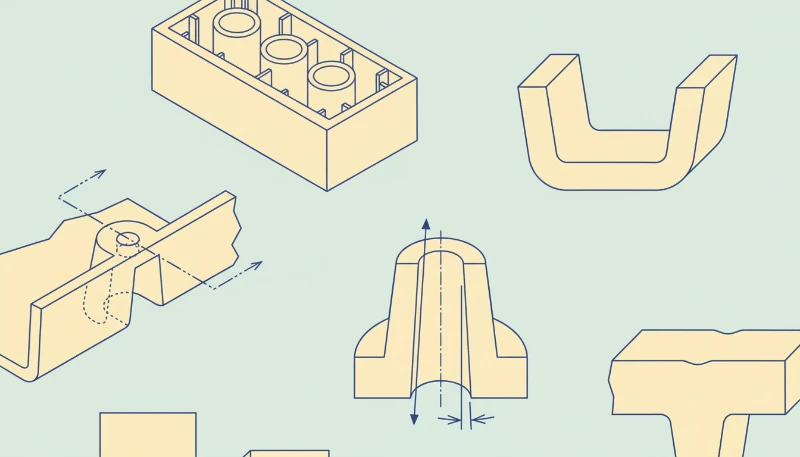
Comment concevoir l’épaisseur de paroi, les nervures et les bossages ?
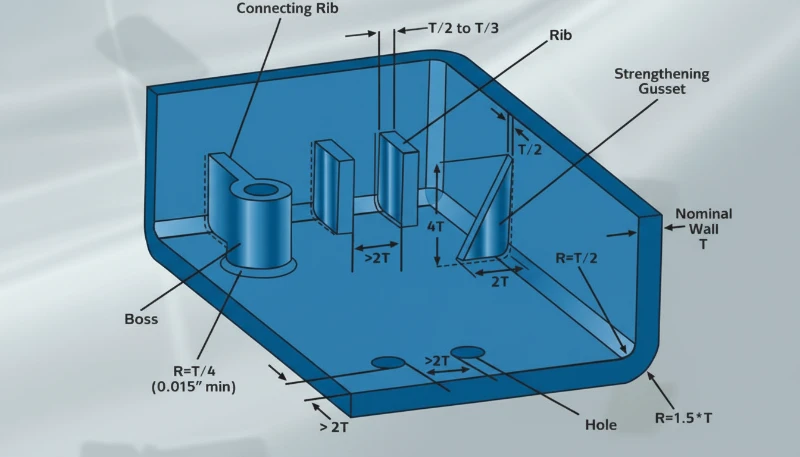
L’épaisseur de paroi est le principal paramètre de contrôle du temps de refroidissement, du retrait et des contraintes locales dans une pièce moulée. Elle doit être aussi uniforme que la fonction du produit le permet, car l’épaisseur contrôle le temps de refroidissement, le retrait et les contraintes locales. Une épaisseur de paroi nominale est une valeur cible utilisée sur toute la pièce afin que l’écoulement et le refroidissement restent prévisibles au lieu de changer brutalement d’une région à l’autre.
Pour de nombreux thermoplastiques techniques, les premiers concepts commencent souvent avec des parois de 1,5 mm à 3,0 mm, puis sont ajustés après que les besoins en résine, longueur de flux, rigidité et tests de chute sont connus. Les sections fines peuvent figer avant que la cavité soit remplie, tandis que les sections épaisse peuvent retenir la chaleur et créer un enfoncement visible sur la face esthétique.
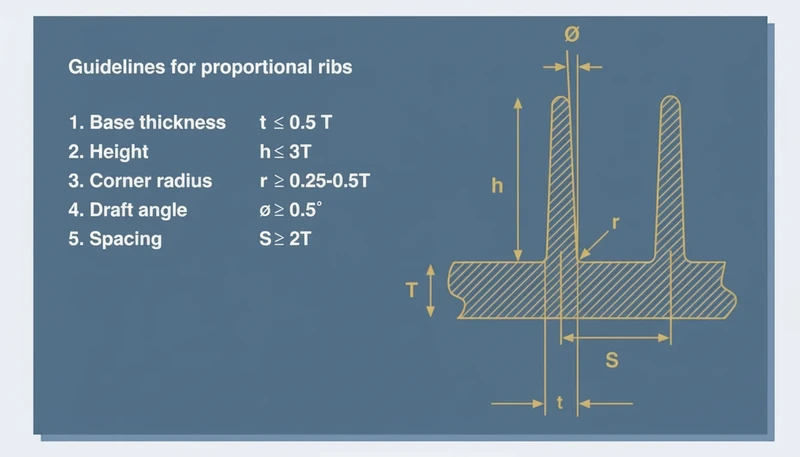
Les nervures augmentent la rigidité sans transformer la pièce en un bloc épais. Un rapport nervure/paroi3 courant est d’environ 40 % à 60 % de la paroi adjacente, avec des rayons généreux à la base et un espacement suffisant pour préserver la résistance de l’acier. Une nervure trop épaisse peut créer une retassure en surface ; trop haute et trop mince, elle rend le remplissage et l’éjection instables.
Les bossages nécessitent la même discipline. Un bossage de vis doit être relié par des nervures ou des goussets, et non par un cylindre massif reposant sur une paroi fine. Le diamètre extérieur du bossage, la résistance de l’âme, l’engagement de la vis et la direction d’éjection doivent être revus ensemble afin que la conception ne crée pas de manques de matière, de marques de brûlure ou d’âmes cassées.
Lors de nos revues DFM en usine, une transition de paroi supérieure d’environ 30% à la paroi voisine est généralement signalée pour discussion. Nous examinons aussi les bases des nervures à la loupe après les premières injections, car une petite retassure sur un boîtier visible peut être plus difficile à faire accepter qu’une légère modification de l’outillage.
Les angles doivent être arrondis plutôt que vifs. Les rayons intérieurs améliorent l’écoulement et réduisent les concentrations de contraintes, tandis que les rayons extérieurs maintiennent une épaisseur constante dans l’angle. Un angle intérieur vif peut sembler net en CAO, mais il impose un changement brutal de direction au polymère et peut créer un point faible sous les chocs ou les vibrations.
Lorsque la pièce doit rester rigide, combinez nervures, choix du matériau et géométrie locale. La meilleure conception est rarement la plus épaisse. C’est celle qui place la matière là où les chemins de charge l’exigent tout en maintenant un refroidissement assez uniforme pour assurer un moulage répétable.
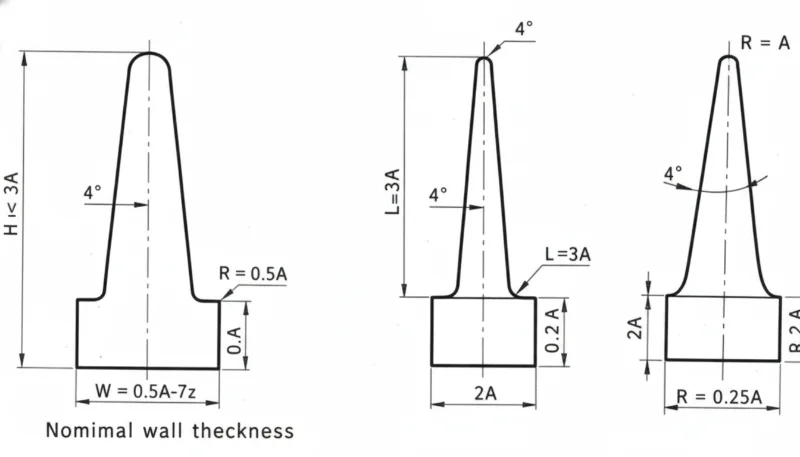
Comment l’angle de dépouille, la ligne de séparation et les fermetures réduisent le risque d’outillage ?
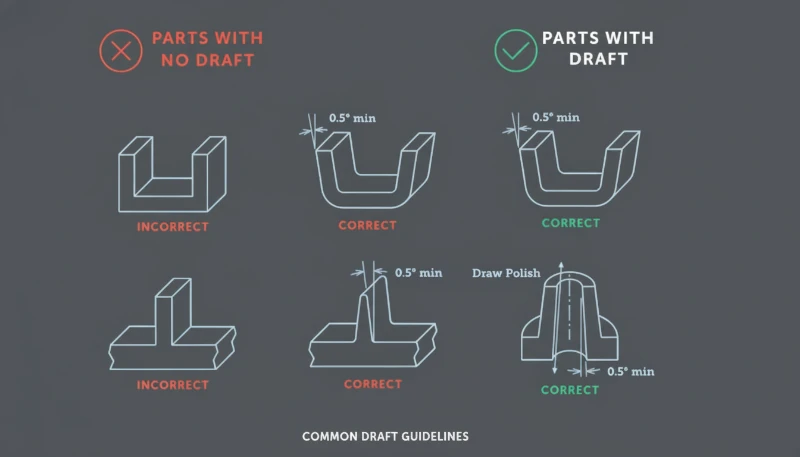
L’angle de dépouille est le dégagement qui facilite la sortie d’une pièce de l’empreinte ou du noyau. Il réduit le risque d’outillage pendant l’éjection. Une dépouille insuffisante fait frotter textures, nervures profondes et parois hautes contre l’acier, causant traînées, blanchiment, déformation ou blocage.
Pour de nombreuses faces verticales lisses, une cible initiale courante est de 1.0 à 2.0 degrés par côté, avec davantage de dépouille pour les textures ou les éléments profonds. La valeur finale dépend du retrait de la matière, de l’état de surface, de la profondeur de démoulage, du polissage de l’outil et du côté de la surface, empreinte ou noyau.
La stratégie de ligne de joint doit être choisie avant de figer la surface visible. La ligne de joint détermine où les bavures peuvent apparaître, où les faces d’obturation se rejoignent et si des coulisseaux ou éjecteurs inclinés sont nécessaires. Une séparation esthétique du produit peut devenir coûteuse si elle masque une contre-dépouille inévitable ou impose un acier d’obturation fragile.
Les fermetures doivent présenter un angle et une surface d’appui suffisants pour résister aux cycles répétés. Des arêtes en acier très fines peuvent s’ébrécher, s’user ou créer des bavures après le début de la production. Si un clip, une fenêtre, un évent ou un encliquetage nécessite une fermeture, la revue DFM doit vérifier l’épaisseur de l’acier, l’accès pour le polissage et la possibilité de reconcevoir la caractéristique pour sécuriser le mouvement du moule.
"Les choix de dépouille et de plan de joint doivent apparaître dans la revue DFM avant l'approbation du plan du moule."True
C’est exact, car ces choix déterminent le sens d’ouverture du moule, le nombre de tiroirs, l’usure des zones d’obturation, les marques esthétiques et la fiabilité de l’éjection. Les modifications tardives exigent souvent de revoir les pièces en acier.
"Une paroi sans dépouille est acceptable lorsque le modèle CAO présente une finition de surface lisse."False
C'est faux, car même une surface lisse peut adhérer à l'acier après retrait. Une dépouille nulle augmente la force d'éjection et peut marquer ou déformer la pièce lors du démoulage.
Considérez le sens d’ouverture du moule comme une contrainte de conception, et non comme une réflexion tardive. Indiquez sur le modèle le côté noyau, le côté empreinte, les courses des tiroirs, le mouvement des éjecteurs inclinés et les lignes de joint attendues. Lorsque nos ingénieurs examinent un boîtier, ils utilisent souvent un code couleur pour montrer au client où fonction, aspect et coût d’outillage entrent en concurrence.
C’est aussi là que la communication entre acheteur et fournisseur compte. Un fournisseur qui chiffre uniquement le plan peut ignorer des risques cachés de l’outillage ; celui qui explique le sens de démoulage, la réserve d’acier et le risque au premier essai donne à l’acheteur une meilleure base de décision. La revue de conception doit donc faire partie du processus commercial de RFQ, et non intervenir après l’émission du bon de commande.
Comment équilibrer les tolérances, le choix des matériaux et les caractéristiques d’assemblage ?
L’équilibrage des tolérances consiste à adapter les dimensions, le comportement de la résine et le risque d’assemblage aux capacités réelles du moulage. Tolérances, matériau et fonctions d’assemblage doivent être équilibrés selon la fonction, car chaque cote serrée augmente le risque du procédé. La GD&T est un langage de plan qui définit les variations admissibles de forme, orientation, position et battement afin que les fournisseurs sachent quelles dimensions commandent réellement l’assemblage.
La tolérance d’une pièce plastique moulée doit tenir compte du retrait de la résine, de la température de l’outillage, de l’humidité, de la teneur en charge, de la géométrie de la pièce et de la méthode de mesure. Une tolérance de 0.05 mm peut convenir à un élément court en acier d’une pièce usinée, mais être irréaliste sur une longue portée moulée qui refroidit de façon irrégulière.
Le choix du matériau modifie les règles de conception. Le nylon chargé verre peut exiger un acier d’outillage plus résistant et davantage d’attention à l’orientation des fibres, tandis que PC, ABS, PP, POM, PPSU et PEEK présentent chacun des comportements différents de retrait, rigidité, résistance thermique et lignes de soudure. Pour les premières comparaisons, évaluez performances produit et stabilité du moulage.
Les fonctions d’assemblage doivent être tolérantes lorsque cela est possible. Les encliquetages nécessitent un guidage d’entrée, une maîtrise de la déformation et des limites de flèche vérifiables. Les bossages de vis exigent un soutien par broche de noyau et une géométrie anti-fendage. Les charnières intégrées, clips, joints et nervures de soudage par ultrasons requièrent tous des détails propres au procédé, et non de simples ajouts génériques de paroi.
| Domaine de conception | Revue recommandée | Risque usine |
|---|---|---|
| Ajustement critique | Définir le référentiel et la méthode de mesure | Litige relatif au contrôle |
| Encliquetage | Vérifier la déformation et le sens de démoulage | Fissuration ou faible rétention |
| Patron | Vérifier la charge de la broche de noyau et de la vis | Remplissage incomplet ou bossage fendu |
| Face esthétique | Protéger des marques de seuil et d’éjecteur | Défaut visible |
Pour les programmes allant du prototype à la production, comparez la conception moulée au procédé de prototypage. Un prototype CNC peut masquer les risques de moulage, car il ne nécessite ni écoulement depuis un seuil, ni compensation du retrait, ni éjection. Le moulage par injection pour prototypage rapide explique quand un outillage prototype peut réduire cet écart avant l’outillage de production en acier.
L’historique des défauts doit également alimenter la revue de conception. Si des produits similaires ont présenté des retassures, des bavures, des remplissages incomplets ou du gauchissement, utilisez ces données avant de construire le moule suivant. La liste des défauts courants du moulage par injection est utile pour convertir les modes de défaillance connus en contrôles géométriques.
Notre équipe traite la revue des tolérances comme un exercice de hiérarchisation des risques. Nous préférons maintenir une tolérance serrée uniquement lorsque la fonction du produit l’exige, puis élargir les tolérances des surfaces non critiques afin de préserver la stabilité du cycle, la rapidité du contrôle et le rendement de production à long terme.
Avant d’approuver l’usinage de l’acier, transformez ces choix de tolérance en instructions de contrôle. Définissez les surfaces de référence, le principe du montage, la température de mesure et la règle d’échantillonnage. Cela évite qu’un plan exige une précision que personne ne peut mesurer de façon constante en production.
Quel workflow de revue de conception les acheteurs doivent exiger avant l’outillage ?
Un processus de revue de conception est un jalon DFM par étapes précédant le lancement de l’outillage. Il vérifie la fonction du produit, le choix de la résine, les mouvements du moule, l’emplacement du point d’injection, le refroidissement, l’éjection, les tolérances et le contrôle. Ce processus transforme les principes de conception en décisions vérifiables plutôt qu’en opinions échangées par e-mail.
Le premier jalon est une revue de géométrie. Confirmez la cartographie des parois et des nervures, la disposition des bossages, les rayons d’angle, la dépouille, le plan de joint et les contre-dépouilles. Le second jalon est une revue d’outillage. Confirmez le nombre de cavités, les mouvements des coulisseaux et des éjecteurs inclinés, le type de seuil, l’accès aux canaux de refroidissement, la mise à l’air, la marge de reprise de l’acier et les points de maintenance prévus.
Le troisième jalon est une revue de production. Confirmez le séchage de la résine, le temps de cycle prévu, les critères d’acceptation esthétique, les montages de contrôle, les charges d’emballage et les règles de gestion des modifications. Un moule validé sur échantillons, mais dépourvu de plan de production, peut encore échouer lorsque le volume de commande augmente.
Conservez les preuves de revue dans un registre uniquement cumulatif. Archivez les captures annotées, commentaires DFM, approbations client, rapports de premier essai et dossiers de modification du moule. En cas de défaut ultérieur, cet historique permet de déterminer si l’origine tient à la conception, à l’outillage, au matériau, au réglage du procédé ou à une modification non documentée.
Le meilleur résultat n’est pas une liste de contrôle plus longue, mais un parcours plus court entre l’exigence produit et une production stable. Lorsque le fichier de conception, le plan du moule et les critères de contrôle sont alignés, le fournisseur chiffre plus précisément, l’acheteur compare les offres plus équitablement et la première série comporte moins de surprises évitables.
Pour un contenu visant à rétablir le classement, ce processus contribue aussi à la qualité de la recherche. Les lecteurs ont besoin d’une page qui répond directement aux questions de conception, présente des preuves de production et propose une séquence de revue pratique pour leur prochain projet. Cette combinaison est plus efficace qu’une liste générique de conseils sur la conception de pièces plastiques.
Cela offre aussi à l’équipe commerciale un parcours de demande plus clair : l’acheteur peut joindre des plans, signaler les caractéristiques à risque et demander une analyse DFM ciblée au lieu d’envoyer uniquement une demande de prix.
Questions fréquemment posées
Quelle est la règle de conception la plus importante pour les produits injectés ?
La règle la plus importante est de concevoir la pièce autour d’un remplissage, d’un refroidissement et d’une ejection uniformes, plutôt que seulement autour de la forme finale du produit. Une épaisseur de paroi uniforme, des transitions douces, des tolérances réalistes et un dépouille suffisant préviennent de nombreux défauts de moulage courants. Lorsque ces bases sont ignorées, le fabricant de moules peut encore produire des échantillons, mais la production peut souffrir de marques de retassure, de déformation, de pièces bloquées, de bavures et de dimensions instables. Cela transforme la DFM en une liste de contrôle commune pour le client et le fournisseur et prévient les disputes tardives sur ce que l’outil était censé résoudre.
Quel angle de dépouille doit avoir une pièce plastique ?
Une cible utile en phase initiale est souvent de 1,0 à 2,0 degrés par côté sur les parois verticales lisses, mais la dépouille finale dépend du matériau, de la texture, de la profondeur de tirage, du retrait et des exigences esthétiques. Les nervures profondes, les faces texturées et les matériaux chargés de verre nécessitent généralement une analyse plus conservatrice. La bonne question n’est pas seulement de savoir quelle dépouille est visible en CAO, mais si la pièce peut se démouler proprement pour le volume de production attendu sans marques de frottement, blanchiment, déformation ou force d’éjection excessive. La profondeur de texture et l’accessibilité pour le polissage doivent également être prises en compte dans cette décision.
Pourquoi les nervures provoquent-elles des marques de retrait en moulage par injection ?
Les nervures provoquent des marques de retrait lorsque leur base crée une section localement épaisse qui refroidit plus lentement que la paroi environnante. Lorsque cette zone massive se rétracte, la face esthétique extérieure peut se déformer vers l’intérieur et présenter une dépression visible. La correction habituelle consiste à réduire l’épaisseur de la nervure, à ajouter des rayons généreux, à diviser une nervure épaisse en plusieurs nervures plus fines, ou à éloigner l’élément d’une surface d’apparence critique. La nervure doit améliorer la rigidité sans se comporter comme un bloc caché de plastique retardant le refroidissement.
Une pièce plastique moulée doit-elle utiliser des tolérances très serrées partout ?
Non. Les tolérances serrées doivent être réservées aux interfaces fonctionnelles telles que les surfaces d’étanchéité, les clips, l’alignement des engrenages, les emplacements de connecteurs ou les références d’assemblage. Les surfaces non critiques doivent utiliser des tolérances plus larges pour maintenir la stabilité du processus de moulage. Appliquer des tolérances serrées partout augmente les coûts d’inspection, le risque de rebut, le temps de réglage du moule et la confusion des fournisseurs sans améliorer la fonction du produit final. Un meilleur plan sépare les dimensions critiques pour la fonction des dimensions esthétiques ou de jeu et clarifie la responsabilité des mesures. Cela aide également le fournisseur à chiffrer honnêtement les gabarits de contrôle, la fréquence d’échantillonnage et la capacité attendue du processus.
Quand la revue DFM doit-elle avoir lieu dans un nouveau projet de moulage par injection ?
La revue de la fabrication (DFM) doit avoir lieu avant que le devis du moule ne soit finalisé, puis à nouveau avant que l’acier du moule ne soit usiné. La première revue identifie les risques géométriques et de processus tant que les modifications de conception sont encore peu coûteuses. La seconde revue confirme la disposition du moule convenue, l’emplacement de l’attaque, la ligne de jointure, le plan d’éjection et les exigences d’inspection. Attendre les premiers tirages transforme de nombreuses modifications simples en CAO en modifications coûteuses du moule. Une revue documentée donne également à l’acheteur de meilleurs éléments de comparaison entre fournisseurs et pour l’approbation du lancement de l’outillage. Elle doit être archivée avec les plans, la disposition du moule et les enregistrements d’approbation.
angle de dépouille : L’angle de dépouille est une légère inclinaison appliquée aux faces verticales afin qu’une pièce moulée se libère de l’empreinte ou du noyau avec moins de frottement. ↩
épaisseur de paroi nominale : L’épaisseur de paroi nominale est la valeur cible servant de référence pour évaluer le refroidissement, le remplissage, la rigidité et le retrait d’une pièce plastique moulée. ↩
rapport nervure/paroi : Le rapport nervure/paroi exprime la relation entre l’épaisseur à la base d’une nervure et la paroi nominale adjacente, afin d’accroître la rigidité sans provoquer de retassure excessive. ↩