 Saltar para o conteúdo

You are specifying plastic components for a new vehicle platform. The design calls for 47 injection-molded parts across the interior, exterior, and under-hood systems—and your supplier needs to deliver consistent quality across all of them at automotive volumes. Injection molding produces the majority of plastic parts in a modern car, from instrument panel trim to air intake manifolds. This article breaks down the specific materials, molding techniques, and quality requirements that separate a reliable automotive parts program from one that generates scrap and delays.
- Injection molding accounts for over 90% of plastic parts in passenger vehicles
- PP, ABS, and nylon dominate automotive molding due to cost and performance balance
- Multi-shot and insert molding enable integrated components that reduce assembly steps
- IATF 16949 and PPAP are non-negotiable for production-tier automotive parts
- Partner selection should prioritize tonnage range, material experience, and defect tracking
What Role Does Injection Molding Play in Modern Automotive Manufacturing?
Injection molding is the backbone of automotive plastic component production. A single mid-size sedan contains roughly 30,000 parts, and over 1,000 of those are plastic—most of them injection molded¹. Bumpers, dashboards, door panels, intake manifolds, fluid reservoirs, sensor housings, and connector blocks all come off molding machines, not machining centers.
The reason is straightforward: once the mold is built, each part costs fractions of a dollar in material and machine time. At production volumes above 10,000 units, no other process competes on per-part cost. A typical automotive mold runs 500,000 to over 1 million cycles before requiring significant refurbishment. This is why every major automaker and their Tier 1 suppliers rely on moldagem por injeção1 as the primary method for producing non-metallic components.
But automotive molding is not the same as consumer-goods molding. The tolerances are tighter (often ±0.05 mm for functional features), the material specifications are stricter (each resin grade must meet OEM approval lists), and the documentation burden is heavier. If you have ever been through a PPAP submission for a plastic bracket, you know the paperwork can outweigh the part.
The shift toward electric vehicles is expanding the role of injection molding further. EV battery enclosures, thermal management housings, charging port assemblies, and lightweight structural brackets are all new application areas where plastic parts replace heavier metal alternatives. The weight savings directly translate to range improvements, which is why OEMs are pushing material suppliers and molders to deliver structural-grade plastics at scale.

What Materials Are Used for Automotive Injection Molding?
This section is about materials are used for automotive injection molding and its impact on cost, quality, timing, or sourcing risk. Material selection in automotive molding is driven by three constraints: cost per kilogram, mechanical performance at temperature, and regulatory compliance (interior parts must meet fogging and VOC limits; under-hood parts must survive continuous exposure to 120–150 °C). The table below shows the workhorse resins that dominate automotive production worldwide.
| Material | Propriedades principais | Typical Automotive Use |
|---|---|---|
| Polipropileno (PP) | Low density (0.90 g/cm³), chemical resistance, low cost | Bumpers, battery cases, interior trim |
| ABS | Impact strength, good surface finish, paintable | Dashboard components, grilles, wheel covers |
| Nylon 6/6 (PA66) | High strength, heat resistance (up to 180 °C short-term) | Intake manifolds, engine covers, gears |
| Policarbonato (PC) | Transparency, impact resistance, dimensional stability | Headlamp lenses, sunroof modules |
| POM (Acetal) | Low friction, excellent fatigue resistance | Fuel system components, fasteners, clips |
| TPO / TPE | Flexible, weatherable, paintable | Seals, gaskets, soft-touch interior panels |
| PA66-GF30 | High stiffness, creep resistance at elevated temperatures | Structural brackets, transmission components |
In practice, the OEM specifies an approved material list for each subsystem. As a molder, you do not get to swap PA66 for PA6 without engineering sign-off—even if the melt flow index is similar. This is why working with a supplier who stocks 400+ material grades matters: they are less likely to push a substitution that creates problems downstream in the vehicle assembly.
Glass-filled grades deserve special attention. Adding 30% short glass fiber to nylon increases tensile strength by roughly 2.5×, but it also accelerates mold wear (the fibers act like microscopic sandpaper on cavity surfaces) and requires higher injection pressures. If you are sourcing structural brackets or under-hood components, confirm the molder has experience running glass-filled compounds on production tooling—not just sample shots in a lab environment.
Regulatory requirements also shape material choices. Interior components in vehicles sold in the EU must comply with REACH and ELV Directive substance restrictions. Parts that contact food or drinking water (cup holders, water bottle holders) may need FDA-compliant resin grades. A knowledgeable molder will flag these requirements early in the design phase, before tool steel is cut.
What Are the Key Automotive Applications of Injection Molded Parts?
The key automotive applications of injection molded parts are the main categories or options explained in this section. Automotive applications split into three zones, each with distinct performance demands and quality requirements.
Interior Systems
Instrument panels, center consoles, door trim panels, HVAC ducting, and airbag covers. Interior parts require Class A surface finish (no visible sink marks, weld lines, or flow marks in visible areas) and must pass fogging tests (< 1 mg condensate per DIN 75201). Multi-material sobremoldagem2 is common here: a rigid PP substrate gets a TPE skin for soft-touch feel without a separate assembly step. The cost savings from eliminating a bonding operation can be substantial at automotive volumes.
Exterior Systems
Bumpers, grilles, fender liners, mirror housings, and lamp bezels. These parts face UV exposure, temperature cycling from −40 °C to +90 °C, and stone impact on the road. Paint adhesion on molded TPO bumpers is a well-known pain point—surface treatment (flame or plasma) is required before the paint line, and the molder must control additive migration that interferes with adhesion. Getting the surface energy right before painting is critical to avoid warranty claims for peeling paint.
Under-Hood and Powertrain
Air intake manifolds, coolant reservoirs, sensor housings, connector blocks, and wire harness clips. These are the most demanding applications: continuous temperatures above 120 °C, exposure to fuel, oil, and coolant, and vibration loads from the engine. Nylon 6/6 (often glass-filled) dominates this zone. moldagem por inserção3 is frequently used to encapsulate metal inserts or electronic sensors directly into the plastic housing, eliminating assembly steps and improving reliability under vibration.
The electric vehicle transition is adding new categories: battery module housings, inverter enclosures, thermal management manifolds, and high-voltage connector systems. Many of these parts require flame-retardant materials (UL94 V-0 rated) and must maintain dimensional stability across a wide temperature range. Mold design for these parts is more complex because wall sections tend to be thicker, increasing cooling time and the risk of sink marks.
What Injection Molding Techniques Are Used in Automotive Production?
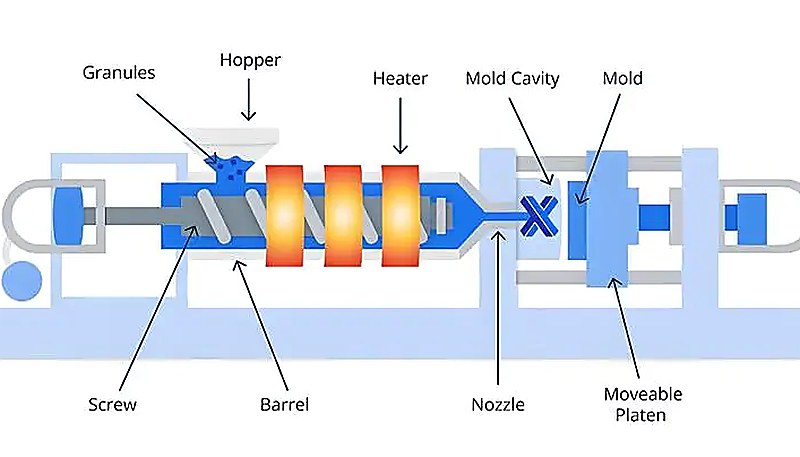
This section is about injection molding techniques are used in automotive production and its impact on cost, quality, timing, or sourcing risk. Standard single-shot molding handles the bulk of automotive plastic parts, but several specialized techniques are essential for functional integration and cost reduction in modern vehicle programs.
Two-shot (multi-component) molding molds two different materials in a single machine cycle. A typical automotive application is a button with a rigid PC body and a soft TPE top—the process uses a rotating mold core to transfer the substrate from cavity A to cavity B without demolding. This eliminates a secondary assembly operation and ensures precise alignment between the two materials. The resulting bond is typically stronger than any adhesive joint because the materials interlock at the molecular level during cooling.
Moldagem por inserção places a metal stamping, threaded bushing, or electronic component into the mold before the shot. The plastic flows around it, creating a single integrated part. Automotive connector blocks with pre-positioned metal terminals are a high-volume example—billions of these are molded annually across the global automotive supply chain.
Gas-assist molding injects nitrogen gas into the melt to hollow out thick sections. This reduces part weight by 10–30%, eliminates sink marks on show surfaces, and shortens tempo de produção da moldagem por injeção by reducing the mass that needs to cool. Door grab handles, console armrest frames, and mirror brackets often use this technique. The hollow core also improves stiffness-to-weight ratio compared to a solid part of the same exterior dimensions, because the gas channel acts like an internal rib without adding material.
Choosing the right molding technique is not a decision you make in isolation. The part geometry, annual volume, material requirements, and assembly constraints all factor in. A good molding partner will recommend the most cost-effective technique based on the total cost of ownership—including tooling, cycle time, secondary operations, and scrap rate—rather than defaulting to the simplest method and hoping it works. The upfront investment in mold flow simulation pays for itself many times over when you consider that a single mold rework cycle for an automotive production tool can cost $5,000–$15,000 and add two to four weeks to the timeline.
“Two-shot molding eliminates the need for a separate adhesive-bonding step between rigid and soft components.”Verdadeiro
The second material bonds molecularly to the substrate during the molding cycle, producing a stronger interface than any secondary adhesive process could achieve.
“Gas-assist molding is mainly used for small, precision parts under 50 grams.”Falso
Gas-assist is most valuable for large, thick-sectioned parts (often over 500 grams) where hollowing out the core saves significant weight and reduces sink marks on cosmetic surfaces.
How Does Quality Control Work for Automotive Injection Molded Parts?
Automotive quality is not optional and not negotiable. Two frameworks define the baseline: IATF 16949 (the automotive-specific quality management system standard, built on ISO 9001 but with additional requirements for process control, risk management, and traceability) and PPAP (Production Part Approval Process, which defines the 18-element submission package a supplier must provide before the OEM approves production release).
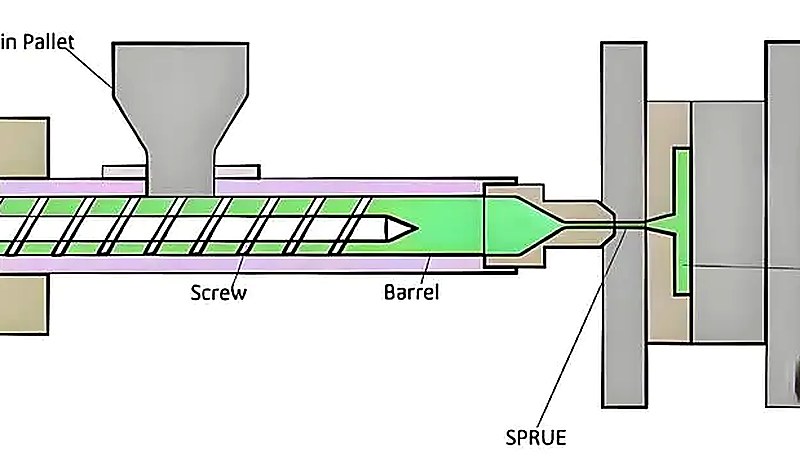
On the shop floor, this translates to several concrete activities. First-run samples are measured against the GD&T drawing using CMM equipment. Process parameters such as injection pressure, melt temperature, gate freeze time, and cooling time are mapped to the etapas da moldagem por injeção and then locked in a control plan. During production, SPC (statistical process control) charts track critical dimensions on a sampling basis—typically every 2 hours or every 500 parts, whichever comes first.
A supplier running automotive parts without CMM capability and documented SPC is not a Tier 1 or Tier 2 supplier, regardless of what their website says. When we audit suppliers at ZetarMold, we look for the actual inspection equipment—coordinate measuring machines, profile projectors, hardness testers—and the calibration records for each instrument. ISO 9001 / ISO 13485 certification is the floor, not the ceiling, for automotive work.
Traceability is another non-negotiable. Every production lot must be traceable back to the specific material batch, machine, mold, and operator. If a field failure occurs, the OEM needs to identify every affected vehicle within hours, not weeks. This level of traceability requires systematic lot tracking from raw material receiving through final shipment, and it is one of the first things an automotive auditor will verify during a facility assessment.
Without a robust lot tracking system, a recall becomes exponentially more expensive because the OEM cannot isolate the affected production window and must recall a wider range of vehicles as a precaution. Any supplier who cannot demonstrate this capability during an audit should be disqualified from automotive work, regardless of their other qualifications.
“PPAP requires dimensional results from a minimum of 3 production runs before a supplier can ship production parts.”Verdadeiro
The 3-run minimum demonstrates process repeatability, not just that the machine was dialed in once for sample shots. Each run must produce parts within specification using production-equivalent conditions.
“If a part passes visual inspection, it is approved for automotive production use.”Falso
Visual inspection catches cosmetic defects only. Automotive PPAP requires dimensional data, material certifications, process capability studies (Cpk values), and often destructive testing results before any production approval.
How Do You Choose the Right Automotive Injection Molding Partner?
Choosing the right automotive injection molding partner is about tooling capability, quality systems, communication, and commercial fit. Selecting a molder for automotive work involves questions that go beyond price-per-part. Here is what actually matters in practice when you are evaluating a long-term molding partner for a vehicle program.
Tonnage range and machine fleet. Automotive parts span from 5-gram connector clips to 3-kilogram bumper fascias. A supplier limited to 200T machines cannot run large exterior parts. Conversely, a shop with only 1000T+ machines will waste capacity on small components. Look for a tonnage range of at least 90T to 1000T, with the flexibility to go higher for specialized jobs. Machine age matters too—older hydraulic machines may lack the precision of servo-electric or hybrid machines, which affects consistency in tight-tolerance work.
Material experience. Running glass-filled nylon at production volumes is different from molding commodity PP. The abrasive filler wears gates and cavity surfaces faster, requiring more frequent mold maintenance and more disciplined process monitoring. A supplier who has run 400+ materials across automotive, medical, and consumer applications has seen (and solved) the processing problems that a PP-only shop has not encountered yet.
Quality system depth. Ask for a copy of their control plan template and a recent dimensional report. If they cannot produce these within a day, their quality system is shelfware. The supplier should have a structured quality flow—IQC, in-process checks, process inspection, packaging inspection, FQC, and OQC—as a minimum framework, backed by calibrated measurement equipment and documented procedures.
Engineering support for mold modifications. Automotive programs run for 5–7 years. During that time, design changes are inevitable—sometimes driven by cost reduction, sometimes by vehicle facelifts, and sometimes by manufacturing process optimization.
If your molder does not have in-house mold manufacturing capability, every design change becomes a logistics negotiation with an external tool shop, adding weeks to the timeline. An in-house mold shop with CNC, EDM, and wire-cut equipment can turn around a steel change in days instead of weeks, keeping the production line running without interruption.
Communication and responsiveness. When a dimensional issue surfaces on the production line, you need a response within hours, not days. A supplier with English-speaking project managers who understand the technical context (not just a sales team forwarding emails) can resolve issues before they become line-down situations. This is particularly important for overseas sourcing, where time zone differences already compress the communication window.
What Are Common Defects in Automotive Injection Molding and How Are They Prevented?
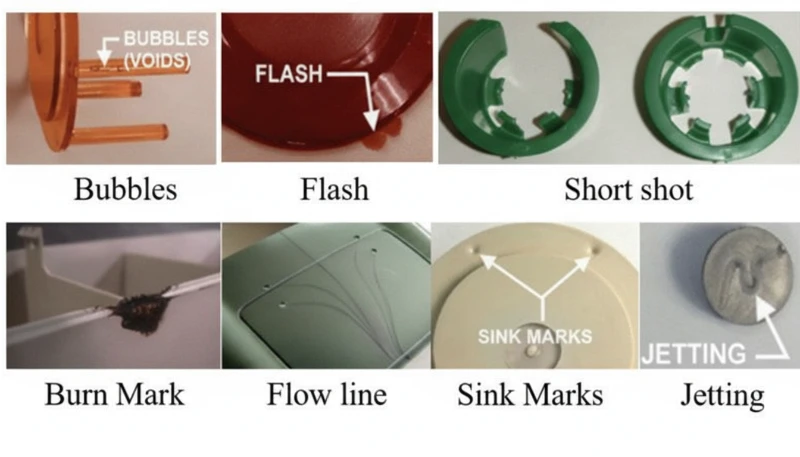
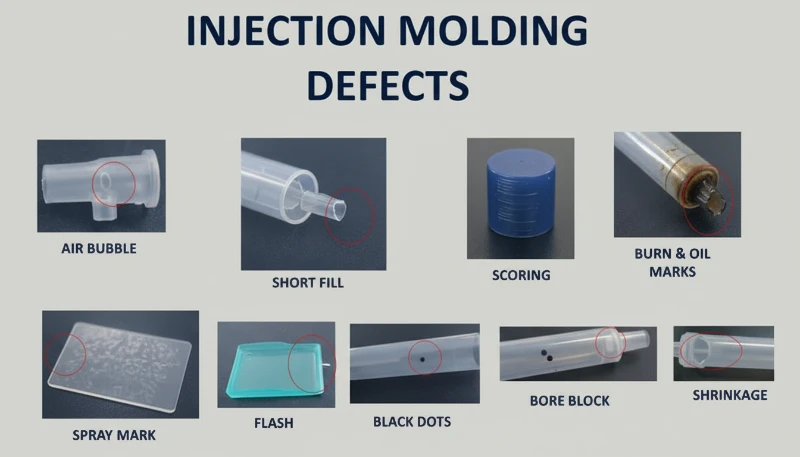
Common defects in automotive injection molding and how are they prevented are the main categories or options explained in this section. Even with optimized processes, certain defects recur in automotive molding. Understanding these helps you evaluate whether a supplier is actively controlling their process or just hoping for the best. The three most common automotive-specific defect categories are sink marks, weld lines, and short shots.
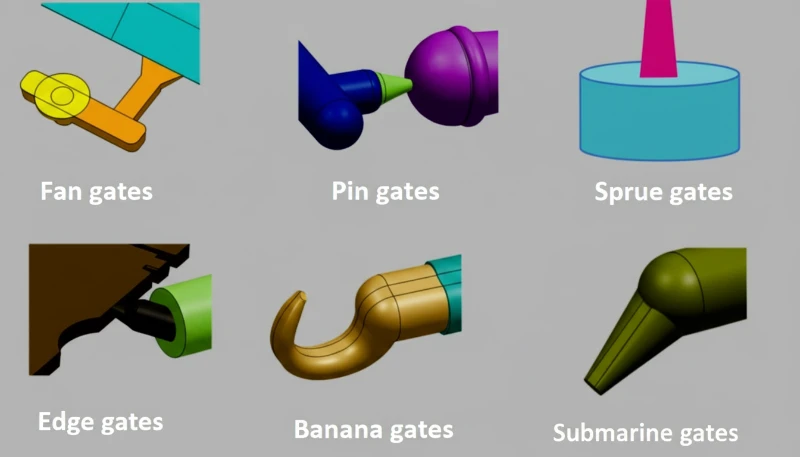
reduza o desperdício de corredores mantendo o plástico fundido, mas eles adicionam $5.000–$15.000 ao custo do molde. Saiba mais no nosso guia de moldes de corredor quente. appear on the show surface opposite thick sections—ribs, bosses, and wall transitions. The thicker section cools slower, contracts, and pulls the visible surface inward. Prevention: maintain rib-base thickness at 50–60% of the nominal wall, and pack with sufficient hold pressure and time. A supplier who sets hold pressure by feel rather than by monitoring the actual pressure curve data is gambling with your Class A surface requirements.
Linhas de soldadura form where two flow fronts meet, typically around holes or inserts. In glass-filled materials, the fibers orient parallel to the weld line, creating a weak spot where tensile strength can drop 30–50% compared to the bulk material. Prevention involves adjusting gate placement to move the weld line to a non-critical area, or increasing melt temperature to improve molecular diffusion across the knit line. Flow simulation before tool cutting catches most of these issues, but only if the molder actually runs the simulation and acts on the results.
Beyond these three categories, automotive molders also watch for warpage (especially in large flat parts like door panels), flash (excess material escaping along the parting line), and dimensional drift over long production runs. Each of these has root causes in process control, mold condition, or material consistency—and each is far cheaper to prevent through disciplined setup than to fix through post-molding rework or scrap.
The cost of defects in automotive production is not limited to the scrap value of the part itself. A defective part that reaches the assembly line can stop production, and a defective part that reaches the end customer triggers a warranty claim or a recall. This is why automotive OEMs set defect rate targets in parts per million (PPM), and why serious molders invest in automated inspection equipment and real-time process monitoring to catch deviations before they produce out-of-spec parts.
What Does a Qualified Automotive Molding Partner Look Like in Practice?
In our Shanghai factory, our team runs 47 injection molding machines from 90T to 1850T and works under ISO 9001, ISO 13485, ISO 14001, and ISO 45001 systems. With 20+ years of injection molding and tooling experience, our engineers check automotive part feasibility against material, tonnage, dimensional risk, and PPAP documentation before tooling starts.
For automotive projects specifically, we focus on three practical controls. First, our in-house mold manufacturing facility keeps tooling design, machining, trial, and maintenance under one roof instead of splitting accountability across outside tool shops. Second, our quality process documents incoming inspection, in-process sampling, packaging checks, final inspection, and outgoing inspection so PPAP evidence is not rebuilt from memory after production starts. Third, our team has experience with 400+ plastic materials, which reduces resin substitution risk when an OEM requires a specific PP, ABS, PA, PC, or glass-filled grade.
O nosso equipa de produção inclui mais de 120 funcionários que compreendem a diferença entre revestimentos cosméticos, suportes semi-estruturais e componentes sob o capot expostos ao calor e vibração. Se está avaliando parceiros de moldagem para um programa automóvel, solicite relatórios dimensionais de amostras, um modelo de plano de controlo, registos de rastreabilidade de materiais e dados de capacidade do processo antes de comprometer-se com um investimento em ferramentas.
What Questions Do Buyers Ask About Automotive Injection Molding?
Perguntas mais frequentes
What is the typical lead time for an automotive injection mold?
Um molde automóvel padrão de cavidade única demora 6–10 semanas desde a aprovação do design até às amostras T1. Moldes multi-cavidade ou de família com ações laterais complexas podem demorar 12–16 semanas. Na ZetarMold, o nosso departamento interno de moldes normalmente fornece amostras T1 dentro de 8 semanas para ferramentas automóveis de complexidade moderada, porque controlamos todo o processo de maquinagem e teste internamente, sem depender de oficinas externas de ferramentas. O teste do molde propriamente dito geralmente requer 2–3 iterações para ajustar os parâmetros do processo antes de ser gerado o relatório de inspeção do primeiro artigo.
A moldagem por injecção pode produzir componentes automóveis estruturais?
Sim, quando se utiliza nylon com fibra de vidro ou compostos termoplásticos de fibra longa (LFT). Um suporte PA66-GF30 pode alcançar uma resistência à tração superior a 180 MPa—suficiente para muitas aplicações estruturais e semi-estruturais, como estruturas de bancos, suportes de pedais e componentes de montagem de bateria em plataformas EV. O essencial é selecionar o conteúdo e orientação adequados da fibra, onde a simulação de fluxo do molde e a experiência na colocação da entrada fazem a diferença entre um componente que passa os testes laboratoriais e outro que falha em condições de carga real.
Qual é o volume mínimo de produção que justifica a moldagem por injecção para componentes automóveis?
Para componentes simples com complexidade moderada do molde, 5.000–10.000 unidades é tipicamente o ponto de equilíbrio versus maquinagem CNC ou impressão 3D, quando se considera o custo amortizado da ferramenta ao longo da produção. Para ferramentas complexas multi-cavidade com ações laterais e elevadores, o limite aumenta para 30.000–50.000 unidades antes de as economias por componente compensarem o maior investimento inicial em ferramentas. Os programas automóveis normalmente funcionam bem acima destes volumes durante um ciclo de vida de modelo de 5–7 anos, tornando a moldagem por injecção a escolha económica clara. Alguns moldadores também oferecem prototipagem intermédia usando moldes de alumínio para volumes menores antes de comprometer-se com ferramentas de produção em aço, que podem reduzir o custo inicial da ferramenta por 40–60%.
Como são testados os componentes automóveis moldados por injecção para durabilidade?
Categorias de teste comuns incluem ciclos térmicos (−40 °C a +120 °C para 100+ ciclos conforme especificação OEM), envelhecimento UV (exposição acelerada em weatherometer conforme SAE J2412 ou normas equivalentes), teste de vibração (conforme ISO 16750-3 espectros de perfil de via, tipicamente 8–24 horas por eixo), e resistência química (imersão em combustível, óleo e líquido refrigerante durante durações especificadas em temperaturas elevadas). Algumas aplicações também requerem teste de queda, teste de impacto a baixa temperatura e envelhecimento por humidade. O OEM define a matriz de teste exata no documento de especificação do componente, e o fornecedor deve fornecer relatórios de teste certificados como parte do pacote de submissão PPAP antes de qualquer aprovação de produção ser concedida.
Que tolerâncias pode a moldagem por injecção alcançar para componentes automóveis?
Tolerâncias gerais de ±0,1 mm são rotineiras para características abaixo de 50 mm em resinas de engenharia padrão. Tolerâncias apertadas de ±0,05 mm são alcançáveis para características críticas como grampos de encaixe, pinos de posicionamento e superfícies de vedação, mas exigem construção de molde de precisão, parâmetros de processo bloqueados e monitorização estatística. Características acima de 150 mm normalmente mantêm ±0,2–0,3 mm devido à variação de retração do material em dimensões mais longas. Materiais cristalinos como o nylon e o POM apresentam maior retração do que as resinas amorfas como o ABS ou o PC, o que afeta a capacidade de tolerância.
A sobremoldagem é utilizada na produção automóvel?
Extensivamente. A moldagem por injecção de dois passos produz componentes multi-material como botões de volante com toque suave, conectores eléctricos selados com rebordos de gaxeta integrados e suportes de montagem amortizados de vibração—tudo num único ciclo de máquina sem qualquer montagem secundária. Isto elimina operações de ligação separadas e produz ligações de material mais robustas que a junção por adesivo poderia alcançar, porque os dois materiais fundem-se ao nível molecular durante o arrefecimento. O processo requer uma máquina de moldagem equipada com duas unidades de injecção independentes e um molde com um núcleo rotativo ou uma placa de índice para transferir o substrato entre o primeiro e o segundo passo de material.
Que certificação deve ter um fornecedor de moldação por injeção automóvel?
A IATF 16949 é a norma setorial de gestão da qualidade para fornecedores automóveis e é exigida pela maioria dos OEMs de Nível 1 para aprovação de aprovisionamento a nível de produção. No mínimo, a certificação ISO 9001 é esperada para qualquer fornecedor que cote trabalhos automóveis, mas os programas de produção sérios exigirão a IATF 16949 como um requisito obrigatório no processo de qualificação de fornecedores. A certificação de gestão ambiental (ISO 14001) e a certificação de saúde e segurança ocupacional (ISO 45001) são cada vez mais exigidas pelos OEMs europeus e norte-americanos como parte dos seus padrões de aprovisionamento sustentável e requisitos de responsabilidade corporativa.
Escolher um parceiro de moldagem por injecção para produção automóvel é uma decisão de 5–7 anos. O fornecedor adequado fornece qualidade dimensional consistente, maneja alterações de design sem interrupção do cronograma e fornece a documentação que a sua submissão PPAP requer. Se está procurando componentes plásticos automóveis e deseja discutir seleção de material, design do molde ou capacidade do processo com a nossa equipa de engenharia, use o nosso guia completo de molde de injeção como uma lista de verificação de avaliação técnica antes de cotar.
-
injection molding: A moldação por injeção é um processo de fabrico no qual a resina termoplástica fundida é injetada sob alta pressão numa cavidade de molde fechada, onde arrefece e solidifica na geometria final da peça. ↩
-
overmolding: A sobremoldagem refere-se a um processo de moldação por injeção de dois tiros em que um segundo material é moldado sobre um substrato previamente moldado para criar uma peça multimaterial com aderência, vedação ou amortecimento de vibrações melhorados. ↩
-
insert molding: A moldagem por inserção é um processo em que um componente metálico ou electrónico pré-colocado é encapsulado por plástico injetado para formar uma montagem integrada única. ↩




 EN
EN  ES
ES  FR
FR  DE
DE  PT
PT  AR
AR  RU
RU  JA
JA  KO
KO  IT
IT  NL
NL  TR
TR  PL
PL 