Als u een onderdeel ontwerpt dat twee materialen combineert — bijvoorbeeld metaal en kunststof, of harde kunststof en zacht TPE — moet u uiteindelijk kiezen tussen insert molding1 en overmolding2. Met beide maakt u één component uit meerdere materialen, maar ze werken anders, kosten anders en passen bij andere toepassingen.
In de praktijk kan een verkeerde keuze duizenden kosten aan aanpassingen van het gereedschap veroorzaken, naast weken projectvertraging. Ik heb engineers standaard voor overmolding zien kiezen terwijl insert molding eenvoudiger en goedkoper was, en omgekeerd. De verwarring is begrijpelijk: beide processen combineren materialen, elimineren secundaire assemblage en produceren geïntegreerde componenten. De onderliggende mechanica verschilt echter volledig.
Dit artikel legt precies uit hoe elk proces werkt, waar elk proces wint, en hoe je beslist—gebaseerd op twee decennia praktijkervaring in de fabriek waarbij beide processen dagelijks worden uitgevoerd. Of je nu metalen schroefinserts in plastic nodig hebt of een zachte grip over een stijve kern, het begrijpen van deze twee processen helpt je de eerste keer het juiste pad te kiezen.
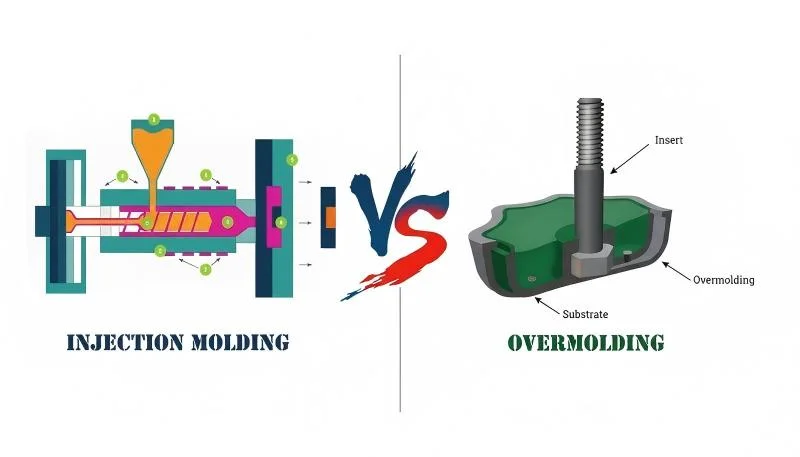
- Bij insert molding wordt een voorgevormd inzetstuk (meestal van metaal) in de matrijs geplaatst, waarna er in één shot kunststof omheen wordt geïnjecteerd.
- Bij overspuiten wordt een tweede materiaal over een eerder gevormd substraat gespuitgiet, waarvoor minimaal twee shots nodig zijn.
- Inzetstukspuitgieten blinkt uit in het combineren van metalen schroefdraad, contacten of versterkingen met kunststofbehuizingen.
- Overmolding is de voorkeursmethode voor handgrepen met zachte grip, afdichtingen en meerkleurige consumentenproducten.
- Gereedschapskosten en cyclustijd verschillen aanzienlijk — begrijp beide voordat u zich vastlegt.
Kosten per onderdeel versus productievolume grafiek
Insert moulding is een een-schotsproces dat een voorgevormd onderdeel—meestal metaal—omhult met gesmolten plastic tijdens één inspuitcyclus. Het insert wordt voor elk schot in de matrijs geladen, en het plastic vormt eromheen om een permanente verbinding te creëren.
Insert molding is een eenmalig spuitgietproces waarbij een voorgevormde component — meestal een metalen schroefinzetstuk, elektrisch contact of versteviging — vóór de kunststofinjectie in de vormcaviteit wordt geplaatst. Het gesmolten polymeer omhult het inzetstuk en vormt na afkoeling een permanente verbinding. Zo ontstaat één geïntegreerd onderdeel zonder nabewerking. Onze gids voor leveranciersselectie voor spuitgieten behandelt offertevoorbereiding, kwalificatie en commerciële risicocontroles.
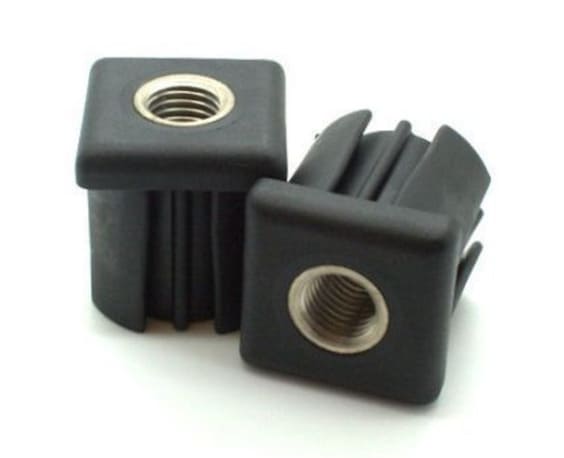
De inzetstukken zijn doorgaans gemaakt van messing, staal of roestvast staal en hebben vrijwel altijd een gekartelde, gegroefde of van schroefdraad voorziene buitenzijde voor een betere mechanische verankering in de kunststof. Bij kleine productievolumes plaatsen operators de inzetstukken handmatig in de matrijs. Bij grote series automatiseren robotarmen, trilkommen of pick-and-placesystemen het proces. De meeste speciale machines voor insert molding gebruiken een verticale kleminrichting: door de zwaartekracht blijft het inzetstuk vanzelf op zijn plaats wanneer de matrijs opent en sluit, waardoor het risico op verschuiving tijdens de handling sterk afneemt.
De kritieke procesparameters omvatten smelttemperatuur, inspuitsnelheid en houddruk. Smelttemperatuur varieert per materiaal—PA66 ligt rond 280–300 °C, terwijl PBT dichter bij 240–260 °C ligt. Inspuitsnelheid moet snel genoeg zijn om rond het insert te stromen voordat de poort bevriest, maar niet zo snel dat het insert wordt verplaatst.
De oppervlaktevoorbereiding van het inzetstuk is even belangrijk. Een goed ontworpen kartelpatroon, dwarsboringen of spiraalgroeven zorgen voor mechanische verankering. Voor maximale hechtsterkte gebruiken sommige toepassingen zowel mechanische kenmerken als hechtprimers.
Wat is overspuiten en hoe werkt het?
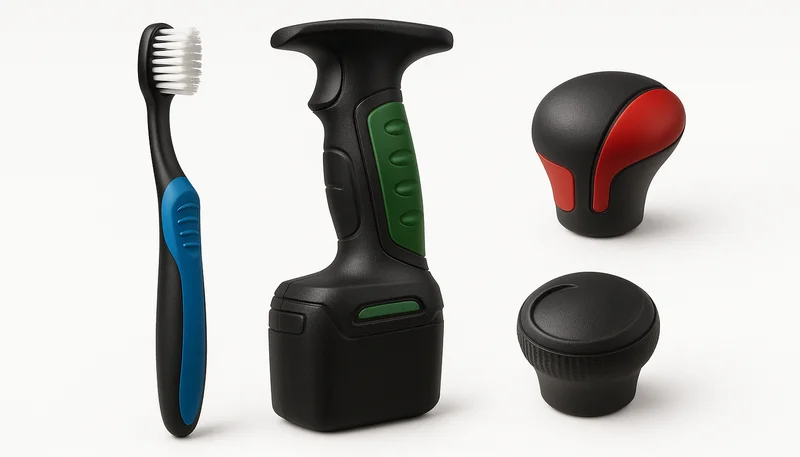
Overmoulding is een twee-schotsproces waarbij een tweede materiaal—meestal een zachte elastomeer—over een stijve kunststof ondergrond wordt gespoten. Het resultaat is één onderdeel met twee verschillende materiaalzones die aan elkaar gebonden zijn. Het meest voorkomende scenario is een hard kunststof lichaam met een rubberachtig gripgebied.
Er zijn twee verschillende verbindingsmechanismen. Chemische verbinding ontstaat wanneer drager- en overmoldmaterialen compatibele moleculaire structuren hebben: het overmoldmateriaal smelt het drageroppervlak deels en versmelt er tijdens injectie moleculair mee. Dit is de sterkste verbinding, maar sterk materiaalafhankelijk. Mechanische verankering gebruikt fysieke kenmerken in de drager — ondersnijdingen, groeven, T-sleuven of doorlopende gaten — waarin het overmoldmateriaal vloeit en achter vastgrijpt wanneer het afkoelt.
In de praktijk gebruiken de beste en betrouwbaarste overmolded onderdelen beide mechanismen. Mechanische verankeringskenmerken vormen een vangnet; compatibele materialen zorgen dat de chemische verbinding de primaire hechting levert. Als deze faalt, bijvoorbeeld door oppervlakteverontreiniging of procesvariatie, houden de mechanische kenmerken het onderdeel intact.
Overmolding kan op één machine met een roterende vorm worden uitgevoerd (two-shot molding3) of op twee machines waartussen de drager handmatig of robotisch wordt overgebracht. Het two-shotproces is sneller, consistenter en maatvaster omdat de drager in de beheerste omgeving blijft. Overdracht tussen machines biedt meer flexibiliteit en goedkoper gereedschap, maar veroorzaakt variatie en arbeidskosten. Gangbare materialen zijn TPU voor slijtvastheid en flexibiliteit, SEBS voor soft-touchproducten en TPV voor afdichtingen onder de motorkap.
Wat is het verschil tussen insert molding en overmolding?
Insert moulding en overmoulding zijn fundamenteel verschillend in aantal cycli, matrijscomplexiteit en het type verbinding tussen materialen. Insert moulding is een een-schotsproces; overmoulding vereist twee schotsen. De onderstaande tabel geeft een overzicht van de verschillen in de factoren die het meest belangrijk zijn in productie.
| “Runnerbalancering is alleen nodig voor mallen met meer dan 16 holtes.” | Tussenvoegsel Vormen | Overspuiten |
|---|---|---|
| Aantal shots | Enkelvoudig shot | Twee of meer shots |
| Typische insert/typisch substraat | Metaal (messing, staal, roestvast staal) of voorgevormde component | Eerder gevormde drager van stijve kunststof |
| Overmoldingmateriaal | Thermoplastische hars (PA, PBT, PC enz.) | Zachte TPE, TPU, SEBS of een tweede stijve kunststof |
| Primair hechtingsmechanisme | Mechanische verankering (karteling, schroefdraad, ondersnijdingen, krimppassing) | Chemische hechting + mechanische verankering |
| Complexiteit van de matrijs | Eén caviteit met laadstation voor inzetstukken | Twee holten (of roterende matrijs voor tweecomponentenspuitgieten) |
| Typische cyclustijd | Korter (één injectie + koeling) | Langer (twee shots + overbrengen + koelen) |
| Gereedschapskosten | Lager (één caviteit) | Besparingen op assemblagearbeid |
| Typische toepassingen | Bevestigingsmiddelen met schroefdraad, elektrische connectoren, medische naalden | Gereedschappen met zachte grip, afdichtingen, meerkleurige consumentenonderdelen |
| Geschiktheid voor productievolume | Laag tot hoog (handmatige of geautomatiseerde plaatsing van inzetstukken) | Gemiddeld tot hoog (automatisering heeft de voorkeur) |
Door het éénschotskarakter is insert molding per cyclus inherent sneller—er is geen overdracht van een substraat, geen tweede injectie en geen extra koelperiode. De laadtijd van inzetstukken kan dat voordeel echter tenietdoen, vooral bij handmatig laden in kleine volumes. Een ervaren operator kan inzetstukken in 5–10 seconden laden, maar robotbelading verkort dit tot 1–3 seconden per cyclus. Het tweeschotsproces van overmolding voegt daarentegen aanzienlijk cyclustijd toe, maar het resultaat—een naadloos onderdeel uit meerdere materialen—maakt vaak nabewerkingsassemblage overbodig (afdichting plaatsen, lijmverbinding, klikmontage) die insert molding eenvoudigweg niet kan vervangen.
Een veelvoorkomend misverstand is dat insert molding alleen mogelijk is met metalen inzetstukken. In werkelijkheid kunnen kunststofcomponenten, keramische delen, PCB-assemblages, glazen lenzen en zelfs inzetstukken van textiel of folie worden meegespoten. De belangrijkste beperking is dat het inzetstuk bestand moet zijn tegen de injectietemperatuur en -druk van het omhullende materiaal. Ook overmolding is niet beperkt tot zacht-op-hardcombinaties; voor constructieve versteviging of een meerkleurig uiterlijk kan een tweede harde kunststof worden overmold.
Wanneer kiest u voor insert molding?
Insert molding is geschikt wanneer een voorgevormd onderdeel, vooral metaal, direct in kunststof moet worden geïntegreerd. Voor connectorbehuizingen met messing schroefbussen die herhaaldelijk worden gemonteerd, is het resultaat sterker en constanter dan bij montage achteraf.
Elektrische en elektronische componenten
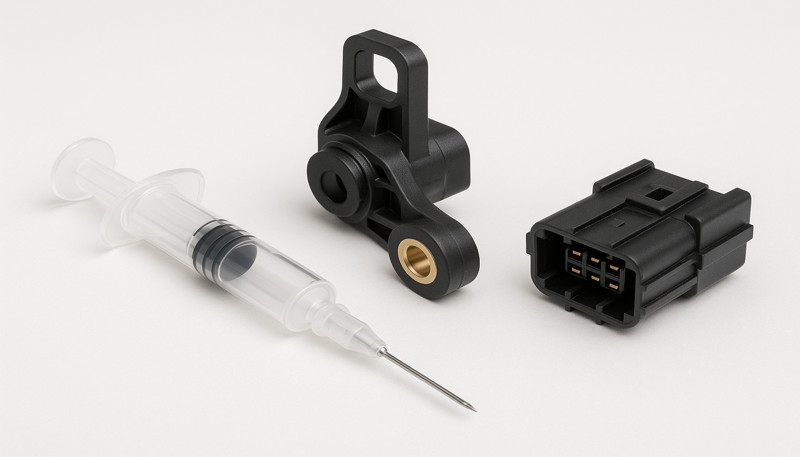
Connectorbehuizingen, sensorlichamen, PCB-omkastingen en antenne-eenheden gebruiken vaak spuitgieten met inzetstukken om metalen pennen, aansluitingen of EMI-afscherming rechtstreeks in de kunststofbehuizing op te nemen. Het proces vormt rond elk contact een hermetische afdichting, cruciaal voor behuizingen met een IP-classificatie die buiten of in industriële omgevingen worden gebruikt. In onze productie-ervaring doorstaan connectors met meegespuitgiete inzetstukken consequent IP67- en IP68-tests, terwijl onderdelen met achteraf gemonteerde contacten bij drukwisselingen vaak lekken op het raakvlak tussen pen en kunststof.
Medische apparaten
Chirurgische instrumenten, systemen voor medicijntoediening, katheterhubs en diagnostische apparatuur combineren vaak roestvaststalen naalden, lumina of elektroden met kunststof behuizingen. Insert molding biedt de steriliteit, precisie en materiaalcompatibiliteit die deze toepassingen vereisen. Biocompatibele kunststoffen zoals PEEK, PC van medische kwaliteit en PPSU hechten goed aan correct voorbereide metalen oppervlakken, en het eenslagproces minimaliseert het besmettingsrisico ten opzichte van meerstapsassemblage.
Bevestigingsmiddelen en constructiedelen voor de auto-industrie
Messing schroefinzetstukken in kunststof montagebeugels komen overal in moderne voertuigen voor, van dashboardsteunen en interieurclips tot kabelgeleidingsbeugels en sensorbehuizingen onder de motorkap. Het inzetstuk levert duurzame schroefdraad voor honderden montagecycli, terwijl het ontwerp van de spuitgietvorm complexe geometrieën mogelijk maakt die volledig in metaal te duur zijn. Gewichtsbesparing door metalen beugels te vervangen door insert-molded kunststof-metaalhybriden stimuleert lichtgewicht voertuigbouw.
"Overmolding vereist doorgaans een duurdere matrijs dan insert molding, omdat er twee vormholten of een roterende matrijs nodig zijn."True
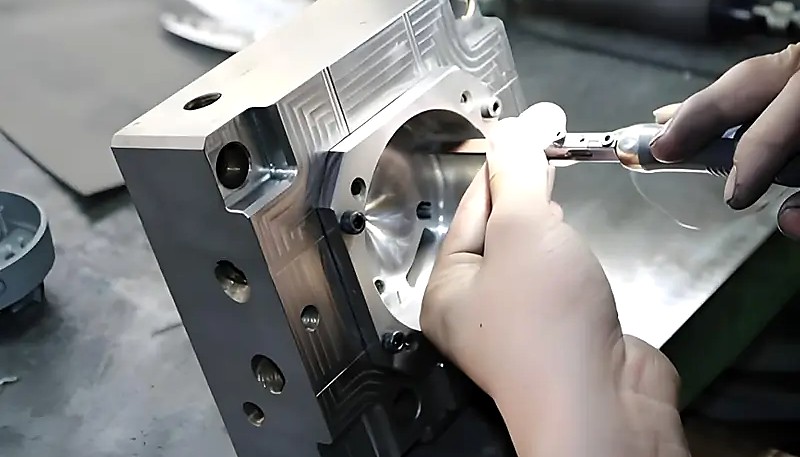
Matrijzen voor overmolding kosten $15,000–$40,000+, tegenover $8,000–$20,000 voor insert molding, voornamelijk omdat voor overmolding twee afzonderlijke caviteiten (voor transfer molding) of een roterende matrijs met twee stations (voor two-shot molding) nodig zijn. De extra complexiteit van het nauwkeurig uitlijnen van twee caviteiten en het beheersen van het overdrachtsmechanisme van het substraat veroorzaakt de kostenopslag.
"Voor insert molding zijn minstens twee injectieshots nodig om een onderdeel te voltooien."False
Insert molding is een proces met één injectie. Het metalen inzetstuk wordt vóór het begin van de enkele injectiecyclus in de matrijsholte geplaatst. Overmolding vereist daarentegen twee of meer injecties om het onderdeel te voltooien.
Wanneer kiest u voor overmolding?
Overmoulding is de juiste keuze wanneer je twee materialen met verschillende eigenschappen in één naadloos onderdeel nodig hebt. Zacht over hard, flexibel over stijf—als ergonomie, afdichting of esthetiek belangrijk zijn, wint overmoulding.
Consumentenproducten en ergonomisch ontwerp
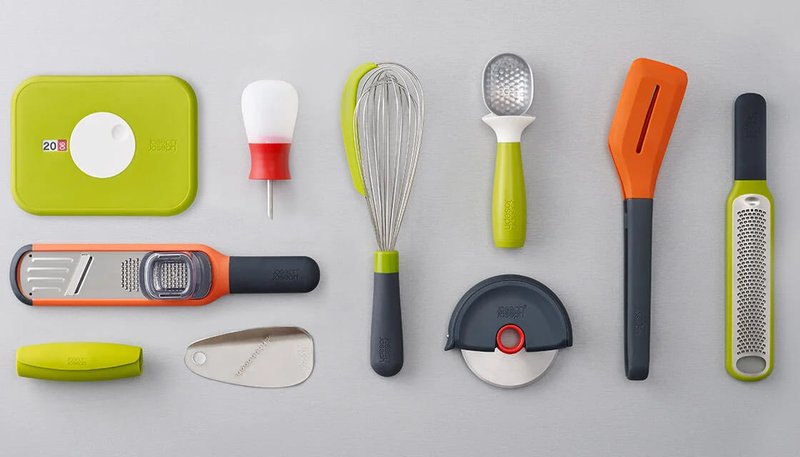
Tandenborstels, handgrepen van elektrisch gereedschap, keukengerei, gamecontrollers en verzorgingsapparaten gebruiken overmolding voor zachte oppervlakken op stijve kernen. De zachte TPE- of TPU-laag biedt gripcomfort, trillingsdemping, schokabsorptie en een premium gevoel dat met één stijf materiaal onmogelijk is. Consumentenmerken bouwen hun identiteit rond deze nette meercomponentenesthetiek—het contrast tussen glanzende harde kunststof en matte soft-touchvlakken is direct herkenbaar.
Afdichting en bescherming tegen omgevingsinvloeden
Wanneer een onderdeel water- of stofdicht moet zijn, vormt het direct overspuiten van een zacht afdichtingsmateriaal (zoals een siliconenalternatief TPE) op een stijve behuizing één monolithische afdichting—zonder afzonderlijke O-ring, te bewerken groef, montagestap of lekpad. Dit is standaard voor buitenelektronica, maritieme apparatuur, industriële sensoren en automotive-connectorsystemen. De gebonden afdichting is betrouwbaarder dan een ingeperste O-ring, omdat geen groef tijdens montage kan verschuiven en geen compressieset gedurende de productlevensduur verslechtert.
Esthetiek met meerdere kleuren en materialen
Bij tweestaps-omsluitgieten kunnen kunststoffen met verschillende kleuren in één machinecyclus worden gevormd, waardoor scherpe, strakke kleurgrenzen ontstaan zonder secundair lakken, tampondruk of etikettering. De kleur is integraal onderdeel van het onderdeel — deze krast niet af, vervaagt niet en bladdert niet. Dit wordt veel gebruikt voor merklogo’s op consumentenelektronica, bedieningspanelen op apparaten en kleurgecodeerde onderdelen van medische hulpmiddelen waarbij kleurvastheid een wettelijke eis is.
"Omspuiten maakt secundaire assemblage bij multimateriaalonderdelen volledig overbodig."True
Bij omspuiten ontstaat het afgewerkte onderdeel van meerdere materialen al tijdens het vormproces. Afdichtingen, zacht aanvoelende greepvlakken, pakkingen en meerkleurige kenmerken worden allemaal tijdens het spuitgieten gevormd. Daardoor zijn afzonderlijke montagestappen, zoals het plaatsen van O-ringen, lijmen of lakken, niet nodig.
"Messing schroefdraadinzetstukken kunnen alleen na het vormen door ultrasoon inbrengen in kunststofonderdelen worden aangebracht."False
Messing inzetstukken kunnen op verschillende manieren worden aangebracht: insert molding (vóór injectie geplaatst), ultrasoon inbrengen (met ultrasone trillingen in voorgevormde gaten geperst), thermisch inbrengen (verwarmd en ingeperst) of zelftappende montage. Insert molding levert de sterkste en meest consistente resultaten op, omdat de kunststof direct rond de kenmerken van het inzetstuk krimpt.
Hoe verhouden de kosten van insert molding en overspuiten zich tot elkaar?
De kosten bepalen de praktische keuze. Insert molding heeft doorgaans aanzienlijk lagere gereedschapskosten omdat u met een matrijs met één caviteit werkt—het laadmechanisme voor het inzetstuk is meestal een eenvoudige opspanning of handmatige plaatsing. Overmolding vereist een tweestationsmatrijs met overdrachtsmechanisme of een roterende matrijs met twee afzonderlijke caviteiten, waardoor de initiële investering in gereedschap kan verdubbelen of verdrievoudigen.
Aan de kant van de kosten per onderdeel ligt de economie genuanceerder. Insert molding heeft lagere materiaalkosten (één polymeerhars plus het metalen inzetstuk) en kortere cyclustijden, maar de kosten van de inzetstukken zelf lopen op—messing schroefdraadinzetstukken kosten doorgaans $0.02–$0.15 per stuk, afhankelijk van grootte en aantal. Overmolding gebruikt meer materiaal (twee verschillende polymeren) en langere cyclustijden, maar kan arbeid voor downstreamassemblage volledig elimineren—afdichtingen, pakkingen, lijmverbindingen en klikmontage—die anders aanzienlijke kosten per onderdeel zouden toevoegen.
Bij productie in grote volumes (50.000+ stuks) compenseren de arbeidsbesparingen door overspuiten vaak de hogere gereedschapskosten binnen de eerste of tweede productierun. Bij lagere volumes of toepassingen waarbij metaalintegratie de belangrijkste eis is, levert insert molding de laagste totale eigendomskosten op.
| Kostenfactor | Tussenvoegsel Vormen | Overspuiten |
|---|---|---|
| Investering in gereedschappen | $8,000–$20,000 (één caviteit) | $15.000–$40.000+ (twee caviteiten of roterend) |
| Materiaalkosten per onderdeel | Lager (één hars + metalen inzetstuk) | Hoger (twee harsmaterialen) |
| Typische cyclustijd | 15–40 seconden per schot | 30–80 seconden totaal (twee injecties) |
| Kosten van inzetstuk/onderdeel | $0.02–$0.15 per inzetstuk | N.v.t. (tweede materiaal ter plaatse aangespoten) |
| Besparing op assemblagearbeid | Tandwielassemblages, lage wrijving plus zachte aanraking | Maakt afdichtings-, pakking- en lijmstappen overbodig |
| Break-evenvolume | Economisch vanaf ~1,000 stuks | Beste ROI vanaf 10,000 eenheden |
Kortom: als uw ontwerp voornamelijk een metalen component vereist die in kunststof wordt ingebed, is inzetspuitgieten bij vrijwel elk volume de voordeligste keuze. Als u zacht aanvoelende kenmerken, geïntegreerde afdichtingen of een meerkleurige vormgeving nodig hebt, verdienen de hogere matrijskosten van omspuiten zichzelf terug doordat secundaire bewerkingen vervallen en de productbetrouwbaarheid verbetert.
Wat zijn de belangrijkste ontwerpoverwegingen voor elk proces?
Ontwerprichtlijnen voor insert molding
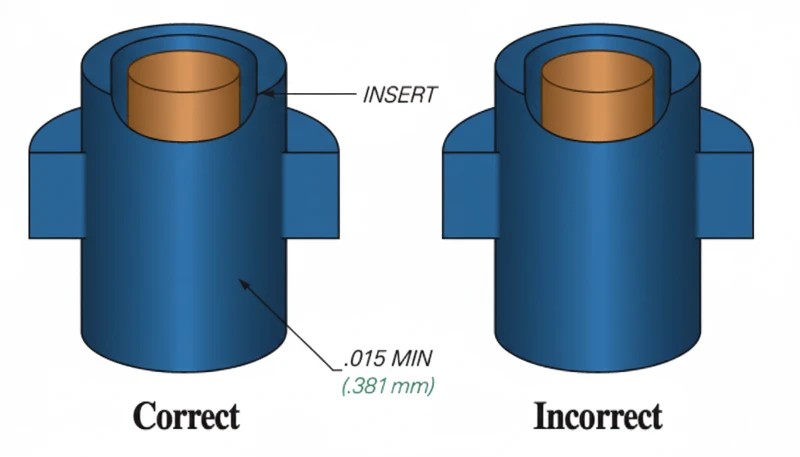
Ontwerpoverwegingen zijn fundamenteel verschillend tussen insert moulding en overmoulding. Voor insert moulding moet de wanddikte rond het insert minimaal 0,5× de insertdiameter zijn (en idealiter 1×) om zinkmarkeringen op het tegenoverliggende oppervlak te voorkomen en voldoende materiaalstroom voor volledige omhulling te garanderen.
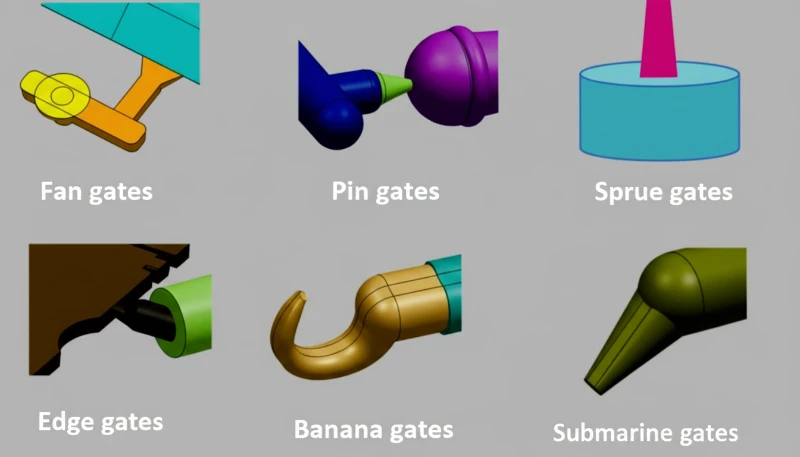
Ontwerp de vorm altijd zo dat het inzetstuk aan minstens twee zijden wordt ondersteund tegen afbuigen of draaien tijdens injectie. Plaats de poort zodat de smeltstroom in evenwicht om het inzetstuk heen vloeit en het van beide kanten omsluit, in plaats van er frontaal tegenaan te botsen. Een onevenwichtig vloeifront kan het inzetstuk 0.2–0.5 mm verschuiven, wat bij nauwkeurige elektrische connectoren onaanvaardbaar kan zijn.
Ontwerprichtlijnen voor overmolding
De sterkte van de chemische hechting hangt volledig af van de materiaalcompatibiliteit—raadpleeg altijd de hechtingstabel voor overmolding van uw materiaalleverancier voordat u uw keuze definitief maakt. Bewezen combinaties zijn onder meer ABS + TPE, PP + SEBS en PC + TPU. Wanneer chemische hechting niet mogelijk is (incompatibele materiaalparen), moet u volledig vertrouwen op mechanische verankering. Dit betekent dat u ondersnijdingen, T-sleuven of doorlopende gaten in het substraat moet ontwerpen waarin het overmoldingmateriaal kan vloeien en waarachter het zich kan verankeren.
De wanddikte van de overspuitlaag ligt doorgaans tussen 1.0 en 3.0 mm. Dunnere lagen (minder dan 1.0 mm) bereiken mogelijk onvoldoende hechtsterkte en kunnen moeilijk consistent te vullen zijn. Dikkere lagen (meer dan 3.0 mm) verlengen de cyclustijd aanzienlijk door de koelbehoefte en kunnen het substraat doen kromtrekken. Vermijd scherpe overgangen tussen substraat en overspuiting—gebruik afgeronde randen (minimale radius 0.5 mm) om spanningsconcentraties te voorkomen die bij belasting of thermische cycli tot delaminatie kunnen leiden.
Lossingshoeken in de overspuitholte moeten rekening houden met de flexibiliteit van het zachte materiaal: 1–2° is doorgaans voldoende voor TPE-overspuitingen, tegenover 0.5–1° voor stijve kunststoffen. Het substraat moet vanaf het begin voor overspuiten zijn ontworpen, niet als toevoeging achteraf. Achteraf overspuitkenmerken toevoegen aan een bestaand substraatontwerp is een veelvoorkomende oorzaak van hechtingsproblemen.
"Een overspuitwanddikte onder 1.0 mm kan de hechtsterkte verlagen en vulproblemen veroorzaken."True
Dunne overmoldlagen (minder dan 1.0 mm) leveren twee problemen op: het materiaal stroomt mogelijk onvoldoende om de matrijsholte consistent te vullen en het kleinere contactoppervlak beperkt het chemische hechtingsvlak. Het aanbevolen minimum is 1.0 mm; voor de meeste TPE- en TPU-overmolds is 1.5–2.5 mm optimaal.
"Gladde cilindrische inserts bieden voldoende bevestigingssterkte voor de meeste insert-moldingtoepassingen."False
Gladde inzetstukken vertrouwen uitsluitend op een krimppassing, die varieert met de procesomstandigheden. Gekartelde of gegroefde inzetstukken bieden een drie- tot vijfmaal hogere uittreksterkte doordat de kunststof mechanisch in de oppervlaktekenmerken grijpt. Voor elke dragende toepassing is oppervlaktevoorbereiding van het inzetstuk essentieel.
Welke materialen zijn het meest geschikt voor elk proces?
Materiaalkeuze is voor beide processen cruciaal, maar de overwegingen verschillen fundamenteel. Bij insert molding ligt de nadruk op het vermogen van de omhullende kunststof om rond het inzetstuk te stromen en dit tijdens afkoeling en krimp mechanisch vast te grijpen. Bij overmolding staat de hechting — chemisch én mechanisch — tussen substraat en overspuitmateriaal centraal.
| Proces | Substraat/inzetstuk | Vormmateriaal | Belangrijk aandachtspunt |
|---|---|---|---|
| Inleggieten | Messing schroefdraadinzetstuk | PA6, PA66, PBT | Hoge krimp creëert een sterke mechanische verankering |
| Inleggieten | Roestvaststalen naald | PC en PEEK van medische kwaliteit | Biocompatibiliteit, autoclaafbestendigheid |
| Inleggieten | Koperen aansluitklem/pen | PBT, PPS, LCP | Elektrische isolatie, maatvastheid |
| Inleggieten | Aluminium koellichaam | PBT, PA66 + GF | Thermisch beheer, structurele versterking |
| Overspuiten | ABS-ondergrond | TPE (Shore A-hardheid 50–80) | Sterke chemische hechting, consumentenproducten |
| Overspuiten | PP-substraat | SEBS, TPV | Autoafdichtingen, soft-touch over polyolefine |
| Overspuiten | PC-substraat | TPU | Slijtvastheid, optische helderheid mogelijk |
| Overspuiten | PA66-substraat | TPE-S of TPE-O | Automotive onder de motorkap, chemische bestendigheid |
| Overspuiten | POM-substraat | TPU of TPE | Tandwielassemblages, lage wrijving plus zachte aanraking |
Insert Giettoepassingen in Fabrieksproductie
Controleer bij overspuiten de chemische compatibiliteit altijd met fysieke tests. Een hechtsterktetest volgens ASTM D903 is de industrienorm om de hechting tussen substraat en overspuitlaag te kwantificeren. Materiaalgegevensbladen van leveranciers vermelden hechtingswaarden, maar de werkelijke hechtsterkte hangt af van uw specifieke procesomstandigheden, waaronder smelttemperatuur, injectiesnelheid, toestand van het substraatoppervlak en koelsnelheid.
Wat hebben we geleerd uit meer dan 20 jaar productie-ervaring?
Dagelijkse productie met insert molding en overmolding in onze fabriek in Shanghai op 47 spuitgietmachines (90T–1850T, waaronder 3 speciale tweecomponentenmachines) heeft ons lessen geleerd die niet in leerboeken staan:
De plaatsingsnauwkeurigheid van het inzetstuk is de belangrijkste kwaliteitsfactor. Zelfs 0.2 mm verschuiving kan nauwkeurige elektrische connectoren afkeuren. Voor grote volumes gebruiken we robotbelading met visuele verificatie. Bij verticale klemmachines helpt de zwaartekracht, maar sensoren in de vorm bevestigen vóór elke injectie de positie. Door uitval wegens verkeerd geplaatste inzetstukken te elimineren verdiende het sensorsysteem zich binnen drie maanden terug.
Hechtingstests voor overmolding moeten in de monsterfase beginnen, niet tijdens de productieopschaling. Te veel projecten ontdekken verbindingsproblemen pas bij PPAP of de eerste-artikelinspectie omdat de materiaalcombinatie niet onder productieomstandigheden is getest. Onze standaard vereist hechtsterktegegevens van de eerste monsters voordat een opdracht de monsterfase verlaat. Met 8 senior engineers (elk 10+ jaar ervaring) en 120+ productiemedewerkers hebben we hiervoor voldoende capaciteit.
Optimalisatie van de cyclustijd bepaalt de echte marge. Bij insert molding bespaart automatische inzetstukbelading met trilkommen en pick-and-placerobots vaak meer tijd dan optimalisatie van injectieparameters. Bij overmolding zijn minimale overdrachtstijd tussen stations en gelijktijdige koeling van beide materialen de grootste hefbomen. Ons engineeringteam richt zich hierop omdat deze gebieden het hoogste rendement leveren.
Wij zijn gecertificeerd volgens ISO 9001, ISO 13485, ISO 14001 en ISO 45001 en hanteren een kwaliteitscontroleproces in 6 stappen: ingangscontrole, bemonstering tijdens het proces, procesinspectie, verpakkingsinspectie, eindinspectie en uitgangscontrole. Of uw project nu insert molding vereist voor componenten van medische kwaliteit of overmolding voor de ergonomie van consumentenproducten, onze interne matrijzenbouw en maandelijkse levering van meer dan 100 matrijssets bieden de capaciteit en precisie om te leveren.
Wat Zijn de Meest Gestelde Vragen Over Insert Moulding en Overmoulding?
Veelgestelde vragen
Wat is het belangrijkste verschil tussen insert molding en overmolding?
Insert molding is een eenshotsproces waarbij vóór het inspuiten van kunststof rond een voorgevormd inzetstuk — doorgaans van metaal — dit inzetstuk in de matrijsholte wordt geplaatst. Door krimppassing en oppervlaktekenmerken ontstaat een permanente mechanische verbinding. Overmolding is een tweeshotproces waarbij een tweede materiaal over een eerder gevormde kunststofdrager wordt gevormd en zowel door chemische hechting als mechanische vergrendeling bindt. De fundamentele verschillen zijn het vereiste aantal injectiecycli, de soorten materialen die worden gecombineerd en de betrokken hechtingsmechanismen.
Is spuitgieten met inzetstukken goedkoper dan omspuiten?
Gereedschappen voor insert molding zijn doorgaans goedkoper, omdat hiervoor slechts een matrijs met één holte en een mechanisme voor het laden van inserts nodig is, terwijl overmolding twee afzonderlijke holtes of een rotatiematrijs vereist, wat de initiële investering kan verdubbelen of verdrievoudigen. De kosten per onderdeel zijn genuanceerder: insert molding heeft lagere materiaalkosten en kortere cyclustijden, maar de metalen inserts voegen zelf $0,02–$0,15 per stuk toe. Overmolding kost meer per cyclus, maar kan latere assemblagehandelingen elimineren. Bij volumes boven 10.000 eenheden wordt overmolding vaak de voordeligere optie op basis van de totale kosten.
Kunt u op een metalen substraat overspuiten?
U kunt kunststof over een metalen component vormen, maar de maakindustrie classificeert dit proces als insert molding en niet als overmolding. Overmolding verwijst specifiek naar het vormen van een tweede kunststofmateriaal over een eerste kunststofsubstraat. Wanneer metaal als vooraf geplaatst component wordt gebruikt, is de standaardterm insert molding, ongeacht het polymeer dat eromheen wordt geïnjecteerd. Dit onderscheid is belangrijk omdat de procesparameters, het matrijsontwerp en de hechtingsmechanismen aanzienlijk verschillen tussen beide methoden. Correcte terminologie waarborgt duidelijke communicatie met uw matrijzenmaker en productieteam.
Welke materialen worden doorgaans voor overmolding gebruikt?
De meest gebruikte overspuitmaterialen zijn TPE (thermoplastisch elastomeer) voor algemene soft-touchtoepassingen, TPU (thermoplastisch polyurethaan) voor slijtvastheid en flexibiliteit, SEBS (styreen-ethyleen/butyleen-styreen) voor auto- en consumentenproducten die chemisch bestendig moeten zijn, TPV (thermoplastisch vulkanisaat) voor afdichtingen onder de motorkap en TPR (thermoplastisch rubber) voor gripoppervlakken. De materiaalkeuze hangt voornamelijk af van de chemische hechtingscompatibiliteit met het substraatmateriaal, het vereiste hardheidsbereik op de Shore A-schaal, de omgevingsomstandigheden tijdens gebruik, waaronder temperatuur en chemische blootstelling, en eventuele wettelijke eisen zoals naleving van FDA of USP Class VI voor medische toepassingen.
Hoe sterk is de hechting bij overmolding?
De hechtsterkte varieert sterk afhankelijk van materiaalcombinatie, oppervlaktevoorbereiding en onderdeelontwerp. Chemisch gebonden overspuitingen met compatibele materiaalparen zoals ABS en TPE bereiken bij beproeving volgens ASTM D903 doorgaans afpelsterkten van 15–30 N/mm. Mechanische vergrendelingen via ondersnijdingen, T-sleuven en doorlopende gaten bieden extra houdkracht, onafhankelijk van de chemische hechtingsomstandigheden. De betrouwbaarste productie-overspuitingen combineren chemische en mechanische hechting voor consistente prestaties bij procesvariaties en gedurende de levensduur van het product onder werkelijke bedrijfsomstandigheden.
Welke industrieën gebruiken spuitgieten met inzetstukken het meest?
De grootste gebruikers van insert-moldingtechnologie zijn de elektronica-industrie (connectorbehuizingen met ingebedde metalen pennen, sensorlichamen met afgedichte aansluitingen, antennesamenstellingen op PCB-niveau), fabrikanten van medische hulpmiddelen (chirurgische instrumenten met roestvaststalen componenten, systemen voor medicijntoediening met naaldnaven, diagnostische apparatuur met ingebedde elektroden), de auto-industrie (bevestigingsmiddelen voor interieurbekleding, montagebeugels voor dashboards, kabelclips voor onder de motorkap met messing schroefdraadinzetstukken) en fabrikanten van consumentenapparatuur (behuizingen met geïntegreerde montagepunten en afstandsbussen met schroefdraad). Elke sector die duurzame metalen kenmerken permanent in kunststof componenten moet integreren, vertrouwt op insert molding als primair productieproces.
Kunnen insert molding en overmolding in één onderdeel worden gecombineerd?
Ja, hybride processen die zowel insert molding als overmolding combineren, komen veel voor bij complexe samenstellingen van meerdere materialen. Een typisch voorbeeld is een elektronische connector waarbij metalen contacten eerst in een stijve kunststofbehuizing worden meegespoten, waarna de volledige subsamenstelling wordt overmold met een zachte TPE-afdichting voor IP67-bescherming tegen omgevingsinvloeden. Deze aanpak met drie materialen en meerdere processen is krachtig, maar vereist een zorgvuldige procesvolgorde, een aanzienlijk hogere investering in matrijzen en strenge kwaliteitscontrole in elke productiefase om tijdens de gehele productierun maatnauwkeurigheid en hechtintegriteit te waarborgen.
Welke maattolerantie kunnen insert-molded onderdelen bereiken?
Onderdelen met ingegoten inserts behalen doorgaans toleranties van ±0.05 tot ±0.15 mm op kritieke afmetingen, volgens de richtlijnen van ISO 20457:2018 voor spuitgegoten componenten. De metalen inserts zelf worden met veel nauwere toleranties (±0.01–0.02 mm) bewerkt; de voornaamste uitdaging is de positionele nauwkeurigheid van de insert tijdens het hogedrukspuitgietproces te behouden. Factoren die de uiteindelijke tolerantie beïnvloeden, zijn de krimp van het kunststofmateriaal, de nauwkeurigheid waarmee de insert wordt geplaatst, de locatie van de aanspuiting en het stromingspatroon, de gelijkmatigheid van de koeling in het onderdeel en de stijfheid van de ondersteuningsconstructie van de insert in de matrijsholte tijdens de spuitgietcyclus.
insertspuitgieten: Insertspuitgieten is een enkelvoudig spuitgietproces waarbij een voorgevormd onderdeel (meestal van metaal) in de matrijsholte wordt geplaatst voordat er kunststof omheen wordt gespoten. Zo ontstaat door krimppassing en in elkaar grijpende oppervlaktedetails een permanente mechanische verbinding. ↩
overspuiten: Overspuiten is een tweestaps spuitgietproces waarbij een tweede materiaal over een eerder gespoten substraat wordt gespoten. De hechtsterkte tussen compatibele combinaties (ABS/TPE) bereikt doorgaans een pelsterkte van 15–30 N/mm volgens ASTM D903. ↩
2K-spuitgieten: 2K-spuitgieten gebruikt een roterende matrijs om tijdens één machinecyclus verschillende materialen na elkaar in te spuiten, wat de consistentie verbetert en de handling tussen de spuitgangen vermindert. ↩