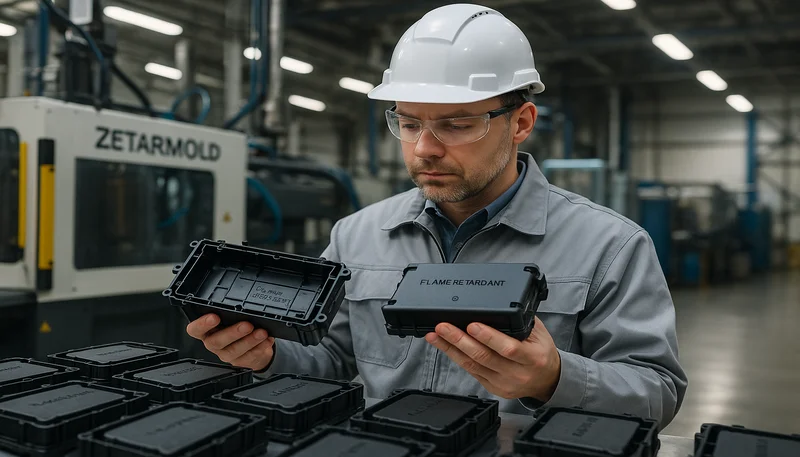
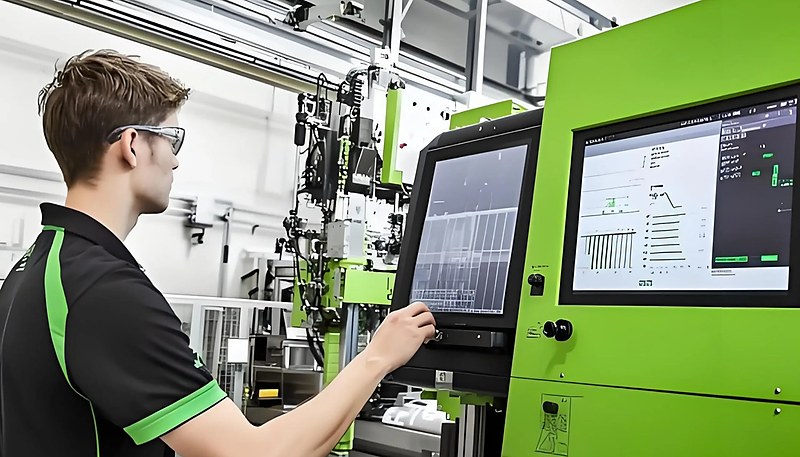
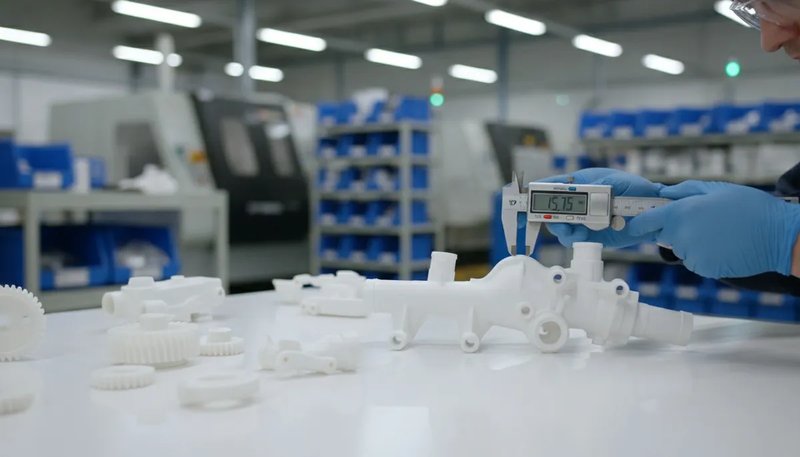
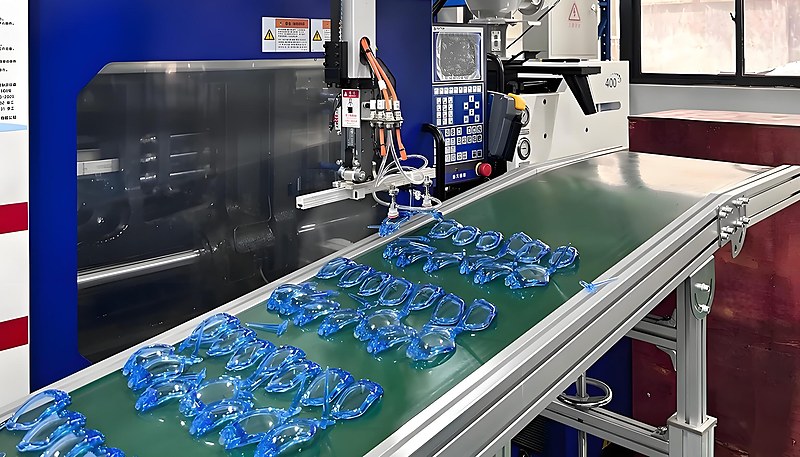
O tempo de enchimento — os segundos necessários para o plástico fundido encher completamente uma cavidade do molde — é uma das variáveis mais decisivas na moldagem por injeção. Acertar e obtém-se peças dimensionalmente precisas com superfícies lisas; errar e está-se perante peças incompletas, marcas de afundamento, rebarbas ou material queimado. Numa oficina com 47 máquinas a funcionar com prensas de 90T a 1850T, mesmo um excesso de 0,3 segundos no tempo de enchimento acumula milhares de peças defeituosas por turno.
Este guia apresenta todos os métodos práticos utilizados pelos engenheiros para calcular o tempo de enchimento — desde a fórmula simples V/Q, que pode aplicar numa calculadora, até à simulação Moldflow, que considera o comportamento de fluxo não newtoniano. Ao longo do guia, assinalarei as armadilhas mais comuns e partilharei o que aprendemos em duas décadas de séries de produção nas instalações da ZetarMold em Xangai.
- Tempo de preenchimento = volume da cavidade dividido pela vazão volumétrica (tf = V/Q).
- A viscosidade do material, a geometria do molde e as configurações da máquina influenciam o tempo de enchimento.
- As ferramentas de simulação (Moldflow, Moldex3D) apresentam uma precisão de mais ou menos 5% para moldes complexos.
- Otimizar o tempo de preenchimento reduz o tempo de ciclo, diminui o refugo e melhora a qualidade da peça.
- A validação no mundo real é sempre a etapa final — nenhuma fórmula substitui uma injeção de teste.
O que é o tempo de preenchimento da máquina de moldagem por injeção?
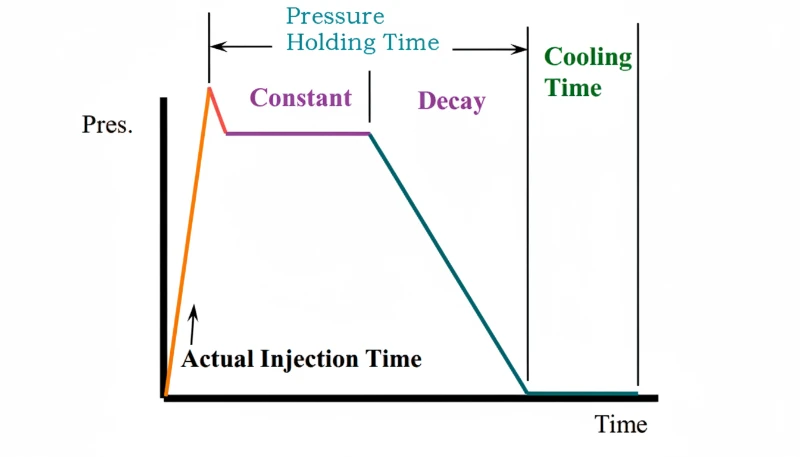
O tempo de enchimento da máquina de moldagem por injeção é a duração da fase de enchimento desde o movimento da rosca até ao enchimento completo da cavidade. Exclui o tempo de compactação e de manutenção, por isso os engenheiros usam-no para definir o primeiro perfil de velocidade, estimar o calor de cisalhamento e comparar a capacidade da máquina com o volume do molde.
Num ambiente de produção, o termo “tempo de enchimento” é por vezes confundido com o tempo total de injeção. Não são a mesma coisa. O tempo total de injeção no temporizador da máquina inclui o enchimento e a compactação; a fórmula V/Q aplica-se apenas à fase de enchimento. Confundir os dois é um dos erros mais comuns que vejo os engenheiros cometerem ao configurar um molde novo.
O molde de injeção geometria — disposição dos canais, tipo de ponto de injeção, distribuição da espessura da parede — determina o avanço da frente de fundido. Um molde com canais equilibrados enche uniformemente; um molde desequilibrado provoca escoamento preferencial, sobrecompactação de um lado e injeções incompletas do outro. É por isso que o desenho do molde e o cálculo do tempo de enchimento são indissociáveis.
Por que o tempo de preenchimento é importante para a qualidade do produto?
O tempo de enchimento é importante porque controla a temperatura da massa fundida, a transferência de pressão, as linhas de solda, as peças incompletas, as rebarbas e o tempo de ciclo. Um enchimento demasiado lento congela a frente de fluxo antes de a cavidade estar cheia, enquanto um enchimento demasiado rápido pode cisalhar excessivamente o material ou forçar rebarbas na linha de separação.
Esta é uma regra prática que uso: se o tempo de preenchimento exceder 3 segundos em uma peça de parede fina (espessura de parede inferior a 1.5 mm), a probabilidade de uma injeção incompleta aumenta para mais de 15 por cento. Se o tempo de preenchimento for inferior a 0.5 segundos em uma peça com geometria complexa, provavelmente haverá formação de rebarba na linha de partição. A faixa ideal para a maioria dos termoplásticos de engenharia é de 1–3 segundos para peças de média complexidade.
Para além da qualidade da peça, o tempo de enchimento afeta diretamente o tempo do ciclo e a produção. Reduzir 0,5 segundos num ciclo de 12 segundos num molde de 16 cavidades a funcionar 24 horas por dia traduz-se em aproximadamente 250.000 peças adicionais por ano por máquina. Num chão de fábrica com 47 prensas, isso representa mais de 11 milhões de peças extra anualmente — uma vantagem significativa em receitas e custos.
"O tempo de enchimento e o tempo de compactação são fases distintas do ciclo de injeção."True
Correto. O tempo de preenchimento abrange apenas a fase em que a cavidade passa de vazia para volumetricamente cheia. O tempo de compactação é a fase subsequente, na qual material adicional é introduzido para compensar a contração. A maioria dos temporizadores das máquinas exibe o tempo de injeção como a soma de ambos.
"Um tempo de enchimento mais longo produz sempre um melhor acabamento superficial."False
Um tempo de preenchimento excessivamente longo permite que o fundido arrefeça e aumente sua viscosidade, o que pode causar marcas de fluxo, linhas de solda e preenchimento incompleto. O acabamento superficial ideal resulta da velocidade de preenchimento correta — não da mais lenta.
Que fatores afetam o tempo de enchimento?
Os principais fatores que afetam o tempo de enchimento são a viscosidade do material, a geometria do molde, a velocidade de injeção, o limite de pressão e as temperaturas da massa fundida e do molde. O comportamento do fluxo do material estabelece a linha de base, enquanto o comprimento do canal de alimentação, o tamanho da entrada, a espessura da parede e a capacidade de fluxo da máquina determinam se a cavidade pode encher antes da frente de fluxo solidificar.
Viscosidade do material
A viscosidade é o principal fator do material. Um polipropileno de baixa viscosidade (MFI superior a 30 g/10 min) enche uma determinada cavidade aproximadamente duas vezes mais depressa do que um policarbonato de alta viscosidade (MFI de cerca de 5–10 g/10 min), à mesma pressão de injeção. Contudo, a viscosidade não é constante — diminui com o aumento da temperatura e da taxa de corte. Isto pseudoplástico1 é o comportamento que torna a modelação não newtoniana essencial para previsões rigorosas.
Geometria do molde
O comprimento e o diâmetro do canal, o tamanho do ponto de injeção, o número de cavidades e a distribuição da espessura das paredes criam resistência ao fluxo. Um canal mais longo implica uma maior queda de pressão, o que reduz a vazão efetiva na entrada da cavidade. Moldes multicavidade com canais desequilibrados terão tempos de enchimento diferentes em cada cavidade — um problema que deve ser resolvido na fase de projeto do molde, não no chão de fábrica.
Parâmetros da máquina
A velocidade de injeção, o limite de pressão de injeção, o diâmetro da rosca e a geometria da ponta do bico determinam a taxa de fluxo volumétrico máxima Q que a máquina pode fornecer. Numa prensa de 200T com uma rosca de 40 mm a funcionar a 150 mm/s, Q é aproximadamente pi vezes 20 ao quadrado vezes 150, o que equivale a cerca de 188,5 cm/s. Substitua essa rosca por uma versão de 30 mm e Q cai para aproximadamente 106 cm/s — aumentando instantaneamente o tempo de enchimento em cerca de 78 por cento para a mesma cavidade.
Temperatura do material fundido e do molde
Uma temperatura mais alta do fundido reduz a viscosidade, acelerando o preenchimento. Uma temperatura mais alta do molde mantém a superfície da cavidade aquecida, retardando a formação de uma camada solidificada que restringe o fluxo. Ambos os ajustes implicam maior tempo de resfriamento e possível degradação do material, portanto devem ser otimizados como um sistema — e não ajustados isoladamente.
Como calcular o tempo de enchimento?
Existem quatro métodos principais, cada um trocando simplicidade por precisão. Na prática, os engenheiros começam pelo método mais simples e avançam para a simulação conforme as exigências do projeto.
Método 1 — Fórmula empírica (tf = V / Q)
A estimativa rápida mais utilizada é a razão volumétrica. O volume da cavidade V (em cm) dividido pelo caudal volumétrico Q da máquina (em cm/s) dá o tempo de enchimento em segundos. O caudal é calculado a partir da área da secção transversal do fuso A e da velocidade de injeção do fuso v. Em fórmula: Q é igual a A vezes v, que é igual a pi vezes (D dividido por 2) ao quadrado vezes v. Depois, tf é igual a V dividido por Q.
Exemplo prático — Caixa de PP com uma rosca de 30 mm a 100 mm/s, volume da cavidade 200 cm. A área da rosca A é igual a pi vezes 15 ao quadrado, resultando em 706,86 mm². A taxa de fluxo Q é igual a 706,86 mm² vezes 100 mm/s, o que equivale a 70.686 mm/s ou aproximadamente 70,69 cm/s. Dividindo o volume da cavidade 200 cm por 70,69 cm/s, obtém-se um tempo de enchimento de aproximadamente 2,83 segundos.
Este método pressupõe que a vazão seja constante durante todo o preenchimento, o que é apenas aproximadamente verdadeiro para moldes simples com uma única entrada. Ele ignora perdas de pressão no canal, pseudoplasticidade e a camada congelada que se forma nas paredes da cavidade. Ainda assim, apresenta precisão de aproximadamente 20 a 30 por cento para geometrias simples e continua sendo o primeiro cálculo realizado por todo engenheiro de processo.
Método 2 — Modelo de fluido newtoniano
Nos fluidos newtonianos, a viscosidade é constante independentemente da taxa de corte. Com este pressuposto, pode utilizar a Equação de Hagen-Poiseuille2 para o fluxo através de canais de dimensões conhecidas e calcular a queda de pressão em cada segmento do canal de alimentação, derivando depois Q a partir da pressão de injeção disponível. Na prática, muito poucos termoplásticos se comportam como verdadeiros fluidos newtonianos durante o enchimento do molde — a maioria são materiais pseudoplásticos com redução da viscosidade por cisalhamento. O modelo newtoniano é útil sobretudo como ferramenta de ensino e para validar a razoabilidade dos resultados da simulação.
Método 3 — Modelo não newtoniano (lei de potência)
O modelo de lei de potência3 descreve a relação entre a tensão de corte e a taxa de corte através de dois parâmetros — o índice de consistência k e o índice de comportamento do escoamento n. Na maioria dos termoplásticos, n é inferior a 1, o que significa um comportamento de diminuição da viscosidade por corte. Um PP típico pode ter n aproximadamente igual a 0.3 a 0.4 às temperaturas de processamento. O modelo da lei de potência fornece uma melhor estimativa de Q nas condições reais de moldação, porque considera a redução da viscosidade a taxas de corte elevadas junto do ponto de injeção.
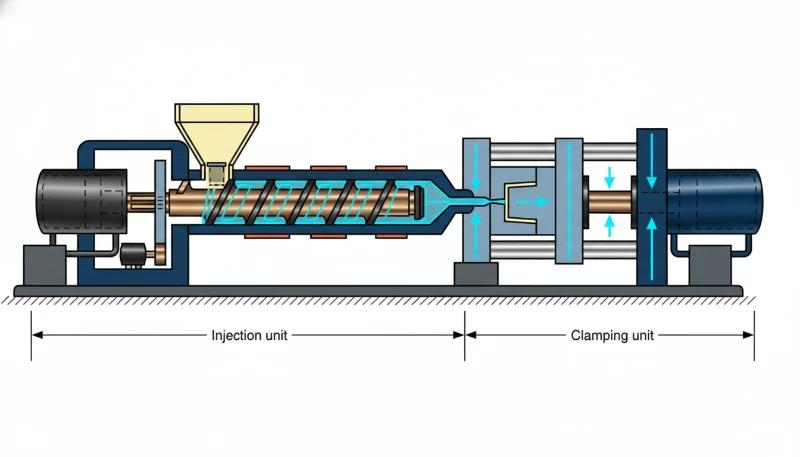
Esquema da máquina destacando a unidade de injecção.
"A maioria dos termoplásticos apresenta afinamento por corte, o que significa que a viscosidade diminui à medida que aumenta a taxa de corte."True
Correto. No modelo de lei de potência, a maioria dos termoplásticos tem índice de comportamento de fluxo n inferior a 1, portanto a viscosidade efetiva diminui em taxas de cisalhamento mais altas. Por isso a velocidade de injeção tem efeito não linear no tempo de preenchimento e uma injeção mais rápida pode preencher as cavidades com mais eficiência do que um modelo linear simples indicaria.
"A fórmula empírica V/Q tem em conta a perda de pressão no sistema de canais."False
A fórmula simples tf igual a V dividido por Q pressupõe vazão constante e ignora a queda de pressão no canal, o afinamento por cisalhamento e a formação da camada solidificada. É apenas uma primeira aproximação.
Método 4 — Simulação numérica (Moldflow ou Moldex3D)
As ferramentas CAE modernas resolvem as equações completas de quantidade de movimento, energia e continuidade numa malha 3D da geometria do molde, utilizando os dados reológicos reais do material (frequentemente fornecidos pelo fabricante da resina). O fluxo de trabalho é: importar o CAD, gerar a malha do modelo, atribuir os dados do material, definir as condições do processo, executar o solucionador e, depois, analisar os resultados.
A precisão da simulação do tempo de preenchimento normalmente fica entre 3 e 8% em comparação com os valores medidos — uma melhoria expressiva em relação à margem de 20 a 30% da fórmula empírica. A contrapartida é o tempo de configuração (de 30 minutos a várias horas) e o custo do software. Na ZetarMold, usamos simulação em todo molde novo antes de cortar o aço, pois o custo de retrabalhar um molde supera muito o custo de executar uma simulação.
No exemplo da carcaça de PP acima, o Moldflow previu um tempo de preenchimento de 2.85 segundos — com diferença de 0.7% em relação aos 2.83 segundos medidos. A pequena discrepância decorre dos efeitos de compressibilidade e de diferenças mínimas entre a geometria modelada e a real dos canais.
"Uma velocidade de injeção com perfil pode reduzir o tempo de enchimento e, simultaneamente, diminuir as taxas de defeitos."True
Ao começar devagar no ponto de injeção (evitando jateamento), acelerar na cavidade e desacelerar perto do fim do preenchimento (permitindo a saída do ar), a injeção perfilada combina as vantagens — preenchimento mais curto e menos defeitos. A maioria das máquinas modernas aceita de 5 a 10 estágios de velocidade.
"Adicionar um segundo ponto de injeção melhora sempre a qualidade da peça."False
Um segundo ponto de injeção reduz o tempo de preenchimento, mas introduz uma linha de solda onde as duas frentes de fundido se encontram. Se a linha de solda ficar em uma superfície estrutural ou cosmética, a peça poderá ser mais fraca ou apresentar defeito visual. A localização dos pontos de injeção deve ser otimizada de forma holística por simulação para prever a posição da linha de solda.
Como se comparam todos os métodos de cálculo?
Os métodos de cálculo são empíricos V/Q, fluxo newtoniano, fluxo da lei de potência e simulação numérica. O método simples V/Q é suficientemente rápido para estimativas iniciais, enquanto o Moldflow ou Moldex3D dá a melhor previsão para moldes de produção de parede fina, múltiplas entradas ou alto risco.
| Método | Tempo de preenchimento calculado | Precisão vs. valor medido | Esforço de configuração |
|---|---|---|---|
| Empírico (V/Q) | 2.83 s | linha de base | 1 minuto |
| Modelo newtoniano | 2.83 s | as mesmas premissas | 10 minutos |
| Modelo de lei de potência | 2.78 s | aproximadamente menos 1.8% | 30 minutos |
| Simulação Moldflow | 2.85 s | mais 0,7% | 1 a 2 horas |
| Medido (injeção de teste) | 2.80 s | real | 2 a 4 horas |
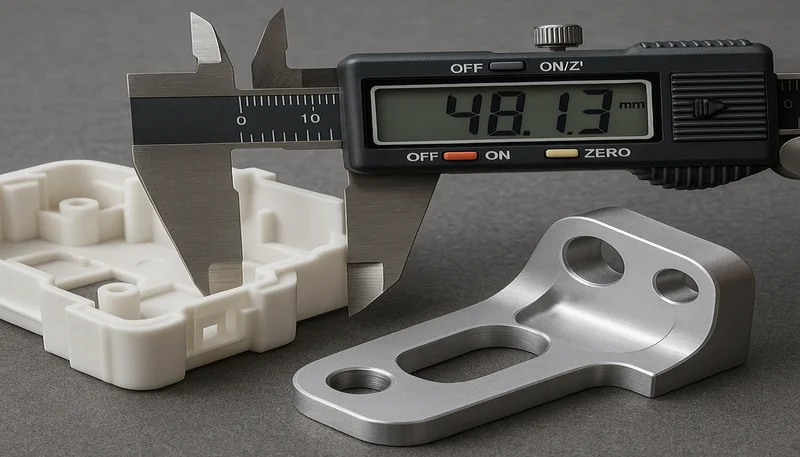
Para esta peça relativamente simples com uma única entrada, todos os métodos concordam dentro de 2 por cento. As diferenças tornam-se muito maiores em peças com múltiplas entradas, de parede fina ou com inserção moldada — precisamente as situações em que a simulação compensa. Em peças de tolerância apertada (moldes usinados por CNC com ±0,05 mm), mesmo um erro de tempo de enchimento de 0,2 segundos pode empurrar as dimensões para fora da especificação, razão pela qual a maioria dos moldadores de alta precisão validam o cálculo com um estudo de peça incompleta antes da produção total.
Como otimizar o tempo de preenchimento?
Calcular o tempo de preenchimento é apenas o começo. Otimizá-lo — reduzir o tempo de ciclo mantendo ou melhorando a qualidade da peça — é onde reside o verdadeiro valor da engenharia. Estes são os parâmetros que ajustamos com maior frequência no chão de fábrica.
Aumente a velocidade de injeção
Em nosso exemplo, aumentar a velocidade da rosca de 100 mm/s para 150 mm/s reduz o tempo de preenchimento de 2,83 s para cerca de 1,89 s. O problema é que velocidades maiores aumentam o aquecimento por cisalhamento, podendo elevar a temperatura do material fundido acima do limite de degradação de materiais sensíveis, como POM ou tipos retardantes de chama. Após alterar a velocidade, sempre monitore a temperatura do material fundido com um pirômetro.
Otimize o projeto do canal e do ponto de injeção
Acrescentar um segundo ponto ao molde reduziu o enchimento simulado de 2.85 s para 1.75 s — melhoria de 39 percent. Canais maiores reduzem a queda de pressão e trajetos mais curtos reduzem a distância. Estas alterações ocorrem no projeto, tornando indispensável envolver engenheiros de processo.
Aumente a temperatura do fundido dentro dos limites
Aumentar a temperatura do fundido de 220 graus C para 240 graus C no PP pode reduzir a viscosidade em 20 a 30 por cento, encurtando proporcionalmente o tempo de preenchimento. Porém, cada aumento de 10 graus acrescenta aproximadamente 1 a 2 segundos ao tempo de resfriamento, e a temperatura excessiva pode causar descoloração, formação de gases ou redução do peso molecular. O efeito líquido sobre o tempo de ciclo costuma ser neutro ou negativo quando se vai longe demais.
Use velocidade de injeção perfilada
Em vez de operar a uma única velocidade, as máquinas modernas permitem perfis de velocidade em várias etapas — lento através do ponto de injeção para evitar o jateamento, depois rápido através da cavidade e novamente lento próximo do fim do enchimento para evitar rebarbas e permitir a saída do ar. A injeção com perfil normalmente proporciona tempos de enchimento 5 a 15 por cento menores do que a injeção a velocidade única em moldes complexos, com menos defeitos.
O que a produção real ensina sobre o tempo de preenchimento?
A produção real mostra que o tempo de enchimento é uma estimativa que deve ser validada com estudos de peças incompletas, verificações de equilíbrio da cavidade e inspeção das peças. Na nossa instalação de Xangai, começamos com a estimativa V/Q, confirmamos o padrão de enchimento e depois ajustamos os perfis de velocidade em função dos defeitos, tempo de ciclo e estabilidade dimensional.
A produção real ensina que o tempo de enchimento é uma estimativa validada por estudos de peças incompletas, verificações de equilíbrio da cavidade e inspeção das peças. Na nossa instalação de Xangai, começamos com a estimativa V/Q para definir a velocidade de injeção inicial, depois realizamos estudos de peças incompletas antes de ajustar os perfis de velocidade em função dos defeitos, tempo de ciclo e estabilidade dimensional.
Uma lição que levou anos para internalizar: o preenchimento mais rápido raramente é o melhor. Em um molde multicavidade de conectores automotivos, operar a 85% da velocidade máxima gerou menos refugo que operar no limite, pois o preenchimento ligeiramente mais lento deu tempo aos respiros para evacuar o ar. Os 0.3 segundos adicionados economizaram 12% em refugo — muito mais que a pequena perda de produtividade.
Se está a adquirir peças moldadas por injeção e quer um fornecedor que otimize o tempo de enchimento cientificamente em vez de apenas aumentar a velocidade da máquina, consulte o nosso guia de procura de fornecedores de moldagem por injeção para obter uma estrutura de avaliação de parceiros de fabrico.

Perguntas frequentes sobre o tempo de preenchimento
Tempo de Enchimento da Máquina de Moldagem por Injeção: Guia de Especialista
A maioria das peças termoplásticas de complexidade média é preenchida em 1 a 3 segundos sob condições padrão de processamento em equipamentos de produção típicos. Moldes de embalagens de parede fina podem ser preenchidos em menos de 0,5 segundo, enquanto grandes peças estruturais com paredes espessas podem levar de 5 a 10 segundos para encher completamente. A faixa exata depende do volume da cavidade, da viscosidade do material, da espessura da parede e da vazão máxima da máquina de moldagem por injeção. Sempre faça a comparação com moldes semelhantes do seu próprio histórico de produção para estabelecer uma referência realista antes de ajustar os parâmetros de processo de um novo projeto de molde.
Como medir o tempo real de enchimento numa máquina?
A maioria das máquinas modernas de moldagem por injeção exibe o tempo de enchimento diretamente na tela do controlador, facilitando a leitura durante a configuração inicial e as execuções subsequentes de otimização do processo. Também é possível observar a transição da pressão de injeção para a pressão de recalque no gráfico de pressão versus tempo, no qual o ponto de inflexão marca claramente o fim da fase de enchimento. Em máquinas mais antigas sem leitura digital, cronometrar desde o início do movimento da rosca até o clique de comutação da pressão fornece uma aproximação razoável da duração real do enchimento em segundos.
O tempo de preenchimento muda com diferentes plásticos?
Sim, o tempo de preenchimento muda significativamente entre diferentes plásticos devido às diferenças de viscosidade do fundido e propriedades térmicas durante o processo de moldagem. Materiais de baixa viscosidade, como polipropileno com MFI acima de 20, preenchem mais rapidamente que materiais de alta viscosidade, como policarbonato ou PEEK, mesmo com o mesmo ajuste de pressão de injeção na máquina. O comportamento de afinamento por cisalhamento do material também desempenha um papel importante na prática — alguns polímeros afinam drasticamente sob altas taxas de cisalhamento, o que acelera efetivamente o preenchimento da cavidade em comparação com o previsto por um cálculo de viscosidade constante.
O tempo de enchimento pode ser demasiado curto?
Sim, o tempo de preenchimento pode definitivamente ser curto demais para a peça e o projeto de molde específicos. Preenchimentos extremamente rápidos causam aquecimento excessivo por cisalhamento, aprisionamento de ar, jateamento através do ponto de injeção e rebarba na linha de partição do molde. Em peças transparentes, o jateamento cria defeitos cosméticos visíveis semelhantes a vermes na superfície; em peças estruturais, o ar aprisionado causa queimaduras internas e pontos mecanicamente fracos. O tempo de preenchimento ideal equilibra velocidade, qualidade da peça e consistência dimensional — nem sempre é o menor tempo possível que a máquina consegue alcançar.
O que acontece se o tempo de enchimento for demasiado longo?
Quando o tempo de preenchimento é longo demais, o material fundido esfria progressivamente e engrossa ao percorrer a cavidade, aumentando o risco de preenchimentos incompletos, marcas de fluxo na superfície e elevada tensão residual na peça acabada. Peças de paredes finas são especialmente sensíveis a esse problema — se a camada solidificada bloquear o canal antes do preenchimento total da cavidade, a peça ficará incompleta. Tempos de preenchimento longos também reduzem a produtividade geral ao prolongar desnecessariamente a fase de injeção do ciclo.
A simulação Moldflow justifica o custo para moldes pequenos?
Para moldes simples de cavidade única e geometria direta, a fórmula básica V/Q normalmente é suficiente para a configuração inicial e elimina totalmente a taxa de simulação. Para moldes multicavidade, de parede fina ou de alta precisão, a simulação se paga ao evitar uma única revisão do molde, que normalmente custa de 10 a 50 vezes o valor combinado do software de simulação e do tempo de engenharia. Como orientação prática, qualquer molde com mais de duas cavidades ou com uma relação entre comprimento de fluxo e espessura superior a 100 deve ser simulado antes da usinagem do ferramental.
Como a espessura da parede afeta o tempo de preenchimento?
Paredes mais finas restringem o fluxo do polímero e aumentam a resistência viscosa na cavidade, exigindo maior pressão de injeção e resultando frequentemente em tempos totais de enchimento mais longos. A relação entre comprimento de fluxo e espessura é uma métrica essencial para avaliar a capacidade de enchimento de um projeto — relações acima de 150 exigem normalmente velocidades de injeção muito elevadas para preencher completamente sem injeções incompletas. Os projetistas devem procurar uma espessura uniforme em toda a geometria para evitar hesitações do fluxo que causam bolsas de ar, linhas de soldadura visíveis e padrões de enchimento irregulares.
Qual é a diferença entre o tempo de preenchimento e o tempo de ciclo?
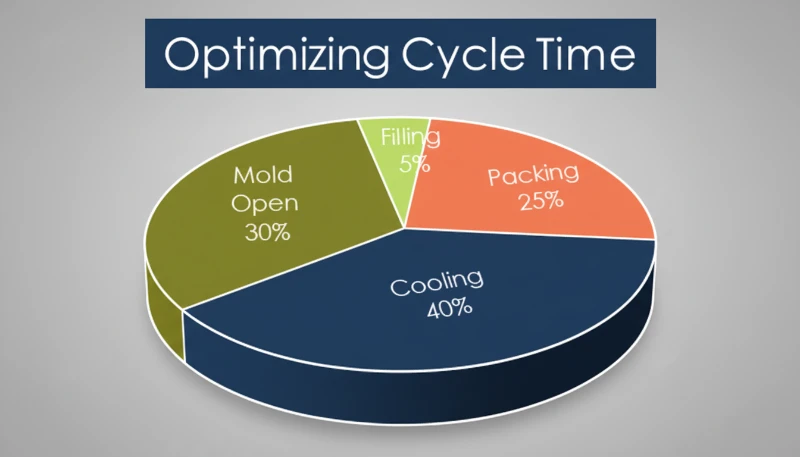
O tempo de enchimento corresponde apenas à fase de preenchimento da cavidade, durando normalmente 1 a 3 segundos, consoante o tamanho da peça, o material escolhido e a complexidade do molde. O tempo de ciclo inclui a sequência completa de enchimento, compactação, arrefecimento, abertura do molde, ejeção e fecho do molde — geralmente 10 a 60 segundos no total para um ciclo completo de moldagem de produção. O tempo de enchimento representa normalmente apenas 5 a 15 por cento do ciclo total. Reduzir apenas o tempo de enchimento pode não diminuir significativamente o tempo de ciclo global se o arrefecimento for o principal estrangulamento do processo.
Conclusão
O tempo de enchimento está na interseção entre ciência dos materiais, engenharia de moldes e capacidade da máquina. O cálculo mais simples — tf é igual a V dividido por Q — fornece um ponto de partida útil. A adição de modelagem reológica ou simulação completa melhora progressivamente a precisão. E as injeções de teste em condições reais continuam sendo a validação definitiva.
Otimizar o tempo de enchimento não significa buscar o menor número possível. Significa encontrar a velocidade que produza peças dimensionalmente estáveis e esteticamente limpas pelo menor custo total — considerando tempo de ciclo, taxa de refugo e longevidade do ferramental. Esse equilíbrio é exatamente o que nossa equipe de engenharia da ZetarMold busca em cada projeto.
Precisa de ajuda para otimizar seu processo de moldagem por injeção? A equipa de engenharia da ZetarMold fornece feedback de DFM, simulação do fluxo no molde e otimização do processo de produção. Com 20+ anos de experiência em 400+ materiais e 47 máquinas (90T–1850T), podemos ajudá-lo a ajustar corretamente o tempo de enchimento — e todos os outros parâmetros. Solicite hoje um orçamento gratuito.
afinamento por cisalhamento: A pseudoplasticidade refere-se ao fenómeno em que a viscosidade de um fluido diminui à medida que aumenta a taxa de corte aplicada. A maioria dos termoplásticos fundidos apresenta este comportamento durante a moldação por injeção. ↩
Equação de Hagen-Poiseuille: A equação de Hagen-Poiseuille descreve o escoamento laminar de um fluido newtoniano através de um tubo cilíndrico comprido, relacionando o caudal com a perda de pressão, o raio do tubo e a viscosidade do fluido. ↩
modelo da lei de potência: o modelo de fluido segundo a lei da potência refere-se ao modelo da lei da potência, ou modelo de Ostwald-de Waele, que relaciona a tensão de corte com a taxa de corte através da equação τ = k × γ̇ⁿ, em que k é o índice de consistência e n é o índice de comportamento do escoamento. ↩