Saltar para o conteúdo
PETG1 O PETG (Polietileno Tereftalato Glicol) ocupa um ponto ideal que poucos outros termoplásticos conseguem igualar: clareza ótica próxima do policarbonato, resistência ao impacto que rivaliza com o ABS e resistência química que supera ambos — tudo a uma temperatura de processamento e custo mais baixos. Se já segurou uma caixa transparente de dispositivo médico, uma janela de exposição de eletrónica de consumo ou um recipiente para contacto alimentar, é provável que tenha sido moldado em PETG. Neste guia, percorremos tudo o que precisa de saber para processar PETG com sucesso no seu chão de moldagem por injeção, desde a secagem e temperaturas de fusão até ao desenho do canal de injeção e resolução de defeitos.
- O PETG é um copolímero amorfo com uma transição vítrea de ~88 °C — fácil de moldar, resistente e completamente transparente.
- Secar o PETG a 65–75 °C durante 4–6 horas; humidade acima de 0,02% causa manchas e fragilidade.
- Janela de temperatura de fusão: 220–260 °C. Temperatura do molde: 15–40 °C para clareza, até 65 °C para alívio de tensões.
- A espessura da parede deve manter-se entre 1,0–3,0 mm; uma espessura uniforme evita marcas de afundamento e tensões internas.
- O PETG é conforme com a FDA para contacto alimentar, resistente a produtos químicos e totalmente reciclável — ideal para aplicações médicas e de consumo.
O Que É PETG e Por Que É Importante na Moldagem por Injeção?
O PETG é uma versão modificada com glicol do polietileno tereftalato (PET). O comonómero de glicol perturba a cristalização, o que é a chave para compreender quase tudo sobre como este material se comporta num molde. Ao contrário do PET, que tende a cristalizar e tornar-se opaco, o PETG permanece amorfo — transparente, dimensionalmente estável e tolerante durante o processamento. A sua temperatura de transição vítrea situa-se aproximadamente a 88 °C (190 °F). Isso coloca-o bem abaixo do policarbonato (cerca de 147 °C), mas acima dos plásticos transparentes comuns como o poliestireno.
Na prática, isso significa que o PETG oferece uma clareza óptica próxima ao PC sem a alta sensibilidade à secagem ou o comportamento propenso à deformação. Também significa menor moldagem por injeção tempos de ciclo, porque está a arrefecer a partir de uma temperatura de fusão mais baixa para um molde que não precisa de estar tão quente. Para os fabricantes que precisam de uma peça transparente, resistente, quimicamente estável — e que querem manter a sua janela de moldagem ampla — o PETG é frequentemente a primeira escolha.
O material também é atrativo do ponto de vista da sustentabilidade. O PETG é reciclável (código de resina SPI 1 na maioria dos fluxos de PET), e muitos graus são conformes com a FDA para contacto direto com alimentos. À medida que a pressão regulatória sobre embalagens de uso único e médicas se intensifica, ter um termoplástico transparente que cumpre as normas de contacto alimentar e grau médico sem o custo do PC é uma verdadeira vantagem.
Quais São as Principais Propriedades do Material PETG?
As propriedades-chave do material PETG incluem uma transição vítrea de ~88 °C, uma resistência à tração de 50–55 MPa e uma transmissão de luz de 85–92 %. Antes de definir uma única temperatura nos controladores do canhão, precisa de compreender os números que regem o comportamento do PETG. Aqui está um resumo das propriedades que mais importam no chão de fábrica.
| Imóveis | Value | Notas |
|---|---|---|
| Densidade | 1,27 g/cm3 | Moderado; mais leve do que muitos plásticos de engenharia |
| Transição Vítrea (Tg) | ~88 °C (190 °F) | Amorfo; sem ponto de fusão definido |
| Intervalo de Temperatura de Fusão | 220–260 °C | Evitar exceder 280 °C para prevenir degradação |
| Gama de Temperatura do Molde | 15–65 °C | Mais baixo = mais transparente; mais alto = menos tensão |
| Resistência à tração | 50–55 MPa | Comparável ao ABS, inferior ao PC |
| Alongamento na rutura | 100–150 % | Alta ductilidade — resiste à fratura frágil |
| Módulo de flexão | ~2.100 MPa | Suficientemente rígido para peças estruturais |
| Impacto Izod Entalhado | ~800 J/m | Muito superior ao acrílico; próximo do PC |
| Transmissão de luz | 85–92% | Quase clareza ótica |
| Moisture Absorption | 0,2–0,3 % | Baixa, mas ainda requer secagem |
A combinação de alta elongação e boa Resistência à tração do PETG2 (50–55 MPa) é o que distingue o PETG de outros plásticos transparentes. O acrílico (PMMA) pode transmitir mais luz, mas racha sob impacto. O policarbonato é mais resistente, mas custa significativamente mais e é muito mais sensível à humidade e a ataques químicos. O PETG situa-se no meio, e na nossa experiência, é nesse meio-termo que a maioria das aplicações do mundo real realmente se encontram.
Como Preparar o PETG para Moldagem por Injeção?
PETG is hygroscopic — not as aggressively as nylon or polycarbonate, but enough that skipping the dryer will cost you. The target moisture content is below 0.02 % by weight. In our shop, we dry PETG at 65–75 °C for 4–6 hours in a dehumidifying hopper dryer, and we keep the hopper at temperature throughout the run. This drying temperature for PETG3 is critical — too hot and the pellets stick together; too cold and you never reach the target moisture level.
“Undried PETG resin produces splay marks and reduced impact strength due to hydrolysis of the polymer backbone.”Verdadeiro
True. Moisture in the melt causes steam bubbles that create silver streaks on the surface. Hydrolysis also breaks ester bonds in the polymer chain, permanently reducing toughness and elongation.
“PETG does not need drying before injection molding because its moisture absorption is very low.”Falso
False. While PETG absorbs less moisture than nylon, any moisture above 0.02 % causes splay marks, bubbles, and reduced impact strength. Always dry PETG at 65–75 °C for 4–6 hours before molding.
Here is what happens when you skip or short-cut the drying process: splay marks (silver streaks on the part surface) caused by steam expanding in the melt; reduced impact strength because hydrolysis breaks ester bonds in the polymer backbone; bubbles and voids in thick sections; brittle weld lines at knit points; and inconsistent shot-to-shot weight with dimensional drift.
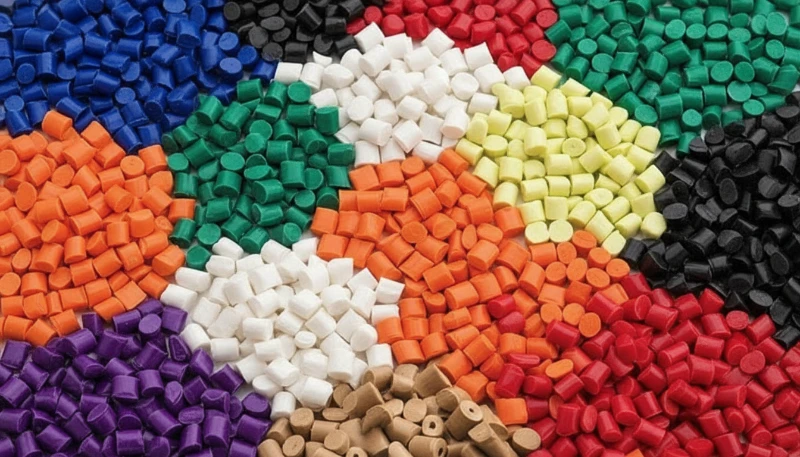
A quick field test: if you hear popping or see foam at the nozzle when purging, your PETG is wet. Stop, reload with dried material, and purge the barrel thoroughly. The drying investment is always cheaper than the scrap cost. Colorant and additive concentrates (masterbatches) also need to be dry — PETG processes at a temperature where any residual moisture in a color pellet will generate the same defects.
Quais São os Parâmetros Ótimos de Moldagem por Injeção para PETG?
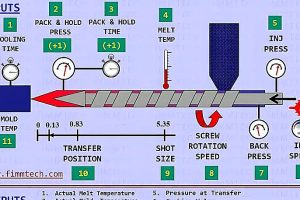
PETG is one of the more forgiving materials to mold, which is part of why it is so popular. But “forgiving” does not mean you can ignore the fundamentals. Here are the parameters we tune on every PETG job, along with the ranges that work reliably across part geometries.
| Parâmetro | Gama recomendada | Tips |
|---|---|---|
| Zona Traseira do Cilindro | 210–230 °C | Keep lower to avoid premature melting |
| Zona Média do Cilindro | 230–250 °C | Primary melting zone |
| Barrel Front Zone / Nozzle | 240–260 °C | Do not exceed 280 °C |
| Temperatura do molde | 15–40 °C (clarity) / 40–65 °C (stress relief) | Cooler = clearer surface |
| Velocidade de injeção | Moderate to fast | Avoid hesitation marks in thin walls |
| Pressão de retenção | 40–70 % of injection pressure | Hold until gate freezes |
| Tempo de retenção | 3–8 seconds (depends on wall thickness) | Gate seal is critical |
| Tempo de arrefecimento | 15–40 seconds (depends on wall thickness) | Uniform wall = shorter cycle |
| Pressão de retorno | 5–10 bar | Low to moderate; excessive shear degrades PETG |
| Velocidade do parafuso | 40–80 RPM | Lower speeds reduce shear heating |
One practical tip: PETG has a relatively wide processing window, but the edges of that window produce different results. At the low end (220–230 °C), you get better clarity and less risk of yellowing, but you may struggle to fill thin-wall sections. At the high end (250–260 °C), flow improves dramatically, but extended residence time causes thermal degradation — the material starts to yellow and lose impact strength. For most parts, 240–250 °C is the sweet spot.
Injection speed matters more for PETG than many molders realize. Because PETG is amorphous, it does not have a sharp melting point — it gradually softens over a range. Fast injection helps the material flow uniformly through the cavity before the leading edge starts to freeze off. On thin-wall parts (under 1.5 mm), we typically run at 70–90 % of maximum injection speed. On thicker parts, we slow down to 40–60 % to avoid jetting and air traps.
Holding pressure and time are where most PETG molding issues originate. PETG is a “soft” material at demolding temperature — it will warp, sink, or dimensionally shift if you release holding pressure before the gate freezes. A gate freeze study (weighing parts at progressively longer hold times until weight stabilizes) is worth doing once per mold. In our shop, we find that 4–6 seconds of hold time covers most PETG parts under 3 mm wall thickness.
“Running a gate freeze study is recommended for every new PETG mold to determine optimal holding time.”Verdadeiro
True. Gate freeze time varies with wall thickness, gate size, and mold temperature. Weighing parts at progressively longer hold times until weight stabilizes gives you the minimum hold time needed for consistent part quality.
“PETG should always be molded at the highest possible melt temperature to ensure complete cavity fill.”Falso
False. While higher melt temperatures improve flow, exceeding 280 °C causes thermal degradation, yellowing, and loss of impact strength. The recommended range is 220–260 °C, with 240–250 °C being optimal for most applications.
Como Deve Projetar Moldes para Peças em PETG?
PETG mold design is driven by uniform 1-3 mm wall thickness, 2-3 degree draft angles, and low-shear gate types for clean release and optical clarity.
Wall Thickness and Shrinkage
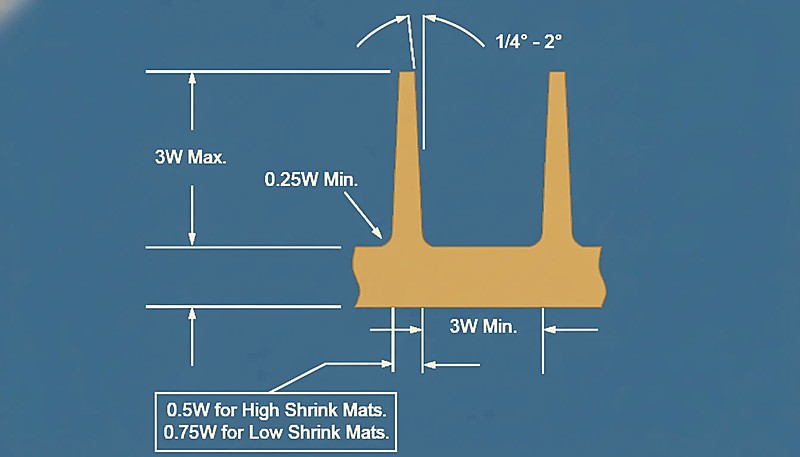
Target 1.0–3.0 mm wall thickness, and keep it as uniform as possible. PETG does not crystallize, so it shrinks less than semi-crystalline materials like nylon — but it still shrinks (0.3–0.7 %). Uneven thickness causes differential shrinkage that shows up as sink marks and warpage. If you need a thicker section for structural reasons, coring it out with ribs is always preferable to a solid chunk.
Gate Design and Placement
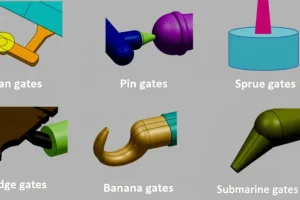
For transparent PETG parts, gate placement and type directly affect optical quality. Edge gates and fan gates are the most common choice because they provide a wide, low-shear entry point that minimizes jetting and flow marks. Submarine (tunnel) gates work for small parts, but they can leave a vestige that is visible on clear parts. Avoid pinpoint gates for anything larger than a few grams — the high shear through a small orifice degrades PETG and creates haze near the gate.
Place gates so that the flow front moves uniformly through the cavity. If the flow path is uneven, you will see weld lines and flow marks in the transparent material. Moldflow simulation before cutting steel is a worthwhile investment for any PETG part where optical quality matters.
Draft Angles and Surface Finish
Standard draft is 1–2° per side, but PETG benefits from slightly more draft (2–3°) on deep draws because the material is relatively soft at ejection temperature. Insufficient draft leads to drag marks that are immediately visible on a clear part. Polish core and cavity surfaces to a mirror finish (SPI A-2 or better) for best optical clarity — PETG replicates mold surface texture faithfully.
Ventilation
PETG does not release aggressive gases during molding (unlike PVC or acetal), but adequate venting is still essential. Trapped air causes burns and short shots. Standard vent depths of 0.01–0.02 mm are sufficient. For parts with complex geometry, add vents at the end of flow paths and at blind pockets.
Quais São os Defeitos Comuns na Moldagem por Injeção de PETG e as Suas Soluções?
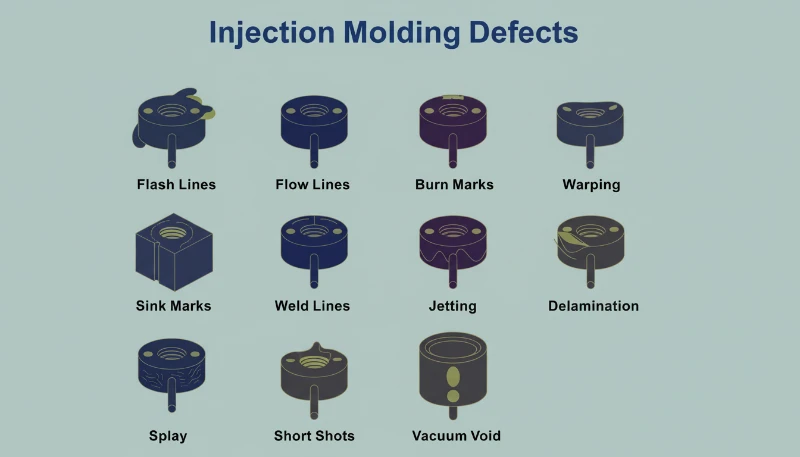
Common PETG defects include splay marks, haze, sink marks, and warpage — most are preventable with proper drying, gate design, and hold pressure. Even with good parameters, PETG has its quirks. Here are the defects we see most often on the production floor, along with the fixes that actually work.
Splay Marks (Silver Streaks)
Cause: Moisture in the resin. This is the number one issue with PETG. Even a small amount of moisture creates steam bubbles that burst at the flow front, leaving silver streaks on the part surface. The fix is straightforward: verify dryer temperature and time. Check that the dew point of the drying air is below -20 °C. If using regrind, pre-dry it separately — regrind has more surface area and absorbs moisture faster than virgin pellets.
Haze or Cloudiness
Cause: Excessive shear from too-fast injection through a small gate, contamination, or melt temperature that is too low for complete homogenization. The fix: open the gate slightly, reduce injection speed, and ensure the barrel temperatures are properly profiled. Also check for contamination in the hopper — even trace amounts of a different resin (especially crystalline materials) will cause cloudiness in PETG.
Marcas de pia
Cause: Insufficient holding pressure or time, or excessive wall thickness variation. PETG is amorphous and relatively low-shrink, but thick sections will still sink if they are not properly packed. The fix: increase holding pressure and extend hold time until the gate freezes. Redesign thick sections with coring ribs. A properly packed molde de injeção cavity should produce parts with minimal sink.
“PETG’s amorphous structure means it has lower and more uniform shrinkage compared to semi-crystalline plastics like nylon or POM.”Verdadeiro
True. Amorphous materials like PETG shrink isotropically (0.3–0.7 %), while semi-crystalline materials can shrink 1–2.5 % with significant directional variation. This makes PETG easier to mold to tight tolerances.
“Sink marks in PETG parts can be eliminated by simply reducing the mold temperature.”Falso
False. While mold temperature affects surface finish, sink marks are primarily caused by insufficient holding pressure or thick wall sections that shrink unevenly during cooling. The fix involves increasing hold pressure, extending hold time, and redesigning thick sections with coring.
Warpage and Jetting
Warpage is caused by uneven cooling or differential shrinkage between thick and thin sections. PETG’s low shrinkage helps, but asymmetrical wall thickness or uneven mold cooling will still cause warp. Ensure uniform cooling channel layout, use mold temperature controllers on both halves, and consider running a slightly higher mold temperature (50–65 °C) for parts with unavoidable thickness variation.
Jetting occurs when the melt stream enters the cavity too fast through a restrictive gate without making wall contact — it snakes across the cavity and creates worm-like surface marks. The fix: reduce injection speed at the initial fill stage, switch to a fan gate or tab gate to spread the entry flow, and position the gate so the melt hits a wall or core pin immediately upon entry.
Que Indústrias e Aplicações Utilizam Moldagem por Injeção de PETG?
PETG is used primarily in medical devices, food packaging, consumer electronics, and industrial guards where clarity and toughness matter. Its combination of clarity, toughness, chemical resistance, and regulatory compliance makes it a go-to material across several demanding industries.
Medical and Healthcare
PETG is widely used for medical device housings, fluid handling components, diagnostic equipment covers, and blister packaging. Its clarity allows visual inspection of fluid levels and device status, while its toughness survives drops and impacts that would shatter acrylic. Many PETG grades meet USP Class VI and ISO 10993 biocompatibility requirements for medical device applications. In our experience running PETG for medical customers, the combination of optical clarity and sterilization compatibility (compatible with ethylene oxide and gamma sterilization) makes it the default choice for clear medical enclosures.
Food and Beverage Packaging
FDA-compliant PETG grades are used for clear food containers, beverage bottles, deli trays, and cosmetic packaging. The material’s chemical resistance handles oils and acids without stress cracking, and its clarity drives shelf appeal. Unlike PET, PETG can be thermoformed and injection molded without crystallization, which simplifies processing for packaging manufacturers.
Consumer Electronics and Industrial
Display windows, LED light diffusers, protective covers, and transparent housings for wearables and gadgets all use PETG. It provides the optical clarity of PC at a lower cost, and it does not yellow as quickly under UV exposure when properly stabilized. Industrial applications include retail display fixtures, signage, guards, and machine vision windows where impact resistance makes PETG preferable to acrylic in high-traffic environments.
PETG vs. Outros Plásticos Transparentes — Como se Compara?
Choosing between PETG, polycarbonate, acrylic (PMMA), and clear ABS comes down to balancing clarity, toughness, cost, and processing requirements. Here is how they stack up head-to-head.
| Imóveis | PETG | Policarbonato (PC) | Acrílico (PMMA) | Clear ABS |
|---|---|---|---|---|
| Transmissão de luz | 85–92% | 88–91 % | 92 % | 75–85 % |
| Impact Strength (Izod) | ~800 J/m | ~850 J/m | ~20 J/m | ~300 J/m |
| Tg | ~88 °C | ~147 °C | ~105 °C | ~105 °C |
| Processing Temp. | 220–260 °C | 280–320 °C | 200–250 °C | 220–260 °C |
| Sensibilidade à Humidade | Moderado | Elevado | Baixa | Moderado |
| Resistência química | Bom | Poor (cracks) | Pobres | Moderado |
| Custo (relativo) | $$ | $$$ | $ | $$ |
| FDA Compliance | Yes (many grades) | Some grades | Some grades | Não |
The bottom line: if your part needs to be clear, tough, and chemically resistant, and you do not need the extreme temperature resistance of polycarbonate, PETG is usually the best choice. It processes easily, costs less than PC, and delivers better chemical resistance. The trade-off is lower heat resistance — if your part will see sustained temperatures above 70 °C, you should be looking at PC instead.
Como a ZetarMold Processa PETG em Produção?
At our Shanghai facility, PETG is one of the top five materials we run by volume. With 47 injection molding machines ranging from 90T to 1850T, we handle PETG parts from small medical device housings to large industrial display covers. Here is what we have learned from running thousands of PETG cycles over the past 20+ years.
| Capability | Specification |
|---|---|
| Máquinas de moldagem por injeção | 45 machines, 90T–1850T |
| Material Range | 400+ materials processed including all major PETG grades |
| Engineering Team | 8 senior engineers with 10+ years experience each |
| Production Staff | 120+ production workers |
| Monthly Mold Output | 100+ sets of injection molds per month |
| Quality System | ISO 9001 / 13485 / 14001 / 45001 certified |
| International Team | 30+ fluent English speakers for global communication |
Dryer discipline is non-negotiable. We run dehumidifying hopper dryers at 70 °C for a minimum of 4 hours before every PETG job. Our material handlers know that skipping drying on PETG means scrapping the first 20 shots minimum. Gate design matters more than people think — on transparent PETG parts, we almost always specify fan gates or edge gates with a width of 60–80 % of the wall thickness to minimize shear and produce a clean flow front.
Mold temperature control wins quality. We use water-circulating mold temperature controllers set to 25–30 °C for most PETG parts. This gives the best combination of surface clarity and cycle time. For parts with heavy wall thickness variation, we bump to 50 °C. For medical and optical applications, we sometimes anneal PETG parts at 65–70 °C for 30–60 minutes to relieve residual internal stress, improving dimensional stability and reducing the risk of stress cracking in chemical environments.
If you are developing a new PETG application and need help with material selection, mold design, or process optimization, reach out — we are happy to share what we have learned. Our team responds within 24 hours and can provide comprehensive sourcing support from initial DFM review through production launch.
Perguntas Frequentes sobre Moldagem por Injeção de PETG
Perguntas mais frequentes
What temperature do you injection mold PETG at?
PETG is typically injection molded with a melt temperature of 220–260 °C and a mold temperature of 15–40 °C for clarity-critical parts, or up to 65 °C for parts requiring additional stress relief during cooling. The barrel should be profiled from 210 °C at the rear to 250 °C at the nozzle for optimal material homogenization and consistent melt quality. Exceeding 280 °C risks thermal degradation, yellowing, and loss of impact properties, so stay within the recommended window and monitor melt color closely throughout your production runs.
Does PETG need to be dried before injection molding?
Yes, absolutely. PETG should be dried at 65–75 °C for 4–6 hours to reduce moisture below 0.02 % by weight before any molding begins. Even though PETG is less hygroscopic than nylon or polycarbonate, residual moisture causes splay marks on the part surface, significantly reduced impact strength, bubbles trapped in thick sections, and dimensional inconsistency from shot to shot. Use a dehumidifying hopper dryer with a dew point below -20 °C, and keep the hopper at temperature throughout the entire production run to prevent reabsorption of ambient moisture.
Can PETG be used for food-contact applications?
Many PETG grades comply with FDA 21 CFR §177.1630 for direct food-contact use, making them suitable for food containers, beverage bottles, deli trays, and kitchenware applications. Always verify the specific grade’s compliance certificate with your material supplier before committing to a food-contact application, as not all PETG formulations are manufactured to food-grade standards. Additionally, some PETG grades also meet European Union food contact regulations under EU Regulation 10/2011 for broader international market access and regulatory compliance across multiple global regions.
What causes haze in molded PETG parts?
Haze in PETG molded parts is typically caused by excessive shear from too-fast injection through a small gate opening, insufficient melt temperature for complete material homogenization, or contamination from a different resin introduced through the hopper or barrel. To fix haze issues, increase the gate size to reduce shear stress on the melt, verify that barrel temperatures are properly profiled at 240–250 °C at the nozzle, reduce injection speed during the initial fill stage, and thoroughly clean the hopper and feeding system to eliminate any cross-contamination from previous production runs.
How does PETG compare to polycarbonate for transparent parts?
PETG offers similar optical clarity to polycarbonate at a significantly lower material cost and with much easier processing characteristics overall. PETG melts at 220–260 °C versus PC’s 280–320 °C, requires less aggressive drying procedures, and resists many chemicals that cause stress cracking in polycarbonate. However, polycarbonate wins on heat resistance with a Tg of 147 °C compared to PETG’s 88 °C, and PC has slightly higher absolute impact strength. For most applications operating below 70 °C service temperature, PETG provides the better overall value proposition for transparent injection molded parts.
What is the typical shrinkage rate for PETG injection molding?
PETG exhibits shrinkage of 0.3–0.7 %, which is typical for amorphous thermoplastics and significantly lower than semi-crystalline materials like nylon at 1.0–2.0 % or acetal at 1.8–2.5 %. This low, isotropic shrinkage rate makes PETG relatively straightforward to mold to tight dimensional tolerances without requiring complex shrinkage compensation in the tool design. Maintaining uniform wall thickness throughout the part geometry and applying proper holding pressure until gate freeze both help minimize differential shrinkage and prevent warpage in the finished molded components.
Can you overmold PETG with TPE or TPU materials?
Yes, PETG is commonly used as a rigid substrate for TPE or TPU overmolding in consumer electronics, power tools, and medical device applications where a soft-touch surface is needed over a clear or rigid base component. The chemical compatibility between PETG and many TPE or TPU grades is good, producing adequate bond strength at the material interface. For best results, design mechanical interlocks into the tool geometry, ensure proper surface preparation of the PETG substrate, and optimize the overmold temperature to achieve chemical bonding without deforming or distorting the rigid base part during the second injection shot.
What gate types work best for PETG injection molding?
Edge gates and fan gates are the best choices for PETG, especially for transparent parts where optical quality matters. These gate types provide a wide, low-shear entry that minimizes flow marks, jetting, and gate blush. Submarine gates work for small parts but may leave visible vestige on clear surfaces. Avoid pinpoint gates for larger parts because the high shear through a small orifice degrades PETG and creates haze near the gate. Gate width should be 60–80 % of the nominal wall thickness for optimal fill.
Como Começar com a Moldagem por Injeção de PETG?
PETG injection molding combines optical clarity, impact toughness, and processing ease in one versatile clear thermoplastic. Whether you are molding medical device housings, food-contact containers, consumer electronics displays, or protective packaging, PETG offers a balance that few other transparent resins can match.
The key to success is straightforward: dry the material properly at 65–75 °C for 4–6 hours, design your mold with adequate gates and uniform wall thickness, run within the 220–260 °C melt window, and hold until the gate freezes. Do those four things consistently, and PETG will reward you with clear, tough, dimensionally stable parts cycle after cycle.
At ZetarMold, we have been running PETG and 400+ other materials for over 20 years at our Shanghai facility. With 45 machines from 90T to 1850T and a team of 8 senior engineers, we can help you take your PETG project from concept to production. Get a free quote today and let our engineering team optimize your part design and molding process.
-
PETG: PETG refers to polyethylene Terephthalate Glycol — a thermoplastic polyester copolymer known for clarity, toughness, and chemical resistance. Glass transition temperature of approximately 88 °C (190 °F). ↩
-
Resistência à tração do PETG: PETG tensile strength refers to the nominal range of 50–55 MPa for standard PETG grades, with elongation at break of 100–150 % per Eastman Chemical datasheets. ↩
-
drying temperature for PETG: Drying temperature for PETG refers to the recommended 65–75 °C for 4–6 hours to reduce moisture below 0.04 % per Autodesk Moldflow material guidelines. ↩



 EN
EN  ES
ES  FR
FR  DE
DE  PT
PT  AR
AR  RU
RU  JA
JA  KO
KO  IT
IT  NL
NL  TR
TR  PL
PL