Skip to content
PETG1 (Polyéthylène téréphtalate glycol) se situe dans une position idéale que peu d'autres thermoplastiques peuvent égaler : une clarté optique approchant celle du polycarbonate, une résistance aux chocs rivalisant avec l'ABS et une résistance chimique surpassant les deux — le tout à une température de traitement et un coût inférieurs. Si vous avez déjà tenu un boîtier transparent de dispositif médical, une vitre d'affichage d'électronique grand public ou un contenant en contact alimentaire, il y a de fortes chances qu'il ait été moulé en PETG. Dans ce guide, nous parcourons tout ce que vous devez savoir pour utiliser le PETG avec succès sur votre ligne de moulage par injection, du séchage et des températures de fusion à la conception des canaux d'alimentation et au dépannage des défauts.
- Le PETG est un copolymère amorphe avec une transition vitreuse d'environ 88 °C — facile à mouler, résistant et parfaitement transparent.
- Sécher le PETG à 65–75 °C pendant 4–6 heures ; une humidité supérieure à 0,02 % provoque des éclaboussures et une fragilité.
- Fenêtre de température de fusion : 220–260 °C. Température du moule : 15–40 °C pour la clarté, jusqu'à 65 °C pour le soulagement des contraintes.
- L'épaisseur de paroi doit rester entre 1,0 et 3,0 mm ; une épaisseur uniforme évite les retassures et les contraintes internes.
- Le PETG est conforme à la FDA pour le contact alimentaire, résistant chimiquement et entièrement recyclable — idéal pour les applications médicales et grand public.
Qu'est-ce que le PETG et pourquoi est-il important dans le moulage par injection ?
Le PETG est une version modifiée au glycol du polyéthylène téréphtalate (PET). Le comonomère glycol perturbe la cristallisation, ce qui est la clé pour comprendre presque tout sur le comportement de ce matériau dans un moule. Contrairement au PET, qui tend à cristalliser et devenir opaque, le PETG reste amorphe — transparent, dimensionnellement stable et indulgent pendant le traitement. Sa température de transition vitreuse se situe à environ 88 °C (190 °F). Cela le place bien en dessous du polycarbonate (environ 147 °C) mais au-dessus des plastiques transparents courants comme le polystyrène.
En pratique, cela signifie que le PETG offre une clarté optique proche du PC sans la sensibilité élevée au séchage ni le comportement enclin au gauchissement. Cela signifie également un moulage par injection les temps de cycle, car vous refroidissez à partir d'une température de fusion plus basse dans un moule qui n'a pas besoin d'être aussi chaud. Pour les fabricants qui ont besoin d'une pièce transparente, résistante, chimiquement inerte — et qui souhaitent garder une fenêtre de moulage large — le PETG est souvent le premier choix.
Le matériau est également intéressant d'un point de vue durable. Le PETG est recyclable (code de résine SPI 1 dans la plupart des flux PET) et de nombreuses qualités sont conformes à la FDA pour le contact alimentaire direct. Alors que la pression réglementaire sur les emballages à usage unique et médicaux s'intensifie, disposer d'un thermoplastique transparent qui répond aux normes de contact alimentaire et médical sans le coût du PC est un véritable avantage.
Quelles sont les principales propriétés matérielles du PETG ?
Les propriétés clés du PETG incluent une transition vitreuse d'environ 88 °C, une résistance à la traction de 50–55 MPa et une transmission lumineuse de 85–92 %. Avant de régler la moindre température sur vos contrôleurs de cylindre, vous devez comprendre les chiffres qui régissent le comportement du PETG. Voici un résumé des propriétés les plus importantes en production.
| Propriété | Value | Notes |
|---|---|---|
| Densité | 1,27 g/cm3 | Modérée ; plus léger que de nombreux plastiques techniques |
| Transition vitreuse (Tg) | ~88 °C (190 °F) | Amorphe ; pas de point de fusion net |
| Plage de température de fusion | 220–260 °C | Éviter de dépasser 280 °C pour prévenir la dégradation |
| Plage de température du moule | 15–65 °C | Plus bas = plus transparent ; plus élevé = moins de contraintes |
| Résistance à la traction | 50–55 MPa | Comparable à l'ABS, inférieur au PC |
| Allongement à la rupture | 100–150 % | Haute ductilité — résiste à la rupture fragile |
| Module de flexion | ~2 100 MPa | Assez rigide pour les pièces structurelles |
| Impact Izod entaillé | ~800 J/m | Bien supérieur à l'acrylique ; proche du PC |
| Transmission de la lumière | 85–92 % | Clarté quasi optique |
| Moisture Absorption | 0,2–0,3 % | Faible mais nécessite tout de même un séchage |
La combinaison d'une grande allongement et d'une bonne Résistance à la traction du PETG2 (50–55 MPa) est ce qui distingue le PETG des autres plastiques transparents. L'acrylique (PMMA) peut transmettre plus de lumière, mais il se fissure sous l'impact. Le polycarbonate est plus résistant, mais il coûte nettement plus cher et est bien plus sensible à l'humidité et aux attaques chimiques. Le PETG se situe au milieu, et selon notre expérience, ce juste milieu correspond à la plupart des applications réelles.
Comment préparer le PETG pour le moulage par injection ?
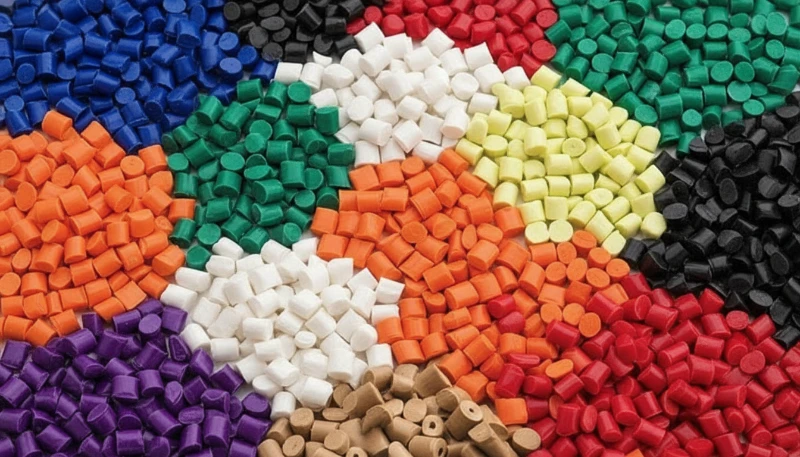
PETG is hygroscopic — not as aggressively as nylon or polycarbonate, but enough that skipping the dryer will cost you. The target moisture content is below 0.02 % by weight. In our shop, we dry PETG at 65–75 °C for 4–6 hours in a dehumidifying hopper dryer, and we keep the hopper at temperature throughout the run. This drying temperature for PETG3 is critical — too hot and the pellets stick together; too cold and you never reach the target moisture level.
“Undried PETG resin produces splay marks and reduced impact strength due to hydrolysis of the polymer backbone.”Vrai
True. Moisture in the melt causes steam bubbles that create silver streaks on the surface. Hydrolysis also breaks ester bonds in the polymer chain, permanently reducing toughness and elongation.
“PETG does not need drying before injection molding because its moisture absorption is very low.”Faux
False. While PETG absorbs less moisture than nylon, any moisture above 0.02 % causes splay marks, bubbles, and reduced impact strength. Always dry PETG at 65–75 °C for 4–6 hours before molding.
Here is what happens when you skip or short-cut the drying process: splay marks (silver streaks on the part surface) caused by steam expanding in the melt; reduced impact strength because hydrolysis breaks ester bonds in the polymer backbone; bubbles and voids in thick sections; brittle weld lines at knit points; and inconsistent shot-to-shot weight with dimensional drift.
A quick field test: if you hear popping or see foam at the nozzle when purging, your PETG is wet. Stop, reload with dried material, and purge the barrel thoroughly. The drying investment is always cheaper than the scrap cost. Colorant and additive concentrates (masterbatches) also need to be dry — PETG processes at a temperature where any residual moisture in a color pellet will generate the same defects.
Quels sont les paramètres optimaux de moulage par injection du PETG ?
PETG is one of the more forgiving materials to mold, which is part of why it is so popular. But “forgiving” does not mean you can ignore the fundamentals. Here are the parameters we tune on every PETG job, along with the ranges that work reliably across part geometries.
| Paramètres | Fourchette recommandée | Tips |
|---|---|---|
| Zone arrière du cylindre | 210–230 °C | Keep lower to avoid premature melting |
| Zone centrale du cylindre | 230–250 °C | Primary melting zone |
| Barrel Front Zone / Nozzle | 240–260 °C | Do not exceed 280 °C |
| Température du moule | 15–40 °C (clarity) / 40–65 °C (stress relief) | Cooler = clearer surface |
| Vitesse d'injection | Moderate to fast | Avoid hesitation marks in thin walls |
| Pression de maintien | 40–70 % of injection pressure | Hold until gate freezes |
| Temps de maintien | 3–8 seconds (depends on wall thickness) | Gate seal is critical |
| Temps de refroidissement | 15–40 seconds (depends on wall thickness) | Uniform wall = shorter cycle |
| Contre-pression | 5–10 bar | Low to moderate; excessive shear degrades PETG |
| Vitesse de la vis | 40–80 RPM | Lower speeds reduce shear heating |
One practical tip: PETG has a relatively wide processing window, but the edges of that window produce different results. At the low end (220–230 °C), you get better clarity and less risk of yellowing, but you may struggle to fill thin-wall sections. At the high end (250–260 °C), flow improves dramatically, but extended residence time causes thermal degradation — the material starts to yellow and lose impact strength. For most parts, 240–250 °C is the sweet spot.
Injection speed matters more for PETG than many molders realize. Because PETG is amorphous, it does not have a sharp melting point — it gradually softens over a range. Fast injection helps the material flow uniformly through the cavity before the leading edge starts to freeze off. On thin-wall parts (under 1.5 mm), we typically run at 70–90 % of maximum injection speed. On thicker parts, we slow down to 40–60 % to avoid jetting and air traps.
Holding pressure and time are where most PETG molding issues originate. PETG is a “soft” material at demolding temperature — it will warp, sink, or dimensionally shift if you release holding pressure before the gate freezes. A gate freeze study (weighing parts at progressively longer hold times until weight stabilizes) is worth doing once per mold. In our shop, we find that 4–6 seconds of hold time covers most PETG parts under 3 mm wall thickness.
“Running a gate freeze study is recommended for every new PETG mold to determine optimal holding time.”Vrai
True. Gate freeze time varies with wall thickness, gate size, and mold temperature. Weighing parts at progressively longer hold times until weight stabilizes gives you the minimum hold time needed for consistent part quality.
“PETG should always be molded at the highest possible melt temperature to ensure complete cavity fill.”Faux
False. While higher melt temperatures improve flow, exceeding 280 °C causes thermal degradation, yellowing, and loss of impact strength. The recommended range is 220–260 °C, with 240–250 °C being optimal for most applications.
Comment concevoir les moules pour les pièces en PETG ?
PETG mold design is driven by uniform 1-3 mm wall thickness, 2-3 degree draft angles, and low-shear gate types for clean release and optical clarity.
Wall Thickness and Shrinkage
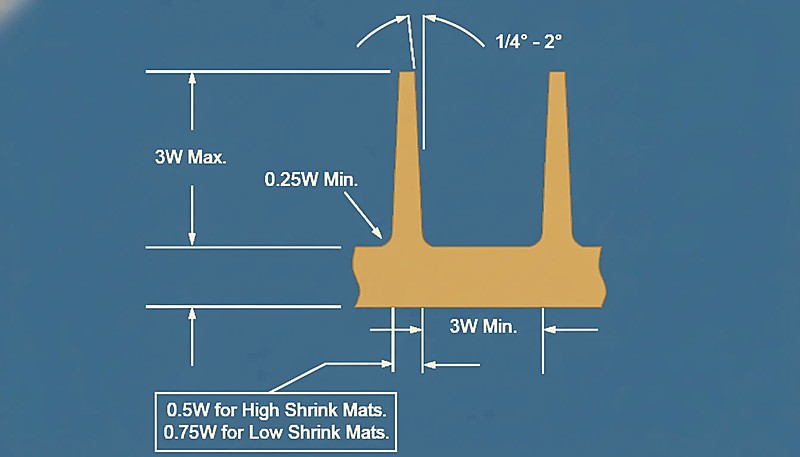
Target 1.0–3.0 mm wall thickness, and keep it as uniform as possible. PETG does not crystallize, so it shrinks less than semi-crystalline materials like nylon — but it still shrinks (0.3–0.7 %). Uneven thickness causes differential shrinkage that shows up as sink marks and warpage. If you need a thicker section for structural reasons, coring it out with ribs is always preferable to a solid chunk.
Gate Design and Placement
For transparent PETG parts, gate placement and type directly affect optical quality. Edge gates and fan gates are the most common choice because they provide a wide, low-shear entry point that minimizes jetting and flow marks. Submarine (tunnel) gates work for small parts, but they can leave a vestige that is visible on clear parts. Avoid pinpoint gates for anything larger than a few grams — the high shear through a small orifice degrades PETG and creates haze near the gate.
Place gates so that the flow front moves uniformly through the cavity. If the flow path is uneven, you will see weld lines and flow marks in the transparent material. Moldflow simulation before cutting steel is a worthwhile investment for any PETG part where optical quality matters.
Draft Angles and Surface Finish
Standard draft is 1–2° per side, but PETG benefits from slightly more draft (2–3°) on deep draws because the material is relatively soft at ejection temperature. Insufficient draft leads to drag marks that are immediately visible on a clear part. Polish core and cavity surfaces to a mirror finish (SPI A-2 or better) for best optical clarity — PETG replicates mold surface texture faithfully.
Ventilation
Le PETG ne libère pas de gaz agressifs lors du moulage (contrairement au PVC ou à l'acétal), mais une ventilation adéquate reste essentielle. L'air piégé provoque des brûlures et des courts-circuits. Les profondeurs de ventilation standard de 0,01 à 0,02 mm sont suffisantes. Pour les pièces à géométrie complexe, ajoutez des évents à l'extrémité des chemins d'écoulement et dans les poches aveugles.
Quels sont les défauts courants du moulage par injection de PETG et leurs solutions ?
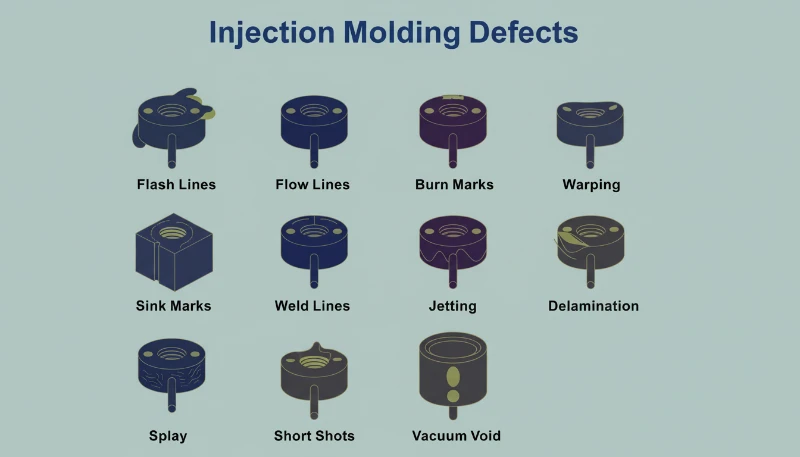
Les défauts courants du PETG incluent les marques d'éclaboussures, la buée, les marques de retassure et le gauchissement — la plupart sont évitables avec un séchage approprié, une conception de canal d'alimentation et une pression de maintien. Même avec de bons paramètres, le PETG a ses particularités. Voici les défauts que nous rencontrons le plus souvent en production, ainsi que les corrections qui fonctionnent réellement.
Marques d'Éclaboussures (Stries Argentées)
Cause : Humidité dans la résine. C'est le problème numéro un avec le PETG. Même une petite quantité d'humidité crée des bulles de vapeur qui éclatent au front d'écoulement, laissant des stries argentées sur la surface de la pièce. La solution est simple : vérifier la température et le temps du sécheur. Vérifiez que le point de rosée de l'air de séchage est inférieur à -20 °C. Si vous utilisez du regrind, pré-séchez-le séparément — le regrind a une surface plus grande et absorbe l'humidité plus rapidement que les granulés vierges.
Voile ou opacité
Cause : Cisaillement excessif dû à une injection trop rapide par une petite entrée, contamination, ou température de fusion trop basse pour une homogénéisation complète. La solution : élargir légèrement l'entrée, réduire la vitesse d'injection et s'assurer que les températures du cylindre sont correctement profilées. Vérifiez également la contamination dans la trémie — même des traces d'une autre résine (en particulier des matériaux cristallins) provoqueront un trouble dans le PETG.
Marques d'évier
Cause : Pression ou temps de maintien insuffisant, ou variation excessive de l'épaisseur de paroi. Le PETG est amorphe et relativement peu rétrécissant, mais les sections épaisses se rétracteront toujours si elles ne sont pas correctement compactées. La solution : augmenter la pression de maintien et prolonger le temps de maintien jusqu'à ce que l'entrée gèle. Redessinez les sections épaisses avec des nervures d'âme. Une cavité correctement compactée moule d'injection la cavité doit produire des pièces avec un retassement minimal.
“PETG’s amorphous structure means it has lower and more uniform shrinkage compared to semi-crystalline plastics like nylon or POM.”Vrai
Vrai. Les matériaux amorphes comme le PETG rétrécissent de manière isotrope (0,3–0,7 %), tandis que les matériaux semi-cristallins peuvent rétrécir de 1 à 2,5 % avec une variation directionnelle significative. Cela rend le PETG plus facile à mouler avec des tolérances serrées.
« Les marques de retassement dans les pièces en PETG peuvent être éliminées en réduisant simplement la température du moule. »Faux
Faux. Bien que la température du moule affecte la finition de surface, les marques de retassement sont principalement causées par une pression de maintien insuffisante ou des sections de paroi épaisses qui rétrécissent de manière inégale pendant le refroidissement. La solution consiste à augmenter la pression de maintien, à prolonger le temps de maintien et à redessiner les sections épaisses avec des âmes.
Gauchissement et Jetting
Le gauchissement est causé par un refroidissement irrégulier ou une rétraction différentielle entre les sections épaisses et fines. La faible rétraction du PETG aide, mais une épaisseur de paroi asymétrique ou un refroidissement de moule inégal provoquera toujours un gauchissement. Assurez une disposition uniforme des canaux de refroidissement, utilisez des régulateurs de température de moule sur les deux moitiés, et envisagez d'utiliser une température de moule légèrement plus élevée (50–65 °C) pour les pièces présentant une variation d'épaisseur inévitable.
Le jetting se produit lorsque le flux de matière fondue pénètre dans la cavité trop rapidement par une entrée restrictive sans contact avec la paroi — il serpente à travers la cavité et crée des marques de surface en forme de ver. La solution : réduire la vitesse d'injection au stade initial de remplissage, passer à une entrée en éventail ou à une entrée à languette pour étaler le flux d'entrée, et positionner l'entrée de sorte que la matière fondue frappe une paroi ou un noyau immédiatement à l'entrée.
Quelles industries et applications utilisent le moulage par injection de PETG ?
Le PETG est principalement utilisé dans les dispositifs médicaux, l'emballage alimentaire, l'électronique grand public et les protections industrielles où la clarté et la robustesse sont importantes. Sa combinaison de clarté, de robustesse, de résistance chimique et de conformité réglementaire en fait un matériau de choix dans plusieurs industries exigeantes.
Médical et Santé
Le PETG est largement utilisé pour les boîtiers de dispositifs médicaux, les composants de gestion des fluides, les couvercles d'équipements de diagnostic et les emballages blister. Sa clarté permet une inspection visuelle des niveaux de fluide et de l'état des dispositifs, tandis que sa résistance aux chocs survit aux chutes et impacts qui briseraient l'acrylique. De nombreuses qualités de PETG répondent aux exigences de biocompatibilité USP Classe VI et ISO 10993 pour les applications de dispositifs médicaux. D'après notre expérience avec le PETG pour les clients médicaux, la combinaison de clarté optique et de compatibilité avec la stérilisation (compatible avec l'oxyde d'éthylène et la stérilisation gamma) en fait le choix par défaut pour les boîtiers médicaux transparents.
Emballage Alimentaire et des Boissons
Les qualités de PETG conformes à la FDA sont utilisées pour les contenants alimentaires transparents, les bouteilles de boissons, les plateaux de charcuterie et les emballages cosmétiques. La résistance chimique du matériau supporte les huiles et les acides sans fissuration sous contrainte, et sa clarté renforce l'attrait sur les étagères. Contrairement au PET, le PETG peut être thermoformé et moulé par injection sans cristallisation, ce qui simplifie le traitement pour les fabricants d'emballages.
Électronique grand public et industriel
Les vitrines d'exposition, les diffuseurs de lumière LED, les protections et les boîtiers transparents pour les wearables et les gadgets utilisent tous du PETG. Il offre la clarté optique du PC à un coût inférieur et ne jaunit pas aussi rapidement sous l'exposition aux UV lorsqu'il est correctement stabilisé. Les applications industrielles incluent les présentoirs de vente au détail, la signalétique, les protections et les hublots de vision industrielle où la résistance aux chocs rend le PETG préférable à l'acrylique dans les environnements à fort trafic.
PETG vs. autres plastiques transparents — Comment se compare-t-il ?
Choisir entre le PETG, le polycarbonate, l'acrylique (PMMA) et l'ABS transparent revient à équilibrer la clarté, la robustesse, le coût et les exigences de transformation. Voici comment ils se comparent directement.
| Propriété | PETG | Polycarbonate (PC) | Acrylique (PMMA) | ABS transparent |
|---|---|---|---|---|
| Transmission de la lumière | 85–92 % | 88–91 % | 92 % | 75–85 % |
| Impact Strength (Izod) | ~800 J/m | ~850 J/m | ~20 J/m | ~300 J/m |
| Tg | ~88 °C | ~147 °C | ~105 °C | ~105 °C |
| Température de Transformation | 220–260 °C | 280–320 °C | 200–250 °C | 220–260 °C |
| Sensibilité à l'humidité | Modéré | Haut | Faible | Modéré |
| Résistance chimique | Bon | Mauvais (fissures) | Pauvre | Modéré |
| Cost (relative) | $$ | $$$ | $ | $$ |
| Conformité FDA | Oui (de nombreuses qualités) | Certaines qualités | Certaines qualités | Non |
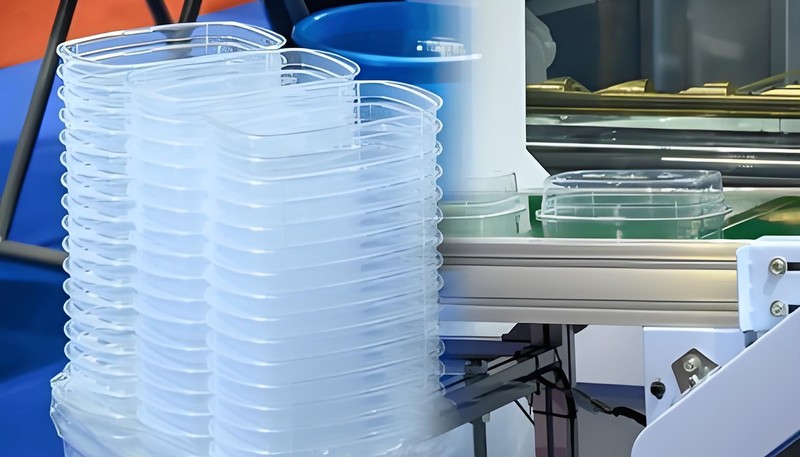
En résumé : si votre pièce doit être transparente, robuste et chimiquement résistante, et que vous n'avez pas besoin de la résistance extrême à la température du polycarbonate, le PETG est généralement le meilleur choix. Il se transforme facilement, coûte moins cher que le PC et offre une meilleure résistance chimique. Le compromis est une résistance à la chaleur inférieure — si votre pièce sera exposée à des températures soutenues au-dessus de 70 °C, vous devriez plutôt envisager le PC.
Comment ZetarMold utilise-t-il le PETG en production ?
Dans notre usine de Shanghai, le PETG est l'un des cinq matériaux les plus utilisés en volume. Avec 47 machines de moulage par injection allant de 90T à 1850T, nous traitons des pièces en PETG allant des petits boîtiers de dispositifs médicaux aux grands couvercles d'affichage industriel. Voici ce que nous avons appris en réalisant des milliers de cycles PETG au cours des 20 dernières années et plus.
| Capability | Specification |
|---|---|
| Machines de moulage par injection | 45 machines, 90T–1850T |
| Gamme de Matériaux | Plus de 400 matériaux traités, y compris toutes les principales qualités de PETG |
| Équipe d'ingénierie | 8 ingénieurs seniors avec plus de 10 ans d'expérience chacun |
| Personnel de Production | 120+ production workers |
| Production mensuelle de moules | 100+ jeux de moules d'injection par mois |
| Quality System | Certifié ISO 9001 / 13485 / 14001 /这三种标准 |
| Équipe Internationale | 30+ locuteurs anglophones courants pour une communication mondiale |
La discipline de séchage est non négociable. Nous faisons fonctionner des séchoirs trémies déshumidifiants à 70 °C pendant au moins 4 heures avant chaque travail sur PETG. Nos opérateurs de matériaux savent que sauter le séchage sur du PETG signifie mettre au rebut au moins les 20 premières pièces. La conception de l'attaque compte plus qu'on ne le pense — sur les pièces transparentes en PETG, nous spécifions presque toujours des attaques en éventail ou des attaques latérales avec une largeur de 60–80 % de l'épaisseur de paroi pour minimiser le cisaillement et produire un front d'écoulement propre.
Le contrôle de la température du moule garantit la qualité. Nous utilisons des contrôleurs de température de moule à circulation d'eau réglés à 25–30 °C pour la plupart des pièces en PETG. Cela donne la meilleure combinaison de clarté de surface et de temps de cycle. Pour les pièces avec de fortes variations d'épaisseur de paroi, nous augmentons à 50 °C. Pour les applications médicales et optiques, nous recuisons parfois les pièces en PETG à 65–70 °C pendant 30–60 minutes pour soulager les contraintes internes résiduelles, améliorant la stabilité dimensionnelle et réduisant le risque de fissuration sous contrainte dans les environnements chimiques.
Si vous développez une nouvelle application en PETG et avez besoin d'aide pour la sélection du matériau, la conception du moule ou l'optimisation du processus, contactez-nous — nous sommes heureux de partager ce que nous avons appris. Notre équipe répond dans les 24 heures et peut fournir un soutien complet sourcing du premier examen DFM jusqu'au lancement de la production.
Questions fréquemment posées sur le moulage par injection de PETG
Questions fréquemment posées
À quelle température moule-t-on le PETG par injection ?
Le PETG est généralement moulé par injection avec une température de fusion de 220–260 °C et une température de moule de 15–40 °C pour les pièces nécessitant une grande clarté, ou jusqu'à 65 °C pour les pièces nécessitant un soulagement supplémentaire des contraintes pendant le refroidissement. Le cylindre doit être profilé de 210 °C à l'arrière à 250 °C à la buse pour une homogénéisation optimale du matériau et une qualité de fusion constante. Dépasser 280 °C risque une dégradation thermique, un jaunissement et une perte des propriétés d'impact, donc restez dans la fenêtre recommandée et surveillez étroitement la couleur de la fusion tout au long de vos productions.
Le PETG doit-il être séché avant le moulage par injection ?
Oui, absolument. Le PETG doit être séché à 65–75 °C pendant 4–6 heures pour réduire l'humidité en dessous de 0,02 % en poids avant tout moulage. Bien que le PETG soit moins hygroscopique que le nylon ou le polycarbonate, l'humidité résiduelle provoque des marques d'éclaboussures sur la surface de la pièce, une résistance aux chocs considérablement réduite, des bulles piégées dans les sections épaisses et une incohérence dimensionnelle d'un coup à l'autre. Utilisez un séchoir à trémie déshumidifiante avec un point de rosée inférieur à -20 °C, et maintenez la trémie à température tout au long de la production pour éviter la réabsorption de l'humidité ambiante.
Le PETG peut-il être utilisé pour des applications en contact avec des aliments ?
De nombreuses qualités de PETG sont conformes à la FDA 21 CFR §177.1630 pour une utilisation en contact direct avec les aliments, ce qui les rend adaptées aux contenants alimentaires, bouteilles de boissons, plateaux de charcuterie et applications d'articles de cuisine. Vérifiez toujours le certificat de conformité de la qualité spécifique auprès de votre fournisseur de matériau avant de vous engager dans une application en contact avec des aliments, car toutes les formulations de PETG ne sont pas fabriquées selon des normes alimentaires. De plus, certaines qualités de PETG répondent également aux règlements de l'Union européenne sur les contacts alimentaires sous le règlement UE 10/2011 pour un accès plus large aux marchés internationaux et une conformité réglementaire dans plusieurs régions du monde.
Quelles sont les causes de la brume dans les pièces moulées en PETG ?
La brume dans les pièces moulées en PETG est généralement causée par un cisaillement excessif dû à une injection trop rapide à travers une petite ouverture d'attaque, une température de fusion insuffisante pour une homogénéisation complète du matériau, ou une contamination par une autre résine introduite via la trémie ou la vis. Pour résoudre les problèmes de brume, augmentez la taille de l'attaque pour réduire la contrainte de cisaillement sur la matière fondue, vérifiez que les températures du cylindre sont correctement profilées à 240–250 °C à la buse, réduisez la vitesse d'injection pendant la phase de remplissage initiale, et nettoyez soigneusement la trémie et le système d'alimentation pour éliminer toute contamination croisée des productions précédentes.
Comment le PETG se compare-t-il au polycarbonate pour les pièces transparentes ?
Le PETG offre une clarté optique similaire au polycarbonate à un coût matériel significativement inférieur et avec des caractéristiques de traitement globalement beaucoup plus faciles. Le PETG fond à 220–260 °C contre 280–320 °C pour le PC, nécessite des procédures de séchage moins agressives et résiste à de nombreux produits chimiques qui provoquent la fissuration sous contrainte dans le polycarbonate. Cependant, le polycarbonate l'emporte sur la résistance à la chaleur avec un Tg de 147 °C contre 88 °C pour le PETG, et le PC a une résistance aux chocs absolue légèrement supérieure. Pour la plupart des applications fonctionnant en dessous de 70 °C en service, le PETG offre la meilleure proposition de valeur globale pour les pièces transparentes moulées par injection.
Quel est le taux de retrait typique pour le moulage par injection de PETG ?
Le PETG présente un retrait de 0,3–0,7 %, ce qui est typique pour les thermoplastiques amorphes et significativement inférieur à celui des matériaux semi-cristallins comme le nylon à 1,0–2,0 % ou l'acétal à 1,8–2,5 %. Ce faible taux de retrait isotrope rend le PETG relativement simple à mouler avec des tolérances dimensionnelles serrées sans nécessiter de compensation complexe du retrait dans la conception de l'outillage. Maintenir une épaisseur de paroi uniforme dans toute la géométrie de la pièce et appliquer une pression de maintien appropriée jusqu'au gel de l'attaque aident tous deux à minimiser le retrait différentiel et à prévenir la déformation dans les composants moulés finis.
Pouvez-vous surmouler le PETG avec des matériaux TPE ou TPU ?
Oui, le PETG est couramment utilisé comme substrat rigide pour le surmoulage de TPE ou TPU dans l'électronique grand public, les outils électriques et les dispositifs médicaux, lorsqu'une surface douce au toucher est nécessaire sur un composant de base transparent ou rigide. La compatibilité chimique entre le PETG et de nombreuses qualités de TPE ou TPU est bonne, produisant une force d'adhésion adéquate à l'interface des matériaux. Pour de meilleurs résultats, intégrez des verrous mécaniques dans la géométrie de l'outil, assurez une préparation adéquate de la surface du substrat en PETG et optimisez la température du surmoulage pour obtenir une liaison chimique sans déformer ou distordre la pièce de base rigide pendant la seconde injection.
Quels types d'attaque fonctionnent le mieux pour le moulage par injection de PETG ?
Les attaques latérales et les attaques en éventail sont les meilleurs choix pour le PETG, en particulier pour les pièces transparentes où la qualité optique est importante. Ces types d'attaque offrent une entrée large et à faible cisaillement qui minimise les marques d'écoulement, la projection et le voile à l'attaque. Les attaques subaquatiques fonctionnent pour les petites pièces mais peuvent laisser un vestige visible sur les surfaces transparentes. Évitez les attaques pointes pour les pièces plus grandes car le cisaillement élevé à travers un petit orifice dégrade le PETG et crée de la brume près de l'attaque. La largeur de l'attaque doit être de 60–80 % de l'épaisseur nominale de paroi pour un remplissage optimal.
Comment démarrer avec le moulage par injection de PETG ?
Le moulage par injection de PETG combine clarté optique, résistance aux chocs et facilité de traitement en un thermoplastique transparent polyvalent. Que vous mouliez des boîtiers de dispositifs médicaux, des contenants en contact alimentaire, des écrans d'électronique grand public ou des emballages de protection, le PETG offre un équilibre que peu d'autres résines transparentes peuvent égaler.
La clé du succès est simple : séchez correctement le matériau à 65–75 °C pendant 4–6 heures, concevez votre moule avec des canaux d'alimentation adéquats et une épaisseur de paroi uniforme, travaillez dans la fenêtre de fusion de 220–260 °C, et maintenez jusqu'à ce que le canal gèle. Faites ces quatre choses régulièrement, et le PETG vous récompensera avec des pièces claires, résistantes et dimensionnellement stables cycle après cycle.
Chez ZetarMold, nous utilisons le PETG et 400+ autres matériaux depuis plus de 20 ans dans notre usine de Shanghai. Avec 45 machines de 90T à 1850T et une équipe de 8 ingénieurs seniors, nous pouvons vous aider à mener votre projet PETG du concept à la production. Obtenez un devis gratuit aujourd'hui et laissez notre équipe d'ingénieurs optimiser la conception de votre pièce et le processus de moulage.
-
PETG: PETG désigne le polyéthylène téréphtalate glycol — un copolymère polyester thermoplastique connu pour sa clarté, sa résistance et sa résistance chimique. Température de transition vitreuse d'environ 88 °C (190 °F). ↩
-
Résistance à la traction du PETG: La résistance à la traction du PETG fait référence à la plage nominale de 50–55 MPa pour les grades standard de PETG, avec un allongement à la rupture de 100–150 % selon les fiches techniques d'Eastman Chemical. ↩
-
drying temperature for PETG: La température de séchage pour le PETG fait référence à la recommandation de 65–75 °C pendant 4–6 heures pour réduire l'humidité en dessous de 0,04 % selon les directives matérielles d'Autodesk Moldflow. ↩




 EN
EN  ES
ES  FR
FR  DE
DE  PT
PT  AR
AR  RU
RU  JA
JA  KO
KO  IT
IT  NL
NL  TR
TR  PL
PL