 Saltar para o conteúdo

- Metal insert injection molding integrates metal components directly into plastic parts during molding for superior mechanical bond strength.
- Insert design—knurling, undercuts, wall thickness—is the primary driver of pull-out strength. Poor design causes spin-out.
- Tooling complexity increases with insert loading: vertical loading is simpler, side-loading requires slides and increases cost.
- ZetarMold supports insert programs with DFM review, insert qualification, and first-article testing.
A product engineer designing a metal insert into a plastic part solves three problems: reliable threaded performance under torque, electrical connections without fasteners, or structural reinforcement. Metal insert injection molding places metal components into the mold before injection, allowing plastic to flow around and create mechanical bond.
This differs from post-mold insertion methods like heat staking or press fitting, where metal is added after plastic is formed. In-mold insertion provides higher pull-out strength and consistent quality but requires careful design and process control. For fundamentals, see injection molding complete guide. For mold tooling details, see injection mold complete guide1.
What Is Metal Insert Injection Molding?
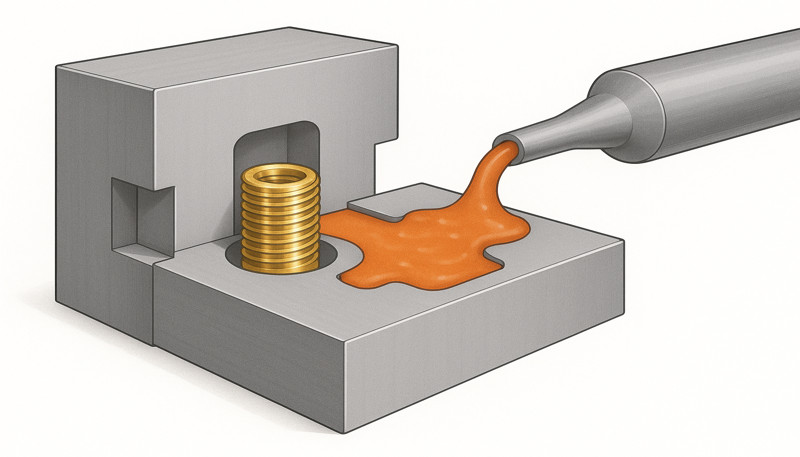
Metal insert injection molding places pre-formed metal components into the mold before plastic injection. Inserts are held by core pins or magnetic fixturing. Molten plastic flows around and encapsulates the insert, creating mechanical interlock as it cools and shrinks.
The process requires coordination between insert geometry, material selection, tooling design, and process parameters. Common inserts include threaded brass inserts, electrical contacts, and reinforcement bushings. Used in automotive sensor housings, electronics enclosures, and industrial pump components.
How Do You Design Metal Inserts?
Insert design determines pull-out strength. The three variables that control retention are external geometry (knurling and undercuts), internal features (through-hole vs blind-hole), and the plastic wall section surrounding the insert. Getting any one of these wrong can produce parts that pass initial inspection but fail under torque or thermal cycling in the field.
Key considerations include knurling pattern, undercut geometry, and wall thickness around the insert.
Knurling pattern: Diamond or straight knurling provides mechanical interlock. Diamond pattern provides multidirectional retention and is preferred for torque or vibration applications. Straight knurling provides higher axial pull-out strength but less rotational resistance.
Knurl depth: Must engage plastic without causing excessive stress. For most brass inserts in ABS or nylon, 0.3–0.5 mm knurl depth is a practical starting point that balances retention with mold core pin durability.
| Parâmetro | Guideline | Risk if violated |
|---|---|---|
| Knurl depth | 0.3–0.5 mm (brass/ABS) | Spin-out under torque |
| Espessura da parede | ≥1.5× insert OD | Sink marks, voids |
| Thread engagement | ≥1.5× thread diameter | Pull-out failure |
| Undercut depth | 0.2–0.4 mm typical | Insufficient retention |
Undercut geometry: Grooves or steps in the insert create positive mechanical lock. Undercut depth and spacing balance retention strength against manufacturing cost. Deep undercuts increase strength but require robust mold core pins.
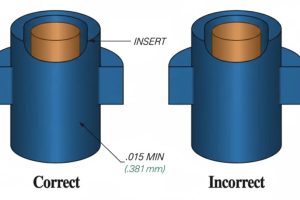
Espessura da parede: Plastic wall thickness surrounding insert must absorb molding stresses. Insufficient thickness causes sink marks or cracks. As guideline, thickness should be at least 1.5 times insert outer diameter for thermoplastics, with additional margin for engineering resins.
In practice, wall thickness violations account for a significant share of insert molding defects. When the plastic section between insert outer surface and part exterior wall drops below 1.0 mm, the risk of sink marks and voids increases sharply — especially with glass-filled nylon or PC where packing pressure transfer is already limited by the insert geometry.
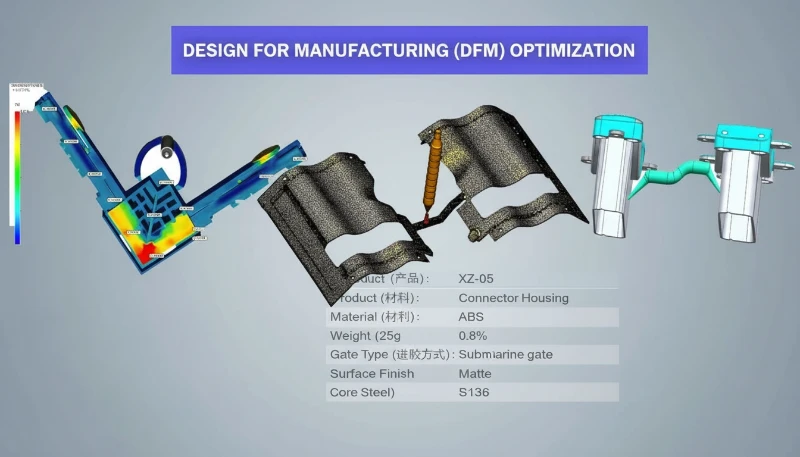
The interaction between insert geometry and molding parameters directly affects part quality. Key factors include insert placement tolerance (typically ±0.05 mm), gate location relative to the insert, and cooling channel proximity. These considerations become especially critical for multi-insert designs where differential thermal contraction can shift insert positions during the molding cycle.
What Material Considerations Apply?
Material selection involves both plastic and metal. Plastic must have sufficient strength and shrinkage characteristics. Metal must have appropriate hardness and thermal properties.
Seleção de plástico: Thermoplastics with moderate shrinkage—ABS, PC, nylon, PP—are commonly used. High-shrinkage materials create greater compressive stress on insert but increase warpage risk. Engineering resins require careful design due to low shrinkage reducing natural bond.
Metal selection: Brass is common for threaded applications due to machinability and corrosion resistance. Steel provides higher strength for high-load applications. Stainless steel for corrosion-critical applications. Aluminum is lightweight but has lower strength.
Thermal expansion: CTE mismatch creates stress during molding and temperature cycling. Plastic shrinks more than metal during cooling, creating beneficial compressive stress but must be managed to avoid stress térmico2.
Factory Insight: ZetarMold Insert Molding
We have produced millions of insert-molded parts. Programs include brass threaded inserts in nylon pump housings, steel pins in automotive sensor bodies, and copper contacts in electrical connectors. Our DFM process includes pull-out testing—typical pull-out exceeds 800 N for M4 brass inserts in ABS with diamond knurling. Our 45-machine operation supports vertical and side-loading tooling.
What Tooling and Process Controls?
Tooling for insert molding is more complex than standard injection molding. Mold must locate and hold insert securely, accommodate loading, and maintain accuracy. Process controls ensure consistent placement and fill.
Insert loading method: Vertical loading from mold open face is simplest. Side loading requires slides or lifters for side placement, increasing tooling cost but enabling complex designs. Robotic loading ensures consistent placement in high-volume production.
Core and cavity design: Core pins must be precise to maintain location and prevent flash. Cavity must allow plastic flow around insert without air traps. Cooling channels must provide uniform cooling to prevent differential shrinkage.
Parâmetros do processo: Injection speed, pressure, temperature must be tuned for fill around insert without causing displacement. Higher speeds may cause float or misalignment. Mold temperature affects shrinkage stress—higher temperature reduces stress but increases cycle time.

Perguntas mais frequentes
What is the difference between metal insert molding and overmolding?
Insert molding places pre-formed metal before plastic injection for mechanical bond. Overmolding molds plastic over existing substrate without removal between shots. Insert molding provides stronger retention for discrete metal components.
What is typical pull-out strength for threaded inserts?
M4 brass inserts in ABS typically exceed 800 N pull-out strength with proper design. Larger inserts or engineering resins can exceed 3000 N. Validate through testing for critical applications.
Can metal inserts be molded into PEEK or PPS?
Yes, but design changes. High-temperature resins have lower shrinkage reducing natural bond. Design must rely more on knurling and undercuts than shrinkage stress.
What causes inserts to spin out?
Insufficient mechanical interlock from inadequate knurling, insufficient wall thickness, or flash gaps. DFM review before tooling prevents this.
Does ZetarMold support insert molding?
Yes. We produce insert-molded parts for automotive, electronics, and industrial applications with DFM review, insert qualification, and testing.
How does cost compare to post-mold assembly?
Higher tooling cost but lower per-part assembly cost. For high-volume production, total cost is typically lower than post-mold assembly.
Bottom Line
Bottom line: Metal insert injection molding provides superior mechanical performance for integrating threaded fasteners, electrical contacts, and reinforcement into plastic parts. Requires careful insert design and controlled tooling and process parameters. DFM review before tooling prevents costly rework.
Quick rule: if application requires repeated torque cycles, electrical conductivity, or structural reinforcement, metal insert molding is appropriate. Compare against serviço de moldagem por injeção3.
-
injection molding: Manufacturing process injecting molten thermoplastic under pressure into closed steel mold cavity. ↩
-
CTE mismatch: Coefficient of thermal expansion difference between metal insert and plastic resin that creates interfacial stress during molding and temperature cycling. ↩
-
injection molding service: End-to-end manufacturing support covering DFM, tooling, inspection, and production. ↩





 EN
EN  ES
ES  FR
FR  DE
DE  PT
PT  AR
AR  RU
RU  JA
JA  KO
KO  IT
IT  NL
NL  TR
TR  PL
PL 