18 Conselhos Importantes para Moldadores por Injeção — Guia Prático
Este artigo apresenta 18 dicas práticas que realmente importam — aquelas que utilizamos diariamente ao aplicar o guia completo de moldação por injeção em 47 máquinas. Nada de teoria pela teoria. Apenas aspetos que fazem a diferença entre uma produção estável e uma situação de crise.
- A contrapressão de 5–15 bar proporciona material fundido consistente; acima de 20 bar, aumenta o desgaste com retornos decrescentes.
- O colchão da rosca de 3–9 mm deve permanecer constante — até um desvio de 1 mm altera o peso da peça.
- A temperatura do material fundido deve ser medida no bico, e não presumida a partir das configurações do cilindro.
- Uma variação de ±2 °C na temperatura do molde pode alterar as dimensões da peça em 0.1–0.3 mm nas resinas de engenharia.
- A uniformidade da refrigeração — não a velocidade — é o verdadeiro fator determinante da estabilidade dimensional.
Quais são os ajustes mais críticos das máquinas para moldadores por injeção?
As definições mais críticas das máquinas para os profissionais de moldação por injeção correspondem às principais categorias ou opções explicadas nesta secção. Se estiver a comparar fornecedores ou a planear uma aquisição, o nosso guia de seleção de fornecedores de moldação por injeção aborda a preparação do pedido de cotação, a qualificação e a verificação dos riscos comerciais.
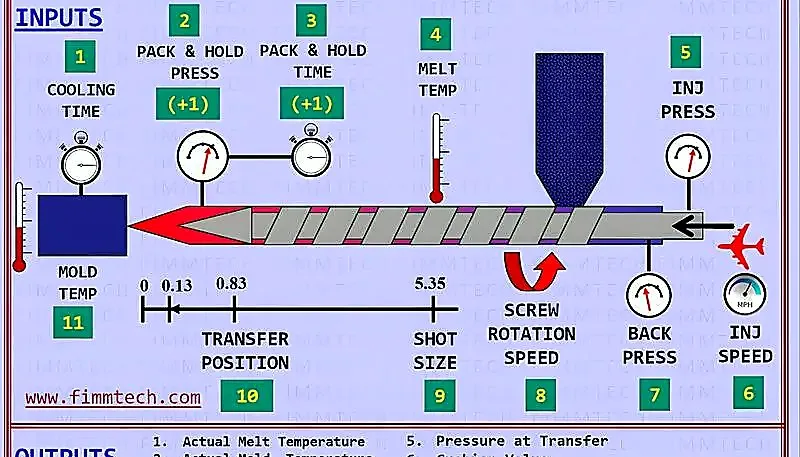
As cinco definições que causam 80% dos problemas de produção são a contrapressão1, a velocidade do fuso, a almofada2, a temperatura do material fundido e a temperatura do molde. Se as ajustar corretamente, a maioria dos defeitos — enchimentos incompletos, marcas de rechupe e desvios dimensionais — desaparece sem ser necessário alterar parâmetros secundários.
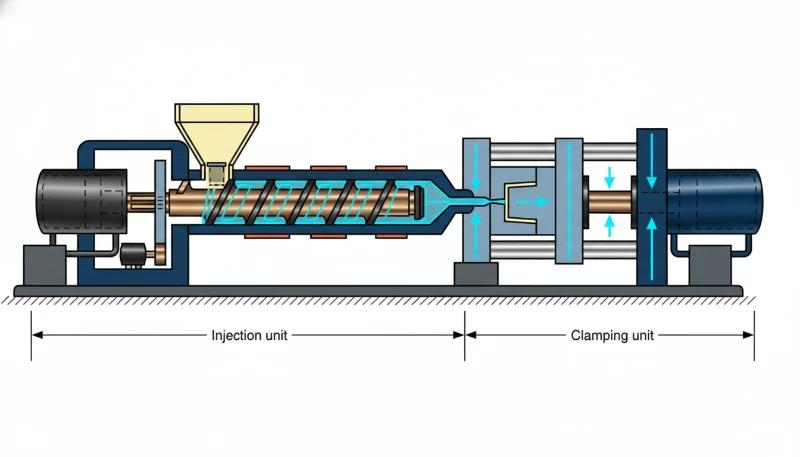
Na nossa experiência, ao trabalhar com mais de 400 materiais em 47 máquinas, o parâmetro mais subajustado é a pressão de retorno. A maioria dos operadores deixa-a no padrão de fábrica. Isso é aceitável para PP ou PE. Para nylon com fibra de vidro ou policarbonato de alta temperatura, significa deixar qualidade em cima da mesa.
Considere esses cinco parâmetros como um sistema, não como controles independentes. O aumento da contrapressão acrescenta calor de cisalhamento, o que pode exigir a redução das temperaturas do cilindro. O aumento da velocidade da rosca produz o mesmo efeito. Cada alteração gera consequências em cadeia. Os melhores operadores ajustam um parâmetro por vez e observam o resultado por pelo menos 10 ciclos consecutivos antes de fazer a próxima alteração.
Antes de detalhar cada configuração, este é o esquema rápido que usamos no chão de fábrica: primeiro ajuste as temperaturas (cilindro e molde), depois as pressões (contrapressão e recalque), em seguida as velocidades (rosca e injeção) e, por fim, refine os tempos (recalque e resfriamento). Essa sequência minimiza o número de variáveis alteradas ao mesmo tempo e sistematiza a solução de problemas.
Como selecionar e fazer a manutenção dos bicos de injeção?
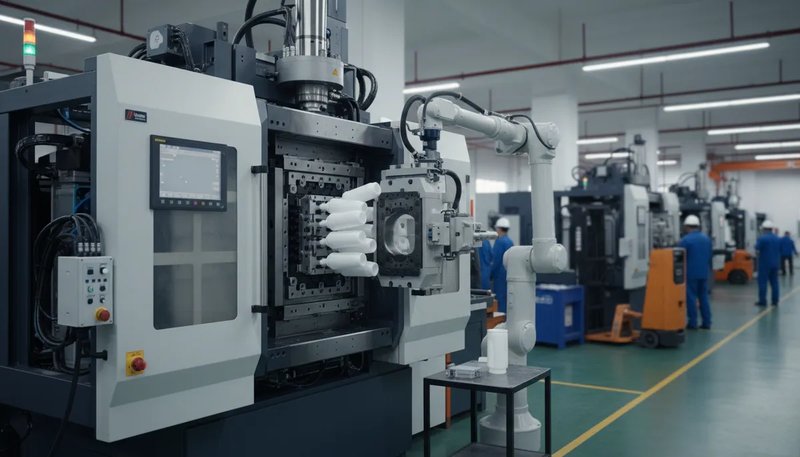
Bicos abertos funcionam em 90% das produções. São mais baratos, simples e têm menos pontos mortos onde o material pode se degradar. Use bicos fechados (com válvula de fechamento) somente ao processar resinas de baixa viscosidade, como PA6 ou POM, em uma máquina sem retração da rosca — e, mesmo assim, a válvula de fechamento precisa ser inspecionada a cada 2,000 ciclos.
O raio da ponta do bico deve ser 0,5 mm menor que o raio da bucha do canal de alimentação. Uma diferença de 1 mm no diâmetro parece insignificante, mas causa gotejamento, formação de fios e material frio no canal. Verificamos o alinhamento do bico a cada troca de molde — leva 30 segundos com um medidor de altura e evita horas de defeitos.
Para materiais sensíveis à mistura (mudanças de cor de masterbatch, misturas retardantes de chama), considere adicionar um misturador estático entre o cilindro e o bico. Ele acrescenta 50 mm ao percurso do fundido, mas reduz os defeitos de estrias de cor em cerca de 60%. O compromisso é um pequeno aumento da queda de pressão — cerca de 10–15 bar — compensado pela elevação da pressão de injeção.
A manutenção do bico é uma daquelas tarefas que são ignoradas quando a produção está intensa. Porém, um bico com acúmulo de resíduos carbonizados altera o diâmetro efetivo do orifício, o que muda a taxa de cisalhamento e a temperatura do fundido no ponto de injeção. Programamos a remoção e limpeza dos bicos a cada 3,000 ciclos para resinas de engenharia e a cada 5,000 para materiais de uso geral.
Por que a contrapressão determina a qualidade da massa fundida?
Esta secção explica por que motivo a contrapressão pode determinar a qualidade do material fundido e qual é o seu impacto no custo, na qualidade, nos prazos ou no risco de fornecimento. A contrapressão é a definição mais subestimada numa máquina de moldação por injeção — controla diretamente a homogeneidade do material fundido, a uniformidade da cor e a estabilidade do peso entre injeções. Para a maioria das resinas de engenharia, o intervalo ideal é de 5–15 bar. Se for demasiado baixa (0–3 bar), surgem grânulos não fundidos, variações de cor e um peso de injeção irregular. Se for demasiado alta (25+ bar), obtém-se um tempo de ciclo3 mais longo, calor de corte excessivo e desgaste acelerado do fuso.
A gama prática para a maioria das resinas de engenharia é de 5–15 bar. Comece em 8 bar, faça uma injeção ao ar e verifique se a extrusão é consistente. Se o fundido tiver um aspeto leitoso ou apresentar grânulos visíveis, aumente em incrementos de 2 bar. Para PC ou PEEK, podem ser necessários 12–18 bar devido à sua elevada viscosidade.
Um erro comum é aumentar contrapressão para compensar fuso gasto. Funciona temporariamente, mas a solução é inspecionar fuso e cilindro. Se a almofada deriva e a recuperação aumenta, a folga pode superar 0.5 mm; nenhum ajuste restaurará a consistência.
Outra questão subtil: a contrapressão interage com a descompressão do fuso (recuo). Se utilizar contrapressão elevada e depois aplicar um recuo agressivo, pode puxar bolhas de ar para o material fundido. A correção é simples — reduza ligeiramente a contrapressão ou reduza a distância de recuo para 2–3 mm. Em máquinas de cilindro ventilado que processam resinas higroscópicas, é especialmente importante controlar esta combinação.
"Aumentar a contrapressão de 3 bar para 10 bar pode reduzir em mais de 50% os defeitos de espiral de cor nas peças de ABS."True
Uma contrapressão mais alta melhora a dispersão do corante no material fundido ao forçá-lo através das folgas mais estreitas entre os filetes da rosca e a parede do cilindro, produzindo pigmentação mais uniforme em todo o volume de injeção.
"Uma contrapressão mais elevada produz sempre peças de melhor qualidade."False
A contrapressão excessiva (acima de 20 bar para a maioria das resinas) gera calor de cisalhamento demais, degrada as cadeias poliméricas, aumenta o tempo de ciclo devido à recuperação mais longa da rosca e acelera o desgaste da rosca e do cilindro. O valor ideal é específico do material e normalmente fica entre 5 e 15 bar.
Como é que a velocidade do parafuso afeta a plastificação e a consistência das peças?
A velocidade do parafuso determina diretamente a uniformidade da temperatura de fusão e a consistência da cor — para a maioria das máquinas, 50–100 rpm é a gama ideal. Rotação mais rápida gera mais calor por fricção, mas produz fusão menos uniforme; rotação mais lenta proporciona melhor mistura, mas pode não terminar a recuperação antes da abertura do molde. O segredo é ajustar a velocidade do parafuso para que a recuperação termine 1–2 segundos antes da abertura do molde.
Regra prática: ajuste a velocidade da rosca para que a recuperação termine 1–2 segundos antes da abertura do molde. Se a rosca ainda estiver se recuperando quando o molde abrir, você estará perdendo tempo de resfriamento e criando pressão desnecessária sobre o operador. Se a recuperação terminar muito antes da abertura, reduza a velocidade da rosca e o aquecimento por cisalhamento.
Materiais diferentes exigem velocidades de rosca distintas. PVC e PMMA são sensíveis ao cisalhamento — mantenha a velocidade abaixo de 60 rpm para evitar degradação. POM e PA66 toleram 80–120 rpm. Apesar das altas temperaturas de fusão, PEEK e LCP se beneficiam de uma velocidade moderada (40–80 rpm), pois sua baixa viscosidade exige menos aquecimento por cisalhamento.
A velocidade do fuso também afeta a consistência da cor. A velocidades muito baixas (<30 rpm), o fundido pode não ficar suficientemente homogéneo para obter uma cor uniforme. A velocidades muito elevadas (>120 rpm em máquinas pequenas), pode ocorrer um sobreaquecimento localizado que provoca estrias de cor ou queimaduras. Uma velocidade intermédia, combinada com uma contrapressão adequada, proporciona os melhores resultados tanto para a qualidade do fundido como para a uniformidade da cor.
O que é a almofada da rosca e por que ela deve permanecer constante?
A almofada da rosca² é a pequena quantidade de fundido deixada à frente da rosca no fim da injeção. Em máquinas pequenas, a meta é 3 mm. Em máquinas grandes (1000T+), 6–9 mm. O número exato importa menos que a consistência — se a almofada variar 2 mm entre ciclos, o peso da peça flutuará e as dimensões se desviarão.
Máquinas modernas mantêm a almofada em ±0,1 mm. Se houver variação de ±1 mm, verifique: (1) vazamento na válvula de retenção, (2) alimentação inconsistente, (3) cilindro desgastado na zona de dosagem. Em nossa fábrica, a consistência da almofada é a primeira verificação quando um cliente relata variação dimensional em uma peça que antes funcionava bem.
A retração da rosca (descompressão) é relacionada, mas diferente. Após a injeção e antes da abertura do molde, a rosca recua ligeiramente para descomprimir o material fundido e evitar o gotejamento do bico. A descompressão típica é de 3–5 mm. Em cilindros ventilados que processam materiais higroscópicos, reduza-a para 2 mm — puxar ar para o material fundido cria bolhas que aparecem como estrias prateadas na superfície da peça.
Grânulos de resina plástica translúcidos amarelos
Como calcular e verificar a capacidade de plastificação?
A capacidade de plastificação³ é a velocidade à qual a sua máquina consegue fundir uniformemente o material, expressa em kg/h de equivalente de PS. Todas as máquinas apresentam esta especificação no manual. O problema é que a maioria das pessoas nunca verifica se o tempo de ciclo real excede a capacidade de fusão da máquina.
Utilize esta fórmula: tmín = (peso total da injeção em g × 3600) ÷ (taxa de plastificação em kg/h × 1000). Se o tempo de ciclo real for inferior a tmín, a máquina não consegue fundir o material com rapidez suficiente — observará uma viscosidade irregular, enchimentos incompletos nas cavidades posteriores e variações do brilho superficial ao longo da injeção.
Isto é especialmente crítico para moldes multicavidade com pesos de injeção elevados. Se o cálculo indicar que está a utilizar 85% ou mais da capacidade de plastificação, deve prolongar o tempo de arrefecimento, reduzir o número de cavidades ou mudar para uma máquina maior. Operar no limite da capacidade de plastificação é uma receita para gerar sucata.
Outra consideração: a capacidade de plastificação diminui ao longo da vida útil da máquina. Uma rosca desgastada, com maior folga nos filetes, não consegue gerar o mesmo cisalhamento e compressão que uma nova. Se você notar que peças de uma máquina mais antiga apresentam consistentemente mais variação de cor ou material não fundido que o mesmo molde em uma máquina mais nova, meça a rosca e o cilindro. Um desgaste de 0,3–0,5 mm no diâmetro dos filetes pode reduzir a capacidade efetiva de plastificação em 15–25%.
Por que o controle da temperatura do material fundido é crítico?
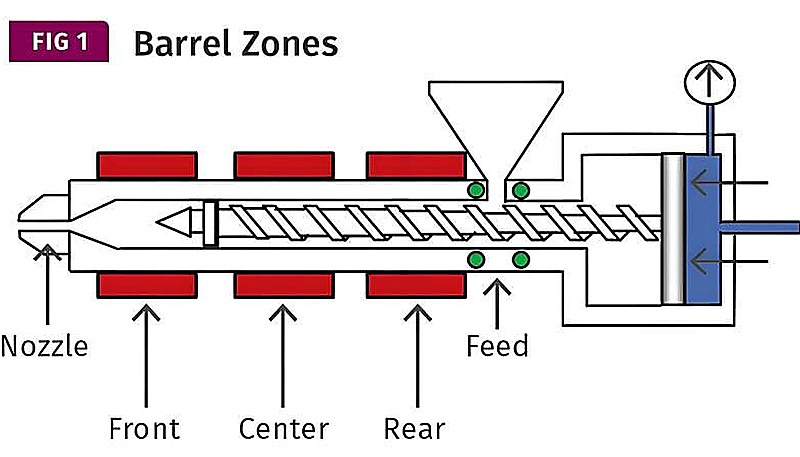
Os ajustes de temperatura do cilindro da máquina não correspondem à temperatura do fundido. Eles são os pontos de ajuste das cintas de aquecimento. A temperatura real do fundido é afetada pela velocidade da rosca, contrapressão, volume de injeção e tempo de residência⁵. A única maneira confiável de conhecer a temperatura do fundido é medi-la no bico com um pirômetro ou pelo método de injeção ao ar.
Para purgas ao ar, utilize luvas resistentes ao calor e uma viseira. Extruda uma pequena quantidade de fundido para um recipiente metálico e introduza uma sonda de termopar pré-aquecida. A leitura deve situar-se dentro de ±5 °C do intervalo recomendado pelo fornecedor do material. Se estiver 10–15 °C acima, o aquecimento por cisalhamento resultante da velocidade do fuso e da contrapressão está a adicionar energia em excesso — reduza um ou ambos.
O perfil de temperatura também é importante. Ajuste a zona traseira, de alimentação, para a menor temperatura a fim de evitar fusão prematura e formação de pontes. Aumente-a gradualmente em direção ao bico. A ponta do bico pode ficar 5–10 °C abaixo da zona dianteira para evitar gotejamento. Se você não tiver experiência com determinada resina, comece sempre pela menor temperatura recomendada e aumente em incrementos de 5 °C.
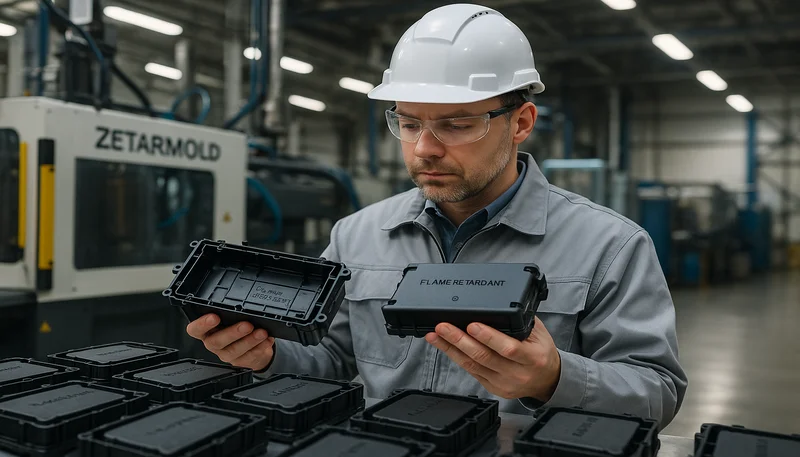
Na ZetarMold, a nossa fábrica de Xangai opera 47 máquinas de moldagem por injeção, desde 90T até 1850T. Com mais de 20 anos de experiência em moldagem desde 2005 e 8 engenheiros de moldes seniores na equipa, padronizamos a verificação da temperatura de fusão como parte de cada configuração de produção — antes da aprovação do primeiro artigo, o operador deve confirmar que a temperatura real de fusão do bico está dentro de ±5 °C da folha de processo.
"Medir a temperatura do material fundido através de uma injeção ao ar é mais preciso do que confiar nos valores definidos para os aquecedores do cilindro."True
Os termopares do cilindro estão embutidos na parede de aço e medem a temperatura do aço, não a do polímero. O aquecimento por corte causado pela rotação do parafuso e contrapressão pode elevar a temperatura real do fundido 10–30 °C acima do valor definido, tornando essencial a medição direta.
"Para simplificar, todas as zonas de aquecimento devem ser reguladas para a mesma temperatura."False
Um perfil de temperatura adequado começa mais frio na zona de alimentação para evitar a formação de pontes, aumenta ao longo da zona de transição para promover a fusão progressiva e pode ser ligeiramente menor na ponta do bico para evitar gotejamento. Configurações uniformes em todas as zonas causam problemas de alimentação e fusão inconsistente.
E quanto ao tempo de residência e à degradação do material?
O tempo de residência — quanto tempo o plástico permanece no cilindro aquecido — é o principal fator de degradação térmica na moldagem por injeção. Cada polímero tem um tempo máximo seguro de residência a uma determinada temperatura; excedê-lo resulta em perda de peso molecular, descoloração, geração de gases e peças enfraquecidas que podem passar na inspeção visual, mas falham em serviço.
Calcule-o: tpermanência = (volume do cilindro em g × tempo de ciclo em s) ÷ (peso da injeção em g × 300). Este cálculo fornece um valor aproximado. O valor real é sempre superior, porque o material fica retido em zonas mortas. Para trabalhos de precisão, faça um teste de purga com cor: adicione grânulos coloridos e meça o tempo até a cor surgir na injeção.
O maior risco: máquinas com cilindros grandes operando com pesos de injeção pequenos. Se a injeção utilizar menos de 30% da capacidade do cilindro, o tempo de residência poderá facilmente ultrapassar os limites seguros. A solução é usar uma máquina menor ou purgar o cilindro a cada 15–20 minutos durante operações prolongadas. Para materiais como POM ou PVC, que se degradam intensamente, deve-se evitar totalmente a utilização de injeção abaixo de 20%.
Observe os primeiros sinais de degradação: estrias prateadas (splay), descoloração marrom-clara ou amarelada, um leve odor acre no bico ou uma redução gradual do peso da peça sem qualquer alteração no processo. Todos indicam que o material está se decompondo no cilindro. Ao identificá-los, pare e faça a purga imediatamente — continuar processando material em degradação contamina o cilindro e agrava o problema nas injeções seguintes.
Como a temperatura do molde deve ser controlada?
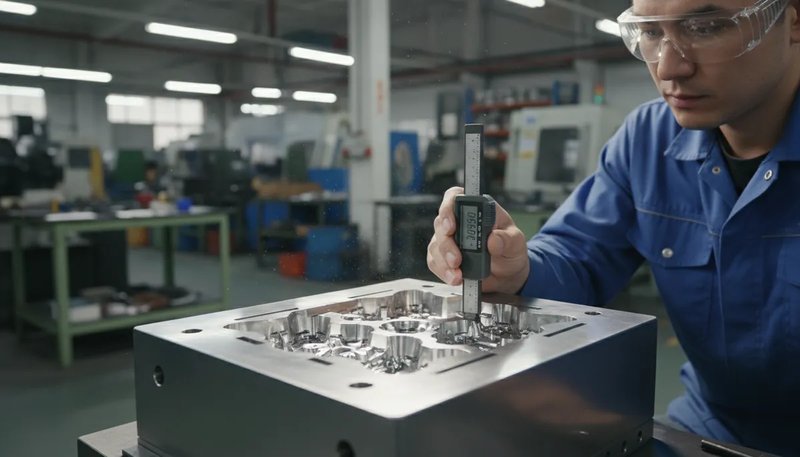
Esta secção trata do controlo da temperatura do molde e do seu impacto no custo, qualidade, tempo ou risco de aprovisionamento. A temperatura do molde deve ser verificada com um termómetro de contacto na superfície da cavidade — nunca confiar no visor do termorregulador, que pode diferir em 5–15 °C. Para peças de tolerância apertada, mantenha a variação dentro de ±2 °C utilizando termorreguladores individuais por circuito. A temperatura do molde controla diretamente o acabamento superficial, a cristalinidade, a retração e a deformação.
Sempre verifique a temperatura do molde com um termômetro de contato na superfície da cavidade, não pela leitura do termorregulador. O visor mostra a temperatura do fluido refrigerante na unidade, que pode diferir da superfície real da cavidade em 5–15 °C conforme o comprimento do circuito, a vazão e o acúmulo de incrustações nos canais.
Para peças com tolerâncias apertadas, mantenha a variação da temperatura do molde dentro de ±2 °C. Na nossa fábrica, isto significa utilizar termorreguladores individuais por circuito do molde nos moldes críticos — e não ligar vários circuitos em cadeia a uma única unidade. Sim, o equipamento custa mais. Mas o retrabalho e o desperdício decorrentes do desvio dimensional custam ainda mais, sobretudo em moldes multicavidade nos quais um circuito a funcionar 5 °C mais quente deixa metade das cavidades fora de especificação.
Um erro comum: definir a temperatura do molde com base no que funcionou para um material semelhante em outro molde. O tamanho do molde, o layout do circuito e a espessura da parede afetam a temperatura que a superfície da cavidade realmente atinge. Um ajuste de 60 °C em um molde pequeno e simples pode produzir 55 °C na superfície, enquanto o mesmo ajuste em um molde grande com circuitos de resfriamento longos pode atingir apenas 42 °C. Meça cada molde, sempre.
Por que a refrigeração uniforme é mais importante do que a refrigeração rápida?
Um arrefecimento uniforme é mais importante do que um arrefecimento rápido, devido aos compromissos de custo, qualidade, volume e aplicação. A maioria dos operadores tenta arrefecer o molde o mais depressa possível para reduzir o tempo indicado no guia completo de projeto de moldes de injeção. A velocidade é importante, mas a uniformidade é ainda mais. Um arrefecimento desigual causa contração diferencial, que provoca empeno, tensões internas e dimensões fora da tolerância — mesmo que o tempo de ciclo pareça excelente no papel.
A técnica contraintuitiva: usar água mais fria no macho (interior da peça) e água mais quente na cavidade (exterior). Isto equaliza a velocidade de arrefecimento entre secções espessas e finas. Em peças planas e de precisão — como lentes óticas, superfícies de vedação ou carcaças de acoplamento — esta medida, por si só, pode reduzir o empeno em 40–60%.
Verifique a vazão do circuito de resfriamento a cada troca de molde. Um circuito que fornecia 12 L/min no último lote pode cair para 4 L/min devido ao acúmulo de incrustações. Com vazão baixa, o fluxo turbulento se torna laminar, a transferência de calor diminui 30–50% e as temperaturas cuidadosamente definidas perdem o sentido. Se a vazão cair abaixo de 60% da original, limpe ou substitua o circuito antes da produção.
Em moldes multicavidade, equilibrar o resfriamento entre as cavidades é fundamental. A cavidade mais próxima da entrada de água sempre resfria mais rapidamente. Use restritores de fluxo ou circuitos individuais por cavidade para uniformizar o resfriamento. Em moldes de oito cavidades, medimos uma diferença de temperatura de 8 °C entre a primeira e a última cavidade em um único circuito em série — suficiente para produzir variação dimensional mensurável entre as peças.
Quais são as dicas mais ignoradas pelos moldadores por injeção?
As dicas mais negligenciadas pelos moldadores por injeção são as principais categorias ou opções explicadas nesta seção. Além das cinco configurações essenciais, vários fatores secundários surpreendem as pessoas regularmente:
Dica 14: verifique a válvula antirretorno. A válvula de retenção anular na ponta do fuso desgasta-se gradualmente. Quando a folga excede 0,1 mm, perde-se a uniformidade da pressão de manutenção. Inspecione-a a cada 500 000 injeções ou sempre que a variação da almofada exceder ±0,5 mm. Uma válvula antirretorno de substituição custa algumas centenas de dólares; produzir com uma válvula desgastada custa milhares em desperdício.
Dica 15: ventile corretamente o molde. O ar retido causa queimaduras, efeito Diesel e enchimentos incompletos em zonas sem saída. Os canais de ventilação devem ter 0,01–0,02 mm de profundidade na linha de junta e estar limpos — não devem ficar fechados pelo polimento de rebarbas anteriores. Adicione pinos de ventilação no fim dos percursos de fluxo e em bolsas cegas onde o ar fica naturalmente retido.
Dica 16: seque corretamente o material. As resinas higroscópicas (PC, nylon, PET, TPU) absorvem humidade, que causa estrias prateadas, degradação molecular e enfraquecimento das linhas de união. O PC deve ser seco a 120 °C durante 3–4 horas, com um ponto de orvalho inferior a –20 °C. Um material que «parece seco» não está necessariamente seco — verifique-o com um analisador de humidade antes de cada produção.
Dica 17: registe tudo. Cada alteração de parâmetro, cada leitura de temperatura e cada dimensão das cavidades nas primeiras 10 injeções. Quando surgirem problemas no terceiro dia de produção, precisará desses valores de referência. Exigimos que todos os operadores preencham um registo de preparação antes da aprovação da primeira peça. Os 10 minutos gastos na documentação poupam horas de atribuição de culpas mais tarde.
Dica 18: confie nos dados, não na intuição. Se a ficha do processo indicar material fundido a 240 °C e molde a 60 °C, e as peças tiverem bom aspeto, não «otimize por instinto» na produção seguinte. Janelas de processo documentadas e repetíveis superam sempre o julgamento do operador. É assim que se obtém uma qualidade consistente com mais de 120 trabalhadores de produção em vários turnos.
Quais são as perguntas mais frequentes sobre dicas de moldagem por injeção?
18 Dicas Importantes Para Moldadores por Injeção | ZetarMold
A pressão de retorno ideal para a maioria das resinas de engenharia é de 5–15 bar. Comece com 8 bar para materiais de uso geral como ABS e PP. Aumente para 12–18 bar para resinas de alta viscosidade, como policarbonato ou PEEK. Exceder 20 bar oferece retornos de qualidade decrescentes, enquanto acelera o desgaste do parafuso e prolonga o tempo de ciclo. Verifique sempre o resultado com uma verificação de injecção a ar. Nas nossas 47 máquinas, que trabalham com mais de 400 materiais, verificamos que manter a pressão de retorno entre 8–12 bar abrange aproximadamente 80% dos trabalhos de produção sem problemas.
Qual volume de colchão da rosca devo manter?
Mantenha uma almofada de 3 mm em máquinas abaixo de 300T e de 6–9 mm em máquinas acima de 1000T. A métrica principal é a consistência — a almofada não deve variar mais de ±0.5 mm entre injeções. Variações maiores normalmente indicam válvula antirretorno desgastada, alimentação inconsistente ou desgaste do cilindro na zona de dosagem. Verifique e elimine a causa-raiz, em vez de compensá-la com outros parâmetros. Em nossa fábrica, os operadores registram os valores a cada 50 injeções; qualquer tendência superior a ±1 mm aciona uma inspeção da válvula antes da continuação da produção.
Como verifico a temperatura real do material fundido?
Use o método de purga ao ar com uma sonda de pirômetro preaquecida. Usando luvas resistentes ao calor e protetor facial, extrude uma pequena amostra do material fundido em um recipiente metálico e insira a sonda imediatamente. A leitura deve ficar dentro de ±5 °C da faixa indicada na ficha técnica do material. Os valores ajustados nos aquecedores do cilindro não são indicadores confiáveis da temperatura do material fundido, pois o aquecimento por cisalhamento gerado pela rotação da rosca pode elevar a temperatura real em 10–30 °C acima desses valores. Para trabalhos críticos, recomendamos fazer leituras de purga ao ar no início de cada turno e após qualquer alteração de velocidade ou contrapressão.
Porque é que as minhas peças moldadas por injeção estão a empenar?
O empenamento ocorre quando a variação da taxa de arrefecimento excede 15 °C ao longo da peça, geralmente devido a uma espessura de parede não uniforme que excede uma proporção de 3:1 ou a um projeto inadequado do circuito de arrefecimento. Corrija primeiro a uniformidade do arrefecimento, usando água mais fria no lado do núcleo e água mais quente no lado da cavidade. Esta técnica de arrefecimento diferencial reduz o empenamento em 40–60% em peças planas de precisão sem alterar significativamente o tempo de ciclo. Verifique também se a posição do ponto de injeção permite um enchimento equilibrado — o enchimento assimétrico cria tensões internas que amplificam o empenamento mesmo quando o arrefecimento é uniforme.
Com que frequência os bicos de moldagem por injeção devem ser inspecionados?
Inspecione os bicos abertos a cada troca de molde quanto ao alinhamento e ao desgaste do raio da ponta — o raio da ponta deve ser 0.5 mm menor que o raio da bucha do canal de injeção. Inspecione os bicos de fechamento (fechados) a cada 2,000 ciclos quanto à integridade do assentamento da válvula. Programe a remoção e a limpeza dos bicos a cada 3,000 ciclos para resinas de engenharia e a cada 5,000 ciclos para materiais de uso geral, a fim de evitar o acúmulo de resíduos carbonizados. Durante os meses de pico de produção, nossa equipe remove os bicos semanalmente nas máquinas que processam náilon com fibra de vidro, pois o desgaste abrasivo acelera significativamente com compostos carregados.
O que acontece quando o tempo de residência no cilindro é longo demais?
O tempo de residência excessivo causa degradação térmica: o peso molecular diminui, surge descoloração (tom amarelo ou marrom), a geração de gases aumenta e as propriedades mecânicas se deterioram. O risco é maior quando o peso da injeção utiliza menos de 30% da capacidade do cilindro. Purgue o cilindro a cada 15–20 minutos durante essas operações ou use uma máquina menor. Observe sinais iniciais, como estrias prateadas ou odor acre. Calcule o tempo de residência dividindo o volume do cilindro pelo volume da injeção e multiplicando pelo tempo de ciclo — se exceder 5 minutos para a maioria das resinas de engenharia, você estará na zona de degradação.
Como calculo se a minha máquina tem capacidade de plastificação suficiente?
Divida o peso total da injeção em gramas por 1000, multiplique por 3600 e divida pela capacidade nominal de plastificação da máquina em kg/h. O resultado é o tempo de ciclo mínimo em segundos. Se o tempo de ciclo real for inferior a este mínimo calculado, a máquina não consegue fundir o material com rapidez suficiente para garantir uma qualidade consistente — surgirão variações de viscosidade e defeitos superficiais. Inclua sempre uma margem de 10–15% acima do mínimo calculado para ter em conta as variações entre lotes de material e as alterações da temperatura ambiente que afetam a produtividade real.
Todos os circuitos de refrigeração do molde devem utilizar a mesma temperatura da água?
Não. Para peças com variação significativa de espessura de parede, use resfriamento diferencial: água mais fria (10–15 °C abaixo) no macho e água mais quente no lado da cavidade. Isso equaliza as taxas de resfriamento entre as seções grossas e finas, reduzindo o empenamento em 40–60%. Em moldes de múltiplas cavidades, use circuitos individuais por cavidade ou restritores de fluxo para equilibrar o resfriamento entre todas elas. Em nossa unidade de Xangai, verificamos as vazões dos circuitos de resfriamento a cada troca de molde com um medidor de vazão — qualquer circuito com vazão inferior a 80% da taxa de projeto é desincrustado ou substituído antes do início da produção.
contrapressão: a contrapressão é a resistência aplicada ao fuso durante o curso de recuperação, medida em bar ou MPa, que controla a homogeneidade do material fundido e a qualidade da mistura no cilindro de injeção. ↩
almofada: a almofada, também denominada almofada do fuso, corresponde ao pequeno volume de plástico fundido que permanece à frente da ponta do fuso no fim da injeção, normalmente 3–9 mm, assegurando uma transferência de pressão uniforme para a cavidade. ↩
tempo de ciclo: o tempo de ciclo é o tempo total decorrido desde o início de uma injeção até ao início da seguinte, medido em segundos, e abrange as fases de injeção, manutenção, arrefecimento e ejeção. ↩