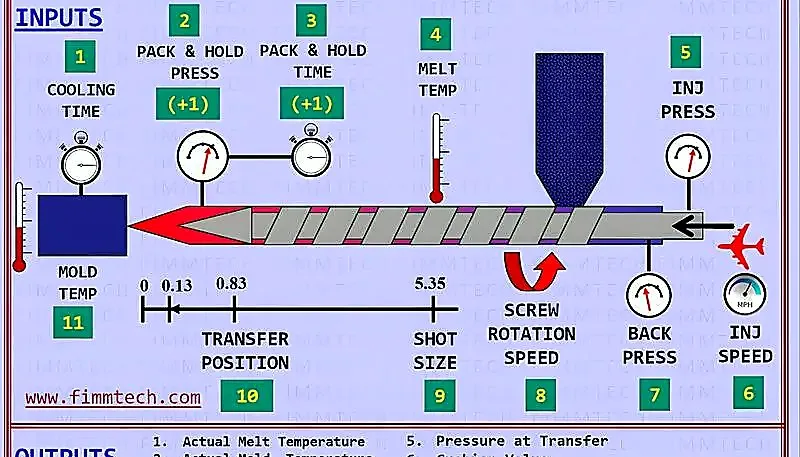
Al configurar el cushion, recuerda: el valor de cushion que programas en el controlador de la máquina supone que el punto cero del tornillo es correcto. Después de un pull del tornillo y limpieza, siempre vuelve a cero la posición del tornillo. Hemos visto casos donde un cushion de 3 mm era en realidad 0 mm porque el punto cero se desplazó durante el reensamblaje — resultando en ninguna transferencia de presión de retención y 100% short shots en el primer intento de setup.
Este artículo presenta 18 consejos prácticos que importan de verdad, los que aplicamos cada día en nuestra guía completa del moldeo por inyección con 47 máquinas. Nada de teoría gratuita: solo aspectos que marcan la diferencia entre una producción estable y una crisis.
- Una contrapresión de 5–15 bar proporciona una masa fundida uniforme; por encima de 20 bar aumenta el desgaste con rendimientos decrecientes.
- El colchón de tornillo de 3–9 mm debe permanecer constante: incluso una desviación de 1 mm modifica el peso de la pieza.
- La temperatura del fundido debe medirse en la boquilla, no deducirse de los ajustes del cilindro.
- Una variación de ±2 °C en la temperatura del molde puede desplazar las dimensiones de la pieza entre 0.1–0.3 mm en resinas de ingeniería.
- La uniformidad de la refrigeración —no la velocidad— es el verdadero factor determinante de la estabilidad dimensional.
¿Cuáles son los ajustes más críticos de las máquinas de moldeo por inyección?
Los ajustes más críticos de las máquinas son las categorías que se explican en esta sección. Si está comparando proveedores o planificando compras, nuestra guía de selección de proveedores de moldeo por inyección aborda la preparación de RFQ, la homologación y las comprobaciones de riesgo comercial.
Los cinco ajustes que causan el 80% de los problemas son la contrapresión1, la velocidad del husillo, el colchón2, la temperatura de fusión y la temperatura del molde. Si son correctos, la mayoría de los defectos —llenado incompleto, rechupes y desviación dimensional— desaparecen sin perseguir parámetros secundarios.
En nuestra experiencia ejecutando más de 400 materiales en 47 máquinas, el ajuste único más subajustado es la contrapresión. La mayoría de los operadores la dejan en el valor predeterminado de fábrica. Eso está bien para PP o PE. Para nailon con carga de vidrio o policarbonato de alta temperatura, es dejar calidad sobre la mesa.
Considere estos cinco parámetros como un sistema, no como controles independientes. Aumentar la contrapresión añade calor por cizallamiento, por lo que quizá deba reducir las temperaturas del cilindro. Aumentar la velocidad del husillo produce el mismo efecto. Cada cambio genera consecuencias en cadena. Los mejores operarios ajustan un parámetro cada vez y observan el resultado durante al menos 10 inyecciones consecutivas antes de realizar el siguiente cambio.
Antes de analizar cada ajuste en detalle, este es el marco rápido que utilizamos en producción: primero se fijan las temperaturas (cilindro y molde), después las presiones (contrapresión y mantenimiento), luego las velocidades (husillo e inyección) y finalmente se afinan los tiempos (mantenimiento y enfriamiento). Esta secuencia minimiza las variables que cambian simultáneamente y sistematiza la resolución de problemas.
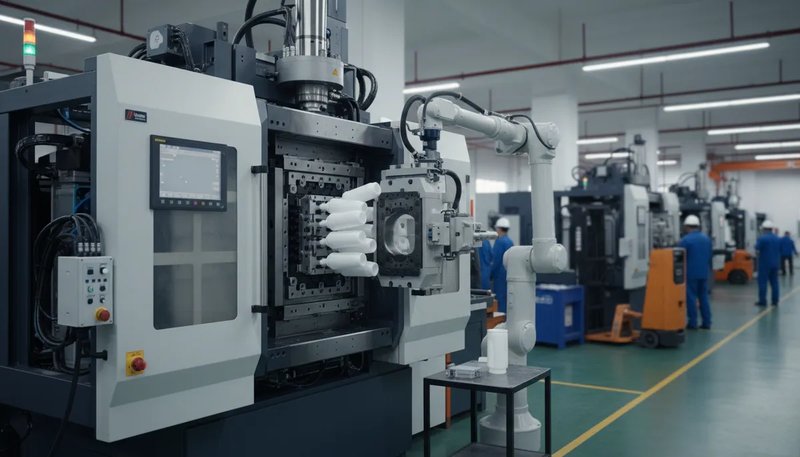
¿Cómo debe seleccionar y mantener las boquillas de inyección?
Las boquillas abiertas sirven para el 90% de las series de producción. Son más baratas, sencillas y tienen menos zonas muertas donde el material pueda degradarse. Use boquillas cerradas (de cierre) solo al procesar resinas de baja viscosidad como PA6 o POM en una máquina sin retracción del husillo; aun así, la válvula de cierre debe inspeccionarse cada 2,000 ciclos.
El radio de la punta de la boquilla debe ser 0.5 mm menor que el del casquillo del bebedero. Una diferencia de 1 mm de diámetro parece trivial, pero causa goteo, hilos y tapones fríos en el canal. Comprobamos la alineación en cada cambio de molde: tarda 30 segundos con un medidor de altura y evita horas de defectos.
Para materiales sensibles a la mezcla (cambios de color con masterbatch, mezclas retardantes de llama), considere añadir un mezclador estático entre el cilindro y la boquilla. Añade 50 mm al recorrido de la masa, pero reduce aproximadamente un 60% los defectos de vetas de color. La contrapartida es un ligero aumento de la caída de presión —unos 10–15 bar— que se compensa elevando la presión de inyección.
El mantenimiento de la boquilla es una de esas tareas que se omiten cuando la producción está muy ocupada. Sin embargo, la acumulación de residuos carbonizados en una boquilla cambia el diámetro efectivo del orificio, lo que altera la velocidad de cizallamiento y la temperatura de la masa fundida en la compuerta. Programamos la extracción y limpieza de las boquillas cada 3,000 ciclos para resinas de ingeniería y cada 5,000 para materiales de uso general.
¿Por qué la contrapresión determina la calidad de la masa fundida?
Esta sección explica por qué la contrapresión determina la calidad de la masa fundida y afecta al coste, la calidad, los plazos y el riesgo de suministro. Es el ajuste menos valorado de la máquina: controla directamente la homogeneidad, la uniformidad del color y la estabilidad del peso. Para la mayoría de las resinas de ingeniería, el intervalo óptimo es 5–15 bar. Con 0–3 bar aparecen gránulos sin fundir, remolinos de color y pesos irregulares; con 25+ bar se prolonga el tiempo de ciclo3, aumenta el calor de cizallamiento y se acelera el desgaste del husillo.
El intervalo práctico para la mayoría de las resinas de ingeniería es de 5–15 bar. Empiece con 8 bar, realice una purga al aire y compruebe que la extrusión sea uniforme. Si la masa fundida presenta un aspecto lechoso o contiene gránulos visibles, aumente en incrementos de 2 bar. Para PC o PEEK, puede necesitar 12–18 bar debido a su alta viscosidad.
Un error frecuente es aumentar la contrapresión para compensar un husillo desgastado. Funciona temporalmente, pero la solución real es inspeccionar el husillo y el cilindro. Si el colchón deriva y el tiempo de recuperación sigue aumentando, probablemente el filete del husillo esté desgastado más allá de una holgura de 0.5 mm. Ningún ajuste de contrapresión restaurará entonces la uniformidad del proceso.
Otro aspecto sutil: la contrapresión interactúa con la descompresión del husillo (retroceso). Si se utiliza una contrapresión alta y después se aplica un retroceso agresivo, pueden introducirse burbujas de aire en el material fundido. La solución es sencilla: reduzca ligeramente la contrapresión o reduzca la distancia de retroceso a 2–3 mm. En máquinas con cilindro ventilado que procesan resinas higroscópicas, es especialmente importante controlar esta combinación.
"Aumentar la contrapresión de 3 bar a 10 bar puede reducir en más de un 50% los defectos de remolino de color en las piezas de ABS."True
Una mayor contrapresión mejora la dispersión del colorante en el material fundido al forzarlo a pasar por holguras más estrechas entre los filetes del husillo y la pared del cilindro, lo que produce una pigmentación más uniforme en todo el volumen de la inyección.
"Una contrapresión mayor siempre produce piezas de mejor calidad."False
Una contrapresión excesiva (superior a 20 bar para la mayoría de las resinas) genera demasiado calor por cizallamiento, degrada las cadenas poliméricas, aumenta el tiempo de ciclo por la recuperación más lenta del husillo y acelera el desgaste del husillo y del cilindro. El valor óptimo depende del material y suele estar entre 5 y 15 bar.
¿Cómo afecta la velocidad del husillo a la plastificación y la uniformidad de las piezas?
La velocidad del husillo determina directamente la uniformidad de la temperatura de fusión y la consistencia del color — para la mayoría de las máquinas, 50–100 rpm es el rango óptimo. Una rotación más rápida genera más calor por fricción pero produce una fusión menos uniforme; una rotación más lenta da una mejor mezcla pero puede no terminar la recuperación antes de que el molde se abra. La clave es ajustar la velocidad del husillo para que la recuperación termine 1–2 segundos antes de que el molde se abra.
Regla práctica: ajuste la velocidad del husillo para que la recuperación termine 1–2 segundos antes de que se abra el molde. Si el husillo sigue recuperándose cuando se abre el molde, está perdiendo tiempo de refrigeración y ejerciendo una presión innecesaria sobre el operario. Si la recuperación termina mucho antes de que se abra el molde, puede reducir la velocidad del husillo y disminuir el calentamiento por cizallamiento.
Cada material exige una velocidad de husillo distinta. El PVC y el PMMA son sensibles al cizallamiento: mantenga la velocidad por debajo de 60 rpm para evitar la degradación. El POM y el PA66 toleran 80–120 rpm. El PEEK y el LCP, pese a sus altas temperaturas de fusión, se benefician de una velocidad moderada (40–80 rpm), ya que su baja viscosidad requiere menos calentamiento por cizallamiento.
La velocidad del husillo también afecta a la uniformidad del color. A velocidades muy bajas (<30 rpm), la masa fundida puede no ser suficientemente homogénea para lograr un color uniforme. A velocidades muy altas (>120 rpm en máquinas pequeñas), puede producirse un sobrecalentamiento localizado que cause vetas de color o quemaduras. Un valor intermedio, combinado con una contrapresión adecuada, ofrece los mejores resultados tanto en calidad de la masa fundida como en uniformidad del color.
¿Qué es el colchón del husillo y por qué debe mantenerse constante?
El colchón del husillo² es la pequeña cantidad de masa fundida que queda delante del husillo al final de la inyección. En máquinas pequeñas, el objetivo es 3 mm. En máquinas grandes (1000T+), 6–9 mm. El valor exacto importa menos que la uniformidad: si el colchón varía 2 mm entre inyecciones, fluctuarán el peso y las dimensiones de la pieza.
Las máquinas modernas pueden mantener el colchón dentro de ±0.1 mm. Si observa una variación de ±1 mm, compruebe: (1) fugas en la válvula antirretorno, (2) alimentación irregular y (3) desgaste del cilindro en la zona de dosificación. En nuestro taller, la uniformidad del colchón es lo primero que revisamos cuando un cliente informa de variación dimensional en una pieza que antes se producía correctamente.
La retracción del husillo (descompresión) está relacionada, pero es diferente. Después de la inyección y antes de abrir el molde, el husillo retrocede ligeramente para descomprimir el fundido y evitar el goteo de la boquilla. La descompresión habitual es de 3–5 mm. En cilindros ventilados que procesan materiales higroscópicos, reduzca la descompresión a 2 mm: introducir aire en el fundido crea burbujas que aparecen como vetas plateadas en la superficie de la pieza.
Al ajustar el colchón, recuerde que el valor programado en el controlador de la máquina supone que el punto cero del tornillo es correcto. Después de extraer y limpiar el tornillo, vuelva siempre a poner a cero su posición. Hemos visto casos en los que un colchón de 3 mm era en realidad de 0 mm porque el punto cero se desplazó durante el montaje, lo que produjo una transferencia nula de presión de mantenimiento y un 100% de llenados incompletos en el primer intento de configuración.
¿Cómo se calcula y verifica la capacidad de plastificación?
La capacidad de plastificación³ es la velocidad a la que su máquina puede fundir uniformemente el material, expresada en kg/h de equivalente de PS. Todas las máquinas incluyen esta especificación en el manual. El problema es que la mayoría de las personas nunca comprueba si el tiempo de ciclo real supera la capacidad de fusión de la máquina.
Utilice esta fórmula: tmin = (peso total de la inyección en g × 3600) ÷ (capacidad de plastificación en kg/h × 1000). Si el ciclo real es más corto que tmin, la máquina no puede fundir el material con suficiente rapidez y aparecerán viscosidad irregular, llenados incompletos en las últimas cavidades y variaciones de brillo.
Esto es especialmente crítico para moldes multicavidad con pesos de inyección elevados. Si el cálculo muestra que está al 85% o más de la capacidad de plastificación, debe prolongar el tiempo de enfriamiento, reducir el número de cavidades o pasar a una máquina más grande. Trabajar al límite de la capacidad de plastificación es una receta para generar rechazos.
Otra consideración: la capacidad de plastificación disminuye durante la vida útil de la máquina. Un husillo desgastado con mayor holgura entre filetes no puede generar el mismo cizallamiento y compresión que uno nuevo. Si observa que las piezas de una máquina antigua muestran sistemáticamente más variación de color o material sin fundir que el mismo molde en una máquina nueva, solicite medir el husillo y el cilindro. Un desgaste de 0.3–0.5 mm en el diámetro de los filetes puede reducir la capacidad efectiva de plastificación un 15–25%.
¿Por qué es crítica la gestión de la temperatura de la masa fundida?
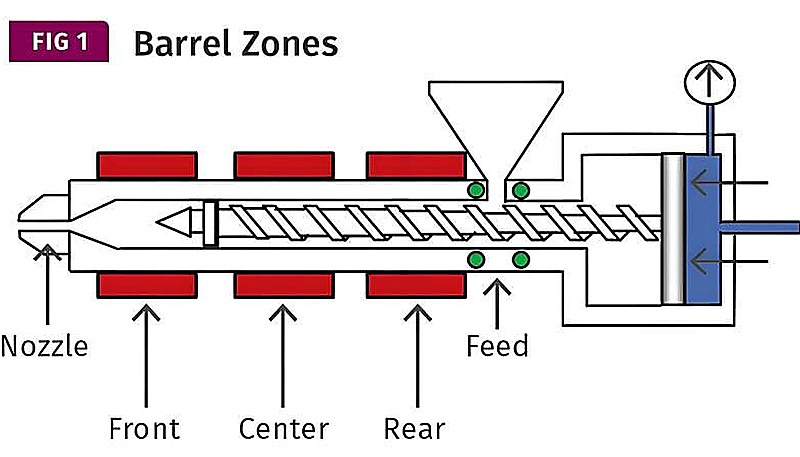
Los ajustes de temperatura del cilindro de su máquina no son la temperatura de la masa fundida. Son valores de consigna de las bandas calefactoras. La temperatura real de la masa fundida depende de la velocidad del tornillo, la contrapresión, el volumen de inyección y el tiempo de residencia⁵. La única forma fiable de conocer la temperatura de la masa fundida es medirla en la boquilla con un pirómetro o mediante el método de inyección al aire.
Para las purgas al aire, use guantes resistentes al calor y una pantalla facial. Extruya una pequeña cantidad de masa fundida en un recipiente metálico e introduzca una sonda de termopar precalentada. La lectura debe estar dentro de ±5 °C del intervalo recomendado por el proveedor del material. Si es 10–15 °C superior, el calentamiento por cizallamiento debido a la velocidad del husillo y la contrapresión está aportando demasiada energía — reduzca una o ambas.
El perfil de temperaturas también es importante. Ajuste la zona trasera —alimentación— a la temperatura más baja para evitar la fusión prematura y la formación de puentes. Aumente progresivamente la temperatura hacia la boquilla. La punta de la boquilla puede ajustarse 5–10 °C por debajo de la zona delantera para evitar el goteo. Si no tiene experiencia con una resina determinada, empiece siempre por la temperatura mínima recomendada y aumente en incrementos de 5 °C.
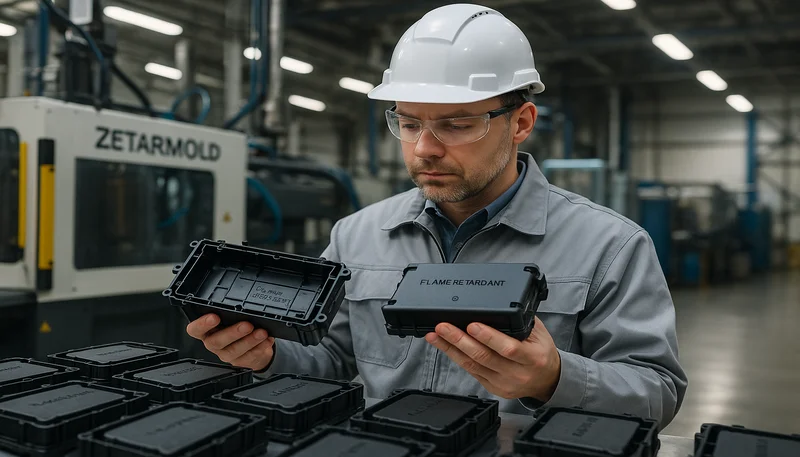
En ZetarMold, nuestra fábrica de Shanghai opera 47 máquinas de moldeo por inyección que van desde 90T hasta 1850T. Con más de 20 años de experiencia en moldeo desde 2005 y 8 ingenieros senior de moldes en plantilla, estandarizamos la verificación de la temperatura de fusión como parte de cada configuración de producción — antes de la aprobación de la primera pieza, el operador debe confirmar que la temperatura real de fusión en la boquilla esté dentro de ±5 °C de la hoja de proceso.
"Medir la temperatura de la masa mediante una purga al aire es más preciso que confiar en los valores configurados de los calentadores del cilindro."True
Los termopares del cilindro están embutidos en la pared de acero y miden la temperatura del acero, no la del polímero. El calentamiento por cizallamiento causado por la rotación del husillo y la contrapresión puede elevar la temperatura real de la masa fundida entre 10–30 °C por encima del valor ajustado en el cilindro, por lo que la medición directa es esencial para controlar el proceso.
"Todas las zonas de calentamiento deben configurarse a la misma temperatura para simplificar."False
Un perfil de temperatura correcto comienza más frío en la zona de alimentación para evitar puentes, aumenta a través de la zona de transición para una fusión progresiva y puede ser ligeramente inferior en la punta de la boquilla para evitar el goteo. Los ajustes uniformes en todas las zonas causan problemas de alimentación y una fusión inconsistente.
¿Qué ocurre con el tiempo de residencia y la degradación del material?
El tiempo de residencia — cuánto tiempo permanece el plástico en el cilindro calentado — es el principal impulsor de la degradación térmica en el moldeo por inyección. Cada polímero tiene un tiempo máximo seguro de residencia a una temperatura dada; si se excede, se produce pérdida de peso molecular, decoloración, generación de gases y piezas debilitadas que pueden pasar la inspección visual pero fallar en servicio.
Cálculo: tresidence = (volumen del cilindro en g × tiempo de ciclo en s) ÷ (peso de la inyección en g × 300). Es una aproximación; el tiempo real siempre es mayor porque el material queda retenido en zonas muertas. Para trabajos de precisión, realice una purga de color: añada gránulos coloreados y mida cuánto tardan en aparecer en la inyección.
El mayor riesgo son las máquinas con cilindros grandes que trabajan con pesos de inyección pequeños. Si la inyección utiliza menos del 30% de la capacidad del cilindro, el tiempo de residencia puede superar fácilmente los límites seguros. La solución es usar una máquina más pequeña o purgar el cilindro cada 15–20 minutos durante series prolongadas. Para materiales como POM o PVC, que se degradan de forma agresiva, debe evitarse por completo una utilización de inyección inferior al 20%.
Esté atento a los primeros indicios de degradación: vetas plateadas, decoloración marrón clara o amarillenta, un leve olor acre en la boquilla o una disminución gradual del peso de la pieza sin cambios en el proceso. Todos ellos indican que el material se está degradando en el cilindro. Cuando los observe, detenga la máquina y purgue de inmediato; seguir procesando material degradado contamina el cilindro y agrava el problema en las inyecciones posteriores.
¿Cómo debe controlarse la temperatura del molde?
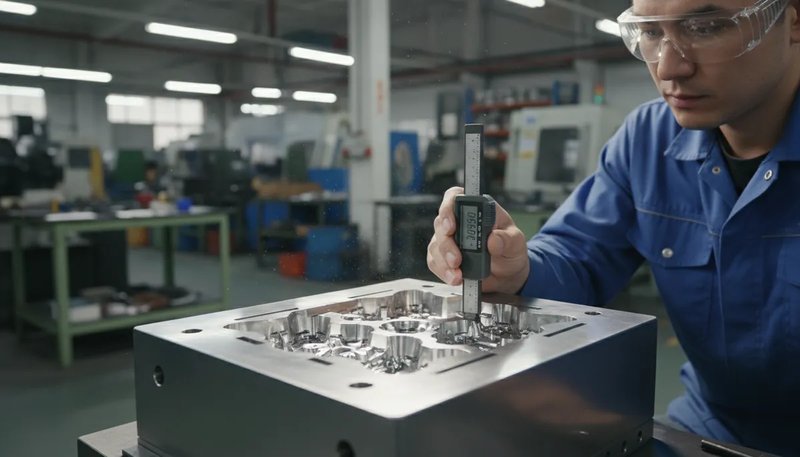
Esta sección trata sobre el control de la temperatura del molde y su impacto en el costo, la calidad, el tiempo o el riesgo de abastecimiento. La temperatura del molde debe verificarse con un termómetro de contacto en la superficie de la cavidad — nunca confiar en la pantalla del termorregulador, que puede diferir en 5–15 °C. Para piezas de tolerancia estrecha, mantenga la variación dentro de ±2 °C usando termorreguladores individuales por circuito. La temperatura del molde controla directamente el acabado superficial, la cristalinidad, la contracción y el alabeo.
Verifique siempre la temperatura del molde con un termómetro de contacto sobre la superficie de la cavidad, no leyendo la pantalla del termorregulador. La pantalla muestra la temperatura del refrigerante en la unidad, que puede diferir entre 5–15 °C de la superficie real de la cavidad según la longitud del circuito, el caudal y la acumulación de incrustaciones dentro de los canales.
Para piezas con tolerancias estrechas, mantenga la variación de temperatura del molde dentro de ±2 °C. En nuestra planta, esto implica utilizar termorreguladores individuales por circuito de molde para los moldes críticos, sin conectar varios circuitos en serie a una sola unidad. Sí, cuesta más en equipos. Pero el retrabajo y los desperdicios por desviaciones dimensionales cuestan aún más, especialmente en moldes multicavidad donde un circuito que funciona 5 °C más caliente deja la mitad de las cavidades fuera de especificación.
Un error común: ajustar la temperatura del molde según lo que funcionó para un material similar en otro molde. El tamaño del molde, la disposición de los circuitos y el espesor de pared afectan a la temperatura que alcanza realmente la superficie de la cavidad. Un ajuste de 60 °C en un molde pequeño y sencillo puede producir 55 °C en la superficie, mientras que el mismo ajuste en un molde grande con circuitos de refrigeración largos puede alcanzar solo 42 °C. Mida cada molde, siempre.
¿Por qué es más importante una refrigeración uniforme que una refrigeración rápida?
Un enfriamiento uniforme importa más que uno rápido por las contrapartidas de coste, calidad, volumen y aplicación. Muchos operarios intentan enfriar el molde lo antes posible para acortar el ciclo, como explica nuestra guía completa de diseño de moldes de inyección. La velocidad importa, pero la uniformidad más. Un enfriamiento desigual causa contracción diferencial, alabeo, tensiones internas y dimensiones fuera de tolerancia, aunque el ciclo parezca excelente.
La técnica contraintuitiva consiste en usar agua más fría en el núcleo (interior de la pieza) y agua más caliente en la cavidad (exterior). Esto iguala la velocidad de enfriamiento entre las secciones gruesas y delgadas. En piezas planas de precisión —como lentes ópticas, superficies de sellado o carcasas acopladas—, solo esta medida puede reducir el alabeo entre un 40 y un 60%.
Compruebe el caudal del circuito de refrigeración en cada cambio de molde. Un circuito que alcanzó 12 L/min en la última serie podría haber bajado a 4 L/min por la acumulación de incrustaciones. Un caudal bajo hace que el flujo turbulento se vuelva laminar, reduce la transferencia de calor un 30–50% y resta utilidad a las temperaturas ajustadas cuidadosamente. Si el caudal cae por debajo del 60% del original, limpie o sustituya el circuito antes de iniciar la producción.
En moldes multicavidad, equilibrar el enfriamiento entre cavidades es fundamental. La cavidad más cercana a la entrada de agua siempre se enfría más rápido. Utilice restrictores de caudal o circuitos individuales por cavidad para igualar el enfriamiento. En moldes de ocho cavidades hemos medido una diferencia de temperatura de 8 °C entre la primera y la última cavidad de un único circuito en serie, suficiente para producir una variación dimensional medible entre las piezas.
¿Cuáles son los consejos que más pasan por alto los moldeadores por inyección?
Los consejos que más suelen pasar por alto los moldeadores por inyección son las principales categorías u opciones explicadas en esta sección. Además de los cinco ajustes fundamentales, hay varios factores secundarios que sorprenden con frecuencia:
Consejo 14: Compruebe la válvula antirretorno. La válvula anular de la punta del husillo se desgasta gradualmente. Cuando la holgura supera 0.1 mm, se pierde uniformidad en la presión de mantenimiento. Inspecciónela cada 500,000 inyecciones o cuando la variación del colchón supere ±0.5 mm. Sustituirla cuesta unos cientos de dólares; producir con una desgastada genera miles en residuos.
Consejo 15: Ventile bien el molde. El aire atrapado causa quemaduras, efecto diésel y llenado incompleto en zonas sin salida. Los respiraderos deben tener 0.01–0.02 mm de profundidad en la línea de partición y estar limpios, no cerrados por el pulido de rebabas anteriores. Añada pasadores de ventilación al final de los flujos y en cavidades ciegas.
Consejo 16: Seque correctamente el material. Las resinas higroscópicas (PC, Nylon, PET, TPU) absorben humedad que causa ráfagas, degradación molecular y líneas de soldadura débiles. El PC debe secarse a 120 °C durante 3–4 horas con un punto de rocío inferior a –20 °C. Un material que parece seco no lo está: verifíquelo con un analizador de humedad antes de cada producción.
Consejo 17: Regístrelo todo. Cada cambio de parámetro, lectura de temperatura y dimensión de cavidad en las primeras 10 inyecciones. Si surgen problemas el tercer día, necesitará esa referencia. Exigimos que los operarios completen el registro de configuración antes de aprobar la primera pieza. Diez minutos de documentación ahorran horas de reproches.
Consejo 18: Confíe en los datos, no en la intuición. Si la ficha indica masa fundida a 240 °C y molde a 60 °C, y las piezas salen bien, no optimice a ojo en la siguiente producción. Las ventanas documentadas y repetibles siempre superan al criterio subjetivo. Así se mantiene una calidad uniforme con más de 120 trabajadores en varios turnos.
¿Cuáles son las preguntas más frecuentes sobre consejos de moldeo por inyección?
¿Cuál es la contrapresión ideal para el moldeo por inyección?
La contrapresión ideal para la mayoría de las resinas de ingeniería es de 5–15 bar. Comience en 8 bar para materiales de uso general como ABS y PP. Aumente a 12–18 bar para resinas de alta viscosidad como policarbonato o PEEK. Exceder los 20 bar proporciona rendimientos de calidad decrecientes mientras acelera el desgaste del husillo y extiende el tiempo de ciclo. Verifique siempre el resultado con una prueba de disparo al aire. En nuestras 47 máquinas que ejecutan más de 400 materiales, encontramos que mantener la contrapresión entre 8–12 bar cubre aproximadamente el 80% de los trabajos de producción sin problemas.
¿Qué colchón de tornillo debo mantener?
18 Consejos Importantes para Moldeadores por Inyección — Guía Práctica
¿Cómo verifico la temperatura real del material fundido?
Utilice el método de inyección al aire con una sonda de pirómetro precalentada. Extruda una pequeña muestra en un recipiente metálico con guantes térmicos y pantalla facial e introduzca la sonda inmediatamente. La lectura debe estar dentro de ±5 °C del intervalo de la ficha. Los puntos de ajuste del cilindro no son fiables porque el cizallamiento puede elevar la temperatura real 10–30 °C. En trabajos críticos, mida al inicio de cada turno y tras cambiar velocidad o contrapresión.
¿Por qué se alabean mis piezas moldeadas por inyección?
El alabeo se produce cuando la variación de la velocidad de enfriamiento supera 15 °C en la pieza, normalmente por un espesor de pared no uniforme con una relación superior a 3:1 o por un diseño inadecuado del circuito de enfriamiento. Corrija primero la uniformidad del enfriamiento haciendo circular agua más fría por el lado del núcleo y agua más caliente por el lado de la cavidad. Esta técnica de enfriamiento diferencial reduce el alabeo entre un 40–60% en piezas planas de precisión sin cambiar significativamente el tiempo de ciclo. Compruebe también que la ubicación de la compuerta permita un llenado equilibrado —el llenado asimétrico genera tensiones internas que amplifican el alabeo incluso cuando el enfriamiento es uniforme.
¿Con qué frecuencia deben inspeccionarse las boquillas de moldeo por inyección?
Inspeccione las boquillas abiertas en cada cambio de molde para comprobar la alineación y el desgaste del radio de la punta —el radio de la punta debe ser 0.5 mm menor que el radio del casquillo de bebedero—. Inspeccione las boquillas de cierre (cerradas) cada 2,000 ciclos para verificar la integridad del asiento de la válvula. Programe la extracción y limpieza de boquillas cada 3,000 ciclos para resinas de ingeniería y cada 5,000 ciclos para materiales de uso general, a fin de evitar la acumulación de residuos carbonizados. Durante los meses de máxima producción, nuestro equipo extrae semanalmente las boquillas de las máquinas que procesan nailon reforzado con vidrio, ya que el desgaste abrasivo se acelera considerablemente con los compuestos reforzados.
¿Qué ocurre si el tiempo de residencia en el cilindro es demasiado largo?
Un tiempo de residencia excesivo causa degradación térmica: disminuye el peso molecular, aparece decoloración (tono amarillo o marrón), aumenta la generación de gases y se deterioran las propiedades mecánicas. El riesgo es mayor cuando el peso del disparo utiliza menos del 30% de la capacidad del cilindro. Purgue el cilindro cada 15–20 minutos durante estas tiradas o cambie a una máquina más pequeña. Vigile señales tempranas como vetas plateadas u olor acre. Calcule el tiempo de residencia dividiendo el volumen del cilindro por el volumen del disparo y multiplicándolo por el tiempo de ciclo; si supera los 5 minutos para la mayoría de las resinas de ingeniería, se encuentra en la zona de degradación.
¿Cómo calculo si mi máquina tiene suficiente capacidad de plastificación?
Divida el peso total de la inyección en gramos por 1000, multiplíquelo por 3600 y divídalo por la capacidad nominal de plastificación de la máquina en kg/h. El resultado es el tiempo de ciclo mínimo en segundos. Si el ciclo real es más corto, la máquina no puede fundir material con suficiente rapidez para mantener una calidad uniforme: aparecerán variaciones de viscosidad y defectos superficiales. Incluya siempre un margen del 10–15% sobre el mínimo calculado para cubrir variaciones entre lotes y cambios de temperatura ambiente que afectan al rendimiento real.
¿Deben utilizar todos los circuitos de refrigeración del molde la misma temperatura del agua?
No. Para piezas con variaciones importantes de espesor, utilice refrigeración diferencial: agua más fría (10–15 °C menos) en el núcleo y más caliente en la cavidad. Esto iguala la refrigeración entre secciones gruesas y delgadas y reduce el alabeo un 40–60%. En moldes multicavidad, use circuitos individuales o restrictores de flujo. En nuestra planta de Shanghái verificamos el caudal en cada cambio mediante un medidor; cualquier circuito por debajo del 80% del caudal de diseño se desincrusta o sustituye antes de producir.
contrapresión: Resistencia aplicada al husillo durante su carrera de recuperación, medida en bar o MPa, que controla la homogeneidad y la calidad de mezcla en el cilindro de inyección. ↩
colchón: También llamado colchón del husillo, es el pequeño volumen de plástico fundido que queda delante de su punta al final de la inyección, normalmente 3–9 mm, y garantiza una transferencia uniforme de presión a la cavidad. ↩
tiempo de ciclo: Tiempo total desde el inicio de una inyección hasta el inicio de la siguiente, medido en segundos, que comprende inyección, mantenimiento, enfriamiento y expulsión. ↩