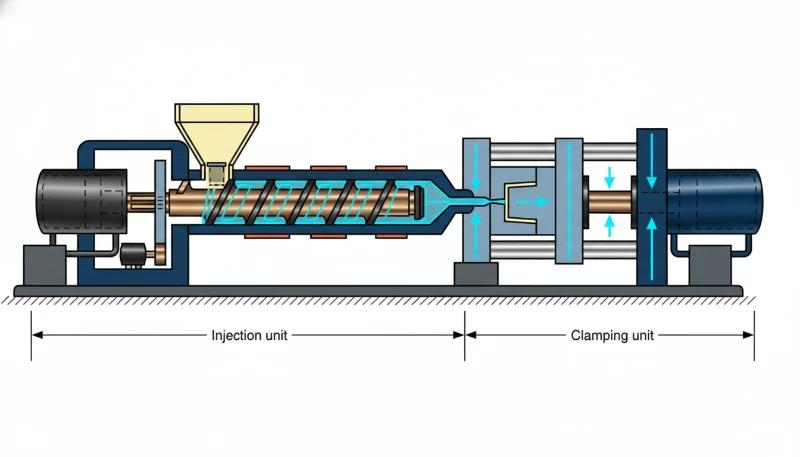
- De sluitsnelheid van de matrijs volgt een tweefasenprofiel. Benaderingsfase: snel sluiten van 200-300 mm/s totdat de matrijsvlakken binnen 5-10 mm van contact zijn. Positioneringsfase: langzaam sluiten van 5-10 mm/s voor de uiteindelijke sluiting om matrijsvlakken en uitlijningskenmerken te beschermen. Sommige moderne machines voegen een derde fase met lagedrukbescherming toe bij 1-2 mm/s met 5-10 bar sluitdruk voordat de volledige sluiting plaatsvindt. Dit voorkomt schade als vreemd materiaal of een vastzittend onderdeel in de matrijsholte achterblijft.
- Materiaaldroging is verplicht voor hygroscopische kunststoffen zoals PA6 en PEEK
- Verdeling van de cyclustijd: injectie 10%, koeling 60-80%, uitwerpen 5-15%
- De sluitkracht moet 20-30% hoger zijn dan de injectiedruk om braamvorming te voorkomen
- Een goed koelontwerp verkort de cyclustijd met 20-35% ten opzichte van conventionele kanalen
- De uitwerpkracht moet 1.5-2 keer het geprojecteerde onderdeeloppervlak bedragen
- Na elke injectie volgt een kwaliteitsinspectie: visuele, maat- en functiecontroles
Stap 1: wat is een DFM-beoordeling en waarom is die belangrijk?
De geometrie van uw onderdeel ligt vast. De offerte voor het gereedschap ligt op uw bureau. Voordat het staal wordt verspaand, is er één beslissing die bepaalt of de eerste proefspuiting slaagt: een beoordeling van het ontwerp op maakbaarheid (DFM). Sinds 2005 hebben we voor meer dan 5.000 projecten DFM-controles uitgevoerd, en ongeveer 40% van de mislukkingen bij de eerste proefspuiting is terug te voeren op wanddiktes van meer dan 4mm met onvoldoende koeling. Dit achteraf herstellen kost na de gereedschapsbouw tien keer zoveel. Lees voor meer informatie over de basisprincipes van matrijsontwerp onze matrijsgids.
Bij ZetarMold is onze DFM-werkstroom gedurende 20 jaar matrijzenbouw verfijnd. We verwerken meer dan 400 materialen en bouwen meer dan 100 matrijzen per maand, waardoor we deze afweging vaak zien. Ons team omvat 8 ervaren matrijsingenieurs die elk nieuw onderdeel vóór goedkeuring van de matrijs beoordelen op uniforme wanddikte, optimale plaatsing van aanspuitpunten en efficiëntie van koelkanalen.
"Een DFM-beoordeling elimineert 80% van de potentiële spuitgietfouten."True
Door variaties in wanddikte, onvoldoende lossingshoeken en problemen met de positie van het aanspuitpunt vóór het verspanen van staal te ontdekken, voorkomen fabrikanten inval, kromtrekken en onvolledige vulling die doorgaans matrijswijzigingen van $5.000–$50.000 per wijziging vereisen.
"Voor alle variaties in wanddikte moet de matrijs worden aangepast."False
Kleine variaties binnen een verhouding van 2:1 kunnen soms worden gecompenseerd met procesaanpassingen, zoals veranderingen in nadruk en koeltijd. Grote variaties boven 3:1 of variaties die chronische defecten veroorzaken, vereisen wel een herontwerp van de matrijs.
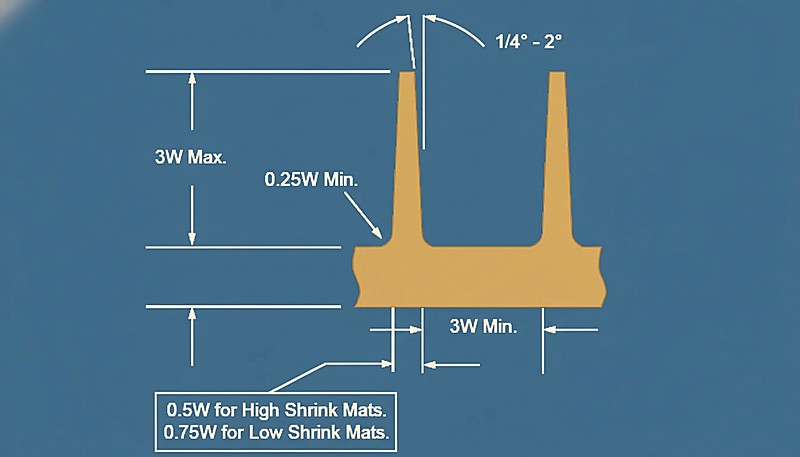
De DFM-checklist die uw engineer moet presenteren, bevat vijf niet-onderhandelbare punten. Bekijk voor een breder overzicht van de volledige spuitgietworkflow onze complete gids. Uniformiteit van de wanddikte (doel: ±10% variatie), voldoende lossingshoek (minimaal 1-3°), onderbouwing van type en locatie van de aanspuiting, materiaalspecifieke krimpcompensatie en de lay-out van de koelkanalen.
Uw DFM-goedkeuring moet specifieke metingen bevatten: nominale wanddikte met toleranties (±0,1 mm voor details kleiner dan 3 mm), verwachte krimppercentages per materiaal (0,5% voor amorfe en 1,5–2,5% voor semikristallijne materialen), een onderbouwing van de grootte en positie van het aanspuitpunt en verificatie van de indeling van de koelkanalen. Als een van deze gegevens in het DFM-rapport ontbreekt, vraag er dan om voordat u de matrijsbouw goedkeurt.
Als u leveranciers vergelijkt of de inkoop plant, behandelt onze gids voor het vinden van spuitgietleveranciers de voorbereiding van de offerteaanvraag, kwalificatie en controles op commerciële risico’s.
Stap 2: Hoe droogt en bereidt u materialen voor op het spuitgieten?
Droog resin pellets in een ontvochtigende hopper droger op materiaalspecifieke temperaturen (80–160 °C) voor 2–6 uur totdat vocht onder 0.02% valt, voer ze dan direct in de machinehopper via een gesloten droge lucht transferlijn. Gesloten zakken staan in warehouses, en hygroscopische resins absorberen vocht snel na opening—PA6 op 50% relatieve humidity bereikt 0.3% vocht in uren, veel boven de 0.02% threshold. Droging is niet optioneel voor engineering plastics; het is de eerste kwaliteitsgate.
Droogspecificaties hangen af van het materiaaltype. PA6 vereist 80-100°C gedurende 4-6 uur. PC heeft 120°C gedurende 3-4 uur nodig. PEEK vereist 150-160°C gedurende 4-6 uur. Bewaak het dauwpunt van de drooglucht—onder -30°C duidt op goed werkende apparatuur. Boven -10°C heeft uw droger onderhoud nodig.
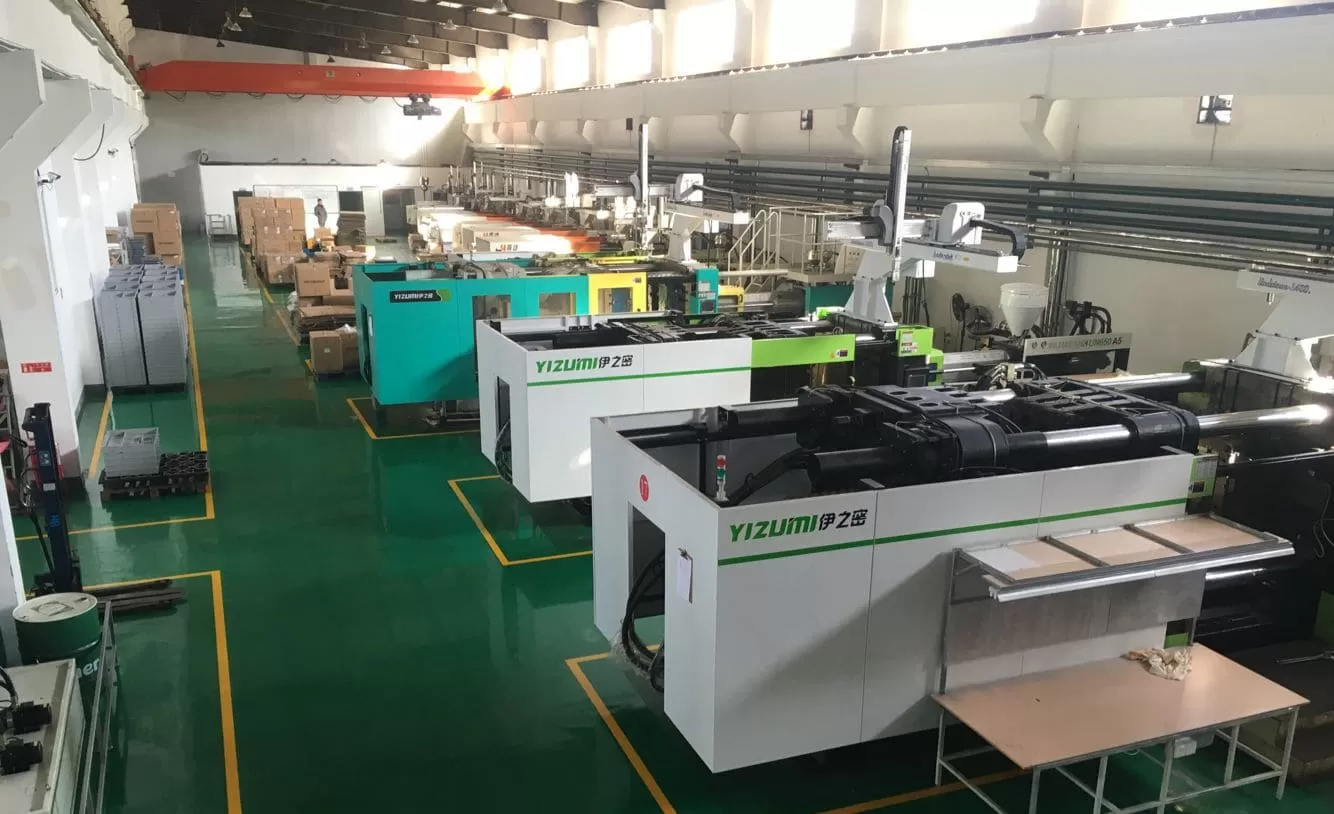
Onze Shanghai fabriek draait 47 spuitgietmachines van 90T tot 1850T, en we hebben 6 dedicated droogstations. Met 120+ productiewerkers en 8 matrijs engineers hebben we gezien wat gebeurt wanneer materiaaldroging wordt gehaast. We houden -40°C dew point drogers voor hygroscopische materialen en documenteren droogparameters voor elk van de 400+ materialen die we verwerken.
| Materiaal | Droogtemperatuur (°C) | Droogtijd (uur) | Doelvochtgehalte (%) |
|---|---|---|---|
| PA6 | 80-100 | 4-6 | <0.02 |
| PC | 120 | 3-4 | <0.02 |
| PEEK | 150-160 | 4-6 | <0.01 |
| ABS | 80-85 | 2-3 | <0.02 |
| POM | 80 | 2-3 | <0.02 |
Niet-hygroscopische materialen zoals polypropyleen en PE hoeven niet intensief te worden gedroogd, maar oppervlaktevocht door condensatie moet wel worden verwijderd met een korte droogcyclus van 1–2 uur bij 60–80 °C. Sla het drogen alleen volledig over als het materiaal in een klimaatgecontroleerde omgeving is opgeslagen.
Vochtgehalteverificatie voorkomt oppervlaktedefecten en structurele zwakte in gevormde onderdelen. Gebruik een halogenen-vochtmeter of Karl Fischer-titratie om te bevestigen dat het vochtgehalte van het hars onder de materiaalspecifieke drempel blijft voordat het in de trechter wordt geladen. Veelvoorkomende doelwaarden zijn PA6 en PA66 onder 0,2% vocht, polycarbonaat en PET op 0,02% of lager, en PBT onder 0,05%. In onze fabriek in Shanghai controleren we het vochtgehalte van elke productiebatch voordat de verwerking begint. Hergebruikt materiaal – zelfs wanneer het goed is opgeslagen in afgesloten containers – neemt omgevingsvocht sneller op dan nieuw hars, waardoor verificatie vooral cruciaal is bij het verwerken van hergebruiksmengsels. Het overslaan van deze controle leidt tot sproeimarkeringen, verminderde slagvastheid en dimensionale instabiliteit die geen na-bewerkingsparameteraanpassing kan omkeren.
Stap 3: hoe werken sluiten en dichtlopen van de matrijs?
Bij het klemmen wordt een hydraulische of mechanische kracht, uitgedrukt in ton, toegepast om de scheidingslijn van de matrijs gesloten te houden tegen injectiedrukken van 18,000–50,000 psi. De praktische regel is eenvoudig: bereken het geprojecteerde oppervlak van de holte, vermenigvuldig dit met de maximale injectiedruk1 en tel daar een veiligheidsmarge van 10–20% bij op. Correct klemmen voorkomt bramen, beschermt de geometrie van de scheidingslijn en houdt de afmetingen tijdens productieruns reproduceerbaar.
De tonnageclassificatie van de machine bepaalt de maximaal beschikbare sluitkracht2. Door een matrijs op 60-80% van het nominale tonnage te laten draaien, wordt een optimale energie-efficiëntie bereikt terwijl voldoende veiligheidsmarge behouden blijft voor drukpieken tijdens de injectie- en nadrukfasen.
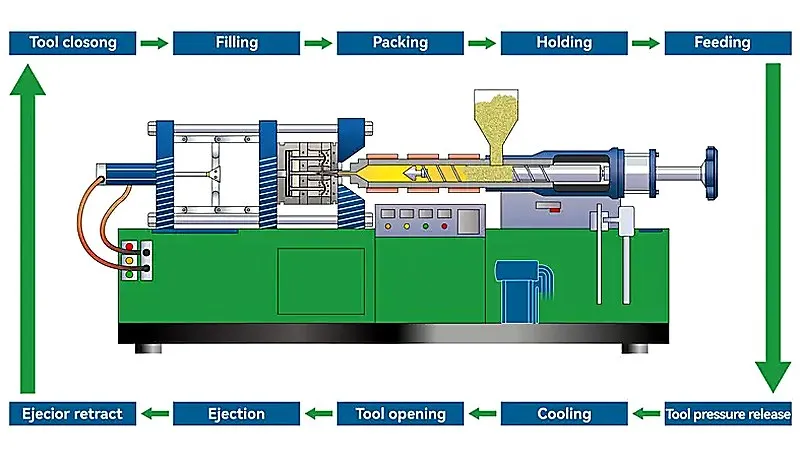
"Voor de berekening van de sluitkracht is een veiligheidsmarge van 20-30% vereist."True
De formule (geprojecteerd oppervlak × injectiedruk) geeft het theoretische minimum. Een toevoeging van 20-30% compenseert drukpieken tijdens het vullen, thermische uitzetting van de matrijs en variaties in materiaalviscositeit.
"Een hogere sluitkracht verbetert altijd de productkwaliteit."False
Een te hoge sluitkracht kan ontluchtingskanalen dichtdrukken, lucht insluiten en zo brandplekken veroorzaken, en de matrijsslijtage versnellen. Het doel is voldoende kracht om de matrijs gesloten te houden zonder spanningsconcentraties te creëren.
De sluitsnelheid van de matrijs volgt een tweetrapsprofiel. Benaderingsfase: snel sluiten met 200–300 mm/s totdat de matrijsvlakken zich op 5–10 mm van contact bevinden. Positioneringsfase: langzaam sluiten met 5–10 mm/s voor de definitieve sluiting om matrijsoppervlakken en uitlijnkenmerken te beschermen. Sommige moderne machines voegen vóór de volledige sluiting een derde lagedrukbeveiligingsfase toe met 1–2 mm/s en 5–10 bar sluitdruk. Dit voorkomt schade als vreemd materiaal of een vastzittend onderdeel in de matrijsholte achterblijft.
Uw matrijs moet op de bewegende en vaste helft slijtplaten hebben om de uitlijnvlakken te beschermen. Geleidepennen en -bussen moeten volgens het onderhoudsschema worden gesmeerd. Trekstangen van de sluiteenheid moeten binnen 0.1 mm/meter parallel staan om ongelijkmatige verdeling van de sluitkracht te voorkomen. De matrijshoogte-instelling moet de deelnaad centraal in de slag positioneren om de beschikbare dagmaat te maximaliseren en trekstangbelasting te beperken.
Stap 4: hoe werken het smelten en injecteren van kunststof?
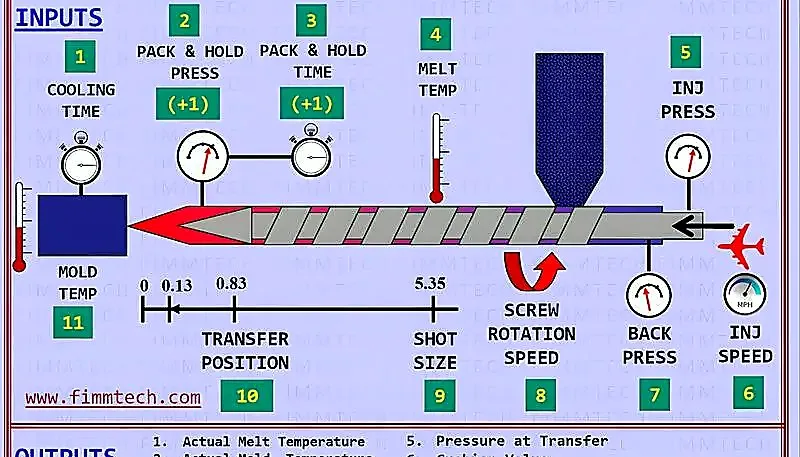
Injectie smelt resin pellets in een verwarmde barrel via een roterende screw, forceert dan de homogenized melt in de matrijs cavity op 50–200 mm/s. Granules enter de hopper, bewegen door de verwarmde barrel, en worden gesheared door de roterende screw. De feed, compression, en metering zones transport, melt, homogenize, en meter het materiaal zodat viscosity stabiel blijft tijdens filling.
De rotatiesnelheid van de schroef beïnvloedt de smeltkwaliteit en doorvoer. Te langzaam: onvoldoende afschuivingswarmte leidt tot ongesmolten pellets. Te snel: overmatige afschuiving degradeert het polymeer en veroorzaakt verkleuring. De meeste technische harsen presteren het best bij 50–120 tpm, waarbij de snelheid wordt aangepast aan de schroefdiameter en materiaalviscositeit.
Met 20+ jaar ervaring in spuitgieten sinds 2005 hebben we uitgebreide proceskennis opgebouwd voor 400+ materialen. Onze fabriek in Shanghai hanteert standaard schroefprofielen voor elke materiaalklasse en past deze aan voor speciale kwaliteiten. De plastificeertijd — de tijd die nodig is om voldoende smelt voor één shot te verzamelen — bedraagt op onze machines doorgaans 2-4 seconden en vormt 10-15% van de totale cyclustijd3.
De injectie begint wanneer de schroef stopt met draaien en als plunjer naar voren beweegt. De verzamelde smelt wordt daarbij door de spuitmond, het aanspuitkanaal en het verdeelkanalensysteem de matrijsholte in geperst. De injectiesnelheid bepaalt de oppervlakteafwerking en de sterkte van laslijnen. Snel vullen beperkt temperatuurverlies, maar kan lucht insluiten. Langzaam vullen verbetert de ontluchting, maar kan voortijdig dichtvriezen veroorzaken.
Stap 5: Wat zijn nadrukdruk en nadruktijd?
De matrijs is voor 95-98% gevuld. De matrijsholte is grotendeels gevuld, maar nog niet nageperst. De nadruk compenseert de volumetrische krimp wanneer de kunststof afkoelt van smelttemperatuur tot uitwerptemperatuur—doorgaans 10-15% volumetrische krimp voor semikristallijne materialen. Zonder voldoende nadruk vertonen onderdelen inval, holtes en maatafwijkingen waardoor ze buiten de tolerantie vallen.
"Nadruk compenseert thermische krimp."True
Wanneer kunststof afkoelt van de injectietemperatuur (200-300°C) tot kamertemperatuur, neemt de dichtheid toe en daalt het volume afhankelijk van het materiaal met 1-3%. Tijdens deze overgang drukt de nadruk materiaal in de holte om de maatnauwkeurigheid te behouden.
"Een hogere nadruk elimineert altijd inval."False
Overmatig nadrukken veroorzaakt braamvorming op de deellijn en uitwerpproblemen. Inval veroorzaakt door dikke wandsecties vereist ontwerpwijzigingen, zoals uithollingen of een nieuw ribontwerp, en niet alleen drukaanpassingen.
Het kritieke beslismoment is de dichtvriestijd van het aanspuitpunt. Het aanspuitpunt moet stollen voordat de nadrukdruk wordt vrijgegeven, anders stroomt materiaal terug uit de caviteit. Gebruikelijke dichtvriestijden lopen uiteen van 1-3 seconden voor randaanspuitingen tot 0,3-0,8 seconden voor tunnelaanspuitingen. Bewaak de caviteitsdrukcurven—een scherpe drukval na het naduwen wijst op voortijdig ontdooien van het aanspuitpunt.
Het nadrukprofiel kan uit fasen bestaan in plaats van constant te zijn. Fase 1: hoge druk (80–100% van de injectiedruk) gedurende 20–30% van de nadruktijd om materiaal in dikke gedeelten en hoeken te persen. Fase 2: verlaagde druk (50–70% van de injectiedruk) gedurende de resterende tijd om de dichtheid te handhaven zonder overvulling. Dit profiel vermindert inval en beperkt tegelijk het risico op braamvorming. Het overgangspunt wordt bepaald door de gewichtscurve van het onderdeel te observeren en dikke gedeelten visueel op inval te inspecteren bij verschillende drukniveaus.
Stap 6: hoe werken koeling en stolling?
De poort is bevroren. Het materiaal is nagevuld. Het onderdeel is maatvast genoeg om uitwerping te doorstaan, maar moet volledig stollen voordat de matrijs opent. De koeltijd domineert de cyclustijd met 60-80% van het totaal. Een verkorting van de koeltijd met 10 seconden bij een cyclus van 25 seconden levert 40% productiviteitswinst op. Hier verdient engineering zichzelf terug.
Conventionele koeling gebruikt recht geboorde kanalen met 8–12 mm diameter, spacing 3–5 keer de diameter, en afstand van onderdeeloppervlak tot kanaal centerline van 2–3 diameters. Dit werkt voor uniforme wanddikte onderdelen met simpele geometrie. Wanneer je bosses, ribs, of variërende wanddikte hebt, wordt uniforme koeling moeilijk—dikke secties koelen langzamer, veroorzaken differentiële shrinkage, warpage, en restspanning.
ZetarMold past sinds 2013 conforme koelkanalen toe in matrijzen voor grote volumes. Door de contour van de matrijsholte te volgen in plaats van recht te boren, hebben we de koeltijd voor complexe onderdelen met 20–35% verkort. Deze capaciteit, gecombineerd met onze eigen matrijzenmakerij, stelt ons in staat maandelijks meer dan 100 matrijzen met geoptimaliseerde koelontwerpen te leveren.
| Materiaal | Wand van 2 mm (s) | Wand van 3 mm (s) | Wand van 4 mm (s) |
|---|---|---|---|
| PP | 8-10 | 12-15 | 16-20 |
| ABS | 10-12 | 15-18 | 20-24 |
| PC | 12-15 | 18-22 | 25-30 |
| PA6 | 10-12 | 15-18 | 20-25 |
| PEEK | 15-18 | 22-27 | 30-36 |
De koelmiddeltemperatuur moet 10-20°C onder de warmtevervormingstemperatuur van het materiaal liggen. Stel voor PC de matrijstemperatuur in op 80-100°C. Voor PP werkt 20-40°C. Hogere matrijstemperaturen verbeteren de oppervlakteafwerking en kristalliniteit, maar verlengen de cyclustijd. De afweging is altijd cosmetische kwaliteit tegenover doorvoer.
Koelingoptimalisatie kan cyclustijd verminderen met 20-35% op bestaande matrijzen zonder hardware wijzigingen. Procesaanpassingen: verminder packing tijd tot het minimum dat onderdeelgewicht houdt, verhoog coolant flow rate binnen pomp limieten, en verlaag matrijs temperatuur tot het minimum dat vervorming voorkomt. Matrijs modificaties: add baffles om diepe cores te koelen, reposition kanalen dichter bij dikke secties, en install conformal cooling voor complexe geometrieën. ROI wordt typisch gerealiseerd binnen 1000-5000 onderdelen.
Stap 7: hoe werken het openen van de matrijs en het uitwerpen van het onderdeel?
Het onderdeel is gestold. De koeltijd is verstreken. De matrijs opent. Dit lijkt eenvoudig, maar 20–30% van de spuitgietfouten ontstaat tijdens het uitwerpen. Bij het uitwerpen moeten twee krachten worden overwonnen: de hechting van de afgekoelde kunststof aan het matrijsstaal en mechanische vergrendeling door ondersnijdingen of onvoldoende lossingshoek. Het uitwerpsysteem moet voldoende kracht leveren om deze factoren te overwinnen zonder het onderdeel te vervormen, afdrukken van uitwerppennen te veroorzaken of het onderdeel aan de kernzijde te laten terugkleven.
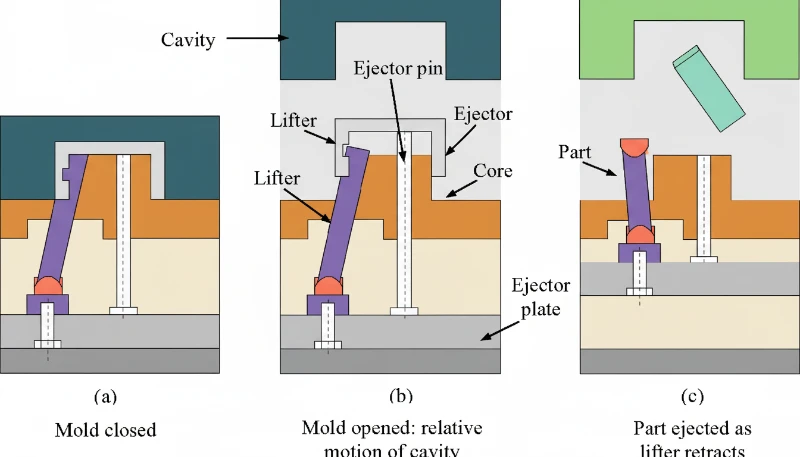
"De uitwerpkracht moet 1.5-2 keer het geprojecteerde oppervlak van het onderdeel bedragen."True
Voor een onderdeel met een geprojecteerd oppervlak van 50 cm2 op het matrijsoppervlak, geeft een ejectiekracht van 75-100 N een betrouwbare ejectie terwijl pinmarkeringen worden geminimaliseerd. Over-ejectie veroorzaakt pinmarkeringen en oppervlakteschade.
"Meer uitwerppennen verbeteren altijd de betrouwbaarheid van het uitwerpen."False
Te veel pennen veroorzaken oppervlaktesporen, verhogen de matrijskosten en creëren meer faalpunten. Strategische plaatsing van pennen bij kruisingen van ribben en in hoeken is effectiever dan alleen meer pennen gebruiken.
De keuze van het uitwerpsysteem hangt af van de geometrie van het onderdeel. Rechte uitwerping gebruikt uitwerppennen voor eenvoudige geometrieën. Hulsuitwerping is geschikt voor bussen en cilindrische kenmerken. Uitwerping met een afstroopplaat werkt het best voor dunwandige bekers en doppen. Voor ondersnijdingen zijn schuine uitwerpers of schuine pennen nodig. De keuze van het verkeerde systeem veroorzaakt vervorming of vastlopen van onderdelen of schade aan de matrijs, die zich over duizenden cycli opstapelt.
Voor de plaatsing van uitwerppennen gelden specifieke richtlijnen. Plaats pennen in dikke secties en op kruisingen van ribben, waar de uitwerpweerstand het hoogst is. Verdeel de pennen gelijkmatig langs de omtrek van het onderdeel om de kracht te spreiden. De pendiameter moet ten minste 1.5x de penlengte bedragen om buigen te voorkomen. Plaats bij gepolijste of getextureerde oppervlakken geen pennen in zichtbare cosmetische zones.
De openingssnelheid van de matrijs beïnvloedt de uitwerpkwaliteit. Het openingsprofiel: aanvankelijk langzaam openen (5-10 mm/s) over de eerste 10-20mm, zodat het onderdeel zonder spanning van de kern kan loskomen. Snel openen (100-200 mm/s) gedurende het grootste deel van de slag om de cyclustijd te minimaliseren. Afremmen (20-50 mm/s) over de laatste 50-100mm om te voorkomen dat de matrijs hard openslaat en om slijtage van geleidepennen en -bussen te beperken. Het afremmen is vooral belangrijk bij matrijzen met afstroopplaten of complexe schuine uitwerpers die een beheerste openingsvolgorde vereisen.
Stap 8: hoe inspecteert u de kwaliteit en bewaakt u het proces?
Het onderdeel wordt uitgeworpen. Het belandt in de afvoergoot of wordt door een robot verwijderd. En nu? Als u ervan uitgaat dat het proces is ingesteld en het laat doorlopen, ontdekt u uren of dagen later defecten wanneer uw klant de zending afkeurt. Kwaliteitsinspectie moet plaatsvinden aan het begin van elke ploeg, na elke materiaalwissel en met vastgestelde tussenpozen tijdens de productie. De inspectiehiërarchie: First Article Inspection (FAI) bij de start, procesinspectie om de 50–100 onderdelen en eindinspectie van elke verzendpartij.
Bij ZetarMold omvat onze kwaliteitsworkflow IQC (inkomende kwaliteitscontrole), tussentijdse controles met monsters, procesinspectie, verpakkingsinspectie, FQC (eindkwaliteitscontrole) en OQC (uitgaande kwaliteitscontrole). We hebben 10+ QC-specialisten die bij elke productierun afmetingen, oppervlaktekwaliteit en functionele eisen controleren. Deze workflow in 6 stappen, gecombineerd met ISO 9001/13485/14001/45001-certificeringen, waarborgt een consistente kwaliteit in onze fabriek in Shanghai.
Visuele inspectie detecteert 60-70% van de defecten. Brandplekken, braamvorming, onvolledige vulling, inval en oppervlaktegebreken zijn direct zichtbaar. Train operators om eerst kritieke cosmetische zones en daarna structurele kenmerken te inspecteren. Gebruik inspectiestations met achtergrondverlichting voor transparante onderdelen en gepolariseerd licht om dubbele breking in optische componenten te detecteren.
| Controle | Methode | Frequentie | Acceptatiecriteria |
|---|---|---|---|
| Visuele defecten | Inspectie met lichtbak | Elke 50 onderdelen | No sink >0.2mm in A-surface |
| Afmetingen | Coördinatenmeetmachine/schuifmaat | Elke 100 onderdelen | ±0.1mm voor een tolerantie van ±0.05mm |
| Gewicht | Schaal | Elke 25 onderdelen | ±2% van het doelgewicht |
| Passing/functie | Assemblagetest | Hoe bereken je de klemkracht voor spuitgieten? | Geen interferentie of vastlopen |
| Cosmetisch | Gouden monster | Elk onderdeel | Afstemmen op uiterlijkreferentie |
Maatinspectie verifieert dat onderdelen aan de tekeningseisen voldoen. Kritieke afmetingen worden met een CMM (coördinatenmeetmachine) gemeten met een nauwkeurigheid van ±0.01mm. Standaardafmetingen worden gecontroleerd met een schuifmaat of goed-/afkeurkaliber. Neem per cyclus van 100 shots een steekproef van 5 onderdelen voor statistische procesbeheersing en volg de Cp- en Cpk-waarden.
Moderne machines tracken injectiedruk, pack druk, melt temperatuur, matrijs temperatuur, cyclustijd, en screw recovery tijd real-time. Alarmen op ±10–20% van targetwaarden triggeren automatische pauses, segregeren aangetaste onderdelen, en alert operators—vangen proces drift op voordat out-of-spec onderdelen accumuleren.
Wat zijn veelvoorkomende problemen bij spuitgieten en hoe lost u ze op?
Veelvoorkomende spuitgietdefecten – zinkplekken, uitstulpingen en onvolledige onderdelen – komen zelfs in goed afgestelde processen voor. Hier zijn de oorzaken en oplossingen.
Inval ontstaat wanneer dikke secties langzamer afkoelen dan aangrenzende dunne secties, waardoor oppervlaktedeukjes ontstaan. De hoofdoorzaak is ongelijke krimp. Probleemoplossing: controleer eerst de verhouding van de wanddikten—als die groter is dan 3:1, is een herontwerp nodig. Als de wanddikte acceptabel is, verhoogt u de nadruk in stappen van 10% en controleert u daarbij op braamvorming. Voeg keerschotten of borrelkoelers toe om dikke secties sneller te koelen. Verlaag de smelttemperatuur met 5-10°C om de initiële krimp te beperken. Voeg in ernstige gevallen externe kernuitsparingen toe of gebruik gasgeassisteerd spuitgieten om dikke secties volledig te elimineren.
Bramen ontstaan bij de deelnaad, rond uitwerppennen of in ontluchtingsspleten wanneer materiaal door een te hoge injectie- of nadruk uit de holte ontsnapt. Oorzaken zijn onder meer versleten matrijsoppervlakken, onvoldoende sluitkracht en hoge smelttemperaturen die de viscositeit verlagen. Verhelp bramen door eerst de sluitkracht te verhogen, vervolgens de nadruk te verlagen en ten slotte de uitlijning van de matrijsoppervlakken te controleren als het probleem in meerdere holten aanhoudt.
Onvolledige vulling ontstaat wanneer de caviteit niet volledig wordt gevuld, waardoor onvolledige onderdelen ontstaan. Veelvoorkomende oorzaken zijn onvoldoende injectiedruk, geblokkeerde ontluchtingen die verhinderen dat lucht ontsnapt, een lage smelttemperatuur die de viscositeit verhoogt of een ontoereikend schotvolume. Stel de diagnose door eerst de injectiedrukcurves te controleren—de meeste onvolledige vullingen worden verholpen door de injectiesnelheid of -druk met 10-15% te verhogen. Als de ontluchting het probleem is, reinig of verdiep de ontluchtingskanalen tot een diepte van 0.01-0.02mm.
Wanneer moet u uw spuitgietproces bijstellen en wanneer herontwerpen?
Ga over naar redesign wanneer drie of meer ±20% parameterwijzigingen falen, of wanneer de oorzaken wandratio’s boven 3:1 of inadequate ontwerphellingen bevatten. De vuistregel: als je drie parameters hebt aangepast met ±20% en het defect blijft, is het probleem waarschijnlijk design-gerelateerd. Verder aanpassen na dit punt verspilt materiaal en cyclustijd zonder het probleem op te lossen.
"Een wanddikteverhouding >3:1 vereist een ontwerpwijziging."True
Als de verhouding in wanddikte groter is dan 3:1, kunnen procesaanpassingen inval en kromtrekken niet oplossen. Uithollen, een nieuw ribontwerp of gasinjectiespuitgieten zijn dan noodzakelijke ontwerpoplossingen.
"Voor elke onvolledige vulling moet de matrijs opnieuw worden ontworpen."False
Onvolledige vulling door ontluchtingsproblemen, materiaalverontreiniging of onjuist drogen kan via procesaanpassingen worden verholpen. Alleen onvolledige vulling door beperkingen in de vloeilengte of opgesloten lucht in de geometrie vereist aanpassing van de matrijs.
Ontwerpproblemen die niet met procesaanpassingen kunnen worden verholpen, vallen in vijf categorieën: ongelijkmatige wanddikte (veroorzaakt invalplekken en kromtrekken), onvoldoende lossingshoeken (veroorzaken kleven), een onjuist type of onjuiste locatie van het aanspuitpunt (veroorzaakt stromings- en laslijnen), onvoldoende uitholling (verspilt materiaal en cyclustijd) en scherpe hoeken zonder afrondingen (vormen spanningsconcentraties). Elk hiervan vereist een matrijswijziging, geen aanpassing van parameters.
Redesign kost 5.000–15.000 USD voor engineering, modificatie en re-validatie, maar het produceren van defecte onderdelen met 5–15% afvalpercentages op een run van 100.000 onderdelen kost veel meer.
Hoe optimaliseert u spuitgieten voor productie-efficiëntie?
Target koeling eerst—het domineert 60–80% van elke cyclus—via conformal kanalen en turbulente flow, minimaliseer dan packing en ejectie tijden. Cyclustijd is de som van injectietijd (5–10%), packing en holding tijd (10–20%), koeltijd (60–80%), matrijs opening en sluiting tijd (5–10%), en ejectietijd (2–5%). Koeling is de dominante factor, dus optimalisatie moet daar eerst focussen, dan door de andere componenten gaan.
ZetarMold draait 47 spuitgietmachines van 90T tot 1850T, en we hebben koeling geoptimaliseerd op 100+ matrijzen alleen in het afgelopen jaar. Door conformal cooling te implementeren, coolant flow te optimaliseren, en gating te redesignen, hebben we cyclustijden verminderd met 15-30% op meerdere productielijnen. Deze verbeteringen, gecombineerd met onze 20+ jaar ervaring sinds 2005, laten ons competitieve prijzen leveren terwijl kwaliteit wordt gehouden.
Optimalisatie van de koeling richt zich op drie gebieden: plaatsing van de kanalen, koelmiddelparameters en keuze van het matrijsmateriaal. Conformale koelkanalen volgen de contour van het onderdeel en verkleinen de afstand tot het matrijsoppervlak van 15-25mm (geboord) tot 3-8mm (conformaal). Het koelmiddeldebiet moet turbulente stroming handhaven (reynoldsgetal boven 5,000) voor effectieve warmteoverdracht. Matrijsmaterialen met een hogere thermische geleidbaarheid, zoals inzetstukken van berylliumkoper op hotspots, kunnen de lokale koeltijd met 30-40% verkorten.
Injectieoptimalisatie richt zich op vultijd en smeltkwaliteit. Optimalisatie van de vultijd: verkort de injectietijd totdat brandplekken (te snel) of onvolledige vulling (te langzaam) optreden en ga vervolgens 10% terug. Het omschakelpunt van snelheid naar druk moet bij 95-98% vulling worden geactiveerd om doorschieten te voorkomen. Profilering van de smelttemperatuur over de cilinderzones voorkomt degradatie en waarborgt tegelijk volledige versmelting.
| Onderdeel | Typisch percentage van de cyclus | Optimalisatiepotentieel | ROI-tijdlijn |
|---|---|---|---|
| Koeling | 60-80% | 15-30% | 500-2000 onderdelen |
| Nadruk/vasthouden | 10-20% | 10-20% | Onmiddellijk |
| Matrijs openen/sluiten | 5-10% | 5-15% | Onmiddellijk |
| Injectie | 5-10% | 5-10% | 100-500 onderdelen |
| Uitwerping | 2-5% | 5-10% | 1000-5000 onderdelen |
ROI hangt af van de onderdeelwaarde en volume. Terugverdientijd onder 1.000 onderdelen moet direct worden geïmplementeerd; 1.000–5.000 onderdelen vereist evaluatie; meer dan 5.000 onderdelen vereist strategische rechtvaardiging.
Veelgestelde vragen over het spuitgietproces
Veelgestelde vragen
Wat zijn de 7 stappen van spuitgieten?
De zeven stappen van spuitgieten zijn: (1) klemmen en sluiten van de matrijs, waarbij de machine de twee matrijshelften onder hoge druk bijeenhoudt; (2) smelten en injecteren van kunststof, waarbij verwarmde granulaten smelten en in de caviteit worden geperst; (3) nadrukken en vasthouden, waarbij extra materiaal de krimp compenseert; (4) koelen en stollen, waarbij het product in de matrijs uithardt; (5) openen van de matrijs en uitwerpen van het product, waarbij het voltooide product wordt verwijderd; (6) kwaliteitsinspectie, die visuele, maat- en functionele controles omvat; en (7) procesbewaking en -aanpassing, waarmee tijdens productieruns een consistente output wordt gewaarborgd.
Hoe lang duurt een spuitgietcyclus?
De cyclustijd varieert van slechts 5 seconden voor kleine dunwandige onderdelen tot meer dan 120 seconden voor grote dikwandige componenten. Reken voor een gebruikelijk onderdeel van engineeringkunststof met een wanddikte van 3 mm op 15–25 seconden per cyclus. Koeling domineert de planning en beslaat 60–80% van de totale cyclustijd, terwijl het injecteren de holte in slechts 0,5–2 seconden vult. Koeltijd verkorten met conforme kanalen of een geoptimaliseerde koelmiddelstroom is de doeltreffendste manier om de productie te verhogen en verkort de cyclustijd van bestaande matrijzen vaak met 20–35%.
Wat is het verschil tussen injectie en nadruk?
Injectie is de vulfase onder hoge druk waarin gesmolten kunststof met snelheden in de vormholte wordt geperst die zijn bedoeld om 95-98% van het volume te vullen, doorgaans binnen 0.5-2 seconden. Nadrukken (of vasthouden) volgt direct bij een lagere druk, waarbij extra materiaal in de vormholte wordt gedrukt om thermische krimp te compenseren terwijl de kunststof afkoelt en samentrekt. Het nadrukken gaat door totdat de aanspuiting bevriest, meestal 2-6 seconden. Zie injectie als het in de matrijs brengen van het materiaal en nadrukken als het maatvast houden ervan tijdens het stollen.
Waarom moet ik kunststof drogen vóór het spuitgieten?
Hygroscopische materialen zoals PA6, PC, PET en PEEK nemen na verloop van tijd vocht uit de omgevingslucht op. Tijdens het spuitgieten verdampt dit opgesloten vocht onmiddellijk bij smelttemperaturen (vaak boven 250°C), wat zichtbare bellen (splay marks), oppervlaktestrepen, verminderde mechanische sterkte en maatinstabiliteit in het eindproduct veroorzaakt. Correct drogen bij materiaalspecifieke temperaturen (80-160°C) gedurende 3-6 uur verlaagt het vochtgehalte tot onder de kritieke grens van 0.02% die nodig is voor foutloos spuitgieten. Het overslaan van de droogstap blijft een van de meest voorkomende en kostbare oorzaken van afgekeurde productieonderdelen.
Welke temperatuur wordt voor spuitgieten gebruikt?
Spuitgiettemperaturen verschillen sterk per materiaalsoort. Polypropyleen wordt verwerkt bij 180-220°C, ABS bij 210-250°C, polycarbonaat bij 280-320°C en hoogwaardig PEEK vereist 380-420°C. De cilinder houdt een temperatuurgradiënt in stand van de invoerzone (het koelst) via compressie naar de doseerzone (het warmst), doorgaans met een stijging van 20-40°C. Ook de matrijstemperatuur speelt een cruciale rol: koudere matrijzen verkorten de cyclustijd maar kunnen restspanning verhogen, terwijl verwarmde matrijzen (60-150°C, afhankelijk van de hars) de oppervlakteafwerking, kristalliniteit en maatvastheid van technische materialen verbeteren.
Hoeveel druk is nodig voor spuitgieten?
De injectiedruk ligt voor standaard technische thermoplasten doorgaans tussen 18,000 en 25,000 psi. Hoogviskeuze of glasvezelversterkte materialen zoals PEEK of PA66-GF30 kunnen tot 35,000-50,000 psi vereisen. De nadruk bedraagt 50-80% van de injectiedruk. Vermenigvuldig voor de vereiste sluitkracht het geprojecteerde onderdeeloppervlak (in vierkante inch) met de injectiedruk en voeg vervolgens een veiligheidsmarge van 20-30% toe. Een onderdeel van 10 vierkante inch bij 18,000 psi vereist bijvoorbeeld ongeveer 90 ton sluitkracht, zodat een machine van 110-115 ton voldoende reserve biedt.
Waardoor ontstaan invalplekken bij spuitgieten?
Inval ontstaat wanneer dikke wandsecties langzamer afkoelen dan aangrenzende dunne secties, waardoor een verschil in krimp ontstaat dat het oppervlaktemateriaal fysiek naar binnen trekt. De belangrijkste oorzaken zijn wanddikteratio’s van meer dan 3:1, onvoldoende nadruk of nahoudtijd en een ontoereikende plaatsing van koelkanalen bij zware doorsneden. Praktische oplossingen zijn onder meer het uithollen van dikke secties tijdens de DFM-fase, het verhogen van de nadruk en verlengen van de nahoudtijd totdat het aanspuitpunt bevriest, en het herontwerpen van koelkanalen om dikke gebieden gericht te koelen. Procesaanpassingen kunnen milde gevallen oplossen, maar ernstige terugkerende inval vereist meestal een aanpassing van de matrijs.
Hoe berekent u de sluitkracht voor spuitgieten?
Beheers het spuitgietproces stap voor stap: van DFM-beoordeling via klemmen, inspuiten, naspuiten, koelen en uitwerpen tot kwaliteitsinspectie.
injectiedruk: Injectiedruk is de hydraulische druk die op de schroef wordt uitgeoefend om gesmolten kunststof in de matrijsholte te persen, doorgaans tussen 35,000 en 50,000 psi. ↩
sluitkracht: Sluitkracht is de hydraulische of mechanische kracht die de matrijs tijdens het injecteren gesloten houdt. Deze wordt gemeten in ton; gangbare waarden lopen van 90T tot 1850T. ↩
cyclustijd: De cyclustijd is de totale tijd in seconden die nodig is om één spuitgietcyclus te voltooien, vanaf het sluiten van de matrijs tot het begin van de volgende cyclus. ↩