Sie benötigen 200 große Polyurethan1-Gehäuse für ein Industriegehäuseprojekt. Angebote für konventionelles Spritzgießen beliefen sich allein für das Werkzeug auf 45.000 $ — auf 200 Teile umgelegt sind das 225 $ pro Stück nur für das Werkzeug. Reaktionsspritzgießen (RIM) kann diese Werkzeugkosten um 60–80 % senken und zugleich Teile mit vergleichbarer struktureller Leistungsfähigkeit liefern. Dieser Leitfaden behandelt die Chemie, Prozessparameter, Materialoptionen, Kostenabwägungen und die tatsächlichen Entscheidungskriterien für die Wahl von RIM statt konventionellem Spritzgießen.
- RIM bildet Teile durch chemische Reaktion, nicht durch Schmelzen und Abkühlen
- Werkzeugkosten 60–80% niedriger als beim traditionellen Spritzgießen
- Ideal für große Teile (>12 Zoll) bei kleinen bis mittleren Stückzahlen (50–5.000 Einheiten)
- Hauptsächlich auf Polyurethan-basierte Duroplastmaterialien beschränkt
- Einspritzdrucke sind 90–95% niedriger als beim thermoplastischen Spritzgießen
| Kenngröße | Typischer Wert |
|---|---|
| Einspritzdruck | 50–200 psi (3.4–13.8 bar) |
| Temperatur der Form | 100–180 °F (40–80 °C) |
| Primärmaterial | Polyurethan (PU) |
| Ideale Teilegröße | > 12 Zoll (300 mm) |
| Typischer Volumenbereich | 50–5.000 Einheiten/Jahr |
| Werkzeugkosten vs. Spritzgießen | 60–80% niedriger |
Was ist Reaktionsspritzgießen (RIM)?
Reaktionsspritzgießen (RIM) wird durch die in diesem Abschnitt erläuterte Funktion, die Randbedingungen und die Zielkonflikte definiert. Wenn Sie Anbieter vergleichen oder die Beschaffung planen, behandelt unser Leitfaden zur Beschaffung von Spritzgießlieferanten die RFQ-Vorbereitung, Qualifizierung und Prüfung kommerzieller Risiken.
Reaktionsspritzgießen (RIM) ist ein Niederdruck-Fertigungsverfahren, bei dem zwei flüssige chemische Komponenten — typischerweise ein Polyol und ein Isocyanat — dosiert, durch Hochdruck-Gegenstrommischung vermischt und in ein geschlossenes Werkzeug eingespritzt werden, wo sie zu einem festen Duroplast2-Bauteil reagieren. Anders als beim konventionellen Spritzgießen, bei dem feste Kunststoffgranulate geschmolzen und mit 5.000–20.000 psi in ein Werkzeug gepresst werden, erzeugt RIM das Bauteil durch Chemie statt durch Wärme und Druck.
Der entscheidende Unterschied: Traditionelles Spritzgießen ist ein physikalischer Prozess (schmelzen → füllen → kühlen → auswerfen). RIM ist ein chemischer Prozess (mischen → reagieren → aushärten → entformen). Dieser grundlegende Unterschied treibt jeden Vorteil und jede Einschränkung an, die folgt.
RIM wurde Ende der 1960er entwickelt und fand in den 1970er und 1980er Jahren breite Anwendung in der Automobilindustrie für Stoßfängerverkleidungen, Karosserieteile und Innenkomponenten. Heute bleibt es der bevorzugte Prozess für große, komplexe Polyurethan²-Teile bei Volumen, wo traditionelles Spritzgießwerkzeug nicht wirtschaftlich ist.
Wie funktioniert der RIM-Prozess Schritt für Schritt?
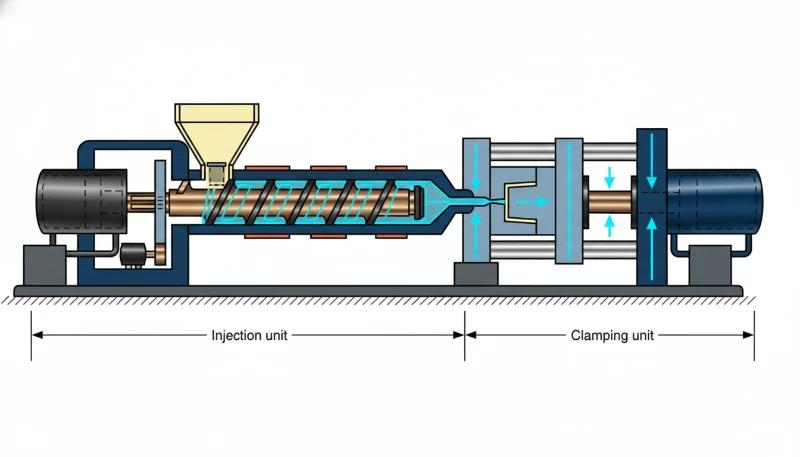
Der RIM-Prozess besteht aus fünf Schritten: Dosieren, Mischen, Füllen, Aushärten und Entformen eines reaktiven Polyurethanteils. Die folgende Abfolge stellt RIM dem Arbeitsablauf einer Schnecken-Spritzgießmaschine gegenüber, damit Ingenieure Qualitätsprobleme diagnostizieren und Zykluszeiten optimieren können.
Schritt 1: Materiallagerung und Temperaturregelung. Die beiden Komponenten — üblicherweise eine Polyolmischung (Komponente A) und ein Isocyanat (Komponente B) — werden in getrennten beheizten Tanks bei kontrollierten Temperaturen gelagert, typischerweise bei 80–120 °F (27–49 °C). Temperaturstabilität ist wichtig, weil Viskositätsänderungen die Mischqualität unmittelbar beeinflussen. Eine Abweichung von 10 °F kann die Viskosität um 15–25 % verändern und zu unvollständiger Vermischung führen.
Schritt 2: Hochdruckdosierung und -mischung. Zu Zyklusbeginn fördern Präzisionsdosierpumpen die beiden Komponenten im vorgegebenen Verhältnis (häufig 1:1 nach Volumen, je nach Formulierung jedoch zwischen 100:30 und 100:200). Die Ströme treffen bei 1.500–3.000 psi in einem Hochdruck-Gegenstrommischkopf aufeinander. Diese Aufprallenergie erzeugt innerhalb von Millisekunden eine turbulente Durchmischung — ein mechanisches Rührwerk ist nicht erforderlich.
Schritt 3: Werkzeugfüllung. Die gemischte Flüssigkeit fließt bei relativ niedrigem Druck (50–200 psi) in ein geschlossenes Werkzeug. Da das reagierende Gemisch eine niedrige, wasserähnliche Viskosität besitzt, füllt es komplexe Geometrien und dünnwandige Bereiche problemlos. Das Werkzeug wird üblicherweise auf 100–180 °F beheizt, um die Aushärtungsreaktion zu beschleunigen.
Schritt 4: Chemische Reaktion und Aushärtung. Im Werkzeug findet eine exotherme Reaktion3 statt, bei der Polyol und Isocyanat vernetzen. Das Material dehnt sich leicht aus (Schaumbildung bei strukturell geschäumtem RIM), füllt sämtliche Werkzeugdetails und härtet zu seinem endgültigen festen Zustand aus. Je nach Formulierung beträgt die Aushärtezeit 1–10 Minuten. Die Reaktionswärme kann im Inneren 250–350 °F erreichen, obwohl das Werkzeug selbst relativ kühl bleibt.
Schritt 5: Entformen und Nachbearbeitung. Nach Erreichen der Entformungszeit⁴ öffnet sich das Werkzeug und das Bauteil wird entnommen. RIM-Teile müssen üblicherweise nachhärten (24–48 Stunden bei Raumtemperatur), um ihre vollständigen mechanischen Eigenschaften zu erreichen. Gratbeschnitt, Oberflächenbearbeitung und Lackieren sind gängige Sekundärarbeiten.
Welche Materialien werden bei RIM verwendet?
Das Materialangebot für RIM ist deutlich kleiner als für thermoplastisches Spritzgießen. Thermoplastisches IM bietet tausende Harztypen über viele Polymerfamilien, während RIM von Polyurethanchemie dominiert wird. Dies ist sowohl seine Stärke (tiefe Optimierung innerhalb PU) als auch seine Grenze (Sie können kein Nylon, Polycarbonat oder PEEK in einer RIM-Maschine verwenden).

Polyurethan-(PU-)Elastomere. Das Arbeitspferd des RIM-Verfahrens. Massive elastomere PU-Teile reichen von Shore A 50 (weich, gummiartig) bis Shore D 80 (hart, steif). Sie werden für Stoßfängerverkleidungen, Kotflügelverbreiterungen und Industriegehäuse eingesetzt. Typischer Biegemodul: 5.000–300.000 psi.
PU-Strukturschaum⁵. Durch Zugabe eines Treibmittels (häufig Wasser, das mit überschüssigem Isocyanat unter Bildung von CO₂ reagiert) erzeugt RIM Teile mit zelligem Kern und massiver Außenhaut. Dadurch sinkt das Gewicht bei gleichbleibender Steifigkeit um 10–30 %. Wandstärken bis 0,5 Zoll sind ohne Einfallstellen möglich — eine Herausforderung für das thermoplastische Spritzgießen.
Verstärktes RIM (RRIM). Die Zugabe gemahlener Glasfasern (typischerweise 10–25 Gew.-%) oder mineralischer Füllstoffe zur Polyolkomponente erhöht Steifigkeit, Maßhaltigkeit und Wärmebeständigkeit. RRIM-Teile besitzen einen 2–4× höheren Biegemodul als ungefülltes PU und eignen sich daher für semistrukturelle Automobilbauteile wie Ladeflächenverkleidungen von Pick-ups und Türverkleidungen.
Nicht-PU-Systeme. Weniger verbreitet, aber kommerziell erhältlich sind Polyharnstoff (schnellere Aushärtung, bessere thermische Stabilität), Nylon-Blockcopolymere (für Anwendungen bei höheren Temperaturen) und Dicyclopentadien (DCPD, für extrem große Teile wie Verkleidungen von Landmaschinen). Sie machen weniger als 15 % der gesamten RIM-Produktion aus.
| Werkstoffsystem | Dichte (g/cm³) | Biegemodul (psi) | Typische Verwendung |
|---|---|---|---|
| Massives PU-Elastomer | 1.0–1.2 | 5,000–50,000 | Stoßstangenverkleidungen, Dichtungen |
| Strukturschaum PU | 0.4–0.8 | 20,000–100,000 | Platten, Gehäuse |
| RRIM (20% Glas) | 1.2–1.4 | 100,000–300,000 | Türverkleidungen, Kotflügel |
| Polyharnstoff | 1.0–1.1 | 15,000–80,000 | Hochtemperatur-Abdeckungen |
| DCPD | 1.0–1.1 | 200,000–350,000 | Großgeräteplatten |
Was sind die Vorteile von RIM?
Die Vorteile von RIM sind die Hauptkategorien oder Optionen, die in diesem Abschnitt erläutert werden. RIM bietet spezifische Vorteile, die es für bestimmte Anwendungen zur richtigen technischen Wahl machen – und für andere zur falschen. Hier ist, was es wirklich gut kann, basierend auf realen Produktionsdaten, nicht auf Marketingaussagen.
Niedrige Werkzeugkosten. RIM-Werkzeuge arbeiten mit 50–200 psi, gegenüber 5.000–20.000 psi beim thermoplastischen Spritzgießen. Daher können Werkzeuge aus Aluminium, gegossenem Epoxidharz oder für Prototypen sogar aus 3D-gedruckten Harzen gefertigt werden. Ein RIM-Produktionswerkzeug aus Stahl kostet für ein mittelkomplexes Teil 5.000–25.000 $, gegenüber 30.000–150.000 $ für ein vergleichbares Spritzgießwerkzeug. Bei Stückzahlen unter 1.000 macht allein dieser Unterschied RIM häufig zur wirtschaftlich vernünftigen Wahl.
Eignung für große Bauteile. RIM bewältigt Teile, die für das Standardspritzgießen unpraktikabel sind. Bis zu 6 Fuß lange Stoßfängerverkleidungen, Verkleidungen für Landmaschinen und Gehäuse medizinischer Geräte sind typische RIM-Anwendungen. Der niedrige Fülldruck hält die erforderliche Schließkraft gering — eine 10-Tonnen-Schließeinheit kann Teile fertigen, die beim thermoplastischen Spritzgießen eine 500-Tonnen-Schließeinheit erfordern würden.

Konstruktionsfreiheit. Aufgrund der wasserähnlichen Viskosität der reagierenden Flüssigkeit füllt RIM Hinterschneidungen, dünne Rippen und komplexe Geometrien ohne den hohen Nachdruck, den das thermoplastische Spritzgießen erfordert. Wandstärkenunterschiede von 3:1 innerhalb desselben Bauteils sind beherrschbar. Einlegeteile, Gewindebuchsen und strukturelle Verstärkungen lassen sich in einem Schuss einformen.
Einkapselung. RIM kapselt Metall-Einlegeteile, elektronische Komponenten und Verstärkungsstrukturen auf natürliche Weise ein. Der niedrige Einspritzdruck (unter 200 psi) beschädigt empfindliche Elektronik nicht. Das Verfahren eignet sich daher ideal für Gehäuse medizinischer Geräte mit eingebetteten Leiterplatten, Automobilkomponenten mit Metallhaltern und Industriegehäuse mit integrierter EMI-Abschirmung.
Wirtschaftlichkeit bei kleinen Stückzahlen. Bei Produktionsmengen von 50–2.000 Stück pro Jahr erzielt RIM unter Einbeziehung der Werkzeugamortisation häufig niedrigere Gesamtkosten pro Teil als das Spritzgießen in Kleinserie. Der Break-even gegenüber thermoplastischem Spritzgießen liegt je nach Teilegeometrie und Material typischerweise zwischen 2.000 und 5.000 Stück.
Bei ZetarMold treffen wir regelmäßig auf Kunden, die Angebote für Spritzguss bei geringen Stückzahlen für Teile anfordern, die besser durch RIM bedient würden. Wenn ein Kunde 300 Einheiten eines 500-mm-Gehäuses benötigt und die Angebote für Stahlwerkzeuge bei $40.000+ liegen, erklären wir den ehrlichen Kompromiss: Unsere 45 Spritzgussmaschinen mit 90T–1850T sind für thermoplastische Produktionsmengen von 1.000+ Einheiten optimiert. Für Läufe unter 1.000 Einheiten großer Polyurethan-Teile ist RIM die wirtschaftlich richtige Wahl, auch wenn wir diese Arbeit an einen spezialisierten RIM-Betrieb vergeben würden. Kunden dabei zu helfen, den richtigen Prozess zu finden – selbst wenn es nicht unserer ist – schafft langfristiges Vertrauen und führt sie oft für produktionsreife Thermoplast-Programme zurück.
Was sind die Einschränkungen von RIM?
In diesem Abschnitt werden die wichtigsten Kategorien oder Ausprägungen der Einschränkungen von RIM erläutert. Jedes Fertigungsverfahren unterliegt Grenzen. Die Einschränkungen von RIM zu verstehen ist ebenso wichtig wie seine Stärken zu kennen, denn die Wahl des falschen Verfahrens ist erheblich teurer als die Wahl des richtigen.
Eingeschränkte Materialauswahl. RIM ist weitgehend auf Systeme auf Polyurethanbasis beschränkt. Benötigt Ihre Anwendung die Chemikalienbeständigkeit von PPS, die Transparenz von PMMA, die Maßhaltigkeit von PEEK oder die Kosteneffizienz von Polypropylen, kann RIM dies nicht leisten. Dies ist der häufigste Einzelgrund, weshalb Ingenieure RIM nach einer ersten Bewertung verwerfen.
Zykluszeit. RIM-Zykluszeiten liegen zwischen 2 und 10 Minuten, gegenüber 10–60 Sekunden beim thermoplastischen Spritzgießen. Die chemische Reaktion dauert schlicht länger als das Abkühlen geschmolzenen Kunststoffs. Bei Großserien (über 5.000 Stück/Jahr) wird RIM dadurch ungeachtet der Werkzeugeinsparungen unwirtschaftlich.
Oberflächenqualität. RIM-Teile können zwar auf Class-A-Automobilstandard lackiert werden, doch die rohe Formteiloberfläche weist typischerweise Fließspuren, Porosität und Farbabweichungen auf. Optisch hochwertige Oberflächen erfordern Grundieren, Spachteln und Lackieren — das erhöht Kosten und Lieferzeit. Wird direkt aus dem Werkzeug eine Sichtoberfläche benötigt, ist thermoplastisches Spritzgießen mit polierten Stahlwerkzeugen die bessere Wahl.
Recyclingfähigkeit. Duroplastische Polyurethane lassen sich nicht erneut aufschmelzen und verarbeiten. Anders als thermoplastischer Ausschuss, der vermahlen und wiederverwendet werden kann, landen RIM-Angüsse, Grate und Ausschussteile auf der Deponie oder erfordern spezielles chemisches Recycling. Für Unternehmen mit Nachhaltigkeitsvorgaben ist dies eine echte Einschränkung.
„RIM-Werkzeuge kosten bei vergleichbaren Bauteilgeometrien 60–80% weniger als Werkzeuge für das Thermoplast-Spritzgießen.“True
RIM arbeitet mit 50–200 psi gegenüber 5.000–20.000 psi bei thermoplastischem Spritzguss, was Aluminium- oder Epoxidformen anstelle von gehärtetem Stahl ermöglicht. Eine mittelkomplexe RIM-Form kostet $5.000–$25.000 gegenüber $30.000–$150.000 für eine Spritzgussform.
"Mit RIM lassen sich Bauteile aus jedem Polymer herstellen, einschließlich technischer Thermoplaste wie PEEK, PPS und Polycarbonat."False
RIM ist grundsätzlich auf duroplastische Polymere beschränkt, die durch chemische Reaktion aushärten – hauptsächlich Polyurethane, Polyharnstoffe und einige Spezialsysteme. Technische Thermoplaste erfordern Schmelzen und Abkühlen, was das Gebiet des traditionellen Spritzgießens ist.
Wie schneidet RIM im Vergleich zum traditionellen Spritzgießen ab?
RIM ist gegenüber traditionellem Spritzgießen wettbewerbsfähiger, wenn die nachstehenden Abwägungen bei Kosten, Lieferzeit und Qualität zu den Anforderungen Ihres Programms passen. Gegenüber traditionellem Spritzgießen tauscht RIM eine langsamere Zykluszeit und engere Materialauswahl gegen wesentlich niedrigeren Werkzeugdruck, geringere Werkzeugkosten und eine einfachere Fertigung großer Teile. Bei unseren Angebotskalkulationen im Werk stellten wir fest, dass die Entscheidung meist von Stückzahl, Teilegröße, Materialanforderungen und Oberflächenstandards abhängt. Für Zykluszeit-Benchmarks vergleichen Sie die 2–10-minütige RIM-Aushärtung mit der Produktionszeit beim Standardspritzgießen.
| Faktor | RIM | Traditionelles IM |
|---|---|---|
| Einspritzdruck | 50–200 psi | 5,000–20,000 psi |
| Typische Werkzeugkosten | $5,000–$25,000 | $30,000–$150,000 |
| Zykluszeit | 2–10 Minuten | 10–60 Sekunden |
| Material-Optionen | PU, Polyharnstoff, DCPD | Mehr als 100 Thermoplaste |
| Maximale Teilgröße | 6+ Fuß (2m) | Begrenzt durch Pressentonnen |
| Volumen-Sweetspot | 50–5.000 Einheiten/Jahr | 1.000–1.000.000+ Einheiten/Jahr |
| Oberflächengüte (wie geformt) | Erfordert Lackierung | Klasse A erreichbar |
| Wanddickenbereich | 0,125–0,5 Zoll | 0,02–0,5 Zoll |
| Wiederverwertbarkeit | Nicht recyclable (Thermoset) | Regranuliert und wiederverwendet |
Der kritische Schwellenwert ist die Stückzahl. Unter 2,000 Einheiten gleichen die Einsparungen bei den RIM-Werkzeugkosten üblicherweise die längere Zykluszeit und die höheren Materialkosten pro Teil aus. Über 5,000 Einheiten sind die schnelleren Zyklen und niedrigeren Materialkosten des Thermoplast-Spritzgießens eindeutig vorteilhaft. Zwischen 2,000–5,000 Einheiten hängt die Entscheidung von der Bauteilkomplexität, den Materialanforderungen und der erforderlichen Oberflächengüte ab.
Teilgröße ist die zweite Schlüsselvariable. Für Teile größer als 12 Inch (300 mm), hat RIM oft keine viable thermoplast Alternative bei niedrigen Volumen. Die Kosten eines großformatigen Spritzgießwerkzeugs (erfordert 1.000+ Tonnen Presse) kann über 200.000 $ überschreiten, während ein vergleichbarer RIM Werkzeug unter 30.000 $ bleibt. Dies ist, warum Automotive RIM für Jahrzehnte für Stoßfänger-Fascias verwendet hat, sogar auf Massenproduktionsfahrzeugen.

"Bei Produktionsmengen von weniger als 2,000 Einheiten pro Jahr bietet RIM typischerweise niedrigere Gesamtstückkosten als das thermoplastische Spritzgießen."True
Ein über 1,000 Einheiten amortisiertes RIM-Werkzeug im Wert von $20,000 verursacht Werkzeugkosten von $20/unit. Ein über dieselbe Menge amortisiertes Spritzgießwerkzeug im Wert von $100,000 verursacht $100/unit. Trotz der höheren Materialkosten pro Teil beim RIM sind die gesamten Stückkosten bei Mengen unter 2,000 niedriger.
"RIM fertigt Bauteile mit derselben Maßgenauigkeit und Oberflächengüte wie das Spritzgießen mit Stahlformen."False
RIM-Teile erreichen typisch ±0,010–0,030 Inch Toleranzen gegenüber ±0,002–0,005 Inch für Präzisionsspritzgießen. Rohgeformte RIM Oberflächen benötigen Grundierung und Lackierung für kosmetische Qualität, während polierte Stahl-Spritzgießwerkzeuge Klasse A Oberflächen direkt liefern können.
Was sind die häufigsten RIM-Anwendungen?
Die häufigsten RIM-Anwendungen sind die Hauptkategorien oder Optionen, die in diesem Abschnitt erläutert werden. RIM hat sich spezifische Nischen erobert, in denen seine Kombination aus niedrigen Werkzeugkosten, Großteilfähigkeit und Gestaltungsfreiheit klare Vorteile schafft. Dies sind keine theoretischen Anwendungen – sie repräsentieren Bereiche, in denen RIM heute aktiv in der Produktion eingesetzt wird.
Automobilindustrie. Stoßfängerverkleidungen sind weltweit weiterhin die größte einzelne RIM-Anwendung. Weitere Automobilanwendungen umfassen Kotflügelverbreiterungen, Spoiler, Instrumententafelträger, Türverkleidungen und Ladeflächenverkleidungen von Pick-ups. Die Automobilindustrie stellt etwa 65 % des gesamten RIM-Produktionsvolumens.
Medizintechnik. Große Gerätegehäuse für MRT-Anlagen, CT-Scanner und Operationsroboter sind ideale RIM-Kandidaten. Diese Teile sind üblicherweise groß (über 300 mm), werden in kleinen Stückzahlen benötigt (100–500 Stück/Jahr) und müssen elektronische Komponenten einkapseln. Der niedrige Einspritzdruck verhindert Schäden an eingebetteten Leitungen und Sensoren.
Industriegehäuse. Gehäuse für Bedienfelder, elektrische Anschlusskästen und Geräteabdeckungen für Bau- und Landmaschinen. Da RIM Metall-Einlegeteile für Befestigungselemente einformen kann und stoß- sowie chemikalienbeständig ist, eignet es sich gut für raue Umgebungen.
Luft- und Raumfahrt. Innenverkleidungen, Luftkanäle und Verkleidungsteile für Flugzeuge. Die inhärente Flammwidrigkeit von Polyurethan (bei Formulierung mit geeigneten Additiven) und seine Fähigkeit, die FAA-Anforderungen an Rauch und Toxizität zu erfüllen, machen RIM zu einer praktischen Wahl für Luftfahrt-Innenbauteile in kleinen Stückzahlen.
Unterhaltungselektronik. Großformatige Gehäuse für Spielautomaten, Geldautomaten und Kioskterminals. Bei Produktionsmengen unter 1.000 Stück und Teilen, die den üblichen Größenbereich des Spritzgießens überschreiten, bietet RIM einen kosteneffizienten Mittelweg zwischen Spritzgießen und handlaminiertem Glasfaserverbund.
Wann sollten Sie RIM für Ihr Projekt wählen?
Nachdem Sie die Vorteile, Einschränkungen und Vergleich oben gelesen haben, reduziert sich das Entscheidungsframework auf eine praktische Checkliste. Hier ist, wenn RIM die richtige Antwort ist – und wenn es nicht ist.
Wählen Sie RIM, wenn Ihre Jahresmenge unter 5.000 Stück liegt, Ihr Teil in mindestens einer Abmessung größer als 12 Zoll ist, Sie von Polyurethan bereitgestellte Materialeigenschaften benötigen (Schlagfestigkeit, Flexibilität oder Schaumisolierung) und das Werkzeugbudget begrenzt ist. Treffen drei dieser vier Bedingungen zu, verdient RIM eine ernsthafte Prüfung.
Wählen Sie RIM nicht, wenn Sie mehr als 10.000 Stück pro Jahr benötigen (die Zykluszeit zerstört die Wirtschaftlichkeit), technische Thermoplaste wie Spritzgießmaterialien wie PEEK, PPS oder Polycarbonat brauchen, eine Class-A-Oberfläche ohne Lackierung verlangen oder enge Toleranzen (±0,005 Zoll oder besser) benötigen. In diesen Fällen ist thermoplastisches Spritzgießen das richtige Verfahren.
Grauzone (2.000–5.000 Stück): Hier erfordert die Entscheidung eine detaillierte Kostenmodellierung. Erstellen Sie eine Tabelle, die Folgendes vergleicht: (1) über das prognostizierte Lebenszeitvolumen amortisierte Werkzeugkosten, (2) Materialkosten pro Teil, (3) Zykluszeit × Maschinensatz und (4) Sekundärarbeiten (Lackieren bei RIM, mögliche Werkzeugänderungen beim Spritzgießen). Nach unserer Erfahrung liegt der Kipppunkt für die meisten mittelkomplexen Teile bei etwa 3.000–3.500 Stück.
Was sind die am häufigsten gestellten Fragen zum Reaktionsspritzgießen?
Was ist der Unterschied zwischen RIM und Spritzgießen?
RIM verwendet flüssige chemische Komponenten — typisch ein Polyol und ein Isocyanat — die in der Form reagieren und ausheilen, um feste thermoset Teile zu bilden, bei nur 50–200 psi Einspritzdruck. Traditionelles Spritzgießen schmilzt feste thermoplastische Granulate und presst sie in eine Form bei 5.000–20.000 psi, dann kühlt sie zur Verfestigung. RIM bietet deutlich niedrigere Werkzeugkosten (60–80% weniger) und kann viel größere Teile verarbeiten als Standard-Spritzgießen, aber es ist auf Polyurethan-basierte Materialien beschränkt und hat Zykluszeiten von 2–10 Minuten gegenüber 10–60 Sekunden für thermoplastisches IM. Spritzgießen bietet eine breitere Materialauswahl über 100+ Thermoplasten, schneller Produktionszyklen und engeren Maßtoleranzen.
Wie viel kostet RIM Werkzeug im Vergleich zum Spritzgießen?
RIM-Werkzeuge kosten für Bauteile mittlerer Komplexität in der Regel $5,000–$25,000, gegenüber $30,000–$150,000 für vergleichbare thermoplastische Spritzgießformen — eine Reduzierung um 60–80%. Dieser erhebliche Kostenunterschied ist auf den niedrigen Betriebsdruck des RIM-Verfahrens zurückzuführen (unter 200 psi gegenüber 5,000–20,000 psi beim IM). Dadurch können Formen aus Aluminium, Gießepoxid oder Verbundwerkstoffen statt aus gehärtetem Werkzeugstahl gefertigt werden. Für Prototypen und sehr kleine Serien können 3D-gedruckte RIM-Formen weniger als $1,000 kosten. Der Nachteil besteht darin, dass RIM-Formen schneller verschleißen als Stahlspritzgießformen und typischerweise 5,000–20,000 Schuss halten, gegenüber 100,000+ bei Werkzeugen aus gehärtetem Stahl.
Welche Arten von Teilen sind für RIM am besten geeignet?
Die besten RIM-Kandidaten sind große Teile mit einer Größe über 12 Zoll (300 mm) in jeder Dimension, benötigt in niedrigen bis mittleren Produktionsvolumina von 50–5.000 Einheiten pro Jahr, wo die Polyurethan-Materialeigenschaften den Anforderungen entsprechen. Typische Beispiele sind Automobil-Stoßfängerblenden und Karosserieteile, Gehäuse für medizinische Geräte wie MRI und CT-Maschinen, industrielle Schaltschrankverkleidungen und Luftfahrt-Innenkomponenten. Teile, die die Einbettung von Metallinserts, elektronischen Komponenten oder strukturellen Verstärkungen benötigen, sind ebenfalls starke RIM-Kandidaten, weil der niedrige Einspritzdruck (unter 200 psi) eingebaute Hardware während des Formprozesses nicht beschädigt.
Kann RIM Teile mit engen Toleranzen produzieren?
RIM erreicht typische Toleranzen von ±0.010–0.030 inch (0.25–0.75 mm), was für viele strukturelle Gehäuse, Einhausungen und Plattenanwendungen ausreichend ist. Dies bleibt jedoch hinter der Leistung zurück, die das thermoplastische Spritzgießen mit gehärteten Stahlwerkzeugen bietet — ±0.002–0.005 inch (0.05–0.13 mm). Wenn Ihre Anwendung präzise Lagersitze, Dichtflächen für Dichtungen, eng tolerierte Passflächen zwischen mehreren Teilen oder Angaben zur geometrischen Bemaßung und Tolerierung (GD&T) mit engeren Toleranzen als ±0.010 inch erfordert, ist das konventionelle Spritzgießen mit Stahlwerkzeugen das geeignetere Fertigungsverfahren.
Ist RIM umweltfreundlich?
RIM hat eine gemischte Umweltbilanz, die eine ehrliche Bewertung benötigt. Positiv ist, dass RIM minimalen Materialabfall während der Verarbeitung produziert, weil die flüssigen Reaktionsmittel die Formkavität präzise füllen, und der Prozess deutlich weniger Energie pro Teil benötigt aufgrund niedrigerer Betriebstemperaturen (100–180 °F) und Drucke (50–200 psi) im Vergleich zum thermoplastischen Spritzgießen. Allerdings können thermoset Polyurethane nicht durch konventionelle mechanische Methoden recycelt werden — Abfallmaterial, Angüsse, Grat und End-of-Life-Teile können nicht wie Thermoplasten wieder aufgeschmolzen und verarbeitet werden. Chemische Recyclingprozesse für Polyurethane existieren, sind aber noch nicht kommerziell in großem Maßstab verfügbar, was bedeutet, dass derzeit der meisten RIM-Abfall auf Deponien landet.
Wie lange dauert die Aushärtung eines RIM-Teils?
RIM-Zykluszeiten liegen zwischen 2–10 Minuten pro Schuss, abhängig von Teilstärke, Materialformulierung, Formtemperatur und Teilkomplexität. Dünnwandige Teile unter 6 mm Wandstärke können mit schnellreagierenden Polyurea-Formulierungen in 2–3 Minuten entformt werden, während dickere strukturelle Schaumteile über 12 mm möglicherweise 8–10 Minuten benötigen, um eine ausreichende Grünfestigkeit für sichere Entnahme zu erreichen. Nach der Entformung benötigen RIM-Teile typisch eine Nachaushärtung bei Raumtemperatur für 24–48 Stunden, um ihre vollständigen spezifizierten mechanischen Eigenschaften zu erreichen. Dieser Nachaushärtungs-Schritt ist essenziell — Teile, die vor Abschluss der Nachaushärtung behandelt oder belastet werden, können permanente Verformung oder reduzierte Schlagfestigkeit zeigen.
Kann man mit RIM überformen oder Insertformen?
Ja, RIM unterstützt natürlicherweise die Einbettung von Metallinserts, elektronischen Komponenten, Gewindebefestigungen und strukturellen Verstärkungen in einem einzigen Formprozess. Der niedrige Einspritzdruck (unter 200 psi) verschiebt oder beschädigt vorpositionierte Insertions während des Formfüllens nicht. Anders als beim Thermoplast-Überspritzen, das eine zweite Einspritzungseinheit, präzise Temperaturkontrolle und sorgfältige Materialkompatibilitätssteuerung benötigt, erfolgt die RIM-Einbettung in einem einzigen Schritt ohne chemische Verbindung zwischen den Schichten. Dies macht RIM besonders effektiv für medizinische Gerätegehäuse mit eingebetteten Elektronikteilen, Automobilkomponenten mit vorgeschalteten Metallbefestigungen und industrielle Gehäuse mit integrierter EMI-Abschirmung oder Gewindemontagepunkten.
Polyurethan: Polyurethan (PU) ist ein vielseitiges Polymer, das durch die Reaktion von Diisocyanaten mit Polyolen entsteht und als Weichschaum, Hartschaum sowie Elastomer mit einem breiten Spektrum an Härtegraden und mechanischen Eigenschaften erhältlich ist. ↩
Duroplast: Ein Duroplast ist ein Polymer, das beim Aushärten eine irreversible chemische Reaktion durchläuft und eine dauerhaft vernetzte Molekülstruktur bildet, die weder erneut aufgeschmolzen noch umgeformt werden kann. ↩
Exotherme Reaktion: Eine exotherme Reaktion ist ein chemischer Prozess, der Energie in Form von Wärme an seine Umgebung abgibt, wobei die Gesamtenergie der Produkte niedriger ist als die der Reaktanten. ↩