Vous avez besoin de 200 grands boîtiers en polyuréthane1 pour un projet d’enveloppe industrielle. Les devis de moulage par injection traditionnel atteignent $45,000 pour le seul outillage, soit $225 par unité une fois ce coût amorti sur 200 pièces. Le moulage par injection-réaction (RIM) peut réduire ce coût d’outillage de 60–80% tout en offrant des pièces aux performances structurelles comparables. Ce guide présente la chimie, les paramètres du procédé, les matériaux disponibles, les compromis économiques et les véritables critères de décision pour choisir le RIM plutôt que le moulage par injection conventionnel.
- Le RIM forme des pièces par réaction chimique, et non par fusion et refroidissement
- Les coûts d'outillage sont inférieurs de 60 à 80 % à ceux du moulage par injection traditionnel
- Idéal pour les grandes pièces (>12 pouces) en petites à moyennes séries (50 à 5 000 unités)
- Principalement limité aux matériaux thermodurcissables à base de polyuréthane
- Les pressions d'injection sont inférieures de 90 à 95 % à celles du moulage par injection thermoplastique
| Paramètres | Valeur typique |
|---|---|
| Pression d'injection | 50–200 psi (3.4–13.8 bar) |
| Température du moule | 100 à 180 °F (40 à 80 °C) |
| Matière principale | Polyuréthane (PU) |
| Taille idéale de la pièce | > 12 pouces (300 mm) |
| Plage de volumes typique | 50–5 000 unités/an |
| Coût de l'outillage vs. moulage par injection | 60 à 80 % inférieur |
Qu’est-ce que le moulage par injection réactionnelle (RIM) ?
Le moulage par injection-réaction (RIM) se définit par la fonction, les contraintes et les compromis expliqués dans cette section. Si vous comparez des fournisseurs ou préparez vos achats, notre guide de sélection des fournisseurs de moulage par injection traite de la préparation de l’appel d’offres, de la qualification et des contrôles des risques commerciaux.
Le moulage par injection-réaction (RIM) est un procédé de fabrication à basse pression dans lequel deux composants chimiques liquides — généralement un polyol et un isocyanate — sont dosés, mélangés par impact à haute pression, puis injectés dans un moule fermé où ils réagissent pour former une pièce solide en thermodurcissable2. Contrairement au moulage par injection conventionnel, qui fait fondre des granulés de plastique solides et les force dans un moule à 5,000–20,000 psi, le RIM s’appuie sur la chimie, et non sur la chaleur et la pression, pour créer la pièce.
La distinction clé : le moulage par injection traditionnel est un procédé physique (fusion → remplissage → refroidissement → éjection). Le RIM est un procédé chimique (mélange → réaction → durcissement → démoulage). Cette différence fondamentale explique chaque avantage et limitation qui suit.
Le RIM a été développé à la fin des années 1960 et a connu une adoption généralisée dans l’industrie automobile durant les années 1970 et 1980 pour la production de pare-chocs, de panneaux de carrosserie et de composants intérieurs. Aujourd’hui, il reste le procédé privilégié pour les pièces en polyuréthane² grandes et complexes, à des volumes où l’outillage de moulage par injection traditionnel n’est pas économiquement justifié.
Comment fonctionne le procédé RIM étape par étape ?
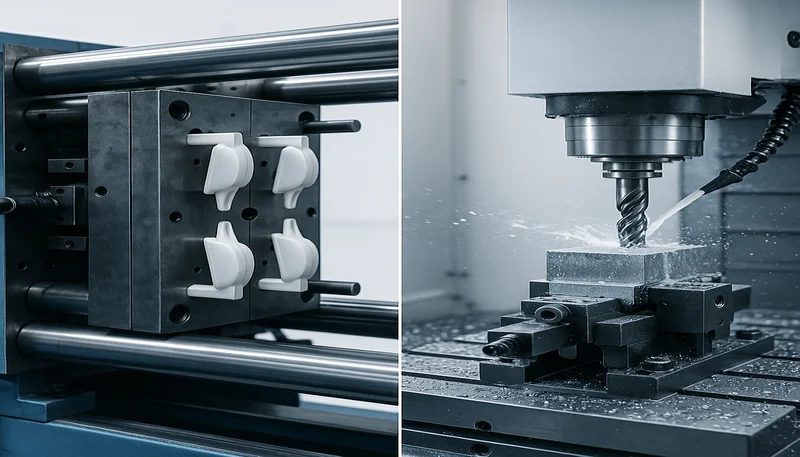
Le procédé RIM suit cinq étapes : doser, mélanger, remplir, polymériser et démouler une pièce réactive en polyuréthane. La séquence ci-dessous compare le RIM au fonctionnement d’une presse à injecter à vis afin d’aider les ingénieurs à diagnostiquer les problèmes de qualité et à optimiser les temps de cycle.
Étape 1 : stockage des matières et contrôle de la température. Les deux composants — généralement un mélange de polyols (composant A) et un isocyanate (composant B) — sont stockés dans des cuves chauffées séparées à des températures contrôlées, généralement 80–120 °F (27–49 °C). La stabilité thermique est importante, car les variations de viscosité influencent directement la qualité du mélange. Un écart de 10 °F peut modifier la viscosité de 15–25% et entraîner un mélange incomplet.
Étape 2 : dosage et mélange à haute pression. Au lancement du cycle, des pompes doseuses de précision délivrent les deux composants selon un rapport défini (souvent 1:1 en volume, mais compris entre 100:30 et 100:200 selon la formulation). Les flux se rencontrent dans une tête de mélange par impact à haute pression, à 1,500–3,000 psi. Cette énergie d’impact crée en quelques millisecondes un mélange turbulent, sans nécessiter d’agitateur mécanique.
Étape 3 : remplissage du moule. Le liquide mélangé s’écoule dans un moule fermé à une pression relativement faible (50–200 psi). Comme le mélange réactif présente une faible viscosité, comparable à celle de l’eau, il remplit facilement les géométries complexes et les sections à paroi mince. Le moule est généralement chauffé à 100–180 °F afin d’accélérer la réaction de polymérisation.
Étape 4 : réaction chimique et polymérisation. Dans le moule, une réaction exothermique3 se produit lorsque le polyol et l’isocyanate se réticulent. Le matériau se dilate légèrement (effet moussant dans le RIM à mousse structurelle), épouse tous les détails du moule et durcit jusqu’à son état solide final. Selon la formulation, le temps de polymérisation varie de 1–10 minutes. La température interne due à l’exothermie peut atteindre 250–350 °F, même si le moule reste relativement froid.
Étape 5 : démoulage et post-traitement. Une fois le temps de démoulage⁴ atteint, le moule s’ouvre et la pièce est retirée. Les pièces RIM nécessitent généralement une post-polymérisation (24–48 heures à température ambiante) pour acquérir toutes leurs propriétés mécaniques. L’ébavurage, la finition de surface et la peinture sont des opérations secondaires courantes.
Quels matériaux sont utilisés en RIM ?
Le paysage des matériaux pour le RIM est bien plus restreint que pour le moulage par injection thermoplastique. Alors que l’injection thermoplastique offre des milliers de nuances de résine à travers des dizaines de familles de polymères, le RIM est dominé par la chimie du polyuréthane. C’est à la fois sa force (optimisation poussée au sein du PU) et sa limite (on ne peut pas traiter du nylon, du polycarbonate ou du PEEK sur une machine RIM).

Élastomères de polyuréthane (PU). C’est le matériau de référence du RIM. Les pièces en PU élastomère massif vont de Shore A 50 (souple et caoutchouteux) à Shore D 80 (dur et rigide). Elles sont utilisées pour les boucliers de pare-chocs, les élargisseurs d’aile et les boîtiers industriels. Module de flexion type : 5,000–300,000 psi.
PU à mousse structurelle⁵. En introduisant un agent gonflant (souvent de l’eau qui réagit avec l’excès d’isocyanate pour former du CO₂), le RIM produit des pièces dotées d’un cœur cellulaire et d’une peau pleine. Le poids diminue ainsi de 10–30% sans perte de rigidité. L’épaisseur de paroi peut atteindre 0.5 inches sans retassures, ce qui est difficile en moulage par injection thermoplastique.
RIM renforcé (RRIM). L’ajout de fibres de verre broyées (généralement 10–25% en poids) ou de charges minérales au composant polyol augmente la rigidité, la stabilité dimensionnelle et la résistance thermique. Le module de flexion des pièces RRIM est 2–4× supérieur à celui du PU non chargé, ce qui convient aux composants automobiles semi-structurels tels que les doublures de benne de pick-up et les panneaux de porte.
Systèmes sans PU. Moins courants mais disponibles dans le commerce : polyurée (polymérisation plus rapide et meilleure stabilité thermique), copolymères séquencés de nylon (pour les applications à température plus élevée) et dicyclopentadiène (DCPD, utilisé pour de très grandes pièces telles que les panneaux de machines agricoles). Ils représentent moins de 15% de la production totale en RIM.
| Système de matériau | Densité (g/cm³) | Module de flexion (psi) | Utilisation typique |
|---|---|---|---|
| Élastomère PU massif | 1.0–1.2 | 5,000–50,000 | Facades de pare-chocs, joints |
| Mousse structurelle PU | 0.4–0.8 | 20,000–100,000 | Panneaux, enveloppes |
| RRIM (20% verre) | 1.2–1.4 | 100,000–300,000 | Panneaux de porte, ailes |
| Polyurée | 1.0–1.1 | 15,000–80,000 | Couvercles haute température |
| DCPD | 1.0–1.1 | 200,000–350,000 | Grands panneaux d'équipement |
Quels sont les avantages du RIM ?
Les avantages du RIM sont les principales catégories ou options expliquées dans cette section. Le RIM offre des avantages spécifiques qui en font le choix technique correct pour certaines applications — et le mauvais pour d’autres. Voici ce qu’il fait vraiment bien, basé sur des données de production réelles, et non sur des arguments marketing.
Faible coût d’outillage. Les moules RIM fonctionnent à 50–200 psi, contre 5,000–20,000 psi pour le moulage par injection thermoplastique. Ils peuvent donc être fabriqués en aluminium, en époxy coulé, voire en résines imprimées en 3D pour le prototypage. Un moule RIM de production en acier coûte $5,000–$25,000 pour une pièce de complexité moyenne, contre $30,000–$150,000 pour un moule d’injection comparable. En dessous de 1,000 unités, cette différence suffit souvent à faire du RIM le choix économiquement rationnel.
Capacité à produire de grandes pièces. Le RIM convient à des pièces peu pratiques à fabriquer par moulage par injection standard. Les boucliers automobiles jusqu’à 6 feet de long, les panneaux de machines agricoles et les enveloppes d’équipements médicaux sont des applications RIM courantes. La faible pression de remplissage réduit au minimum la force de fermeture : une presse de 10 tons peut produire des pièces qui exigeraient 500 tons en injection thermoplastique.

Liberté de conception. Grâce à la viscosité du liquide réactif, comparable à celle de l’eau, le RIM remplit les contre-dépouilles, les nervures minces et les géométries complexes sans le compactage à haute pression requis par l’injection thermoplastique. Des variations d’épaisseur de paroi de 3:1 sur une même pièce restent maîtrisables. Inserts, bossages filetés et renforts structurels peuvent être surmoulés en une seule injection.
Encapsulation. Le RIM encapsule naturellement les inserts métalliques, les composants électroniques et les structures de renfort. Sa faible pression d’injection (inférieure à 200 psi) n’endommage pas les composants électroniques sensibles. Il convient donc parfaitement aux boîtiers de dispositifs médicaux avec PCB intégrés, aux composants automobiles munis de supports métalliques et aux enveloppes industrielles avec blindage EMI intégré.
Rentabilité en petite série. Pour des productions de 50–2,000 unités par an, le RIM offre souvent un coût total par pièce inférieur à celui du moulage par injection en petite série, une fois l’amortissement de l’outillage pris en compte. Le seuil de rentabilité par rapport à l’injection thermoplastique se situe généralement entre 2,000–5,000 unités, selon la géométrie de la pièce et le matériau.
Chez ZetarMold, nous rencontrons régulièrement des clients qui demandent des devis pour du moulage par injection en faible volume pour des pièces qui seraient mieux adaptées au RIM. Lorsqu'un client a besoin de 300 unités d'un boîtier de 500 mm et que les devis reviennent à plus de 40 000 $ pour l'outillage en acier, nous expliquons le compromis honnête : nos 45 machines de moulage par injection de 90T à 1850T sont optimisées pour des volumes de production thermoplastique de 1 000+ unités. Pour des séries inférieures à 1 000 unités de grandes pièces en polyuréthane, le RIM est le choix économiquement correct, même si nous référerions ce travail à un atelier RIM spécialisé. Aider les clients à trouver le bon procédé — même quand ce n'est pas le nôtre — bâtit une confiance à plus long terme et les ramène souvent pour des programmes thermoplastiques à l'échelle de la production.
Quelles sont les limites du RIM ?
Les limites du RIM sont regroupées dans les principales catégories ou options présentées dans cette section. Tout procédé de fabrication comporte des contraintes. Comprendre les limites du RIM est aussi important que connaître ses atouts, car choisir le mauvais procédé coûte bien plus cher que choisir le bon.
Choix de matériaux restreint. Le RIM se limite très largement aux systèmes à base de polyuréthane. Si votre application exige la résistance chimique du PPS, la transparence du PMMA, la stabilité dimensionnelle du PEEK ou l’économie du polypropylène, le RIM ne peut pas y répondre. C’est la raison la plus fréquente pour laquelle les ingénieurs abandonnent cette solution après l’évaluation initiale.
Temps de cycle. Les cycles RIM durent 2–10 minutes, contre 10–60 secondes pour le moulage par injection thermoplastique. La réaction chimique prend tout simplement plus de temps que le refroidissement du plastique fondu. En grande série (plus de 5,000 unités/year), le RIM devient non rentable, quelles que soient les économies d’outillage.
État de surface. Les pièces RIM peuvent être peintes pour satisfaire aux normes automobiles de classe A, mais leur surface brute de moulage présente généralement des traces d’écoulement, de la porosité et des variations de couleur. Obtenir un aspect esthétique exige un apprêt, un rebouchage et une peinture, ce qui augmente le coût et le délai. Pour une surface esthétique directement en sortie de moule, le moulage par injection thermoplastique avec des outillages en acier poli est préférable.
Recyclabilité. Les polyuréthanes thermodurcissables ne peuvent être ni refondus ni retraités. Contrairement aux déchets thermoplastiques, qui peuvent être broyés puis réutilisés, les carottes, bavures et pièces RIM rebutées finissent en décharge ou exigent un recyclage chimique spécialisé. C’est une véritable limite pour les entreprises soumises à des objectifs de durabilité.
"L’outillage RIM coûte 60–80% de moins qu’un outillage d’injection thermoplastique pour des géométries équivalentes."True
La RIM fonctionne à 50–200 psi contre 5 000–20 000 psi pour l'injection thermoplastique, permettant des moules en aluminium ou en époxy plutôt qu'en acier durci. Un moule RIM de complexité moyenne coûte $5 000–$25 000 contre $30 000–$150 000 pour un moule d'injection.
"Le RIM peut produire des pièces dans tout polymère, y compris des thermoplastiques techniques comme PEEK, PPS et polycarbonate."False
Le RIM est fondamentalement limité aux polymères thermodurcissables qui durcissent par réaction chimique — principalement les polyuréthanes, les polyurées, et quelques systèmes spécialisés. Les thermoplastiques techniques nécessitent une fusion et un refroidissement, domaine du moulage par injection traditionnel.
Comment le RIM se compare-t-il au moulage par injection traditionnel ?
Le RIM est plus compétitif que le moulage par injection traditionnel lorsque les compromis ci-dessous en matière de coût, de délai et de qualité correspondent aux besoins de votre programme. Par rapport au moulage par injection traditionnel, il échange un cycle plus lent et un choix de matériaux plus restreint contre une pression d’outillage bien moindre, un moule moins coûteux et une production facilitée des grandes pièces. Dans nos chiffrages en usine, la décision dépend généralement du volume, des dimensions de la pièce, des exigences de matériau et des normes d’état de surface. Pour comparer les temps de cycle, confrontez la polymérisation de 2-10 minutes du RIM au temps de production standard du moulage par injection.
| Facteur | RIM | Moulage par injection traditionnel |
|---|---|---|
| Pression d'injection | 50–200 psi | 5,000–20,000 psi |
| Coût d’outillage typique | $5,000–$25,000 | $30,000–$150,000 |
| Durée du cycle | 2 à 10 minutes | 10–60 secondes |
| Options de matériaux | PU, polyurée, DCPD | 100+ thermoplastiques |
| Taille maximale de la pièce | 6+ pieds (2m) | Limité par la puissance de la presse |
| Volume optimal | 50–5 000 unités/an | 1 000–1 000 000+ unités/an |
| Finition de surface (telle que moulée) | Nécessite une peinture | Classe A réalisable |
| Plage d'épaisseur de paroi | 0,125–0,5 pouces | 0,02–0,5 pouces |
| Recyclabilité | Non recyclable (thermodurcissable) | Rectifié et réutilisé |
Le seuil critique est le volume. En dessous de 2,000 unités, les économies d’outillage du RIM compensent généralement son cycle plus lent et son coût matière unitaire plus élevé. Au-dessus de 5,000 unités, les cycles plus rapides et les coûts matière inférieurs du moulage par injection thermoplastique l’emportent nettement. Entre 2,000–5,000 unités, le choix dépend de la complexité de la pièce, des exigences matière et de l’état de surface requis.
La taille de la pièce est la deuxième variable clé. Pour les pièces de plus de 12 pouces (300 mm), le RIM n’a souvent pas d’alternative thermoplastique viable à faible volume. Le coût d’un moule d’injection grand format (nécessitant une presse de 1 000+ tonnes) peut dépasser 200 000 $, tandis qu’un moule RIM comparable reste inférieur à 30 000 $. C’est pourquoi l’automobile utilise le RIM depuis des décennies pour les pare-chocs, même sur les véhicules produits en série.

"Pour des volumes de production inférieurs à 2,000 unités par an, le RIM offre généralement un coût total par pièce inférieur à celui du moulage par injection de thermoplastiques."True
Un moule RIM de $20,000 amorti sur 1,000 unités ajoute $20/unité au coût d’outillage. Un moule d’injection de $100,000 amorti sur le même volume ajoute $100/unité. Malgré le coût matière par pièce supérieur du RIM, le coût unitaire total reste inférieur pour des volumes de moins de 2,000 unités.
"Le RIM produit des pièces dont la précision dimensionnelle et l’état de surface sont identiques à ceux du moulage par injection dans un moule en acier."False
Les pièces en RIM atteignent généralement des tolérances de ±0,010–0,030 pouce contre ±0,002–0,005 pouce pour le moulage par injection de précision. Les surfaces RIM telles que moulées nécessitent une amorce et une peinture pour une qualité esthétique, tandis que les moules d'injection en acier poli peuvent fournir directement des surfaces de Classe A.
Quelles sont les applications RIM les plus courantes ?
Les applications RIM les plus courantes sont les principales catégories ou options expliquées dans cette section. Le RIM s’est taillé des niches spécifiques où sa combinaison de faible coût d’outillage, de capacité pour les grandes pièces et de liberté de conception crée des avantages nets. Il ne s’agit pas d’applications théoriques — elles représentent les domaines où le RIM est activement utilisé en production aujourd’hui.
Automobile. Les boucliers de pare-chocs restent la première application mondiale du RIM. Les autres usages automobiles comprennent les élargisseurs d’aile, les becquets, les supports de planche de bord, les panneaux de porte et les doublures de benne de pick-up. L’industrie automobile représente environ 65% du volume total de production RIM.
Équipements médicaux. Les grandes enveloppes d’IRM, de scanners CT et de robots chirurgicaux sont d’excellentes candidates au RIM. Ces pièces sont généralement grandes (plus de 300 mm), produites en faibles volumes (100–500 unités/year) et doivent encapsuler des composants électroniques. La faible pression d’injection évite d’endommager les câblages et capteurs intégrés.
Enveloppes industrielles. Boîtiers de tableaux de commande, boîtes de jonction électriques et capots d’équipements pour engins de chantier et machines agricoles. La capacité du RIM à intégrer des inserts métalliques destinés aux fixations, ainsi que sa résistance aux chocs et aux produits chimiques, l’adaptent particulièrement aux environnements difficiles.
Aéronautique. Panneaux intérieurs, conduits et carénages d’aéronefs. La résistance au feu intrinsèque du polyuréthane (avec une formulation contenant les additifs appropriés) et sa capacité à satisfaire aux exigences FAA relatives aux fumées et à la toxicité font du RIM un choix pratique pour les composants intérieurs aéronautiques produits en petite série.
Électronique grand public. Boîtiers grand format pour machines de jeu, distributeurs automatiques et bornes interactives. Lorsque les séries restent inférieures à 1,000 unités et que les pièces dépassent les dimensions compatibles avec le moulage par injection standard, le RIM offre un compromis économique entre le moulage par injection et la fibre de verre stratifiée à la main.
Quand choisir le RIM pour votre projet ?
Après avoir lu les avantages, limites et comparaisons ci-dessus, le cadre décisionnel se simplifie en une liste de contrôle pratique. Voici quand le RIM est la bonne réponse — et quand il ne l’est pas.
Choisissez le RIM si : votre volume annuel est inférieur à 5,000 unités, votre pièce dépasse 12 inches dans au moins une dimension, vous avez besoin des propriétés du polyuréthane (résistance aux chocs, souplesse ou isolation par mousse) et votre budget d’outillage est limité. Si trois de ces quatre conditions sont remplies, le RIM mérite une évaluation approfondie.
Ne choisissez pas le RIM si : vous avez besoin de plus de 10,000 unités par an (le temps de cycle anéantit la rentabilité), vous exigez des thermoplastiques techniques parmi les matériaux pour moule d’injection tels que le PEEK, le PPS ou le polycarbonate, vous voulez un état de surface de classe A sans peinture ou des tolérances serrées (±0.005 inch ou mieux). Dans ces cas, le moulage par injection thermoplastique est le procédé approprié.
Zone grise (2,000–5,000 unités) : la décision exige ici une modélisation détaillée des coûts. Créez un tableur comparant : (1) le coût de l’outillage amorti sur le volume prévu pendant sa durée de vie, (2) le coût matière par pièce, (3) le temps de cycle × le tarif machine et (4) les opérations secondaires (peinture pour le RIM, éventuelles modifications du moule pour l’injection). D’après notre expérience, le seuil se situe autour de 3,000–3,500 unités pour la plupart des pièces de complexité moyenne.
Quelles sont les questions les plus fréquemment posées sur le moulage par injection réactionnelle ?
Quelle est la différence entre le RIM et le moulage par injection ?
Le RIM utilise des composants chimiques liquides — typiquement un polyol et un isocyanate — qui réagissent et durcissent dans le moule pour former des pièces thermodurcies solides, fonctionnant à seulement 50–200 psi de pression d’injection. Le moulage par injection traditionnel fond des granulés thermoplastiques solides et les force dans un moule à 5,000–20,000 psi, puis les refroidit pour solidification. Le RIM offre des coûts d’outillage substantiellement plus bas (60–80% moins) et traite des pièces beaucoup plus grandes que le moulage par injection standard, mais il est limité aux matériaux à base de polyuréthane et des temps de cycle de 2–10 minutes contre 10–60 secondes pour l’injection thermoplastique. Le moulage par injection offre une sélection de matériaux plus large sur plus de 100 thermoplastiques, des cycles de production plus rapides et des tolérances dimensionnelles plus strictes.
Combien coûte l’outillage RIM par rapport au moulage par injection ?
Un outillage RIM coûte généralement $5,000–$25,000 pour des pièces de complexité moyenne, contre $30,000–$150,000 pour des moules d’injection thermoplastique équivalents, soit une réduction de 60–80%. Cet écart important provient de la faible pression de fonctionnement du RIM, inférieure à 200 psi contre 5,000–20,000 psi pour l’IM, qui permet de fabriquer les moules en aluminium, en époxy coulé ou en composites plutôt qu’en acier à outils trempé. Pour le prototypage et les très petites séries, un moule RIM imprimé en 3D peut coûter moins de $1,000. En contrepartie, les moules RIM s’usent plus vite que les moules d’injection en acier : ils durent généralement 5,000–20,000 injections, contre 100,000+ pour les outillages en acier trempé.
Quels types de pièces sont les plus adaptés au RIM ?
Les meilleurs candidats pour le RIM sont les grandes pièces dépassant 12 pouces (300 mm) dans toute dimension, nécessaires en volumes de production faible à moyen de 50–5,000 unités par année, où les propriétés du matériau polyuréthane répondent aux exigences de l’application. Des exemples courants incluent les pare-chocs et panneaux de carrosserie automobiles, les boîtiers d’équipement médical pour machines MRI et CT, les enclos de panneaux de contrôle industriels, et les composants intérieurs aérospatiaux. Les pièces nécessitant l’encapsulation d’inserts métalliques, de composants électroniques ou de renforts structurels sont aussi des candidats forts pour le RIM car la faible pression d’injection (moins de 200 psi) n’endommage pas les éléments intégrés durant le moulage.
Le RIM peut-il produire des pièces avec des tolérances étroites ?
Le RIM permet d’obtenir des tolérances typiques de ±0.010–0.030 inch (0.25–0.75 mm), adaptées à de nombreux boîtiers structurels, enveloppes et panneaux. Ces performances restent toutefois inférieures à celles du moulage par injection de thermoplastiques avec des moules en acier trempé : ±0.002–0.005 inch (0.05–0.13 mm). Si votre application exige des ajustements précis de paliers, des surfaces d’étanchéité pour joints, des interfaces d’assemblage serrées entre plusieurs pièces ou des spécifications de cotation et tolérancement géométriques (GD&T) inférieures à ±0.010 inch, le moulage par injection traditionnel avec un outillage en acier est le procédé de fabrication le plus approprié.
Le RIM est-il écologique ?
Le RIM présente un profil environnemental mitigé qui nécessite une évaluation honnête. D’un côté positif, le RIM génère un minimum de déchets de matériau lors du traitement car les réactifs liquides remplissent précisément la cavité du moule, et le processus utilise nettement moins d’énergie par pièce grâce à des températures (100–180 °F) et des pressions (50–200 psi) de fonctionnement plus basses que le moulage par injection thermoplastique. Cependant, les polyuréthanes thermodurcissables ne peuvent pas être recyclés par les moyens mécaniques conventionnels — les chutes, les canaux d’alimentation, les bavures et les pièces en fin de vie ne peuvent pas être refondues et retraitées comme les thermoplastiques. Des procédés de recyclage chimique pour les polyuréthanes existent mais ne sont pas encore largement disponibles à l’échelle commerciale, ce qui signifie que la plupart des déchets RIM finissent actuellement en décharge.
Combien de temps faut-il pour que une pièce RIM durcisse ?
Les temps de cycle RIM varient de 2–10 minutes par injection selon l’épaisseur de la pièce, la formulation du matériau, la température du moule et la complexité de la pièce. Les pièces à paroi mince sous 6 mm d’épaisseur peuvent être démoulées en 2–3 minutes avec des formulations de polyurée à réaction rapide, tandis que les pièces structurelles en mousse épaisse dépassant 12 mm peuvent nécessiter 8–10 minutes pour une résistance suffisante avant retrait sûr. Après démoulage, les pièces RIM nécessitent typiquement un post-durcissement à température ambiante pendant 24–48 heures pour atteindre leurs propriétés mécaniques spécifiées complètes. Cette étape de post-durcissement est essentielle — les pièces manipulées ou chargées avant complétion du post-durcissement peuvent présenter une déformation permanente ou une résistance à l’impact réduite.
Peut-on surmouler ou mouler avec inserts avec le RIM ?
Oui, le RIM supporte naturellement l’encapsulation d’inserts métalliques, de composants électroniques, de fixations filetées et de renforts structurels dans une seule opération de moulage. La faible pression d’injection (moins de 200 psi) ne déplace ni endommage les inserts pré-positionnés lors du remplissage du moule. Contrairement au surmoulage thermoplastique, qui nécessite une deuxième unité d’injection, un contrôle précis de la température et une gestion attentive de la compatibilité des matériaux, l’encapsulation RIM se fait en une seule injection sans nécessiter une liaison chimique entre les couches. Cela rend le RIM particulièrement efficace pour les boîtiers de dispositifs médicaux avec composants électroniques intégrés, les composants automobiles avec supports métalliques pré-placés, et les enclos industriels avec blindage EMI intégré ou points de montage filetés.
polyuréthane : le polyuréthane (PU) est un polymère polyvalent issu de la réaction de diisocyanates avec des polyols. Il existe sous forme de mousse souple, de mousse rigide et d’élastomère, dans une vaste gamme de duretés et de propriétés mécaniques. ↩
thermodurcissable : un thermodurcissable est un polymère qui subit pendant la polymérisation une réaction chimique irréversible, formant une structure moléculaire réticulée permanente qui ne peut être ni refondue ni remise en forme. ↩
réaction exothermique : une réaction exothermique est un processus chimique qui libère de l’énergie sous forme de chaleur dans son environnement, l’énergie totale des produits étant inférieure à celle des réactifs. ↩