 Zum Inhalt springen

Getting Spritzgießen1 process parameters right makes the difference between profitable production and expensive scrap. After 20 years of troubleshooting everything from warped automotive parts to sink marks in consumer electronics, I’ve learned that successful molding comes down to mastering five core parameters: temperature, pressure, speed, timing, and cooling. These aren’t just numbers on a machine display—they’re the levers that control your part quality, cycle time, and bottom line. If you are evaluating suppliers, check our sourcing guide3 for practical qualification tips.
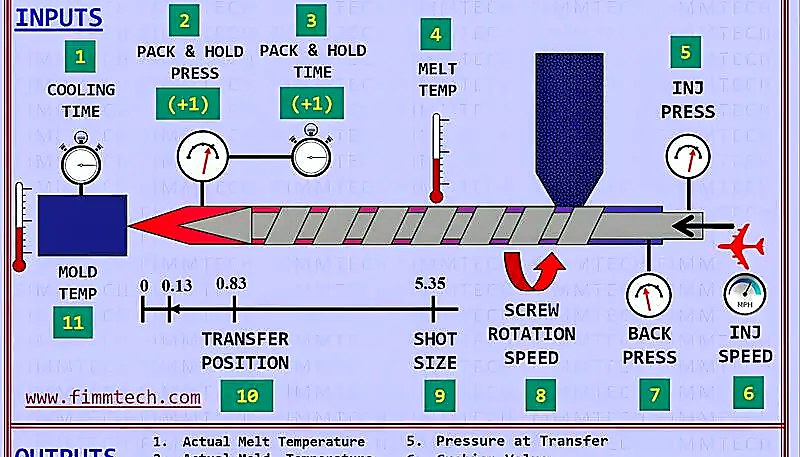
- Temperature control affects material flow, crystallization, and surface finish—typically ranges from 180°C for PP to 280°C for PC
- Injection pressure determines cavity fill and part density, usually 800-1500 bar for most thermoplastics
- Speed parameters control shear heating and molecular orientation—injection speeds of 50-200 mm/s are common
- Holding pressure and time prevent shrinkage and sink marks—typically 60-80% of injection pressure for 3-15 seconds
- Cooling time directly impacts cycle time and part quality—calculate using wall thickness squared times material thermal diffusivity
What Are the Key Injection Molding Process Parameters?
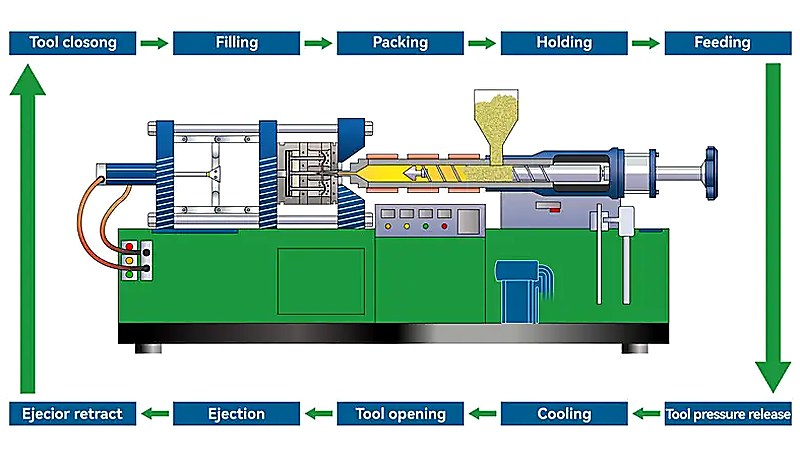
The key injection molding process parameters are the main categories or options explained in this section. The five critical injection moulding process parameters are temperature, pressure, speed, timing, and cooling—each controlling specific aspects of part quality and production efficiency. Temperature affects material viscosity and flow behavior. Pressure determines cavity filling and part density. Speed controls shear heating and molecular orientation. Timing manages material solidification. Cooling governs cycle time and dimensional stability.
Temperature parameters include barrel zones (typically 4-5 zones), nozzle temperature, and Spritzgussform temperature. For ABS, I typically run barrel temperatures from 220°C at the feed zone to 240°C at the nozzle, with mold temperatures around 60-80°C. These temperatures ensure proper melt flow while preventing degradation.
Pressure parameters work in sequence: injection pressure fills the cavity (800-1500 bar), holding pressure maintains part density (60-80% of injection pressure), and back pressure controls melt homogeneity (3-15 bar). Speed parameters include injection speed (50-200 mm/s), screw rotation speed (50-150 RPM), and ejection speed. Timing parameters cover injection time, holding time, cooling time, and total cycle time.
How Does Temperature Affect Injection Molding Quality?
Temperature directly controls material viscosity, flow length, surface finish, and molecular structure in injection molded parts. Higher temperatures reduce viscosity, allowing longer flow lengths and better cavity filling, but excessive heat causes degradation, flash, and poor surface quality. Lower temperatures increase viscosity, potentially causing short shots and high injection pressures.
Barrel temperature profiles typically increase from rear to front zones. For polypropylene, I run 180°C at the feed zone, 200°C in the compression zone, 210°C in the metering zone, and 220°C at the nozzle. This progressive heating ensures proper plasticization without overheating. The temperature difference between zones should be 10-20°C to prevent material degradation.
Mold temperature affects crystallization in semi-crystalline plastics like nylon and polypropylene. Higher mold temperatures (80-120°C for nylon) promote crystallinity, improving chemical resistance and dimensional stability but increasing cycle time. Lower mold temperatures (40-60°C) reduce cycle time but may cause warpage and poor surface finish. I’ve seen 20% cycle time increases when mold temperature rises from 60°C to 100°C for nylon parts.
“Increasing barrel temperature by 10°C typically reduces injection pressure requirements by 50-100 bar for most thermoplastics.”Wahr
This relationship holds true because higher temperatures reduce melt viscosity, making the material flow more easily through the runner system and into the mold cavity. I’ve consistently observed this 50-100 bar pressure reduction when optimizing process parameters for materials like ABS, PC, and nylon.
“Faster injection speeds always improve part quality by reducing flow marks and hesitation lines.”Falsch
While faster injection can improve surface finish in many cases, excessive speed creates problems including high shear heating, molecular orientation leading to warpage, and increased injection pressures. Optimal injection speed depends on part geometry, wall thickness, and material properties. I’ve seen warpage increase 30% when injection speed exceeded 250 mm/s in thin-wall PC parts.
What Role Does Injection Pressure Play in Part Quality?
Injection pressure determines cavity filling completeness, part density, and dimensional accuracy by forcing molten plastic through runners, gates, and into every detail of the mold cavity. Insufficient pressure causes short shots, sink marks, and low part density. Excessive pressure leads to flash, high residual stress, and difficult part ejection.
Typical injection pressures range from 800-1500 bar for most thermoplastics, but thin-wall applications may require 1800+ bar. I calculate required pressure using flow length, wall thickness, and material viscosity. For a 200mm flow length through 2mm wall thickness in ABS, expect 1000-1200 bar injection pressure at standard processing temperatures.
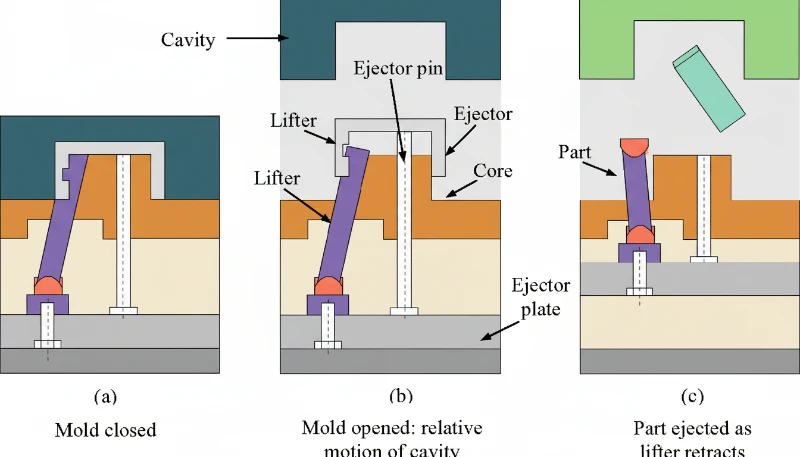
Holding pressure maintains part quality after cavity filling by compensating for material shrinkage during cooling. Set holding pressure at 60-80% of injection pressure—too low causes sink marks and dimensional variations, too high wastes energy and may cause flash. Holding time should be 3-15 seconds, depending on wall thickness and material thermal properties. For thick sections (>5mm), extend holding time to 10-15 seconds.
How Do Speed and Timing Parameters Shape the Final Product?
Speed and timing parameters control material flow behavior, molecular orientation, and part solidification, directly affecting surface finish, mechanical properties, and dimensional stability. Injection speed determines shear heating and flow front advancement through the cavity. Screw speed affects melt homogeneity and color dispersion. Timing parameters manage material phase transitions from liquid to solid state, governing how long each stage lasts and when transitions occur. Getting these parameters right requires understanding the interaction between material rheology, part geometry, and cooling capacity of the mold.
Injection speed typically ranges from 50-200 mm/s, but optimal speed depends on part geometry and material sensitivity. Fast injection (150-200 mm/s) improves surface finish and reduces flow marks but increases shear heating and molecular orientation. Slow injection (50-100 mm/s) reduces stress but may cause flow marks and temperature variations. I use multi-stage injection profiles: fast filling for 90% cavity volume, then slow speed for final 10% to minimize stress.
Screw rotation speed affects melt quality and cycle time. Standard speeds of 50-150 RPM provide good mixing without excessive shear heating. Higher speeds above 200 RPM cause degradation in heat-sensitive materials like PVC and POM, leading to discoloration and reduced mechanical properties. Lower speeds below 50 RPM may produce poor melt homogeneity, resulting in color streaking or inconsistent part quality. Back pressure of 3-15 bar improves mixing—use higher values (10-15 bar) for recycled materials or color-critical applications where uniform appearance is essential. I typically start with 8-10 bar back pressure and adjust based on melt temperature monitoring and visual inspection of test shots.
Why Is Mold Temperature Critical for Crystalline Plastics?
Mold temperature controls crystallization kinetics in semi-crystalline plastics like nylon, polypropylene, and POM, directly affecting mechanical properties, chemical resistance, and dimensional stability. Higher mold temperatures promote crystal formation, improving strength and chemical resistance but increasing cycle time. Lower temperatures limit crystallization, reducing properties but enabling faster production.
For nylon 66, I typically run mold temperatures of 80-120°C depending on part requirements. High-performance applications requiring maximum strength and chemical resistance need 100-120°C mold temperature, achieving 40-50% crystallinity. Consumer products prioritizing cost over performance can use 60-80°C, accepting lower crystallinity (20-30%) for faster cycles.

Polypropylene shows dramatic property changes with mold temperature. At 40°C mold temperature, expect 30-40% crystallinity with good impact resistance. At 80°C, crystallinity increases to 50-60% with higher stiffness but reduced impact strength. The key is matching mold temperature to application requirements—automotive under-hood parts need high crystallinity, while flexible packaging prefers lower crystallinity. I once ran tests on a PP gear housing where raising mold temperature from 50°C to 85°C increased tensile strength by 18% but nearly doubled cycle time. That tradeoff between mechanical performance and throughput is one every process engineer must evaluate carefully. POM follows a similar pattern—80-100°C mold temperatures produce better creep resistance for gears and mechanical components.
Parameter-related defects follow predictable patterns that experienced molders recognize immediately. Short shots indicate insufficient pressure or temperature preventing complete cavity fill. Flash suggests excessive pressure or worn tooling allowing material to escape the mold parting line. Sink marks result from inadequate holding pressure or insufficient holding time during cooling. Warpage stems from uneven cooling, excessive molecular orientation, or improper gate location creating differential shrinkage. Understanding which parameter causes each defect type is the first step toward systematic troubleshooting. I always start by checking the easiest parameter to adjust before moving to more complex causes—this diagnostic approach saves hours of trial-and-error debugging on the production floor.
For short shots, first increase injection pressure by 50-100 bar increments until the cavity fills completely. If pressure reaches machine limits above 1500 bar without improvement, increase barrel temperature by 10°C steps to reduce melt viscosity. Check for gate freeze-off by extending holding time—sometimes the gate seals before the cavity fills. Verify adequate venting as well, since trapped air prevents complete filling even at high pressures. On one automotive connector project, we traced persistent short shots to a blocked vent channel that was limiting air escape during high-speed filling.
Flash elimination requires systematic pressure reduction and mold inspection. Reduce injection pressure by 50 bar steps until flash disappears, then optimize holding pressure. Check parting line condition—worn or damaged mold surfaces cause flash at low pressures. Verify mold clamping force meets calculated requirements based on projected part area and cavity pressure.
Sink mark correction focuses on holding pressure and time optimization. Increase holding pressure to 70-80% of injection pressure. Extend holding time until gate freezes—typically 3-15 seconds depending on gate size and material. For thick sections, consider sequential valve gating or gas-assist molding to maintain pressure throughout cooling.
“Warpage in injection molded parts is primarily caused by differential shrinkage between thick and thin sections rather than material properties.”Wahr
Differential shrinkage creates internal stresses that cause warpage as parts cool and solidify. Thick sections cool slower and shrink more than thin sections, creating stress concentrations. This is why uniform wall thickness design is critical—I’ve reduced warpage by 60% simply by maintaining consistent 2-3mm wall thickness in complex housings.
“Back pressure settings above 20 bar are always necessary for achieving good color mixing in injection molding.”Falsch
While back pressure improves mixing, excessive values (>20 bar) cause unnecessary shear heating, longer cycle times, and potential material degradation. Most applications achieve excellent color mixing with 5-15 bar back pressure. I’ve found that 8-12 bar provides optimal mixing for most materials without the negative effects of excessive shear.
At ZetarMold, our 20+ years of injection molding experience across 47 machines ranging from 90T to 1850T has taught us that process parameter optimization is both science and art. Working with 400+ different materials, we’ve developed parameter databases that reduce setup time by 70% and first-shot success rates above 85%. Our process engineers use statistical process control to maintain parameter stability within ±2% across production runs.
Ready to optimize your injection molding process parameters? ZetarMold’s sourcing guide provides detailed parameter recommendations for over 400 materials. Our process engineers can help you establish robust parameter windows that ensure consistent quality while minimizing cycle time. Contact us for a free process parameter audit of your current molding operations.
Häufig gestellte Fragen
What is the optimal injection molding temperature range for ABS?
ABS injection molding temperatures typically range from 220-250°C in the barrel with mold temperatures of 60-80°C. I recommend starting with 230°C barrel temperature and 70°C mold temperature for most general-purpose applications. Higher temperatures around 240-250°C improve flow and surface finish but increase the risk of thermal degradation. Lower temperatures around 220-230°C reduce cycle time but may cause short shots in thin-wall parts. Nozzle temperature should be set 5-10°C higher than the front barrel zone to prevent premature freeze-off. Always monitor actual melt temperature with a pyrometer—target 235-245°C for optimal ABS processing results.
How do you calculate the correct holding pressure for injection molding?
Calculate holding pressure as 60-80% of the injection pressure required for complete cavity filling. Start with 70% as baseline, then adjust based on part quality. For thick sections (>4mm), use 75-80% to prevent sink marks. For thin walls (<2mm), 60-65% prevents flash while maintaining density. Monitor part weight—consistent weight indicates proper holding pressure. I use cavity pressure sensors when available, targeting 400-600 bar cavity pressure during holding phase. Holding pressure too low causes sink marks and dimensional variation. Too high wastes energy and may cause flash or difficult ejection.
Was verursacht Gratbildung beim Spritzgießen und wie behebt man sie?
Gratbildung tritt auf, wenn der Einspritzdruck die Formschließkraft übersteigt oder wenn die Formtrennfächen verschlissen oder beschädigt sind. Berechnen Sie die erforderliche Schließkraft mit projizierter Teilfläche mal Hohlraumdruck – typischerweise 3-5 Tonnen pro Quadratzoll projizierter Fläche. Reduzieren Sie den Einspritzdruck in 50-100 bar Schritten, bis der Grat verschwindet. Überprüfen Sie den Werkzeugzustand – verschlissene Trennlinien, beschädigte Entlüftungen oder unzureichende Werkzeugwartung verursachen Gratbildung bei normalen Drücken. Vergewissern Sie sich der richtigen Werkzeugausrichtung und ausreichender Zugankerdehnung. Manchmal zeigt Gratbildung unzureichende Entlüftung an, was Druckreduzierung oder zusätzliche Entlüftungskanäle erfordert. Die Materialviskosität beeinflusst die Gratneigung – Materialien mit höherem Schmelzflussindex neigen leichter zu Gratbildung.
Was ist der Unterschied zwischen Einspritzdruck und Nachdruck?
Der Einspritzdruck füllt den Formhohlraum vollständig, typischerweise 800-1500 bar, abhängig von der Teilgeometrie und dem Material. Der Nachdruck erhält die Teiledichte während der Abkühlung, normalerweise 60-80% des Einspritzdrucks. Der Einspritzdruck wirkt während der Füllphase (1-3 Sekunden), während der Nachdruck während der Erstarrung wirkt (3-15 Sekunden). Hoher Einspritzdruck gewährleistet vollständiges Füllen und gute Oberflächenqualität. Richtiger Nachdruck verhindert Einfallstellen und Maßschrumpfung. Der Übergang von Einspritz- zu Nachdruck erfolgt bei 95-98% Hohlraumfüllung. Moderne Maschinen verwenden Hohlraumdruckrückmeldung, um diesen Umschaltpunkt automatisch zu optimieren.
Wie beeinflusst die Schneckendrehzahl die Qualität der Kunststoffschmelze?
Die Schneckendrehzahl steuert die Mischintensität und Verweilzeit und beeinflusst direkt die Schmelzehomogenität und -temperatur. Standarddrehzahlen von 50-150 U/min sorgen für gute Durchmischung ohne übermäßige Schererwärmung. Höhere Drehzahlen (>200 U/min) verursachen Abbau bei wärmeempfindlichen Materialien wie PVC oder POM. Niedrigere Drehzahlen (<50 U/min) können zu schlechter Farbdurchmischung oder Temperaturschwankungen führen. Ich passe die Schneckendrehzahl basierend auf der Materialempfindlichkeit und den Mischanforderungen an. Wärmeempfindliche Materialien benötigen langsamere Drehzahlen (50-100 U/min). Recycelte Materialien oder Farbkonzentrate profitieren von höheren Drehzahlen (100-150 U/min). Überwachen Sie die Schmelztemperatur – übermäßige Schneckendrehzahl erhöht die Temperatur durch Schererwärmung um 10-20°C.
Was ist die ideale Abkühlzeit für spritzgegossene Teile?
Die Abkühlzeit hängt vom Quadrat der Wandstärke und der thermischen Diffusivität des Materials ab. Verwenden Sie die Formel: Abkühlzeit = (Wandstärke)² × Materialfaktor. Für ABS mit 3 mm Wandstärke ist eine Abkühlzeit von 15-25 Sekunden zu erwarten. Polypropylen kühlt schneller ab (Materialfaktor 0,8), während PC langsamer abkühlt (Materialfaktor 1,3). Die Werkzeugtemperatur beeinflusst die Abkühlzeit – jede Erhöhung um 10°C fügt 15-20% zur Zykluszeit hinzu. Effizientes Kühlkanaldesign reduziert die Zeit um 30-40%. Ich überprüfe eine ausreichende Kühlung durch Messen der Ausstoßtemperatur des Teils – sie sollte für die meisten Thermoplaste unter 60°C liegen, um Verzug zu verhindern. Optimieren Sie die Abkühlzeit durch systematische Reduzierung, bis die Teilqualität nachlässt.
Wie stellt man den Gegendruck für das Spritzgießen ein?
Stellen Sie den Gegendruck zwischen 3-15 bar ein, abhängig von den Materialmischanforderungen und Qualitätsbedürfnissen. Beginnen Sie mit 5-8 bar für die meisten Anwendungen und passen Sie dann basierend auf der Schmelzqualität an. Höherer Gegendruck (10-15 bar) verbessert die Farbdurchmischung und Schmelzehomogenität, erhöht aber die Zykluszeit und Schererwärmung. Niedrigerer Gegendruck (3-5 bar) reduziert die Zykluszeit, kann aber zu Farbstreifen oder schlechter Durchmischung führen. Wärmeempfindliche Materialien wie PVC benötigen minimalen Gegendruck (3-5 bar). Recycelte Materialien oder Masterbatch-Anwendungen profitieren von höheren Werten (10-12 bar). Überwachen Sie die Schmelztemperatur – übermäßiger Gegendruck erhöht die Temperatur durch Schererwärmung. Passen Sie schrittweise in 2-3 bar Schritten an.
Was passiert, wenn die Werkzeugtemperatur zu niedrig ist?
Eine niedrige Werkzeugtemperatur verursacht schlechte Oberflächenqualität, unvollständige Formfüllung, hohe Eigenspannungen und Maßinstabilität. Oberflächendefekte umfassen Fließmarkierungen, Bindenahtstellen und matten Glanz. Teile können sich während der Anwendung aufgrund von Spannungsabbau verziehen. Teilkristalline Kunststoffe wie Nylon zeigen reduzierte mechanische Eigenschaften aufgrund begrenzter Kristallisation. Ich habe eine 20-30%ige Festigkeitsreduktion bei Nylonteilen beobachtet, die bei 40°C gegenüber 80°C Werkzeugtemperatur gespritzt wurden. Niedrige Werkzeugtemperatur erhöht auch den erforderlichen Einspritzdruck um 100-200 bar. Allerdings verringert sich die Abkühlzeit, was die Zykluszeit verbessert. Ausgewogenheit ist entscheidend – verwenden Sie die minimale Temperatur, die eine akzeptable Teilqualität erreicht. Typische Mindestwerte: ABS 50°C, Nylon 60°C, Polypropylen 40°C.
-
injection molding: Spritzgießen bezeichnet den Produktionsprozess, bei dem Kunststoff geschmolzen, in eine Formhohlraum eingespritzt, das Teil abgekühlt und der Zyklus für eine stabile Serienfertigung wiederholt wird. ↩
-
injection mold: injection mold refers to an injection mold is the precision tool that defines part geometry, cooling behavior, ejection, gating, surface finish, and repeatability. ↩
-
Beschaffungsleitfaden: Beschaffungsleitfaden bezieht sich auf einen Beschaffungsleitfaden, der bei der Bewertung von Fertigungspartnern hinsichtlich Werkzeugfähigkeiten, Prozesskontrolle, Materialkenntnis, Prüfdisziplin und Zuverlässigkeit hilft. ↩



 EN
EN  ES
ES  FR
FR  DE
DE  PT
PT  AR
AR  RU
RU  JA
JA  KO
KO  IT
IT  NL
NL  TR
TR  PL
PL 