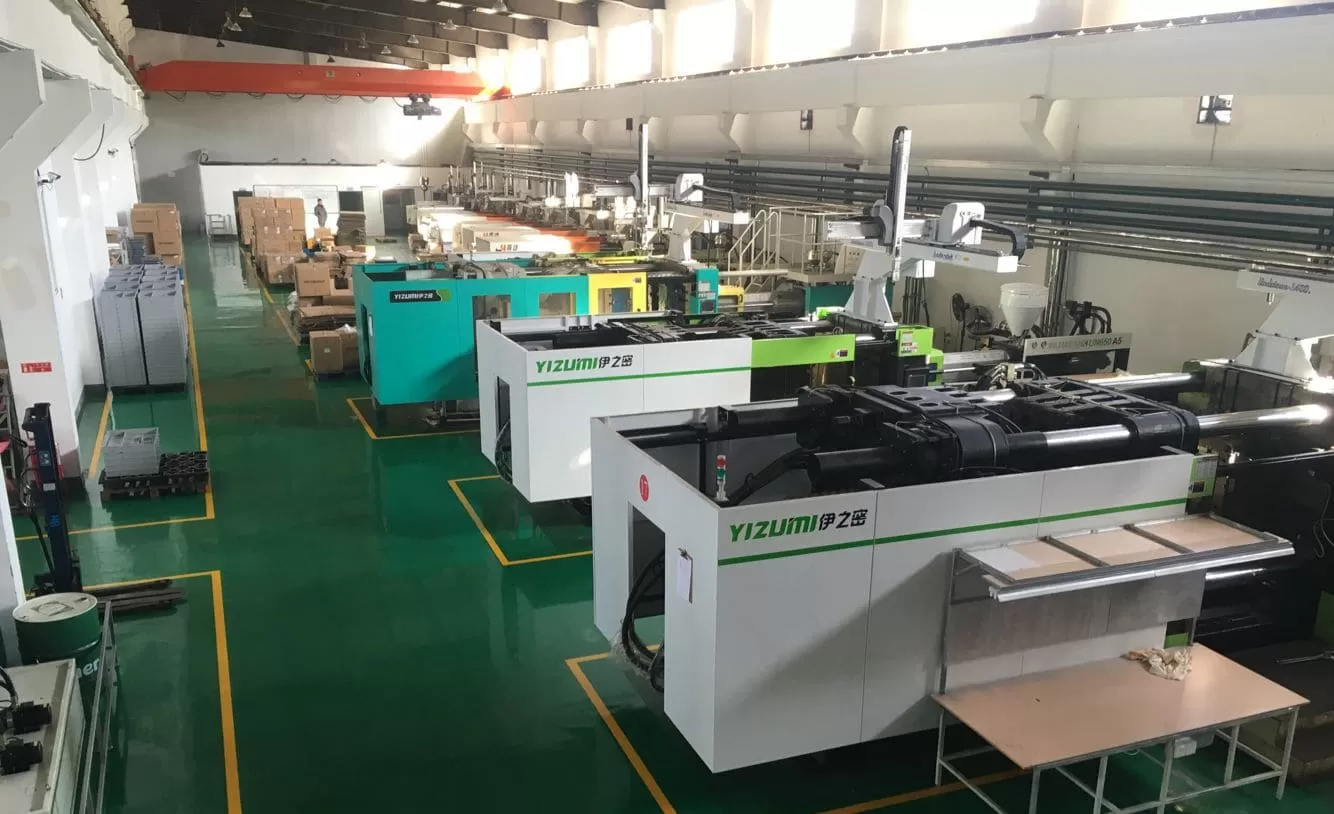
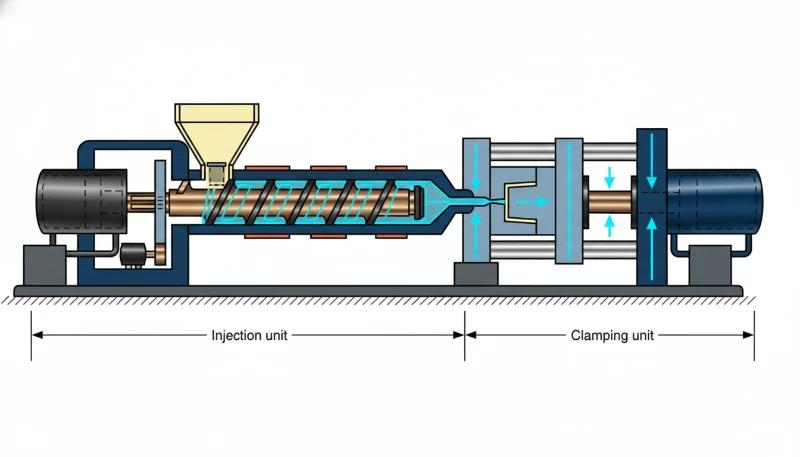
Ajustar correctamente los parámetros del moldeo por inyección1 marca la diferencia entre una producción rentable y costosos residuos. Tras 20 años resolviendo problemas que van desde piezas de automóvil deformadas hasta rechupes en productos electrónicos, he aprendido que un moldeo satisfactorio depende de dominar cinco parámetros fundamentales: temperatura, presión, velocidad, tiempos y refrigeración. No son simples cifras en la pantalla de una máquina, sino los controles que determinan la calidad de la pieza, el tiempo de ciclo y la rentabilidad. Si está evaluando proveedores, consulte nuestra guía de abastecimiento3 para obtener consejos prácticos de cualificación.
- El control de temperatura afecta al flujo del material, la cristalización y el acabado superficial; normalmente oscila entre 180°C para PP y 280°C para PC
- La presión de inyección determina el llenado de la cavidad y la densidad de la pieza, normalmente 800-1500 bar para la mayoría de los termoplásticos
- Los parámetros de velocidad controlan el calentamiento por cizallamiento y la orientación molecular; son habituales velocidades de inyección de 50-200 mm/s
- La presión y el tiempo de mantenimiento evitan la contracción y los rechupes; normalmente son el 60-80% de la presión de inyección durante 3-15 segundos
- El tiempo de refrigeración afecta directamente al tiempo de ciclo y a la calidad de la pieza; calcúlelo mediante el cuadrado del espesor de pared multiplicado por la difusividad térmica del material
¿Cuáles son los parámetros clave del proceso de moldeo por inyección?
Los parámetros clave del proceso de moldeo por inyección son las principales categorías u opciones explicadas en esta sección. Los cinco parámetros críticos del proceso de moldeo por inyección son la temperatura, la presión, la velocidad, la temporización y la refrigeración—cada uno controla aspectos específicos de la calidad de las piezas y la eficiencia de producción. La temperatura afecta a la viscosidad y al comportamiento de flujo del material. La presión determina el llenado de la cavidad y la densidad de la pieza. La velocidad controla el calentamiento por cizallamiento y la orientación molecular. La temporización gestiona la solidificación del material. La refrigeración determina el tiempo de ciclo y la estabilidad dimensional.
Los parámetros térmicos incluyen las zonas del cilindro —normalmente 4-5—, la temperatura de la boquilla y la del molde de inyección. Para ABS, suelo ajustar el cilindro desde 220 °C en la zona de alimentación hasta 240 °C en la boquilla, con el molde a unos 60-80 °C. Estas temperaturas garantizan un flujo adecuado de la masa fundida y evitan su degradación.
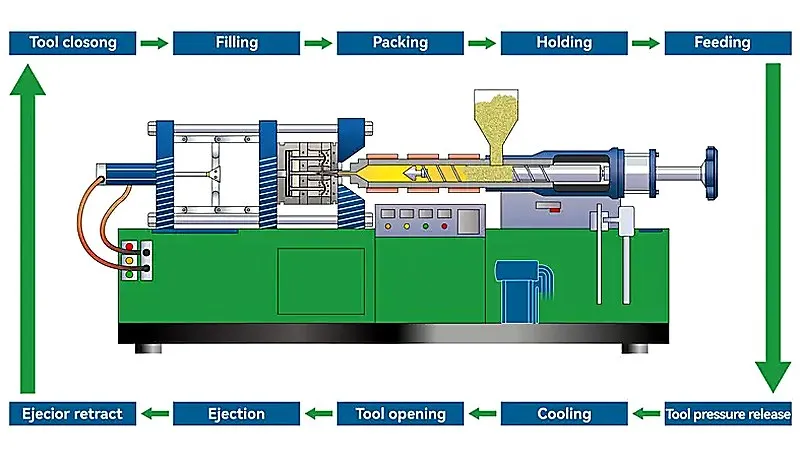
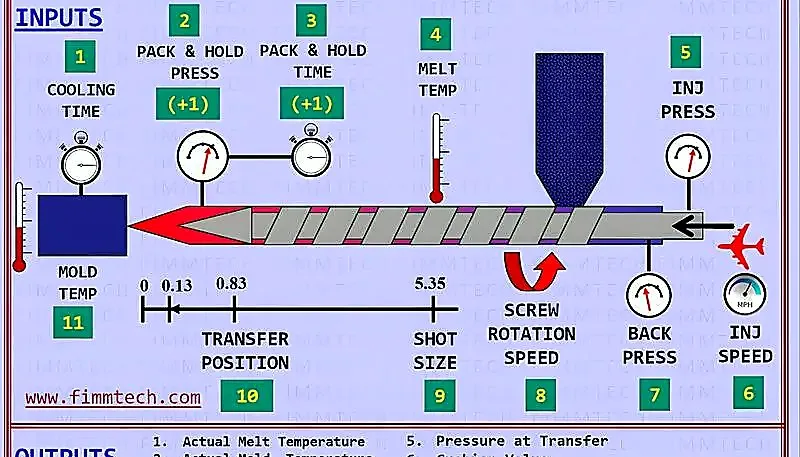
Los parámetros de presión actúan de forma secuencial: la presión de inyección llena la cavidad (800-1500 bar), la presión de mantenimiento conserva la densidad de la pieza (60-80% de la presión de inyección) y la contrapresión controla la homogeneidad de la masa fundida (3-15 bar). Los parámetros de velocidad incluyen la velocidad de inyección (50-200 mm/s), la velocidad de rotación del husillo (50-150 RPM) y la velocidad de expulsión. Los parámetros temporales abarcan el tiempo de inyección, el tiempo de mantenimiento, el tiempo de enfriamiento y el tiempo total del ciclo.
¿Cómo afecta la temperatura a la calidad del moldeo por inyección?
La temperatura controla directamente la viscosidad del material, la longitud de flujo, el acabado superficial y la estructura molecular de las piezas moldeadas por inyección. Una temperatura mayor reduce la viscosidad, permite recorridos de flujo más largos y mejora el llenado de la cavidad, pero un calor excesivo causa degradación, rebabas y mala calidad superficial. Una temperatura menor aumenta la viscosidad y puede provocar inyecciones incompletas y presiones de inyección elevadas.
Los perfiles de temperatura del cilindro suelen aumentar desde las zonas traseras hacia las delanteras. Para el polipropileno, utilizo 180°C en la zona de alimentación, 200°C en la zona de compresión, 210°C en la zona de dosificación y 220°C en la boquilla. Este calentamiento progresivo garantiza una plastificación adecuada sin sobrecalentamiento. La diferencia de temperatura entre zonas debe ser de 10-20°C para evitar la degradación del material.
La temperatura del molde afecta a la cristalización de plásticos semicristalinos como el nailon y el polipropileno. Las temperaturas de molde más altas (80-120°C para el nailon) favorecen la cristalinidad, lo que mejora la resistencia química y la estabilidad dimensional, pero aumenta el tiempo de ciclo. Las temperaturas de molde más bajas (40-60°C) reducen el tiempo de ciclo, pero pueden causar alabeo y un acabado superficial deficiente. He observado aumentos del 20% en el tiempo de ciclo cuando la temperatura del molde sube de 60°C a 100°C en piezas de nailon.
"Aumentar la temperatura del cilindro en 10°C suele reducir los requisitos de presión de inyección en 50-100 bar para la mayoría de los termoplásticos."True
Esta relación se mantiene porque las temperaturas más altas reducen la viscosidad del fundido, lo que facilita el flujo del material por el sistema de canales y hacia la cavidad del molde. He observado de forma constante esta reducción de presión de 50-100 bar al optimizar los parámetros del proceso para materiales como ABS, PC y nailon.
"Una mayor velocidad de inyección siempre mejora la calidad de las piezas al reducir las marcas de flujo y las líneas de vacilación."False
Aunque una inyección más rápida puede mejorar el acabado superficial en muchos casos, una velocidad excesiva genera problemas como un elevado calentamiento por cizallamiento, orientación molecular que provoca alabeo y mayores presiones de inyección. La velocidad óptima de inyección depende de la geometría de la pieza, el espesor de pared y las propiedades del material. He observado que el alabeo aumenta un 30% cuando la velocidad de inyección supera 250 mm/s en piezas de PC de pared delgada.
¿Qué papel desempeña la presión de inyección en la calidad de la pieza?
La presión de inyección determina el llenado completo de la cavidad, la densidad de la pieza y la precisión dimensional al forzar el plástico fundido a través de canales y compuertas hasta cada detalle de la cavidad. Una presión insuficiente causa llenados incompletos, rechupes y baja densidad. Una presión excesiva provoca rebabas, alta tensión residual y dificultad para expulsar la pieza.
Las presiones de inyección habituales oscilan entre 800-1500 bar para la mayoría de los termoplásticos, pero las aplicaciones de pared delgada pueden requerir 1800+ bar. Calculo la presión necesaria a partir de la longitud de flujo, el espesor de pared y la viscosidad del material. Para una longitud de flujo de 200mm a través de una pared de 2mm en ABS, cabe esperar una presión de inyección de 1000-1200 bar a temperaturas de procesamiento estándar.
La presión de mantenimiento conserva la calidad de la pieza después del llenado de la cavidad al compensar la contracción del material durante la refrigeración. Ajuste la presión de mantenimiento al 60-80% de la presión de inyección: un valor demasiado bajo provoca rechupes y variaciones dimensionales; uno demasiado alto desperdicia energía y puede causar rebabas. El tiempo de mantenimiento debe ser de 3-15 segundos, según el espesor de pared y las propiedades térmicas del material. Para secciones gruesas (>5mm), amplíe el tiempo de mantenimiento a 10-15 segundos.
¿Cómo determinan los parámetros de velocidad y tiempo el producto final?
Los parámetros de velocidad y tiempo controlan el comportamiento del flujo del material, la orientación molecular y la solidificación de la pieza, y afectan directamente al acabado superficial, las propiedades mecánicas y la estabilidad dimensional. La velocidad de inyección determina el calentamiento por cizallamiento y el avance del frente de flujo por la cavidad. La velocidad del husillo afecta a la homogeneidad de la masa fundida y a la dispersión del color. Los parámetros de tiempo gestionan las transiciones de fase del material del estado líquido al sólido, y determinan cuánto dura cada etapa y cuándo se producen las transiciones. Ajustar correctamente estos parámetros exige comprender la interacción entre la reología del material, la geometría de la pieza y la capacidad de refrigeración del molde.
La velocidad de inyección suele oscilar entre 50-200 mm/s, pero la velocidad óptima depende de la geometría de la pieza y de la sensibilidad del material. La inyección rápida (150-200 mm/s) mejora el acabado superficial y reduce las marcas de flujo, pero aumenta el calentamiento por cizallamiento y la orientación molecular. La inyección lenta (50-100 mm/s) reduce las tensiones, pero puede causar marcas de flujo y variaciones de temperatura. Utilizo perfiles de inyección multietapa: llenado rápido para 90% del volumen de la cavidad y después velocidad lenta para el 10% final, a fin de minimizar las tensiones.
La velocidad de rotación del husillo afecta a la calidad de la masa fundida y al tiempo de ciclo. Las velocidades estándar de 50-150 RPM proporcionan una buena mezcla sin calentamiento excesivo por cizalladura. Las velocidades superiores a 200 RPM degradan materiales sensibles al calor como PVC y POM, provocando decoloración y pérdida de propiedades mecánicas. Las velocidades inferiores a 50 RPM pueden producir una homogeneidad deficiente de la masa fundida y causar vetas de color o una calidad irregular de las piezas. Una contrapresión de 3-15 bar mejora la mezcla; utilice valores más altos (10-15 bar) para materiales reciclados o aplicaciones donde la uniformidad del color sea fundamental. Suelo comenzar con una contrapresión de 8-10 bar y ajustarla según la supervisión de la temperatura de la masa fundida y la inspección visual de las inyecciones de prueba.
¿Por qué es crítica la temperatura del molde para los plásticos cristalinos?
La temperatura del molde controla la cinética de cristalización en plásticos semicristalinos como nailon, polipropileno y POM, lo que afecta directamente a las propiedades mecánicas, la resistencia química y la estabilidad dimensional. Temperaturas de molde más altas favorecen la formación de cristales, mejoran la resistencia mecánica y química, pero aumentan el tiempo de ciclo. Temperaturas más bajas limitan la cristalización, reducen las propiedades, pero permiten producir más rápido.
Para el nylon 66, suelo utilizar temperaturas de molde de 80-120°C según los requisitos de la pieza. Las aplicaciones de alto rendimiento que exigen la máxima resistencia mecánica y química necesitan una temperatura de molde de 100-120°C, con la que se alcanza una cristalinidad del 40-50%. Los productos de consumo que priorizan el coste frente al rendimiento pueden utilizar 60-80°C y aceptar una cristalinidad menor (20-30%) a cambio de ciclos más rápidos.
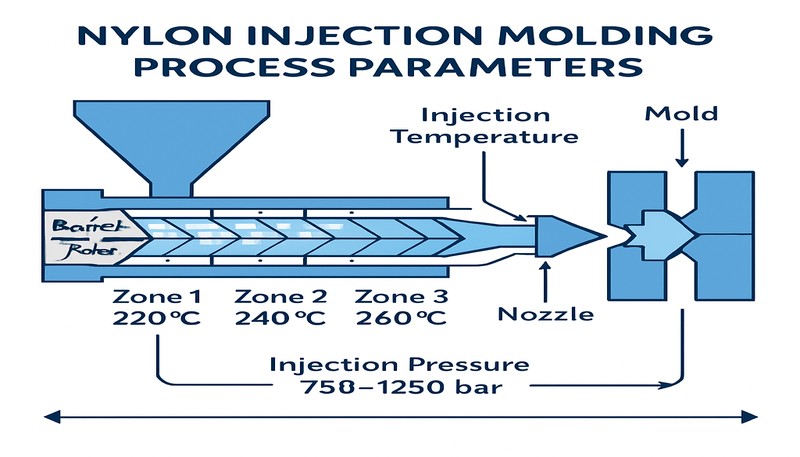
El polipropileno presenta cambios drásticos de propiedades según la temperatura del molde. A una temperatura del molde de 40°C, cabe esperar una cristalinidad del 30-40% con buena resistencia al impacto. A 80°C, la cristalinidad aumenta al 50-60%, con mayor rigidez pero menor resistencia al impacto. La clave consiste en adaptar la temperatura del molde a los requisitos de la aplicación: las piezas de automoción bajo el capó necesitan una cristalinidad elevada, mientras que los envases flexibles prefieren una menor. En una ocasión realicé pruebas con la carcasa de un engranaje de PP en las que elevar la temperatura del molde de 50°C a 85°C aumentó la resistencia a la tracción un 18%, pero casi duplicó el tiempo de ciclo. Todo ingeniero de procesos debe evaluar cuidadosamente este equilibrio entre rendimiento mecánico y productividad. El POM sigue un patrón similar: las temperaturas del molde de 80-100°C mejoran la resistencia a la fluencia de engranajes y componentes mecánicos.
¿Cómo se solucionan los defectos habituales relacionados con los parámetros?
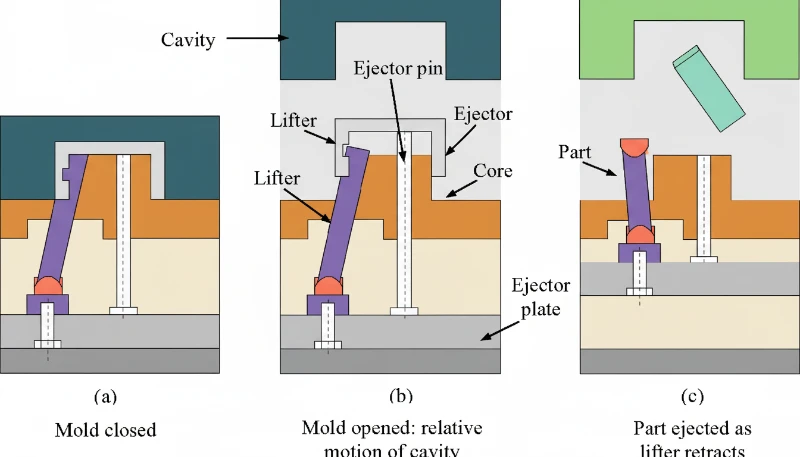
Los defectos relacionados con los parámetros siguen patrones predecibles que los moldeadores experimentados reconocen de inmediato. Los llenados incompletos indican que la presión o la temperatura son insuficientes e impiden llenar por completo la cavidad. Las rebabas sugieren una presión excesiva o un utillaje desgastado que permite que el material escape por la línea de partición del molde. Los rechupes se deben a una presión de mantenimiento inadecuada o a un tiempo de mantenimiento insuficiente durante el enfriamiento. El alabeo deriva de un enfriamiento irregular, una orientación molecular excesiva o una ubicación incorrecta de la compuerta que genera una contracción diferencial. Entender qué parámetro causa cada tipo de defecto es el primer paso para resolver problemas de forma sistemática. Siempre empiezo por comprobar el parámetro más fácil de ajustar antes de pasar a causas más complejas; este enfoque de diagnóstico ahorra horas de depuración por ensayo y error en la planta de producción.
Ante llenados incompletos, aumente primero la presión de inyección en incrementos de 50-100 bar hasta que la cavidad se llene por completo. Si la presión alcanza los límites de la máquina por encima de 1500 bar sin mejora, incremente la temperatura del cilindro en pasos de 10°C para reducir la viscosidad del fundido. Compruebe si la entrada se solidifica prematuramente ampliando el tiempo de mantenimiento; a veces la entrada se sella antes de que la cavidad se llene. Verifique también que la ventilación sea adecuada, ya que el aire atrapado impide el llenado completo incluso con presiones elevadas. En un proyecto de conectores para automoción, rastreamos llenados incompletos persistentes hasta un canal de ventilación obstruido que limitaba la salida de aire durante el llenado a alta velocidad.
La eliminación de la rebaba requiere una reducción sistemática de la presión y la inspección del molde. Reduzca la presión de inyección en pasos de 50 bar hasta que desaparezca la rebaba y, después, optimice la presión de mantenimiento. Compruebe el estado de la línea de partición: las superficies desgastadas o dañadas del molde causan rebaba a bajas presiones. Verifique que la fuerza de cierre del molde cumpla los requisitos calculados a partir del área proyectada de la pieza y la presión de la cavidad.
La corrección de los rechupes se centra en optimizar la presión y el tiempo de mantenimiento. Aumente la presión de mantenimiento al 70-80% de la presión de inyección. Prolongue el tiempo de mantenimiento hasta que se solidifique la compuerta, normalmente 3-15 segundos según el tamaño de la compuerta y el material. Para secciones gruesas, considere la alimentación secuencial con válvulas o el moldeo asistido por gas para mantener la presión durante todo el enfriamiento.
"El alabeo de las piezas moldeadas por inyección se debe principalmente a la contracción diferencial entre las secciones gruesas y delgadas, no a las propiedades del material."True
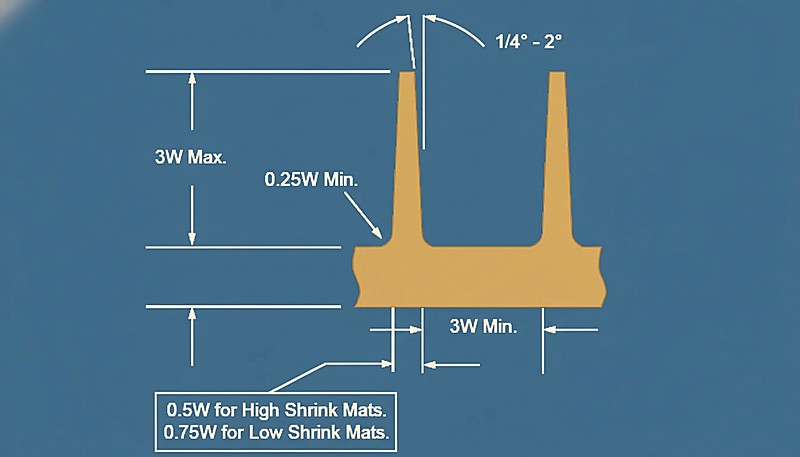
La contracción diferencial genera tensiones internas que provocan alabeo a medida que las piezas se enfrían y solidifican. Las secciones gruesas se enfrían más despacio y se contraen más que las delgadas, lo que crea concentraciones de tensión. Por eso es fundamental diseñar un espesor de pared uniforme: he reducido el alabeo un 60% simplemente manteniendo un espesor constante de 2-3mm en carcasas complejas.
"Los ajustes de contrapresión superiores a 20 bar siempre son necesarios para lograr una buena mezcla de colores en el moldeo por inyección."False
Aunque la contrapresión mejora la mezcla, los valores excesivos (>20 bar) provocan calentamiento innecesario por cizallamiento, ciclos más largos y posible degradación del material. La mayoría de las aplicaciones logran una mezcla de color excelente con una contrapresión de 5-15 bar. He comprobado que 8-12 bar proporciona una mezcla óptima para la mayoría de los materiales sin los efectos negativos de un cizallamiento excesivo.
En ZetarMold, más de 20 años de experiencia en moldeo por inyección con 47 máquinas de entre 90T y 1850T nos han enseñado que optimizar los parámetros del proceso es tanto ciencia como arte. Tras trabajar con más de 400 materiales distintos, hemos desarrollado bases de datos de parámetros que reducen el tiempo de preparación un 70% y elevan la tasa de éxito a la primera inyección por encima del 85%. Nuestros ingenieros de procesos utilizan el control estadístico de procesos para mantener la estabilidad de los parámetros dentro de ±2% durante las series de producción.
¿Está listo para optimizar los parámetros de su proceso de moldeo por inyección? La guía de aprovisionamiento de ZetarMold ofrece recomendaciones detalladas de parámetros para más de 400 materiales. Nuestros ingenieros de procesos pueden ayudarle a establecer ventanas de parámetros robustas que garanticen una calidad constante y minimicen el tiempo de ciclo. Póngase en contacto con nosotros para solicitar una auditoría gratuita de los parámetros de proceso de sus operaciones de moldeo actuales.
Preguntas frecuentes
¿Cuál es el intervalo óptimo de temperatura para el moldeo por inyección de ABS?
Las temperaturas de moldeo por inyección de ABS suelen oscilar entre 220-250°C en el cilindro, con temperaturas del molde de 60-80°C. Para la mayoría de las aplicaciones de uso general, recomiendo comenzar con una temperatura del cilindro de 230°C y una temperatura del molde de 70°C. Las temperaturas más altas, de alrededor de 240-250°C, mejoran el flujo y el acabado superficial, pero aumentan el riesgo de degradación térmica. Las temperaturas más bajas, de alrededor de 220-230°C, reducen el tiempo de ciclo, pero pueden provocar llenados incompletos en piezas de pared delgada. La temperatura de la boquilla debe ajustarse 5-10°C por encima de la zona delantera del cilindro para evitar la congelación prematura. Supervise siempre la temperatura real de la masa fundida con un pirómetro; el objetivo es 235-245°C para obtener resultados óptimos al procesar ABS.
¿Cómo se calcula la presión de mantenimiento correcta para el moldeo por inyección?
Calcule la presión de mantenimiento como el 60-80% de la presión de inyección necesaria para llenar completamente la cavidad. Comience con el 70% como referencia y ajústela según la calidad de la pieza. Para secciones gruesas (>4mm), utilice el 75-80% para evitar rechupes. Para paredes delgadas (<2mm), el 60-65% evita rebabas y mantiene la densidad. Controle el peso de la pieza: un peso constante indica una presión de mantenimiento correcta. Cuando dispongo de ellos, utilizo sensores de presión en la cavidad y fijo un objetivo de 400-600 bar durante la fase de mantenimiento. Una presión demasiado baja causa rechupes y variaciones dimensionales. Una presión excesiva desperdicia energía y puede provocar rebabas o dificultar la expulsión.
¿Qué causa el rebaba en el moldeo por inyección y cómo se soluciona?
El rebaba ocurre cuando la presión de inyección excede la fuerza de cierre del molde o cuando las superficies de separación del molde están desgastadas o dañadas. Calcule la fuerza de cierre requerida usando el área proyectada de la pieza multiplicada por la presión de la cavidad—típicamente 3-5 toneladas por pulgada cuadrada de área proyectada. Reduzca la presión de inyección en incrementos de 50-100 bar hasta que desaparezca el rebaba. Verifique el estado del molde—líneas de separación desgastadas, ventilación dañada o mantenimiento insuficiente del molde causan rebaba a presiones normales. Verifique la alineación adecuada del molde y el estiramiento suficiente de las barras de unión. A veces el rebaba indica ventilación insuficiente, requiriendo reducción de presión o canales de ventilación adicionales. La viscosidad del material afecta la tendencia al rebaba—los materiales con mayor índice de flujo fundido generan rebaba más fácilmente.
¿Cuál es la diferencia entre presión de inyección y presión de mantenimiento?
La presión de inyección llena completamente la cavidad del molde, típicamente 800-1500 bar dependiendo de la geometría de la pieza y el material. La presión de mantenimiento mantiene la densidad de la pieza durante el enfriamiento, usualmente 60-80% de la presión de inyección. La presión de inyección opera durante la fase de llenado (1-3 segundos), mientras que la presión de mantenimiento opera durante la solidificación (3-15 segundos). La alta presión de inyección asegura un llenado completo y buen acabado superficial. La presión de mantenimiento adecuada previene marcas de hundimiento y contracción dimensional. La transición de presión de inyección a mantenimiento ocurre al 95-98% de llenado de la cavidad. Las máquinas modernas usan retroalimentación de presión de cavidad para optimizar este punto de cambio automáticamente.
¿Cómo afecta la velocidad del tornillo la calidad de la masa fundida de plástico?
La velocidad del husillo controla la intensidad de mezcla y el tiempo de residencia, lo que afecta directamente a la homogeneidad y la temperatura de la masa fundida. Las velocidades estándar de 50-150 RPM proporcionan una buena mezcla sin calentamiento excesivo por cizallamiento. Las velocidades más altas (>200 RPM) provocan la degradación de materiales sensibles al calor, como PVC o POM. Las velocidades más bajas (<50 RPM) pueden producir una mezcla deficiente del color o variaciones de temperatura. Ajusto la velocidad del husillo según la sensibilidad del material y los requisitos de mezcla. Los materiales sensibles al calor requieren velocidades menores (50-100 RPM). Los materiales reciclados o concentrados de color se benefician de velocidades mayores (100-150 RPM). Supervise la temperatura de la masa fundida: una velocidad excesiva del husillo aumenta la temperatura entre 10-20°C por calentamiento de cizallamiento.
¿Cuál es el tiempo de enfriamiento ideal para piezas moldeadas por inyección?
El tiempo de enfriamiento depende del espesor de pared al cuadrado y de la difusividad térmica del material. Use la fórmula: tiempo de enfriamiento = (espesor de pared)² × factor del material. Para ABS con espesor de pared de 3mm, espere 15-25 segundos de tiempo de enfriamiento. El polipropileno se enfría más rápido (factor del material 0.8), mientras que el PC se enfría más lento (factor del material 1.3). La temperatura del molde afecta el tiempo de enfriamiento—cada aumento de 10°C agrega 15-20% al tiempo de ciclo. Un diseño eficiente de canales de enfriamiento reduce el tiempo en 30-40%. Verifico un enfriamiento adecuado midiendo la temperatura de expulsión de la pieza—debe estar por debajo de 60°C para la mayoría de los termoplásticos para prevenir deformaciones. Optimice el tiempo de enfriamiento mediante reducción sistemática hasta que la calidad de la pieza se degrade.
¿Cómo se ajusta la contrapresión para el moldeo por inyección?
Ajuste la contrapresión entre 3-15 bar dependiendo de los requisitos de mezclado del material y las necesidades de calidad. Comience con 5-8 bar para la mayoría de las aplicaciones, luego ajuste según la calidad de la masa fundida. Una contrapresión más alta (10-15 bar) mejora la mezcla de color y la homogeneidad de la masa fundida pero aumenta el tiempo de ciclo y el calentamiento por cizallamiento. Una contrapresión más baja (3-5 bar) reduce el tiempo de ciclo pero puede causar vetas de color o mala mezcla. Materiales sensibles al calor como PVC necesitan contrapresión mínima (3-5 bar). Los materiales reciclados o aplicaciones con masterbatch se benefician de valores más altos (10-12 bar). Monitoree la temperatura de la masa fundida—la contrapresión excesiva aumenta la temperatura a través del calentamiento por cizallamiento. Ajuste gradualmente en incrementos de 2-3 bar.
¿Qué sucede si la temperatura del molde es demasiado baja?
Una temperatura baja del molde provoca un acabado superficial deficiente, un llenado incompleto de la cavidad, altas tensiones residuales e inestabilidad dimensional. Los defectos superficiales incluyen marcas de flujo, líneas de soldadura y un acabado opaco. Las piezas pueden alabearse durante el uso debido a la relajación de tensiones. Los plásticos semicristalinos como el nailon presentan propiedades mecánicas reducidas debido a una cristalización limitada. He observado una reducción de resistencia del 20-30% en piezas de nailon moldeadas con una temperatura de molde de 40°C frente a 80°C. Una temperatura baja del molde también aumenta entre 100-200 bar la presión de inyección necesaria. Sin embargo, el tiempo de enfriamiento disminuye, mejorando el tiempo de ciclo. El equilibrio es fundamental: utilice la temperatura mínima que permita obtener una calidad de pieza aceptable. Mínimos habituales: ABS 50°C, nailon 60°C, polipropileno 40°C.
moldeo por inyección: proceso de producción que funde plástico, lo inyecta en la cavidad de un molde, enfría la pieza y repite el ciclo para una fabricación estable en serie. ↩
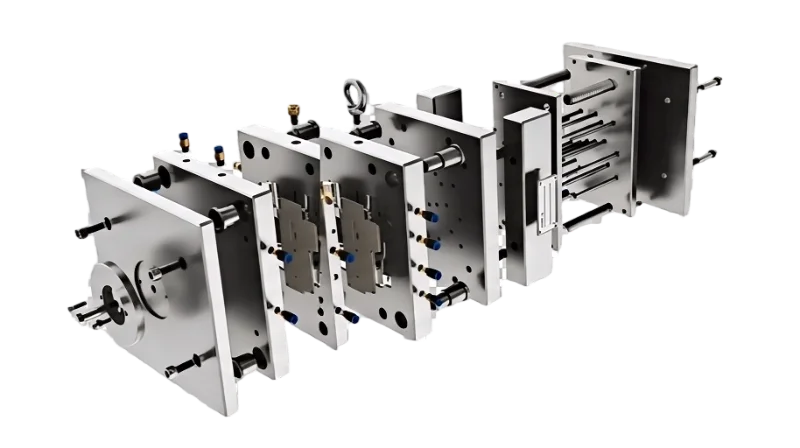
molde de inyección: herramienta de precisión que define la geometría de la pieza, la refrigeración, la expulsión, la alimentación, el acabado superficial y la repetibilidad. ↩
guía de abastecimiento: recurso para evaluar socios fabricantes según su capacidad de utillaje, control de procesos, conocimiento de materiales, rigor de inspección y fiabilidad. ↩