 Zum Inhalt springen

You just pulled a batch of parts from the mold and half of them have sink marks. The other half? Warped. Your first instinct is to tweak the holding pressure or slow down the injection speed. But the real culprit is almost always the same thing: Werkzeugtemperatur1.
In der Spritzgießen process, mold temperature is one of the most powerful — and most underrated — process variables you can control. It affects everything: surface finish, dimensional accuracy, cycle time, warpage, crystallinity, and even the internal stress locked inside the part. Getting it right is not optional — it is the difference between a stable production run and a scrap rate that eats your margin.
This guide breaks down exactly how mold temperature works, which control method to use for your situation, specific temperature ranges for common materials, and the practical adjustments that separate a good molder from one that constantly fights defects.
- Mold temperature controls cooling rate, crystallinity, and part dimensional stability.
- Water systems work for most materials under 95 C; oil systems are needed above that.
- Each resin has an optimal mold temperature range — deviating by even 5 to 10 C can cause visible defects.
- Uniform cooling channel design prevents warpage and sink marks.
- Higher mold temperature improves surface finish but increases cycle time.
What Is Mold Temperature in Injection Molding?
Mold temperature is the temperature of the cavity surface that contacts the molten plastic. It is not the temperature of the cooling medium entering the mold — it is what the steel surface actually reads when measured with a contact thermometer or pyrometer after a few cycles have stabilized. This distinction matters because the delta between coolant supply and cavity surface can be 10 to 20 C depending on steel thickness, channel placement, and coolant flow rate.
When hot melt (typically 180 to 320 C depending on the material) enters the Spritzgussform cavity, it starts transferring heat into the steel immediately. The mold’s job is to remove that heat at a controlled rate so the part solidifies with the right structure — amorphous or semi-kristallin2 — and the right dimensions.
If the mold is too cold, the plastic surface freezes on contact. That sounds good for fast cycles, but it traps frozen-in stresses, creates weak weld lines, and produces dull or inconsistent surface finishes. If the mold is too hot, the part takes longer to solidify, shrinks more, and can warp or stick in the mold. Neither extreme serves you well.
In practice, we define mold temperature as a range, not a single number. For example, PP (polypropylene) typically runs at 20 to 60 C mold temperature, while PEEK needs 160 to 200 C. The exact value within that range depends on part geometry, wall thickness, and what surface quality you need.
Why Does Mold Temperature Matter So Much?
Mold temperature is the single variable that controls surface finish, accuracy, cycle time, warpage, and mechanical strength. It is the most underrated process variable on most shop floors.
1. Surface finish and appearance. A warmer mold allows the plastic skin to form smoothly against the cavity wall, producing a glossy, consistent surface.
2. Dimensional accuracy and shrinkage. Semi-crystalline resins (PA, POM, PEEK) undergo significant crystallization during cooling. Higher mold temperature produces larger, more uniform crystals — more shrinkage but far more predictable.
3. Cycle time. Roughly 60 to 70% of the injection molding cycle is cooling time. Raising the mold temperature from 40 °C to 80 °C can add 30 to 50% more cycle time.
Raising the mold temperature from 40 °C to 80 °C can add 30 to 50% more cycle time.
Dimensional accuracy and shrinkage. Semi-crystalline resins (PA, POM, PEEK) undergo significant crystallization during cooling. Higher mold temperature produces larger, more uniform crystals — which means more shrinkage but far more predictable shrinkage. Lower temperature freezes the structure before full crystallization, and the part continues to shrink over the next 24 to 72 hours in ways you cannot compensate for with mold steel. 3. Cycle time. Roughly 60 to 70% of the injection molding cycle is cooling time. Raising the mold temperature from 40 °C to 80 °C can add 30 to 50% more cycle time. That tradeoff — better quality versus slower output — is the core engineering decision you make every time you set the temperature controller.
“Oil heating systems can achieve mold temperatures up to 250 C.”Wahr
Thermal oil circulation systems are rated for continuous operation at 200 to 250 C, making them the standard choice for high-temperature engineering plastics like PEEK (160 to 200 C mold temp), PPS (130 to 160 C), and PEI. However, oil systems have slower response times and higher maintenance requirements compared to water.
“A colder mold always produces parts faster.”Falsch
While a cold mold does reduce cooling time, it also increases the risk of short shots, poor surface finish, and weld-line weakness. The net effect on productivity depends on scrap rate — a faster cycle with 15% scrap is slower overall than a slightly longer cycle with 2% scrap.
4. Warpage and residual stress. Uneven mold temperature creates differential shrinkage. The side of the part against a hotter cavity surface shrinks more than the cooler side, and the part curls. This is the single most common cause of warpage in flat, thin-wall parts and one of the hardest defects to fix after the tool is built.
5. Mechanical properties. For semi-crystalline materials, mold temperature determines the crystal structure. A part molded at the correct temperature will have higher tensile strength, better impact resistance, and improved chemical resistance compared to the same part quenched in a cold mold. This effect is most pronounced in nylon and POM.
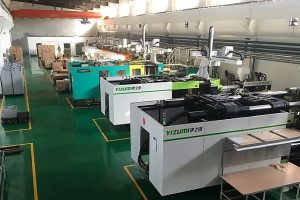
ZetarMold Factory Data: Our Shanghai facility operates 47 injection molding machines from 90T to 1850T, all equipped with independent PID-controlled temperature units. For medical and precision parts, we maintain mold temperature within plus or minus 1 C using closed-loop controllers with real-time thermocouple feedback.
How Do You Control Mold Temperature?
There are three main methods: water cooling, oil heating and cooling, and electrical heating. The method you choose depends on the target temperature, the material, and the part requirements. Most production shops use water for 80% or more of their tooling.
Water circulation (standard). A temperature controller circulates water through channels drilled into the mold. For standard applications below 95 C, pressurized water systems are the default. They are fast, efficient, and easy to maintain. Most commodity plastics (PP, PE, PS, ABS) and many engineering plastics (PC, POM) use water systems. The key advantage of water is its high specific heat capacity — it absorbs and transfers heat faster than any other practical coolant.
Oil heating and cooling (high-temperature). When you need mold temperatures above 95 C — which is common for PEEK, PPS, LCP, PEI, and high-temperature nylons — you switch to thermal oil. Oil systems can reach 200 to 250 C safely. The trade-off is slower response time, higher energy consumption, and more maintenance (oil degradation, seal leaks). Oil also has lower specific heat capacity than water, so it takes longer to stabilize after start-up or temperature changes.
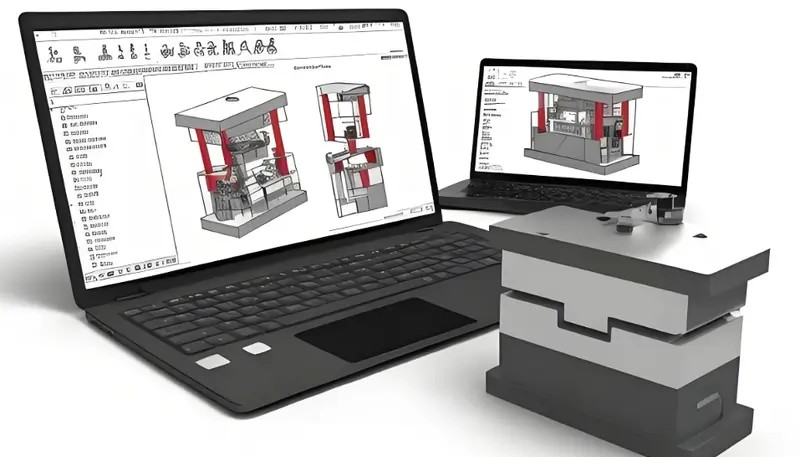
Elektrische Heizpatronen. Für sehr spezifische Zonen, die eine unabhängige Temperaturregelung benötigen – wie ein Heißkanalverteiler oder ein Kerninsert, der tendenziell kalt läuft – bieten Heizpatronen mit Thermoelement-Feedback punktgenaue Präzision. Sie werden nicht für die vollständige Werkzeugtemperaturregelung verwendet, sondern als gezielte Ergänzungen zum primären Kühlungssystem.
What Are the Recommended Mold Temperatures by Material?
Nachfolgend finden Sie eine praktische Referenztabelle basierend auf Datenblättern von Materiallieferanten und realen Produktionserfahrungen. Dies sind Ausgangspunkte – Sie verfeinern von hier aus basierend auf Ihrer spezifischen Bauteilgeometrie und Qualitätsanforderungen.
| Material | Abkürzung | Werkzeugtemp.-Bereich (°C) | Kühlmedium |
|---|---|---|---|
| Polypropylen | PP | 20 bis 60 | Wasser |
| Polyethylen (HDPE/LDPE) | PE | 15 bis 60 | Wasser |
| Polystyrol (Allgemein/HIPS) | PS | 20 bis 60 | Wasser |
| ABS | ABS | 40 bis 80 | Wasser |
| Polyamid 6 (Nylon 6) | PA6 | 60 bis 90 | Wasser/Öl |
| Polyamid 66 (Nylon 66) | PA66 | 70 bis 100 | Wasser/Öl |
| Polycarbonat | PC | 80 bis 120 | Wasser/Öl |
| Polyoxymethylen (Acetal) | POM | 60 bis 100 | Wasser/Öl |
| Polybutylenterephthalat | PBT | 40 bis 80 | Wasser |
| Polyethylenterephthalat | PET | 120 bis 150 | Öl |
| Polyetheretherketon | PEEK | 160 bis 200 | Öl |
| Polyphenylensulfid | PPS | 130 bis 160 | Öl |
| Thermoplastisches Polyurethan | TPU | 20 bis 50 | Wasser |
| Polymethylmethacrylat (Acryl) | PMMA | 60 bis 90 | Wasser |
| Polyphenylenoxid (Noryl) | PPO/PPE | 70 bis 100 | Wasser/Öl |
How Does Mold Temperature Affect Part Quality?
Mold temperature directly causes or prevents the four most common part defects: sink marks, weak weld lines, short shots, and warping. Adjusting it is usually the fastest fix for each problem. Einfallstellen. These appear when the skin of a thick section solidifies before the core has fully packed out. A higher mold temperature slows skin formation, allowing more packing time and significantly reducing sink depth. For a 5 mm thick ABS boss, raising the mold from 40 °C to 70 °C can cut sink mark depth from 0.3 mm to under 0.05 mm. Schweißnähte. Where two flow fronts meet, the strength of the weld depends on how well the two molten surfaces fuse.
A warmer mold keeps the melt front temperature higher at the meeting point. For glass-filled PA66, raising mold temperature from 80 °C to 120 °C can improve weld line strength by 20 to 30%. Kurze Aufnahmen. Ein zu kaltes Werkzeug führt dazu, dass die Schmelze erstarrt, bevor der Kavität vollständig gefüllt ist. Eine Temperaturerhöhung verbessert die Fließlänge, insbesondere bei dünnwandigen Teilen. Warping. Wenn eine Seite des Werkzeugs heißer läuft als die andere, schrumpft das Teil ungleichmäßig und biegt sich zur heißeren Seite hin. Die Lösung besteht nicht nur darin, dieselbe Solltemperatur auf beiden Hälften einzustellen, sondern darin zu überprüfen, dass die tatsächlichen Oberflächentemperaturen innerhalb von 2 bis 3 °C übereinstimmen.
Schweißnähte. Wo sich zwei Fließfronten treffen, hängt die Festigkeit der Schweißnaht davon ab, wie gut die beiden geschmolzenen Oberflächen verschmelzen. Ein wärmerer Werkzeug hält die Temperatur der Schmelzfront am Treffpunkt höher. Bei glasgefülltem PA66 kann eine Erhöhung der Werkzeugtemperatur von 80 °C auf 120 °C die Festigkeit der Schweißnaht um 20 bis 30% verbessern. Kurze Aufnahmen. Ein zu kaltes Werkzeug führt dazu, dass die Schmelze erstarrt, bevor die Kavität vollständig gefüllt ist. Eine Temperaturerhöhung verbessert die Fließlänge, insbesondere bei dünnwandigen Teilen. Dies ist oft das Erste, was zu prüfen ist, wenn bei einem Mehrfachkavitätswerkzeug intermittierende Nichtfüllungen auftreten. Warping. Flache Teile sind am anfälligsten.
Wenn eine Seite des Werkzeugs heißer läuft als die andere, schrumpft das Teil ungleichmäßig und biegt sich zur heißeren Seite hin. Die Lösung besteht nicht nur darin, dieselbe Solltemperatur auf beiden Hälften einzustellen, sondern darin zu überprüfen, dass die tatsächlichen Oberflächentemperaturen innerhalb von 2 bis 3 °C übereinstimmen.
Wie entwirft man Kühlkanäle für gleichmäßige Temperatur?
Eine gleichmäßige Werkzeugtemperatur ist das Ziel, und sie beginnt mit der Kühlkanalgestaltung während der Werkzeugfertigung. Die Prinzipien sind einfach, werden jedoch oft aufgrund von Kosten- oder Zeitgründen beeinträchtigt – was später durch höhere Ausschussraten und endlose Prozessoptimierung bezahlt wird.
Kanalplatzierung. Kühlkanäle sollten dem Kavitätenkontur so nah wie möglich folgen. Der Abstand vom Kanalmittelpunkt zur Kavitätenoberfläche sollte das 1,5- bis 2,5-fache des Kanaldurchmessers betragen. Zu nah, und es entstehen Kaltstellen; zu weit, und die Kühlung ist zu langsam. In unserer Werkstatt ist der Standard für die meisten Produktionswerkzeuge das 2-fache des Durchmessers.
Fließgeschwindigkeit. Turbulente Strömung transportiert Wärme 3 bis 5 Mal effizienter als laminare Strömung. Sie wollen eine Reynolds-Zahl3 über 4000 in jedem Kanal. Das bedeutet, dass Ihre Kühlmittelpumpen genügend Druck benötigen, um Wasser mit ausreichender Geschwindigkeit durch alle Kanäle zu drücken – nicht nur durch den größten Kanal zu leiten und die anderen zu unterversorgen.
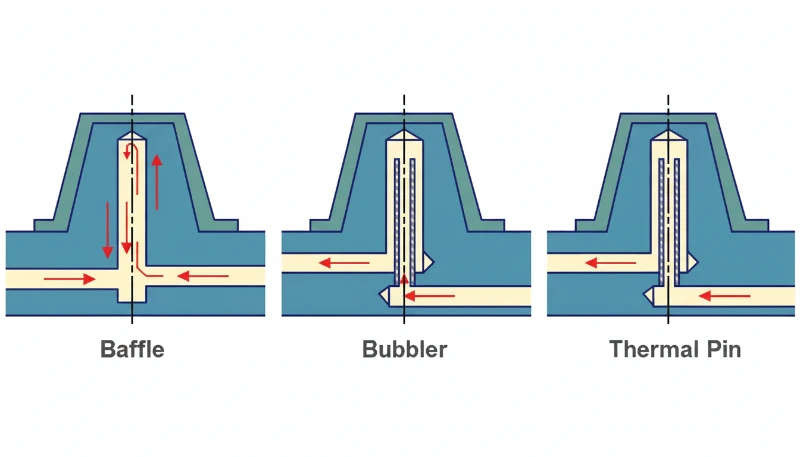
Leitbleche und Blasdüsen. Für tiefe Kerne oder Bereiche, die mit geraden Kanälen schwer zu erreichen sind, sind Leitbleche (flache Platten, die den Fluss in zwei Richtungen aufteilen) und Lufteinleitrohre (Rohre innerhalb eines größeren Lochs) die praktische Lösung. Sie funktionieren gut, erhöhen jedoch den Druckabfall und müssen regelmäßig gereinigt werden, um Ablagerungen zu verhindern.
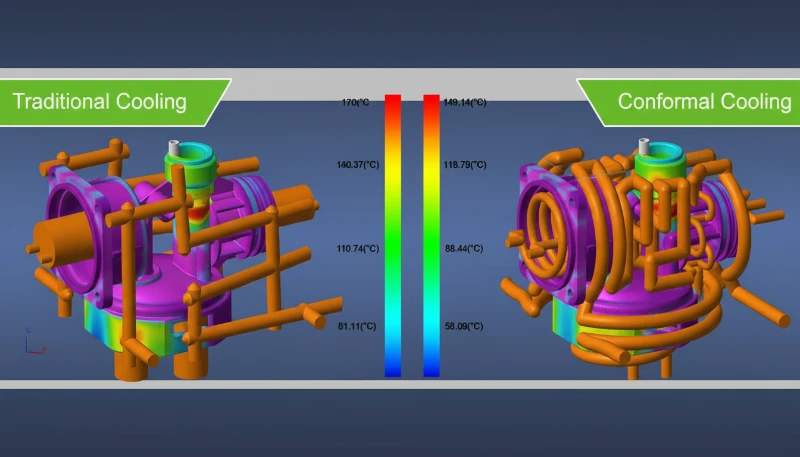
Konformkühlung. Metall-3D-Druck (DMLS/SLM) erzeugt Kühlkanäle, die dem Kavitätskontur genau folgen. Konformkühlung reduziert die Zykluszeit um 20 bis 40% und beseitigt Hotspots. Das gedruckte Einschubteil kostet 3- bis 5-mal mehr als eine gebohrte Platte – lohnt sich für die Großserienproduktion (100.000+ Teile), übertrieben für kleine Stückzahlen.
„Ein Temperaturgradient von 5 °C über die Kavitätsoberfläche kann messbare Maßabweichungen bei Präzisionsteilen verursachen.“Wahr
Bei Teilen mit Toleranzen von plus/minus 0,05 mm oder enger führt ein Temperaturunterschied von 5 °C zwischen der festen und der beweglichen Werkzeughälfte zu unterschiedlicher Schrumpfung, die die Maße außerhalb der Spezifikation bringt. Deshalb streben Präzisionsspritzgießer eine Oberflächentemperaturgleichmäßigkeit im Hohlraum von plus/minus 2 °C an.
“Oil heating systems can achieve mold temperatures up to 250 C.”Falsch
Thermal oil circulation systems are rated for continuous operation at 200 to 250 C, making them the standard choice for high-temperature engineering plastics like PEEK (160 to 200 C mold temp), PPS (130 to 160 C), and PEI. However, oil systems have slower response times and higher maintenance requirements compared to water.

Wie vergleichen sich verschiedene Temperaturregelungsmethoden?
Die Wahl zwischen Wasser, Öl und elektrischer Beheizung betrifft nicht nur die maximale Temperatur – es geht um Ansprechgeschwindigkeit, Wartungskosten und Präzision. Hier ist ein direkter Vergleich basierend auf unseren täglichen Produktionserfahrungen.
| Method | Temperaturbereich | Ansprechgeschwindigkeit | Präzision | Wartung | Am besten für |
|---|---|---|---|---|---|
| Wasser (Standard) | 10 bis 90 °C | Schnell | Plus oder minus 1 bis 2 °C | Niedrig | Die meisten Standard- und Technikkunststoffe |
| Druckwasser | 90 bis 130 °C | Schnell | Plus oder minus 1 bis 2 °C | Niedrig bis mittel | PC, Hochtemperatur-Nylon, POM |
| Thermöl | 100 bis 250 °C | Slow | Plus oder minus 2 bis 5 °C | Hoch | PEEK, PPS, PEI, LCP |
| Elektrische Kartusche | 200 bis 400 °C | Mittel | Plus oder minus 1 °C (lokal) | Mittel | Heißkanäle, gezielte Zonen |
| Konformkühlung und Wasser | 10 bis 90 °C | Sehr schnell | Plus oder minus 1 °C | Niedrig | Präzisionsteile in Großserie |
Welche häufigen Probleme entstehen durch falsche Formtemperatur?
Hier ist eine Fehlerbehebungstabelle, die auf unseren wiederkehrenden Beobachtungen auf der Produktionsfläche basiert, wenn die Werkzeugtemperatur nicht korrekt eingestellt ist. Wenn Sie mit einem dieser Probleme kämpfen, überprüfen Sie zuerst Ihre Werkzeugtemperatur, bevor Sie etwas anderes anpassen.
| Symptom | Wahrscheinliche Ursache | Fix |
|---|---|---|
| Glanzvariation auf strukturierter Oberfläche | Form zu kalt – Kunststoffoberfläche friert vor Texturwiedergabe ein | Formtemperatur um 10 bis 15 °C erhöhen |
| Einfallstellen an Rippen oder Bossen | Werkzeug zu kalt – unzureichendes Nachdrücken vor dem Einfrieren | Formtemperatur erhöhen und Nachdruckzeit verlängern |
| Verzug bei flachen Teilen | Temperaturgradient zwischen Formhälften übersteigt 5 °C | Durchflussraten ausgleichen, Leitbleche hinzufügen, auf blockierte Kanäle prüfen |
| Lange Zykluszeit | Formtemperatur für das Material zu hoch eingestellt | Unterhalb des empfohlenen Bereichs; mit Kavitätsthermoelement überprüfen |
| Unvollständige Füllung in dünnen Wänden | Form zu kalt – vorzeitiges Einfrieren | Formtemperatur um 10 bis 20 °C erhöhen |
| Auswerferstiftmarkierungen oder Haften | Form zu heiß – Bauteil bei Auswurf nicht ausreichend steif | Formtemperatur senken oder Kühlzeit erhöhen |
| Spröde Teile (PA/POM) | Werkzeug zu kalt — unzureichende Kristallisation | Formtemperatur auf das obere Ende des empfohlenen Bereichs erhöhen |
| Maßabweichungen zwischen Kavitäten | Ungleichmäßiger Kühlmittelfluss über Mehrfachkavitäten-Form | Fluss mit Drosseln ausgleichen; Ablagerungen aus Kanälen reinigen |
Wie misst und überwacht man die Werkzeugtemperatur?
Der Standardansatz ist Pyrometer für Stichproben und Thermoelemente zur kontinuierlichen Überwachung, abgeglichen mit Kühlmitteltemperaturmessungen. In der Produktion benötigen Sie mindestens zwei Methoden. Sich allein auf die Anzeige des Temperaturreglers zu verlassen, ist keine Messung – das ist der Sollwert, nicht die tatsächliche Kavitätsoberflächentemperatur. Oberflächenpyrometer. Die schnellste Methode. Nach 5 bis 10 Spritzzyklen zur Stabilisierung, richten Sie ein Kontaktpyrometer unmittelbar nach dem Auswerfen auf die Kavitätsoberfläche. Messen Sie mindestens drei Punkte – nahe dem Anguss, am Ende der Füllung und an einem dickeren Bereich. Wenn die Abweichung 5 °C überschreitet, ist Ihre Kühlung nicht gleichmäßig.
Thermoelementsensoren. Für die kontinuierliche Überwachung während der Produktion liefern in den Formstahl eingebettete Thermoelemente (1 bis 2 mm unter der Kavitätsoberfläche) Echtzeitdaten. Die meisten modernen Temperaturregler können diese Messwerte protokollieren und Alarme auslösen, wenn die Temperatur außerhalb eines festgelegten Bereichs driftet. Kühlmittelfluss und Temperaturdifferenz. Messen Sie die Temperatur des Kühlmittels am Ein- und Austritt jedes Kreislaufs. Eine Differenz von 2 bis 3 °C ist normal; alles über 5 °C bedeutet, dass der Kreislauf zu viel Wärme aufnimmt, was normalerweise auf unzureichende Durchflussmenge oder einen zu langen Kanal hinweist.
Wie beeinflusst die Formtemperatur bestimmte Materialien?
Der Einfluss der Formtemperatur unterscheidet sich grundlegend zwischen teilkristallinen und amorphen Harzen. Teilkristalline Materialien benötigen 70 bis 200 °C für eine ordnungsgemäße Kristallbildung; amorphe Harze benötigen 20 bis 120 °C hauptsächlich zur Spannungsabbau. PA6 und PA66 (Nylon). Die Verarbeitungstemperatur für Nylon 6 in der Schmelze liegt typischerweise bei 230 bis 280 °C, mit Formtemperaturen von 70 bis 90 °C für Standardqualitäten und 80 bis 120 °C für glasfaserverstärkte Versionen. Unter 40 °C kristallisiert PA66 ungleichmäßig, was zu Teilen führt, die Tage nach dem Spritzgießen schrumpfen. PC (Polycarbonat). Die Spritzgusstemperatur für PC-Schmelze liegt zwischen 280 und 320 °C, mit Werkzeugtemperaturen von 80 bis 120 °C. PC ist amorph – innere Spannung ist das Problem, nicht Kristallisation.
Eine kalte Form friert Polymerketten in einem stark orientierten Zustand ein, was die Gefahr von Spannungsrissen birgt. TPU (thermoplastisches Polyurethan). TPU-Verarbeitungsparameter sind eng: Schmelze bei 190 bis 230 °C, Werkzeug bei 20 bis 50 °C. Zu kalt = matte Oberfläche; zu warm = Teil klebt am Werkzeug. Weichere Typen sind empfindlicher. PEEK (Polyetheretherketon). PEEK benötigt die höchsten Werkzeugtemperaturen: 160 bis 200 °C mittels Ölheizung. Unterhalb von 150 °C ist die Kristallisation unzureichend, was zu Teilen mit reduzierter Festigkeit und Chemikalienbeständigkeit führt.
Was sind fortgeschrittene Werkzeugtemperatur-Regeltechniken?
Fortgeschrittene Techniken wie Varitherm dynamische Heizung, Pulskühlung und konforme Kanäle können die Zykluszeit um 20 bis 40 % reduzieren und gleichzeitig die Qualität verbessern. Sie erfordern Investitionen, amortisieren sich aber schnell in der Großserienproduktion. Varitherm (dynamische Werkzeugtemperaturregelung). Das Werkzeug wird während des Spritzens auf eine hohe Temperatur erhitzt und dann für die Entformung schnell gekühlt. Dies ergibt die Oberflächenqualität eines heißen Werkzeugs mit Zykluszeiten, die näher an einem kalten Werkzeug liegen. Sie benötigen Dampf oder Heißöl plus Kaltwasserschaltung – aber für hochwertige Oberflächen wie Automobilinnenverkleidungen entfallen dadurch Lackier- oder Oberflächennachbearbeitungsschritte. Pulskühlung. Puls-Kühlung wechselt zwischen Fluss und Pause in den Kühlkreisläufen ab.
Während der Pause dringt Wärme tiefer in den Werkzeugstahl ein, wodurch ein gleichmäßigerer Temperaturgradient entsteht. Bei Wiederaufnahme des Flusses wird die Massenwärme effizienter abgeführt. Studien zeigen eine Zykluszeitverkürzung von 10 bis 15 % bei dickwandigen Teilen. Isolierschichten. In Mehrfachkavitätswerkzeugen werden zwischen den Kavitäten wärmetechnische Isolierungen (Titanlegierung oder Keramik) eingefügt, um Wärmetransfer von einer heißlaufenden zu einer kaltlaufenden Kavität zu verhindern. So können Sie verschiedene Materialien oder Wandstärken im selben Werkzeug verarbeiten, ohne dass Temperaturzonen sich gegenseitig beeinflussen. Wenn Sie Lieferanten evaluieren und verstehen möchten, wie Werkzeugtemperaturfähigkeiten Ihr Projekt beeinflussen, siehe unsere injection molding supplier sourcing guide für einen strukturierten Bewertungsrahmen.
Was sind die am häufigsten gestellten Fragen zur Werkzeugtemperatur?
Häufig gestellte Fragen
Was ist die ideale Werkzeugtemperatur für das Spritzgießen von ABS?
For ABS, the recommended mold temperature is 40 to 80 C. Run at 50 to 60 C for general-purpose parts where surface finish is not critical. If you need a high-gloss surface without paint, go to 70 to 80 C to get full texture replication. Below 40 C, you will see flow marks and dull patches on the part surface. Also note that ABS is amorphous, so mold temperature primarily affects surface quality and residual stress rather than crystallinity. This is why experienced molders always start with the material supplier’s data sheet recommendations and then fine-tune based on actual cavity temperature measurements and part inspection results during the first production trial run.
Kann die Werkzeugtemperatur zu hoch sein?
Ja, absolut. Wenn das Werkzeug zu heiß ist, erstarrt das Bauteil vor dem Auswerfen nicht ausreichend. Dies führt zu Haften, Verformung, verlängerten Zykluszeiten und erhöhtem Schwinden. In extremen Fällen kann sich das Bauteil unter seinem eigenen Gewicht verformen, wenn es das Werkzeug verlässt. Halten Sie sich stets innerhalb des vom Materiallieferanten empfohlenen Bereichs und überprüfen Sie die tatsächliche Hohlraumoberflächentemperatur mit einem Pyrometer, anstatt sich nur auf die Anzeige des Temperaturreglers zu verlassen. Deshalb beginnen erfahrene Spritzgießer stets mit den Empfehlungen des Materialdatenblatts des Lieferanten und justieren dann basierend auf tatsächlichen Hohlraumtemperaturmessungen und Bauteilprüfergebnissen während des ersten Produktionsversuchslaufs nach.
Wie beeinflusst die Werkzeugtemperatur die Zykluszeit?
Die Kühlzeit macht typischerweise 60 bis 70% des gesamten Spritzgießzyklus aus. Eine höhere Werkzeugtemperatur bedeutet, dass das Bauteil länger braucht, um eine Temperatur zu erreichen, bei der es fest genug für den Auswurf ist. Eine Erhöhung der Werkzeugtemperatur um 20 °C kann die Zykluszeit um 10 bis 30% verlängern, abhängig von der Wandstärke und der Wärmeleitfähigkeit des Materials. Deshalb sollten Sie die niedrigste Werkzeugtemperatur verwenden, die Ihren Qualitätsanforderungen noch entspricht. Deshalb beginnen erfahrene Spritzgießer stets mit den Empfehlungen des Materialdatenblatts des Lieferanten und justieren dann basierend auf tatsächlichen Hohlraumtemperaturmessungen und Bauteilprüfergebnissen während des ersten Produktionsversuchslaufs nach.
Was ist der Unterschied zwischen Werkzeugtemperatur und Schmelztemperatur?
Die Schmelztemperatur ist die Temperatur des Kunststoffs beim Eintritt in den Werkzeughohlraum, typischerweise 180 bis 320 °C, abhängig vom Material. Die Werkzeugtemperatur ist die Temperatur der Stahlhohlraumoberfläche, typischerweise 15 bis 200 °C. Sie werden unabhängig voneinander geregelt – die Schmelztemperatur durch die Zylinderheizungen und die Scherung in der Schnecke, die Werkzeugtemperatur durch das Kühl- oder Heizsystem. Beide müssen korrekt eingestellt sein, um eine optimale Bauteilqualität zu erreichen. Deshalb beginnen erfahrene Spritzgießer stets mit den Empfehlungen des Materialdatenblatts des Lieferanten und justieren dann basierend auf tatsächlichen Hohlraumtemperaturmessungen und Bauteilprüfergebnissen während des ersten Produktionsversuchslaufs nach.
Wie behebt man Verzug, der durch ungleichmäßige Werkzeugtemperatur verursacht wird?
Zuerst messen Sie die Kavitätenoberflächentemperatur an mehreren Punkten mit einem Pyrometer nach 5 bis 10 Stabilisierungsschüssen. Identifizieren Sie die heißen und kalten Zonen. Balancieren Sie dann den Kühlmittelfluss durch Anpassen der Durchflussraten mit Ventilen, Hinzufügen von Durchflussbegrenzern zu überkühlten Kanälen oder Einbau von Strömungsbremsen in unterkühlten Bereichen. Das Ziel ist eine Differenz von weniger als 3 °C über die Kavitätenoberfläche. Bei anhaltender Verzug müssen Sie möglicherweise das Kühlkanallayout im Werkzeug ändern. Deshalb beginnen erfahrene Formteilehersteller immer mit den Empfehlungen des Materiallieferanten im Datenblatt und optimieren dann basierend auf tatsächlichen Kavitätentemperaturmessungen und Teileinspektionsergebnissen während des ersten Produktionsversuchslaufs.
Beeinflusst die Werkzeugtemperatur das Schwinden beim Spritzgießen?
Ja, erheblich. Eine höhere Werkzeugtemperatur ermöglicht mehr Kristallisation in teilkristallinen Materialien wie PA, POM und PEEK, was das Schwinden erhöht. Bei amorphen Materialien wie PC, ABS und PS hat die Werkzeugtemperatur einen geringeren Einfluss auf das Schwinden, beeinflusst aber dennoch die Maßhaltigkeit durch Relaxation von Eigenspannungen. Bei engen Toleranzen muss der Schwindungsunterschied zwischen dem unteren und oberen Ende des Werkzeugtemperaturbereichs berücksichtigt werden. Deshalb beginnen erfahrene Spritzgießer stets mit den Empfehlungen des Materialdatenblatts des Lieferanten und justieren dann basierend auf tatsächlichen Hohlraumtemperaturmessungen und Bauteilprüfergebnissen während des ersten Produktionsversuchslaufs nach.
Was passiert, wenn man PA66 mit einer Werkzeugtemperatur unter 50 °C verarbeitet?
Die Nylonoberfläche erstarrt zu einer weitgehend amorphen Schicht mit deutlich geringerer Kristallinität. Dies reduziert die Zugfestigkeit um 10 bis 20%, verringert die Chemikalienbeständigkeit, erhöht die Feuchtigkeitsaufnahmerate und erzeugt oft sichtbare Fließmarken auf der Bauteiloberfläche. Für strukturelle oder tragende PA66-Teile sollte stets eine Werkzeugtemperatur von 70 °C oder höher verwendet werden, um eine ordnungsgemäße Kristallisation und mechanische Leistung zu erreichen. Deshalb beginnen erfahrene Spritzgießer stets mit den Empfehlungen des Materialdatenblatts des Lieferanten und justieren dann basierend auf tatsächlichen Hohlraumtemperaturmessungen und Bauteilprüfergebnissen während des ersten Produktionsversuchslaufs nach.
Wie eng sollte die Werkzeugtemperaturtoleranz für Präzisionsteile sein?
Für Präzisionsteile mit Toleranzen von plus/minus 0,05 mm oder enger sollten Sie die Formtemperatur auf plus/minus 2 °C über alle Kavitätenoberflächen hinweg kontrollieren. Dies erfordert gut ausgelegte Kühlkanäle, ausgeglichenen Kühlmittelfluss und PID-geregelte Temperaturgeräte mit Thermoelement-Rückmeldung. Für Ultrapräzisionsspritzguss wie optische Linsen oder medizinische Komponenten ist das Ziel plus/minus 1 °C, was typischerweise konforme Kühlung oder mehrere unabhängige Temperaturzonen erfordert. Deshalb beginnen erfahrene Formteilehersteller immer mit den Empfehlungen des Materiallieferanten im Datenblatt und optimieren dann basierend auf tatsächlichen Kavitätentemperaturmessungen und Teileinspektionsergebnissen während des ersten Produktionsversuchslaufs.
Die Werkzeugtemperatur von Anfang an richtig einstellen
Bei ZetarMold ist jede unserer 47 Spritzgießmaschinen (90T bis 1850T) mit unabhängigen PID-geregelten Temperiereinheiten ausgestattet. Unser Team aus 8 Senior-Ingenieuren entwirft Kühllayouts, die für Ihre Bauteilgeometrie und Ihr Material optimiert sind. Mit über 400 verarbeiteten Materialien und mehr als 20 Jahren Erfahrung in unserer Einrichtung in Shanghai halten wir die Werkzeugtemperatur konstant vom ersten Schuss bis zum millionsten Teil. Kostenloses Angebot anfordern.
-
Werkzeugtemperatur: Werkzeugtemperatur bezeichnet die Temperatur der Hohlraumoberfläche, die während des Spritzgießens mit dem geschmolzenen Polymer in Kontakt steht. Sie wird typischerweise durch zirkulierendes Wasser oder Thermoöl durch Kanäle im Werkzeug geregelt. ↩
-
semi-kristallin: Teilkristallin bezieht sich auf einen Polymertyp, der beim Abkühlen aus der Schmelze geordnete kristalline Bereiche bildet. Die Werkzeugtemperatur steuert direkt die Geschwindigkeit und den Grad der Kristallisation in teilkristallinen Polymeren wie Nylon, POM und PEEK. ↩
-
Reynolds-Zahl: Die Reynolds-Zahl ist eine dimensionslose Zahl, die zur Vorhersage von Strömungsmustern in Rohren und Kanälen verwendet wird; eine Reynolds-Zahl über 4000 zeigt turbulente Strömung an, die einen 3- bis 5-mal besseren Wärmeübergang als laminare Strömung bietet. ↩



 EN
EN  ES
ES  FR
FR  DE
DE  PT
PT  AR
AR  RU
RU  JA
JA  KO
KO  IT
IT  NL
NL  TR
TR  PL
PL 