 Saltar para o conteúdo

Acabou de retirar um lote de peças do molde e metade delas tem marcas de encolhimento. A outra metade? Deformada. O seu primeiro instinto é ajustar a pressão de retenção ou reduzir a velocidade de injeção. Mas o verdadeiro culpado é quase sempre o mesmo: temperatura do molde1.
No moldagem por injeção processo, a temperatura do molde é uma das variáveis mais poderosas — e mais subestimadas — que pode controlar. Afeta tudo: acabamento superficial, precisão dimensional, tempo de ciclo, empenamento, cristalinidade e até a tensão interna bloqueada dentro da peça. Acertá-la não é opcional — é a diferença entre uma produção estável e uma taxa de refugo que consome a sua margem.
Este guia explica exatamente como funciona a temperatura do molde, qual o método de controlo a utilizar na sua situação, intervalos de temperatura específicos para materiais comuns e os ajustes práticos que separam um bom moldador de um que luta constantemente contra defeitos.
- A temperatura do molde controla a taxa de arrefecimento, a cristalinidade e a estabilidade dimensional da peça.
- Os sistemas de água funcionam para a maioria dos materiais abaixo de 95 °C; os sistemas de óleo são necessários acima disso.
- Cada resina tem um intervalo ótimo de temperatura do molde — desviar-se mesmo 5 a 10 °C pode causar defeitos visíveis.
- O design uniforme dos canais de arrefecimento evita a deformação e as marcas de encolhimento.
- Uma temperatura de molde mais elevada melhora o acabamento superficial, mas aumenta o tempo de ciclo.
O Que É a Temperatura do Molde na Moldagem por Injeção?
A temperatura do molde é a temperatura da superfície da cavidade que contacta com o plástico fundido. Não é a temperatura do meio de arrefecimento que entra no molde — é o que a superfície do aço realmente regista quando medida com um termómetro de contacto ou pirómetro após alguns ciclos estabilizados. Esta distinção é importante porque a diferença entre o fornecimento do refrigerante e a superfície da cavidade pode ser de 10 a 20 °C, dependendo da espessura do aço, da colocação dos canais e da taxa de fluxo do refrigerante.
Quando a massa fundida quente (tipicamente 180 a 320 °C, dependendo do material) entra na molde de injeção cavidade, começa imediatamente a transferir calor para o aço. A função do molde é remover esse calor a uma taxa controlada para que a peça solidifique com a estrutura correta — amorfa ou semicristalino2 — e as dimensões corretas.
Se o molde estiver demasiado frio, a superfície do plástico congela ao contacto. Isso parece bom para ciclos rápidos, mas prende tensões congeladas, cria linhas de solda fracas e produz acabamentos superficiais baços ou inconsistentes. Se o molde estiver demasiado quente, a peça demora mais a solidificar, encolhe mais e pode empenar ou colar-se ao molde. Nenhum dos extremos lhe convém.
Na prática, definimos a temperatura do molde como um intervalo, não um número único. Por exemplo, o PP (polipropileno) funciona tipicamente a uma temperatura de molde de 20 a 60 °C, enquanto o PEEK necessita de 160 a 200 °C. O valor exato dentro desse intervalo depende da geometria da peça, da espessura da parede e da qualidade superficial necessária.
Por Que é Que a Temperatura do Molde é Tão Importante?
A temperatura do molde é a única variável que controla o acabamento superficial, a precisão, o tempo de ciclo, o empenamento e a resistência mecânica. É a variável de processo mais subestimada na maioria das oficinas.
1. Acabamento superficial e aparência. Um molde mais quente permite que a pele do plástico se forme suavemente contra a parede da cavidade, produzindo uma superfície brilhante e consistente.
2. Precisão dimensional e encolhimento. As resinas semicristalinas (PA, POM, PEEK) sofrem uma cristalização significativa durante o arrefecimento. Uma temperatura do molde mais elevada produz cristais maiores e mais uniformes — mais contração, mas muito mais previsível.
3. Tempo de ciclo. Aproximadamente 60 a 70% do ciclo de moldagem por injeção é tempo de arrefecimento. Aumentar a temperatura do molde de 40 °C para 80 °C pode adicionar mais 30 a 50% de tempo de ciclo.
Aumentar a temperatura do molde de 40 °C para 80 °C pode adicionar 30 a 50% mais tempo de ciclo.
Precisão dimensional e contração. As resinas semicristalinas (PA, POM, PEEK) sofrem uma cristalização significativa durante o arrefecimento. Uma temperatura do molde mais elevada produz cristais maiores e mais uniformes — o que significa mais contração, mas uma contração muito mais previsível. Uma temperatura mais baixa congela a estrutura antes da cristalização completa, e a peça continua a contrair nas próximas 24 a 72 horas de formas que não podem ser compensadas com o aço do molde. 3. Tempo de ciclo. Aproximadamente 60 a 70% do ciclo de moldagem por injeção é tempo de arrefecimento. Aumentar a temperatura do molde de 40 °C para 80 °C pode adicionar 30 a 50% mais tempo de ciclo. Esse compromisso — melhor qualidade versus produção mais lenta — é a decisão de engenharia central que toma sempre que define o controlador de temperatura.
“Os sistemas de aquecimento por óleo podem atingir temperaturas de molde até 250 °C.”Verdadeiro
Os sistemas de circulação de óleo térmico são classificados para funcionamento contínuo a 200 a 250 °C, tornando-os a escolha padrão para plásticos de engenharia de alta temperatura como PEEK (temperatura do molde de 160 a 200 °C), PPS (130 a 160 °C) e PEI. No entanto, os sistemas de óleo têm tempos de resposta mais lentos e requisitos de manutenção mais elevados em comparação com a água.
“Um molde mais frio produz sempre peças mais rapidamente.”Falso
Embora um molde frio reduza o tempo de arrefecimento, também aumenta o risco de peças incompletas, acabamento superficial deficiente e fragilidade nas linhas de solda. O efeito líquido na produtividade depende da taxa de refugo — um ciclo mais rápido com 15% de refugo é, no geral, mais lento do que um ciclo ligeiramente mais longo com 2% de refugo.
4. Deformação e tensão residual. Uma temperatura de molde desigual cria encolhimento diferencial. O lado da peça contra uma superfície de cavidade mais quente encolhe mais do que o lado mais frio, e a peça encurva. Esta é a causa mais comum de deformação em peças planas de paredes finas e um dos defeitos mais difíceis de corrigir após a construção do molde.
5. Propriedades mecânicas. Para materiais semicristalinos, a temperatura do molde determina a estrutura cristalina. Uma peça moldada à temperatura correta terá maior resistência à tração, melhor resistência ao impacto e maior resistência química em comparação com a mesma peça arrefecida num molde frio. Este efeito é mais pronunciado no nylon e no POM.
Dados da Fábrica ZetarMold: A nossa instalação de Xangai opera 47 máquinas de moldagem por injeção de 90T a 1850T, todas equipadas com unidades de temperatura independentes controladas por PID. Para peças médicas e de precisão, mantemos a temperatura do molde dentro de mais ou menos 1 °C utilizando controladores de circuito fechado com feedback de termopar em tempo real.
Como se Controla a Temperatura do Molde?
Existem três métodos principais: arrefecimento por água, aquecimento e arrefecimento por óleo e aquecimento elétrico. O método que escolhe depende da temperatura alvo, do material e dos requisitos da peça. A maioria das oficinas de produção utiliza água para 80% ou mais das suas ferramentas.
Circulação de água (padrão). Um controlador de temperatura faz circular água através de canais perfurados no molde. Para aplicações padrão abaixo de 95 °C, os sistemas de água pressurizada são a opção predefinida. São rápidos, eficientes e fáceis de manter. A maioria dos plásticos de consumo (PP, PE, PS, ABS) e muitos plásticos de engenharia (PC, POM) utilizam sistemas de água. A principal vantagem da água é a sua elevada capacidade térmica específica — absorve e transfere calor mais rapidamente do que qualquer outro refrigerante prático.
Aquecimento e arrefecimento por óleo (alta temperatura). Quando necessita de temperaturas do molde acima de 95 °C — o que é comum para PEEK, PPS, LCP, PEI e nylons de alta temperatura — muda para óleo térmico. Os sistemas de óleo podem atingir 200 a 250 °C com segurança. A contrapartida é um tempo de resposta mais lento, maior consumo de energia e mais manutenção (degradação do óleo, fugas nas juntas). O óleo também tem uma capacidade térmica específica inferior à da água, pelo que demora mais a estabilizar após o arranque ou mudanças de temperatura.
Aquecedores elétricos de cartucho. Para zonas muito específicas que necessitam de controlo de temperatura independente — como um coletor de canal quente ou um inserto de núcleo que tende a ficar frio — os aquecedores de cartucho com termopar dão-lhe precisão pontual. Não são utilizados para o controlo da temperatura total do molde, mas como suplementos direcionados ao sistema de arrefecimento principal.
Quais São as Temperaturas de Molde Recomendadas por Material?
Abaixo está uma tabela de referência prática baseada em folhas de dados de fornecedores de materiais e experiência de produção real. Estes são pontos de partida — a partir daqui, ajusta-se com base na geometria específica da peça e nos requisitos de qualidade.
| Material | Abreviação | Intervalo de Temperatura do Molde (C) | Meio de Arrefecimento |
|---|---|---|---|
| Polipropileno | PP | 20 a 60 | Water |
| Polietileno (HDPE/LDPE) | PE | 15 a 60 | Water |
| Poliestireno (Geral/HIPS) | PS | 20 a 60 | Water |
| ABS | ABS | 40 a 80 | Water |
| Poliamida 6 (Nylon 6) | PA6 | 60 a 90 | Água/Óleo |
| Poliamida 66 (Nylon 66) | PA66 | 70 a 100 | Água/Óleo |
| Policarbonato | PC | 80 a 120 | Água/Óleo |
| Polioximetileno (Acetal) | POM | 60 a 100 | Água/Óleo |
| Politereftalato de Butileno | PBT | 40 a 80 | Water |
| Politereftalato de Etileno | PET | 120 a 150 | Oil |
| Poliéterétercetona | PEEK | 160 a 200 | Oil |
| Sulfeto de Polifenileno | PPS | 130 a 160 | Oil |
| Poliuretano Termoplástico | TPU | 20 a 50 | Water |
| Polimetilmetacrilato (Acrílico) | PMMA | 60 a 90 | Water |
| Óxido de Polifenileno (Noryl) | PPO/PPE | 70 a 100 | Água/Óleo |
Como É Que a Temperatura do Molde Afeta a Qualidade da Peça?
A temperatura do molde causa ou previne diretamente os quatro defeitos mais comuns nas peças: marcas de encolhimento, linhas de solda fracas, injecções curtas e empenamento. Ajustá-la é geralmente a correção mais rápida para cada problema. Marcas de encolhimento. Estas aparecem quando a pele de uma secção espessa solidifica antes de o núcleo ter sido completamente compactado. Uma temperatura de molde mais elevada retarda a formação da pele, permitindo mais tempo de compactação e reduzindo significativamente a profundidade do encolhimento. Para um boss de ABS com 5 mm de espessura, aumentar a temperatura do molde de 40 °C para 70 °C pode reduzir a profundidade da marca de encolhimento de 0,3 mm para menos de 0,05 mm. Linhas de soldadura. Onde duas frentes de fluxo se encontram, a resistência da solda depende de quão bem as duas superfícies fundidas se fundem.
Um molde mais quente mantém a temperatura da frente de fusão mais elevada no ponto de encontro. Para o PA66 com fibra de vidro, aumentar a temperatura do molde de 80 °C para 120 °C pode melhorar a resistência da linha de solda em 20 a 30%. Injeções curtas. Um molde demasiado frio faz com que a massa fundida solidifique antes de preencher completamente a cavidade. Aumentar a temperatura melhora o comprimento de fluxo, especialmente para peças de paredes finas. Warping. Quando um lado do molde funciona mais quente do que o outro, a peça encolhe de forma desigual e curva-se para o lado mais quente. A solução não é apenas definir a mesma temperatura alvo em ambas as metades — é verificar que as temperaturas reais da superfície coincidem dentro de 2 a 3 °C.
Linhas de soldadura. Onde duas frentes de fluxo se encontram, a resistência da solda depende de quão bem as duas superfícies fundidas se fundem. Um molde mais quente mantém a temperatura da frente de fusão mais elevada no ponto de encontro. Para o PA66 com fibra de vidro, aumentar a temperatura do molde de 80 °C para 120 °C pode melhorar a resistência da linha de solda em 20 a 30%. Injeções curtas. Um molde demasiado frio faz com que a massa fundida solidifique antes de encher completamente a cavidade. Aumentar a temperatura melhora o comprimento de fluxo, especialmente para peças de paredes finas. Esta é frequentemente a primeira coisa a verificar quando se obtém um não-enchimento intermitente numa ferramenta de múltiplas cavidades. Warping. As peças planas são as mais vulneráveis.
Quando um lado do molde funciona mais quente do que o outro, a peça encolhe de forma desigual e curva-se para o lado mais quente. A solução não é apenas definir a mesma temperatura alvo em ambas as metades — é verificar que as temperaturas reais da superfície coincidem dentro de 2 a 3 °C.
Como Projetar Canais de Arrefecimento para uma Temperatura Uniforme?
A temperatura uniforme do molde é o objetivo, e começa com o projeto dos canais de arrefecimento durante a construção do molde. Os princípios são simples, mas muitas vezes comprometidos por razões de custo ou tempo — o que se paga mais tarde em maiores taxas de refugo e ajustes intermináveis do processo.
Colocação dos canais. Os canais de arrefecimento devem seguir o contorno da cavidade o mais próximo possível. A distância do centro do canal à superfície da cavidade deve ser 1,5 a 2,5 vezes o diâmetro do canal. Se estiver demasiado perto, surgem pontos frios; se estiver demasiado longe, o arrefecimento é muito lento. Na nossa oficina, o padrão é 2x o diâmetro para a maioria dos moldes de produção.
Velocidade do fluxo. O fluxo turbulento transfere calor 3 a 5 vezes mais eficientemente do que o fluxo laminar. É necessário um Número de Reynolds3 acima de 4000 em cada canal. Isso significa que a sua bomba de refrigerante precisa de pressão suficiente para empurrar a água por todos os canais a uma velocidade adequada — não apenas despejá-la pelo canal maior e deixar os outros sem caudal.
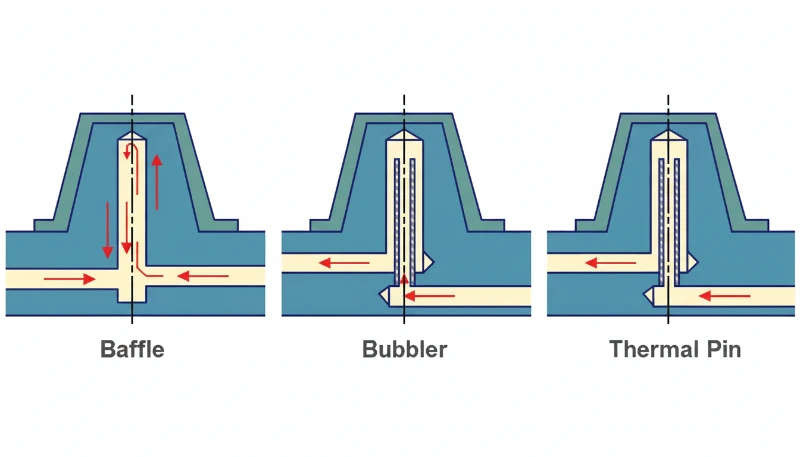
Defletores e borbulhadores. Para núcleos profundos ou áreas difíceis de alcançar com canais retos, defletores (placas planas que dividem o fluxo em duas direções) e borbulhadores (tubos dentro de um furo maior) são a solução prática. Funcionam bem, mas aumentam a queda de pressão e necessitam de limpeza regular para evitar acumulação de incrustações.
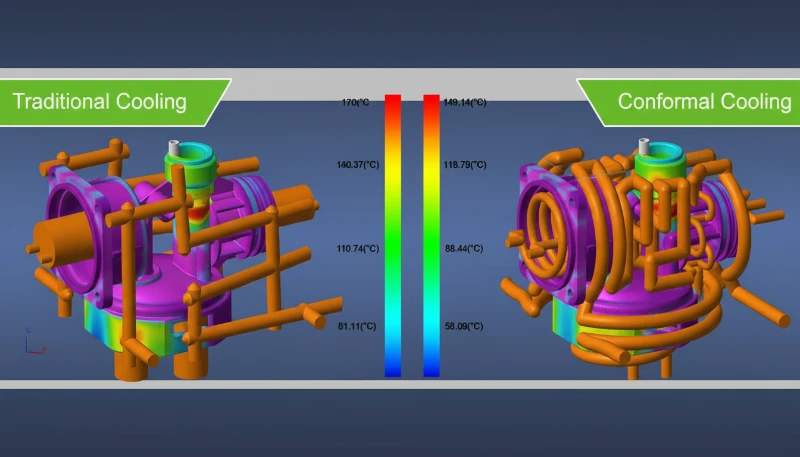
Arrefecimento conformado. A impressão 3D de metal (DMLS/SLM) cria canais de arrefecimento que seguem o contorno da cavidade com precisão. O arrefecimento conforme reduz o tempo de ciclo em 20 a 40% e elimina pontos quentes. O inserto impresso custa 3 a 5 vezes mais do que uma placa perfurada — compensa para produção de alto volume (100.000+ peças), exagerado para séries curtas.
“Um gradiente de 5 ºC na superfície da cavidade pode causar desvio dimensional mensurável em peças de precisão.”Verdadeiro
Para peças com tolerâncias de mais ou menos 0,05 mm ou mais apertadas, uma diferença de temperatura de 5 °C entre as metades fixa e móvel do molde produz retração diferencial que empurra as dimensões fora das especificações. É por isso que os moldadores de precisão visam uma uniformidade da temperatura da superfície da cavidade dentro de mais ou menos 2 °C.
“Os sistemas de aquecimento por óleo podem atingir temperaturas de molde até 250 °C.”Falso
Os sistemas de circulação de óleo térmico são classificados para funcionamento contínuo a 200 a 250 °C, tornando-os a escolha padrão para plásticos de engenharia de alta temperatura como PEEK (temperatura do molde de 160 a 200 °C), PPS (130 a 160 °C) e PEI. No entanto, os sistemas de óleo têm tempos de resposta mais lentos e requisitos de manutenção mais elevados em comparação com a água.

Como Se Comparam Diferentes Métodos de Controlo de Temperatura?
Escolher entre água, óleo e aquecimento elétrico não é apenas sobre temperatura máxima — é sobre velocidade de resposta, custo de manutenção e precisão. Aqui está uma comparação direta baseada no que vemos na produção diária.
| Method | Temp Range | Velocidade de Resposta | Precisão | Manutenção | Melhor para |
|---|---|---|---|---|---|
| Água (padrão) | 10 a 90 ºC | Rápido | Mais ou menos 1 a 2 °C | Baixa | A maioria dos plásticos comuns e de engenharia |
| Água pressurizada | 90 a 130 °C | Rápido | Mais ou menos 1 a 2 °C | Baixo a médio | PC, nylon de alta temperatura, POM |
| Óleo térmico | 100 a 250 ºC | Slow | Mais ou menos 2 a 5 °C | Elevado | PEEK, PPS, PEI, LCP |
| Cartucho elétrico | 200 a 400 °C | Médio | Mais ou menos 1 °C (local) | Médio | Canais quentes, zonas específicas |
| Arrefecimento conforme e água | 10 a 90 ºC | Muito rápido | Mais ou menos 1 ºC | Baixa | Peças de precisão de alto volume |
Que Problemas Comuns Surgem de uma Temperatura de Molde Incorreta?
Aqui está uma tabela de resolução de problemas extraída do que vemos repetidamente na nossa linha de produção quando a temperatura do molde não está ajustada corretamente. Se estiver a enfrentar algum destes problemas, verifique primeiro a temperatura do molde antes de ajustar qualquer outro parâmetro.
| Symptom | Causa Provável | Fix |
|---|---|---|
| Variação de brilho na superfície texturizada | Molde demasiado frio — a pele do plástico congela antes de replicar a textura | Aumentar a temperatura do molde 10 a 15 ºC |
| Marcas de afundamento em nervuras ou bossagens | Molde demasiado frio — embalagem insuficiente antes do congelamento | Aumentar a temperatura do molde e prolongar o tempo de embalagem |
| Empenamento em peças planas | Gradiente de temperatura entre as metades do molde excede 5 °C | Equilibrar vazões, adicionar defletores, verificar canais bloqueados |
| Tempo de ciclo longo | Temperatura do molde definida demasiado alta para o material | Reduzir dentro da gama recomendada; verificar com termopar da cavidade |
| Injeções curtas em paredes finas | Molde demasiado frio — congelação prematura | Aumentar a temperatura do molde 10 a 20 °C |
| Marcas ou aderência dos pinos ejetores | Molde demasiado quente — peça não suficientemente rígida na ejeção | Baixar a temperatura do molde ou aumentar o tempo de arrefecimento |
| Peças frágeis (PA/POM) | Molde demasiado frio — cristalização insuficiente | Aumentar a temperatura do molde para o limite superior da faixa recomendada |
| Deriva dimensional entre cavidades | Fluxo de refrigerante desigual através do molde multi-cavidade | Equilibrar o fluxo com restritores; limpar incrustações dos canais |
Como Medir e Monitorizar a Temperatura do Molde?
A abordagem padrão é usar pirómetros para verificações pontuais e termopares para monitorização contínua, cruzando os dados com as leituras da temperatura do refrigerante. É necessário pelo menos dois métodos em produção. Confiar apenas no visor do controlador de temperatura não é medição — esse é o ponto de ajuste, não a temperatura real da superfície da cavidade. Pirómetro de superfície. O método mais rápido. Após executar 5 a 10 tiros para estabilizar, aponte um pirómetro de contacto para a superfície da cavidade imediatamente após a ejeção. Meça pelo menos três pontos — perto do ponto de injeção, no final do enchimento e numa secção espessa. Se a variação exceder 5 °C, o seu arrefecimento não é uniforme.
Sensores termopares. Para monitorização contínua durante a produção, os termopares embutidos no aço do molde (1 a 2 mm abaixo da superfície da cavidade) fornecem dados em tempo real. A maioria dos controladores de temperatura modernos pode registar estas leituras e acionar alarmes se a temperatura se desviar fora de uma banda definida. Fluxo do refrigerante e diferencial de temperatura. Meça a temperatura do refrigerante que entra e sai de cada circuito. Uma diferença de 2 a 3 °C é normal; qualquer valor acima de 5 °C significa que o circuito está a absorver demasiado calor, o que normalmente indica um caudal insuficiente ou um canal demasiado longo.
Como é que a Temperatura do Molde Afeta Materiais Específicos?
O impacto da temperatura do molde é fundamentalmente diferente entre resinas semicristalinas e amorfas. Os materiais semicristalinos necessitam de 70 a 200 °C para uma formação adequada dos cristais; as resinas amorfas necessitam de 20 a 120 °C principalmente para alívio de tensões. PA6 e PA66 (Nylon). A temperatura de processamento do Nylon 6 para a massa fundida é tipicamente de 230 a 280 °C, com temperaturas de molde de 70 a 90 °C para graus padrão e de 80 a 120 °C para versões com fibra de vidro. Abaixo de 40 °C, o PA66 cristaliza de forma irregular, produzindo peças que empenam dias após a moldagem. PC (Policarbonato). A temperatura de moldagem por injeção de PC para a massa fundida varia entre 280 e 320 °C, com temperaturas do molde de 80 a 120 °C. O PC é amorfo — a preocupação é a tensão interna, não a cristalização.
Um molde frio congela as cadeias poliméricas num estado altamente orientado, criando risco de fendilhação por tensão. TPU (Poliuretano Termoplástico). Os parâmetros do processo de moldagem de TPU são estreitos: massa fundida a 190 a 230 °C, molde a 20 a iii50 °C. Muito frio = superfície baça; muito quente = peça cola ao molde. Os graus mais macios são mais sensíveis. PEEK (Poliéterétercetona). O PEEK necessita das temperaturas de molde mais elevadas: 160 a 200 °C via aquecimento a óleo. Abaixo de 150 °C, a cristalização é pobre, produzindo peças com resistência e resistência química reduzidas.
Quais São as Técnicas Avançadas de Controlo da Temperatura do Molde?
Técnicas avançadas como o aquecimento dinâmico Varitherm, o arrefecimento por pulso e os canais conformados podem reduzir o tempo do ciclo em 20 a 40% enquanto melhoram a qualidade. Requerem investimento, mas compensam rapidamente na produção de alto volume. Varitherm (controlo dinâmico da temperatura do molde). O molde é aquecido a uma temperatura elevada durante a injeção, depois arrefecido rapidamente para ejeção. Isto dá a qualidade superficial de um molde quente com tempos de ciclo próximos de um molde frio. É necessário vapor ou óleo quente mais comutação de água refrigerada — mas para peças de alta cosmética, como revestimentos interiores automóveis, elimina etapas de pintura ou retoques superficiais. Arrefecimento por pulso. O arrefecimento por pulsos alterna entre fluxo e pausa nos circuitos de arrefecimento.
Durante a pausa, o calor conduz mais profundamente para o aço do molde, criando um gradiente de temperatura mais uniforme. Quando o fluxo é retomado, o calor em massa é removido de forma mais eficiente. Estudos mostram reduções de 10 a 15% no tempo do ciclo em peças de paredes espessas. Camadas de isolamento. Em moldes de múltiplas cavidades, insira isolamento térmico (liga de titânio ou cerâmica) entre as cavidades para evitar a transferência de calor de uma cavidade que funciona quente para uma que funciona fria. Isto permite trabalhar com materiais ou espessuras de parede diferentes no mesmo molde sem contaminação cruzada das zonas de temperatura. Se está a avaliar fornecedores e quer compreender como as capacidades de temperatura do molde afetam o seu projeto, consulte a nossa injection molding supplier sourcing guide para uma estrutura de avaliação estruturada.
Quais São as Perguntas Mais Frequentes Sobre a Temperatura do Molde?
Perguntas mais frequentes
Qual é a temperatura ideal do molde para a moldagem por injeção de ABS?
Para o ABS, a temperatura recomendada do molde é de 40 a 80 °C. Para peças de uso geral onde o acabamento superficial não é crítico, trabalhe a 50 a 60 °C. Se precisar de uma superfície de alto brilho sem pintura, vá para 70 a 80 °C para obter uma replicação total da textura. Abaixo de 40 °C, verá marcas de fluxo e manchas opacas na superfície da peça. Note também que o ABS é amorfo, pelo que a temperatura do molde afeta principalmente a qualidade superficial e a tensão residual, em vez da cristalinidade. É por isso que os moldadores experientes começam sempre com as recomendações da ficha técnica do fornecedor do material e depois afinam com base nas medições reais da temperatura da cavidade e nos resultados da inspeção das peças durante o primeiro ensaio de produção.
A temperatura do molde pode ser demasiado elevada?
Sim, absolutamente. Se o molde estiver demasiado quente, a peça não solidifica o suficiente antes da ejeção. Isto causa aderência, deformação, tempos de ciclo alongados e aumento do encolhimento. Em casos extremos, a peça pode deformar sob o seu próprio peso ao sair do molde. Mantenha-se sempre dentro da gama recomendada pelo fornecedor do material e verifique a temperatura real da superfície da cavidade com um pirómetro em vez de confiar apenas no visor do controlador de temperatura. É por isso que os moldadores experientes começam sempre com as recomendações da ficha técnica do fornecedor do material e depois afinam com base em medições reais da temperatura da cavidade e nos resultados da inspeção das peças durante o primeiro ensaio de produção.
Como é que a temperatura do molde afeta o tempo do ciclo?
O tempo de arrefecimento representa tipicamente 60 a 70% do ciclo total de moldagem por injeção. Uma temperatura do molde mais elevada significa que a peça demora mais a atingir uma temperatura em que seja suficientemente rígida para a ejeção. Um aumento de 20 °C na temperatura do molde pode adicionar 10 a 30% ao tempo do ciclo, dependendo da espessura da parede e da condutividade térmica do material. É por isso que deve utilizar a temperatura do molde mais baixa que ainda satisfaça os seus requisitos de qualidade. É por isso que os moldadores experientes começam sempre com as recomendações da ficha técnica do fornecedor do material e depois afinam com base nas medições reais da temperatura da cavidade e nos resultados da inspeção da peça durante o primeiro ensaio de produção.
Qual é a diferença entre a temperatura do molde e a temperatura de fusão?
A temperatura de fusão é a temperatura do plástico quando entra na cavidade do molde, tipicamente entre 180 e 320 °C, dependendo do material. A temperatura do molde é a temperatura da superfície de aço da cavidade, tipicamente entre 15 e 200 °C. São controladas independentemente — a temperatura de fusão pelos aquecedores do cilindro e pelo cisalhamento da rosca, a temperatura do molde pelo sistema de arrefecimento ou aquecimento. Ambas devem ser definidas corretamente para uma qualidade ótima da peça. É por isso que os moldadores experientes começam sempre com as recomendações da ficha técnica do fornecedor do material e depois ajustam com base em medições reais da temperatura da cavidade e nos resultados da inspeção das peças durante o primeiro ensaio de produção.
Como corrige a deformação causada pela temperatura desigual do molde?
Primeiro, meça a temperatura da superfície da cavidade em vários pontos usando um pirómetro após 5 a 10 injeções de estabilização. Identifique as zonas quentes e frias. Depois, equilibre o fluxo do refrigerante ajustando as vazões com válvulas, adicionando restritores de fluxo aos canais superarrefecidos ou instalando defletores nas áreas subarrefecidas. O objetivo é uma diferença inferior a 3 °C na superfície da cavidade. Para deformações persistentes, poderá ser necessário modificar o layout dos canais de arrefecimento no molde. É por isso que os moldadores experientes começam sempre com as recomendações da ficha técnica do fornecedor do material e depois ajustam com base em medições reais da temperatura da cavidade e nos resultados da inspeção das peças durante o primeiro ensaio de produção.
A temperatura do molde afeta a contração na moldagem por injeção?
Sim, significativamente. Uma temperatura do molde mais elevada permite maior cristalização em materiais semicristalinos, como PA, POM e PEEK, o que aumenta a contração. Para materiais amorfos como PC, ABS e PS, a temperatura do molde tem um efeito menor na contração, mas ainda assim afeta a precisão dimensional através do alívio de tensões residuais. Quando são necessárias tolerâncias apertadas, deve-se considerar a diferença de contração entre os limites inferior e superior da faixa de temperatura do molde. É por isso que os moldadores experientes começam sempre com as recomendações da ficha técnica do fornecedor do material e depois ajustam com base em medições reais da temperatura da cavidade e nos resultados da inspeção das peças durante o primeiro ensaio de produção.
O que acontece se moldar PA66 com uma temperatura do molde abaixo de 50 °C?
A superfície do nylon congela numa camada maioritariamente amorfa com cristalinidade significativamente menor. Isto reduz a resistência à tração em 10 a 20%, diminui a resistência química, aumenta a taxa de absorção de humidade e frequentemente produz marcas de fluxo visíveis na superfície da peça. Para peças estruturais ou de carga em PA66, utilize sempre uma temperatura do molde de 70 °C ou superior para obter a cristalização adequada e o desempenho mecânico correto. É por isso que os moldadores experientes começam sempre com as recomendações da ficha técnica do fornecedor do material e depois ajustam com base em medições reais da temperatura da cavidade e nos resultados da inspeção das peças durante o primeiro ensaio de produção.
Quão apertada deve ser a tolerância da temperatura do molde para peças de precisão?
Para peças de precisão com tolerâncias de mais ou menos 0,05 mm ou mais apertadas, procure controlar a temperatura do molde dentro de mais ou menos 2 °C em todas as superfícies da cavidade. Isto requer canais de arrefecimento bem projetados, fluxo de refrigerante equilibrado e unidades de temperatura controladas por PID com feedback de termopares. Para moldagem de ultra precisão, como lentes óticas ou componentes médicos, o objetivo é mais ou menos 1 °C, o que tipicamente requer arrefecimento conformal ou múltiplas zonas de temperatura independentes. É por isso que os moldadores experientes começam sempre com as recomendações da ficha técnica do fornecedor do material e depois ajustam com base em medições reais da temperatura da cavidade e nos resultados da inspeção das peças durante o primeiro ensaio de produção.
Acertar na Temperatura do Molde — Desde o Primeiro Dia
Na ZetarMold, as nossas 47 máquinas de moldagem por injeção (90T a 1850T) estão equipadas com unidades de temperatura independentes controladas por PID. A nossa equipa de 8 engenheiros seniores projeta layouts de arrefecimento otimizados para a geometria e material da sua peça. Com mais de 400 materiais processados e mais de 20 anos de experiência na nossa instalação de Xangai, mantemos a temperatura do molde consistentemente desde a primeira peça até à milionésima. Obtenha um Orçamento Gratuito.
-
temperatura do molde: temperatura do molde refere-se à temperatura da superfície da cavidade que contacta com o polímero fundido durante a moldagem por injeção, tipicamente controlada pela circulação de água ou óleo térmico através de canais no molde. ↩
-
semicristalino: semicristalino refere-se a um tipo de polímero que forma regiões cristalinas ordenadas ao arrefecer a partir do estado fundido. A temperatura do molde controla diretamente a taxa e o grau de cristalização em polímeros semicristalinos, como nylon, POM e PEEK. ↩
-
Número de Reynolds: Número de Reynolds refere-se a um número adimensional usado para prever padrões de fluxo de fluidos em tubos e canais; um número de Reynolds acima de 4000 indica fluxo turbulento, que proporciona uma transferência de calor 3 a 5 vezes melhor do que o fluxo laminar. ↩



 EN
EN  ES
ES  FR
FR  DE
DE  PT
PT  AR
AR  RU
RU  JA
JA  KO
KO  IT
IT  NL
NL  TR
TR  PL
PL 