As tolerâncias geométricas — os limites que controlam a forma, orientação, localização e batimento das características de uma peça moldada por injeção — fazem a diferença entre um componente que encaixa na perfeição e outro que acaba no contentor de refugo. Ao contrário das simples tolerâncias dimensionais mais/menos, o dimensionamento e toleranciamento geométrico (GD&T) utiliza uma linguagem simbólica normalizada, definida na ASME Y14.51 e na ISO 11012, para comunicar a intenção do projeto sem ambiguidades. Se estiver a especificar peças de plástico para aplicações automóveis, médicas ou de eletrónica de consumo, compreender as tolerâncias geométricas não é opcional — é uma competência essencial de engenharia.
Na nossa fábrica de Xangai, operamos 47 máquinas de moldação por injeção entre 90T e 1850T, produzindo peças com controlos geométricos rigorosos para clientes de todo o mundo. Ao longo de 20+ anos de experiência com 400+ materiais plásticos, comprovámos diretamente como uma especificação GD&T correta evita litígios dispendiosos entre projetistas, fabricantes de moldes e equipas de qualidade. Este guia apresenta os principais tipos de tolerância geométrica necessários na moldação por injeção, explica quais são mais importantes para as peças plásticas e partilha recomendações práticas do chão de fábrica.
- O GD&T utiliza símbolos normalizados (ASME Y14.5 / ISO 1101) para definir a forma, a orientação, a localização e o batimento.
- A planaridade e a retilineidade são as tolerâncias geométricas mais críticas para as peças moldadas por injeção.
- O encolhimento e o empeno do material tornam as tolerâncias geométricas mais difíceis de manter do que no usinagem de metal.
- A seleção do datum deve refletir a montagem funcional — não apenas a conveniência de usinagem.
- Especificar excessivamente tolerâncias geométricas aumenta os custos de ferramentas e inspeção sem agregar valor.
O que são tolerâncias geométricas e porque são importantes na moldagem por injeção?
As tolerâncias geométricas e a razão da sua importância na moldação por injeção são as principais categorias ou opções explicadas nesta secção. As tolerâncias geométricas são os limites da variação admissível na forma, orientação e posição de uma peça para além do que as dimensões lineares, por si só, conseguem representar. Um furo pode ter o diâmetro correto e, ainda assim, estar fora de posição; uma superfície pode apresentar a espessura certa, mas estar demasiado empenada para vedar. O GD&T aborda estas realidades com 14 tipos de tolerância organizados em cinco categorias: forma, orientação, localização, batimento e perfil.
Na moldagem por injeção, as tolerâncias geométricas são especialmente importantes porque as peças de plástico sofrem contração, empenamento e tensões internas durante o arrefecimento. Uma peça que parece perfeita no momento da ejeção pode deformar-se nas 24 a 48 horas seguintes, à medida que as tensões residuais relaxam. Isto significa que a tolerância geométrica especificada deve considerar não só o próprio processo de moldagem, mas também a variação dimensional após a moldagem. Por exemplo, uma indicação de planeza de 0,1 mm numa caixa de policarbonato de 150 mm pode exigir um projeto especial do ponto de injeção, pressão de manutenção otimizada e, eventualmente, um dispositivo para restringir a peça durante o arrefecimento.
A norma ASME Y14.5 define a linguagem simbólica completa para GD&T nos Estados Unidos, enquanto a ISO 1101 desempenha a mesma função a nível internacional. Ambas as normas utilizam um quadro de controlo geométrico — uma caixa retangular que contém o símbolo da característica geométrica, o valor da tolerância e quaisquer referências a elementos de referência. Saber ler e aplicar estes quadros é a base para comunicar os requisitos de tolerância ao seu fornecedor de moldes de injeção.
Quais são os símbolos GD&T mais relevantes para peças plásticas moldadas por injeção?
Nem todos os 14 símbolos GD&T são igualmente relevantes para a moldagem por injeção. Na prática, um pequeno conjunto de tolerâncias geométricas representa a grande maioria das indicações nos desenhos de peças plásticas. Apresentamos uma classificação dos símbolos mais utilizados e explicamos por que são importantes para os componentes moldados.
| Símbolo GD&T | Categoria | Aplicação típica | Dificuldade de manutenção |
|---|---|---|---|
| Planaridade | Forma | Superfícies de vedação, faces de montagem | Alto (empeno) |
| Retilineidade | Forma | Nervuras, bordos, características cilíndricas | Médio |
| Circularidade | Forma | Bosses cilíndricos, furos | Médio |
| Perpendicularidade | Orientação | Boss para face, parede para flange | Médio-Alto |
| Paralelismo | Orientação | Paredes opostas, características de encaixe por pressão | Elevado |
| Posição | Localização | Padrões de furos, pontos de montagem | Médio |
| Concentricidade | Localização | Características rotativas, assentos de rolamento | Muito elevado |
| Perfil de uma superfície | Perfil | Superfícies curvas complexas | Elevado |
A planicidade é, sem dúvida, a tolerância geométrica mais importante para peças moldadas por injeção. Uma superfície de vedação que se encurve apenas 0,15 mm pode ter fugas. Uma face de montagem que empena 0,2 mm pode causar desalinhamento na montagem. Na nossa experiência, os problemas de planicidade representam aproximadamente 30-40% de todas as não-conformidades geométricas em peças moldadas. As causas principais são geralmente arrefecimento desigual, colocação inadequada do gate, ou retração do material que não foi devidamente simulada durante o projeto do molde.
A tolerância de posição é a segunda mais crítica. Quando existe um conjunto de furos de montagem ou clipes de encaixe, a posição relativa destes determina se a montagem é possível. A tolerância de posição é frequentemente mais útil do que as tolerâncias de coordenadas individuais, porque permite uma tolerância adicional resultante da dimensão real do elemento — algo particularmente valioso nas peças de plástico, cujos diâmetros dos furos podem variar devido à contração.
Como é que a escolha do material afeta a tolerância geométrica na moldagem por injeção?
O material que seleciona tem um impacto direto e frequentemente dramático nas tolerâncias geométricas que pode realisticamente manter. Materiais amorfos como policarbonato (PC) e ABS tendem a encolher mais uniformemente e a manter melhor a planaridade do que materiais semicristalinos como nylon (PA6, PA66) ou POM, que sofrem um encolhimento significativo impulsionado pela cristalização. Os compostos com carga de vidro complicam ainda mais as coisas porque a orientação das fibras cria um encolhimento anisotrópico — a peça encolhe de forma diferente ao longo da direção do fluxo versus perpendicularmente a ele.
Considere um exemplo prático: uma tampa plana de 200 mm x 150 mm em PA66-GF30 (nylon 66 com 30% de fibra de vidro). A simulação do fluxo no molde3 pode prever uma contração de 0,6% na direção do fluxo e 0,3% na direção transversal — uma proporção de 2:1. Se especificar uma planeza de 0,1 mm, estará provavelmente a exigir algo que o material simplesmente não consegue oferecer sem medidas extraordinárias, como dispositivos dentro do molde ou recozimento após a moldagem. Uma indicação de planeza mais realista para este cenário seria 0,3-0,5 mm.
É aqui que um fornecedor experiente de moldes de injeção acrescenta valor real. Com 8 engenheiros seniores e experiência em mais de 400 materiais, ajudamos os clientes a compreender quais as tolerâncias geométricas alcançáveis para o material, a geometria da peça e o volume de produção específicos. Especificar tolerâncias fisicamente impossíveis de manter não melhora a qualidade — apenas aumenta a taxa de refugo e o custo.
"O GD&T pode especificar tolerâncias que tenham em conta a contração do material após a moldação."True
Ao combinar GD&T com dados de simulação do fluxo no molde, os projetistas podem prever a geometria após a contração e especificar tolerâncias que reflitam o estado de equilíbrio final da peça, e não apenas a sua condição logo após a moldação.
"Tolerâncias geométricas mais apertadas produzem sempre peças melhores."False
A especificação excessiva de tolerâncias aumenta o custo das ferramentas, o tempo de inspeção e a taxa de desperdício sem melhorar o desempenho funcional. A tolerância correta é a mais ampla que ainda satisfaz os requisitos de montagem e funcionamento.
Que Normas Regulam as Tolerâncias Geométricas para Peças de Plástico Moldadas?
As normas de toleranciamento geométrico são regidas sobretudo por dois referenciais a nível mundial: ASME Y14.5 e ISO 1101. A ASME Y14.5 predomina na América do Norte, enquanto a ISO 1101 (com as normas complementares ISO 5458 e ISO 5459) é utilizada na Europa e na Ásia. Ambas as normas definem os mesmos conceitos fundamentais, mas diferem em alguns pormenores de notação e regras predefinidas.
Especificamente para peças moldadas por injeção, a ISO 20457:2018 fornece orientações adicionais sobre as tolerâncias dimensionais das peças moldadas, incluindo um sistema de classificação que considera fatores relacionados com o molde, como a geometria da peça, a localização do ponto de injeção e o comportamento do material. Esta norma reconhece que as peças de plástico têm uma capacidade de tolerância fundamentalmente diferente da das peças de metal maquinadas e que aplicar GD&T com rigor de maquinação aos plásticos moldados é economicamente irrealista.
Ao preparar desenhos para orçamentos de moldagem por injeção, especifique sempre a norma utilizada. Um quadro de tolerância interpretado segundo a ASME Y14.5 pode produzir resultados diferentes do mesmo quadro interpretado segundo a ISO 1101, sobretudo no que respeita às tolerâncias de posição e à utilização de referências. A divergência na interpretação das normas é uma das fontes mais comuns de litígios de qualidade entre compradores e moldadores.
Como Especificar Tolerâncias Geométricas nos Desenhos de Peças Moldadas por Injeção?
São necessários três elementos para especificar tolerâncias geométricas: o tipo de tolerância, o valor da tolerância e o sistema de referência de datums. O sistema de referência de datums é provavelmente o elemento mais importante — e o mais frequentemente aplicado de forma incorreta. Os datums definem as superfícies de referência a partir das quais são efetuadas todas as outras medições. Para peças moldadas por injeção, a seleção dos datums deve considerar a forma como a peça será inspecionada, e não apenas o seu funcionamento.
Um erro comum consiste em utilizar a linha de separação como datum. A linha de separação é a interface entre as metades do molde e, embora pareça uma referência estável, pode apresentar rebarba, deslocar-se ou desgastar-se ao longo da vida útil do molde. Uma abordagem melhor consiste em designar elementos funcionais — como um ressalto de montagem plano ou um furo de precisão mandrilado — como datums. Estes elementos são maquinados diretamente no aço do molde e mantêm a sua integridade geométrica durante centenas de milhares de ciclos.
Eis um fluxo de especificação prático: primeiro, identifique as características que devem encaixar noutros componentes. Segundo, atribua referências às características mais estáveis e acessíveis. Terceiro, aplique a tolerância geométrica menos apertada que ainda garanta a função. Quarto, valide as indicações com o seu fornecedor de moldagem por injeção antes de finalizar o desenho — ele poderá dizer-lhe o que é realisticamente exequível, tendo em conta a geometria da peça, o material e as restrições de produção.
O Que Causa Desvios de Tolerância Geométrica Durante a Moldagem por Injeção?
O empeno, o arrefecimento irregular, as forças de extração e o desgaste do molde são as principais causas de desvios das tolerâncias geométricas durante a moldagem por injeção. Compreender estas causas ajuda a definir tolerâncias realistas e a projetar peças dimensionalmente mais estáveis.
O empeno é o principal inimigo das tolerâncias geométricas na moldação por injeção. Ocorre quando diferentes regiões da peça arrefecem e contraem a velocidades diferentes. As secções finas arrefecem mais depressa do que as secções espessas. As áreas próximas do ponto de injeção recebem uma pressão de compactação superior à das áreas mais afastadas. Os materiais reforçados com fibras desenvolvem tensões internas devido à orientação das fibras, que são libertadas à medida que a peça atinge o equilíbrio. O resultado é uma peça que estava geometricamente correta no molde, mas que se apresenta deformada quando é medida 24 horas mais tarde.
As forças de ejeção são outro fator significativo. À medida que a peça arrefece, contrai-se sobre o macho do molde. Os pinos extratores têm de empurrar a peça para fora, e esta força pode deformar temporariamente paredes finas ou elementos delicados. Os sistemas de extração bem projetados distribuem a força uniformemente, mas mesmo uma ejeção otimizada pode introduzir desvios geométricos inferiores a um décimo de milímetro em superfícies críticas.
O desgaste e a manutenção do molde também desempenham um papel. Após 100,000+ ciclos, as superfícies do molde podem sofrer erosão, especialmente em torno das áreas dos pontos de injeção e dos machos deslizantes. Este desgaste gradual altera as dimensões e pode fazer com que as características geométricas fiquem fora da tolerância. A manutenção regular do molde e as inspeções periódicas do primeiro artigo são essenciais para detetar este desvio antes de afetar a qualidade da produção.
"A simulação do fluxo no molde pode prever os resultados das tolerâncias geométricas antes de o aço ser maquinado."True
As ferramentas modernas de simulação do fluxo no molde, como Moldflow e Moldex3D, conseguem prever o empeno, a contração e a orientação das fibras com precisão suficiente para validar a viabilidade das tolerâncias geométricas durante a fase de projeto.
"O recozimento após a moldação melhora sempre a conformidade das tolerâncias geométricas."False
O recozimento alivia as tensões internas, mas também pode causar deformação adicional se não for cuidadosamente controlado. Em alguns materiais e geometrias, o recozimento piora efetivamente a planeza ou a precisão da posição. Deve ser avaliado caso a caso.
Como Pode Otimizar o Design da Peça para uma Melhor Conformidade com Tolerâncias Geométricas?
A espessura de parede uniforme, as proporções corretas das nervuras e o posicionamento estratégico dos pontos de injeção são as principais estratégias de projeto para cumprir as tolerâncias geométricas. Estas estratégias melhoram a estabilidade dimensional sem aumentar o custo.
A espessura uniforme das paredes é a decisão de design com maior impacto no controlo geométrico. Quando a espessura das paredes varia significativamente ao longo de uma peça, as secções espessas contraem mais do que as secções finas, criando tensões internas que causam empeno. Uma variação da espessura das paredes superior a 15-20% num material cristalino produzirá quase certamente uma não conformidade geométrica em superfícies planas. Quando as transições de espessura forem inevitáveis, utilize rampas graduais em vez de degraus abruptos para distribuir a tensão de forma mais uniforme.
O projeto das nervuras também afeta os resultados geométricos. As nervuras aumentam a rigidez, o que ajuda a manter a planicidade — mas também criam secções espessas localizadas que contraem mais do que a parede circundante. Para a maioria dos materiais, mantenha a espessura das nervuras em 50-60% da espessura nominal da parede e evite nervuras que se cruzam e criam nós espessos. As secções de parede onduladas podem proporcionar uma rigidez equivalente com melhor estabilidade geométrica do que as nervuras tradicionais.
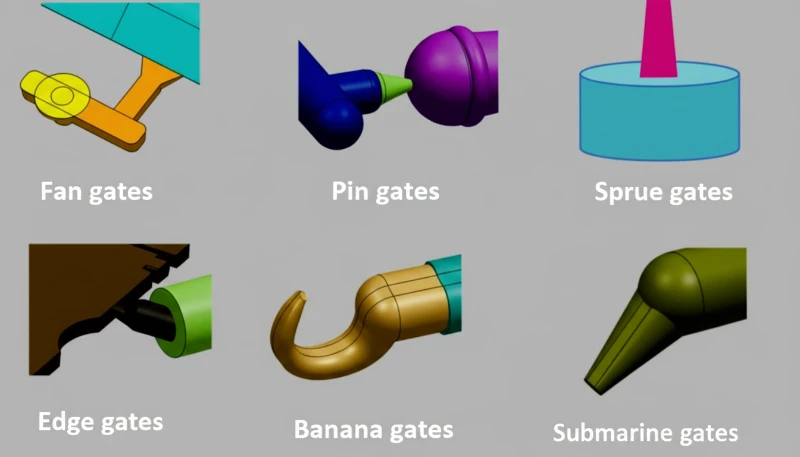
A localização e o tipo do ponto de injeção exigem uma análise cuidadosa. O ponto de injeção é o local por onde o plástico fundido entra na cavidade, e a sua localização determina o padrão de escoamento, a posição das linhas de soldadura e a distribuição da pressão de compactação — fatores que afetam a geometria final. Um único ponto de injeção lateral cria um escoamento unidirecional que favorece o paralelismo na direção do escoamento. Vários pontos de injeção podem equilibrar o enchimento, mas introduzem linhas de soldadura que criam pontos fracos e descontinuidades geométricas.
A equipa de qualidade da ZetarMold inclui mais de 10 especialistas de QC que seguem um fluxo de inspeção em 6 etapas, abrangendo IQC, verificações durante o processo e OQC final, para confirmar a conformidade das tolerâncias geométricas em cada série de produção.
Como Medir e Inspecionar Tolerâncias Geométricas em Peças Moldadas?
As CMMs, os scanners óticos e os calibres funcionais são os três principais métodos de medição de tolerâncias geométricas em peças plásticas moldadas por injeção. Cada método apresenta vantagens específicas consoante o tipo de tolerância e o volume de produção.
A medição por CMM com apalpadores de contacto é o método normalizado para verificar a posição, a perpendicularidade e o paralelismo. Contudo, as peças de plástico são flexíveis — a força de contacto do apalpador pode fletir a superfície e introduzir erros de medição. A utilização de CMM com baixa força de apalpação (normalmente inferior a 50 mN) ou de sondas laser sem contacto minimiza este problema. Para medir a planicidade, a digitalização ótica com luz estruturada fornece dados de toda a superfície, em vez dos conjuntos esparsos de pontos obtidos com apalpadores de contacto, oferecendo uma representação mais exata do estado real da superfície.
A calibração funcional continua a ser o método mais prático para a produção de grande volume. Um calibre passa/não passa que simule o componente correspondente fornece um resultado de aprovação/reprovação diretamente correlacionado com a função da montagem. Embora os calibres não indiquem exatamente a magnitude do desvio geométrico, são rápidos, repetíveis e exigem uma competência mínima do operador — o que os torna ideais para a inspeção durante o processo na área de produção.
Quais são as faixas realistas de tolerância geométrica para peças moldadas por injeção?
Os intervalos de tolerância geométrica das peças moldadas por injeção situam-se normalmente entre 0 e 1 mm, dependendo do tipo de tolerância, do material e da geometria da peça. A tabela seguinte apresenta intervalos práticos baseados na experiência do setor e em referências normalizadas de tolerâncias para moldação por injeção.
| Tipo de tolerância | Precisão (tolerância apertada) | Padrão (normal) | Grosseiro (solto) |
|---|---|---|---|
| Planicidade (por 100 mm) | 0.05–0.10 mm | 0.10–0.30 mm | 0.30–0.60 mm |
| Retilinearidade (por 100 mm) | 0.05–0.10 mm | 0.10–0.25 mm | 0.25–0.50 mm |
| Circularidade (diâmetro) | 0.03–0.08 mm | 0.08–0.15 mm | 0.15–0.30 mm |
| Perpendicularidade (por 100 mm) | 0.05–0.10 mm | 0.10–0.25 mm | 0.25–0.50 mm |
| Paralelismo (por 100 mm) | 0.08–0.15 mm | 0.15–0.35 mm | 0.35–0.70 mm |
| Posição (RFS) | Ø0.10–0.20 mm | Ø0.20–0.50 mm | Diâmetro: Ø0.50–1.00 mm |
| Perfil de uma superfície | 0.10–0.20 mm | 0.20–0.50 mm | 0.50–1.00 mm |
Estes intervalos pressupõem condições de processamento convencionais e um projeto do molde otimizado. Atingir os valores da coluna «Precisão» exige normalmente recursos especializados, como arrefecimento conformado, sensores de pressão no molde e, eventualmente, dispositivos de fixação após a moldagem. A coluna «Padrão» representa o que um molde bem concebido, operado numa máquina de moldagem por injeção moderna, consegue produzir de forma consistente. A coluna «Grosseira» é adequada a características estéticas ou estruturais não críticas.
"Os canais de arrefecimento conformados no molde podem melhorar a planeza em até 40%."True
Os canais de arrefecimento conformado acompanham o contorno da peça, proporcionando um arrefecimento mais uniforme que reduz os gradientes térmicos e o empeno resultante. Os estudos mostram melhorias de planicidade de 30-50% em comparação com canais furados convencionais.
"Os materiais reforçados com fibra de vidro melhoram sempre a estabilidade dimensional e a tolerância geométrica."False
As fibras de vidro aumentam a rigidez e reduzem a contração global, mas introduzem uma contração anisotrópica que pode agravar o empeno e a planicidade. A orientação das fibras depende da direção do fluxo, pelo que o paralelismo e a planicidade podem efetivamente piorar em determinadas orientações.
Porque deve discutir os requisitos de tolerância geométrica com o seu fornecedor de moldagem antecipadamente?
Os maiores problemas de tolerância geométrica que vemos na nossa fábrica não são causados por uma má moldação — são causados por uma má especificação. Os projetistas que definem as tolerâncias sem consultar o fornecedor do molde de injeção especificam frequentemente tolerâncias demasiado apertadas ou mal aplicadas a características não críticas. Ambos os erros fazem desperdiçar dinheiro.
A colaboração precoce entre a equipa de projeto e o fornecedor de moldação permite várias otimizações críticas. Em primeiro lugar, o fornecedor pode executar simulações do fluxo no molde para validar se as tolerâncias especificadas são exequíveis para a geometria e o material em causa. Em segundo lugar, a equipa de moldes pode otimizar a localização do ponto de injeção, a disposição da refrigeração e a estratégia de ejeção para se concentrar nos elementos geométricos mais críticos. Em terceiro lugar, a equipa da qualidade pode conceber protocolos e dispositivos de inspeção que concentrem o esforço de medição nos elementos mais importantes para o funcionamento.
Com as nossas instalações internas de fabrico de moldes a suportarem 100+ conjuntos de moldes por mês, conseguimos iterar rapidamente a conceção dos moldes para obter os melhores resultados possíveis em matéria de tolerâncias geométricas. Os nossos sistemas de qualidade certificados segundo as normas ISO 9001, ISO 13485, ISO 14001 e ISO 45001 garantem que os requisitos de tolerância geométrica são mantidos ao longo de toda a produção, desde a primeira peça até à milionésima.
Precisa de Peças Moldadas por Injeção de Precisão com Tolerâncias Geométricas Apertadas?
A ZetarMold é um fabricante sediado em Xangai que fornece peças moldadas por injeção de precisão, com tolerâncias geométricas apertadas e mais de 20 anos de experiência. Os nossos 8 engenheiros seniores colaboram consigo desde a fase de conceção para otimizar a geometria das peças, a seleção dos materiais e a conceção das ferramentas, de modo a obter os melhores resultados dimensionais. Quer necessite de superfícies planas de vedação com uma tolerância de 0.1 mm ou de tolerâncias de posição para furos de montagem de precisão, a nossa equipa possui os conhecimentos e o equipamento necessários. Solicite hoje um orçamento gratuito e deixe-nos ajudá-lo a especificar e alcançar as tolerâncias geométricas adequadas para o seu projeto.
Perguntas Frequentes sobre Tolerâncias Geométricas na Moldagem por Injeção
Perguntas mais frequentes
Qual é a diferença entre tolerâncias dimensionais e tolerâncias geométricas?
As tolerâncias dimensionais controlam a variação admissível numa única medida linear, como um comprimento, uma largura ou um diâmetro, expressa como um intervalo positivo ou negativo. Em contrapartida, as tolerâncias geométricas controlam a forma, a orientação ou a relação espacial de uma característica: o grau de planicidade de uma superfície, a perpendicularidade entre duas faces ou a precisão do posicionamento de um furo relativamente a uma referência. Nas peças moldadas por injeção, as tolerâncias geométricas são frequentemente mais críticas do que as dimensionais porque determinam diretamente se os componentes encaixam e funcionam corretamente na montagem. Na prática, a maioria dos desenhos de peças necessita dos dois tipos para comunicar plenamente a intenção do projeto.
A moldação por injeção consegue atingir as mesmas tolerâncias geométricas que a maquinação CNC?
Geralmente, não. A maquinagem CNC consegue manter, de forma regular, tolerâncias geométricas de 0.01-0.05 mm, porque a ferramenta de corte cria diretamente a geometria com uma variabilidade mínima do comportamento do material. A moldação por injeção envolve contração, empeno e variabilidade do processo, que tornam impraticáveis tolerâncias inferiores a 0.05 mm para a maioria das geometrias de peças e dos materiais. No entanto, a moldação por injeção é muito mais económica para a produção de grandes volumes, mesmo com tolerâncias ligeiramente mais amplas. O essencial é conceber peças que funcionem de forma fiável dentro do intervalo de tolerâncias geométricas que a moldação consegue proporcionar com consistência, em vez de forçar a moldação a igualar a capacidade da maquinagem.
Como é que o tamanho da peça afeta a tolerância geométrica alcançável?
É mais difícil manter tolerâncias geométricas apertadas em peças maiores, porque a retração se acumula em distâncias superiores e o arrefecimento desigual se torna mais acentuado. Uma planicidade de 0.1 mm ao longo de 50 mm é alcançável para a maioria dos plásticos de engenharia, mas os mesmos 0.1 mm ao longo de 300 mm são extremamente difíceis em materiais semicristalinos. As especificações de tolerância devem ser dimensionadas em função do tamanho da característica, muitas vezes expresso como percentagem ou valor por unidade de comprimento. Uma orientação prática é esperar uma capacidade de planicidade de aproximadamente 0.1 a 0.2 por cento do comprimento da característica para materiais amorfos e de 0.2 a 0.4 por cento para materiais semicristalinos.
Qual é o erro mais comum relativo às tolerâncias geométricas nos desenhos de peças de plástico?
O erro mais comum é o excesso de toleranciamento: especificar tolerâncias geométricas mais apertadas do que as exigidas pelos requisitos funcionais. Isto aumenta o custo do molde, eleva a taxa de desperdício e reduz o rendimento da inspeção, sem qualquer benefício para o produto final. O segundo erro mais comum é a seleção incorreta das referências, quando os elementos escolhidos não são estáveis, acessíveis ou funcionalmente relevantes para a medição. Ambos os erros resultam frequentemente da aplicação de práticas de toleranciamento da maquinação de metais a peças plásticas sem ter em conta as diferenças fundamentais no comportamento dimensional das peças moldadas durante e após a produção.
A utilização de uma máquina de moldação por injeção de maior pressão melhora as tolerâncias geométricas?
Uma pressão de injeção mais elevada, por si só, não melhora a precisão geométrica. A pressão de compactação deve ser cuidadosamente otimizada para cada combinação de peça e material. Uma pressão insuficiente causa enchimentos incompletos e rechupes, enquanto uma pressão excessiva causa rebarbas, sobrecompactação e tensões internas que provocam empeno e instabilidade dimensional. A otimização do processo segundo os princípios da moldação científica, incluindo etapas de enchimento e compactação desacopladas com sensores de pressão e temperatura, é muito mais eficaz do que o simples aumento da tonelagem da máquina ou da pressão de injeção sem uma abordagem sistemática.
Quanto tempo após a moldação deve aguardar para medir as tolerâncias geométricas?
Para a maioria dos plásticos de engenharia, deve aguardar pelo menos 24 horas após a moldação antes de efetuar medições geométricas críticas. Alguns materiais semicristalinos, como o nylon e o PEEK, continuam a estabilizar dimensionalmente durante até 48-72 horas devido à pós-cristalização e ao relaxamento de tensões em curso. Os materiais amorfos, como o policarbonato e o ABS, estabilizam mais rapidamente, mas continuam a beneficiar de um período mínimo de equilíbrio de 12 a 24 horas. Medir demasiado cedo produz resultados enganadores que não refletem a geometria final da peça e pode levar a ajustes incorretos do processo que, na realidade, pioram os resultados de qualidade.
É possível utilizar GD&T em moldes de injeção impressos em 3D para prototipagem?
Os moldes impressos em 3D, como os fabricados com resina SLA ou por fusão em leito de pó metálico, podem produzir peças de protótipo para ensaios de forma e ajuste. Contudo, as tolerâncias geométricas são significativamente mais amplas do que as dos moldes de produção em aço, porque os moldes impressos têm menor condutividade térmica, superfícies da cavidade menos precisas e uma resistência à pressão limitada. Conte com tolerâncias 3 a 5 vezes mais amplas do que as que um molde de aço para ferramentas temperado consegue alcançar. As especificações GD&T nas peças de protótipo devem ser claramente assinaladas como preliminares e reavaliadas na transição para moldes de produção fabricados em aço temperado.
Que papel desempenha a temperatura do molde no controlo das tolerâncias geométricas?
A temperatura do molde afeta diretamente a velocidade de arrefecimento, o comportamento de cristalização e a formação de tensões residuais, fatores que influenciam a precisão geométrica final da peça moldada. Temperaturas do molde mais elevadas proporcionam um arrefecimento mais uniforme e tensões internas menores, o que normalmente melhora a planicidade e o controlo do empeno. Contudo, uma temperatura do molde mais elevada também aumenta o tempo de ciclo e o custo de produção. Nos materiais semicristalinos, a temperatura do molde afeta igualmente o grau de cristalização, que, por sua vez, influencia a magnitude da retração. Determinar a temperatura ideal do molde exige equilibrar a qualidade geométrica, a eficiência da produção e os custos.
ASME Y14.5: norma nacional norte-americana de dimensionamento e toleranciamento geométrico, publicada pela American Society of Mechanical Engineers. ↩
ISO 1101: norma internacional de especificações geométricas dos produtos (GPS) — toleranciamento geométrico — tolerâncias de forma, orientação, localização e batimento. ↩
simulação do fluxo no molde: análise computacional do processo de moldagem por injeção que prevê o padrão de enchimento, a distribuição da pressão e o empenamento antes do fabrico do molde. ↩