 Overslaan naar inhoud

- PC combines impact strength (>800 J/m) with optical clarity (~90% transmission), a combination no other transparent thermoplastic matches—but this comes with strict processing requirements.
- Pre-drying at 120°C for 4 hours to <0.02% moisture is mandatory; skipping this step causes irreversible hydrolysis degradation and brittle parts regardless of injection parameters.
- Process at 280–320°C melt temperature with 80–120°C mold temperature; both ranges are higher than most commodity resins and reflect PC’s engineering-grade processing demands.
- PC has poor chemical resistance to solvents, brake fluid, and many cleaning agents—if chemical exposure is a requirement, PPS, PEEK, or PBT is the correct choice.
“PC’s moisture absorption of 0.4% at saturation makes pre-drying at 120°C for 4 hours mandatory before injection molding.”Echt
PC absorbs up to 0.4% moisture at saturation—20× more than PP’s 0.02%. At melt temperatures of 280–320°C, this moisture causes hydrolysis: water molecules cleave polymer chains, reducing molecular weight and impact strength irreversibly. Standard protocol is drying at 120°C for 4 hours in a dehumidifying hopper dryer, reducing moisture to <0.02% before molding.
“PC is suitable for all applications where chemical resistance is needed.”Vals
PC has poor chemical resistance. Aromatic solvents (toluene, xylene), chlorinated hydrocarbons, automotive brake fluid, gasoline, and many cleaning agents cause stress cracking or chemical attack. PC is appropriate for applications with no solvent or aggressive fluid exposure. For chemical-exposed environments, PPS, PEEK, PBT, or PEI is required.
Engineers specifying polycarbonate for the first time often arrive at the same realization: the data sheet looks excellent, the first sample part looks excellent, and then production starts and stress cracks appear. Almost every PC processing failure traces back to one source—moisture. Polycarbonate absorbs 0.4% moisture at saturation. At melt temperatures of 280–320°C, that moisture hydrolyzes the polymer chains, permanently reducing molecular weight and impact strength. The part looks fine; it’s brittle. The damage is invisible and irreversible. This guide explains what makes PC the right material for specific applications, what the processing requirements actually are, and where PC will fail regardless of process optimization.
| Eigendom | Value |
|---|---|
| Glass transition temperature | 147–150°C |
| Light transmission (3 mm) | ~90% |
| Notched Izod impact | >800 J/m |
| Melt temperature range | 280–320°C |
| Schimmeltemperatuur | 80–120°C |
PC spuitgieten1 is the process of melting polycarbonate resin and injecting it under pressure into a closed mold cavity. PC is an amorphous engineering thermoplastic with a glass transition temperature of 147–150°C, optical transmission of ~90% for 3 mm thickness, and notched Izod impact strength exceeding 800 J/m—the highest among transparent thermoplastics in common use.
What makes PC different from other transparent thermoplastics?
PC is amorphous: it has no defined melting point, softens gradually above Tg (~147°C), and exhibits isotropic shrinkage (~0.5–0.7%)—unlike semi-crystalline resins that show directional shrinkage. This amorphous structure gives PC its optical clarity and dimensional predictability. Compared to PMMA (acrylic), PC has 40× higher impact strength but slightly lower clarity (90% vs. 92–93% transmission). PMMA is harder and more scratch-resistant; PC is tougher. For applications requiring both transparency and impact resistance—safety lenses, headlamp covers, riot shields—PC is the only practical option. For display windows where scratch resistance matters more than toughness, PMMA may be preferred.
PC’s temperature performance stands out among transparent thermoplastics. HDT at 0.45 MPa is 130–138°C, compared to PMMA’s 95°C and ABS’s 80–95°C. This makes PC the material of choice for automotive lighting covers that face radiant heat from LED/HID sources. The combination of optical clarity and heat resistance is not available in any other commodity transparent resin.
What are PC’s processing requirements?
PC requires higher processing temperatures than most engineering thermoplastics. Melt temperature range is 280–320°C—significantly above ABS (200–250°C) or PP (200–270°C). Below 280°C, PC’s melt viscosity is too high for complete fill; above 320°C, thermal degradation produces yellowing and molecular weight loss. Mold temperature of 80–120°C is required to reduce residual stress—cold molds produce optically hazy parts with high internal stress that crack in service. Injection speed should be moderate; fast injection through small gates causes splay (surface streaks from moisture or shear overheating).
The drying step deserves emphasis because it is the most commonly skipped and the most damaging. Hydrolysis degradation in improperly dried PC is permanent: no post-mold annealing recovers molecular weight. A batch run without proper drying can produce parts that test at 50–60% of specification impact strength while appearing visually identical to conforming parts. Standard industry practice: dry at 120°C for 4 hours minimum, verify with inline moisture meter (<0.02%), and re-dry if material has been exposed to ambient humidity for more than 2 hours after drying.
| Eigendom | PC | PMMA | ABS |
|---|---|---|---|
| Impact (notched Izod) | >800 J/m | 10–20 J/m | 100–400 J/m |
| Light transmission | ~90% | 92–93% | Opaque |
| HDT at 0.45 MPa | 130–138°C | 90–100°C | 80–95°C |
| Smelttemperatuur | 280–320°C | 220–260°C | 200–250°C |
| Chemical resistance | Slecht | Matig | Goed |
“PC/ABS blends offer a practical middle ground: lower melt temperature than PC with better impact than ABS.”Echt
PC/ABS blends (typically 60–70% PC) process at 240–260°C—lower than neat PC—while delivering notched Izod impact of 400–700 J/m. Opaque blends cost 1.5–2× ABS pricing. For automotive interiors, electronics housings, and structural covers where transparency is not required, PC/ABS is often the economically optimal choice over neat PC.
“PC parts can be produced without moisture control if visual inspection shows no surface defects.”Vals
Hydrolysis degradation from insufficient drying is not visible on the surface. Parts that appear optically clear may have 40–50% reduced impact strength due to chain scission. Visual inspection cannot detect hydrolysis degradation; only mechanical testing or molecular weight analysis can confirm part integrity. Proper drying is process-mandatory, not optional.
What are PC’s key applications and where does it fail?
PC’s primary applications leverage the transparency + impact combination: automotive headlamp lenses and fog light covers (optical clarity + UV stability + heat resistance), safety equipment (riot shields, safety glasses, face shields), electronics housings requiring flame retardancy (UL94 V-0 at 1.6 mm), and medical devices requiring sterilizability (autoclave-compatible grades). LED lighting optics use PC for light diffusers and light pipes where PMMA would crack under thermal cycling stress. For optical applications in outdoor environments, UV-stabilized PC grades prevent yellowing over 3–5 year exposure periods without significant transparency loss.
PC fails reliably in chemical environments. Brake fluid, gasoline, strong cleaning agents, and many organic solvents attack PC through stress cracking or direct chemical dissolution. This eliminates PC from fuel system components, under-hood applications near fluids, and industrial parts cleaned with solvent-based agents. For chemical resistance with comparable heat performance, PPS (continuous use to 200°C, excellent fluid resistance) or PEEK is the correct material. For tooling design considerations applicable to PC programs, see our injection mold complete guide2.

Factory Insight: PC Processing at ZetarMold
In our Shanghai facility, we process PC across 45 machines (90T–1850T) with 20+ years of engineering thermoplastic experience. Our team has a strict protocol for PC: material is dried at 120°C for 4 hours with inline moisture verification before every production run. We track defect data by resin type, and PC consistently shows the clearest moisture-penalty effect—batches with confirmed pre-drying run at <2% reject rate on stress cracking; batches where drying was abbreviated or skipped show 8–15% reject rates on the same part geometry. The failure mode is typically invisible until functional testing: the part looks fine, but it cracks under assembly torque or thermal cycling in application.
From our production records across 400+ materials processed: PC is one of the top three resins where process discipline—not material quality—determines outcomes. Moisture control, mold temperature maintenance, and moderate injection speed are the three levers that separate acceptable batches from rework batches. When a PC program is running poorly, the root cause is almost always one of these three factors.
Frequently Asked Questions About PC Injection Molding
Is pre-drying mandatory for PC injection molding?
Yes, without exception. PC absorbs 0.4% moisture at saturation. At melt temperatures of 280–320°C, that moisture causes hydrolysis degradation—irreversible chain scission that permanently reduces impact strength. Standard protocol: dry at 120°C for 4 hours to <0.02% moisture. Do not skip or shorten this step.
What causes splay (surface streaks) in PC parts?
Splay in PC results from two sources: (1) moisture in the material flashing to steam at melt temperature, creating streaks at the surface; (2) shear overheating from too-fast injection through small gates. Moisture splay is prevented by proper drying. Shear splay requires gate enlargement or reduced injection speed. Both produce identical surface appearance; distinguish them by checking drying logs vs. gate dimensions.
What mold temperature is required for PC?
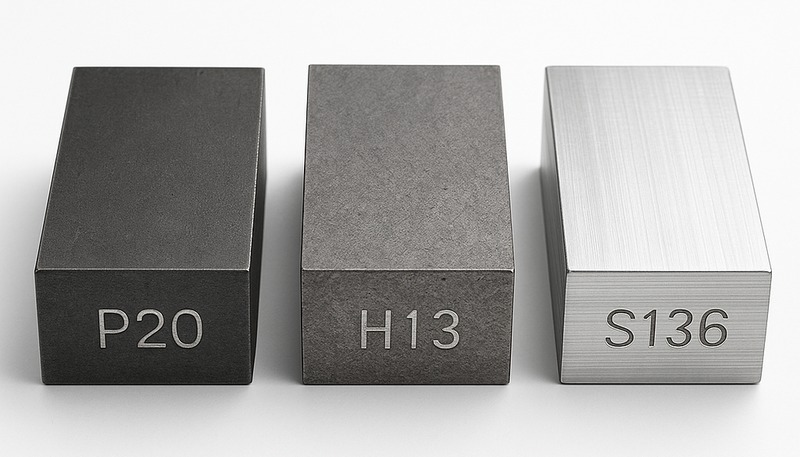
PC requires 80–120°C mold temperature. Cold molds (below 60°C) produce parts with high residual stress, optical haze, and stress cracking tendency in service. Higher mold temperatures improve surface quality and reduce residual stress but extend cooling time. For optical parts, 100–120°C is the standard range.
Can PC be used outdoors without UV stabilizers?
Standard PC yellows under UV exposure within 6–12 months outdoors. UV-stabilized grades with hindered amine light stabilizers (HALS) provide 3–5 years outdoor performance without significant yellowing. For automotive exterior lighting (headlamp lenses, fog covers), UV-stabilized PC is mandatory per OEM specifications.
What is the difference between PC and PC/ABS blend?
Neat PC provides maximum impact strength (>800 J/m) and transparency (~90%). PC/ABS blends sacrifice transparency for lower processing temperature (240–260°C vs. 280–320°C), better flow, and lower cost. For opaque structural parts where maximum impact is needed but transparency is not required, PC/ABS is typically preferred on cost and processability grounds.
Can PC be regrinded and reprocessed?
PC can be reprocessed with up to 20–25% regrind in many applications, but regrind must be re-dried before use. Each processing cycle reduces molecular weight slightly; more than 2–3 reprocessing cycles significantly degrades impact strength. For optical or structural applications, minimize regrind percentage and test impact strength of regrind-containing batches.
Bottom line: PC is the correct choice when you need both optical clarity and impact resistance—no other transparent thermoplastic matches this combination. Dry it at 120°C for 4 hours without compromise; mold at 280–320°C with 80–120°C mold temperature. Avoid applications with solvent or chemical exposure. If transparency is not required, PC/ABS blends provide similar impact at lower processing difficulty and cost. If chemical resistance is required, switch to PPS or PEEK.
Planning a PC injection molding program? Contact us for a material and process review, or explore our spuitgieten3 services for engineering thermoplastic expertise.
-
PC injection molding: The process of melting polycarbonate resin and injecting it under pressure into a closed mold cavity. PC is an amorphous engineering thermoplastic with exceptional impact strength and optical clarity, used for lenses, automotive covers, electronics housings, and medical devices. ↩
-
mold design for PC: PC’s amorphous structure and high melt temperature require specific tooling considerations: gate sizing to avoid shear overheating, mold temperature control at 80–120°C, and uniform cooling to minimize residual stress and optical distortion in transparent parts. ↩
-
PC/ABS blend: A polymer alloy combining polycarbonate and acrylonitrile-butadiene-styrene at ratios of 60–70% PC. PC/ABS blends process at 240–260°C (lower than neat PC), provide notched Izod impact of 400–700 J/m, and are used in opaque automotive and electronics housings where PC transparency is not required. ↩




 EN
EN  ES
ES  FR
FR  DE
DE  PT
PT  AR
AR  RU
RU  JA
JA  KO
KO  IT
IT  NL
NL  TR
TR  PL
PL 