 Overslaan naar inhoud

- Processelectie engineering review
- Injection molding tooling costs $5,000–$100,000 while extrusion dies cost $500–$5,000 — a 10–20× difference.
- Extrusion production rates are 10–200 kg/hour continuously; injection molding cycles 10–120 seconds per shot with pauses between.
- Injection molding achieves ±0.05 mm tolerances; extrusion achieves ±0.1–0.5 mm due to die swell and cooling variation.
- Injection molding handles complex 3D geometries; extrusion is limited to constant cross-sections but excels at long lengths.
- Both processes use the same thermoplastic materials, but extrusion requires higher melt flow index grades for consistent draw.
What Is the Core Difference Between Injection Molding and Extrusion?
The core difference is that injection molding makes discrete 3D parts, while extrusion makes continuous constant-section profiles. Injection molding and extrusie1 differ fundamentally in how they shape plastic: injection molding forces molten plastic into a closed mold cavity under pressure of 500–2,000 bar to produce discrete three-dimensional parts, while extrusion pushes molten plastic continuously through an open die under pressure of 100–400 bar to produce profiles of constant cross-section that are cut to length. Injection molding is cyclic and batch-based; extrusion is continuous and length-based.
Bij ZetarMold bedienen we zowel spuitgiet- als extrusieapparatuur, en we helpen klanten regelmatig bepalen welk proces geschikt is voor hun toepassing. De meest voorkomende vraag is: ‘Kan dit onderdeel worden geëxtrudeerd in plaats van gespoten om gereedschapskosten te besparen?’ Het antwoord hangt af van of het onderdeel een constante doorsnede heeft en of de geometrie kan worden weergegeven als een 2D-profiel dat door de ruimte wordt getrokken. Zo ja, dan is extrusie het overwegen waard. Als het onderdeel een variabele doorsnede, verstevigingen, ribben of driedimensionale kenmerken heeft, is spuitgieten de enige haalbare optie.
For a broader process baseline, use our injection molding complete guide. For tooling-specific decisions such as cavity layout, cooling, draft, and manufacturability, compare this article with the injection mold complete guide.
Related engineering references: schroef spuitgietmachine behavior affects melt preparation, while productietijd spuitgieten determines whether cyclic molding can compete with continuous extrusion.
At ZetarMold, our factory in Shanghai runs 47 injection molding machines from 90T to 1850T. For parts that could be molded or extruded, our engineers review geometry, wall sections, tooling risk, and expected volume before recommending a process.
How Do Injection Molding and Extrusion Work?
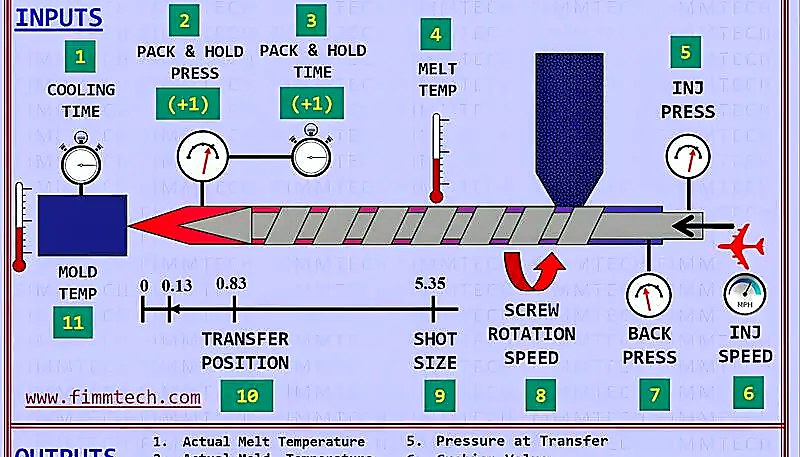
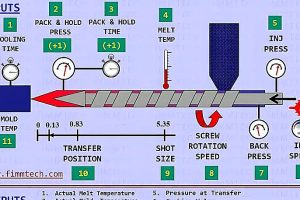
Injection molding is a cyclic shot process, while extrusion is a continuous die process. Injection molding works in measured cycles, while extrusion works as a continuous line. In injection molding, a reciprocating screw both melts and injects the plastic; the screw design2 controls melting stability and shot consistency. The screw rotates to plasticize and accumulate a measured shot of molten material in front of the screw tip, then translates axially like a plunger to inject the shot into the closed mold. The mold is water-cooled, and the part solidifies in 5–40 seconds before the mold opens and the part is ejected. The screw then begins the next plasticizing cycle.
In extrusion, a continuously rotating screw conveys, melts, and pressurizes plastic against the closed end of a barrel where the die is attached. The die shapes the continuous melt stream into the desired cross-section profile. Immediately after exiting the die, the extrudate passes through a calibration die (sizer) and cooling tank that solidify and dimensionally stabilize the profile. A haul-off unit pulls the profile at a controlled speed, and a cutting saw or flying shear cuts it to the specified length.
The key operational difference is that injection molding is intermittent — the machine cycles on/off with each shot — while extrusion runs continuously at steady state. Extrusion achieves maximum efficiency after a 20–45 minute startup period when barrel and die temperatures stabilize. Any process interruption (material change, die cleaning, line stoppage) requires a full restart sequence, making short production runs less efficient for extrusion than for injection molding.
How Do Dies and Molds Differ in Tooling Cost?
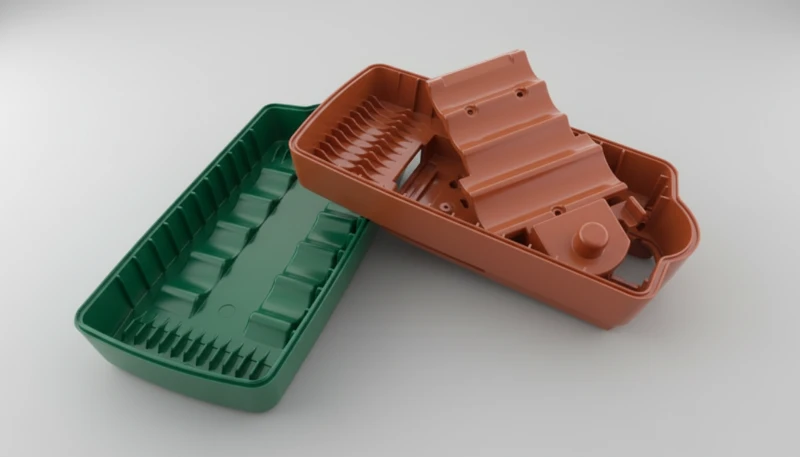
Extrusion dies are cheaper because they shape one open cross-section instead of a closed 3D mold cavity. Extrusion dies usually cost less because they shape one continuous cross-section instead of a closed 3D cavity. Extrusion tooling cost is dramatically lower than injection mold tooling cost. A simple extrusion die for a standard structural profile costs $500–$3,000. A complex co-extrusion die with multiple material channels costs $3,000–$8,000. Injection molds for comparable parts cost $5,000–$100,000 because the mold must withstand injection pressures of 500–2,000 bar (versus 100–400 bar for extrusion), require complex cavity and core machining, and must incorporate cooling channels, ejection systems, and gate/runner geometry.
Extrusion die lead time is also shorter: a standard profile die can be designed and machined in 2–4 weeks versus 4–12 weeks for an injection mold. This makes extrusion more accessible for product development and shorter product lifecycles. However, extrusion dies are not interchangeable between cross-sections — each profile requires its own dedicated die, so a product line with 10 different profile sizes requires 10 separate dies.
Die correction is a critical aspect of extrusion tooling. Due to die swell (the tendency of extruded material to expand as it exits the die due to elastic recovery of the polymer melt), the die opening must be intentionally undersized — typically 5–20% smaller than the target profile dimensions — to compensate. Getting the die dimensions correct often requires 2–3 trial iterations, adding 1–2 weeks and $500–$2,000 in adjustment costs. In contrast, injection mold corrections for shrinkage are performed once during mold qualification and rarely require repeated iteration.
“Extrusiematrijsgereedschap kost 10–20× minder dan spuitgietgereedschap voor vergelijkbare onderdeeldoorsneden.”Echt
Een eenvoudige extrusiematrijs voor een rechthoekig hol profiel kost $1.000–$3.000 en kan in 2–3 weken worden vervaardigd. Een spuitgietmatrijs voor een onderdeel met een vergelijkbare doorsnede maar zelfs bescheiden 3D-kenmerken (ribben, verstevigingen, montagegaten) kost $10.000–$30.000 en vereist 6–10 weken. Dit 10–20× kostenverschil betekent dat extrusie sterk de voorkeur heeft voor onderdelen met constante doorsnede die in elk volume worden geproduceerd, terwijl de investering in spuitgietgereedschap alleen gerechtvaardigd is wanneer de onderdeelgeometrie dit vereist.
“Extrusie kan dezelfde dimensionale toleranties bereiken als spuitgieten voor kunststofonderdelen.”Vals
Extrusion achieves ±0.1–0.5 mm tolerances for standard profiles, compared to ±0.05–0.15 mm for injection molding. The dimensional variation in extrusion arises from die swell variability (which changes with melt temperature, screw speed, and haul-off rate), cooling shrinkage in the sizer, and tension variation in the haul-off unit. Tight-tolerance extrusion for profiles requiring ±0.05 mm requires precision calibrated sizing dies, temperature-controlled water tanks, and servo-controlled haul-off systems — all of which significantly increase cost. Injection molding inherently produces tighter dimensional control because the material solidifies in a dimensionally fixed steel cavity.
For injection mold design decisions that account for the process comparison with extrusion, our injection mold design team documents the design rationale when a customer could potentially use either process. This prevents later second-guessing and ensures the tooling investment is justified by the part geometry requirements.
Maintenance requirements also differ significantly. Injection molds require regular preventive maintenance every 50,000–100,000 cycles including cavity polishing, ejector pin lubrication, water channel inspection, and parting surface reconditioning. Extrusion dies require periodic disassembly and cleaning — typically every 2–4 weeks of continuous production — to remove degraded material and carbon deposits from the die land. The annual maintenance cost for a production injection mold is typically $1,000–$5,000, while an extrusion die costs $200–$800 per year to maintain. This maintenance cost difference is another factor in the lifecycle economic comparison.

What Product Geometry Fits Each Process?
The best geometry is constant cross-section for extrusion and variable 3D geometry for injection molding. Extrusion fits constant-cross-section products, while injection molding fits three-dimensional parts with changing features. Extrusion can produce any product that has a constant cross-section along its length: pipes, tubes, rods, channels, angles, sheets, films, window profiles, cable insulation, and weatherstripping. The cross-section can be extremely complex — hollow multi-chamber profiles for window frames can have dozens of internal cavities — but the same cross-section must be maintained throughout the entire length. Any lengthwise variation, including tapers, steps, or branches, is impossible in standard extrusion.
Injection molding can produce virtually any three-dimensional geometry within the constraints of mold draft, wall thickness uniformity, and undercut management. Parts can have ribs, bosses, threads, snap-fits, living hinges, overmolded inserts, and varying cross-sections in all three axes. This geometric freedom makes injection molding the dominant process for consumer electronics enclosures, automotive components, medical devices, and industrial hardware.
De sleutelvraag bij het evalueren van een nieuw onderdeelontwerp is: ‘Heeft dit onderdeel op elk punt langs één as dezelfde doorsnede?’ Als het antwoord ja is, moet extrusie worden geëvalueerd. Als het onderdeel driedimensionale kenmerken heeft — zelfs een enkel montagegat of lipje — kan extrusie alleen het niet produceren, en zijn spuitgieten of secundaire bewerkingsbewerkingen vereist.
Profiles produced by extrusion can be post-machined (drilling, cutting, punching) to add three-dimensional features after extrusion. This hybrid approach — extrude the profile, then machine features — is common for aluminum extrusion and is applicable to rigid plastic profiles as well. For low-volume production of parts with primarily prismatic geometry plus a few discrete features, this can be more economical than injection molding if feature count is low (fewer than 5–10 secondary operations).
“Extrusie is het superieure proces voor buizen, profielen en platen omdat het deze geometrieën continu produceert tegen lagere kosten dan spuitgieten.”Echt
A 3-meter pipe cannot be injection molded because no mold could be opened around a 3-meter tubular part without mechanical impossibility. Extrusion produces pipes in continuous lengths that are cut to specification, at production rates of 10–100 kg/hour, with tooling costing $500–$3,000. An equivalent injection mold for 3-meter pipe sections would cost $50,000+ for the tooling alone and would still require post-mold welding to join sections. For all constant-cross-section, length-dominant products, extrusion has no viable alternative.
“Spuitgieten is altijd preciezer en consistenter dan extrusie omdat het een gesloten matrijs gebruikt.”Vals
While injection molding achieves tighter dimensional tolerances on 3D part features, extrusion can achieve excellent consistency for its specific dimensional parameters (cross-section shape and wall thickness) when properly controlled. Modern extrusion lines with laser measurement gauges and closed-loop diameter control maintain pipe and tube wall thickness to ±0.05 mm continuously. The closed mold advantage of injection molding applies to 3D features and complex geometry; for simple cross-sectional dimensions of long profiles, extrusion with inline measurement is highly capable.
How Do Materials Differ Between Injection Molding and Extrusion?
Both processes can run many of the same polymer families, but the best resin grade and melt-flow target are different. Both injection molding and extrusion process the same classes of thermoplastics — PE, PP, PVC, ABS, PC, nylon, and engineering polymers. However, the ideal material grade differs between processes. Extrusion uses higher melt flow index3 (MFI) grades that flow more easily under lower pressure, while injection molding uses lower MFI grades with higher molecular weight that pack and hold better under high pressure.
PVC is a particularly interesting case. PVC can be extruded into pipes, profiles, and cable insulation — it is one of the most common extrusion materials globally. However, PVC is also injection molded for fittings, valves, and connectors. The key difference is that extrusion-grade PVC has higher plasticizer content and different stabilizer packages than injection molding grade PVC. Using the wrong grade in the wrong process causes degradation, discoloration, or poor mechanical properties.
High-temperature polymers like PEEK and PPS are processed in both machines, but extrusion is more common for PEEK rods, sheets, and semi-finished stock used in subsequent CNC machining. For PEEK medical implants and semiconductor components, injection molding is used when the complex 3D geometry justifies the tooling investment. The choice of process is driven by part geometry, not material compatibility.
Production Volume Economics: When Does Each Process Win?
De economische winnaar is het proces dat overeenkomt met de onderdeelgeometrie voordat de gereedschapskosten worden vergeleken. Extrusie wint wanneer het product lengtedominant en constant in doorsnede is; spuitgieten wint wanneer 3D-geometrie de gereedschapsinvestering rechtvaardigt. De economische vergelijking tussen spuitgieten en extrusie hangt af van onderdeelgeometrie, productievolume en de aard van de dimensionale eisen van het product. Voor producten met constante doorsnede wint extrusie op gereedschapskosten en productiesnelheid bij vrijwel elk volume. Voor driedimensionale onderdelen die toevallig prismatische geometrie hebben, is de vergelijking genuanceerder.
| Factor | Spuitgieten | Extrusie |
|---|---|---|
| Onderdeelgeometrie | 3D, variable cross-section | Constant cross-section only |
| Kosten gereedschap | $5,000–$100,000 | $500–$5,000 |
| Doorlooptijd | 4–12 weeks | 2–4 weeks |
| Production Rate | Geëxtrudeerde siliconen profielen met verschillende dwarsdoorsneden | 10–200 kg/hour continuous |
| Maattolerantie | ±0.05–0.2 mm | ±0.1–0.5 mm |
| Max Part Length | ~1,200 mm | Unlimited |
| Materiaal Afval | 3–25% (cold runner) | <1% (alleen trimmen) |
| Tooling Flexibility | Fixed geometry | Die swap in 2–4 hours |
For products like pipe fittings (elbows, tees, couplings), injection molding is used even though the related straight pipe is extruded, because the three-dimensional shape of the fitting cannot be extruded. Entire piping systems combine extruded pipe (PE, PVC, PP) with injection molded fittings — the two processes complement each other rather than compete.
When customers ask about alternatives to injection molding for cost reduction, low-volume injection molding in aluminum tooling is often the answer, not extrusion, because the part geometry already requires three-dimensional features. Extrusion substitution only applies when the part design can be simplified to a constant cross-section, which usually requires redesigning the part — a significant engineering investment that may or may not be justified.
Material changeover is significantly faster in extrusion than in injection molding. A die swap on an extrusion line takes 2–4 hours versus 4–8 hours for a mold change on an injection molding machine. This makes extrusion more flexible for production scheduling when multiple profile geometries share the same material and machine. However, material changes within the same die setup require a full purge of the extruder barrel — typically 5–15 minutes and 2–5 kg of material — which is comparable to injection molding purge times.
Post-processing requirements differ between the two processes. Injection molded parts typically require only gate trimming and inspection after molding — no additional operations for dimensional stabilization. Extruded profiles often require an additional annealing step (heating to 50–80% of the glass transition temperature and slow cooling) to relieve residual stresses from the drawing process, particularly for thick-wall profiles in crystalline polymers like PA and POM. This annealing step adds 1–4 hours of production time per batch.
What Quality Issues Differ Between Injection Molding and Extrusion?
The quality risk is different: molding defects come from cyclic filling, and extrusion defects come from die flow. Injection molding quality risk comes from cyclic mold filling, while extrusion quality risk comes from continuous die flow and puller control. Injection molding defects — sink marks, weld lines, warpage, short shots, and flash — arise from the cyclic, high-pressure filling process and are addressed through mold design and process optimization. Extrusion defects — melt fracture, die lines, wall thickness variation, warped profiles, and surface roughness — arise from the continuous flow process and are addressed through die geometry, temperature control, and haul-off speed.
Melt fracture is the most severe extrusion defect, appearing as a rough, irregular surface on the extrudate. It occurs when the shear rate at the die lip exceeds a critical value for the material, causing the melt to fracture rather than flow smoothly. Solutions include increasing die temperature (reduces viscosity), adding processing aids (slip agents), or redesigning the die entry angle to reduce shear concentration. Melt fracture has no direct equivalent in injection molding because the flow path is shorter and the high-pressure injection can overcome localized viscosity.
For applications requiring the highest surface quality, injection molding generally has the advantage because the mold surface finish is directly replicated on the part — a mirror-polished cavity produces a mirror-finish part. Extrusion surface quality is limited by die condition and the post-die cooling process; achieving SPI A1 optical quality in extrusion requires extremely tight process control and is not standard practice.
When Should You Combine Injection Molding and Extrusion?
A hybrid approach is best when long profiles need molded connectors, caps, or mounting features. Use both processes when the product needs long constant profiles plus molded connectors, caps, or mounting features. Many product assemblies use both injection molding and extrusion in the same product. Window frame assemblies use extruded PVC profiles for the main frame members and injection molded corner pieces and hardware. Automotive trim assemblies use extruded sealing profiles with injection molded end caps. Medical device handles use extruded tubing with injection molded connectors and ports.
Insert extrusion — pushing extrusion compound over a pre-placed continuous element such as a wire, rope, or substrate — creates composite products that combine the structural advantages of the core with the protective or functional properties of the extruded jacket. Cable insulation is the most common example. This is fundamentally different from insert molding (placing discrete inserts in an injection mold cavity), but both serve the purpose of combining materials in a single manufacturing step.
For product development teams choosing between processes, our recommendation is to evaluate geometry first, then volume, then tooling cost. Geometry is the primary driver: if the part has constant cross-section, evaluate extrusion first. If not, injection molding is typically required. Volume and cost analysis then determine whether aluminum rapid tooling or full-production injection molds make sense for the intended production lifecycle. Our analyse van de matrijsstroming service helps validate injection molding decisions before tooling is committed.

Veelgestelde vragen
Can the same plastic material be used in both injection molding and extrusion?
Yes, the same polymer family can be used in both processes, but the specific grade usually differs. Extrusion requires higher melt flow index (MFI) grades — typically 2–10 g/10 min for general extrusion — because the plastic must flow steadily at lower pressures (100–400 bar) through a continuous die. Injection molding uses lower MFI grades — typically 0.5–5 g/10 min for structural parts — because higher molecular weight provides better packing, less shrinkage, and stronger mechanical properties under the higher pressures (500–2,000 bar) used. Using an injection molding grade in extrusion causes excessive die pressure and may stall the extruder. Using an extrusion grade in injection molding causes excessive flash and poor dimensional control. Material suppliers provide process-specific grade recommendations.
Why is extrusion not used for making complex plastic parts?
Extrusion cannot make complex plastic parts because the process inherently produces a constant cross-section. The plastic melt is pushed through a fixed die opening, so the shape of the product cross-section is identical at every point along its length. Any feature that varies along the length — ribs, bosses, mounting holes, taper, steps, branches — is impossible to produce by extrusion alone. These features require either a closed mold (injection molding) or secondary machining operations after extrusion. Additionally, the continuous nature of extrusion means that the start and end of each extruded part are identical — there is no way to form a closed end, a lid, or a flange feature that is part of the same extrusion run.
What is the main advantage of extrusion over injection molding?
The main advantage of extrusion over injection molding is significantly lower tooling cost combined with unlimited part length capability. An extrusion die for a standard profile costs $500–$3,000, while an equivalent injection mold costs 10–20× more. For products like pipes, tubes, weatherstripping, channels, and sheets that have constant cross-section, extrusion produces these continuously at 10–200 kg/hour with minimal waste. No injection mold could produce a 6-meter pipe or a continuous roll of sheet material. Extrusion also has faster tooling lead times (2–4 weeks) and lower production startup costs, making it ideal for new product introductions where volume is uncertain.
How do tolerances compare between injection molding and extrusion?
Injection molding achieves tighter tolerances than extrusion for dimensional features of the same plastic material. Injection molded parts in amorphous materials like ABS can achieve ±0.05 mm on small features, because the material solidifies in a dimensionally fixed steel cavity. Extruded profiles achieve ±0.1–0.5 mm on cross-sectional dimensions under standard conditions. The wider tolerance band in extrusion comes from die swell variability (the material expands after leaving the die), cooling shrinkage in the sizer, and draw ratio4 variation.
Modern extrusion lines with inline laser measurement and closed-loop control can achieve ±0.05 mm on specific dimensions like pipe outer diameter, but this requires precision equipment and adds cost. For complex 3D part features like thread pitch, boss height, or snap-fit deflection, injection molding is always superior.
Is injection molding or extrusion more environmentally friendly?
Beide processen hebben vergelijkbare milieuprofielen wanneer ze op basis van materiaalgebruik worden geëvalueerd, maar ze verschillen in specifieke categorieën. Extrusie heeft minder materiaalafval dan koude-loopspuitgieten — typisch minder dan 1% trimafval versus 5–25% loopafval. Hot-runner spuitgieten elimineert echter loopafval en benadert de materiaalefficiëntie van extrusie. Het energieverbruik per kilogram verwerkt kunststof is voor beide vergelijkbaar (3–8 kWh/kg), hoewel extrusie efficiënter draait in stabiele toestand. Voor recyclebaarheid zijn geëxtrudeerde profielen van één materiaal (buis, pijp) gemakkelijker te recyclen dan gespoten meervoudige assemblages. De belangrijkste milieufactor voor beide processen is de materiaalkeuze, niet het proces zelf — bio-gebaseerde en gerecyclede kunststoffen kunnen in beide worden verwerkt.
When should I choose injection molding over extrusion for a new product?
Choose injection molding over extrusion when your part has any of these characteristics: three-dimensional geometry with features that vary along the part length (ribs, bosses, holes, flanges, snap-fits), tight dimensional tolerances of ±0.05–0.15 mm on multiple features, a closed or complex geometry that cannot be defined by a constant 2D cross-section, a need for integrated fastening features like bosses, threads, and living hinges, or production volumes high enough to amortize $5,000–$100,000 tooling cost. Injection molding is also preferred when surface finish quality requires replication of a polished mold surface, when multiple materials need to be combined in a single part (insert molding, overmolding), or when precise shot-to-shot weight control is critical for medical or food-contact applications.
-
extrusie: Extrusion is a continuous manufacturing process in which molten thermoplastic is forced through a shaped die opening to produce profiles, pipes, sheets, or films of constant cross-section, measured in linear meters per minute. ↩
-
screw design: Screw design refers to the geometry of the rotating screw inside the barrel of an injection molding or extrusion machine, defined by parameters including L/D ratio (length-to-diameter), compression ratio, and flight geometry, which determine melting efficiency and melt uniformity. ↩
-
melt flow index: Melt flow index (MFI) is a measure of the ease of flow of a molten thermoplastic polymer, defined as the mass of polymer that flows through a standard orifice in 10 minutes under a specified load and temperature, expressed in g/10 min. ↩
-
draw ratio: Draw ratio is a measure of the degree of stretching in extrusion, defined as the ratio of die opening area to final product cross-sectional area, typically between 1.1 and 5.0, which determines molecular orientation and dimensional control in extruded products. ↩


 EN
EN  ES
ES  FR
FR  DE
DE  PT
PT  AR
AR  RU
RU  JA
JA  KO
KO  IT
IT  NL
NL  TR
TR  PL
PL 