콘텐츠로 건너뛰기
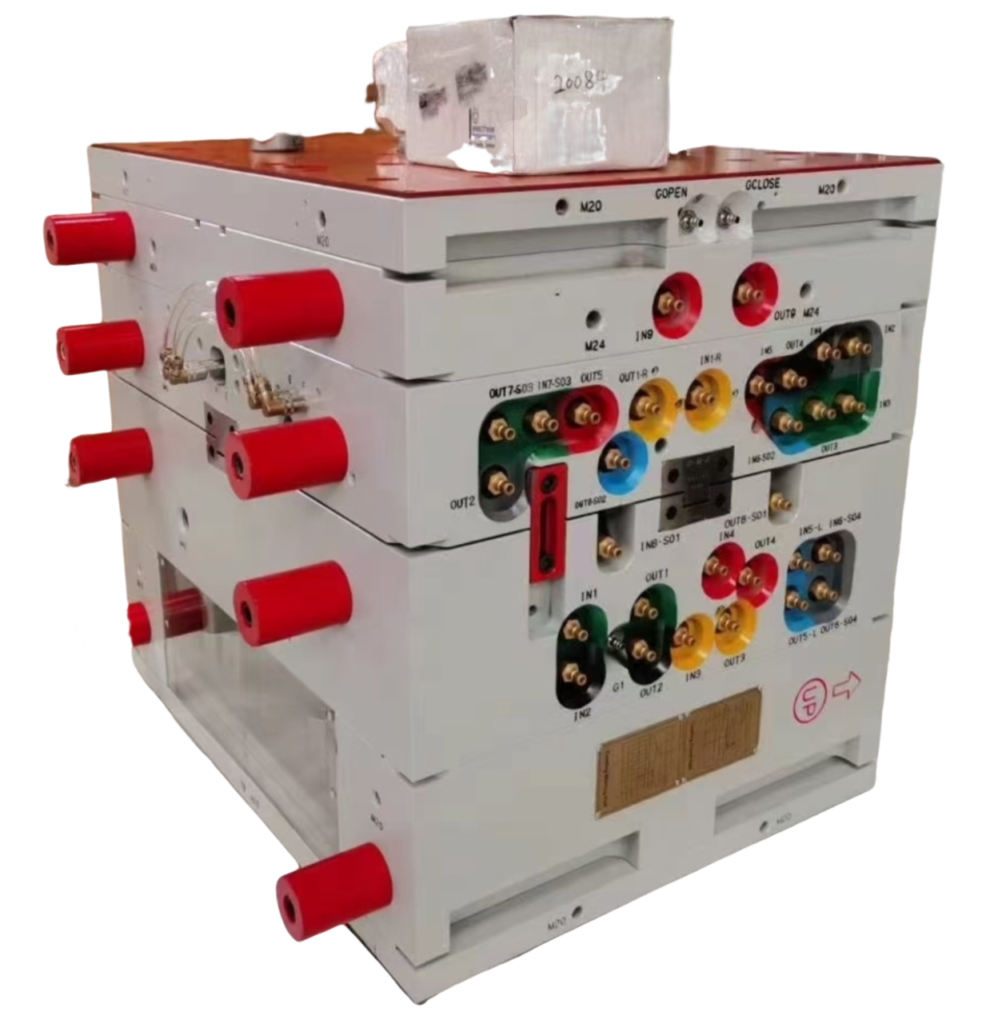
What Is POM Injection Molding and Why Is It So Widely Used?
- POM(폴리옥시메틸렌)은 정밀 부품에 이상적인 낮은 마찰 계수와 높은 강성을 가진 엔지니어링 열가소성 수지입니다.
- 균일중합체 POM은 더 높은 강도를 제공하며, 공중합체 POM은 더 나은 열 안정성으로 더 쉽게 가공됩니다.
- 포름알데히드 가스 발생과 부품 결함을 방지하기 위해 배럴 온도를 220°C 이하로 유지하세요.
- POM의 1.8–2.5% 수축률을 관리하기 위해 균일한 1.0–3.5 mm 벽 두께로 설계하세요.
- POM의 자연적인 윤활성은 자체 윤활 기어와 베어링에 최상의 선택입니다.
POM 사출 성형은 폴리옥시메틸렌을 성형하는 과정입니다. engineering thermoplastic1정밀 부품으로 변환합니다. 우리는 POM을 더 낮은 무게에서 금속과 같은 강성을 가진 '금속 대체 플라스틱'이라고 부릅니다.
If you are comparing vendors or planning procurement, our injection molding supplier sourcing guide covers RFQ prep, qualification, and commercial risk checks.
POM comes in two main types: homopolymer (such as DuPont’s Delrin) and copolymer (such as Celanese’s Celcon or BASF’s Ultraform). Homopolymer POM offers slightly higher mechanical strength and stiffness, while copolymer POM provides better thermal stability and easier processing with less centerline porosity.
The global demand for POM injection molded parts continues to grow, driven by the automotive industry’s push for lighter components and the electronics sector’s need for dimensionally stable housings. POM’s self-lubricating properties make it ideal for moving parts that would otherwise require metal-to-metal contact with added lubricants.
What Are the Key Properties That Make POM Ideal for Injection Molding?
POM을 사출 성형에 이상적으로 만드는 주요 특성은 이 섹션에서 설명하는 주요 범주 또는 옵션입니다. POM은 이상적입니다. 사출 성형 높은 인장 강도(65–70 MPa), 낮은 마찰 계수(0.20–0.35), 우수한 creep resistance2, 그리고 최소한의 수분 흡수율을 갖추고 있어 우리가 가공하는 가장 다재다능한 엔지니어링 플라스틱 중 하나입니다.
| 속성 | POM Homopolymer | POM Copolymer | 단위 |
|---|---|---|---|
| 인장 강도 | 65–70 | 58–65 | MPa |
| 굴곡 탄성 계수 | 2,800–3,200 | 2,500–2,900 | MPa |
| 휴식 시 신장 | 25–45 | 40–75 | % |
| Impact Strength (Izod, notched) | 65–80 | 50–65 | J/m |
| 녹는점 | 175 | 165 | °C |
| HDT at 1.8 MPa | 110 | 100 | °C |
| Coefficient of Friction | 0.20–0.35 | 0.25–0.38 | - |
| 곰팡이 수축3 | 1.8–2.5 | 1.8–2.2 | % |
| Water Absorption (24h) | 0.20 | 0.22 | % |
POM을 차별화하는 한 가지 특성은 크리프 저항성입니다. 지속적인 하중 아래 변형되는 많은 플라스틱과 달리, POM은 고온에서도 지속적인 응력 하에서 형태를 유지합니다. 우리는 하중 아래 10,000시간 이상 작동하는 POM 기어를 0.3 mm 미만의 치수 변화로 테스트했습니다.
“POM의 낮은 수분 흡수율은 정밀 부품용으로 가장 치수 안정성이 뛰어난 플라스틱 중 하나로 만듭니다.”True
With only 0.20% water absorption in 24 hours, POM maintains tight tolerances even in humid environments. This is why it’s the go-to material for precision gears, bearings, and instrument housings.
“POM은 나일론처럼 많은 수분을 흡수하므로, 항상 성형 전 예비 건조가 필요합니다.”False
POM has very low water absorption (0.20–0.22% in 24 hours), far less than nylon’s 1.5–2.8%. While pre-drying at 80°C for 2–4 hours is recommended for optimal surface finish, POM is far less moisture-sensitive than polyamides.
What Are the Optimal Processing Parameters for POM Injection Molding?
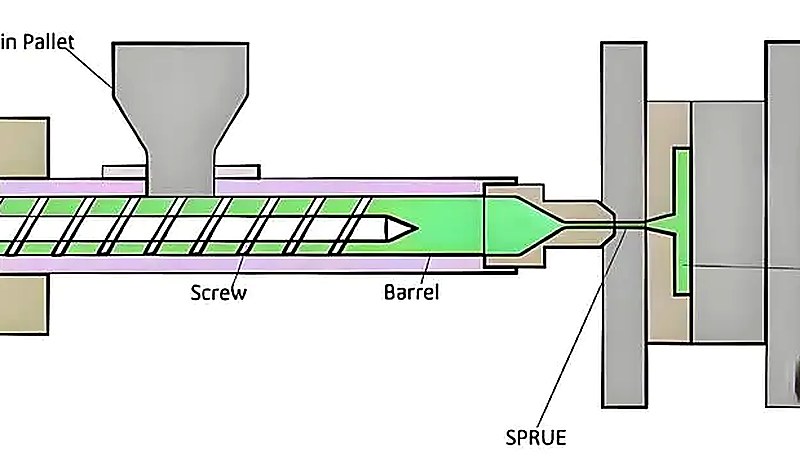
최적의 POM 성형을 위해서는 175~210°C의 배럴 온도, 80~120°C의 금형 온도, 70~120 MPa의 사출 압력이 필요합니다. 이러한 매개변수를 정확히 맞추는 것이 완벽한 부품과 스크랩을 가르는 차이입니다.
| 매개변수 | Homopolymer POM | Copolymer POM | 참고 |
|---|---|---|---|
| Barrel Temp (rear) | 180–190°C | 175–185°C | Avoid exceeding 220°C |
| Barrel Temp (middle) | 190–200°C | 185–195°C | Gradual increase |
| Barrel Temp (front) | 200–210°C | 190–205°C | Nozzle 5°C lower |
| 금형 온도 | 80–120°C | 80–110°C | Higher = better crystallinity |
| 사출 압력 | 80–120 MPa | 70–110 MPa | Adjust for wall thickness |
| 유지 압력 | 50–80% of injection | 50–75% of injection | Critical for shrinkage |
| 사출 속도 | Medium | Medium to medium-high | Too fast causes off-gassing |
| 배압 | 5–15 MPa | 5–10 MPa | Minimize residence time |
| 냉각 시간 | 15–40s | 15–35s | Depends on wall thickness |
| Drying | 80°C / 2–4h | 80°C / 2–4h | Recommended, not critical |
In our experience, the most common mistake with POM is overheating. When POM degrades thermally, it releases formaldehyde gas, which causes bubbles, splay marks, and a pungent smell. We keep barrel temperatures strictly below 220°C and minimize residence time in the barrel to under 5 minutes.
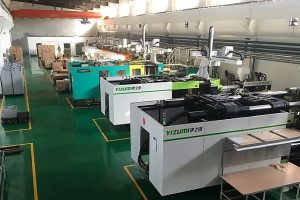
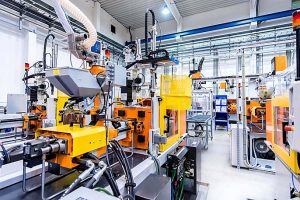
우리 상하이 공장에는 90톤에서 1850톤까지의 47대 사출 성형기가 있으며, 여러 POM 등급을 포함한 400종 이상의 소재를 가공합니다. 이 장비 범위를 통해 우리는 작은 정밀 기어부터 대형 자동차 부품까지 POM 부품을 성형할 수 있습니다.
Mold temperature plays a crucial role in POM part quality. We typically run molds at 90–100°C for most parts. Higher mold temperatures (up to 120°C) improve crystallinity, surface finish, and dimensional stability, but extend cycle time. For gears and precision components, we always go higher.
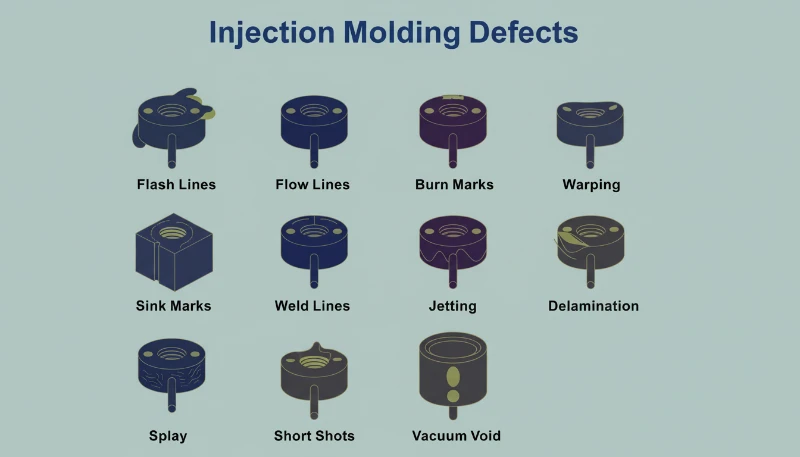
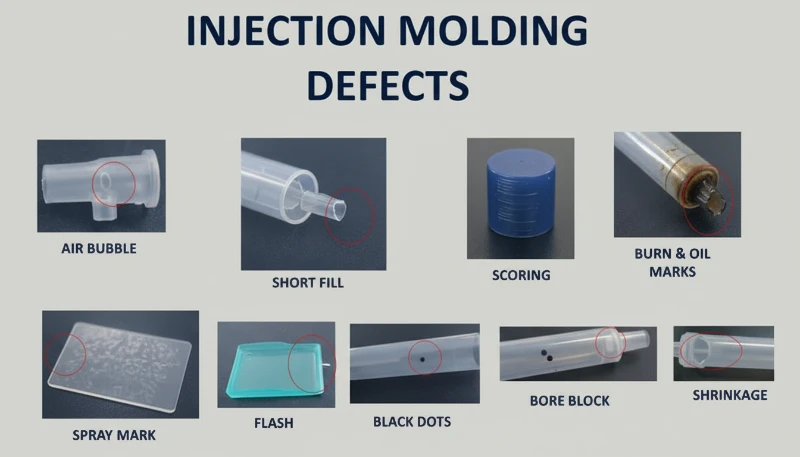
What Are Common POM Injection Molding Defects and How to Solve Them?
가장 흔한 POM 결함은 싱크 마크, 뒤틀림, 중심선 기공, 스플레이입니다. 온도와 압력을 제어하여 예방할 수 있습니다. 아래는 표적 해결책입니다.
| 결함 | Root Cause | 솔루션 |
|---|---|---|
| 싱크 마크 | Insufficient holding pressure; thick sections | Increase holding pressure/time; reduce wall thickness; add coring |
| 뒤틀림 | Uneven cooling; differential shrinkage | Uniform wall thickness; optimize cooling channels; adjust mold temp |
| Centerline Porosity | Thick walls; insufficient packing (homopolymer) | Use copolymer POM; increase holding pressure; reduce wall thickness |
| Splay/Silver Streaks | Moisture; thermal degradation | 우리의 설계 검토에서 POM 부품의 가장 큰 문제는 불균일한 벽 두께입니다. 두꺼운 부분과 얇은 부분이 만날 때, 두꺼운 부분은 더 천천히 냉각되어 차등 수축을 일으킵니다. |
| Formaldehyde Off-gassing | Overheating above 220°C | Reduce barrel temperature; minimize residence time; purge regularly |
| Brittle Parts | Over-crystallization; contamination | Reduce mold temperature; check material purity |
| 플래시 | Excessive injection pressure; worn mold | Reduce pressure; repair mold parting surfaces |
우리가 특히 주의 깊게 살피는 POM 특유의 결함은 중심선 다공성입니다. 이는 주로 두꺼운 단면을 가진 균일중합체 POM 부품에서 발생합니다. 외피가 고화 및 결정화되는 동안 코어는 여전히 용융 상태이며, 코어가 수축하면서 내부에 공극을 생성합니다. 대부분의 경우 공중합체 POM으로 전환하거나 코어 아웃된 단면으로 부품을 재설계하면 이 문제를 해결할 수 있습니다.
What Applications Rely on POM Injection Molded Parts?
POM injection molded parts are found in virtually every industry that demands precision, durability, and low friction. The material’s unique combination of properties makes it irreplaceable in many applications.
Automotive (40% of POM consumption): Fuel system components (fuel sender units, fuel caps), seat belt mechanisms, door lock systems, window regulator gears, HVAC actuator gears, and interior trim clips. We’ve produced fuel rail clips for a major German OEM running 500,000+ cycles without a single failure.
소비자 가전: Keyboard mechanisms, printer gears, fan bearings, zipper sliders, and pen mechanisms. POM’s snap-fit capability and spring-back properties make it perfect for clips and latches in electronic devices.
Industrial: Conveyor chain links, pump impellers, valve bodies, bearing bushings, and spring elements. POM’s fatigue resistance handles millions of load cycles in industrial automation equipment.
“POM의 자연적인 윤활성은 외부 윤활 없이 작동하는 기어와 베어링에 최고의 플라스틱 중 하나입니다.”True
POM has a coefficient of friction of 0.20–0.35, one of the lowest among engineering plastics. POM-on-POM and POM-on-metal contact surfaces perform well without lubrication, making it the material of choice for self-lubricating gears, bearings, and sliding mechanisms.
“POM은 우수한 자외선 저항성을 가지고 있어 실외 적용 분야에 훌륭한 선택입니다.”False
POM has poor UV resistance and degrades when exposed to prolonged sunlight. Outdoor POM parts require UV stabilizer additives or protective coatings. For purely outdoor applications, materials like ASA or UV-stabilized ABS are better choices.
의료 기기: Inhaler mechanisms, insulin pen components, and surgical instrument handles. Medical-grade POM (FDA-compliant copolymer) provides the precision and chemical resistance needed in healthcare.
Plumbing and Hardware: Faucet cartridges, valve stems, tap handles, and pipe fittings. POM’s resistance to hot water (up to 80°C continuous) and cleaning chemicals makes it ideal for plumbing applications.
How Should You Design Parts for POM Injection Molding?
POM 부품의 주요 설계 규칙은 균일한 1.0–3.5 mm 벽, 측면당 0.5°–1.5° 드래프트, 그리고 1.8–2.5% 수축률을 관리하기 위한 50–60% 리브 대 벽 비율입니다. 사출 금형.
| Design Parameter | 권장 값 | Why It Matters |
|---|---|---|
| 벽 두께 | 1.0–3.5 mm (uniform) | Prevents sink marks and centerline porosity |
| 구배 각도 | 0.5°–1.5° per side | POM shrinks onto cores; needs more draft than ABS |
| Rib Thickness | 50–60% of wall | Prevents sink marks on opposite surface |
| 리브 높이 | ≤ 3× wall thickness | Taller ribs are hard to fill and eject |
| Corner Radius | ≥ 0.5 mm (0.25× wall) | Sharp corners cause stress concentration |
| Boss OD | 2× screw diameter | Prevents cracking during screw insertion |
| Snap-Fit Strain | ≤ 4% (single use), ≤ 2% (repeated) | POM’s fatigue limit for living hinges |
| Shrinkage Allowance | 1.8–2.5% (flow), 1.6–2.0% (cross-flow) | Anisotropic shrinkage requires directional compensation |

우리의 설계 검토에서 POM 부품의 가장 큰 문제는 균일하지 않은 벽 두께입니다. 두꺼운 부분과 얇은 부분이 만날 때, 두꺼운 부분은 더 천천히 냉각되어 차등 수축을 일으켜 뒤틀림과 싱크 마크를 초래합니다. 우리는 항상 두꺼운 부분을 코어 아웃하고 전체 부품 전체에서 벽 두께 변동을 ±10% 이내로 유지할 것을 권장합니다.
POM is one of the best plastics for snap-fits and living hinges due to its excellent spring-back properties. However, we recommend limiting strain to 4% for single-use snaps and 2% for repeated assembly/disassembly. For gear teeth, we apply 0.02–0.04 mm per tooth profile compensation for shrinkage to hit AGMA quality grades.
How Does Mold Design Affect POM Part Quality?
POM에 가장 중요한 몰드 설계 요소는 게이트 위치, 균일한 냉각, 환기입니다. POM의 높은 수축률과 포름알데히드 가스 발생은 정밀한 몰드 설계를 필수로 만듭니다.
게이트 디자인: We prefer sub-gate or pin-gate designs for POM parts because they allow automatic degating and leave minimal witness marks. For gears, diaphragm gates provide the most uniform fill and minimize weld lines in the tooth area. Gate size should be 50–70% of wall thickness.
냉각 시스템: Uniform cooling is critical for POM. Temperature variation across the mold surface should stay within ±5°C. We use conformal cooling channels for complex geometries and beryllium copper inserts for areas that need faster heat extraction. For gears, we often use circular cooling channels that follow the gear profile.
환기: POM은 가공 중 포름알데히드 가스를 생성하므로 적절한 환기는 필수입니다. 환기 깊이는 0.01–0.02 mm여야 합니다(POM은 낮은 점도를 가지고 있어 더 깊은 환기에서 플래시가 발생할 수 있습니다). 우리는 모든 용접선 위치와 몰드 흐름 분석을 통해 확인된 마지막 충전 영역에 환기를 배치합니다.
퇴장: POM’s high shrinkage means parts grip tightly onto cores. We design generous draft angles (0.5°–1.5°), use multiple ejector pins distributed evenly, and sometimes apply mold release coatings to core surfaces. For deep-draw parts, air-assisted ejection prevents vacuum lock.
Frequently Asked Questions About POM Injection Molding
Can POM be painted or plated?
POM has very low surface energy, making it difficult to paint or plate without surface treatment. Flame treatment, plasma treatment, or chemical etching can improve adhesion. However, for decorative parts, we usually recommend switching to ABS or PC/ABS, which accept paint and plating much more readily.
What is the difference between POM homopolymer and copolymer?
Homopolymer POM (like Delrin) offers 5–10% higher mechanical strength and stiffness but is more prone to centerline porosity in thick sections and has a narrower processing window. Copolymer POM (like Celcon or Ultraform) processes more easily, has better chemical resistance, and is less likely to degrade thermally. For most applications, we recommend copolymer.
Does POM need to be dried before molding?
POM’s low moisture absorption (0.20%) means drying is recommended but not strictly required for most applications. We pre-dry at 80°C for 2–4 hours as standard practice to ensure optimal surface quality. For critical cosmetic parts, drying is essential.
Is POM FDA-approved for food contact?
Yes, certain copolymer POM grades (such as Celcon M90 and Hostaform C9021) are FDA-compliant for food contact applications. Always verify the specific grade’s FDA status with the resin supplier before production.
What causes the white residue on POM mold surfaces?
The white deposit is formaldehyde and trioxane oligomers released during POM processing. Regular mold cleaning (every 4–8 hours of production), adequate venting, and keeping barrel temperatures below 215°C minimize this buildup. Some shops use mold-cleaning compounds designed specifically for POM residue.
How does POM compare to nylon for gear applications?
POM is generally preferred over nylon for gears because it has lower moisture absorption (0.2% vs. 2.5%), better dimensional stability, lower coefficient of friction, and more consistent mechanical properties across humidity ranges. Nylon offers higher impact strength and better high-temperature performance. For gears running in wet or humid environments, POM is the clear winner.
What Are the Key Takeaways for POM Injection Molding?
POM injection molding is a proven manufacturing process for producing high-precision, low-friction, and dimensionally stable plastic parts. Whether you’re designing gears for an automotive transmission or clips for consumer electronics, POM delivers the mechanical performance of metal at a fraction of the cost and weight. The keys to success are controlling processing temperatures below 220°C, designing for uniform wall thickness to manage 1.8–2.5% shrinkage, and ensuring adequate mold venting to handle formaldehyde off-gassing.
ZetarMold에서는 20년 이상 자동차, 산업 및 소비자 응용 분야에 걸쳐 POM을 가공해 왔습니다. 우리 팀은 DFM 검토 및 금형 설계부터 대량 생산 및 품질 검사까지 모든 것을 처리합니다. POM 사출 성형 부품이 필요한 프로젝트를 진행 중이라면, 무료 DFM 검토 및 견적을 위해 우리 엔지니어링 팀에 문의하십시오. 포괄적인 개요는 우리의 사출 성형 완전 가이드를 참조하세요.
사출 성형 프로젝트 견적 요청하기
Get competitive pricing, DFM feedback, and production timeline from ZetarMold’s engineering team.
Request a Free Quote →


 EN
EN  ES
ES  FR
FR  DE
DE  PT
PT  AR
AR  RU
RU  JA
JA  KO
KO  IT
IT  NL
NL  TR
TR  PL
PL