PA6, PA66, PA12 y PA1010 son los cuatro grados de nailon más comúnmente moldeados por inyección, cada uno con distintas absorción de humedad, resistencia a la temperatura y propiedades mecánicas que los hacen adecuados para diferentes aplicaciones. Elegir el grado incorrecto genera inestabilidad dimensional, fallas frágiles o costos innecesarios. Esta guía compara los cuatro grados uno al lado del otro para que pueda especificar el material adecuado para su proyecto de moldeo por inyección.
Para obtener información sobre el material, compare referencias externas sobre poliamida, Nylon 6 y Nylon 66 con la ficha de datos de secado de su proveedor. Estas referencias son útiles para la terminología, pero la ventana de procesamiento final debe confirmarse según el grado de la resina, la prueba de humedad, la temperatura del molde y los resultados de las inyecciones de prueba.
La planificación del proceso también debe conectar la selección del nailon con el comportamiento de la máquina y el molde. Revise la recuperación del tornillo y el tiempo de residencia con la configuración de recuperación del tornillo y tiempo de residencia, compare el impacto del enfriamiento mediante análisis del tiempo de producción y verifique el riesgo dimensional mediante análisis de contracción del molde antes de la aprobación de producción.
- PA66 ofrece la mayor rigidez y resistencia a la temperatura entre los cuatro grados, lo que lo convierte en la opción predeterminada para aplicaciones automotrices y eléctricas
- El PA6 absorbe más humedad que el PA66 pero cuesta un 15-25% menos y se procesa a temperaturas más bajas, ideal para piezas de consumo e industriales
- El PA12 tiene la menor absorción de humedad (0.25%), lo que permite una estabilidad dimensional de tolerancia estrecha en ambientes húmedos
- PA1010 ofrece la mejor resistencia química y flexibilidad, derivada de materia prima renovable de aceite de ricino
- Los cuatro grados requieren un secado exhaustivo (80-120°C, 4-8 horas) antes del moldeo para evitar deslaminación y degradación hidrolítica
¿Qué son los grados de nailon PA6, PA66, PA12 y PA1010?
PA6, PA66, PA12 y PA1010 son cuatro grados de poliamida semicristalina diseñados para diferentes condiciones térmicas, mecánicas y de humedad. Para comparar proveedores y planificar adquisiciones, nuestra guía de abastecimiento de proveedores de moldeo por inyección cubre la preparación de RFQ, la calificación y las verificaciones de riesgos comerciales.
Los grados de nailon son termoplásticos de ingeniería semicristalinos. La poliamida (nailon) se caracteriza por fuertes enlaces de hidrógeno entre grupos amida en cadenas poliméricas adyacentes. Este enlace intermolecular le da al nailon su combinación característica de alta resistencia, tenacidad y resistencia a la abrasión. El número en cada nombre de grado indica la cantidad de átomos de carbono en el monómero, lo que afecta directamente la cristalinidad, el punto de fusión y el comportamiento de absorción de humedad.
Comprensión de las familias termoplásticas de poliamida
El PA6 (poliamida 6) se produce mediante polimerización por apertura de anillo de la caprolactama, un monómero de seis carbonos. Se funde a aproximadamente 220°C y ofrece buenas propiedades mecánicas a un costo moderado. El PA6 cristaliza a un ritmo más lento que el PA66, lo que da tiempos de ciclo ligeramente más largos pero reduce el riesgo de deformación en geometrías complejas. El PA6 es el grado de nylon más moldeado a nivel mundial por volumen, utilizado en todo desde bridas para cables hasta colectores de admisión automotrices.
PA66: Nailon de ingeniería de alta rigidez
PA66 (poliamida 6,6) se produce por policondensación de hexametilendiamina y ácido adípico, ambos monómeros de seis carbonos. La estructura molecular simétrica produce una mayor cristalinidad y un punto de fusión más alto de aproximadamente 260°C. El PA66 es aproximadamente un 15 a 20 por ciento más rígido que el PA6 a temperatura ambiente y retiene mejor las propiedades mecánicas a temperaturas elevadas que cualquier grado de nailon sin relleno. Esto hace del PA66 la elección estándar para componentes automotrices bajo el capó y conectores eléctricos que operan por encima de 120°C.
PA12: Nylon de Precisión con Baja Humedad
PA12 (poliamida 12) se produce a partir de laurolactama, un monómero de doce carbonos. La cadena alifática más larga reduce la densidad de grupos amida a lo largo de la cadena polimérica, lo que reduce drásticamente la absorción de humedad a aproximadamente 0,25 por ciento en comparación con el 2,5 al 3,0 por ciento del PA6. El PA12 se funde a aproximadamente 178°C, se procesa fácilmente y ofrece una excelente estabilidad dimensional en ambientes húmedos. Tiene un precio significativamente más alto que el PA6 y el PA66, típicamente de 3 a 5 veces más por kilogramo.
PA1010: Nylon Flexible de Origen Biológico
El PA1010 (poliamida 10,10) se produce a partir de ácido sebácico y decametilendiamina, ambos derivados del aceite de ricino. Este origen renovable de materia prima hace que el PA1010 sea atractivo para aplicaciones que requieren certificación de contenido biobasado. El PA1010 combina baja absorción de humedad (aproximadamente 1.0 a 1.5 por ciento) con buena resistencia química y flexibilidad, situándose entre el PA12 y el PA6 tanto en rendimiento como en costo. Está ganando adopción en líneas de combustible automotrices y tuberías hidráulicas donde se especifica contenido renovable.
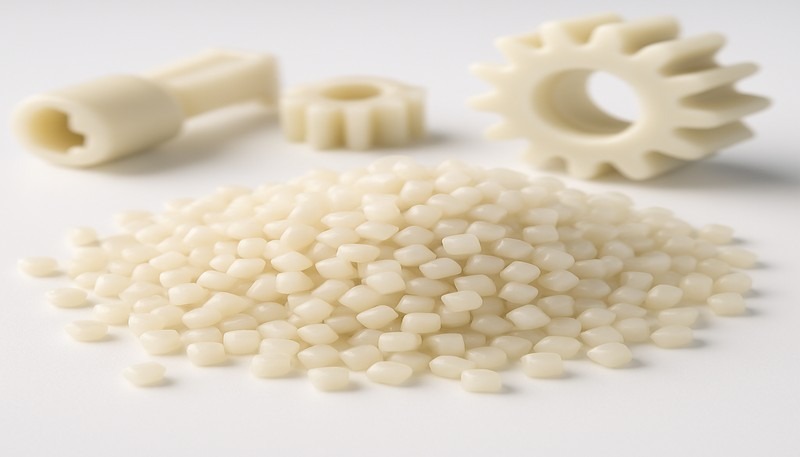
¿Cuáles son las diferencias clave de propiedades entre PA6, PA66, PA12 y PA1010?
PA66 es el más rígido, PA12 absorbe menos humedad, PA6 es el de menor costo y PA1010 ofrece la mejor resistencia química. Estas diferencias afectan el rendimiento de la pieza, la estabilidad de tolerancias, el tiempo de secado y la temperatura de moldeo. Seleccionar el grado incorrecto puede provocar deformaciones evitables, fragilidad o desviaciones dimensionales relacionadas con la humedad.
| Propiedad | PA6 | PA66 | PA12 | PA1010 |
|---|---|---|---|---|
| Punto de fusión | 220°C | 260°C | 178°C | 200°C |
| Absorción de humedad (23°C/50% HR) | 2.8% | 2.5% | 0.25% | 1.2% |
| Resistencia a la tracción (seco) | 80 MPa | 85 MPa | 50 MPa | 55 MPa |
| Módulo de Flexión (seco) | 2.8 GPa | 3.0 GPa | 1.5 GPa | 1.8 GPa |
| Impacto Izod (seco) | 45 J/m | 40 J/m | NB* | NB* |
| Costo (relativo al PA6) | 1.0x | 1.15x | 3.5x | 2.5x |
La absorción de humedad es el diferenciador más importante para el diseño de procesamiento y aplicación. PA6 y PA66 absorben de 2,5 a 3,0 por ciento de humedad en equilibrio en un ambiente de 50 por ciento de humedad relativa, lo que provoca una hinchazón dimensional de 0,5 a 1,0 por ciento y reduce la rigidez de 50 a 60 por ciento en comparación con el estado seco como moldeado. PA12 absorbe sólo el 0,25 por ciento, lo que hace que su cambio dimensional sea insignificante. El diseño adecuado del molde de inyección tiene en cuenta estas diferencias de contracción específicas del material. Si su aplicación requiere tolerancias estrictas en un ambiente húmedo, PA12 es la opción clara independientemente de su mayor costo de materia prima.
Los valores de impacto Izod con entalla marcados como NB (sin rotura) para PA12 y PA1010 indican que estos grados son intrínsecamente tenaces y no presentan fractura frágil en ensayos de impacto estándar. Esta tenacidad, combinada con una baja absorción de humedad, convierte a PA12 y PA1010 en las opciones preferidas para conductos de combustible, tubos hidráulicos y racores neumáticos donde debe mantenerse la resistencia al impacto en distintos intervalos de temperatura y humedad.
¿Cuáles son los parámetros críticos de procesamiento para cada grado de nailon?
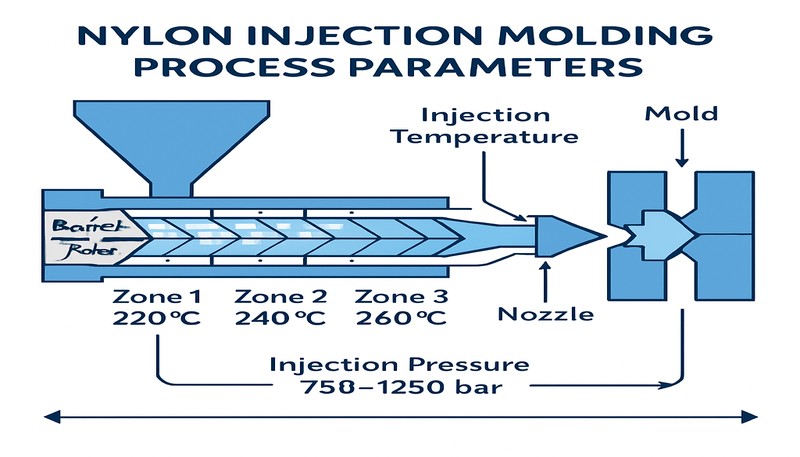
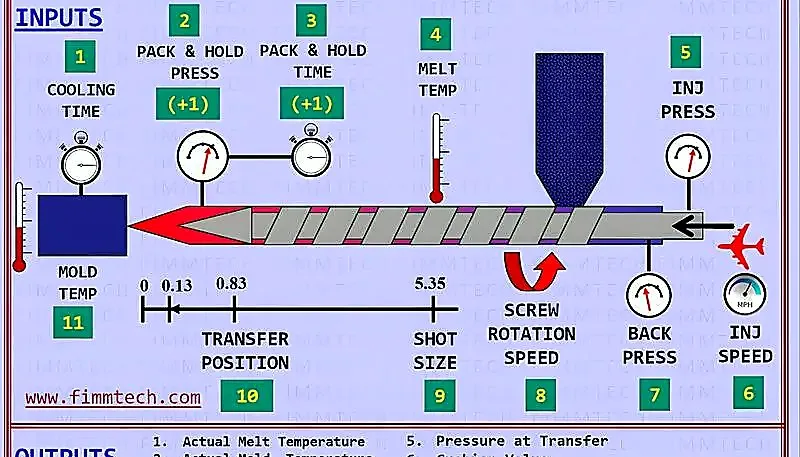
El procesamiento del nailon es sensible a la humedad y a la temperatura de fusión. Los parámetros del moldeo por inyección de nailon1 son más exigentes que los de los plásticos básicos como PP o PE debido a la alta temperatura de fusión del material, su estrecha ventana de procesamiento y su sensibilidad a la humedad. La temperatura de secado y fusión incorrecta es la causa más común de piezas de nailon defectuosas en la producción.
"Secar el nailon hasta lograr un contenido de humedad inferior al 0.2 por ciento antes del moldeo es la decisión de procesamiento de mayor impacto: un secado inadecuado provoca ráfagas plateadas, reducción del peso molecular por hidrólisis2 e inestabilidad dimensional que ningún ajuste posterior de parámetros puede corregir"True
El nailon es higroscópico y absorbe rápidamente la humedad del aire ambiente. Al procesar nailon húmedo, el agua reacciona con los enlaces amida de la cadena polimérica (hidrólisis), lo que reduce permanentemente el peso molecular y las propiedades mecánicas. Este daño es irreversible y no puede detectarse únicamente por el aspecto.
"PA6 y PA66 pueden procesarse a la misma temperatura de fusión porque ambos son materiales de poliamida con estructuras moleculares similares"False
El PA6 se funde aproximadamente a 220°C y se procesa a 240-270°C, mientras que el PA66 se funde a 260°C y requiere una temperatura de fusión de 270-300°C. Utilizar las temperaturas del PA6 para el PA66 provoca una fusión incompleta y una viscosidad elevada. Utilizar las temperaturas del PA66 para el PA6 causa degradación térmica.
Tiempos y temperaturas de secado recomendados por grado
| Parámetro | PA6 | PA66 | PA12 | PA1010 |
|---|---|---|---|---|
| Temperatura de secado | 80-100°C | 80-100°C | 70-80°C | 80-90°C |
| Tiempo de secado | 4-8 horas | 4-8 horas | 2-4 horas | 3-6 horas |
| Humedad objetivo | <0.2% | <0.2% | <0.1% | <0.15% |
| Temperatura de fusión | 240-270°C | 270-300°C | 190-230°C | 210-250°C |
| Temperatura del molde | 60-90°C | 70-100°C | 30-50°C | 40-70°C |
| Presión de inyección | 80-130 MPa | Presión: 90-140 MPa | 70-110 MPa | 75-120 MPa |
Los requisitos de secado varían considerablemente entre los cuatro grados. El PA6 y el PA66 requieren entre 4 y 8 horas a una temperatura de 80 a 100°C en un secador de tolva deshumidificador para reducir la humedad por debajo del 0.2 por ciento. El PA12 solo necesita entre 2 y 4 horas a una temperatura de 70 a 80°C debido a su baja absorción de humedad. El PA1010 se sitúa en un punto intermedio, con entre 3 y 6 horas a una temperatura de 80 a 90°C. Verifique el contenido de humedad mediante una valoración Karl Fischer antes del moldeo. Los cuatro grados deben secarse inmediatamente antes del moldeo: dejar los gránulos secos expuestos al aire ambiente durante más de 30 minutos anula el esfuerzo de secado.
¿Cómo afecta el diseño del molde a la calidad de la pieza de nailon?
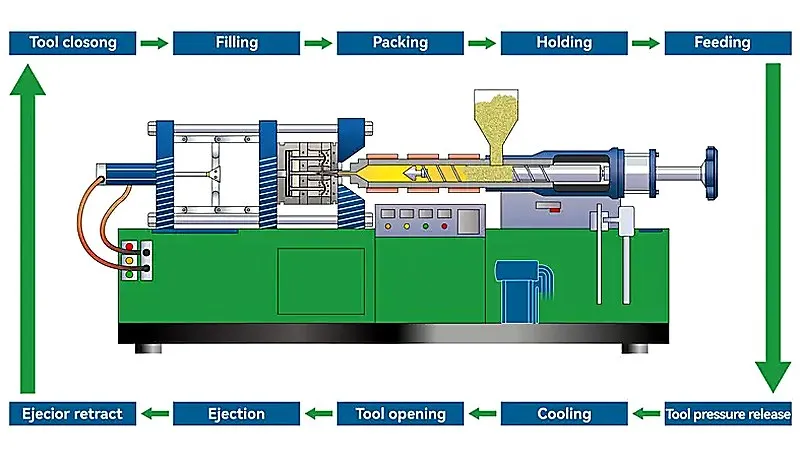
El diseño del molde es el factor principal de la calidad de las piezas de nailon a través del corte de la compuerta, la uniformidad del enfriamiento y la efectividad de la ventilación. El diseño adecuado del molde de inyección3 evita rebabas, líneas de soldadura e inestabilidad dimensional que la naturaleza higroscópica del nailon amplifica.
El diseño del punto de inyección para piezas de nailon debe priorizar el equilibrio del flujo y minimizar el calentamiento por cizallamiento. Los puntos de inyección laterales y submarinos son habituales en piezas de PA6 y PA66, mientras que los sistemas de canal caliente con puntos de inyección con válvula reducen el desperdicio de material en la producción de gran volumen. El tamaño del punto de inyección debe ser del 50 al 80 por ciento del espesor nominal de pared en su ubicación para minimizar el chorro libre y garantizar el llenado progresivo de la cavidad sin que el punto de inyección se solidifique antes de completar la compactación.
El diseño de los canales de refrigeración afecta directamente al tiempo de ciclo y a la uniformidad dimensional de las piezas de nylon. Dado que PA6 y PA66 requieren temperaturas de molde relativamente altas (60 a 100°C), los canales de refrigeración conformada proporcionan el perfil térmico más uniforme y reducen el alabeo en geometrías complejas. En la práctica, hemos comprobado que mantener la variación de temperatura del molde por debajo de 5°C en toda la superficie de la cavidad reduce la dispersión dimensional entre un 30 y un 40 por ciento en piezas de PA66 con tolerancias estrechas. Esto resulta especialmente importante para los grados reforzados con vidrio, en los que la orientación de las fibras amplifica la contracción diferencial.
En nuestra fábrica de Shanghái operamos 47 máquinas de moldeo por inyección con fuerzas de cierre de 90T a 1850T, lo que nos permite abarcar desde microengranajes de nailon en máquinas pequeñas hasta grandes soportes estructurales de automoción en prensas de alto tonelaje. Nuestra planta interna de fabricación de moldes nos permite iterar rápidamente la ubicación de las compuertas y el diseño de la refrigeración al optimizar nuevos programas de piezas de nailon.
El diseño del sistema de expulsión requiere especial atención con el nailon, porque el alto coeficiente de fricción del material y su contracción alrededor de los núcleos generan fuerzas de expulsión considerables. Un ángulo de desmoldeo adecuado (mínimo de 1 grado para nailon sin carga y de 1.5 a 2 grados para grados reforzados con vidrio) y una superficie suficiente de los pernos expulsores evitan marcas de los pernos y la deformación de la pieza durante la expulsión. Se prefieren las placas extractoras para piezas cilíndricas de nailon en las que importa la concentricidad.
¿Cuáles son los defectos comunes del moldeo de nailon y cómo prevenirlos?
Los defectos más comunes del moldeo de nailon son los daños por humedad (vetas, hidrólisis), los errores de temperatura (llenado incompleto, rebabas) y el alabeo dimensional. Identificar a qué categoría pertenece el defecto es la vía más rápida para corregirlo.
"El PA12 cuesta entre 3 y 5 veces más por kilogramo que el PA6, por lo que no resulta rentable en aplicaciones que no requieren su baja absorción de humedad"True
La materia prima PA12 suele costar $8-12/kg frente a $2-3/kg para PA6. Esta prima solo se justifica cuando la aplicación exige específicamente estabilidad dimensional en ambientes húmedos, resistencia al combustible o flexibilidad a baja temperatura que PA6 no puede proporcionar.
"Añadir un 30% de fibra de vidrio al PA6 elimina por completo la absorción de humedad, por lo que no es necesario secar los grados reforzados con fibra de vidrio antes del moldeo"False
El refuerzo con fibra de vidrio reduce, pero no elimina, la absorción de humedad. El PA6 con fibra de vidrio aún absorbe aproximadamente un 1.5% de humedad en equilibrio y requiere el mismo protocolo de secado que los grados sin carga. Moldear nailon húmedo con fibra de vidrio provoca las mismas ráfagas y daños por hidrólisis, con el riesgo adicional de degradar la interfaz entre fibra y matriz.
Las ráfagas y las vetas plateadas son los defectos relacionados con la humedad más visibles. Aparecen como marcas superficiales en forma de abanico en la pieza, donde el vapor de agua se expande rápidamente cuando el fundido entra en la cavidad. La solución siempre es prolongar el secado o elevar su temperatura, nunca ajustar parámetros en la máquina. Compruebe el punto de rocío del secador de tolva (objetivo inferior a -30°C) y verifique el contenido real de humedad del material con una prueba de Karl Fischer antes de ajustar cualquier otro parámetro.
El alabeo de las piezas de nailon se debe a la contracción diferencial entre las direcciones de flujo y transversal al flujo, amplificada por la orientación de las fibras en los grados reforzados con vidrio. La contramedida más eficaz es una temperatura uniforme del molde en todas las superficies de la cavidad, seguida de una ubicación equilibrada de las entradas que iguale las longitudes de flujo. Los útiles posteriores al moldeo que mantienen las piezas en la geometría deseada durante las primeras 24 horas de enfriamiento pueden reducir el alabeo entre un 40 y un 60 por ciento en piezas planas con espesores de pared variables.
¿Cómo seleccionar el grado de nailon adecuado para su aplicación?
El grado de nailon adecuado viene determinado por tres factores: temperatura de servicio, requisitos de tolerancia y exposición química. Compare esos requisitos con el perfil de propiedades de cada grado que figura a continuación.
| Requisito de Aplicación | Grado Recomendado | Razón Clave |
|---|---|---|
| Temperatura de servicio superior a 120°C | PA66 | Temperatura de deflexión por calor más alta entre los cuatro grados |
| Tolerancias estrechas en ambiente húmedo | PA12 | La absorción de humedad más baja (0,25%) minimiza el cambio dimensional |
| Piezas estructurales sensibles al costo por debajo de 100°C | PA6 | 15-25% menor coste del material que el PA66 con un rendimiento adecuado |
| Se requiere resistencia a combustibles o productos químicos | PA12 o PA1010 | Superior resistencia química a hidrocarburos y solventes |
| Se necesita certificación de contenido de base biológica | PA1010 | Derivado de materia prima renovable de aceite de ricino |
| Componentes bajo el capó automotriz | PA66 (relleno de vidrio) | Mantiene rigidez a temperaturas elevadas con refuerzo de fibra |
| Tubos y catéteres médicos | PA12 | Flexibilidad, biocompatibilidad e inercia química |
| Conectores eléctricos (UL94 V0) | PA66 (retardante de llama) | Logra V0 a 0,4mm con aditivos FR adecuados |
Las aplicaciones automotrices consumen más del 40% de la producción mundial de PA66. Los componentes bajo el capó, como colectores de admisión, cubiertas del motor y tanques extremos del radiador, funcionan a temperaturas superiores a 120°C, donde el PA6 pierde rigidez. Los conectores eléctricos, carcasas de sensores y cajas de fusibles utilizan grados de PA66 retardantes a la llama (clasificados V0) que cumplen con los requisitos de la norma de inflamabilidad UL94. Los componentes de interior y los soportes estructurales utilizan PA6 o PA6 con carga de vidrio por eficiencia de costes donde la exposición a la temperatura es moderada.
Las aplicaciones eléctricas y electrónicas aprovechan las excelentes propiedades dieléctricas y la retardancia de llama del nailon. Los grados PA66 con fósforo rojo o retardantes de llama a base de nitrógeno alcanzan la clasificación V0 de la norma de inflamabilidad UL94 con un espesor de pared de 0.4mm, lo que los hace aptos para conectores, interruptores y carcasas de disyuntores. El creciente mercado de vehículos eléctricos impulsa la demanda de componentes PA66 para módulos de baterías que combinan retardancia de llama y rendimiento estructural.
Los fabricantes de bienes de consumo eligen nailon por su equilibrio de resistencia y calidad superficial. Las carcasas de herramientas eléctricas usan PA6 con fibra de vidrio para resistencia al impacto a un costo razonable. Artículos deportivos como fijaciones de esquí y herrajes de cascos dependen de la resistencia a la fatiga del PA66. Los componentes de electrodomésticos de cocina que contactan superficies calientes requieren grados de PA66 estabilizados al calor clasificados para servicio continuo a 130°C.
Las aplicaciones de dispositivos médicos exigen grados específicos de nailon con biocompatibilidad documentada. El PA12 domina en usos de catéteres y tubos debido a su flexibilidad e inercia química. El PA6 se utiliza en mangos de instrumentos quirúrgicos donde la esterilización en autoclave requiere ciclos térmicos entre 121-134°C. Las pruebas ISO 10993 confirman la biocompatibilidad para aplicaciones de contacto con el paciente y la trazabilidad del material es obligatoria para todos los proyectos de nailon médico.
Con más de 20 años de experiencia en moldeo por inyección y un equipo de 8 ingenieros senior, hemos procesado más de 400 materiales plásticos en nuestra planta de producción. En nuestras revisiones de producción, nuestros ingenieros rastrean la humedad de la resina, la temperatura del fundido, los patrones de defectos del primer disparo y la deriva dimensional antes de liberar un trabajo de nailon. Nuestro flujo de trabajo de calidad, desde IQC a través de la inspección de proceso hasta OQC, detecta defectos específicos del nailon como salpicaduras y degradación hidrolítica antes de que lleguen a su línea de ensamblaje.
Preguntas frecuentes
¿Cuánto tiempo debo secar PA6 y PA66 antes del moldeo por inyección?
El PA6 y el PA66 requieren de 4 a 8 horas de secado a 80-100 grados Celsius en un secador de tolva deshumidificante para alcanzar un contenido de humedad inferior al 0,2%. El tiempo exacto depende del nivel inicial de humedad, el tamaño de la granza y la capacidad de flujo de aire del secador. El PA66, con su punto de fusión más alto, es ligeramente más sensible a la humedad residual que el PA6, por lo que, en caso de duda, opte por el extremo más largo del rango de secado. Verifique siempre con un analizador de humedad calibrado antes de comenzar la producción para evitar defectos de salpicaduras e hidrólisis en las piezas moldeadas.
¿Se pueden moldear PA6 y PA66 en la misma máquina sin modificaciones?
Sí, PA6 y PA66 pueden procesarse en la misma máquina pero requieren perfiles de temperatura diferentes. PA66 necesita temperaturas de cañón de 270 a 300 grados Celsius versus 240 a 270 grados Celsius para PA6. La temperatura del molde también difiere: PA66 funciona mejor a 70 a 90 grados Celsius, mientras que PA6 trabaja a 60 a —80 grados Celsius. El cambio requiere purgar el cañón completamente con un material de transición compatible para evitar contaminación cruzada y piezas degradadas. Permita 15 a 20 minutos para estabilización de temperatura después de ajustar la configuración del cañón entre grados.
¿Qué sucede si se moldea nylon sin un secado adecuado?
El moldeo de nylon sin secar causa tres problemas progresivos. Primero, la humedad crea marcas de salpicaduras en la superficie y vetas plateadas que arruinan la apariencia de la pieza. Segundo, el agua desencadena hidrólisis a temperaturas de procesamiento, rompiendo los enlaces amida y reduciendo permanentemente el peso molecular, lo que disminuye la resistencia al impacto y la elongación a la rotura entre un 30 y un 50%. Tercero, la humedad atrapada causa variación dimensional, ya que las piezas absorben y liberan humedad de manera desigual durante el enfriamiento. Estos defectos no se pueden reparar después del moldeo porque el daño en la cadena polimérica es irreversible y las piezas afectadas deben desecharse.
¿Vale la pena la prima de precio significativa del PA12 sobre el PA6 para aplicaciones generales?
Para aplicaciones de uso general donde la absorción de humedad es tolerable y las temperaturas de funcionamiento se mantienen por debajo de los 80 grados Celsius, el PA6 es más rentable, con un precio aproximadamente un tercio del PA12. El PA12 justifica su prima solo cuando se necesita su excepcionalmente baja absorción de humedad del 0,25%, su superior estabilidad dimensional en ambientes húmedos, su resistencia a combustibles y productos químicos para líneas de combustible automotrices, o su excelente flexibilidad a baja temperatura hasta los -40 grados Celsius. Evalúe el coste total de las fallas de calidad y el acondicionamiento posterior al moldeo antes de elegir PA6 sobre PA12 para aplicaciones de precisión.
¿Cómo afecta el refuerzo con fibra de vidrio al procesamiento de moldeo por inyección de nailon?
Los grados de nailon rellenos de vidrio, típicamente con 30 por ciento de fibra de vidrio corta, requieren temperaturas de cañón entre 10 y 20 grados Celsius más altas y presiones de inyección entre 20 y 30 por ciento más altas en comparación con los grados sin rellenar. Las fibras de vidrio aumentan la viscosidad del fundido, reducen la contracción de 1,2 por ciento a 0,3 por ciento para el PA6 y mejoran la rigidez de dos a tres veces. El desgaste de la herramienta aumenta significativamente debido a la abrasión de las fibras, por lo que se recomienda acero de molde endurecido como H13 o S136 para corridas de producción que superen los 100.000 ciclos. El diseño del tornillo debe usar una relación de compresión más baja para minimizar la rotura de fibras durante la plastificación.
¿Cuál es la diferencia entre las propiedades del nailon condicionado y seco como moldeado?
Las propiedades en estado seco se miden inmediatamente después del moldeo, cuando el contenido de humedad es casi cero. Las propiedades acondicionadas reflejan la absorción de humedad en equilibrio, generalmente alcanzada al 50-60% de humedad relativa durante 48 horas. El PA6 acondicionado suele mostrar una resistencia a la tracción entre un 40 y un 50% menor, pero una resistencia al impacto entre 2 y 3 veces mayor que los datos en estado seco. Especifique siempre la condición utilizada en los cálculos de diseño, revisiones de tolerancias y RFQs a proveedores, para que los factores de seguridad no se basen en el conjunto de datos incorrecto. Esta distinción es crítica para las piezas de nylon sometidas a carga.
¿Qué valores de contracción debo usar para el diseño de moldes de nylon?
El PA6 sin rellenar se contrae aproximadamente entre 0,8 y 1,4 por ciento, mientras que el PA66 sin rellenar se contrae entre 1,0 y 1,5 por ciento, dependiendo del espesor de pared, la ubicación de la compuerta y la configuración de temperatura del molde. Los grados rellenos de vidrio se contraen significativamente menos: entre 0,3 y 0,7 por ciento para PA6-GF30 y entre 0,4 y 0,8 por ciento para PA66-GF30. La contracción es anisotrópica en los grados rellenos de vidrio, lo que significa que la contracción en dirección del flujo y en dirección transversal difieren entre 0,2 y 0,4 por ciento. Su diseñador de moldes debe tener en cuenta esta anisotropía en los cálculos de dimensiones de la cavidad para lograr tolerancias estrechas de manera consistente en todas las corridas de producción.
¿Se puede secar en exceso el nylon antes del moldeo?
Sí, el secado excesivo por encima de 110 grados Celsius o más allá de 12 horas provoca oxidación térmica que amarillea las granzas y reduce las propiedades mecánicas, particularmente la resistencia al impacto y la elongación a la rotura. Para el nylon regenerado o reciclado, el riesgo es mayor porque el historial térmico es acumulativo a través de múltiples ciclos de procesamiento. Si el secado debe extenderse más allá de 8 horas debido a retrasos en la programación de producción, reduzca la temperatura a 70-80 grados Celsius para mantener el material de forma segura hasta que comience la producción. Monitoree el color de las granzas como un indicador visual rápido de daño por sobresecado.
¿Por qué elegir ZetarMold para el moldeo por inyección de nailon?
ZetarMold es un socio confiable en moldeo de nailon con 47 prensas (90T–1850T), sistemas de secado dedicados por grado y más de 20 años de experiencia en poliamidas. Mantenemos secadores de tolva dedicados para cada grado de nailon para evitar la contaminación cruzada y ejecutamos monitoreo automatizado de humedad antes de cada turno de producción. Para los desafíos de diseño de moldes de inyección complejos en nailon relleno de vidrio, nuestro equipo de ingeniería proporciona retroalimentación de DFM en 48 horas.
ZetarMold es un socio fuerte en moldeo de nailon porque combinamos 47 prensas, sistemas de secado dedicados y más de 20 años de experiencia en procesamiento de poliamida. Mantenemos secadores de tolva dedicados para cada grado de nailon para prevenir contaminación cruzada y realizamos controles automáticos de humedad antes de iniciar la producción. Nuestro equipo de ingeniería puede ayudarle a comparar PA6, PA66, PA12 y PA1010 frente a requisitos de tolerancia, calor, químicos y costo antes de finalizar el molde.
Regla rápida: Seque PA6/PA66 a 80–100°C durante 4–8 horas antes de moldear. Elija PA66 para piezas por encima de 120 °C, PA6 para piezas estructurales sensibles a los costos, PA12 para aplicaciones flexibles o resistentes a químicos y PA1010 cuando el contenido biológico es importante.
Moldeo por inyección de nailon: El moldeo por inyección de nailon se refiere al proceso de fabricación de dar forma a materiales termoplásticos de poliamida utilizando equipos de moldeo por inyección para producir componentes de ingeniería con alta resistencia y resistencia química. ↩
hidrólisis: La hidrólisis es una reacción química en la que las moléculas de agua escinden los enlaces amida en las cadenas de polímeros de poliamida, lo que reduce permanentemente el peso molecular y degrada las propiedades mecánicas de los materiales de nailon. ↩
Diseño de moldes de inyección: el diseño de moldes de inyección se refiere a la disciplina de ingeniería que abarca la geometría de la herramienta, el diseño del canal de enfriamiento, la ubicación de la puerta y la optimización del sistema de expulsión para producir piezas de plástico dimensionalmente precisas. ↩