콘텐츠로 건너뛰기
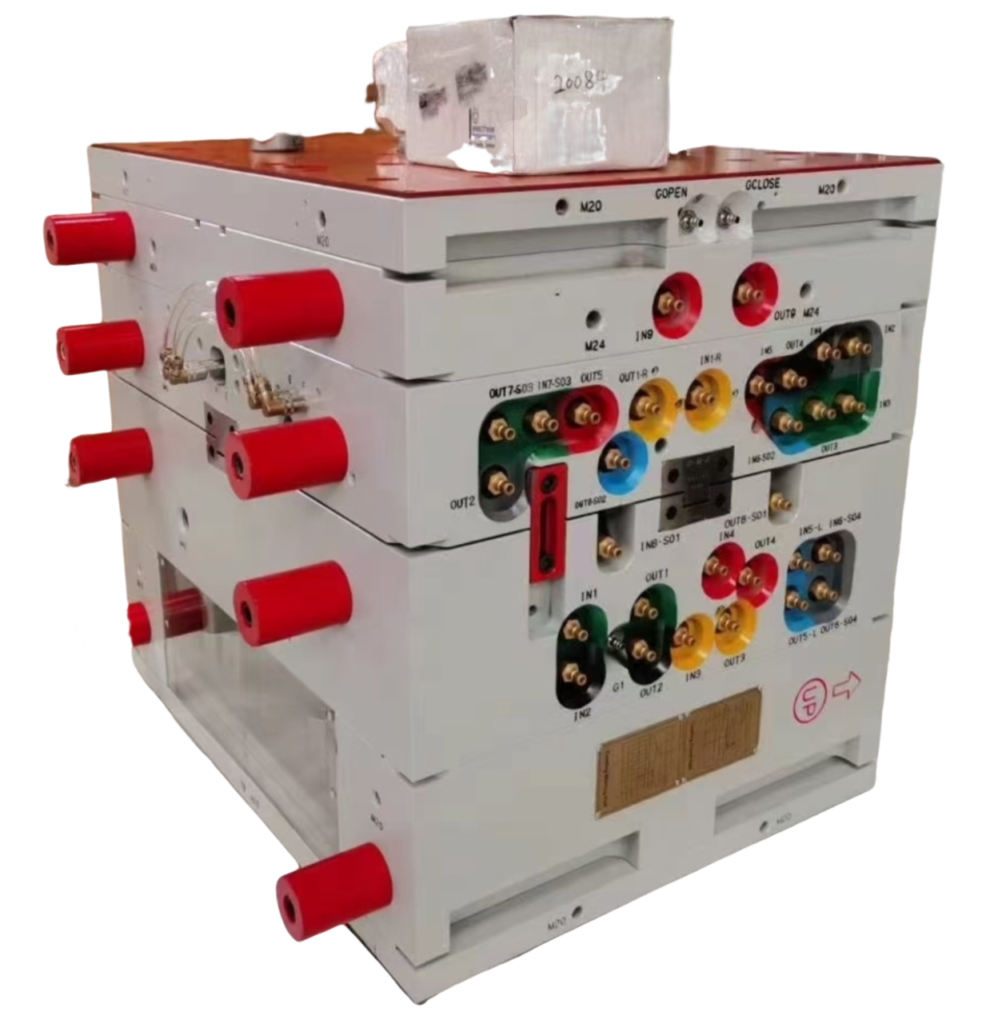
당신은 polycarbonate 부품이 필요한 새로운 project spec을 받았습니다. 당신의 mold supplier는 건조 시간, melt temperature, gate location preference를 알고 싶습니다. 문제: 당신의 팀은 몇 년 동안 PC를 실행하지 않았고, old process sheet가 없습니다. 이는 대부분의 first-shot failure가 발생하는 gap입니다—잘못된 건조는 hydrolysis를 일으키고, 잘못된 melt temperature는 degradation을 일으키며, poor gate placement는 dimensional stability를 sink합니다.
For a broader overview, see our 사출 성형 가이드. We cover what PC is, why it demands strict drying, how to set processing parameters, and how to design molds that actually work with this material. Skip the academic theory—this is what works on the floor.
- PC requires 120-150°C drying for 3-4 hours before molding
- Melt temperature: 280-310°C depending on grade and flow length
- Mold temperature: 80-120°C for dimensional stability
- Wall thickness: 1.5-4.0 mm typical, avoid abrupt transitions
- Avoid sharp corners and use 0.5-1.0 mm radii at gate locations
What Is Polycarbonate Injection Molding?
폴리카보네이트1 injection molding is a processing method that forms PC resin into parts by melting, injecting into a mold, and cooling to achieve final dimensions. The 사출 성형 공정2 for PC requires precise control because this amorphous thermoplastic has high impact strength, optical clarity, and heat resistance up to 135°C continuous use. Engineers choose PC when applications demand transparency, toughness, or dimensional stability.
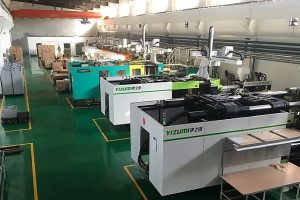
In our Shanghai facility, we process 400+ materials including multiple PC grades—general purpose, flame-retardant, medical, and UV-stabilized variants. Each grade shifts processing windows slightly. We see flame-retardant PC needing slightly higher melt temperatures and longer cycle times due to additive content. Medical-grade PC requires stricter drying and sometimes dedicated drying hoppers to avoid contamination.
현실: PC는 관대하지 않습니다. ABS나 PP와 달리 건조 시간이나 melt temperature의 작은 변화가 즉시 눈에 띄는 결함을 일으킵니다. 한 번의 불량 shot 후에 줄무늬, 은색화, 또는 brittle 부품이 발생합니다. 그래서 PC로 성공하는 엔지니어들은 이를 일반적인 thermoplastic molding보다는 고정밀 공정으로 취급합니다.
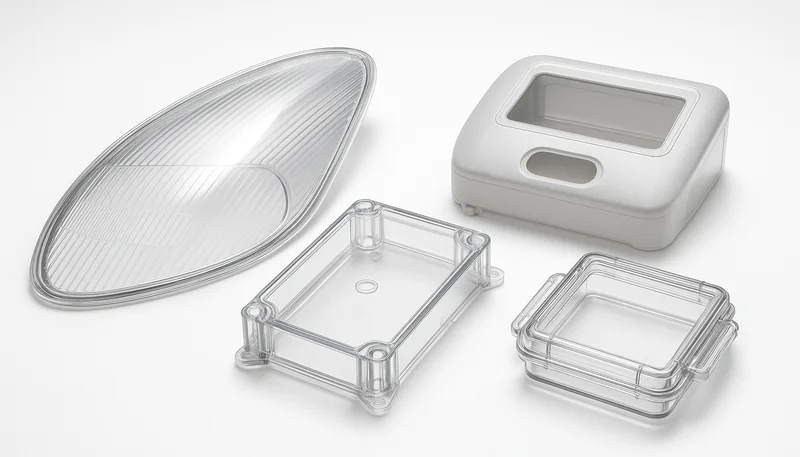
The tradeoff is worth it. PC delivers properties few other materials match—impact strength around 850 J/m notched Izod, light transmission up to 90%, and good resistance to chemicals and flame. That combination makes it the go-to material for automotive headlight lenses, medical device housings, electronic enclosures, and safety glazing.
How Do You Dry PC Before Molding?
Dry PC at 120-150°C for 3-4 hours using desiccant drying equipment before molding. PC absorbs moisture from air and hydrolyzes if processed wet, losing molecular weight and mechanical properties. The moisture content must be below 0.02% before feeding material into the hopper.
건조를 건너뛰면 다음과 같은 일이 발생합니다: 처리 온도에서 물이 PC 사슬과 반응하여 폴리머 결합을 파괴합니다. 결과는 분자량 감소, 충격 강도 손실, 은색 줄무늬나 스플레이 같은 표면 결함입니다. 우리는 이 실패 모드를 끊임없이 관찰합니다—새로운 팀들이 PC를 기계에 급히 투입하고, 충격 강도가 전혀 없는 흐릿한 부품을 얻으며, 재료 등급을 탓합니다.
Our standard drying protocol uses desiccant dryers at -40°C dew point. For standard PC grades, 120-130°C for 3 hours works. For high-heat or glass-filled PC, bump to 140-150°C for 4 hours. The key is maintaining temperature throughout the hopper, not just at the dryer outlet. Ambient moisture reabsorbs quickly—leaving dried pellets exposed for even 30 minutes can push moisture back up.
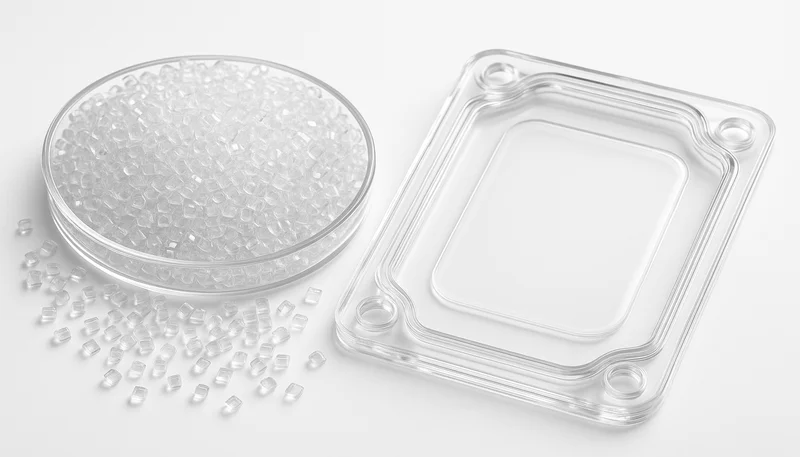
실용적인 팁: 생산 시작 전에 건조를 확인하기 위해 moisture analyzer나 간단한 moisture content meter를 사용하세요. dryer setpoint만 믿지 마세요. 우리는 dryer malfunction이나 thermocouple drift를 보았습니다, 130°C를 표시하면서 실제 재료 온도는 90°C입니다. 그 차이는 한 batch 불량과 생산 시간 손실을 초래합니다.
For high-volume production, consider hopper dryers with closed-loop moisture sensors. These add cost but prevent the single most common PC failure mode. In 20 years of molding PC, we estimate 70% of first-shot failures trace back to inadequate drying. Fix drying upfront, and half your PC problems disappear.
“PC는 molding 전에 120-150°C에서 3-4시간 건조가 필요합니다.”True
Polycarbonate absorbs moisture from ambient air and must be dried below 0.02% moisture content using desiccant dryers to prevent hydrolysis during melt processing.
“PC pellets를 ambient oven에서 overnight 건조할 수 있습니다.”False
Ambient ovens lack controlled dew point and can actually increase moisture content. Desiccant drying at -40°C dew point is required to remove moisture from PC effectively.
What Are Optimal PC Molding Temperatures?
Set melt temperature to 280-310°C and mold temperature to 80-120°C for most PC injection molding applications. The exact melt temperature depends on flow length, part thickness, and PC grade. Mold temperature affects crystallinity and stress levels—higher temperatures reduce residual stress and improve optical clarity.
Starting point: 290-300°C melt, 90-100°C mold for most general-purpose PC parts. If you see incomplete fills or flow marks, increase melt temperature in 5-10°C increments up to 310°C maximum. If you see degradation, discoloration, or gas marks, reduce melt temperature. The window is narrower than for ABS or PP—too cold gives short shots, too hot degrades material rapidly.
Mold temperature is often overlooked but critical for PC. Cold molds (below 60°C) cause high residual stress, warpage, and poor surface finish. Hot molds (above 120°C) extend cycle time and can cause sticking. We run most PC tooling at 90-110°C using circulating oil or cartridge heaters. For optical parts demanding clarity, push mold temperature to 110-120°C.
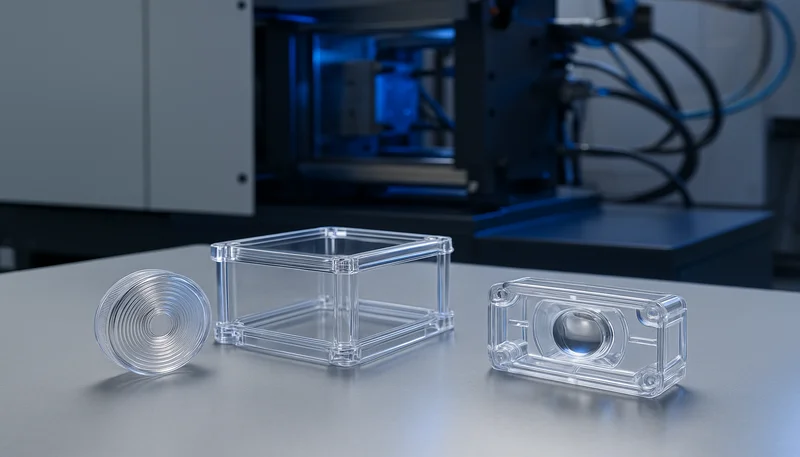
온도 상승 속도도 중요합니다. 20°C에서 300°C로 재료를 즉시 급격히 올리지 마세요. 균일한 용융을 보장하기 위해 barrel zone을 따라 점진적인 프로파일을 사용하세요. 일반적인 zone 설정: rear 260°C, middle 280°C, front 295°C, nozzle 300°C. 이렇게 하면 PC가 mold에 들어가기 전에 melt homogeneity를 안정화할 시간을 얻습니다.
모니터링은 필수입니다. 용융 온도 센서와 주기적인 점도 검사를 사용하여 실제 용융 온도가 기계 설정과 일치하는지 확인하세요. 우리는 배럴 서모커플이 수개월간의 생산 과정에서 10-15°C 정도 표류하여 팀이 진단하기 어려운 점진적인 품질 문제를 일으키는 것을 목격했습니다. 가능하다면 정기적으로 교정하고 피로미터로 검증하세요.
Material grade variations require temperature adjustments too. Flame-retardant PC often needs higher melt temperatures due to flame retardant additives that can reduce flow. UV-stabilized PC may process slightly differently than standard grades. Always consult the material datasheet for recommended temperature ranges from the resin manufacturer, and adjust based on your specific tooling and part geometry.
“PC 용융 온도는 일반적으로 280-310°C 범위입니다.”True
Polycarbonate requires higher melt temperatures than many other thermoplastics due to its high glass transition temperature of approximately 147°C and high melt viscosity.
“냉각 금형(60°C 미만)은 PC의 사이클 타임을 개선합니다.”False
Cold molds increase residual stress and warpage in PC parts, often causing dimensional instability and poor mechanical properties despite shorter cooling times.
How Do You Design Injection Molds for PC?
적절한 사출 금형 설계3 for PC requires uniform wall thickness between 1.5-4.0 mm, smooth transitions with 3:1 thickness ratio, adequate draft angles of 1-2°, and generous radii of 0.5-1.0 mm to minimize stress concentrations. Mold surface finish affects optical clarity—mirror polish yields transparent parts, while textured surfaces scatter light for diffuse appearance.
Wall thickness uniformity is non-negotiable for PC. Abrupt thickness changes cause differential cooling, leading to warpage, sink marks, and internal stress. If your design requires varying thickness, transition gradually over a distance at least three times the thickness difference. For a jump from 2mm to 4mm, maintain a ramp of at least 6mm transition length.
Gate design deserves attention. PC has high viscosity, so gate size matters more than for lower-viscosity resins. Use edge gates of 1.0-1.5mm thickness for parts up to 3mm wall thickness. Submarine or tunnel gates of 0.8-1.2mm diameter work for smaller parts. Hot runners are excellent for PC—they reduce material waste and provide better temperature control, but require higher upfront investment.
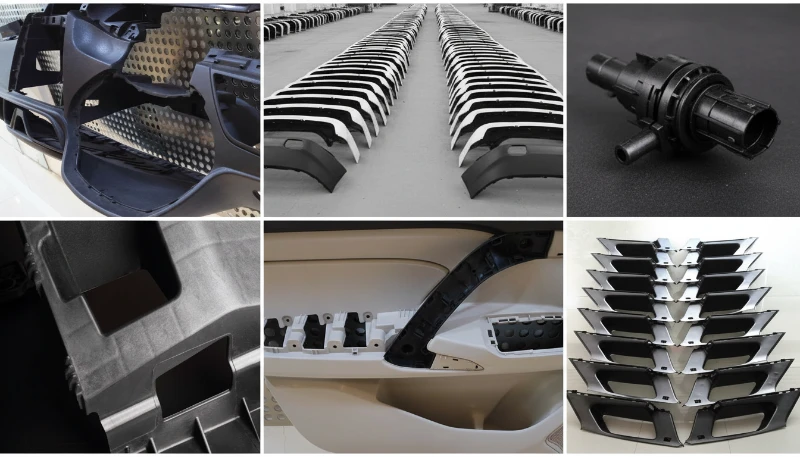
Ventilation is critical. PC produces more gas than some other resins, especially if slightly overdried or if processing near the upper temperature limit. Provide adequate venting in the mold—0.02-0.04mm vent depth, spaced every 50-80mm along the parting line. Poor venting causes burn marks, gas traps, and incomplete fills even with correct injection parameters.
Ejector design requires care. PC parts can be stubborn and mar easily. Use ejector pins of at least 5mm diameter with smooth, rounded ends. Add stripper plates or air ejection for large, flat parts. Polish ejector pins and ensure no sharp edges contact visible surfaces—PC will show every imperfection. Consider using parting line venting integrated into ejection design to improve gas escape during fill.
Cooling channel 설계는 warpage와 cycle time에 큰 영향을 미칩니다. 균일한 cooling은 내부 stress를 줄이고 warpage를 방지합니다. 가능할 때 부품 contour를 따라 cooling channel을 설계하세요—conformal cooling이 이상적이지만 비용이 높습니다. conformal cooling이 불가능하면 cooling channel이 heat load에 적절하게 evenly distributed되고 sized되도록 하세요. ±2°C 내의 water temperature control은 dimensional stability를 유지하는 데 도움이 됩니다.
What Are Common PC Molding Defects?
Common PC injection molding defects include silver streaks and splay from moisture, stress whitening and cracking from residual stress, warpage from non-uniform cooling, discoloration from thermal degradation, and sink marks from poor packing. Each defect has a specific root cause and requires targeted corrective action.
Silver streaks or splay appear as wavy silver lines on the part surface. This almost always indicates moisture in the material. Even if you dried for 3 hours, verify moisture content is below 0.02%. Check dryer function, ensure hopper lids are closed, and prevent material from sitting exposed to ambient air. We see this constantly—dryers set correctly but operators leave the hopper lid open for hours.
Stress whitening appears as milky patches when parts are bent or impacted. This indicates high residual stress from cooling too quickly or from improper ejection. Increase mold temperature by 10-20°C to reduce stress. Check for undercuts or sharp features causing high ejection forces. Ensure adequate packing but avoid overpacking, which locks stress into the part.
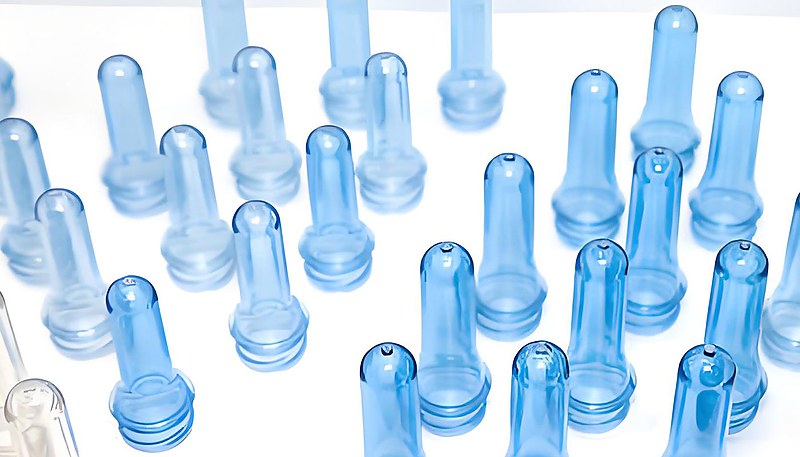
Warpage and dimensional instability trace back to non-uniform cooling or wall thickness variation. Check cooling channel layout—ensure uniform cooling across the part. If wall thickness varies unavoidably, adjust packing and cooling times to compensate. Sometimes adjusting gate location or adding flow leaders helps balance cooling rates across the part. Increasing mold temperature can also reduce residual stress and improve dimensional stability.
Discoloration—yellowing 또는 browning—는 thermal degradation을 나타냅니다. melt temperature을 5-10°C 낮추세요. barrel residence time을 확인하세요—cycle 사이에 molten material을 너무 오래 holding하지 않도록 하세요. barrel이나 screw에서 재료가 stagnates하는 dead spot을 찾으세요. regrind를 사용하는 경우 최대 25-30%로 제한하고 완전히 건조되었는지 확인하세요. 또한 contamination—foreign materials나 다른 resin의 cross-contamination—을 확인하세요, 이는 color change를 일으킬 수 있습니다.
Flow marks and weld lines also plague PC parts, especially with long flow lengths or complex geometries. Flow marks appear as visible lines where material fronts meet. Weld lines occur where material flows around an obstacle and rejoins. These can be weak points structurally. Optimize gate location to minimize flow length, consider multiple gates for large parts, and increase melt temperature to improve flow merging. Surface finish helps hide minor flow marks—textured surfaces conceal these defects better than glossy finishes.
“PC 부품의 은색 줄무늬는 일반적으로 건조 불충분을 나타냅니다.”True
Moisture in PC vaporizes at melt temperatures, creating gas bubbles that appear as silver streaks on the part surface. Proper desiccant drying eliminates this defect.
“Higher mold temperature는 항상 cycle time을 줄입니다.”False
While higher mold temperature reduces residual stress and improves part quality, it increases cooling time and extends cycle time. The optimal mold temperature balances quality and efficiency.
How Do You Optimize PC Processing Parameters?
Optimize PC processing by setting injection speed to medium-fast for filling, using a packing pressure of 50-80% of injection pressure for 2-4 seconds, maintaining cooling time based on wall thickness at approximately 10-12 seconds per mm, and back pressure of 50-150 bar to improve melt homogeneity. Screw speed of 50-100 RPM provides adequate mixing without excessive shear heating.
Injection speed affects part quality significantly. Too slow causes material to freeze prematurely, resulting in short shots or weld lines. Too fast causes jetting, high shear heating, and potential degradation. Start at medium speed and adjust based on part appearance. For thin-walled parts needing long flow, push speed higher. For thick parts where flash is a concern, reduce speed.
Packing pressure compensates for shrinkage as the material cools. PC has relatively low shrinkage (0.5-0.7%), but packing still matters for dimensional accuracy. Start packing at 60% of injection pressure for 3 seconds, then adjust. Too little packing causes sink marks and dimensional undershoot. Too much packing creates flash, high residual stress, and can even cause ejection problems.
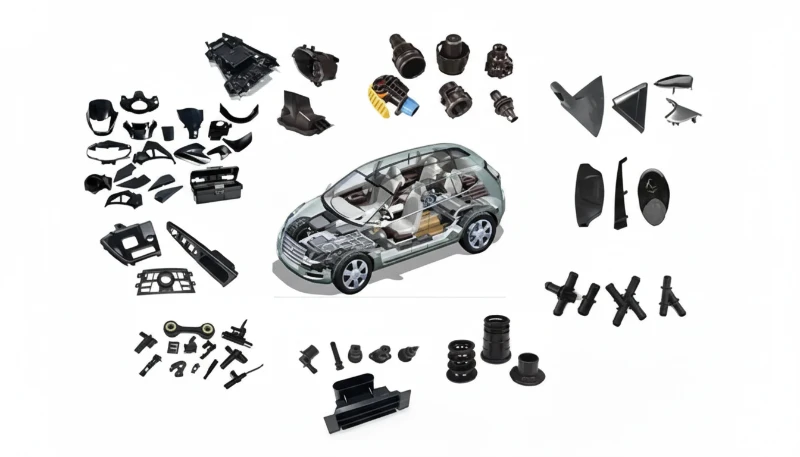
Cooling time depends primarily on wall thickness but also on mold temperature. A rough guideline: 10-12 seconds per mm of wall thickness for PC. A 3mm wall needs roughly 30-36 seconds cooling time. Increase this for thicker sections or parts requiring high dimensional precision. Use infrared temperature probes or thermal imaging to verify the part is solidifying evenly.
Screw recovery and back pressure affect melt quality. Use back pressure of 50-150 bar to improve melt homogeneity and reduce air entrapment. Keep screw speed moderate—50-100 RPM—to avoid excessive shear heating that can degrade PC. Ensure shot size is 20-30% of barrel capacity to maintain consistent melt temperature between shots.
“PC shrinkage는 일반적으로 0.5-0.7%입니다.”True
Polycarbonate exhibits relatively low shrinkage compared to semi-crystalline materials, but packing and cooling parameters still critically affect final dimensions and stability.
“Higher back pressure는 항상 부품 품질을 향상시킵니다.”False
While back pressure improves melt homogeneity, excessive back pressure can cause material degradation, increase barrel temperature, and create color shifts. Optimize back pressure rather than maximizing it.
What Are Typical PC Injection Molding Applications?
PC injection molding serves automotive headlight lenses and light covers, electronic enclosures and connectors, medical device housings and components, safety glazing and riot shields, optical discs and lenses, and consumer electronics requiring impact resistance and clarity. The combination of optical properties, toughness, and heat resistance makes PC versatile across industries.
Automotive applications dominate PC usage. Headlight lenses, fog light covers, and taillight assemblies require transparency and impact resistance. PC withstands UV exposure (with appropriate stabilizers) and maintains clarity at elevated temperatures under the hood. We mold automotive light components with tight optical specifications—transmission above 88% and yellowness index below 2.0.
Electronics 및 electrical applications는 flame retardancy가 필요한 enclosure, connector, component에 PC를 사용합니다. Flame-retardant PC grade는 mechanical property를 유지하면서 UL94 V-0 standard를 충족합니다. 이 부품들은 또한 electronic component의 heat를 견디고 electrical insulation을 제공해야 합니다. PC의 dielectric strength 15-20 kV/mm는 많은 electrical application에 적합합니다.
Medical devices는 증가하는 PC market을 나타냅니다. Surgical instrument housing, fluid handling component, medical equipment enclosure는 PC의 toughness, clarity, sterilization compatibility로 이익을 얻습니다. Medical-grade PC는 biocompatibility와 strict processing control이 필요합니다—cross-contamination을 방지하기 위해 dedicated equipment가 필요합니다. 우리 Shanghai facility는 medical device manufacturing에 ISO 13485 인증으로 운영됩니다.
자주 묻는 질문
How long does PC need to be dried before injection molding?
PC requires 3-4 hours of drying at 120-150°C using desiccant equipment before molding. The moisture content must reach below 0.02% to prevent hydrolysis during melt processing. Higher drying temperatures (140-150°C) are needed for glass-filled or high-heat PC grades. Never rely on ambient drying or skip drying steps—this is the single most common cause of PC part failure. Use a desiccant dryer with -40°C dew point and verify moisture content with a moisture analyzer before production starts. Even dried PC reabsorbs moisture quickly when exposed to air, so keep hopper lids closed and material sealed.
What is the ideal melt temperature for PC injection molding?
The ideal melt temperature for PC ranges from 280-310°C depending on the grade and part geometry. General-purpose PC typically processes at 290-300°C. Flame-retardant or glass-filled grades may require slightly higher temperatures up to 310°C. Exceeding 310°C risks thermal degradation and discoloration. Start at 290°C and adjust in 5-10°C increments based on part fill appearance and surface quality. Use a gradual temperature profile across the barrel zones to ensure uniform melting without thermal shock. Monitor for signs of degradation like yellowing or gas marks.
What mold temperature is best for PC parts?
Optimal mold temperature for PC is 80-120°C, with 90-110°C being the typical range for most applications. Higher mold temperatures (110-120°C) reduce residual stress and improve optical clarity for transparent parts. Lower mold temperatures (80-90°C) provide faster cycle times but may increase warpage risk. Adjust based on part requirements—optical parts need hotter molds than opaque components. Circulating oil or cartridge heaters provide uniform temperature control for PC tooling. Cold molds below 60°C cause high residual stress and poor surface finish results.
Why do PC parts have silver streaks on the surface?
Silver streaks or splay on PC parts indicate moisture in the material, typically from insufficient drying. Even dried PC can reabsorb moisture if left exposed to ambient air. Ensure desiccant drying at 120-150°C for 3-4 hours with a -40°C dew point dryer. Verify moisture content is below 0.02% before molding. Check dryer function and keep hopper lids closed to prevent moisture reabsorption. Silver streaks are the most visible sign of moisture-related hydrolysis during melt processing. This is the most common PC failure and requires immediate drying verification.
What causes warpage in PC injection molded parts?
PC warpage는 주로 non-uniform cooling, differential wall thickness, 또는 high residual stress로 발생합니다. smooth transition(3:1 ratio)과 adequate cooling channel로 uniform wall thickness를 보장하세요. residual stress를 줄이기 위해 mold temperature을 10-20°C 높이세요. thickest section에 충분한 cooling time이 있는지 확인하세요. gate location을 조정하거나 flow leader를 추가하면 부품 전체의 cooling rate를 balance하는 데 도움이 될 수 있습니다. residual stress가 molding 동안 관리되지 않으면 warpage는 시간이 지남에 따라 악화됩니다. tooling 전에 potential warpage area를 식별하기 위해 mold flow analysis를 사용하세요.
Can PC injection molding produce transparent parts?
Yes, PC injection molding can produce transparent parts with light transmission up to 90%. Transparency requires high mold temperatures (110-120°C), proper drying to prevent splay, and highly polished mold surfaces. The mold surface finish directly transfers to the part—mirror-polished cavities yield clear parts, while textured surfaces create diffuse or translucent appearance. Avoid scratches or imperfections in the mold that will affect optical quality. Use PC grades specifically formulated for optical applications rather than general-purpose resin. Monitor yellowness index to ensure consistent clarity.
What is the shrinkage rate of PC in injection molding?
PC has a typical shrinkage rate of 0.5-0.7%, which is relatively low compared to semi-crystalline materials. The low shrinkage helps dimensional accuracy but does not eliminate the need for proper processing. Packing pressure, cooling time, and mold temperature all affect final dimensions. Use standard shrinkage values for initial mold design but validate actual shrinkage during T1 sampling with the specific PC grade. Different PC grades may have slightly different shrinkage characteristics. Measure shrinkage in flow and transverse directions as they can vary.
Quick rule: Dry PC at 120-150°C for 3-4 hours, run melt at 290-300°C, keep mold at 90-110°C, and maintain uniform wall thickness. If you see silver streaks, check drying. If parts warp, balance cooling. If dimensions drift, adjust packing. Master these basics, and PC becomes a reliable workhorse rather than a problematic material.
2005년부터 20년 이상의 경험과 45대의 injection molding machine을 갖춘 우리 Shanghai 공장에서는 automotive, electronics, medical applications에서 매일 PC를 처리합니다. 우리의 8명 senior engineer와 30명 이상의 English-speaking project manager는 재료의 요구 사항을 이해하며 PC 부품의 tooling과 process를 최적화하는 데 도움을 줄 수 있습니다.
We build 100+ molds per month in our in-house tooling facility, supporting projects from rapid prototyping through full-scale production. Our 400+ material capability includes multiple PC grades, and we maintain ISO 9001 and 13485 certification for quality management and medical device manufacturing.
Ready to mold PC parts with confidence? Get a free quote and technical consultation for your project.
-
polycarbonate: Polycarbonate is an amorphous engineering thermoplastic with outstanding impact strength and optical clarity, typically used for parts requiring high toughness and transparency. ↩
-
injection molding process: Injection molding process is a manufacturing method where molten plastic is injected into a mold cavity under high pressure, cooled, and ejected as a solid part. ↩
-
injection mold design: Injection mold design refers to the engineering process of creating the tooling components and features that determine how plastic parts are formed during the molding cycle. ↩



 EN
EN  ES
ES  FR
FR  DE
DE  PT
PT  AR
AR  RU
RU  JA
JA  KO
KO  IT
IT  NL
NL  TR
TR  PL
PL