 콘텐츠로 건너뛰기

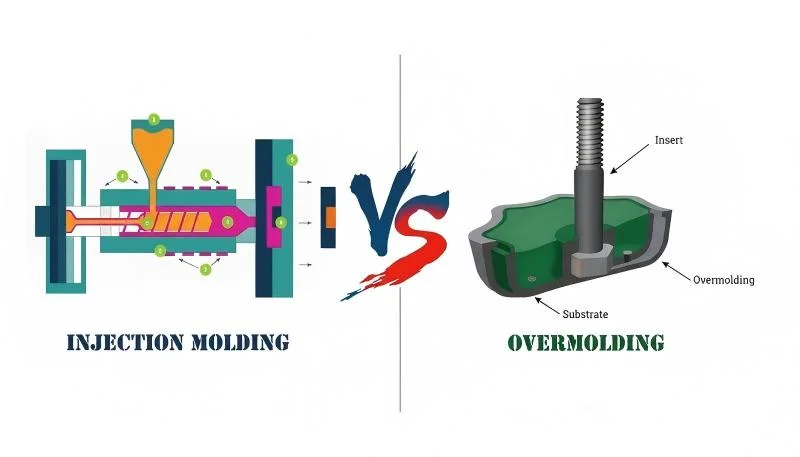
두 가지 재료(금속과 플라스틱, 또는 경질 플라스틱과 소프트 TPE)를 결합하는 부품을 설계하는 경우, 결국 선택해야 합니다: 인서트 몰딩1 또는 오버몰딩2둘 모두 하나의 부품에서 다중 소재 부품을 만들 수 있지만, 작동 방식, 비용, 적용 분야가 다릅니다.
실제로 잘못된 선택은 수천 달러의 금형 재작업 비용을 초래할 수 있으며, 프로젝트 지연까지 수반할 수 있습니다. 저는 엔지니어들이 더 간단하고 저렴한 인서트 몰딩이 적합한 상황에서 오버몰딩을 기본으로 선택하거나 그 반대의 경우를 종종 목격했습니다. 이러한 혼란은 이해할 수 있습니다: 두 공정 모두 재료를 결합하고, 2차 조립을 제거하며, 통합된 구성 요소를 생산합니다. 그러나 내부적으로는 메커니즘이 완전히 다릅니다.
이 글은 각 과정이 어떻게 작동하는지, 각각의 장점이 무엇인지, 그리고 두 과정을 매일 실행하는 20년의 실제 공장 경험을 바탕으로 결정하는 방법을 정확히 설명합니다. 플라스틱에 포장된 나사산 금속 삽입물이 필요하든, 강한 코어 위에 소프트 터치 그립이 필요하든, 이 두 과정을 이해하면 처음부터 올바른 경로를 선택하는 데 도움이 될 것입니다.
- 삽입 몰딩은 사전 성형된 삽입물(일반적으로 금속)을 금형에 넣고, 그 주위를 플라스틱으로 한 번에 사출합니다.
- 오버몰딩은 이전에 성형된 기재 위에 두 번째 재료를 성형하며, 최소 두 번의 사출이 필요합니다.
- 인서트 몰딩은 금속 나사, 접점 또는 보강재와 플라스틱 하우징을 결합하는 데 탁월합니다.
- 오버몰딩은 소프트 그립 핸들, 실, 다색 소비자 제품에 최적입니다.
- 금형 비용과 사이클 시간은 크게 다릅니다—결정하기 전에 둘 모두를 이해하세요.
사출 성형 5 -
인서트 몰딩은 단일 사출 주기 동안 사전 성형된 부품(일반적으로 금속)을 용융 플라스틱 내부에 캡슐화하는 단일 사출 공정입니다. 인서트는 각 사출 전에 금형에 장착되며, 플라스틱이 그 주위를 감싸 영구적인 결합을 형성합니다.
인서트 몰딩은 단일-shot 사출 성형 일반적으로 금속 나사산 인서트, 전기 접점 또는 보강재인 사전 성형된 부품을 플라스틱이 주입되기 전에 금형 캐비티에 배치하는 공정입니다. 용융된 폴리머가 인서트 주위로 흘러 감싸고, 냉각되면 영구적인 결합을 생성합니다. 그 결과 2차 조립이 필요 없는 단일 통합 부품이 만들어집니다. 공급업체를 비교하거나 조달을 계획 중이라면, injection molding supplier sourcing guide covers RFQ prep, qualification, and commercial risk checks.
인서트 자체는 일반적으로 브라스, 강철 또는 스테인리스 스테인리스로 만들어지며, 거의 항상 플라스틱과의 기계적 인터록을 향상시키기 위해 노즐링, 홈 또는 나사산 외부를 특징으로 합니다. 소량 생산에서는 작업자가 인서트를 수동으로 몰드에 장착합니다. 대량 생산에서는 로봇 암, 진동식 벌 피더 또는 피크-앤-플레이스 시스템이 공정을 자동화합니다. 대부분의 전용 인서트 몰딩 기계는 수직 클램프 구성을 사용합니다—몰드가 열리고 닫힐 때 중력이 인서트를 자연스럽게 위치에 유지하므로, 처리 과정에서 인서트 변위 위험을 크게 줄입니다.
중요한 공정 매개변수에는 용융 온도, 주입 속도 및 홀드 압력이 포함됩니다. 용융 온도는 재료에 따라 다릅니다—PA66는 약 280–300 °C에서 실행되며, PBT는 240–260 °C에 더 가깝습니다. 주입 속도는 게이트가 얼기 전에 인서트 주위로 흐르기에 충분히 빠르야 하지만, 인서트를 변위시키지 않도록 너무 빠르지 않아야 합니다.
인서트의 표면 준비도 중요합니다. 잘 설계된 노즐 패턴, 교차 드릴링된 구멍 또는 인서트의 나선형 홈은 기계적 인터록을 제공합니다. 최대 결합 강도를 위해, 일부 응용 분야에서는 기계적 특징과 접착성 프라이머를 모두 사용합니다.
What Is Overmolding and How Does It Work?
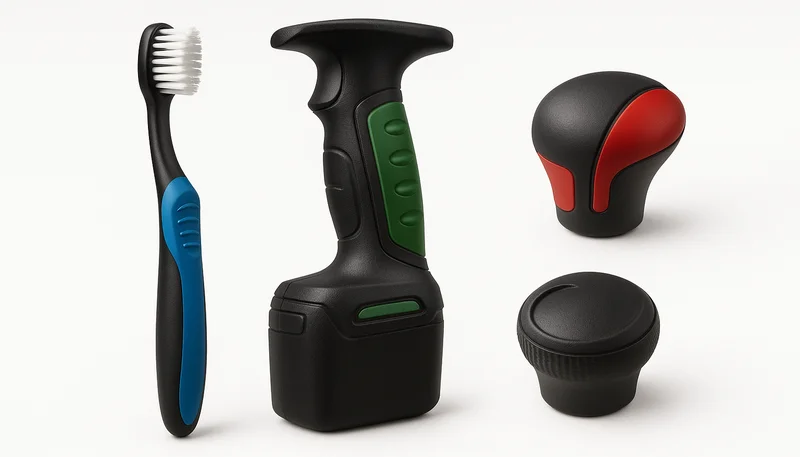
오버몰딩은 두 번째 재료(일반적으로 부드러운 엘라스토머)를 강성 플라스틱 기판 위에 성형하는 2-shot 공정입니다. 결과는 두 개의 구별되는 재료 영역이 결합된 하나의 부품입니다. 가장 일반적인 경우는 고무처럼 느껴지는 그립 영역이 있는 경질 플라스틱 본체입니다.
작동하는 두 가지 독특한 결합 메커니즘이 있으며, 이 차이를 이해하는 것은 안정적인 생산에 필수적입니다. 화학적 결합 기판과 오버몰드 재료가 호환 가능한 분자 구조를 공유할 때 발생합니다—오버몰드 재료는 주입 과정에서 분자 수준으로 기판 표면을 부분적으로 녹여 융합합니다. 이것은 가장 강한 결합 유형이지만, 재료 의존성이 매우 높습니다: 모든 기판-오버몰드 조합이 화학적으로 결합하지는 않습니다. 기계적 인터록 기재에 설계된 물리적 특징—언더컷, 홈, T-슬롯, 또는 관통 구멍—에 의존하며, 오버몰드 소재가 그 안으로 흘러 들어가고 냉각하면서 뒤쪽에 고정됩니다.
실제로 가장 좋고 가장 신뢰할 수 있는 오버몰드 부품은 둘 모두 메커니즘을 함께 결합합니다. 안전망으로 기계적 인터록 기능을 설계한 후, 화학적 결합이 주요 접착력을 제공하도록 호환 가능한 재료를 선택합니다. 표면 오염이나 공정 변동으로 인해 화학적 결합이 실패할 경우, 기계적 기능이 부품을 온전히 유지합니다.
오버몰딩은 회전형 금형(일명 투샷 몰딩3) 또는 두 개의 별도 기계에서 기판이 수동 또는 로봇 방식으로 전송되는 경우. 회전식 기계에서의 2-shot 공정은 더 빠르고 일관성이 있으며, 기판이 통제된 환경을 벗어나지 않기 때문에 더 나은 치수 반복성을 제공합니다. 두 기계 간 전송 성형은 더 유연하고 도구 비용이 저렴하지만, 처리 변동성과 인건비를 발생시킵니다. 일반적인 오버몰드 재료에는 TPU(마모 저항성과 유연성), SEBS(소프트 터치 소비자 제품), TPV(자동차 엔진실 밀폐용)가 포함됩니다.
인서트 몰딩과 오버몰딩은 어떻게 다릅니까?
인서트 몰딩과 오버몰딩은 사이클 수, 도구 복잡성 및 재료 간 결합 유형에서 근본적으로 다릅니다. 인서트 몰딩은 단일-shot 공정입니다; 오버몰딩은 두 개의 shot이 필요합니다. 아래 표는 생산에서 가장 중요한 요소들 간의 차이를 분석합니다.
| 기준 | 인서트 몰딩 | 오버몰딩 |
|---|---|---|
| 사출 횟수 | 단일 사출 | 두 번 이상의 사출 |
| 일반적인 삽입물/기재 | 금속(황동, 강철, 스테인리스) 또는 사전 성형된 부품 | 이전에 성형된 경질 플라스틱 기판 |
| 오버몰드 소재 | 열가소성 수지(PA, PBT, PC 등) | 소프트 TPE, TPU, SEBS 또는 두 번째 경질 플라스틱 |
| 주요 결합 메커니즘 | 기계적 인터록(노릴, 나사산, 언더컷, 수축 맞춤) | 화학적 결합 + 기계적 인터록 |
| 금형 복잡성 | Single cavity with insert loading station | Two cavities (or rotary mold for two-shot) |
| Typical cycle time | Shorter (one injection + cooling) | Longer (two shots + transfer + cooling) |
| Tooling cost | Lower (one cavity) | Higher (two cavities or rotary mold) |
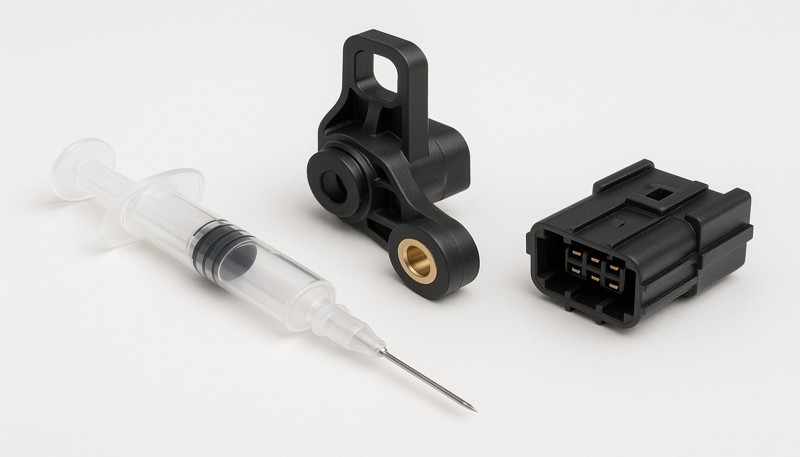
| Typical applications | Threaded fasteners, electrical connectors, medical needles | Soft-grip tools, seals, multi-color consumer parts |
| Volume suitability | Low to high (manual or automated insert loading) | Medium to high (automation preferred) |
The single-shot nature of insert molding makes it inherently faster per cycle—there’s no substrate transfer step, no second injection, and no additional cooling period. But insert loading time can eat into that advantage, especially if you’re hand-loading at low volumes. A skilled operator can load inserts in 5–10 seconds, but robotic loading brings that down to 1–3 seconds per cycle. On the other hand, overmolding’s two-shot process adds significant cycle time, but the result—a seamless multi-material part—often eliminates downstream assembly operations (seal installation, adhesive bonding, snap-fit assembly) that insert molding simply can’t replace.
One common misconception is that insert molding can only handle metal inserts. In reality, you can insert-mold plastic components, ceramic pieces, PCB assemblies, glass lenses, and even fabric or film inserts. The key constraint is that the insert must survive the injection temperature and pressure of the encapsulating material. Similarly, overmolding isn’t limited to soft-over-hard combinations—you can overmold a second rigid plastic for structural reinforcement or multi-color aesthetics.
언제 삽입 몰딩을 선택해야 하나요?
Insert molding is the right call whenever your part needs to integrate a pre-formed component—especially metal—directly into a plastic body. If you’re designing a connector housing with threaded brass inserts that need to withstand repeated assembly and disassembly cycles, insert molding produces a stronger and more consistent result than any post-molding installation method.
Electrical and Electronic Components
Connector housings, sensor bodies, PCB enclosures, and antenna assemblies frequently use insert molding to embed metal pins, terminals, or EMI shielding directly into the plastic housing. The process creates a hermetic seal around each contact, which is critical for IP-rated enclosures used in outdoor and industrial environments. In our production experience, insert-molded connectors consistently pass IP67 and IP68 testing, while parts with post-installed contacts often leak at the pin-to-plastic interface under pressure cycling.
의료 기기
Surgical instruments, drug delivery devices, catheter hubs, and diagnostic equipment often combine stainless steel needles, lumens, or electrodes with plastic bodies. Insert molding provides the sterility, precision, and material compatibility these applications demand. Biocompatible plastics like PEEK, medical-grade PC, and PPSU bond well to properly prepared metal surfaces, and the single-shot process minimizes contamination risk compared to multi-step assembly.
Automotive Fasteners and Structural Components
Threaded brass inserts molded into plastic mounting brackets are found throughout modern vehicles—from dashboard mounts and interior trim clips to under-hood cable routing brackets and sensor housings. The insert provides durable threads that survive hundreds of assembly and disassembly cycles without stripping, while the 사출 금형 design allows complex geometries that would be prohibitively expensive with all-metal construction. The weight savings from replacing metal brackets with insert-molded plastic-metal hybrids is a significant driver in automotive lightweighting.
“Overmolding typically requires a more expensive mold than insert molding because it needs two cavities or a rotary mold.”True
Overmolding tooling costs $15,000–$40,000+ compared to $8,000–$20,000 for insert molding, primarily because overmolding requires either two separate cavities (for transfer molding) or a rotary mold with two stations (for two-shot molding). The added complexity of aligning two cavities precisely and managing the substrate transfer mechanism drives the cost premium.
“Insert molding requires at least two injection shots to complete a part.”False
Insert molding is a single-shot process. The metal insert is placed in the mold cavity before the single injection cycle begins. Overmolding, by contrast, requires two or more shots to complete the part.
When Should You Choose Overmolding?
Overmolding is the right choice when you need two materials with different properties in one seamless part. Soft over hard, flexible over rigid—if ergonomics, sealing, or aesthetics matter, overmolding wins.
Consumer Products and Ergonomic Design
Toothbrushes, power tool grips, kitchen utensils, gaming controllers, and personal care devices all use overmolding to add soft-touch surfaces over rigid structural cores. The soft TPE or TPU layer provides grip comfort, vibration dampening, impact absorption, and a premium tactile feel that’s simply impossible to achieve with a single rigid material. Consumer brands have built their entire product identity around the clean, multi-material aesthetic that overmolding enables—the visual contrast between glossy rigid plastic and matte soft-touch surfaces is instantly recognizable.

Sealing and Environmental Protection
When a part needs to be waterproof or dustproof, overmolding a soft gasket material (like a silicone-alternative TPE) directly into a rigid housing creates a monolithic seal—no separate O-ring to install, no groove to machine, no assembly step, and no leak path. This approach is standard practice for outdoor electronics, marine equipment, industrial sensors, and automotive connector systems. The bonded seal is inherently more reliable than a press-fit O-ring because there’s no groove to misalign during assembly and no compression set degradation over the product’s lifetime.
Multi-Color and Multi-Material Aesthetics
Two-shot overmolding allows different colored plastics to be molded in a single machine cycle, creating sharp, clean color boundaries without any secondary painting, pad printing, or labeling. The color is integral to the part—it won’t scratch off, fade, or peel. This is widely used in brand logos on consumer electronics, button panels on appliances, and color-coded medical device components where color permanence is a regulatory requirement.
“Overmolding completely eliminates the need for secondary assembly in multi-material parts.”True
Overmolding produces a finished multi-material component in the molding process itself. Seals, soft-grip surfaces, gaskets, and multi-color features are all formed during molding, which removes the need for separate assembly steps like O-ring installation, adhesive bonding, or painting.
“Brass threaded inserts can only be installed into plastic parts using ultrasonic insertion after molding.”False
Brass inserts can be installed through multiple methods: insert molding (loaded before injection), ultrasonic insertion (pressed into pre-molded holes using ultrasonic vibration), thermal insertion (heated and pressed in), or self-tapping installation. Insert molding produces the strongest and most consistent results because the plastic shrinks directly around the insert features.
삽입 몰딩과 오버몰딩의 비용은 어떻게 비교되나요?
Cost is where the practical decision gets made. Insert molding generally has significantly lower tooling costs because you’re running a single-cavity mold—the insert loading mechanism is typically a simple fixture or manual placement. Overmolding requires either a two-station mold with a transfer mechanism or a rotary mold with two separate cavities, which can double or triple the upfront tooling investment.
On the per-part side, the economics are more nuanced. Insert molding has lower material costs (one polymer resin plus the metal insert) and shorter cycle times, but the cost of the inserts themselves adds up—brass threaded inserts typically cost $0.02–$0.15 each depending on size and quantity. Overmolding uses more material (two different polymers) and longer cycle times, but it can completely eliminate downstream assembly labor—seals, gaskets, adhesive bonding, snap-fit assembly—that would otherwise add significant per-part cost.
For high-volume production runs (50,000+ units), the labor savings from overmolding often offset the higher tooling cost within the first or second production run. For lower volumes or applications where metal integration is the primary requirement, insert molding wins on total cost of ownership.
| Cost Factor | 인서트 몰딩 | 오버몰딩 |
|---|---|---|
| Tooling investment | $8,000–$20,000 (single cavity) | $15,000–$40,000+ (two-cavity or rotary) |
| Per-part material cost | Lower (one resin + metal insert) | Higher (two resin materials) |
| Typical cycle time | 15–40 seconds per shot | 30–80 seconds total (two shots) |
| Insert/component cost | $0.02–$0.15 per insert | N/A (두 번째 재료가 현장에서 몰딩됨) |
| 조립 노동력 절감 | 패스너 설치 제거 | 씰/개스킷/접착 단계 제거 |
| 손익 분기점 규모 | 약 1,000 단위부터 경제적 | 10,000개 이상 단위에서 최고 ROI |
결론: 설계가 주로 플라스틱 내에 금속 구성요소를 내장해야 하는 경우, 인서트 몰딩은 어떤 규모에서도 거의 항상 더 경제적인 선택입니다. 소프트 터치 기능, 통합된 실, 또는 다중 색상 미학이 필요한 경우, 오버몰딩의 더 높은 툴링 비용은 제거된 후속 작업과 향상된 제품 신뢰성으로 그 비용을 상쇄합니다.
What Are the Key Design Considerations for Each Process?
인서트 몰딩 설계 가이드라인
인서트 몰딩과 오버몰드 간 설계 고려사항은 근본적으로 다릅니다. 인서트 몰딩에서는 인서트 주변 벽 두께가 인서트 직경의 최소 0.5배(이상적으로 1배) 이상이어야 합니다. 이는 반대쪽 표면에 싱크 마크를 방지하고 완전한 캡슐화를 위한 충분한 재료 흐름을 보장합니다.
인서트가 주입 중 굽힘 또는 회전을 방지하기 위해 최소 두 면에서 지지되도록 항상 몰드를 설계하십시오. 게이트 위치는 중요합니다: 용융 흐름이 밀어내도록 게이트를 배치하십시오 주변 인서트를 균형 패턴으로, 정면으로 충돌하지 않고 양쪽에서 감싸도록 합니다. 불균형 흐름 전면은 인서트를 0.2–0.5 mm 위치에서 벗어나게 할 수 있으며, 전기 커넥터 같은 정밀 허용 오차 적용에서는 허용되지 않을 수 있습니다.
오버몰딩 설계 지침
화학적 결합 강도는 전적으로 재료 적합성에 의존합니다—선택을 확정하기 전에 항상 재료 공급업체의 오버몰드 접착 차트를 참조하십시오. 검증된 조합에는 ABS + TPE, PP + SEBS, 및 PC + TPU가 포함됩니다. 화학적 결합이 불가능한 경우(비적합 재료 쌍), 전적으로 기계적 인터록에 의존해야 합니다, 이는 언더컷, T-슬롯, 또는 오버몰드 재료가 흘러 들어가 뒤에서 잠글 수 있는 기판 내 통과 구멍을 설계해야 함을 의미합니다.
오버몰드 층의 벽 두께는 일반적으로 1.0~3.0 mm 범위입니다. 더 얇은 층(1.0 mm 미만)은 충분한 결합 강도를 달성하지 못할 수 있으며 일관적으로 채우기가 어려울 수 있습니다. 더 두꺼운 층(3.0 mm 이상)은 냉각 요구 사항으로 인해 사이클 시간을 크게 증가시키고 기판의 뒤틀림을 유발할 수 있습니다. 기판과 오버몰드 사이의 급격한 전환을 피하십시오—반경 모서리(최소 0.5 mm 반경)를 사용하여 하중 또는 열 사이클링에서 탈층을 유발할 수 있는 응력 집중을 방지합니다.
오버몰드 캡슐의 드래프트 각도는 연성 재료의 유연성을 고려해야 합니다—TPE 오버몰드에는 일반적으로 1–2°가 충분하며, 강성 플라스틱에 자주 사용되는 0.5–1°와 비교됩니다. 기판은 처음부터 오버몰드를 고려하여 설계해야 하며, 사후 고려 사항이 아닙니다. 기존 기판 설계에 오버몰드 특징을 사후 추가하는 것은 접착 실패의 일반적인 원인입니다.
“오버몰드 벽 두께가 1.0 mm 미만일 경우 결합 강도를 감소시키고 채우기 문제를 유발할 수 있습니다.”True
1.0mm 미만의 얇은 오버몰드 층은 두 가지 문제를 야기합니다: 재료가 충분히 흐르지 않아 캐비티를 일관적으로 채우지 못할 수 있으며, 감소된 접촉 면적은 화학적 결합 면을 제한합니다. 권장 최소치는 1.0mm이며, 대부분의 TPE 및 TPU 오버몰드에 대해 1.5–2.5mm가 최적 범위입니다.
“매끄러운 원통형 인서트는 대부분의 인서트 몰딩 적용에 충분한 유지력을 제공합니다.”False
평활 인서트는 단축 맞춤(shrink-fit)에만 의존하며, 이는 처리 조건에 따라 변동합니다. 노릴 또는 홈이 있는 인서트는 플라스틱이 표면 구조물과 기계적으로 인터록되므로 3~5배 더 높은 탈출 강도를 제공합니다. 모든 하중 부하 응용 분야에서는 인서트의 표면 준비가 필수적입니다.
각 공정에 가장 적합한 재료는 무엇입니까?
재료 선택은 두 과정 모두에서 중요하지만, 고려 사항은 근본적으로 다릅니다. 인서트 몰딩에서는 주로 캡슐화 플라스틱이 인서트 주위로 흐르고 냉각 및 수축 시 기계적으로 인서트를 잡는 능력에 초점을 맞춥니다. 오버몰딩에서는 기판과 오버몰드 재료 사이의 접착력—화학적 및 기계적—이 중심 문제입니다.
| 프로세스 | 기판/인서트 | 몰딩 재료 | Key Consideration |
|---|---|---|---|
| 몰딩 삽입 | 황동 나사 인서트 | PA6, PA66, PBT | 높은 수축률이 강력한 기계적 잠금을 생성 |
| 몰딩 삽입 | 스테인리스 스틸 니들 | 의료용 PC, PEEK | 생체 적합성, 자동 멸균(오토클레이브) 내성 |
| 몰딩 삽입 | 구리 단자/핀 | PBT, PPS, LCP | 전기 절연, 치수 안정성 |
| 몰딩 삽입 | 알루미늄 히트싱크 | PBT, PA66 + GF | 열 관리, 구조적 강화 |
| 오버몰딩 | ABS 기판 | TPE (쇼어 A 50–80) | 강한 화학적 결합, 소비자 제품 |
| 오버몰딩 | PP 기판 | SEBS, TPV | 자동차 실, 폴리올레핀 위 소프트 터치 오버몰딩 |
| 오버몰딩 | PC 기판 | TPU | 마모 저항성, 광학적 투명성 가능 |
| 오버몰딩 | PA66 기판 | TPE-S 또는 TPE-O | 자동차 엔진 내부, 화학적 저항성 |
| 오버몰딩 | POM 기판 | TPU 또는 TPE | Gear assemblies, low-friction plus soft-touch |
For insert molding, semi-crystalline materials like PA66 and PBT are popular because their higher shrinkage rates (1.2–2.0%) create stronger shrink-fit forces around the insert compared to amorphous materials like PC (0.5–0.7%). However, amorphous materials offer better dimensional stability and tighter tolerances—so the choice depends on whether pull-out strength or positional accuracy is the priority for your specific application.
For overmolding, always verify chemical compatibility with physical testing. Overmold bond strength testing per ASTM D903 is the industry standard for quantifying adhesion between substrate and overmold layers. Material supplier data sheets provide adhesion ratings, but actual bond strength depends on your specific processing conditions including melt temperature, injection speed, substrate surface condition, and cooling rate.
20년 이상의 생산 경험에서 무엇을 배웠습니까?
Running both insert molding and overmolding daily at our Shanghai facility across 47 injection molding machines (90T–1850T, including 3 dedicated two-shot machines) has taught us several lessons that textbooks don’t cover:
Insert placement accuracy is the #1 quality driver. Even 0.2 mm of insert shift can cause dimensional failure on tight-tolerance electrical connectors. We use robotic insert loading with vision verification on high-volume jobs. On our vertical clamp machines, gravity assists with positioning, but we still run in-mold sensors to confirm placement before every shot. The cost of the sensor system paid for itself within three months by eliminating scrap from misplaced inserts.
Overmold adhesion testing must start at the sampling stage, not during production ramp. We’ve seen too many projects discover bonding failures during PPAP or first-article inspection because the material combination wasn’t tested under actual production conditions. Our standard procedure requires overmold bond strength testing data on first-off samples before any overmolding job moves past the sampling phase. With 8 senior engineers (each with 10+ years of experience) and 120+ production staff, we have the bandwidth to do this right.
Cycle time optimization is where the real margin lives. For insert molding, reducing insert loading time through automation (vibratory bowl feeders, robotic pick-and-place) often cuts more cycle time than optimizing injection parameters. For overmolding, minimizing substrate transfer time between stations and optimizing simultaneous cooling of both materials are the biggest levers. Our engineering team focuses their process optimization efforts on these specific areas because they deliver the highest ROI.
We’re ISO 9001, ISO 13485, ISO 14001, and ISO 45001 certified, with a 6-step quality control process covering incoming inspection, in-process sampling, process inspection, packaging inspection, final inspection, and outgoing inspection. Whether your project needs insert molding for medical-grade components or overmolding for consumer product ergonomics, our in-house mold manufacturing facility and 100+ sets of mold delivered monthly give us the capacity and precision to deliver.
인서트 몰딩과 오버몰딩에 대해 가장 자주 묻는 질문은 무엇입니까?
자주 묻는 질문
What is the main difference between insert molding and overmolding?
Insert molding is a single-shot process where a pre-formed insert (usually metal) is placed in the mold cavity before plastic is injected around it, creating a permanent mechanical bond through shrink-fit and surface features. Overmolding is a two-shot process where a second material is molded over a previously molded plastic substrate, bonding through both chemical adhesion and mechanical interlocking. The fundamental differences are the number of injection cycles required, the types of materials being combined, and the bonding mechanisms involved.
Is insert molding cheaper than overmolding?
Tooling for insert molding is generally less expensive because it requires only a single-cavity mold with an insert loading mechanism, while overmolding requires two separate cavities or a rotary mold, which can double or triple the upfront investment. Per-part costs are more nuanced: insert molding has lower material costs and shorter cycle times, but the metal inserts themselves add $0.02–$0.15 per piece. Overmolding costs more per cycle but can eliminate downstream assembly operations. At volumes above 10,000 units, overmolding often becomes the more economical total-cost option.
Can you overmold onto a metal substrate?
You can mold plastic over a metal component, but the manufacturing industry classifies this process as insert molding rather than overmolding. Overmolding specifically refers to molding a second plastic material over a first plastic substrate. When metal is involved as the pre-placed component, the standard terminology is insert molding regardless of the polymer being injected around it. This distinction matters because the process parameters, tooling design, and bonding mechanisms differ significantly between the two approaches, and using the correct terminology ensures clear communication with your mold maker and production team.
What materials are commonly used for overmolding?
The most widely used overmold materials include TPE (thermoplastic elastomer) for general soft-touch applications, TPU (thermoplastic polyurethane) for wear resistance and flexibility, SEBS (styrene-ethylene/butylene-styrene) for automotive and consumer products requiring chemical resistance, TPV (thermoplastic vulcanizate) for under-hood automotive sealing applications, and TPR (thermoplastic rubber) for grip surfaces. Material selection depends primarily on the substrate material for chemical bond compatibility, required hardness range on the Shore A scale, environmental operating conditions including temperature and chemical exposure, and any regulatory requirements such as FDA or USP Class VI compliance for medical applications.
How strong is the bond in overmolding?
Bond strength varies significantly based on material combination, surface preparation, and part design. Chemically bonded overmolds using compatible material pairs like ABS and TPE typically achieve peel strengths of 15–30 N/mm when tested per the ASTM D903 standard. Mechanical interlocks through undercuts, T-slots, and through-holes provide additional retention strength that is independent of chemical bonding conditions. Most reliable production overmolds combine both chemical and mechanical bonding mechanisms to ensure consistent performance across processing variations and throughout the product’s service life in real-world operating conditions.
What industries use insert molding most heavily?
The largest consumers of insert molding technology are the electronics industry (connector housings with embedded metal pins, sensor bodies with sealed terminals, PCB-level antenna assemblies), medical device manufacturers (surgical instruments with stainless steel components, drug delivery systems with needle hubs, diagnostic equipment with embedded electrodes), the automotive sector (interior trim fasteners, dashboard mounting brackets, under-hood cable clips with threaded brass inserts), and consumer appliance producers (housings with integrated mounting points and threaded standoffs). Any industry that requires durable metal features permanently integrated into plastic components relies on insert molding as a primary manufacturing process.
Can insert molding and overmolding be combined in one part?
Yes, hybrid processes combining both insert molding and overmolding are common in complex multi-material assemblies. A typical example is an electronic connector where metal contacts are first insert-molded into a rigid plastic housing, and then the entire sub-assembly is overmolded with a soft TPE seal for IP67 environmental protection. This three-material, multi-process approach is powerful but requires careful process sequencing, significantly higher tooling investment, and rigorous quality control at each manufacturing stage to ensure dimensional accuracy and bond integrity throughout the production run.
What dimensional tolerance can insert-molded parts achieve?
Insert-molded parts typically achieve tolerances of ±0.05 to ±0.15 mm on critical dimensions, following ISO 20457:2018 guidelines for injection molded components. The metal inserts themselves are machined to much tighter tolerances (±0.01–0.02 mm), and the primary challenge is maintaining the insert’s positional accuracy through the high-pressure injection process. Factors affecting final tolerance include the plastic material’s shrinkage rate, insert placement precision, gate location and flow pattern, cooling uniformity across the part, and the rigidity of the insert support structure within the mold cavity during the injection cycle.
-
인서트 몰딩: Insert molding is a single-shot injection molding process where a pre-formed component (typically metal) is placed in the mold cavity before plastic is injected around it, creating a permanent mechanical bond through shrink-fit and surface interlocking features. ↩
-
오버몰딩: Overmolding is a two-shot molding process where a second material is molded over a previously molded substrate. Bond strength between compatible pairs (ABS/TPE) typically achieves 15–30 N/mm peel strength per ASTM D903. ↩
-
투샷 몰딩: two-shot molding refers to uses a rotary mold to inject different materials sequentially in one machine cycle, improving consistency and reducing handling between shots. ↩



 EN
EN  ES
ES  FR
FR  DE
DE  PT
PT  AR
AR  RU
RU  JA
JA  KO
KO  IT
IT  NL
NL  TR
TR  PL
PL 