 콘텐츠로 건너뛰기

You need 200 large polyurethane1 housings for an industrial enclosure project. Traditional injection molding quotes came back at $45,000 for tooling alone — amortized over 200 parts, that is $225 per unit just for the mold. Reaction Injection Molding (RIM) can cut that tooling cost by 60–80% while delivering parts with comparable structural performance. This guide covers the chemistry, process parameters, material options, cost trade-offs, and real decision criteria for choosing RIM over conventional injection molding.
- RIM forms parts through chemical reaction, not melting and cooling
- Tooling costs 60–80% less than traditional injection molding
- Ideal for large parts (>12 inches) at low-to-medium volumes (50–5,000 units)
- Limited primarily to polyurethane-based thermoset materials
- Injection pressures are 90–95% lower than thermoplastic injection molding
| 매개변수 | Typical Value |
|---|---|
| 사출 압력 | 50–200 psi (3.4–13.8 bar) |
| 금형 온도 | 100–180 °F (40–80 °C) |
| Primary Material | 폴리우레탄(PU) |
| Ideal Part Size | > 12 inches (300 mm) |
| Typical Volume Range | 50–5,000 units/year |
| Tooling Cost vs IM | 60–80% lower |
What Is Reaction Injection Molding (RIM)?
Reaction injection molding (rim) is defined by the function, constraints, and tradeoffs explained in this section. If you are comparing vendors or planning procurement, our injection molding supplier sourcing guide covers RFQ prep, qualification, and commercial risk checks.
Reaction Injection Molding (RIM) is a low-pressure manufacturing process where two liquid chemical components — typically a polyol and an isocyanate — are metered, mixed under high-pressure impingement, and injected into a closed mold where they react to form a solid thermoset2 part. Unlike conventional injection molding, which melts solid plastic pellets and forces them into a mold at 5,000–20,000 psi, RIM relies on chemistry, not heat and pressure, to create the part.
The key distinction: traditional injection molding is a physical process (melt → fill → cool → eject). RIM is a chemical process (mix → react → cure → demold). This fundamental difference drives every advantage and limitation that follows.
RIM was developed in the late 1960s and gained widespread adoption in the automotive industry during the 1970s and 1980s for producing bumper fascias, body panels, and interior components. Today, it remains the go-to process for large, complex polyurethane² parts at volumes where traditional injection molding tooling is not economically justified.
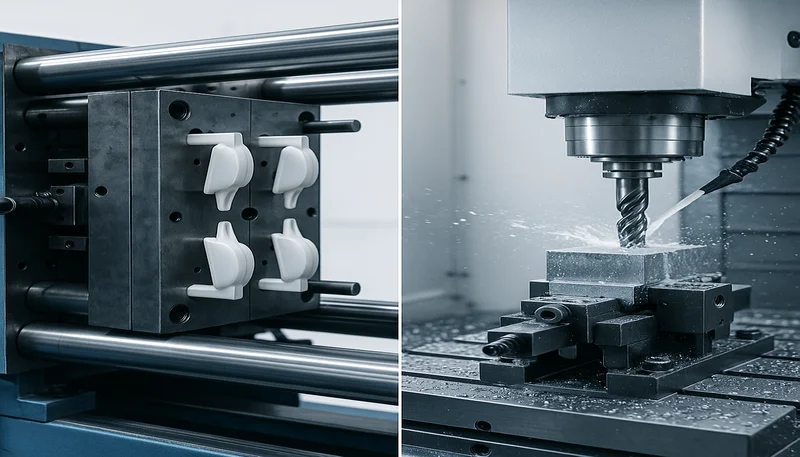
How Does the RIM Process Work Step by Step?
The RIM process is a five-step sequence: meter, mix, fill, cure, and demold a reactive polyurethane part. The sequence below contrasts RIM with a 스크류 사출 성형기 workflow so engineers can diagnose quality issues and optimize cycle times.
Step 1: Material Storage and Temperature Control. The two components — usually a polyol blend (Component A) and an isocyanate (Component B) — are stored in separate heated tanks at controlled temperatures, typically 80–120 °F (27–49 °C). Temperature stability matters because viscosity changes directly affect mix quality. A 10 °F deviation can shift viscosity by 15–25%, leading to incomplete mixing.
Step 2: High-Pressure Metering and Mixing. When the cycle initiates, precision metering pumps deliver the two components at a specified ratio (commonly 1:1 by volume, but ranges from 100:30 to 100:200 depending on the formulation). The streams meet in a high-pressure impingement mixing head at 1,500–3,000 psi. This impingement energy creates turbulent mixing in milliseconds — no mechanical agitator is needed.
Step 3: Mold Filling. The mixed liquid flows into a closed mold at relatively low pressure (50–200 psi). Because the reacting mixture has low viscosity (similar to water), it fills complex geometries and thin-wall sections easily. The mold is typically heated to 100–180 °F to accelerate the cure reaction.
Step 4: Chemical Reaction and Curing. Inside the mold, an exothermic reaction3 occurs as the polyol and isocyanate cross-link. The material expands slightly (foaming action in structural foam RIM), fills all mold details, and cures to its final solid state. Depending on the formulation, cure time ranges from 1–10 minutes. The exotherm can reach 250–350 °F internally, even though the mold itself stays relatively cool.
Step 5: Demolding and Post-Processing. After demold time⁴ is reached, the mold opens and the part is removed. RIM parts typically require post-curing (24–48 hours at ambient temperature) to achieve full mechanical properties. Flash trimming, surface finishing, and painting are common secondary operations.
What Materials Are Used in RIM?
The material landscape for RIM is far narrower than for thermoplastic injection molding. While thermoplastic IM offers thousands of resin grades across dozens of polymer families, RIM is dominated by polyurethane chemistry. This is both its strength (deep optimization within PU) and its limitation (you cannot run nylon, polycarbonate, or PEEK through a RIM machine).

Polyurethane (PU) Elastomers. The workhorse of RIM. Solid elastomeric PU parts range from Shore A 50 (soft, rubbery) to Shore D 80 (hard, rigid). Used for bumper fascias, fender extensions, and industrial housings. Typical flexural modulus: 5,000–300,000 psi.
Structural Foam⁵ PU. By introducing a blowing agent (often water reacting with excess isocyanate to form CO₂), RIM produces parts with a cellular core and solid skin. This cuts weight by 10–30% while maintaining stiffness. Wall thickness can reach 0.5 inches without sink marks — something thermoplastic injection molding struggles with.
Reinforced RIM (RRIM). Adding milled glass fibers (typically 10–25% by weight) or mineral fillers to the polyol component increases stiffness, dimensional stability, and thermal resistance. RRIM parts have 2–4× higher flexural modulus than unfilled PU, making them suitable for semi-structural automotive components like pickup truck bed liners and door panels.
Non-PU Systems. Less common but commercially available: polyurea (faster cure, better thermal stability), nylon block copolymers (for higher-temperature applications), and dicyclopentadiene (DCPD, used for extremely large parts like agricultural equipment panels). These account for less than 15% of total RIM production.
| Material System | 밀도(g/cm³) | Flexural Modulus (psi) | Typical Use |
|---|---|---|---|
| Solid PU Elastomer | 1.0–1.2 | 5,000–50,000 | Bumper fascias, seals |
| Structural Foam PU | 0.4–0.8 | 20,000–100,000 | Panels, enclosures |
| RRIM (20% glass) | 1.2–1.4 | 100,000–300,000 | Door panels, fenders |
| 폴리우레아 | 1.0–1.1 | 15,000–80,000 | High-temp covers |
| DCPD | 1.0–1.1 | 200,000–350,000 | Large equipment panels |
What Are the Advantages of RIM?
The advantages of rim are the main categories or options explained in this section. RIM offers specific advantages that make it the correct engineering choice for certain applications — and the wrong one for others. Here is what it genuinely does well, based on real production data, not marketing claims.
Low Tooling Cost. RIM molds operate at 50–200 psi, compared to 5,000–20,000 psi for thermoplastic injection molding. This means molds can be built from aluminum, cast epoxy, or even 3D-printed resins for prototyping. A steel production RIM mold costs $5,000–$25,000 for a medium-complexity part, versus $30,000–$150,000 for a comparable injection mold. At volumes below 1,000 units, this difference alone often makes RIM the economically rational choice.
Large Part Capability. RIM handles parts that are impractical for standard injection molding. Automotive bumper fascias up to 6 feet long, agricultural equipment panels, and medical equipment enclosures are routine RIM applications. The low fill pressure means clamping force requirements are minimal — a 10-ton clamp can produce parts that would need a 500-ton clamp in thermoplastic IM.

Design Freedom. Because the reacting liquid has water-like viscosity, RIM fills undercuts, thin ribs, and complex geometries without the high-pressure packing that thermoplastic IM requires. Wall thickness variations of 3:1 within the same part are manageable. You can mold in inserts, threaded bosses, and structural reinforcements in a single shot.
Encapsulation. RIM naturally encapsulates metal inserts, electronic components, and reinforcement structures. The low injection pressure (under 200 psi) does not damage sensitive electronics. This makes it ideal for medical device housings with embedded PCBs, automotive components with metal brackets, and industrial enclosures with integrated EMI shielding.
Low Volume Economics. For production runs of 50–2,000 units per year, RIM often delivers lower total cost per part than low-volume injection molding when you factor in tooling amortization. The break-even point versus thermoplastic IM typically falls between 2,000–5,000 units, depending on part geometry and material.
At ZetarMold, we regularly encounter customers who request low-volume injection molding quotes for parts that would be better served by RIM. When a client needs 300 units of a 500 mm enclosure and quotes come back at $40,000+ for steel tooling, we explain the honest trade-off: our 45 injection molding machines running 90T–1850T are optimized for thermoplastic production volumes of 1,000+ units. For sub-1,000 unit runs of large polyurethane parts, RIM is the economically correct choice, even though we would refer that work to a specialized RIM shop. Helping customers find the right process — even when it is not ours — builds longer-term trust and often brings them back for production-scale thermoplastic programs.
What Are the Limitations of RIM?
The limitations of rim are the main categories or options explained in this section. Every manufacturing process has constraints. Understanding RIM’s limitations is as important as knowing its strengths, because choosing the wrong process is far more expensive than choosing the right one.
Material Narrowness. RIM is overwhelmingly limited to polyurethane-based systems. If your application requires the chemical resistance of PPS, the transparency of PMMA, the dimensional stability of PEEK, or the cost efficiency of polypropylene, RIM cannot deliver. This is the single most common reason engineers abandon RIM after initial evaluation.
Cycle Time. RIM cycle times range from 2–10 minutes, compared to 10–60 seconds for thermoplastic injection molding. The chemical reaction simply takes longer than cooling molten plastic. For high-volume production (above 5,000 units/year), this makes RIM uneconomical regardless of tooling savings.
Surface Finish. While RIM parts can be painted to Class A automotive standards, the raw molded surface typically shows flow marks, porosity, and color variation. Achieving cosmetic-quality surfaces requires priming, filling, and painting — adding cost and lead time. If you need a cosmetic surface straight from the mold, thermoplastic injection molding with polished steel tools is the better choice.
Recyclability. Thermoset polyurethanes cannot be remelted and reprocessed. Unlike thermoplastic scrap, which can be reground and reused, RIM runners, flash, and rejected parts go to landfill or require specialized chemical recycling. For companies with sustainability mandates, this is a real limitation.
“RIM tooling costs 60–80% less than thermoplastic injection molding tooling for equivalent part geometries.”True
RIM operates at 50–200 psi versus 5,000–20,000 psi for thermoplastic IM, allowing aluminum or epoxy molds instead of hardened steel. A medium-complexity RIM mold costs $5,000–$25,000 versus $30,000–$150,000 for an injection mold.
“RIM can produce parts in any polymer, including engineering thermoplastics like PEEK, PPS, and polycarbonate.”False
RIM is fundamentally limited to thermosetting polymers that cure through chemical reaction — primarily polyurethanes, polyureas, and a few specialty systems. Engineering thermoplastics require melting and cooling, which is the domain of traditional injection molding.
How Does RIM Compare to Traditional Injection Molding?
Rim is more competitive than traditional injection molding when the cost, lead time, and quality tradeoffs below match your program needs. RIM compares to traditional injection molding by trading slower cycle time and narrower material choice for much lower tooling pressure, lower mold cost, and easier large-part production. In our factory quoting work, we found the decision usually turns on volume, part size, material requirements, and surface finish standards. For cycle-time benchmarks, compare RIM’s 2-10 minute cure with standard 사출 성형 생산 시간.
| 요인 | RIM | Traditional IM |
|---|---|---|
| 사출 압력 | 50–200 psi | 5,000–20,000 psi |
| Typical Tooling Cost | $5,000–$25,000 | 30,000–150,000 |
| 주기 시간 | 2–10분 | 10–60초 |
| 머티리얼 옵션 | PU, 폴리우레아, DCPD | 100+ 열가소성 플라스틱 |
| 최대 부품 크기 | 6피트 이상 (2m) | 프레스 토너지에 의해 제한됨 |
| 최적 생산량 | 50–5,000 units/year | 1,000–1,000,000+개/년 |
| 표면 마감 (성형 상태) | 도장 필요 | 클래스 A 달성 가능 |
| 벽 두께 범위 | 0.125–0.5인치 | 0.02–0.5 인치 |
| 재활용 가능성 | 재활용 불가 (열경화성 수지) | 재분쇄 및 재사용 |
The critical breakpoint is volume. Below 2,000 units, RIM’s tooling savings usually offset its slower cycle time and higher per-part material cost. Above 5,000 units, thermoplastic injection molding’s faster cycles and lower material costs win decisively. Between 2,000–5,000 units, the decision depends on part complexity, material requirements, and surface finish needs.
부품 크기는 두 번째 주요 변수입니다. 12인치(300mm) 이상의 부품에는 소량 생산 시 RIM에 대한 실질적인 열가소성 대안이 없는 경우가 많습니다. 대형 사출 금형(1,000+톤 프레스 필요)의 비용은 $200,000 이상일 수 있지만, 유사한 RIM 금형은 $30,000 미만으로 유지됩니다. 이것이 자동차 산업이 수십 년 동안 범퍼 페이시아에 RIM을 사용한 이유입니다, 대량 생산 차량에도 적용됩니다.

“연간 생산량이 2,000개 미만인 경우, RIM은 일반적으로 열가소성 사출 성형보다 부품당 총 비용이 더 낮습니다.”True
1,000개 단위로 상각되는 $20,000 RIM 금형은 단위당 $20의 금형 비용을 추가합니다. 동일한 생산량으로 상각되는 $100,000 사출 금형은 단위당 $100을 추가합니다. RIM의 높은 부품당 재료 비용에도 불구하고, 총 단위 비용은 2,000개 미만의 생산량에서 더 낮습니다.
“RIM은 강철 금형 사출 성형과 동일한 치수 정밀도와 표면 마무리로 부품을 생산합니다.”False
RIM 부품은 일반적으로 ±0.010–0.030 인치 공차를 달성하는 반면, 정밀 사출 성형은 ±0.002–0.005 인치 공차를 제공합니다. 성형된 RIM 표면은 외관 품질을 위해 프라이밍과 도색이 필요하지만, 연마된 강철 사출 금형은 직접 Class A 표면을 제공할 수 있습니다.
가장 일반적인 RIM 적용 사례는 무엇인가요?
가장 일반적인 RIM 응용 분야는 이 섹션에서 설명하는 주요 범주 또는 옵션입니다. RIM은 낮은 금형 비용, 대형 부품 제작 능력 및 설계 자유도의 조합으로 명확한 장점을 창출하는 특정 틈새 시장을 개척했습니다. 이는 이론적인 응용 분야가 아닌 현재 RIM이 실제 생산에서 적극적으로 사용되고 있는 분야를 나타냅니다.
자동차. 범퍼 페이시아는 전 세계적으로 단일 최대 RIM 응용 분야로 남아 있습니다. 기타 자동차 용도에는 펜더 확장판, 스포일러, 계기판 기판, 도어 패널, 픽업 트럭 적재함 라이너가 포함됩니다. 자동차 산업은 전체 RIM 생산량의 약 65%를 차지합니다.
의료 장비. MRI 기기, CT 스캐너 및 수술용 로봇 외장용 대형 장비 외장은 RIM 적용의 주요 대상입니다. 이러한 부품은 일반적으로 크기가 크고(300mm 이상), 소량 생산이 필요하며(100–500개/년), 전자 부품을 내장해야 합니다. 낮은 사출 압력은 내장된 배선과 센서의 손상을 방지합니다.
산업용 외장. 건설 및 농업 기계용 제어판 하우징, 전기 분전함 및 장비 커버. RIM은 장착 하드웨어용 금속 인서트를 성형할 수 있는 능력과 충격 및 화학 물질에 대한 저항성으로 인해 가혹한 환경에 적합합니다.
항공우주. 항공기용 내부 패널, 덕트 및 페어링. 폴리우레탄의 고유한 난연성(적절한 첨가제로 배합 시) 및 FAA 연기 및 독성 요구 사항을 충족할 수 있는 능력으로 인해 RIM은 소량 항공 우주 내부 구성 요소에 실용적인 선택입니다.
소비자 가전. 게임 머신, ATM 외함, 키오스크 캐비닛용 대형 하우징. 생산 량이 1,000단위 미만이고 부품이 표준 사출 성형 크기 한계를 초과할 때, RIM은 수작업 적층 유리섬유와 표준 사출 성형 사이의 비용 효율적인 중간 지대를 제공합니다. 사출 성형 및 수작업 적층 유리섬유.
프로젝트에 RIM을 선택해야 할 때는 언제인가요?
위의 장점, 제한 사항 및 비교를 읽은 후, 결정 프레임워크는 실용적인 체크리스트로 간소화됩니다. 다음은 RIM이 적합한 경우와 적합하지 않은 경우입니다.
RIM을 선택할 때: 연간 생산량이 5,000개 미만이며, 부품의 한 차원이 12인치보다 크고, 폴리우레탄이 제공하는 재료 특성(충격 저항성, 유연성 또는 폼 단열)이 필요하며, 금형 예산이 제한된 경우입니다. 이 네 가지 조건 중 세 가지가 해당된다면 RIM을 진지하게 평가할 가치가 있습니다.
RIM을 선택하지 않아야 할 경우: 연간 10,000개 이상이 필요할 때(사이클 시간이 경제성을 저해함), 엔지니어링 열가소성 플라스틱이 필요할 때 사출 금형 PEEK, PPS 또는 폴리카보네이트 같은 재료가 필요할 때, 도장 없이 Class A 표면 마감이 필요할 때, 또는 ±0.005인치 이상의 정밀 공차가 필요할 때. 이러한 경우 열가소성 사출 성형이 적절한 공정입니다.
중간 영역 (2,000–5,000 단위): 이 부분은 의사 결정에 상세한 비용 모델링이 필요합니다. (1) 예상 수명 동안 분할된 금형 비용, (2) 부품당 재료 비용, (3) 사이클 시간 × 기계 비율, (4) 후속 공정 (RIM의 도색, IM의 잠재적 금형 수정)을 비교하는 스프레드시트를 작성하세요. 우리의 경험에 따르면, 대부분의 중간 복잡성 부품에 대한 전환점은 약 3,000–3,500 단위 정도입니다.
반응 사출 성형에 대해 가장 자주 묻는 질문은 무엇인가요?
RIM과 사출 성형의 차이는 무엇인가요?
RIM은 액상 화학 성분(일반적으로 폴리올과 이소시아네이트)을 사용하여 금형 내에서 반응하고 경화되어 고체 열경화성 부품을 형성하며, 사출 압력은 단 50–200psi에서 작동합니다. 기존 사출 성형은 고체 열가소성 펠릿을 용융시켜 5,000–20,000psi의 압력으로 금형에 주입한 후 냉각하여 고체화합니다. RIM은 상당히 낮은 금형 비용(60–80% 더 적음)을 제공하고 표준 사출 성형보다 훨씬 더 큰 부품을 처리할 수 있지만, 폴리우레탄 기반 재료로 제한되며 사이클 시간은 열가소성 사출 성형의 10–60초에 비해 2–10분입니다. 사출 성형은 100종 이상의 열가소성 플라스틱에 걸친 더 넓은 재료 선택, 더 빠른 생산 사이클 및 더 엄격한 치수 공차를 제공합니다.
사출 성형에 비해 RIM 금형 비용은 얼마나 드나요?
RIM 금형은 중간 복잡성 부품의 경우 일반적으로 $5,000~$25,000의 비용이 드는 반면, 동등한 열가소성 사출 금형은 $30,000~$150,000으로 — 60~80%의 감소입니다. 이 극적인 비용 차이는 RIM의 낮은 작동 압력(IM의 5,000~20,000 psi 대비 200 psi 미만)에서 비롯되며, 이로 인해 금형이 경화 공구강 대신 알루미늄, 주형 에폭시 또는 복합 재료로 제작될 수 있습니다. 프로토타이핑 및 매우 짧은 생산 런의 경우, 3D 프린팅된 RIM 금형은 $1,000 미만의 비용이 들 수 있습니다. 단점은 RIM 금형이 강철 사출 금형보다 더 빨리 마모되어 일반적으로 경화 강철 공구의 100,000+ 샷 대비 5,000~20,000 샷 동안 지속된다는 점입니다.
어떤 유형의 부품이 RIM에 가장 적합한가요?
RIM에 가장 적합한 것은 어떤 차원으로든 12인치(300mm)를 초과하는 대형 부품으로, 연간 50~5,000개의 저~중간 생산량이 필요하며 폴리우레탄 재료 특성이 애플리케이션 요구 사항을 충족하는 경우입니다. 일반적인 예로는 자동차 범퍼 패시아 및 본드 패널, MRI 및 CT 기기용 의료 장비 하우징, 산업용 제어판 외함, 항공우주 내장 부품 등이 있습니다. 금속 인서트, 전자 부품 또는 구조적 보강재의 캡슐화가 필요한 부품도 강력한 RIM 후보입니다. 왜냐하면 낮은 사출 압력(200psi 미만)이 성형 중에 내장된 하드웨어를 손상시키지 않기 때문입니다.
RIM으로 엄격한 공차를 가진 부품을 생산할 수 있나요?
RIM은 일반적으로 ±0.010~0.030인치(0.25~0.75mm)의 공차를 달성하며, 이는 많은 구조용 하우징, 외함 및 패널 적용 분야에 충분합니다. 그러나 이는 경화 강철 금형을 사용한 열가소성 사출 성형이 제공할 수 있는 ±0.002~0.005인치(0.05~0.13mm)에는 미치지 못합니다. 애플리케이션에 정밀 베어링 맞춤, 개스킷용 밀봉 표면, 여러 부품 간의 긴밀한 결합 인터페이스 또는 ±0.010인치보다 엄격한 기하 공차(GD&T) 호출이 필요한 경우, 강철 금형을 사용한 기존 사출 성형이 더 적합한 제조 공정입니다.
RIM은 환경 친화적인가요?
RIM은 솔직한 평가가 필요한 복합적인 환경적 특성을 가지고 있습니다. 긍정적인 측면으로, RIM은 액상 반응물이 금형 캐비티를 정확히 채우기 때문에 공정 중 최소한의 재료 폐기물을 생성하며, 열가소성 사출 성형에 비해 낮은 작동 온도(100–180°F)와 압력(50–200psi)으로 인해 부품당 상당히 적은 에너지를 사용합니다. 그러나 열경화성 폴리우레탄은 기존의 기계적 수단으로 재활용할 수 없습니다 — 스크랩 재료, 러너, 플래시 및 수명이 다한 부품은 열가소성 플라스틱처럼 재용융 및 재처리될 수 없습니다. 폴리우레탄의 화학적 재활용 공정은 존재하지만 아직 상업적 규모로 널리 사용 가능하지는 않아, 현재 대부분의 RIM 폐기물은 매립지로 처리됩니다.
RIM 부품 경화에는 얼마나 걸리나요?
RIM 사이클 시간은 부품 두께, 재료 배합, 금형 온도 및 부품 복잡성에 따라 샷당 2~10분 범위입니다. 벽 두께 6mm 미만의 얇은 벽 부품은 빠르게 반응하는 폴리우레아 배합으로 2~3분 내에 탈형할 수 있는 반면, 12mm를 초과하는 두꺼운 구조용 폼 부품은 안전한 제거를 위한 충분한 초기 강도를 얻기 위해 8~10분이 필요할 수 있습니다. 탈형 후 RIM 부품은 일반적으로 완전한 규정 기계적 특성을 달성하기 위해 상온에서 24~48시간 동안 후경화가 필요합니다. 이 후경화 단계는 필수적입니다 — 후경화 완료 전에 취급하거나 하중을 가한 부품은 영구 변형 또는 낮은 충격 강도를 나타낼 수 있습니다.
RIM으로 오버몰딩이나 인서트 몰딩이 가능한가요?
네, RIM은 단일 성형 작업으로 금속 인서트, 전자 부품, 나사산 패스너 및 구조적 보강재의 캡슐화를 자연스럽게 지원합니다. 낮은 사출 압력(200psi 미만)은 금형 충진 중에 사전에 배치된 인서트를 이동시키거나 손상시키지 않습니다. 두 번째 사출 장치, 정밀한 온도 제어 및 신중한 재료 적합성 관리가 필요한 열가소성 오버몰딩과 달리, RIM 캡슐화는 레이어 간 화학적 결합 없이 한 번에 이루어집니다. 이는 내장 전자 장치가 있는 의료 기기 하우징, 사전 배치된 금속 브래킷이 있는 자동차 부품, 통합 EMI 차폐 또는 나사산 장착점이 있는 산업용 외함에 RIM을 특히 효과적으로 만듭니다.


 EN
EN  ES
ES  FR
FR  DE
DE  PT
PT  AR
AR  RU
RU  JA
JA  KO
KO  IT
IT  NL
NL  TR
TR  PL
PL 