Un molde de inyección es la herramienta más cara y crítica de la fabricación de plásticos. Si se hace bien, permite producir millones de piezas idénticas con tolerancias de milésimas de pulgada; si se hace mal, cada pieza que sale de la máquina será desecho. Tras más de 20 años fabricando herramental de moldeo por inyección en nuestra planta de Shanghái, hemos visto prácticamente todos los errores posibles. Esta guía reúne esas lecciones en consejos prácticos de ingeniero a ingeniero que puede aplicar de verdad.
- Un molde de inyección es una herramienta de precisión que da forma al plástico fundido para obtener piezas repetibles con calidad de producción
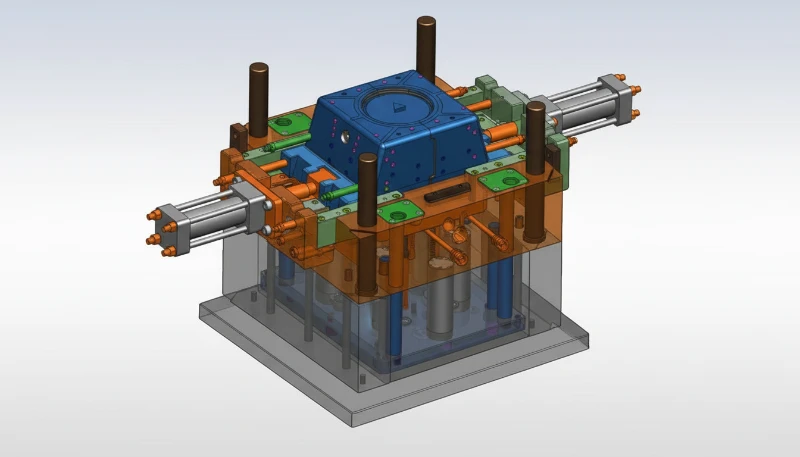
- El diseño de moldes comprende 7 subsistemas principales: alimentación, refrigeración, expulsión, ventilación, posicionamiento, cavidad y bastidor
- La selección del acero (P20, H13, S136) determina directamente la vida útil del molde y el acabado superficial de la pieza
- Un molde de producción habitual tarda 4–8 semanas en fabricarse y cuesta $10,000–$100,000+ según su complejidad
- Trabajar con un taller de moldes propio reduce el plazo de entrega entre un 30–50% frente a la subcontratación
¿Qué es un molde de inyección y por qué es importante?
Qué es un molde de inyección y por qué importa se define mediante la función, las restricciones y las concesiones explicadas en esta sección. Un molde de inyección es una herramienta personalizada de acero o aluminio mecanizado que define la forma, el acabado superficial y la precisión dimensional de cada pieza plástica producida mediante moldeo por inyección. En términos sencillos, el molde es un bloque metálico hueco con una cavidad mecanizada. El plástico fundido se inyecta a alta presión en esa cavidad, se enfría y solidifica, y el molde se abre para liberar la pieza terminada.
¿Por qué importa tanto? Porque la calidad comienza en el molde. Si las dimensiones de la cavidad se desvían aunque solo sea 0.05 mm, todas las piezas arrastrarán ese error durante toda la producción, que podría ser de 100,000 piezas o más. El molde también controla el acabado superficial (brillante, mate, texturizado), la ubicación de las líneas de partición, las marcas de compuerta y las líneas de soldadura. En nuestra fábrica vemos habitualmente piezas que “casi funcionan” porque el molde se diseñó sin suficiente ángulo de desmoldeo o porque la compuerta se colocó en una zona sometida a grandes tensiones. Son lecciones costosas que un diseño adecuado del molde evita desde el principio.
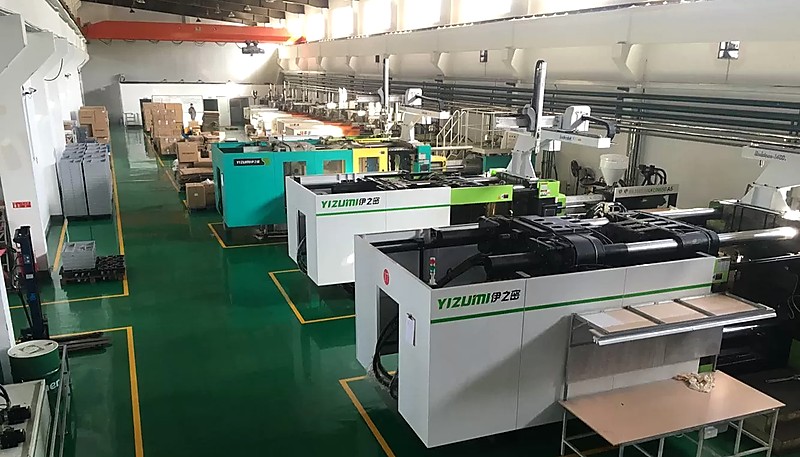
Con más de 20 años de experiencia y una planta interna de fabricación de moldes, nuestro equipo ha construido miles de moldes de producción, desde herramientas sencillas de una cavidad hasta moldes complejos de múltiples cavidades con expulsores inclinados, correderas y sistemas de canal caliente.
¿Cuáles son los componentes clave de un molde de inyección?
Un molde de inyección apto para producción es mucho más que dos mitades de un bloque metálico. Es un conjunto de precisión formado por 7 subsistemas distintos, cada uno con una función específica. Comprender estos componentes es esencial tanto para revisar un presupuesto de molde como para diagnosticar un problema de producción.
Sistema de alimentación (canal y compuerta)
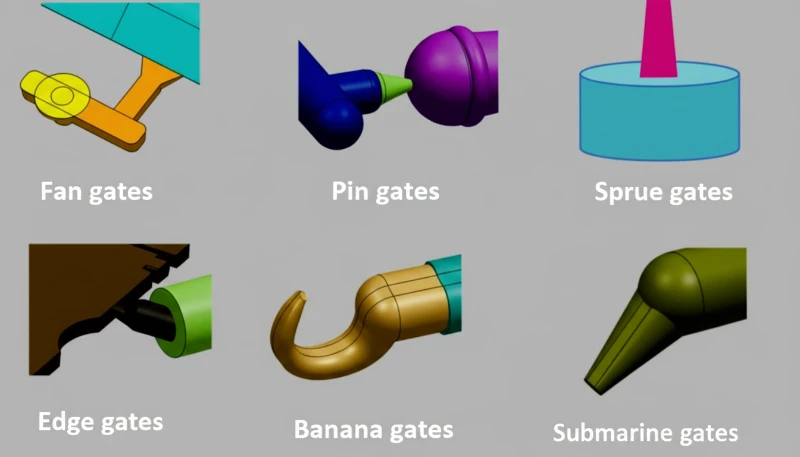
El sistema de alimentación es la red de canales que lleva el plástico fundido desde la boquilla de la máquina hasta la cavidad del molde. Está formado por el bebedero (el canal vertical principal), los canales (conductos horizontales de distribución) y la compuerta (la abertura final y estrecha hacia la cavidad). El diseño de la compuerta es una de las decisiones más críticas en la ingeniería de moldes: el tipo de compuerta (lateral, submarina, puntual, en abanico o de diafragma) y su ubicación afectan directamente al aspecto de la pieza, la precisión dimensional y el patrón de llenado. Una compuerta mal situada puede causar flujo en chorro, bolsas de aire o líneas de soldadura excesivas, defectos que ningún ajuste de los parámetros de procesamiento puede corregir por completo.
Sistema de refrigeración
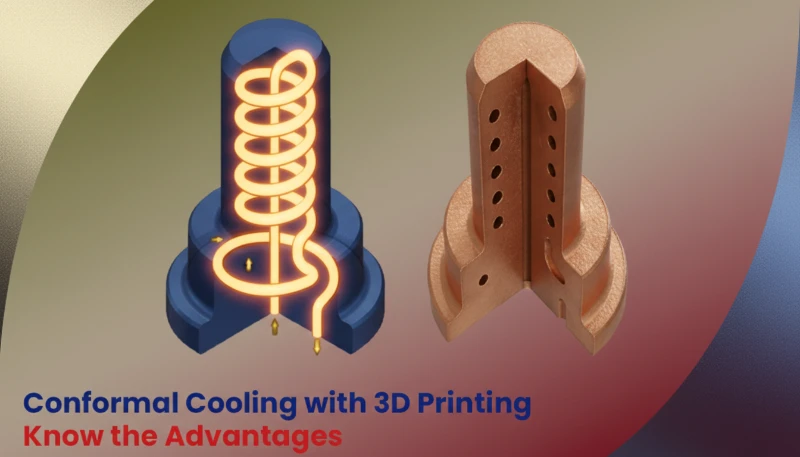
El sistema de refrigeración controla la temperatura del molde mediante una red de canales de agua perforados en sus placas. Una refrigeración eficiente es el factor que más influye en el tiempo de ciclo y, por tanto, en el coste por pieza. Un molde con canales de refrigeración conformal bien diseñados, que siguen el contorno de la cavidad, puede reducir el ciclo un 20–40% frente a los canales rectos convencionales. La refrigeración debe estar equilibrada: una distribución desigual provoca contracción diferencial, alabeo y rechupes. Nuestro equipo utiliza la simulación MOLDFLOW1 para optimizar el trazado antes de cortar el acero.
Sistema de eyección
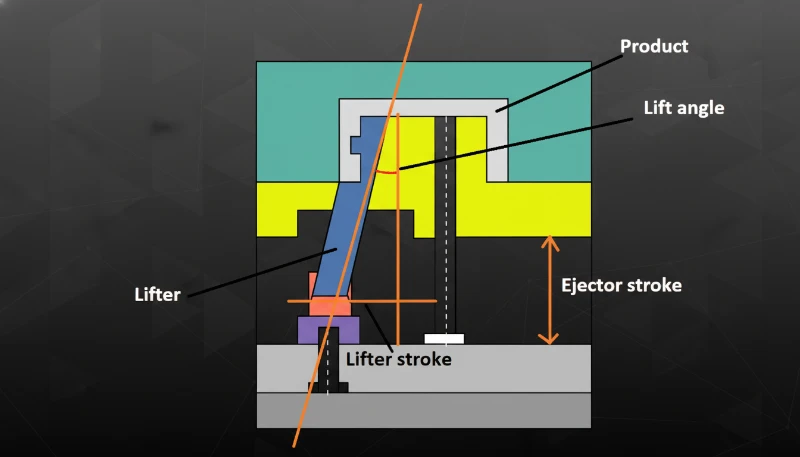
Una vez que la pieza se ha enfriado lo suficiente para conservar su forma, el molde se abre y el sistema de expulsión empuja la pieza para separarla del lado del núcleo. Los métodos de expulsión más habituales son los pasadores eyectores (pasadores redondos que empujan superficies no críticas), las placas extractoras (para piezas cilíndricas o con forma de caja) y la expulsión por chorro de aire (para piezas de pared delgada). El sistema de expulsión debe diseñarse de modo que la pieza no se deforme, se atasque ni sufra daños durante la extracción. La colocación de los pasadores eyectores es un arte: sitúelos en superficies no visibles y asegúrese de que la fuerza de expulsión esté equilibrada para evitar que la pieza se deforme.
Sistema de ventilación
Cuando el plástico fundido llena la cavidad a velocidades de inyección que pueden superar 100 mm/s, el aire que había en su interior debe salir. El sistema de ventilación proporciona canales estrechos (normalmente de 0.01–0.03 mm de profundidad) que dejan escapar el aire, pero son demasiado pequeños para que el plástico forme rebaba a través de ellos. Una ventilación insuficiente provoca marcas de quemado (efecto diésel: el aire atrapado llega a inflamarse), llenados incompletos (las bolsas de aire impiden el llenado completo) y una elevada presión interna que puede dañar el molde. Según nuestra experiencia, los problemas de ventilación representan aproximadamente el 15–20% de todos los problemas de calidad relacionados con el molde que encontramos durante el muestreo T1.
Sistema de posicionamiento y alineación
El molde tiene tres niveles de precisión de posicionamiento. Las columnas guía proporcionan una alineación aproximada durante el cierre del molde. Los enclavamientos cónicos (también denominados bloqueos laterales) proporcionan una alineación intermedia de las bases del molde. Por último, los propios insertos del núcleo y la cavidad se mecanizan con tolerancias extremadamente estrechas para lograr la alineación final y precisa. Cada nivel refina el posicionamiento: si las columnas guía están desgastadas o los enclavamientos están dañados, aparecerán rebabas, desviaciones dimensionales y un desgaste acelerado del molde.
¿Cómo se clasifican los moldes de inyección?
Esta sección trata sobre la clasificación de los moldes de inyección y su repercusión en el coste, la calidad, los plazos o el riesgo de abastecimiento. Los moldes de inyección se clasifican según varias dimensiones, y comprender estas clasificaciones le ayuda a especificar el molde adecuado para sus necesidades de producción.
Según el sistema de canales: Los moldes de canal caliente mantienen fundido el plástico mediante canales calefactados, eliminan el desperdicio del canal y reducen el ciclo, por lo que son idóneos para grandes volúmenes. Los moldes de canal frío son más sencillos y económicos, y resultan adecuados para volúmenes menores o materiales que se degradan en canales calientes.
Según el número de cavidades: Los moldes de una cavidad producen una pieza por ciclo. Los moldes multicavidad producen varias piezas idénticas por ciclo; por ejemplo, uno de 4 cavidades fabrica 4 piezas por inyección. Los moldes familiares producen piezas diferentes en un mismo ciclo, lo que resulta útil para conjuntos, aunque dificulta el equilibrado.
Según el objetivo de producción: Los moldes de prototipo, también llamados herramentales blandos, se fabrican en aluminio o acero blando para series cortas de 100–1,000 piezas; son rápidos y económicos, pero tienen una vida útil limitada. Los moldes de producción, o herramentales duros, se fabrican en acero templado para series de 100,000 a millones de piezas.
Según la estructura: Los moldes de dos placas son los más sencillos y habituales, y se separan en dos mitades por la línea de partición. Los de tres placas incorporan una placa extractora que separa automáticamente el canal de las piezas. Los moldes con acciones laterales incluyen correderas o elevadores para piezas con contrasalidas o roscas exteriores.
¿Qué implica el proceso de diseño de un molde de inyección?
El diseño del molde decide el éxito o el fracaso de la fabricación. Un molde bien diseñado funciona de manera fiable durante cientos de miles de ciclos. Un molde mal diseñado le perseguirá con problemas de calidad, tiempos de inactividad y modificaciones costosas durante toda su vida útil. El proceso de diseño sigue una secuencia estructurada que los fabricantes de moldes experimentados nunca omiten.
Paso 1: análisis de la pieza y revisión DFM
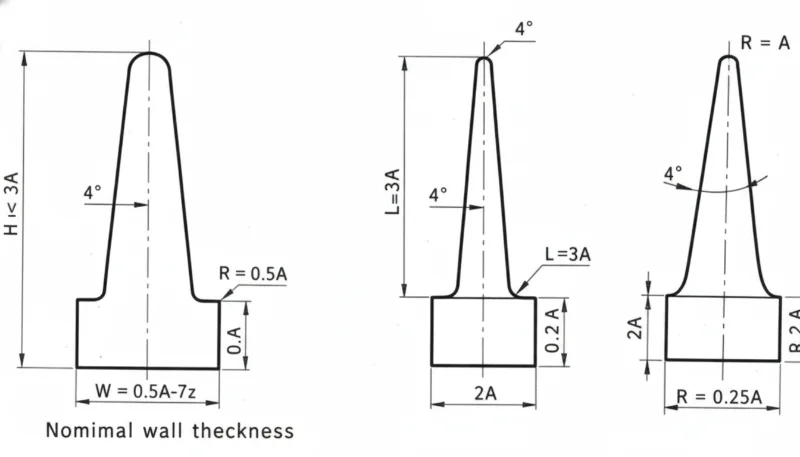
Antes de diseñar el molde, el equipo realiza una revisión exhaustiva del Diseño para la Fabricación (DFM)2 de la pieza. Se analizan la uniformidad del espesor de pared (idealmente 2–4 mm para la mayoría de plásticos técnicos), los ángulos de desmoldeo (mínimo 0.5° por lado; recomendados 1–2°), las proporciones de los nervios (su espesor no debe superar el 60% de la pared nominal para evitar rechupes) y las contrasalidas que requerirán acciones laterales. Según nuestra experiencia, cerca del 30% de los diseños recibidos necesitan al menos pequeños cambios para poder fabricar el molde de forma eficiente. Detectarlos durante el DFM evita semanas de retrabajo.
Paso 2: Simulación de flujo del molde
Mediante MOLDFLOW o un software de simulación similar, el equipo de diseño predice cómo llenará el plástico fundido la cavidad, dónde aparecerán líneas de soldadura, cómo se contraerá y deformará la pieza y si la refrigeración distribuirá uniformemente la temperatura. La simulación no es opcional en moldes de producción: marca la diferencia entre un molde que funciona en la primera prueba y otro que requiere tres rondas de modificaciones del acero. Nuestros 8 ingenieros sénior simulan cada molde y utilizan los resultados para optimizar la ubicación de los puntos de inyección, los canales de refrigeración y los parámetros de proceso antes de mecanizar el primer fragmento de acero.
Paso 3: selección del acero y disposición del molde
La selección del acero depende del volumen de producción previsto, el material plástico y los requisitos de acabado superficial. P20 es el acero de referencia para moldes: resulta adecuado para 100,000–500,000 ciclos con la mayoría de los plásticos de ingeniería. H13 es un acero para trabajo en caliente que soporta resinas de alta temperatura (PC, PEEK) y materiales abrasivos rellenos de fibra de vidrio. S136 es un acero inoxidable para herramientas que se utiliza cuando se necesita resistencia a la corrosión o cuando la pieza requiere un acabado superficial SPI A-1 pulido a espejo. La disposición del molde determina la ubicación de las cavidades, el recorrido de los canales, las posiciones de los canales de refrigeración y el tamaño total de la base del molde; todos estos elementos deben caber dentro de las dimensiones de las platinas de la máquina de moldeo por inyección prevista.
Nuestros 8 ingenieros sénior utilizan UG, SOLIDWORKS y MOLDFLOW para diseñar moldes optimizados para nuestras 47 máquinas de moldeo por inyección, garantizando que cada molde se construya específicamente para el entorno de producción exacto en el que funcionará.
Paso 4: diseño detallado y publicación del plano 2D
La fase final de diseño genera un conjunto completo de planos 2D para cada componente del molde: insertos de cavidad, insertos de núcleo, correderas, expulsores inclinados, pasadores expulsores, tapones de refrigeración y la propia base del molde. Cada componente recibe tolerancias acordes con su función: las dimensiones de la cavidad se mantienen en ±0.01 mm o menos para piezas de precisión, mientras que los componentes estructurales tienen tolerancias más amplias. El paquete de diseño completo se revisa y aprueba antes de iniciar el mecanizado.
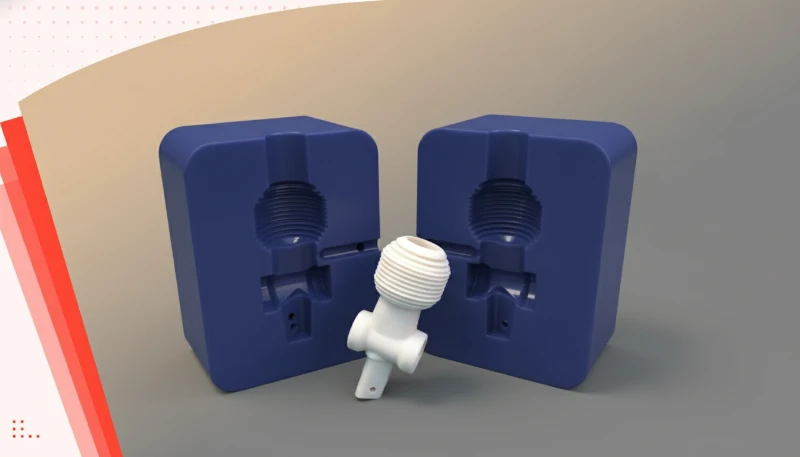
"La simulación de flujo del molde puede predecir la ubicación de las líneas de soldadura y el alabeo de la pieza antes de cortar el acero."True
Las herramientas modernas de simulación, como MOLDFLOW, emplean el análisis de elementos finitos para modelar con gran precisión el flujo, el enfriamiento y la contracción de los polímeros. Predecir las líneas de soldadura, las bolsas de aire y los patrones de alabeo durante la fase de diseño es una práctica habitual en los talleres profesionales de moldes y evita costosas modificaciones del acero después del muestreo T1.
"Los moldes de aluminio pueden producir piezas de la misma calidad que los moldes de acero endurecido en la producción de gran volumen."False
Los moldes de aluminio son excelentes para prototipos y series bajas (menos de 10,000 piezas), pero carecen de la resistencia al desgaste y estabilidad térmica del acero endurecido. Para series superiores a 50,000 piezas, los moldes de acero (P20, H13, S136) conservan mucho mejor la precisión dimensional y el acabado.
¿Cómo se fabrica paso a paso un molde de inyección?
Una vez finalizado y aprobado el diseño, el molde entra en la fase de fabricación. En ella, el mecanizado de precisión transforma bloques de acero en bruto en la compleja herramienta que producirá las piezas. El plazo habitual de un molde de producción es de 4–8 semanas, según su complejidad.
Fase 1: adquisición del material y desbaste
La base del molde y los bloques de cavidad/núcleo se encargan a proveedores de acero. Las bases de molde estándar (LKM, DME, HASCO) están disponibles en catálogo, mientras que los insertos de cavidad se mecanizan a medida a partir de bloques macizos de acero para herramientas. El desbaste elimina la mayor parte del material con fresas de extremo de gran diámetro y altas tasas de arranque. Después, el acero se somete a alivio de tensiones (tratamiento térmico) para eliminar tensiones internas que podrían causar desviaciones dimensionales posteriores. Los talleres de bajo coste omiten este paso con frecuencia, y siempre se manifiesta como inestabilidad dimensional tras unos miles de ciclos.
Fase 2: Mecanizado CNC de precisión y EDM
Tras el desbaste y el tratamiento térmico, los insertos de cavidad y núcleo se mecanizan al acabado en centros CNC de alta velocidad capaces de mantener una precisión posicional de ±0.005 mm. Las características inaccesibles para las herramientas CNC —nervios profundos, esquinas interiores agudas y superficies 3D complejas— se mecanizan mediante Mecanizado por Electroerosión (EDM)3. La EDM por penetración genera cavidades 3D complejas erosionando el acero con chispas eléctricas controladas. La EDM por hilo corta perfiles y orificios pasantes precisos con un electrodo de hilo fino. Ambos procesos son esenciales para los moldes de producción.
Fase 3: acabado superficial y pulido
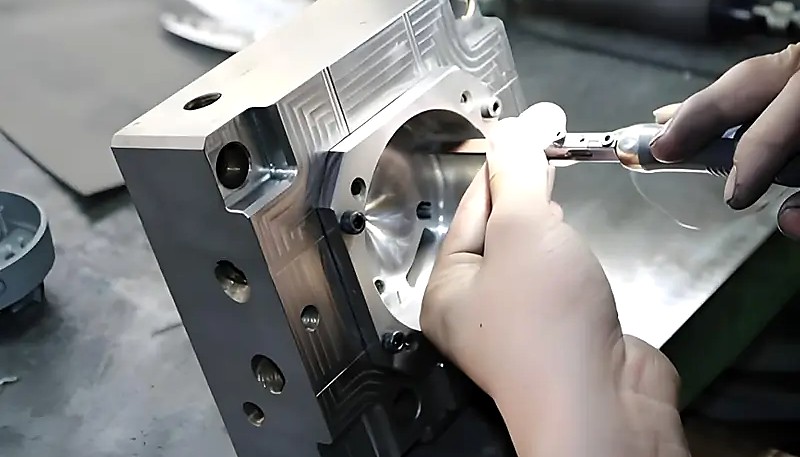
El acabado de la superficie de la cavidad determina directamente el de la pieza. Los estándares de acabado SPI van desde A-1 (pulido espejo, #3 diamond buff) hasta D-3 (chorreado en seco, piedra de grano 240). Los moldes para lentes ópticas pueden requerir una rugosidad inferior a Ra 0.01 μm, mientras que las piezas estructurales suelen necesitar solo un acabado SPI B-2 (papel de grano 320). El pulido es un trabajo manual realizado por especialistas; requiere mucho tiempo y representa una parte importante del coste total del molde en aplicaciones de alto acabado.
Fase 4: montaje, pruebas y muestreo T1
Todos los componentes mecanizados se montan en la base del molde. El sistema de refrigeración se somete a una prueba de presión para detectar fugas. Los pasadores guía, las correderas, los elevadores y los pasadores eyectores se montan y se comprueba que funcionen con suavidad. Después, el molde se instala en la máquina de moldeo por inyección para el muestreo T1 (primera pieza). El muestreo T1 es un hito crítico: es la primera vez que el plástico fundido llena el molde de producción real. Las muestras se miden con respecto al plano de la pieza y cualquier desviación dimensional se registra para ajustar el molde.
Nuestro taller interno de moldes produce 100+ juegos al mes y dispone de capacidades completas de inspección CNC, EDM y CMM, lo que significa que controlamos todo el proceso de fabricación del molde, desde el diseño hasta el muestreo T1, sin depender de proveedores externos.
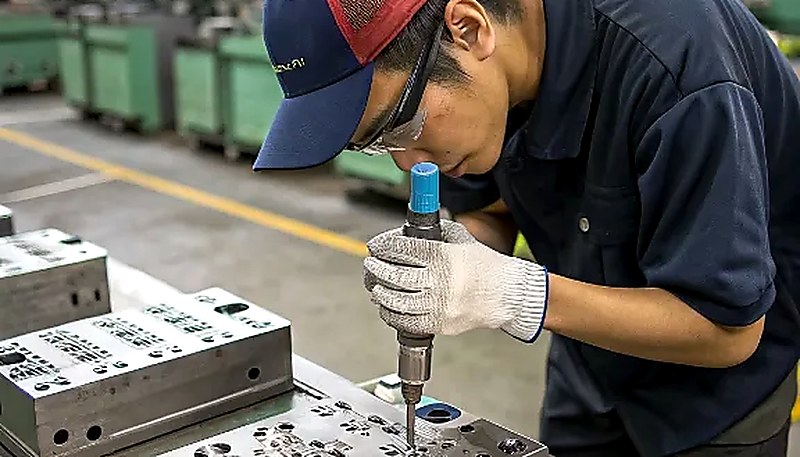
"El tiempo de enfriamiento del molde suele representar el 50–70% del tiempo total del ciclo de moldeo por inyección."True
En la mayoría de las aplicaciones de moldeo por inyección, la fase de refrigeración domina el ciclo. Optimizar el diseño de los canales de refrigeración —mediante refrigeración conformada, sistemas de deflectores o conmutación de agua caliente a fría— es la forma más eficaz de reducir el tiempo de ciclo y el coste por pieza sin sacrificar la calidad.
"Un molde que produce piezas correctas durante el muestreo T1 nunca necesitará modificaciones."False
Las muestras T1 se producen en condiciones de laboratorio cuidadosamente controladas. A medida que aumentan los volúmenes de producción, las variaciones entre lotes de material, el desgaste de la máquina, la temperatura ambiente y la técnica del operario pueden revelar problemas que no eran evidentes durante el muestreo inicial. La mayoría de los moldes de producción pasa por 1–3 rondas de ajuste fino después de T1 para optimizarse según las condiciones reales de producción.
¿Por qué la calidad del molde determina la calidad de la pieza final?
Esta sección trata sobre cómo la calidad del molde determina la calidad final de la pieza y su impacto en el coste, la calidad, los plazos o el riesgo de abastecimiento. Hay un dicho en la industria del moldeo por inyección: “El molde es la calidad”. Los parámetros de procesamiento (temperatura, presión, velocidad y tiempo) pueden ajustarse dentro de un intervalo, pero no pueden compensar problemas fundamentales de diseño del molde. Si el punto de inyección está en el lugar equivocado, ningún ajuste de presión eliminará la línea de soldadura resultante. Si la refrigeración es desigual, ningún tiempo de mantenimiento evitará el alabeo. Si hay muy pocos pasadores expulsores o están mal situados, las piezas se deformarán durante la expulsión, por mucho cuidado que se ponga en ajustar la máquina.
La calidad del molde afecta a cinco aspectos críticos del resultado. Precisión dimensional: la cavidad debe compensar la contracción del plástico, normalmente del 0.5–2.5% según el material y la geometría, y conservar sus dimensiones durante cientos de miles de ciclos. Acabado superficial: el pulido del acero de la cavidad determina el acabado de la pieza; ningún proceso secundario lo mejora. Consistencia: un molde de precisión mantiene variaciones entre piezas inferiores a 0.05 mm; uno deficiente puede desviarse 0.2 mm o más al desgastarse. Tiempo de ciclo: una refrigeración eficiente ahorra segundos en cada ciclo; en 500,000 piezas, ahorrar 2 segundos supone 278 horas menos de máquina.
Vida útil del molde: Un molde de producción correctamente templado y mantenido puede completar entre 500,000 y más de 1,000,000 de ciclos antes de necesitar una renovación importante.
¿Cómo elegir al fabricante de moldes de inyección adecuado?
Esta sección trata sobre cómo elegir al fabricante de moldes de inyección adecuado y su impacto en el coste, la calidad, los plazos o el riesgo de abastecimiento. Elegir un proveedor de moldes es una decisión a largo plazo: trabajará con esta empresa durante toda la vida productiva de su producto, que podría prolongarse durante años. Estos son los factores que realmente importan, según nuestra experiencia de trabajo con cientos de clientes.
Capacidad interna de fabricación de moldes: Una empresa que diseña, mecaniza, ensambla y prueba los moldes bajo un mismo techo siempre obtiene mejores resultados que otra que subcontrata etapas individuales. Cuando el diseñador, el operario de mecanizado y el ingeniero de procesos trabajan en el mismo edificio, los problemas se resuelven en horas y no en semanas. Pregunte si el taller dispone de centros CNC, máquinas EDM y equipos de inspección CMM propios o si subcontrata estas operaciones.
Profundidad de ingeniería: Los mejores talleres no se limitan a ejecutar su diseño, sino que lo mejoran. Un equipo sólido detecta problemas de DFM que se hayan pasado por alto, propone mejores sistemas de compuertas y optimiza la refrigeración para su geometría. Pregunte por su capacidad de simulación —MOLDFLOW es el estándar del sector— y por la experiencia de sus ingenieros de diseño.
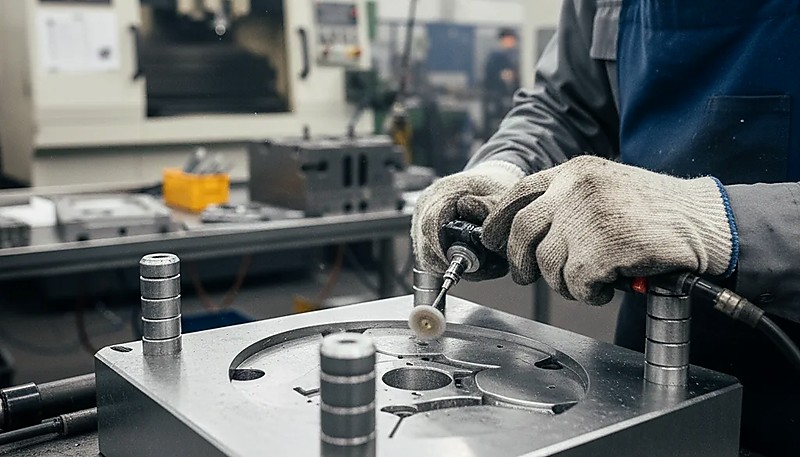
Experiencia en materiales: Los distintos plásticos se comportan de manera muy diferente dentro del molde. Un taller con experiencia en más de 400 materiales conoce cómo fluye, se contrae y se degrada cada resina, y diseña los moldes en consecuencia. Si la pieza utiliza nailon reforzado con fibra de vidrio, por ejemplo, las zonas de desgaste requieren acero templado (H13 como mínimo), porque las fibras son extremadamente abrasivas para el herramental P20 estándar.
Comunicación y asistencia: Para compradores internacionales, una comunicación clara en inglés no es un lujo, sino una necesidad. Malinterpretar una sola tolerancia dimensional puede dar lugar a un molde cuyas piezas no encajen en el conjunto. Busque proveedores con jefes de proyecto angloparlantes e ingenieros que comprendan los requisitos técnicos sin ciclos constantes de aclaraciones.
Si está evaluando proveedores de moldes para su próximo proyecto, nuestro equipo de ZetarMold puede preparar una propuesta detallada de diseño y un presupuesto competitivo, con comentarios de DFM, análisis de flujo y un calendario claro desde la aprobación hasta las muestras T1. Consulte nuestra guía de abastecimiento de moldeo por inyección para conocer un marco completo de evaluación y selección de socios de fabricación.
Con experiencia en más de 400 materiales plásticos y certificaciones ISO 9001, ISO 13485, ISO 14001 e ISO 45001, nuestro equipo de ingeniería ofrece recomendaciones de diseño de moldes específicas para cada material respaldadas por datos reales de producción.
Preguntas frecuentes
¿Cuánto se tarda en fabricar un molde de inyección?
Un molde de producción estándar de una sola cavidad suele requerir 4–6 semanas desde la aprobación del diseño hasta el muestreo T1. Los moldes multicavidad complejos con correderas, elevadores o sistemas de canales calientes pueden requerir 8–12 semanas, según el número de acciones laterales y los requisitos de acabado superficial. Los moldes prototipo fabricados en aluminio pueden completarse en tan solo 1–3 semanas. Los factores clave que determinan el plazo son la complejidad de la pieza (socavados, paredes delgadas y tolerancias estrechas), el número de cavidades y si el molde utiliza un sistema de canales calientes.
¿Cuál es el costo típico de un molde de inyección?
Sí, un molde familiar puede producir varias piezas diferentes en el mismo ciclo de moldeo por inyección, lo que resulta especialmente útil para conjuntos de productos que requieren varios componentes en cantidades iguales. Sin embargo, los moldes familiares exigen un equilibrado cuidadoso del flujo para garantizar que cada cavidad se llene por completo y de forma uniforme en cada ciclo. Funcionan mejor cuando las piezas individuales presentan requisitos similares de volumen, espesor de pared y material. Para piezas con geometrías o tamaños muy diferentes pueden ser preferibles moldes específicos separados, a fin de evitar comprometer la calidad.
¿Puede un molde de inyección producir varias piezas diferentes?
Un molde de canal caliente usa conductos calentados para mantener fundido el plástico, elimina totalmente los residuos y suele reducir el ciclo 1–3 segundos por inyección. A cambio, añade 30–50% al coste inicial y requiere más mantenimiento. Un molde de canal frío usa conductos sin calentar donde el canal solidifica con las piezas y debe separarse y triturarse. Es más sencillo, económico y preferible para bajo volumen o prototipos.
¿Cuál es la diferencia entre un molde de canal caliente y uno de canal frío?
Un molde de canal caliente utiliza canales calentados para mantener el plástico fundido dentro del sistema de canales, eliminando por completo sus residuos y reduciendo a menudo el tiempo de ciclo entre 1–3 segundos por inyección. La contrapartida es que los sistemas de canal caliente añaden un 30–50% al coste inicial del molde y requieren más mantenimiento. Un molde de canal frío utiliza canales sin calentar en los que el material se solidifica junto con las piezas y debe separarse y triturarse de nuevo. Los canales fríos son más sencillos, más baratos y preferibles para producciones de menor volumen o prototipos.
¿Cuántas piezas puede producir un molde de inyección antes de desgastarse?
El moldeo por inyección estándar logra consistentemente tolerancias de más o menos 0.05 a 0.10 mm para dimensiones inferiores a 25 mm con moldes diseñados adecuadamente y condiciones de procesamiento estables. El moldeo de precisión con diseño de compuerta optimizado, enfriamiento controlado y monitoreo estricto del proceso puede lograr más o menos 0.025 mm para características dimensionales críticas en piezas bien diseñadas. Las tolerancias para dimensiones mayores escalan aproximadamente de manera proporcional — típicamente más o menos 0.1 a 0.3 mm para dimensiones superiores a 100 mm. El molde debe diseñarse con una compensación de contracción específica del material apropiada para alcanzar de manera confiable estos objetivos de tolerancia consistentemente a lo largo de toda la producción.
¿Qué tolerancias puede alcanzar el moldeo por inyección?
La simulación de flujo de molde predice exactamente cómo el plástico fundido llenará la cavidad, dónde se formarán las líneas de soldadura y cómo la pieza se encogerá y deformará, todo antes de que se corte cualquier acero. Esto elimina el costoso enfoque de prueba y error de construir un molde y luego modificarlo después de que el muestreo T1 revele problemas. Las modificaciones de acero suelen añadir de 2 a 4 semanas y de $2,000 a $10,000+ por ronda de modificación. Los talleres de moldes profesionales ejecutan simulación en cada molde de producción como un paso estándar de diseño porque el costo de una simulación es una fracción mínima incluso de una sola modificación de acero.
¿Por qué es importante la simulación de flujo de molde antes de construir un molde?
La simulación de flujo de molde predice exactamente cómo el plástico fundido llenará la cavidad, dónde se formarán las líneas de soldadura y cómo la pieza se encogerá y deformará, todo antes de que se corte cualquier acero. Esto elimina el costoso enfoque de prueba y error de construir un molde y luego modificarlo después de que el muestreo T1 revele problemas. Las modificaciones de acero suelen añadir de 2 a 4 semanas y de $2,000 a $10,000+ por ronda. Los talleres de moldes profesionales ejecutan simulación en cada molde de producción como un paso estándar porque el costo de una ejecución de simulación es una fracción de una modificación de acero.
¿Qué mantenimiento necesita un molde de inyección?
Los moldes de producción requieren mantenimiento programado a intervalos regulares para mantener la calidad de la pieza y extender la vida útil de la herramienta. Las tareas de mantenimiento clave incluyen limpieza y pulido de la cavidad cada 50,000–100,000 ciclos para restaurar el acabado superficial, inspección y lubricación de los expulsores, desincrustación de los canales de enfriamiento para mantener el rendimiento térmico, inspección del área de la compuerta por daños por erosión (especialmente importante con materiales rellenos de vidrio), e inspección de los mecanismos de correderas y elevadores por desgaste. Un programa disciplinado de mantenimiento preventivo típicamente extiende la vida útil del molde de 2 a 3 veces y evita costosos tiempos de inactividad de producción no planificados.
simulación MOLDFLOW: Moldflow es un software de simulación del moldeo por inyección de plásticos desarrollado por Autodesk que emplea análisis de elementos finitos para predecir el flujo del polímero, la refrigeración y la contracción durante el proceso. ↩
Diseño para la Fabricación (DFM): El Diseño para la Fabricación (DFM) consiste en diseñar piezas para que puedan fabricarse con facilidad y de forma rentable, considerando la uniformidad del espesor de pared, los ángulos de desmoldeo, las proporciones de los nervios y la reducción de contrasalidas para garantizar un moldeo por inyección satisfactorio. ↩
Mecanizado por Electroerosión (EDM): La EDM es un proceso de mecanizado de precisión que elimina material mediante chispas eléctricas controladas entre un electrodo y la pieza, y permite crear en acero templado geometrías complejas imposibles de obtener con herramientas de corte convencionales. ↩