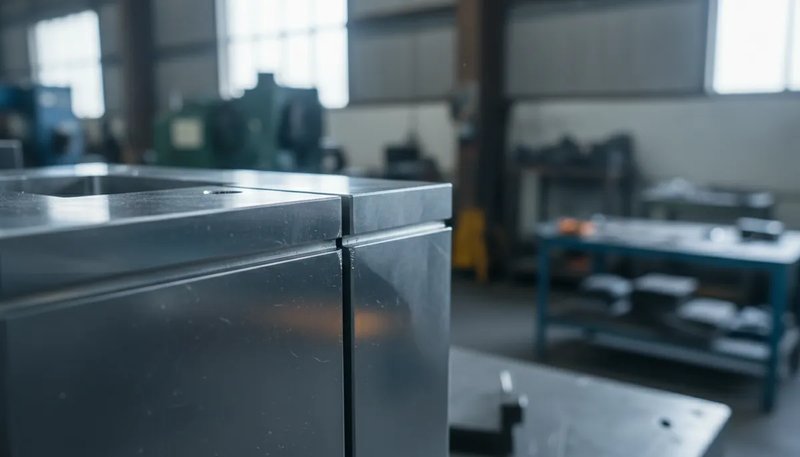
Eine Spritzgussform ist das teuerste und wichtigste Werkzeug in der Kunststofffertigung. Ist sie richtig ausgeführt, lassen sich Millionen identischer Teile mit Toleranzen im Tausendstel-Zoll-Bereich herstellen. Ist sie fehlerhaft, wird jedes produzierte Teil zu Ausschuss. Nach mehr als 20 Jahren Erfahrung mit Spritzgießwerkzeugen in unserem Werk in Shanghai kennen wir nahezu jeden Fehler im Formenbau. Dieser Leitfaden fasst die daraus gewonnenen Erkenntnisse als praxisnahe Empfehlungen von Ingenieur zu Ingenieur zusammen.
- Ein Spritzgusswerkzeug ist ein Präzisionswerkzeug, das geschmolzenen Kunststoff zu reproduzierbaren Teilen in Serienqualität formt
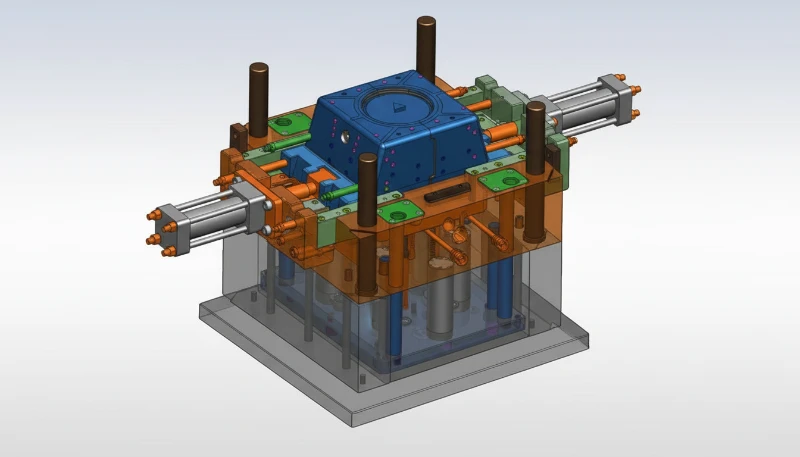
- Die Werkzeugkonstruktion umfasst 7 Kernsysteme: Anschnitt, Kühlung, Auswerfung, Entlüftung, Positionierung, Kavität und Werkzeugrahmen
- Die Stahlauswahl (P20, H13, S136) bestimmt unmittelbar die Lebensdauer des Werkzeugs und die Oberflächenqualität der Teile
- Der Bau einer typischen Produktionsform dauert 4–8 Wochen und kostet je nach Komplexität $10,000–$100,000+
- Die Zusammenarbeit mit einem internen Werkzeugbau verkürzt die Vorlaufzeit gegenüber der Fremdvergabe um 30–50%
Was ist ein Spritzgusswerkzeug und warum ist es wichtig?
Was ein Spritzgusswerkzeug ist und warum es wichtig ist, wird durch die in diesem Abschnitt erläuterten Funktionen, Einschränkungen und Zielkonflikte bestimmt. Ein Spritzgusswerkzeug ist ein kundenspezifisch bearbeitetes Werkzeug aus Stahl oder Aluminium, das Form, Oberflächenqualität und Maßgenauigkeit jedes im Spritzgießverfahren gefertigten Kunststoffteils festlegt. Vereinfacht gesagt ist das Werkzeug ein hohler Metallblock, in den eine Kavität eingebracht wurde. Geschmolzener Kunststoff wird unter hohem Druck in diese Kavität eingespritzt, kühlt ab und erstarrt; anschließend öffnet sich das Werkzeug und gibt das fertige Teil frei.
Warum ist das so wichtig? Weil die Qualität bei der Form beginnt. Weichen die Kavitätsabmessungen auch nur um 0.05 mm ab, trägt jedes einzelne Teil diesen Fehler über den gesamten Produktionslauf — und dieser kann 100,000 Teile oder mehr umfassen. Die Form bestimmt außerdem die Oberflächengüte (glänzend, matt, strukturiert), die Lage der Trennlinien sowie Anschnittmarken und Bindenähte. In unserer Fabrik sehen wir regelmäßig Teile, die „fast funktionieren“, weil die Form mit einem unzureichenden Entformungswinkel konstruiert oder der Anschnitt in einem hoch belasteten Bereich platziert wurde. Eine sachgerechte Formkonstruktion verhindert diese kostspieligen Erfahrungen von Anfang an.
Mit mehr als 20 Jahren Erfahrung und einem eigenen Werkzeugbau hat unser Team Tausende Serienwerkzeuge gefertigt — von einfachen Einkavitätenwerkzeugen bis hin zu komplexen Mehrkavitätenwerkzeugen mit Schrägauswerfern, Schiebern und Heißkanalsystemen.
Was sind die Hauptkomponenten eines Spritzgießwerkzeugs?
Ein produktionsgerechtes Spritzgießwerkzeug ist weit mehr als zwei Hälften eines Metallblocks. Es ist eine Präzisionsbaugruppe aus 7 eigenständigen Subsystemen mit jeweils einer bestimmten Aufgabe. Das Verständnis dieser Komponenten ist unerlässlich, ob Sie ein Werkzeugangebot prüfen oder ein Produktionsproblem beheben.
Angusssystem (Angusskanal und Anschnitt)
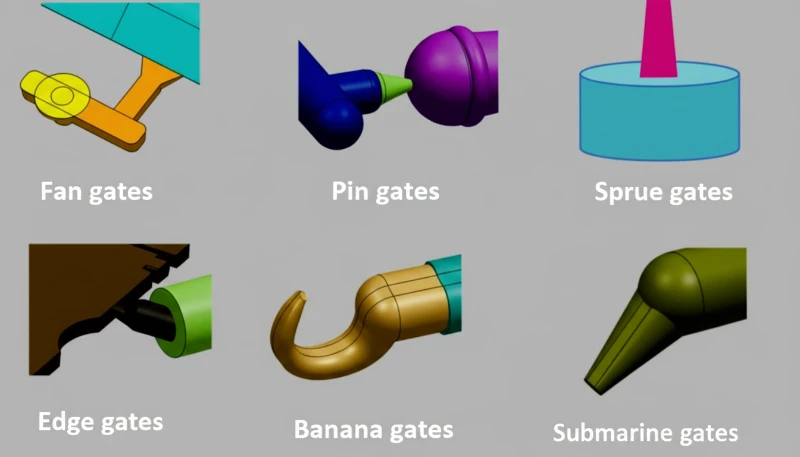
Das Angusssystem ist das Kanalnetz, das geschmolzenen Kunststoff von der Maschinendüse in die Formkavität führt. Es besteht aus dem Anguss (vertikaler Hauptkanal), den Verteilern (horizontale Verteilungskanäle) und dem Anschnitt (letzte schmale Öffnung zur Kavität). Die Anschnittauslegung ist eine der wichtigsten Entscheidungen im Werkzeugbau: Anschnittart (Kanten-, Tunnel-, Punkt-, Fächer- oder Membrananschnitt) und Position beeinflussen unmittelbar Bauteiloptik, Maßhaltigkeit und Füllbild. Ein ungünstig platzierter Anschnitt kann Freistrahlbildung, Lufteinschlüsse oder übermäßige Bindenähte verursachen — Fehler, die sich auch durch Prozessparameteranpassungen nicht vollständig beheben lassen.
Kühlsystem
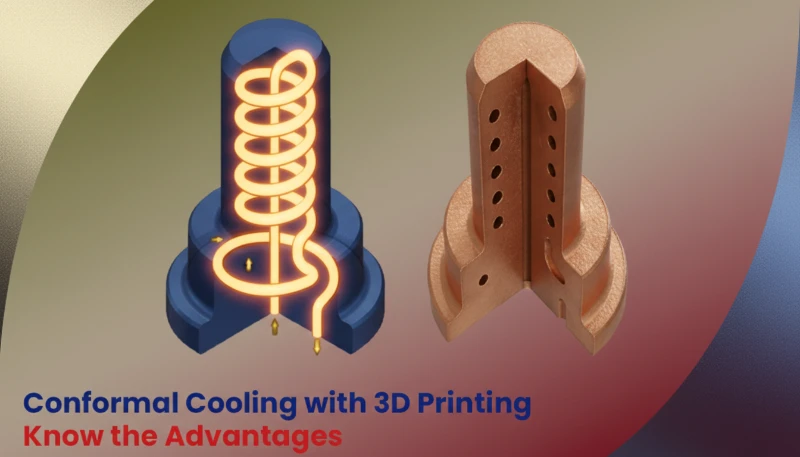
Das Kühlsystem regelt die Formtemperatur über ein Netz von Wasserkanälen in den Formplatten. Eine effiziente Kühlung ist der wichtigste Einflussfaktor auf die Zykluszeit und damit unmittelbar auf die Stückkosten. Eine Form mit gut ausgelegten konturnahen Kühlkanälen kann die Zykluszeit gegenüber herkömmlichen geradlinig gebohrten Kanälen um 20–40% verkürzen. Die Kühlung muss jedoch gleichmäßig sein, denn ungleichmäßige Kühlung verursacht unterschiedliche Schwindung, Verzug und Einfallstellen. Unser Entwicklungsteam optimiert die Kühlkanalanordnung vor dem ersten Stahlabtrag mithilfe einer MOLDFLOW-Simulation1.
Auswurfsystem
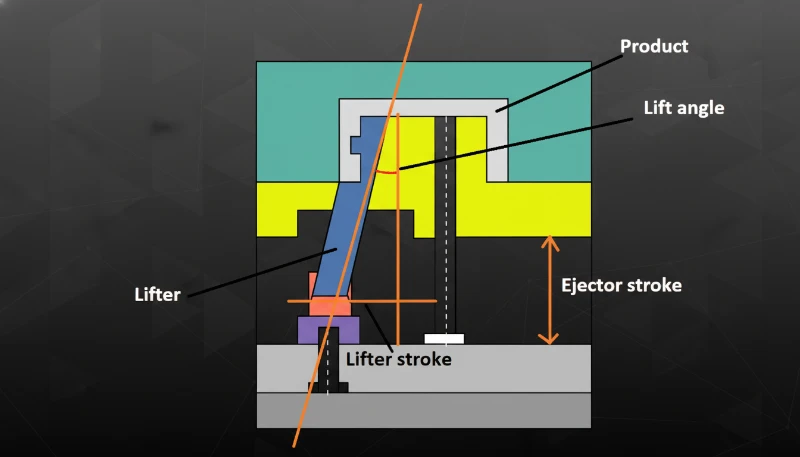
Sobald das Bauteil so weit abgekühlt ist, dass es seine Form behält, öffnet sich die Form, und das Auswerfersystem drückt das Bauteil von der Kernseite. Die gängigsten Auswerfverfahren sind Auswerferstifte (runde Stifte, die auf unkritische Flächen drücken), Abstreiferplatten (für zylindrische oder kastenförmige Bauteile) und Druckluftauswurf (für dünnwandige Bauteile). Das Auswerfersystem muss so ausgelegt sein, dass sich das Bauteil beim Entformen weder verzieht noch festhängt oder beschädigt wird. Die Positionierung der Auswerferstifte ist eine Kunst — setzen Sie sie auf nicht sichtbare Flächen und sorgen Sie für ausgewogene Auswerferkräfte, um eine Verformung des Bauteils zu vermeiden.
Entlüftungssystem
Wenn der geschmolzene Kunststoff den Formhohlraum mit Einspritzgeschwindigkeiten von über 100 mm/s füllt, muss die darin befindliche Luft entweichen können. Das Entlüftungssystem stellt schmale Kanäle bereit (in der Regel 0.01–0.03 mm tief), durch die Luft entweichen kann, die jedoch zu klein sind, als dass Kunststoff hindurchgratet. Eine unzureichende Entlüftung führt zu Brandstellen (Dieseleffekt — die eingeschlossene Luft entzündet sich buchstäblich), unvollständig gefüllten Teilen (Lufteinschlüsse verhindern die vollständige Füllung) und hohem Innendruck, der das Werkzeug beschädigen kann. Nach unserer Erfahrung sind Entlüftungsprobleme für etwa 15–20% aller werkzeugbedingten Qualitätsprobleme verantwortlich, die uns bei der T1-Bemusterung begegnen.
Positionierungs- und Ausrichtungssystem
Das Werkzeug besitzt drei Ebenen der Positioniergenauigkeit. Führungssäulen sorgen beim Schließen des Werkzeugs für die Grobausrichtung. Konische Verriegelungen, auch Seitenverriegelungen genannt, übernehmen die mittlere Ausrichtung der Werkzeughälften. Schließlich werden Kern- und Kavitätseinsätze selbst mit äußerst engen Toleranzen bearbeitet, um die endgültige präzise Ausrichtung sicherzustellen. Jede Ebene verfeinert die Positionierung — verschlissene Führungssäulen oder beschädigte Verriegelungen führen zu Gratbildung, Maßverschiebungen und beschleunigtem Werkzeugverschleiß.
Wie werden Spritzgießwerkzeuge klassifiziert?
Dieser Abschnitt behandelt die Klassifizierung von Spritzgießwerkzeugen und deren Einfluss auf Kosten, Qualität, Zeitplanung oder Beschaffungsrisiko. Spritzgießwerkzeuge werden nach mehreren Dimensionen kategorisiert; das Verständnis dieser Klassen hilft Ihnen, das richtige Werkzeug für Ihre Produktionsanforderungen zu spezifizieren.
Nach Angusssystem: Heißkanalformen halten den Kunststoff in beheizten Kanälen flüssig, vermeiden Angussabfall und verkürzen die Zykluszeit – ideal für große Stückzahlen. Kaltkanalformen sind einfacher und kostengünstiger herzustellen und eignen sich daher für kleinere Serien oder für Werkstoffe, die im Heißkanal abbauen.
Nach Kavitätenzahl: Einkavitätenformen erzeugen ein Teil pro Zyklus. Mehrkavitätenformen fertigen mehrere identische Teile pro Zyklus, beispielsweise vier Teile je Schuss bei einer 4-fach-Form. Familienformen erzeugen in einem Zyklus unterschiedliche Teile derselben Baugruppe, sind jedoch schwieriger auszubalancieren.
Nach Produktionszweck: Prototypenformen, auch als weiche Werkzeuge bezeichnet, bestehen aus Aluminium oder weichem Stahl und sind für Kleinserien von 100–1.000 Teilen vorgesehen. Sie sind schnell und preiswert herzustellen, haben aber eine begrenzte Lebensdauer. Serienformen aus gehärtetem Stahl eignen sich für 100.000 bis mehrere Millionen Teile.
Nach Formaufbau: Zweiplattenformen sind am einfachsten und am weitesten verbreitet; sie trennen sich an der Trennebene in zwei Hälften. Dreiplattenformen besitzen eine zusätzliche Abstreifplatte, die den Anguss automatisch von den Teilen trennt. Formen mit Seitenschiebern oder Schrägauswerfern ermöglichen Bauteile mit Hinterschneidungen oder Außengewinden.
Was umfasst der Konstruktionsprozess eines Spritzgießwerkzeugs?
Die Werkzeugkonstruktion entscheidet über Erfolg oder Misserfolg der Fertigung. Ein gut konstruiertes Werkzeug läuft über Hunderttausende Zyklen zuverlässig. Ein schlecht konstruiertes Werkzeug verursacht während seiner gesamten Lebensdauer Qualitätsprobleme, Stillstände und kostspielige Änderungen. Der Konstruktionsprozess folgt einer strukturierten Abfolge, die erfahrene Werkzeugbauer niemals überspringen.
Schritt 1: Teileanalyse und DFM-Prüfung
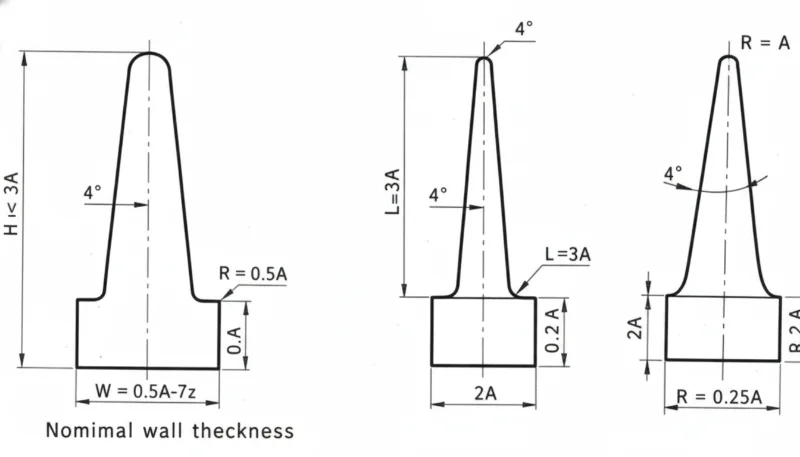
Vor Beginn der Formkonstruktion führt das Entwicklungsteam eine gründliche Prüfung der fertigungsgerechten Konstruktion (DFM)2 des Bauteils durch. Untersucht werden unter anderem eine gleichmäßige Wandstärke (für die meisten technischen Kunststoffe idealerweise 2–4 mm), Entformungsschrägen (mindestens 0.5° je Seite, empfohlen 1–2°), Rippenabmessungen (höchstens 60% der Nennwandstärke, um Einfallstellen zu vermeiden) und Hinterschneidungen, die Seitenschieber erfordern. Nach unserer Erfahrung müssen etwa 30% der eingereichten Bauteilkonstruktionen zumindest geringfügig angepasst werden, bevor sie effizient in ein Werkzeug umgesetzt werden können. Die frühzeitige Erkennung solcher Probleme in der DFM-Prüfung erspart später wochenlange Nacharbeit.
Schritt 2: Werkzeugfüllsimulation
Mit MOLDFLOW oder vergleichbarer Simulationssoftware prognostiziert das Konstruktionsteam, wie die Kunststoffschmelze die Kavität füllt, wo Bindennähte entstehen, wie das Teil schwindet und sich verzieht und ob die Kühlung eine gleichmäßige Temperaturverteilung gewährleistet. Für Serienwerkzeuge ist die Simulation unverzichtbar – sie entscheidet zwischen einer Form, die beim ersten Versuch funktioniert, und einer Form, die drei Runden Stahländerungen benötigt. Unsere 8 erfahrenen Ingenieure simulieren jede von uns gebaute Form und optimieren anhand der Ergebnisse Anschnittlage, Kühlkanalanordnung und Prozessparameter, bevor der erste Span vom Stahl abgetragen wird.
Schritt 3: Stahlauswahl und Formlayout
Die Stahlauswahl hängt vom erwarteten Produktionsvolumen, Kunststoff und den Anforderungen an die Oberflächengüte ab. P20 ist der universelle Formenstahl – geeignet für 100,000–500,000 Zyklen mit den meisten technischen Kunststoffen. H13 ist ein Warmarbeitsstahl für Hochtemperaturharze (PC, PEEK) und abrasive glasfaserverstärkte Materialien. S136 ist ein rostfreier Werkzeugstahl für erforderliche Korrosionsbeständigkeit oder eine spiegelpolierte Oberfläche nach SPI A-1. Das Formlayout bestimmt die Kavitätenanordnung, die Angussführung, die Positionen der Kühlkanäle und die Gesamtgröße des Formaufbaus; all dies muss in die Aufspannmaße der vorgesehenen Spritzgießmaschine passen.
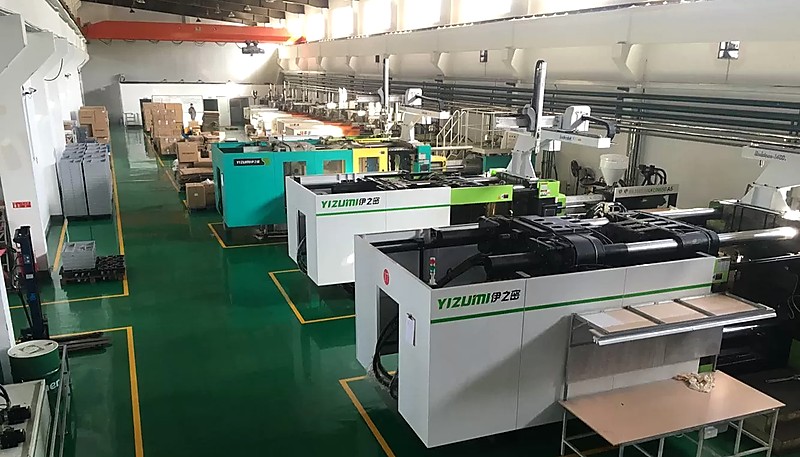
Unsere 8 erfahrenen Ingenieure konstruieren mit UG, SOLIDWORKS und MOLDFLOW Werkzeuge, die für unsere 47 Spritzgießmaschinen optimiert sind. So ist jedes Werkzeug exakt auf seine spätere Produktionsumgebung zugeschnitten.
Schritt 4: Detailkonstruktion und Freigabe der 2D-Zeichnung
Die abschließende Konstruktionsphase erzeugt einen vollständigen Satz 2D-Zeichnungen für jede Werkzeugkomponente — Kavitätseinsätze, Kerneinsätze, Schieber, Schrägauswerfer, Auswerferstifte, Kühlstopfen und den Formaufbau selbst. Jede Komponente wird funktionsgerecht toleriert: Bei Präzisionsteilen werden Kavitätsmaße mit ±0.01 mm oder enger toleriert, während Strukturkomponenten breitere Toleranzen erhalten. Das vollständige Konstruktionspaket wird vor Bearbeitungsbeginn geprüft und freigegeben.
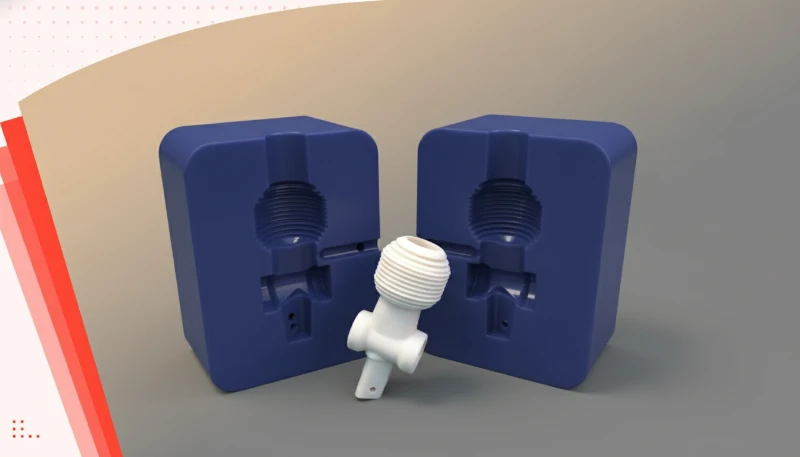
"Eine Füllsimulation kann die Lage von Bindenähten und den Bauteilverzug vor Beginn der Stahlbearbeitung vorhersagen."True
Moderne Simulationswerkzeuge wie MOLDFLOW nutzen die Finite-Elemente-Analyse, um Polymerfluss, Kühlung und Schwindung mit hoher Genauigkeit zu modellieren. Die Prognose von Bindenähten, Lufteinschlüssen und Verzugsmustern während der Konstruktionsphase gehört in professionellen Formenbaubetrieben zum Standard — und verhindert kostspielige Stahländerungen nach der T1-Bemusterung.
"Aluminiumformen können bei der Großserienfertigung dieselbe Bauteilqualität wie Formen aus gehärtetem Stahl erzielen."False
Aluminiumwerkzeuge eignen sich hervorragend für Prototypen und Kleinserien (unter 10,000 Teilen), erreichen jedoch nicht die Verschleißfestigkeit und thermische Stabilität von gehärtetem Stahl. Bei Produktionsläufen von mehr als 50,000 Teilen bewahren Stahlwerkzeuge (P20, H13, S136) Maßgenauigkeit und Oberflächengüte über die Zeit deutlich besser.
Wie wird ein Spritzgießwerkzeug Schritt für Schritt gefertigt?
Nach Abschluss und Freigabe der Konstruktion beginnt die Fertigungsphase der Form. Dabei werden Rohstahlblöcke durch Präzisionsbearbeitung in das komplexe Werkzeug verwandelt, das Ihre Teile produziert. Die übliche Fertigungszeit einer Serienform beträgt je nach Komplexität 4–8 Wochen.
Phase 1: Materialbeschaffung und Schruppbearbeitung
Werkzeugnormalien sowie Kavitäts- und Kernblöcke werden bei Stahllieferanten bestellt. Standardwerkzeugnormalien (LKM, DME, HASCO) sind ab Lager erhältlich, während Kavitätseinsätze kundenspezifisch aus massiven Werkzeugstahlblöcken bearbeitet werden. Beim Schruppen wird der größte Teil des Materials mit Schaftfräsern großen Durchmessers und hoher Zerspanungsleistung abgetragen. Nach dem Schruppen wird der Stahl spannungsarm geglüht, um Eigenspannungen abzubauen, die später zu Maßabweichungen führen könnten. Kostengünstige Werkzeugbaubetriebe lassen diesen Schritt häufig aus — und nach einigen tausend Zyklen zeigt sich dies stets in Form von Maßinstabilität.
Phase 2: Präzisions-CNC-Bearbeitung und EDM
Nach dem Schruppen und der Wärmebehandlung werden Kavitäts- und Kerneinsätze auf Hochgeschwindigkeits-CNC-Fräszentren mit einer Positionsgenauigkeit von ±0.005 mm fertigbearbeitet. Merkmale, die mit CNC-Schneidwerkzeugen nicht erreichbar sind – tiefe Rippen, scharfe Innenecken und komplexe 3D-Flächen –, werden durch Funkenerosion (EDM)3 gefertigt. Beim Senkerodieren entstehen komplexe 3D-Kavitäten, indem kontrollierte elektrische Funken die Elektrodenform in den Stahl übertragen. Drahterodieren schneidet mit einer dünnen Drahtelektrode präzise Durchbrüche und Konturen. Beide Verfahren sind für Serienformen unverzichtbar.
Phase 3: Oberflächenfinish und Polieren
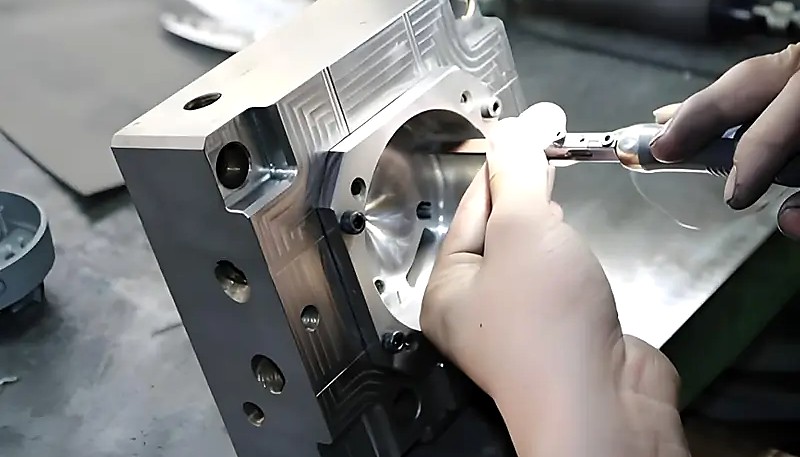
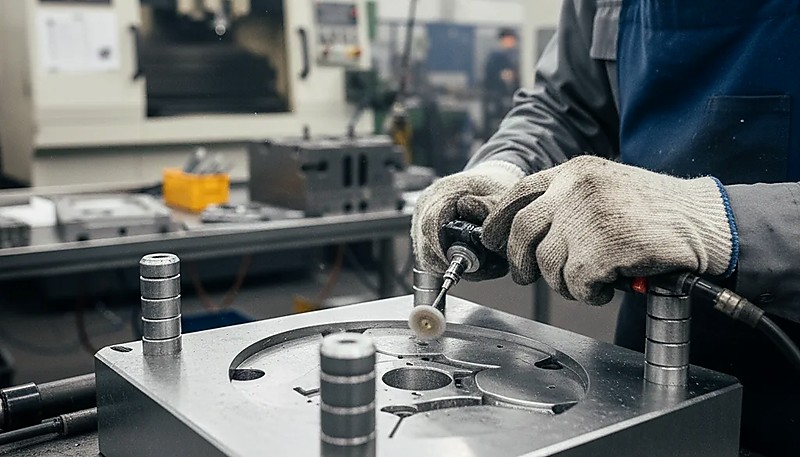
Die Oberflächenqualität der Kavität bestimmt unmittelbar die Oberfläche des Teils. Die SPI-Oberflächenstandards reichen von A-1 (Spiegelpolitur, #3-Diamantpolitur) bis D-3 (Trockenstrahlen, Stein mit Körnung 240). Formen für optische Linsen können eine Oberflächenrauheit unter Ra 0.01 μm erfordern, während für Strukturteile üblicherweise eine Oberfläche nach SPI B-2 (Papier mit Körnung 320) genügt. Das Polieren ist manuelle Facharbeit, die viel Zeit beansprucht und bei Anwendungen mit hohen Oberflächenanforderungen einen erheblichen Anteil der gesamten Formkosten ausmacht.
Phase 4: Montage, Prüfung und T1-Bemusterung
Alle bearbeiteten Komponenten werden im Werkzeuggrundgestell montiert. Das Kühlsystem wird einer Druckprüfung auf Dichtheit unterzogen. Führungssäulen, Schieber, Schrägauswerfer und Auswerferstifte werden eingepasst und auf leichtgängige Funktion geprüft. Anschließend wird das Werkzeug zur T1-Bemusterung (Erstmuster) in die Spritzgießmaschine eingebaut. Die T1-Bemusterung ist ein entscheidender Meilenstein — erstmals füllt Kunststoffschmelze das tatsächliche Produktionswerkzeug. Die Muster werden anhand der Bauteilzeichnung vermessen; sämtliche Maßabweichungen werden für die Werkzeuganpassung dokumentiert.
Unser eigener Werkzeugbau fertigt monatlich 100+ Werkzeugsätze und verfügt über umfassende Möglichkeiten für CNC, EDM und CMM-Prüfungen — dadurch kontrollieren wir den gesamten Werkzeugbauprozess von der Konstruktion bis zur T1-Bemusterung, ohne von externen Lieferanten abhängig zu sein.
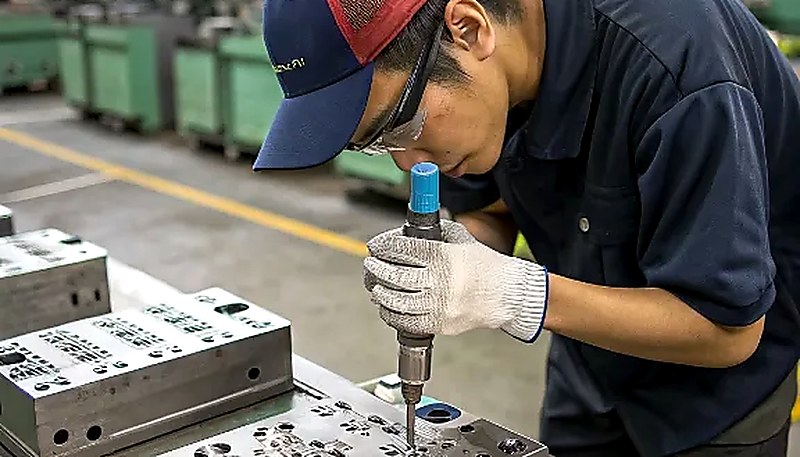
"Die Werkzeugkühlzeit macht typischerweise 50–70% der gesamten Spritzgießzykluszeit aus."True
Bei den meisten Spritzgießanwendungen nimmt die Kühlphase den größten Teil des Zyklus ein. Die Optimierung der Kühlkanalauslegung – durch konturnahe Kühlung, Umlenksysteme oder den Wechsel zwischen Warm- und Kaltwasser – ist die wirksamste Möglichkeit, Zykluszeit und Stückkosten ohne Qualitätseinbußen zu senken.
"Ein Werkzeug, das bei der T1-Bemusterung gute Bauteile produziert, muss niemals geändert werden."False
T1-Muster werden unter sorgfältig kontrollierten Laborbedingungen hergestellt. Mit steigenden Produktionsmengen können Schwankungen bei Materialchargen, Maschinenverschleiß, Umgebungstemperatur und Bedienverfahren Probleme sichtbar machen, die bei der Erstbemusterung nicht erkennbar waren. Die meisten Produktionsformen durchlaufen nach T1 1–3 Feinabstimmungsrunden, um sie für reale Produktionsbedingungen zu optimieren.
Warum bestimmt die Formenqualität die Qualität Ihres Endprodukts?
Dieser Abschnitt behandelt, wie die Werkzeugqualität die endgültige Teilequalität und Kosten, Qualität, Termine oder Beschaffungsrisiken bestimmt. In der Spritzgießbranche heißt es: “Das Werkzeug ist die Qualität.” Prozessparameter (Temperatur, Druck, Geschwindigkeit, Zeit) lassen sich innerhalb eines Bereichs anpassen, grundlegende Probleme der Werkzeugkonstruktion aber nicht ausgleichen. Liegt der Anschnitt falsch, beseitigt keine Druckanpassung die entstehende Bindennaht. Ist die Kühlung ungleichmäßig, verhindert keine Nachdruckzeit den Verzug. Sind zu wenige Auswerferstifte vorhanden oder ungünstig platziert, verformen sich die Teile beim Auswerfen, unabhängig davon, wie sorgfältig die Maschine eingestellt wird.
Die Formqualität beeinflusst fünf entscheidende Produktionsergebnisse. Maßgenauigkeit: Die Kavität muss die Kunststoffschwindung ausgleichen (je nach Werkstoff und Bauteilgeometrie meist 0.5–2.5%) und ihre Abmessungen über Hunderttausende Zyklen verschleißfrei halten. Oberflächengüte: Die Politur des Kavitätenstahls bestimmt unmittelbar die Oberfläche des Bauteils; kein nachgelagerter Prozess verbessert sie. Konstanz: Eine Präzisionsform hält die Schwankung von Teil zu Teil unter 0.05 mm, während eine schlecht gebaute Form mit zunehmendem Verschleiß um 0.2 mm oder mehr abweicht. Zykluszeit: Eine effiziente Kühlung spart in jedem Zyklus Sekunden; bei 500.000 Teilen bedeuten 2 Sekunden weniger pro Zyklus 278 Maschinenstunden weniger.
Formlebensdauer: Eine ordnungsgemäß gehärtete und gewartete Serienform kann 500.000 bis über 1,000,000 Zyklen absolvieren, bevor eine größere Überholung erforderlich wird.
Wie wählt man den richtigen Hersteller von Spritzgießwerkzeugen aus?
In diesem Abschnitt geht es um die Wahl des richtigen Spritzgussformenherstellers und deren Auswirkungen auf Kosten, Qualität, Termine und Beschaffungsrisiken. Die Wahl eines Formenlieferanten ist eine langfristige Entscheidung — Sie arbeiten während der gesamten, möglicherweise mehrjährigen Produktionsdauer Ihres Produkts mit diesem Unternehmen zusammen. Auf Grundlage unserer Erfahrung mit Hunderten Kunden erläutern wir die wirklich entscheidenden Faktoren.
Eigener Werkzeugbau: Ein Unternehmen, das Formen unter einem Dach konstruiert, bearbeitet, montiert und prüft, erzielt stets bessere Ergebnisse als ein Betrieb, der einzelne Schritte auslagert. Wenn Konstrukteur, Zerspaner und Verfahrensingenieur am selben Standort arbeiten, werden Probleme in Stunden statt in Wochen gelöst. Fragen Sie, ob der Formenbauer eigene CNC-Zentren, EDM-Maschinen und KMG-Prüftechnik besitzt oder diese Arbeiten vergibt.
Technische Kompetenz: Die besten Formenbauer setzen Ihre Konstruktion nicht nur um, sondern verbessern sie. Ein starkes Entwicklungsteam erkennt übersehene DFM-Probleme, empfiehlt bessere Anspritzkonzepte und optimiert die Kühlung für Ihre Geometrie. Fragen Sie nach Simulationsmöglichkeiten – MOLDFLOW ist der Branchenstandard – und nach der Erfahrung der Konstrukteure.
Werkstoffkompetenz: Kunststoffe verhalten sich in der Form sehr unterschiedlich. Ein Betrieb mit Erfahrung in über 400 Werkstoffen kennt Fließ-, Schwindungs- und Abbauverhalten der einzelnen Harze und legt seine Formen entsprechend aus. Bei glasfaserverstärktem Nylon benötigt die Form beispielsweise in Verschleißbereichen gehärteten Stahl, mindestens H13, da Glasfasern gewöhnliche P20-Werkzeuge extrem stark abreiben.
Kommunikation und Betreuung: Für internationale Einkäufer ist klare englische Kommunikation kein Luxus, sondern unerlässlich. Schon ein Missverständnis bei einer Maßtoleranz kann dazu führen, dass die Form Teile erzeugt, die nicht in die Baugruppe passen. Achten Sie auf Lieferanten mit festen englischsprachigen Projektleitern und Ingenieuren, die Ihre technischen Anforderungen ohne ständige Rückfragen verstehen.
Wenn Sie Formenlieferanten für Ihr nächstes Projekt bewerten, erstellt unser Team bei ZetarMold gerne einen detaillierten Konstruktionsvorschlag und ein wettbewerbsfähiges Angebot – einschließlich DFM-Rückmeldung, Formfüllanalyse und eines klaren Zeitplans von der Konstruktionsfreigabe bis zur T1-Bemusterung. Einen vollständigen Bewertungsrahmen für Fertigungspartner finden Sie in unserem Beschaffungsleitfaden für Spritzgießdienstleistungen.
Mit Erfahrung in 400+ Kunststoffwerkstoffen und Zertifizierungen nach ISO 9001, ISO 13485, ISO 14001 und ISO 45001 gibt unser Engineering-Team werkstoffspezifische Empfehlungen zur Werkzeugauslegung auf Basis realer Produktionsdaten.
Häufig gestellte Fragen
Wie lange dauert der Bau eines Spritzgießwerkzeugs?
Ein standardmäßiges Einkavitäten-Serienwerkzeug benötigt von der Konstruktionsfreigabe bis zur T1-Bemusterung in der Regel 4–6 Wochen. Komplexe Mehrkavitätenwerkzeuge mit Schiebern, Schrägauswerfern oder Heißkanalsystemen können je nach Anzahl der Seitenbewegungen und Anforderungen an die Oberflächengüte 8–12 Wochen benötigen. Prototypenwerkzeuge aus Aluminium können in nur 1–3 Wochen fertiggestellt werden. Die entscheidenden Einflussfaktoren für den Terminplan sind die Teilekomplexität (Hinterschneidungen, dünne Wände, enge Toleranzen), die Kavitätenzahl und der Einsatz eines Heißkanalsystems.
Was sind die typischen Kosten für ein Spritzgusswerkzeug?
Ja — mit einem Familienwerkzeug lassen sich mehrere unterschiedliche Teile im selben Spritzgießzyklus herstellen. Dies ist besonders bei Produktbaugruppen nützlich, für die mehrere Komponenten in aufeinander abgestimmten Stückzahlen benötigt werden. Familienwerkzeuge erfordern jedoch eine sorgfältige Fließbalancierung, damit jede Kavität in jedem Zyklus vollständig und gleichmäßig gefüllt wird. Sie eignen sich am besten, wenn die einzelnen Teile ein ähnliches Volumen sowie ähnliche Wanddicken und Materialanforderungen aufweisen. Bei Teilen mit stark abweichenden Geometrien oder Größen sind separate, speziell ausgelegte Werkzeuge möglicherweise besser geeignet, um Qualitätseinbußen zu vermeiden.
Kann ein Spritzgießwerkzeug mehrere unterschiedliche Teile herstellen?
Ein Heißkanalwerkzeug hält den Kunststoff mithilfe beheizter Kanäle im Angusssystem geschmolzen, vermeidet Angussabfall vollständig und verkürzt die Zykluszeit häufig um 1–3 Sekunden pro Schuss. Dafür erhöhen Heißkanalsysteme die anfänglichen Werkzeugbaukosten um 30–50% und erfordern mehr Wartung als Kaltkanäle. Bei einem Kaltkanalwerkzeug erstarrt das Material in unbeheizten Kanälen zusammen mit den Teilen und muss anschließend getrennt und vermahlen werden. Kaltkanäle sind einfacher, kostengünstiger und werden bei geringeren Produktionsmengen oder Prototypenanwendungen bevorzugt.
Worin unterscheidet sich ein Heißkanalwerkzeug von einem Kaltkanalwerkzeug?
Ein Heißkanalwerkzeug hält den Kunststoff in beheizten Kanälen des Verteilersystems flüssig, vermeidet Angussabfall vollständig und verkürzt die Zykluszeit häufig um 1–3 Sekunden pro Schuss. Dafür erhöhen Heißkanalsysteme die anfänglichen Werkzeugkosten um 30–50% und erfordern mehr Wartung. Ein Kaltkanalwerkzeug nutzt unbeheizte Kanäle, in denen der Anguss zusammen mit den Teilen erstarrt und anschließend abgetrennt und vermahlen werden muss. Kaltkanäle sind einfacher, günstiger und werden für kleinere Serien oder Prototypen bevorzugt.
Wie viele Teile kann ein Spritzgießwerkzeug herstellen, bevor es verschleißt?
Der Standardspritzguss erreicht mit korrekt konstruierten Formen und stabilen Prozessbedingungen zuverlässig Toleranzen von plus/minus 0.05 bis 0.10 mm für Maße unter 25 mm. Präzisionsspritzguss mit optimierter Anschnittauslegung, geregelter Kühlung und engmaschiger Prozessüberwachung kann bei kritischen Merkmalen gut konstruierter Teile plus/minus 0.025 mm erreichen. Toleranzen größerer Maße skalieren annähernd proportional – typischerweise plus/minus 0.1 bis 0.3 mm bei Maßen über 100 mm. Die Form muss mit einer geeigneten materialspezifischen Schwindungskompensation ausgelegt sein, damit diese Toleranzziele über die gesamte Produktionsserie zuverlässig eingehalten werden.
Welche Toleranzen sind beim Spritzguss erreichbar?
Die Formfüllsimulation prognostiziert genau, wie geschmolzener Kunststoff die Kavität füllen wird, wo Bindelinien entstehen und wie das Teil schrumpfen und sich verziehen wird – alles bevor Stahl geschnitten wird. Dies eliminiert den teuren Trial-and-Error-Ansatz, eine Form zu bauen und sie dann nach T1-Probenproblemen zu modifizieren. Stahlmodifikationen dauern typisch 2–4 Wochen und kosten $2,000–$10,000+ pro Modifikationsrunde. Professionelle Formenbauer führen Simulationen für jede Produktionsform als Standard Design Schritt aus, weil die Kosten einer Simulation nur einen Bruchteil einer einzelnen Stahlmodifikation ausmachen.
Warum ist Formfüllsimulation wichtig vor dem Bau einer Form?
Die Formfüllsimulation prognostiziert genau, wie das geschmolzene Kunststoffmaterial die Kavität füllen wird, wo Bindelinien entstehen und wie das Teil schrumpfen und sich verziehen wird – alles bevor Stahl geschnitten wird. Dies eliminiert den teuren Trial-and-Error-Ansatz, eine Form zu bauen und sie dann nach T1-Probenproblemen zu modifizieren. Stahlmodifikationen dauern typisch 2–4 Wochen und kosten $2,000–$10,000+ pro Runde. Professionelle Formenbauer führen Simulationen für jede Produktionsform als Standard Schritt aus, weil die Kosten einer Simulation nur einen Bruchteil einer Stahlmodifikation ausmachen.
Welche Wartung benötigt eine Spritzgussform?
Produktionsformen benötigen regelmäßige planmäßige Wartung, um die Teilqualität zu erhalten und die Werkzeuglebensdauer zu verlängern. Hauptwartungsaufgaben umfassen Kavitätenreinigung und Polieren nach 50,000–100,000 Zyklen zur Oberflächenrestaurierung, Auswerferstiftinspektion und Schmierung, Kühlkanalentschlackung zur thermischen Leistungsfähigkeit, Einspritzbereichinspektion für Erosionsschäden (besonders wichtig bei glasfaserverstärkten Materialien) sowie Schieber- und Liftermechanismusinspektion für Verschleiß. Ein diszipliniertes vorbeugendes Wartungsprogramm verlängert typisch die Formlebensdauer um 2–3 Mal und verhindert kostspielige unplanmäßige Produktionsausfallzeiten.
MOLDFLOW-Simulation: Moldflow ist eine von Autodesk entwickelte Simulationssoftware für den Kunststoffspritzguss, die mithilfe der Finite-Elemente-Analyse das Fließ-, Kühl- und Schwindungsverhalten von Polymeren während des Spritzgießprozesses vorhersagt. ↩
Fertigungsgerechte Konstruktion (DFM): Design for Manufacturability (DFM) bezeichnet die Praxis, Bauteile so zu konstruieren, dass sie einfach und kostengünstig hergestellt werden können. Dabei werden Faktoren wie gleichmäßige Wandstärken, Entformungsschrägen, Rippenabmessungen und die Minimierung von Hinterschneidungen berücksichtigt, um einen erfolgreichen Spritzguss zu gewährleisten. ↩
Funkenerosion (EDM): EDM ist ein Präzisionsbearbeitungsverfahren, bei dem kontrollierte elektrische Funken zwischen einer Elektrode und dem Werkstück Material abtragen. Damit lassen sich in gehärtetem Stahl komplexe Geometrien herstellen, die mit konventionellen Schneidwerkzeugen nicht realisierbar sind. ↩