 Перейти к содержанию

Какие проблемы может решить регулировка скорости? литьё под давлением машины. Сделайте всё правильно — и вы получите блестящие, размерно стабильные детали цикл за циклом. Ошибетесь — и будете бороться с облоем, недоливами, утяжинами и короблением до скончания веков. На нашем заводе в Шанхае мы более 20 лет настраивали профили скорости на машинах от 90 до 1850 тонн, и это руководство содержит самую суть того, что действительно важно.
- Injection speed directly controls melt flow rate, cavity pressure, and part quality
- Multi-stage speed profiles outperform single-speed filling for most parts
- Thin-walled parts demand faster speeds; thick-walled parts need slow-fast-slow curves
- Speed adjustment can solve flash, short shots, jetting, and burn marks
- Material viscosity and gate design dictate your starting speed range
What Is Injection Speed in Injection Molding?
Скорость впрыска — это скорость шнека, заполняющего полость формы расплавленным пластиком. Обычно она выражается в мм/с или см³/с и становится первым настраиваемым параметром после стабилизации температуры расплава, температуры формы и усилия смыкания. Если вы сравниваете поставщиков или планируете закупку, наш injection molding supplier sourcing guide охватывает подготовку запроса предложений и проверку поставщиков.
Скорость впрыска — это скорость, с которой шнек подает расплавленный полимер в полость формы, измеряемая в мм/с или см/с. Она определяет, насколько быстро полость заполняется до того, как материал начнет отвердевать. На гидравлической машине скорость впрыска регулируется расходом гидравлического масла к цилиндру впрыска. На полностью электрической машине шнек приводится серводвигателем, а скорость задается напрямую как цифровой параметр.
The relationship between speed and part quality is not linear. Below a certain threshold, the melt cools too much during filling, creating weak weld lines, flow marks, and uneven density. Above another threshold, the melt enters the cavity turbulently, trapping air, causing jetting, and generating excessive shear heat that can degrade the polymer. The sweet spot — and it is different for every mold and material — is where the melt front advances steadily, fills uniformly, and packs out completely.
In practice, injection speed interacts with injection pressure, melt temperature, and mold temperature. You cannot optimize speed in isolation. But speed is usually the first parameter to tune after you have set barrel temperatures and clamp force, because its effects on surface appearance and dimensional consistency are immediate and obvious.
In our Shanghai factory, we run 47 injection molding machines ranging from 90T to 1850T. Across thousands of production runs, we have found that injection speed is the single most impactful parameter to get right during initial process setup — more so than holding pressure or cooling time for most parts.

Why Does Injection Speed Matter for Part Quality?
Скорость впрыска является основным параметром контроля качества литой детали. Она управляет скоростью фронта расплава, давлением в полости и равномерностью охлаждения. Когда расплав поступает слишком медленно, полимер охлаждается до полного заполнения полости, вызывая холодные пробки, слабые линии спая, неравномерную плотность и неполное уплотнение. Когда он поступает слишком быстро, процесс может вызвать струйность, воздушные ловушки, облой, следы прожига и избыточный сдвиговый нагрев.
When the melt enters too fast, you get a different set of problems: jetting where the melt shoots through the gate like a fire hose instead of spreading in a smooth front, air traps from turbulent flow which cause burns and voids, flash at the parting line from the sudden pressure spike, and surface blemishes like silver streaks from moisture or gas.
The ideal speed keeps the melt front velocity constant throughout filling. Since the cross-sectional area of the cavity changes along the flow path, the screw speed needs to change too — which is exactly why multi-stage profiling1 exists. Each phase of filling demands a different speed to keep the melt front advancing at a consistent rate.
«Тонкостенные детали, как правило, требуют более высокой скорости впрыска, чем толстостенные».Правда
Thin walls solidify in milliseconds. The melt must fill the entire cavity before the flow channel freezes off, requiring faster injection speeds — often 200 mm/s or higher for wall thicknesses under 0.5 mm.
«Скорость впрыска и давление впрыска — полностью независимые параметры».Ложь
While machine settings are separate, increasing injection speed typically raises cavity pressure due to higher volumetric flow rate and increased shear heating.
What Factors Affect Injection Speed?
Основными факторами, влияющими на скорость впрыска, являются вязкость материала, толщина стенки, конструкция впуска, длина потока и возможности машины. Материалы с низкой вязкостью, такие как ПП и ПА, могут заполняться на умеренной скорости, в то время как ПК, ПММА и стеклонаполненные материалы требуют более жесткого контроля, чтобы избежать повреждения от сдвига. Тонкие стенки требуют более быстрого заполнения до замерзания, в то время как толстые стенки обычно нуждаются в профиле «медленно-быстро-медленно».
Wall thickness plays a decisive role. Thin-walled parts under 1 mm require high speed to fill before freeze-off. Thick-walled parts over 3 mm benefit from a slow-fast-slow profile to minimize sink marks and voids while still achieving reasonable cycle times. Gate type and size also matter — a pinpoint gate creates high shear at the entrance, so speed through the gate needs to be controlled, while a large edge gate can tolerate higher speeds.
Flow length is another key factor. Long flow paths require higher speed to maintain melt temperature. If the polymer cools mid-fill, you get short shots. A general rule: for every 100 mm of flow length, expect to increase speed by 10 to 20 mm/s to compensate for heat loss. Mold temperature also plays a role — a hotter mold allows slower speeds because the melt stays fluid longer.
Finally, machine capability sets the upper bound. The maximum injection speed depends on the machine hydraulic flow rate or servo motor RPM. A machine rated for 300 mm/s maximum may only deliver stable speed control between 20 and 250 mm/s. Understanding these factors together is essential for selecting the right injection speed definition2 for your specific application.
How Do You Control Injection Speed?
Вы управляете скоростью впрыска, программируя расход гидравлического клапана, скорость замкнутого контура сервопривода или движение сервоэлектрического шнека. Пропорциональное клапанное управление регулирует поток масла к цилиндру впрыска, в то время как сервосистемы измеряют фактическое положение и скорость шнека в реальном времени. Для прецизионных деталей управление с замкнутым контуром обеспечивает гораздо лучшую повторяемость, чем настройки скорости с разомкнутым контуром.
Closed-loop servo control uses a high-resolution encoder on the screw to measure actual position and speed in real time. The controller adjusts the servo motor or proportional valve to match the setpoint. This gives plus or minus 0.1 percent speed accuracy and is essential for precision molding — especially medical, optical, and electronic parts where shot-to-shot consistency directly affects part quality.
Servo-electric direct drive eliminates hydraulics entirely. A ball-screw driven by a servo motor moves the injection unit. Speed control is inherently digital, with response times under 10 ms. These machines offer the most consistent shot-to-shot speed and the cleanest speed transitions between stages.
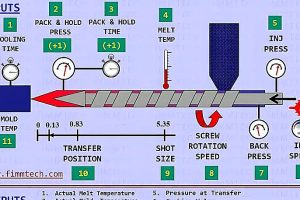
At the process level, most modern controllers let you program 5 to 10 speed stages. Each stage specifies a screw position and a target speed. The machine transitions between stages automatically as the screw advances, allowing you to slow down at the gate, speed up through the cavity, and slow down again at the end of fill — all in a single shot.
Across our 47 machines from 90T to 1850T, we use closed-loop speed control on every press. The difference between open-loop and closed-loop speed control is most visible on tight-tolerance parts — we have seen dimensional variation drop by 40 to 60 percent simply by switching to closed-loop injection speed profiling.
What Is Multi-Stage Injection Speed Profiling?
Multi-stage profiling is the practice of changing injection speed at specific points during the filling phase. Instead of running the screw at one constant speed, you program a speed curve that adapts to what is happening inside the mold. A typical 5-stage profile breaks the filling process into distinct phases, each with its own speed target.
Stage 1 is runner fill at high speed, typically 80 to 100 percent of maximum. The runner has no cosmetic or structural requirements, so speed is prioritized to minimize heat loss. Stage 2 is gate entry at slow speed, dropping to 20 to 40 percent as the melt passes through the gate. This prevents jetting, reduces shear stress, and avoids gate blush. For pinpoint gates on cosmetic parts, this stage is critical.
Stage 3 is cavity fill at fast speed, ramping back up to 60 to 90 percent once the melt has passed the gate and is spreading through the cavity. This stage typically fills to 70 to 85 percent of the part by volume. Stage 4 is the transition phase at medium speed, reducing to 30 to 50 percent as the cavity approaches full, creating a smooth transition to the packing phase and preventing overpacking near the gate.
Stage 5 is end of fill at slow speed, dropping to 10 to 20 percent for the final filling. This prevents flash, allows trapped air to escape through vents, and creates a clean transition to holding pressure. The exact speed percentages and position switchover points depend on the mold and material. Finding the optimal profile is part of the scientific molding methodology3 where you run short shots at different speeds, measure the fill pattern, and iterate.
«Замедление скорости впрыска вблизи литника может помочь уменьшить дефекты струйности и помутнения у литника».Правда
Reducing speed at the gate minimizes shear stress and prevents the melt from shooting through the opening turbulently. This is one of the most effective speed-based defect fixes.
«Постоянная скорость впрыска на протяжении всей фазы заполнения дает наилучшие результаты».Ложь
Multi-stage speed profiling consistently outperforms single-speed filling. Constant speed causes jetting at the gate, flash at end of fill, or both — depending on the chosen speed.
What Problems Can Speed Adjustment Solve?
определение скорости впрыска относится к ISO 294-1:2017, который определяет скорость впрыска как скорость перемещения шнека в фазе наполнения при литье под давлением
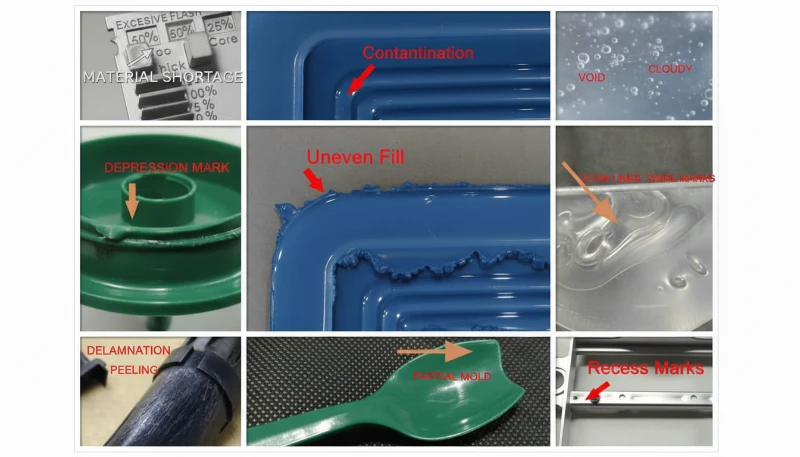
Short shots occur when the part is not filling completely because the melt is freezing before it reaches the end of the cavity. The solution is to increase speed during the cavity fill stage, which keeps the melt hotter and flowing further. Jetting produces worm-like lines on the part surface near the gate when the melt shoots through the gate in a narrow stream instead of spreading in a fan pattern. Slowing down at the gate entry gives the melt time to establish a proper flow front.
Burn marks appear as dark streaks or charred areas, usually near the end of fill or at blind pockets, caused by compressed superheated air. The solution is to slow down the end-of-fill speed to give air time to escape through vents before the cavity seals. Sink marks are localized depressions on the part surface above thick sections or ribs, and while sink is primarily a packing issue, faster injection speed helps by delivering hotter material to thick sections.
Flow lines are visible ripples or waviness on the part surface caused by inconsistent melt front velocity. The solution is to adjust the speed profile to maintain a steady melt front speed, typically by increasing speed as the flow path widens. Understanding material viscosity curves helps predict which speeds will produce the cleanest flow for each polymer type.
How Do You Optimize Injection Speed for Different Materials?
Оптимизация скорости для конкретного материала — это процесс согласования каждой ступени скорости с вязкостью полимера, толщиной стенки и термочувствительностью. Каждый полимер имеет кривую вязкости, которая диктует, как он реагирует на скорость и сдвиг. В таблице ниже приведены стартовые диапазоны для распространенных материалов; затем их следует уточнить с помощью исследований недолива и данных о давлении в полости во время настройки процесса.
| Материал | Typical Speed Range | Key Consideration |
|---|---|---|
| PP (полипропилен) | 50-150 mm/s | Low viscosity; fast fill, moderate shear |
| ПЭ (полиэтилен) | 50-120 mm/s | Similar to PP; watch for warpage in thin walls |
| PA6/PA66 (Nylon) | 60-180 mm/s | Needs fast fill to prevent premature freeze |
| ABS | 40-120 mm/s | Medium viscosity; speed affects gloss uniformity |
| PC (поликарбонат) | 30-100 mm/s | High viscosity; shear-sensitive; avoid spikes at gate |
| PMMA (Acrylic) | 30-80 mm/s | Very high viscosity; optical clarity demands steady flow |
| POM (Acetal) | 50-150 mm/s | Fast crystallization; needs quick fill |
| PBT | 60-140 mm/s | Crystalline; speed affects crystallinity and shrinkage |
| Glass-filled (PA+GF) | 80-200 mm/s | High speed needed; watch fiber orientation |
| TPU | 30-80 mm/s | Low shear tolerance; slow speeds prevent degradation |
For glass-filled materials, higher injection speeds help maintain fiber length and improve mechanical properties. However, excessive speed causes fiber breakage at the gate, reducing the strengthening effect. The sweet spot is typically 100 to 150 mm/s for 30 percent glass-filled nylon. For heat-sensitive materials like PC and POM, the multi-stage approach is especially important — a sudden speed spike at the gate can generate enough shear heat to degrade the polymer.
What Are the Best Practices for Injection Speed Settings?
Based on two decades of production experience, here are the rules we follow. First, start with a decoupled molding approach — fill the cavity to 95 to 99 percent by volume using velocity control, then switch to pressure control via holding pressure. Do not try to fill and pack at the same time. Second, always profile multi-stage speed. Even for simple parts, use at minimum a 3-stage profile. The improvement in consistency is worth the setup time.
Third, use short shot analysis to find your profile. Set the machine to fill only part of the cavity, then gradually increase fill percentage while watching the flow pattern. Fourth, monitor cavity pressure, not just screw speed. What matters inside the литьевая форма is melt pressure and flow velocity — cavity pressure sensors give you the real picture.
Fifth, document your speed profiles. Every mold should have a documented speed curve as part of its process parameters. When you move a mold to a different machine, you will need to adjust speeds to match the new machine response characteristics. Sixth, re-validate after material lot changes — different lots of the same grade can have slightly different viscosity, and a 5 to 10 percent speed adjustment is often enough to compensate.
Как выбрать правильную скорость впрыска
Часто задаваемые вопросы
Какая скорость впрыска считается хорошей для литья под давлением?
Хорошая скорость впрыска зависит от вашего материала и геометрии детали. Для большинства термопластов скорости впрыска варьируются от 50 до 200 мм/с в зависимости от вязкости и толщины стенки. Тонкостенные детали толщиной менее 1 мм обычно требуют скоростей выше 150 мм/с для полного заполнения до застывания, в то время как толстостенные детали толщиной более 3 мм лучше всего работают при скорости 30–80 мм/с. Начните с 50–70% от максимальной скорости машины и корректируйте на основе результатов анализа недолива во время первоначальной настройки процесса.
Как скорость впрыска влияет на качество детали?
Скорость впрыска напрямую управляет скоростью потока расплава, передачей давления в полости и тем, как деталь затвердевает в каждом цикле формования. Слишком медленная скорость вызывает недоливы, слабые линии спая и неполное заполнение, потому что расплав охлаждается до достижения конца полости. Слишком быстрая скорость вызывает облой, струйность, следы прожига и захваченный воздух из-за чрезмерного сдвигового нагрева и сжатого газа. Оптимальная скорость поддерживает постоянную скорость фронта расплава на протяжении всего заполнения, обеспечивая равномерную толщину стенок и стабильную структурную целостность по всей детали.
Что такое многоступенчатое профилирование скорости впрыска?
Многоступенчатое профилирование изменяет скорость впрыска на определенных позициях шнека во время заполнения вместо использования одной постоянной скорости на протяжении всего выстрела. Типичный пятиступенчатый профиль начинается с быстрого заполнения литника на 80–100% от максимальной скорости, замедляется у впуска для предотвращения струйности, ускоряется для заполнения полости на 60–90% и завершается медленной стадией конца заполнения для предотвращения облоя. Этот подход последовательно снижает дефекты, такие как облой, следы прожига и линии спая, за счет контроля поведения входа расплава.
Как измеряется скорость впрыска?
Скорость впрыска точно измеряется как скорость перемещения шнека во время фазы заполнения, обычно выражается в миллиметрах в секунду или кубических сантиметрах в секунду. Современные машины с сервоуправлением замкнутого контура используют высокоразрешающие энкодеры для отслеживания фактического положения и скорости шнека в реальном времени, достигая точности в пределах 1% от заданного значения. Большинство контроллеров машин отображают как мгновенную скорость, так и среднюю скорость заполнения, что позволяет операторам проверять корректность выполнения каждой стадии многоступенчатого профиля во время производственных циклов.
What is the difference between injection speed and injection pressure?
Скорость впрыска — это то, насколько быстро движется вперед шнек во время фазы заполнения, в то время как давление впрыска — это сила, проталкивающая расплав в полость. Скорость управляет фазой заполнения, а давление берет на себя управление во время последующих фаз уплотнения и выдержки. При раздельном формовании вы преднамеренно разделяете эти две фазы для лучшего контроля процесса и повторяемости от выстрела к выстрелу. Установка слишком высокой скорости увеличивает требования к давлению и может вызвать облой, в то время как установка слишком низкой скорости означает, что полость может не заполниться до затвердевания материала.
Может ли скорость впрыска устранить дефекты облоя?
Да, облой — один из наиболее распространенных дефектов, устраняемых регулировкой скорости впрыска в производственных условиях. Облой возникает, когда расплав перетекает за линию разъема формы из-за чрезмерного давления или скорости в конце заполнения. Уменьшение скорости впрыска на завершающей стадии заполнения позволяет форме правильно закрыться до того, как давление станет слишком высоким. Многоступенчатое профилирование с медленной завершающей стадией на уровне 10–20% от максимальной скорости является стандартным корректирующим действием для предотвращения облоя в операциях прецизионного формования.
Какую скорость впрыска следует использовать для АБС?
Для ABS начните со скорости заполнения 80–150 мм/с и корректируйте в зависимости от геометрии детали и требований к толщине стенки. ABS имеет умеренную вязкость и хорошо реагирует на многоступенчатое профилирование с быстрым начальным заполнением, за которым следует более медленная завершающая стадия заполнения. Следите за глянцевыми отметками на поверхности детали, которые указывают на слишком резкие переходы скорости. Если вы видите усадочные раковины на более толстых участках, попробуйте сначала увеличить давление подпрессовки, а не менять скорость впрыска, поскольку ABS менее чувствителен к изменениям скорости, чем PC.
-
multi-stage profilingМногоступенчатое профилирование — это практика изменения скорости впрыска на определенных позициях шнека во время фазы заполнения, техника, центральная для научных и разделенных методологий формования. ↩
-
injection speed definition: определение скорости впрыска относится к скорости движения шнека вперед во время фазы заполнения, измеряемой в мм/с или см³/с, которая напрямую контролирует скорость заполнения полости формы расплавленным полимером ↩
-
scientific molding methodology: научная методология формования относится к системному подходу к разработке процесса литья под давлением, который использует основанный на данных эксперимент, мониторинг давления в полости и принципы раздельного формования ↩




 EN
EN  ES
ES  FR
FR  DE
DE  PT
PT  AR
AR  RU
RU  JA
JA  KO
KO  IT
IT  NL
NL  TR
TR  PL
PL 