 콘텐츠로 건너뛰기

- ABS1 injection molding requires melt temperatures of 200–260°C and must be dried to below 0.1% moisture content (typically 80°C for 2–4 hours) to prevent surface defects.
- Standard ABS shrinkage is 0.4–0.8%, significantly lower than PE or PP, enabling tighter dimensional tolerances with less mold compensation.
- ABS is the most widely used engineering plastic for consumer electronics, automotive interiors, and appliance housings due to its superior impact resistance and electroplating compatibility.
- ABS wall thickness should be maintained at 1.5–4.0 mm with a maximum variation ratio of 3:1 to prevent sink marks, warpage, and flow hesitation.
- Post-mold ABS surfaces accept painting, electroplating, vacuum metallizing, and pad printing without adhesion promoters, making it the preferred material for decorated parts.
What Is ABS and Why Is It the Most Popular Engineering Plastic?
ABS (Acrylonitrile Butadiene Styrene) is an amorphous engineering thermoplastic that delivers a balanced combination of impact resistance, stiffness, chemical resistance, and processability that no single-component polymer achieves alone. The three monomers contribute specific properties: acrylonitrile provides chemical resistance and heat stability; butadiene rubber particles (0.1–1.0 µm diameter) absorb impact energy through cavitation and crazing mechanisms; styrene contributes rigidity, surface gloss, and melt flow properties that make ABS one of the most injection-moldable engineering materials available.
Standard ABS grade properties span: tensile strength 40–55 MPa, flexural modulus 2,000–2,700 MPa, notched Izod impact strength2 100–400 J/m, heat deflection temperature (HDT) at 1.82 MPa: 70–100°C, and shrinkage 0.4–0.8%. These values position ABS between general-purpose plastics (PP, PE) and high-performance engineering polymers (PC, PA), at a cost point ($1.5–$3.0/kg) that makes it economically viable for large-scale consumer production. In our factory, ABS accounts for approximately 25% of total resin consumption across all injection molding machines.
What Are the Critical ABS Injection Molding Process Parameters?
Melt temperature for ABS injection molding ranges from 200–260°C depending on grade and application. Standard general-purpose ABS processes at 220–240°C, while high-impact grades run at the lower end (200–220°C) to preserve the butadiene rubber phase, and high-flow grades process at 230–250°C. Exceeding 270°C causes thermal degradation of the butadiene phase, producing discoloration, poor impact strength, and volatile emissions. The nozzle temperature should be set 5–10°C above the front zone to prevent freeze-off.
Mold temperature for ABS is set at 40–80°C depending on surface finish requirements. Higher mold temperatures (60–80°C) produce glossy surfaces with Ra 0.025–0.1 µm when used with polished steel cavities, and improve weld line strength by 10–15% compared to cold molds. Lower mold temperatures (40–50°C) reduce cycle time but may produce stress whitening, visible weld lines, and internal residual stresses that increase the risk of stress cracking in service. For electroplated ABS parts, mold temperature of 60–70°C is mandatory to ensure adequate adhesion quality.
| 매개변수 | Standard ABS | High-Impact ABS | High-Flow ABS |
|---|---|---|---|
| 용융 온도 | 220–240°C | 200–220°C | 230–250°C |
| 금형 온도 | 40–80°C | 40–70°C | 40–60°C |
| injection pressure guide | 70–120 MPa | 60–110 MPa | 60–100 MPa |
| 유지 압력 | 40–70% of injection | 35–65% of injection | 35–60% of injection |
| 냉각 시간 | 15–40 s | 10–30 s | 10–25 s |
| 배압4 | 5–15 MPa | 5–12 MPa | 3–10 MPa |
| 나사 속도 | 30–70 RPM | 25–60 RPM | 40–80 RPM |
| Pre-drying | 80°C, 2–4 hours | 80°C, 2–4 hours | 80°C, 2–4 hours |
Pre-drying is mandatory for ABS injection molding. ABS is hygroscopic, absorbing moisture from the atmosphere at a rate that depends on ambient humidity and temperature. Undried ABS with moisture above 0.1% produces silver streaks, splay marks, surface roughness, and reduced mechanical properties. Standard drying protocol is 80°C for 2–4 hours in a dehumidifying hopper dryer with dew point below -25°C. At 80% relative humidity, ABS can absorb moisture to problem levels (>0.1%) within 2–4 hours of hopper exposure — continuous desiccant drying during production is essential.

How Should ABS Parts Be Designed for Injection Molding?
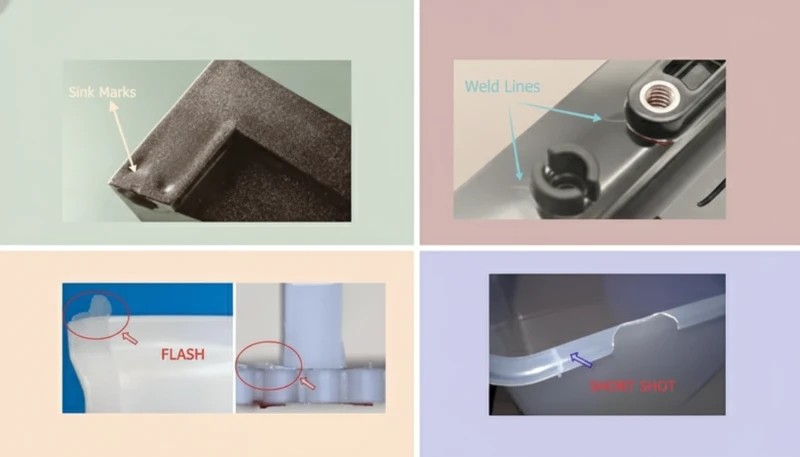
Wall thickness is the most critical ABS part design parameter. Recommended ABS wall thickness is 1.5–4.0 mm, with an optimal range of 2.0–3.0 mm for structural consumer parts. Walls below 1.5 mm require high injection speeds that increase shear stress and may cause surface defects. Walls above 4.0 mm develop sink marks from ABS’s 0.4–0.8% shrinkage and may show surface depressions even at maximum holding pressure settings. When thick sections are unavoidable, core them out from inside to achieve uniform shell geometry.
Draft angles for ABS injection molded parts should be 1°–2° per side for smooth surfaces, increasing to 2°–3° for light texture (MT 11020/SPI C1) and 3°–5° for heavy texture (MT 11030/SPI D2). Insufficient draft causes part drag, ejection marks, and surface scratching on the as-molded surface. ABS sticks to mold steel more aggressively than PE or PP, making adequate draft even more important. 사출 금형 설계 guidelines recommend adding 0.5° additional draft per 25 mm of wall depth for deep-draw ABS features.
Boss design for ABS follows the 0.6:1 ratio rule: boss wall thickness should be 60% of the nominal wall thickness to prevent sink marks on the opposite surface. Boss height should not exceed 3× the boss outer diameter without reinforcing ribs. Gussets connecting bosses to walls should be 50% of nominal wall thickness. For screw-receiving bosses, the outer diameter should be 2.0–2.2× the screw thread diameter to provide adequate pull-out strength without cracking the ABS under installation torque.
Rib design in ABS injection molded parts follows the same 0.6:1 rule: rib thickness at the base should be no more than 60% of the nominal wall to prevent visible sink marks on the opposite cosmetic surface. Rib height is typically limited to 3× the nominal wall thickness for structural ribs, and ribs should taper with at least 0.5° draft per side for clean ejection. Corner radii at rib bases should be 0.25–0.5× the nominal wall thickness to reduce stress concentration that could cause rib-to-wall cracking under repeated loading.
Snap-fit design in ABS leverages the material’s good balance of stiffness and elongation at break (5–20%). Cantilever snap-fits for ABS are designed with strain at maximum deflection of 1.5–2.5% for permanent snaps and 3–4% for temporary single-assembly snaps. The strain at full engagement must stay below the ABS yield strain to avoid permanent deformation or whitening at the snap root. Adding a gradual taper to snap-fit beams — thinner at the tip, thicker at the root — distributes strain uniformly along the beam, increasing allowable deflection without exceeding local strain limits.
“ABS must be dried to below 0.1% moisture before injection molding to prevent silver streaks and splay defects.”True
ABS is hygroscopic due to its acrylonitrile content, which attracts and holds moisture. At moisture levels above 0.1%, water molecules vaporize as steam during injection at 220–240°C, creating gas bubbles that are stretched into silver streaks by the high-velocity melt flow. Standard drying at 80°C for 2–4 hours in a dehumidifying dryer reduces ABS moisture to below 0.05%, well within the safe processing range. Inadequately dried ABS is one of the most common causes of surface quality failure in ABS injection molding.
“ABS injection molding produces identical surface quality regardless of mold temperature setting.”False
Mold temperature has a profound effect on ABS surface quality. At cold mold temperatures (40°C), ABS cools rapidly upon cavity contact, producing higher surface roughness, more visible weld lines, and potential stress whitening. At higher mold temperatures (60–80°C), the melt stays fluid longer against the cavity surface, improving replication of fine cavity detail and producing glossier, smoother surfaces. For electroplated or painted ABS parts, mold temperature of 60–70°C is mandatory to achieve the surface quality required for adhesion of plating or paint.
What Post-Processing Treatments Work Best for ABS?
ABS is the premier material for electroplating among injection molding resins. The butadiene rubber phase is selectively etched by chromic acid (hexavalent chrome) or proprietary non-chrome etchant solutions, creating a micro-porous surface that provides mechanical anchoring for subsequent nickel and chrome plating layers. ABS electroplated with decorative chrome achieves plating adhesion of 8–12 N/cm (peel test), far exceeding the 5 N/cm minimum specification for automotive interior trim. Not all ABS grades are platable — only designated plating grades (typically with butadiene content 15–20%) meet the etch uniformity requirements.
Painting ABS requires no adhesion primer on most properly molded surfaces — solvent-based and water-based paints bond directly to clean, grease-free ABS with excellent adhesion. Spray painting, pad printing, screen printing, and hot stamping are all widely used for ABS consumer products. For two-component (2K) polyurethane clear coats, the ABS surface must be free of mold release residue, which requires alcohol wiping before coating. Laser engraving of ABS produces sharp, white-contrasted characters in molded black or dark-colored parts.
“ABS is the preferred injection molding material for electroplated parts because its butadiene phase enables mechanical adhesion of plating layers.”True
During ABS electroplating, chromic acid etching selectively attacks and removes the butadiene rubber particles from the surface, creating a network of micro-pores (0.5–5 µm diameter) that act as mechanical anchors for the subsequent electroless nickel and electrolytic chrome layers. This unique morphological feature of ABS gives it far superior plating adhesion compared to other amorphous plastics like polycarbonate or polystyrene, which lack the etching-responsive phase. ABS plating adhesion (8–12 N/cm) meets automotive interior grade specifications.
“All ABS grades can be electroplated with equal performance.”False
Only specific ABS grades designated as ‘plating grade’ achieve the etch uniformity required for high-adhesion electroplating. Plating grades contain 15–20% butadiene with carefully controlled rubber particle size and distribution. General-purpose, high-heat, or flame-retardant ABS grades have modified rubber morphology or additive packages that interfere with the etching process, producing uneven etch, adhesion failure, or blistering. Selecting the wrong ABS grade for plated applications is a common and costly mistake that appears only in finished parts, requiring replacement of all tooled parts.
What Are Common ABS Injection Molding Problems and Solutions?
Delamination on ABS parts — where the surface appears to have separating layers that peel like book pages — is almost always caused by material contamination. Even 0.1% contamination with an incompatible material (PP, PE, or silicone from mold release) creates delamination visible on the finished surface. Purging the barrel with a commercial purging compound before ABS runs, avoiding silicone-based mold releases, and strict material handling protocols prevent contamination delamination. Once contamination enters the barrel, it can persist through 50–100+ shots.
Stress cracking of ABS parts in service is caused by residual molding stress combined with environmental stress cracking agents such as greases, cleaning solvents, or aromatic chemicals. Reducing residual stress by lowering holding pressure, extending cooling time, and annealing parts at 70–80°C for 2–4 hours after molding significantly improves stress crack resistance. 열가소성 플라스틱 grade selection also matters: high-impact ABS grades with higher butadiene content are more resistant to environmental stress cracking than standard grades.
자주 묻는 질문
What is the ideal melt temperature for ABS injection molding?
The ideal ABS melt temperature depends on the specific grade and application. Standard general-purpose ABS processes optimally at 220–240°C barrel temperature, measured at the front zone. High-impact ABS grades run at 200–220°C to preserve the butadiene rubber phase, which degrades above 240°C. High-flow ABS grades for thin-wall parts process at 230–250°C. The nozzle is typically set 5–10°C above the front zone. Exceeding 270°C causes visible degradation: yellowing, reduced impact strength, and volatile emissions. The rule of thumb is to use the lowest melt temperature that produces complete fill without surface defects.
How long should ABS be dried before injection molding?
Standard ABS drying protocol is 80°C for 2–4 hours in a dehumidifying hopper dryer with dew point below -25°C. Moisture content must be below 0.1% (preferably below 0.05%) before molding begins. At high ambient humidity (above 70% RH), improperly stored ABS can absorb problematic moisture levels within 2–4 hours of hopper exposure, so continuous desiccant drying during production is essential. Over-drying ABS at temperatures above 90°C or for more than 8 hours can cause oxidative yellowing of the styrene phase. Always check the specific resin supplier’s drying recommendations, as specialty ABS grades may have different requirements.
Can ABS be used for outdoor applications?
Standard ABS has poor UV resistance — extended outdoor exposure causes surface chalking, color fading, and embrittlement within 6–12 months. For outdoor applications, UV-stabilized ABS grades containing ultraviolet absorbers (benzophenones, benzotriazoles) and HALS (hindered amine light stabilizers) extend outdoor service life to 3–5 years. ASA (Acrylonitrile Styrene Acrylate) is often specified instead of ABS for demanding outdoor applications, as its acrylate rubber phase is UV-stable while providing similar processability and mechanical properties. For painted outdoor ABS parts, UV-resistant topcoat selection is as important as resin UV stabilization.
What injection pressure is recommended for ABS?
ABS injection pressure typically ranges from 70–120 MPa for standard grades. Thin-wall parts (1.0–1.5 mm) may require up to 140 MPa to fill completely before gate freeze. The required injection pressure depends on part geometry (flow length-to-wall thickness ratio), melt temperature, injection speed, and gate size. A flow length-to-thickness ratio above 150:1 typically requires pressure above 100 MPa with standard ABS. Holding pressure is set at 40–70% of injection pressure and maintained until the gate freezes (typically 3–8 seconds for 1.5–3 mm gates) to prevent suck-back and sink marks.
How does ABS compare to PC/ABS blend for injection molding?
PC/ABS blends combine the superior heat resistance (HDT: 100–120°C) and impact strength of polycarbonate with the processability and surface quality of ABS. Pure ABS has HDT of 70–100°C and notched Izod of 100–400 J/m, while PC/ABS (20–70% PC content) achieves HDT of 100–115°C and notched Izod of 400–800 J/m. PC/ABS processes at higher temperatures (230–270°C) and requires longer drying (110°C, 4–6 hours). PC/ABS costs 30–60% more than standard ABS. For automotive interior parts, PC/ABS is often mandated for its superior temperature resistance. For consumer electronics where cost and plating compatibility are priorities, standard ABS is preferred.
-
ABS: ABS (Acrylonitrile Butadiene Styrene) is an amorphous engineering thermoplastic defined as a terpolymer combining acrylonitrile for chemical resistance, butadiene rubber for toughness, and styrene for rigidity and processability. ↩
-
notched Izod impact strength: Notched Izod impact strength is a measure of a material’s resistance to sudden impact, defined as the energy absorbed per unit area of notched cross-section when a pendulum strikes the specimen, measured in J/m or kJ/m². ↩
-
heat deflection temperature: Heat deflection temperature (HDT) is the temperature at which a polymer sample deflects a specified amount under a defined load, measured in degrees Celsius under ASTM D648, indicating the material’s practical upper service temperature. ↩
-
back pressure: Back pressure in injection molding refers to the counter-pressure applied to the screw during the plasticizing phase, measured in MPa or bar, which controls melt homogeneity, density, and mixing of additives in the molten ABS. ↩
For a comprehensive overview of injection molding services and capabilities, visit our injection molding service page to learn how ZetarMold can support your project from prototype to mass production.





 KO
KO  EN
EN  ES
ES  FR
FR  DE
DE  PT
PT  AR
AR  RU
RU  JA
JA  IT
IT  NL
NL  TR
TR  PL
PL 