- Injection molding forces molten plastic into a steel mold at 70–140 MPa, producing identical parts in cycle times of 10–120 seconds — cooling alone accounts for 50–70% of that time.
- Five mold configurations cover most applications: two-plate cold runner (lowest cost), three-plate (automatic degating), hot runner (zero runner waste), multi-cavity (high throughput), and family molds (mixed parts per shot).
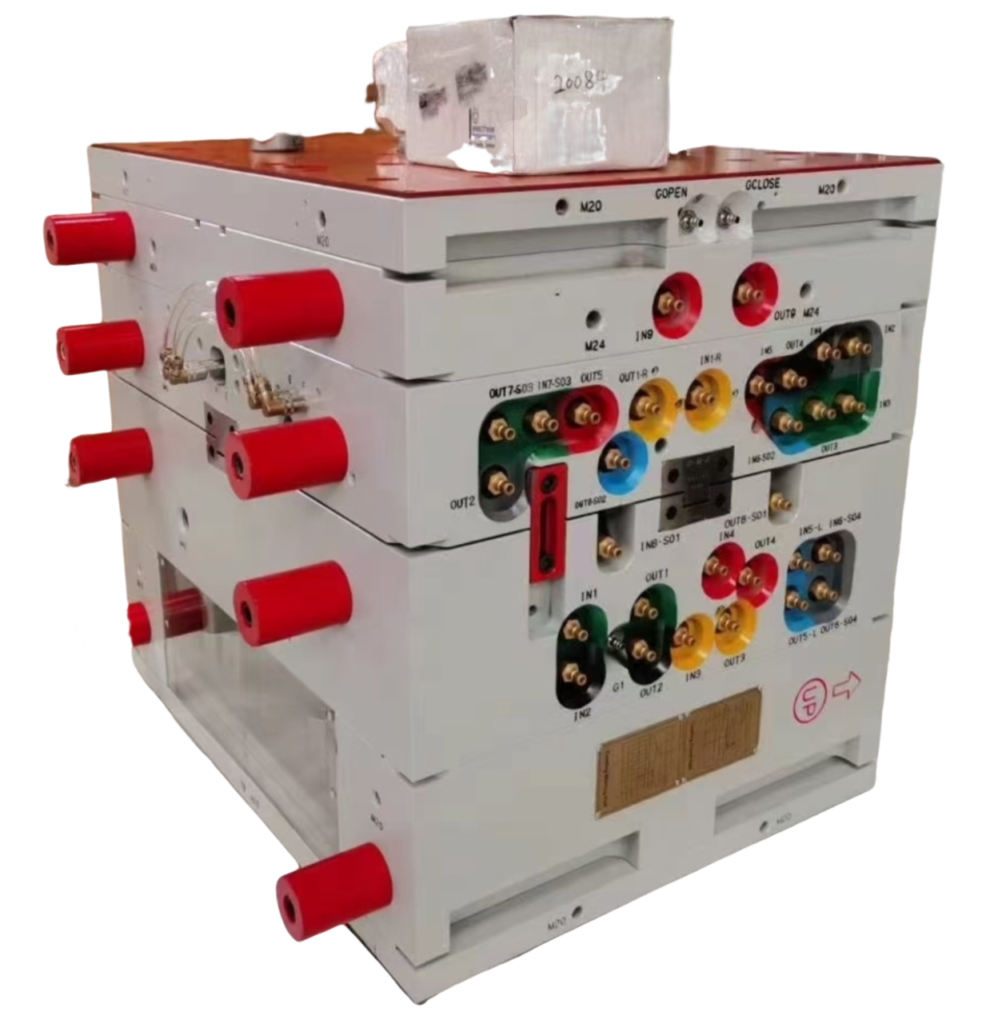
- An injection mold contains ten functional systems — cavity, core, sprue/runner/gate, cooling, venting, ejection, alignment, guiding, mold base, and optional hot runner — each machined to tolerances as tight as 0.01 mm.
- Material choice drives wall thickness, shrinkage rate, and gating strategy: PP shrinks 1.5–2.5%, ABS 0.4–0.7%, PC 0.5–0.7%; adding 30% glass fiber cuts shrinkage by roughly half but introduces anisotropic warpage.
- DFM violations found after tooling cost 5–10 times more to fix than those caught in design review: insufficient draft angle accounts for 38% of first-article failures, wall thickness variation over 40% accounts for 31%.
射出成形とは何か?
射出成形 is a manufacturing process that melts 熱可塑性 pellets and injects the melt into a precision steel mold under pressures of 70–140 MPa, producing finished plastic parts in cycle times of 10–120 seconds. The process repeats millions of times with sub-millimeter consistency, making it the dominant technology for mass-producing plastic components in automotive, medical, consumer electronics, and packaging.
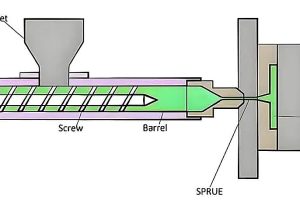
The machine has three main assemblies: the injection unit, the clamping unit, and the mold itself. The injection unit feeds pellets from a hopper into a heated barrel where a reciprocating screw melts and homogenizes the material. As the screw rotates, it accumulates a measured shot of molten plastic at the front. When the shot is ready, the screw acts as a plunger to push the melt forward through the nozzle and into the mold. Machine size is rated in clamping force — a 300-ton press suits palm-sized consumer parts; a 2,000-ton press handles large automotive panels.
Stage one is clamping. The two mold halves — cavity side on the stationary platen, core side on the moving platen — are locked together before injection begins. Clamping force must exceed the injection pressure multiplied by the projected area of the part and runner system. Under-clamping causes the mold to flash (leak) at the パーティングライン; over-clamping accelerates mold wear. For a part with 100 cm² projected area injected at 100 MPa, clamping force must exceed 100 tons just to hold the パーティングライン1 closed.
Stage two is injection. Injection speed ranges from 10 to 200 mm/s depending on material viscosity and part wall thickness. Peak injection pressure — 70 to 140 MPa — fills the cavity in a fraction of a second for thin-walled packaging, or several seconds for thick structural components. After cavity fill, the machine switches to pack-and-hold: it applies 50–80% of injection pressure for 2–10 seconds to compensate for volumetric 縮み as the material solidifies. Insufficient pack pressure leaves sink marks; excessive pack pressure causes part ejection problems and flashing around inserts.
Stage three is cooling — the longest stage, consuming 50–70% of total cycle time. Coolant (typically water at 15–60°C) circulates through channels drilled in the mold, extracting heat until the part reaches ejection temperature. Wall thickness is the dominant variable: a 2 mm PP wall needs roughly 8–12 seconds; a 4 mm wall requires 30+ seconds. Non-uniform cooling causes differential DFM2 and warpage, which is why cooling channel layout and coolant temperature control are engineering-critical decisions, not afterthoughts.
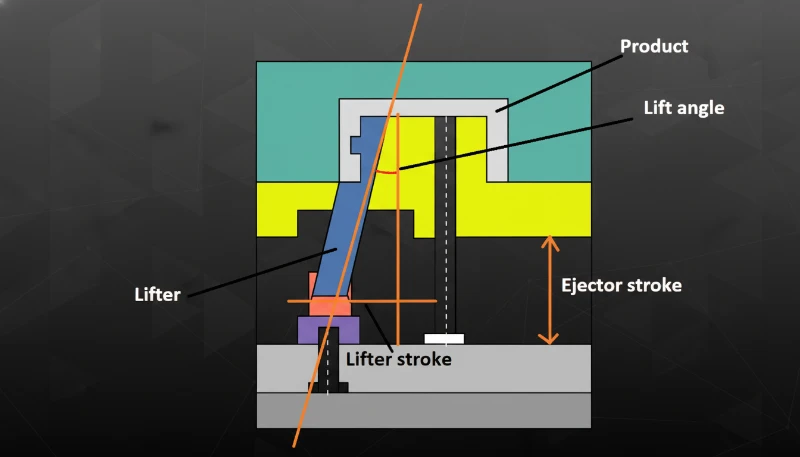
Stage four is ejection. The mold opens and ejector pins, sleeves, or a stripper plate push the solidified part off the core. Every surface parallel to the direction of mold opening needs a 抜き勾配 — typically 0.5–2° — so the part can slide off cleanly without sticking or deforming. After ejection, the mold closes and the cycle begins again. At ZetarMold, our 45 machines run 24 hours a day; shaving 2 seconds from a cycle time on a high-volume part adds up to hundreds of thousands of additional shots per year per machine.
Understanding these four stages — and the parameters that govern each — is the foundation of troubleshooting any injection molding quality problem. Sink marks trace back to insufficient pack pressure or excessive wall thickness. Warpage traces back to non-uniform cooling or asymmetric shrinkage. Short shots trace back to insufficient injection pressure, blocked vents, or degraded melt viscosity from overheating. Every defect has a root cause in one of the four stages, and diagnosing it requires knowing which parameter was out of its control window. Systematic process documentation — recording melt temperature, mold temperature, injection speed, peak pressure, and cycle time for every production run — is the single most effective practice for maintaining part quality over a mold’s lifetime.

What Are the Different Types of Injection Molds?
Injection molds are classified along four dimensions — gating system, cavity count, plate configuration, and specialized process — and the right combination depends on your part geometry, annual volume, material, and cost target. Choosing the wrong mold type is one of the most expensive early decisions in a product program; a ホットランナー mold built for a 20,000-unit run rarely pays back its premium, while a single-cavity cold runner mold running a 5-million-unit program creates a production bottleneck that only more tooling investment can relieve.
| Dimension | タイプ | 代表的なアプリケーション | Cost Factor | Min. Annual Volume |
|---|---|---|---|---|
| ゲートシステム | Cold runner — 2-plate | General thermoplastics (ABS, PP, PE) | 1× | 10,000 |
| ゲートシステム | Cold runner — 3-plate | Multi-ゲート3 or pin-gate requirements | 1.3–1.5× | 50,000 |
| ゲートシステム | Hot runner | High-volume, zero-waste precision parts | 1.8–3× | 500,000 |
| ゲートシステム | Insulated runner | Heat-sensitive resins, short runs, LSR | 1.4–1.7× | 10,000 |
| Cavity Count | シングルキャビティ | Large or complex parts, prototypes | 1× | Any |
| Cavity Count | Multi-cavity (2–64 cavities) | Small, high-volume commodity parts | 2–5× | 500,000 |
| Cavity Count | Family mold | Assembly sets sharing one shot | 1.2–1.8× | 50,000 |
| Plate Config | Two-plate | Standard design; side or edge gate | 1× | Any |
| Plate Config | Three-plate | Auto runner separation; pin gate on top surface | 1.3–1.5× | 100,000 |
| Plate Config | Stack mold | Double output per press shot | 3–5× | 5,000,000 |
| Plate Config | Rotary / turn-table | Multi-component or 2K over-molding | 3–6× | 1,000,000 |
| Special Process | オーバーモールディング | Soft-grip handles, seals over rigid substrate | 1.5–2.5× | 100,000 |
| Special Process | インサート成形 | Metal-to-plastic integration (threads, pins) | 1.3–2× | 50,000 |
| Special Process | Gas-assist | Hollow structural ribs, Class-A outer surface | 1.6–2.2× | 100,000 |
| Special Process | LSR (liquid silicone rubber) | Medical seals, infant parts, connectors | 2–4× | 100,000 |
Two-plate cold runner molds are the industry workhorse: the simplest to build, easiest to maintain, and lowest in upfront cost. The runner solidifies with each shot and must be removed manually or by robot, then reground or discarded. For commodity parts where runner scrap is acceptable and volumes are moderate, this is the rational starting point. Three-plate molds add a stripper plate that automatically separates the runner from the part at mold opening, enabling pin ゲートs on the top surface of a part — especially useful when side gates would leave unacceptable witness marks on cosmetic surfaces.
Hot runner systems maintain the plastic in a molten state inside a heated manifold until it reaches the gate, eliminating the cold runner entirely. Material waste drops 15–30%, cycle times improve 10–20%, and cosmetic gate quality is superior because vestige is reduced to a small pinpoint or can be completely flush. The tradeoff is upfront cost 30–50% higher than cold runner tooling, plus manifold maintenance and longer color-change downtime. For programs running more than 500,000 shots per year, material savings alone typically justify the premium.
Family molds — which produce two or more different parts in a single shot — reduce tooling investment but require careful cavity fill balance; they are most reliable when parts share similar projected areas and use the same resin. オーバーモールディング and insert molding molds add complexity by combining two materials or integrating metal components in a single cycle. These specialized configurations eliminate secondary assembly operations: an overmolded soft-grip handle, for example, is produced ready-to-use from the press without additional bonding steps. The cost premium for overmolding tooling is 50–150% over a comparable single-material mold, but the savings in assembly labor and reduced part count often produce net cost reductions at volumes above 100,000 units.
Rotary and stack molds represent the frontier of mold efficiency for ultra-high-volume applications. A stack mold effectively doubles the output of a given press by stacking two sets of cavities face-to-face, sharing the same clamp force. For a 16-cavity stack mold, a 500-ton press produces the output equivalent of a 32-cavity single-face mold that would require 1,000 tons. The tooling investment is roughly 3–5× a conventional mold, but the reduction in press-hour cost per part is substantial for annual volumes above 5 million.

What Are the Main Components of an Injection Mold?
An injection mold is an assembly of ten functional systems: cavity, core, sprue/runner/gate, cooling, venting, ejection, alignment, guiding, mold base, and hot runner when specified. Each system must be engineered precisely — deficiencies in any one lead directly to part defects, shortened mold life, or yield losses that compound over millions of shots.
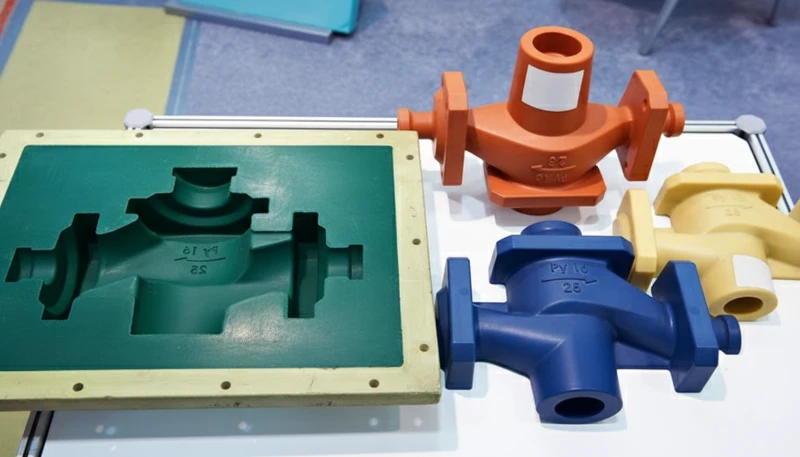
The cavity is the female impression that defines the outer geometry of the part. It is machined from pre-hardened P20 steel (HRC 28–35) for prototype and medium-volume runs, or from H13 tool steel hardened to HRC 46–54 for high-volume production. Cavity surfaces requiring optical or cosmetic quality are bench-polished to Ra 0.025 µm (SPI-A1) or textured via EDM and bead-blast. Corrosive materials such as PVC or flame-retardant ABS benefit from S136 stainless steel to prevent cavity pitting.
The core forms the interior surfaces of the part. Because the cooling part shrinks onto the core during solidification, the core experiences higher contact stress and wear than the cavity. Deep ribs and long thin core pins are particularly vulnerable; machining them from S136 or from carbide inserts extends life. CNC machining is the primary manufacturing method for cores, and tool diameter directly constrains minimum achievable radii: a 6 mm end mill leaves a 3 mm radius; EDM can reach radii below 0.5 mm. This is why injection mold DFM rules specify a minimum internal corner radius of 0.5 mm — anything smaller requires EDM and adds lead time and cost.
The sprue, runner, and gate system channels molten plastic from the machine nozzle to each cavity. The sprue is the primary inlet; runners distribute flow to multiple cavities; gates are the final restricted orifice controlling fill rate and shear. Gate land length is typically 0.5–1.0 mm — too short and the gate stays open during pack, causing flash; too long and it freezes prematurely, creating sink marks. Sub-gate (tunnel gate) designs allow automatic degating on two-plate molds. Hot tip gates leave a vestige under 0.5 mm on the part surface.
The cooling system — drilled channels, baffles, bubblers, or conformal inserts — removes 70–80% of the heat added by injection. Channels are typically 8–12 mm in diameter and positioned 15–25 mm from the cavity surface. Asymmetric cooling is the leading cause of warpage in thin-walled parts; balanced cooling within 2°C across the cavity surface is the target for precision components. The ejection system includes through-hardened ejector pins (HRC 58–62), blade ejectors for thin-wall ribs, and sleeve ejectors for tubular bosses. Ejector pin diameter is typically 1.5–6 mm; pins must be guided to prevent side-loading that causes galling.
Alignment and guiding systems — leader pins, bushings, and parting-line interlocks — register the two mold halves to within ±0.01 mm. Mold bases use standardized frames (DME, HASCO, or LKM standards) that cut lead time 2–4 weeks versus fully custom construction. Venting is the most commonly under-engineered system: 0.02–0.05 mm deep vent channels at parting lines and on core pins allow trapped air to escape during injection. Inadequate venting accounts for burn marks and short shots in up to 25% of first-run mold trials — a preventable issue that adds weeks to first-article timing.
Mold maintenance is built into component selection. Ejector pins are consumables — they wear, gall, and bend — and should be sized to standard catalog diameters so replacement takes hours rather than days. Mold bases are designed with adequate steel section around cavity and core pockets to prevent cracking under repeated clamping cycles. A well-maintained H13 mold running at proper process settings can surpass 1 million shots without dimensional drift; at ZetarMold, our longest-running H13 tool has exceeded 2.1 million shots and remains within original tolerance.

What Materials Work Best for Injection Molding?
The best material for injection molding depends on four variables — mechanical performance, operating temperature, cost budget, and surface appearance requirements — and there is no single universal answer. Thermoplastics divide into three performance tiers: commodity resins for low-stress, high-volume applications; engineering resins for structural and moderate-temperature use; and high-performance resins for demanding thermal and chemical environments.
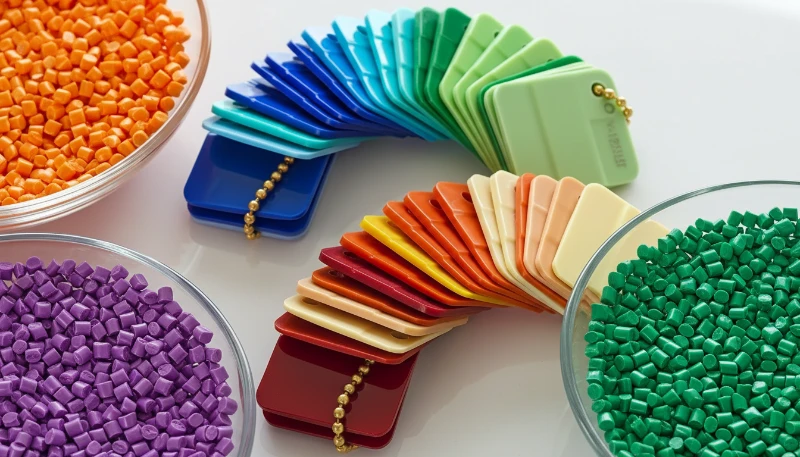
Commodity resins — PP, ABS, PE — handle the majority of consumer and packaging applications. PP is the volume king: low density (0.90 g/cm³), excellent chemical resistance, living-hinge capability at bending cycles exceeding 1 million, and resin cost of $1.50–2.00/kg at scale. ABS combines good impact strength with dimensional stability and superior paintability, making it the default for consumer electronics housings and automotive interior trims. PE covers flexible and semi-rigid containers where chemical resistance and low-temperature ductility matter more than stiffness.
| 素材 | Wall Thickness Range | 収縮 | Melt Temp (°C) | 代表的なアプリケーション |
|---|---|---|---|---|
| PP | 0.8–3.8 mm | 1.5–2.5% | 200–280 | Packaging, living hinges, auto trim |
| ABS | 1.0–3.5 mm | 0.4–0.7% | 220–260 | Electronics housings, automotive interior |
| PE (HDPE/LDPE) | 0.8–3.0 mm | 1.5–4.0% | 170–230 | Containers, flexible snap-fits |
| PA6 (Nylon 6) | 0.8–3.0 mm | 0.6–1.4% | 230–260 | Gears, bushings, structural brackets |
| PA66 (Nylon 66) | 0.8–3.0 mm | 0.8–2.0% | 260–290 | Engine covers, high-load connectors |
| PC(ポリカーボネート) | 1.0–3.8 mm | 0.5–0.7% | 270–320 | Optical lenses, safety shields, medical |
| POM (Acetal) | 0.8–3.0 mm | 1.8–2.5% | 185–215 | Gears, bearings, fuel system parts |
| PBT | 0.8–3.0 mm | 0.9–2.2% | 230–250 | Electrical connectors, motor housings |
| 覗き見 | 1.0–3.0 mm | 0.5–1.1% | 360–400 | Aerospace brackets, medical implants |
| ピーピーエス | 1.0–3.5 mm | 0.4–1.0% | 300–360 | Pump housings, under-hood components |
Engineering resins — PA6, PA66, PC, POM, PBT — step up in strength, temperature resistance, and dimensional stability at a cost premium of 3–8× commodity resins. PC delivers impact strength of 600–900 J/m (notched Izod) and heat deflection at 135°C, enabling thin-walled safety equipment and medical device housings that survive drop tests and autoclave cycles. POM (acetal) machines like metal in terms of dimensional precision and has very low friction, making it the preferred material for sliding and rotating components like gears, cams, and bushings.
The four-dimension selection framework: (1) 強さ — if tensile strength above 100 MPa is required, move to glass-fiber-reinforced engineering resins; PA66-GF30 delivers 180–200 MPa. (2) 温度 — commodity resins deflect under load at 80–100°C; engineering resins handle 120–150°C; PEEK and PPS sustain continuous use at 200–250°C. (3) Cost — PP pellets run $1.50–2.00/kg; PEEK costs $80–150/kg plus heated tooling at 160–180°C mold temperature. (4) Appearance — ABS and PC accept high-gloss textures; POM has limited adhesion for painting and metallizing; GF-filled grades show fiber print on exposed surfaces unless surface-treated.
Moisture content is a processing-critical variable for hygroscopic resins. PA6, PA66, PC, and PBT must be dried to below 0.2% moisture before molding; residual moisture hydrolyzes the polymer chains during plasticization, causing splay marks, reduced impact strength, and molecular weight degradation that cannot be recovered. Drying time at typical desiccant hopper dryer temperatures: PA6 at 80°C for 4 hours, PC at 120°C for 4–6 hours, PBT at 120°C for 3–4 hours. PP and POM are not hygroscopic and do not require pre-drying under normal storage conditions.
Glass fiber at 10–30% loading fundamentally changes processing behavior. Fibers align with melt flow direction, creating anisotropic shrinkage: PA6-GF30 shrinks roughly 0.4% along the flow direction but 1.1% transverse to flow. This differential causes warpage that symmetrical gating alone cannot prevent. Gate location must align fiber orientation with the primary structural load axis. Weld lines in GF-filled materials carry 20–40% less strength than the base material because fibers cannot bridge the knit interface. For structural GF parts, weld lines must be positioned away from high-stress regions or eliminated by gating redesign.

What DFM Design Rules Must You Follow?
について DFM rules for injection molding are specific, numeric, and non-negotiable: wall thickness within the material’s validated range, 縮み4s scaled to surface texture depth, ribs no thicker than 60% of the adjacent wall, and undercuts resolved through bump-off or shut-off geometry before any steel is cut. Violations found after tooling cost 5–10× more to address than changes made at the design stage.
Wall thickness is the most impactful single variable. Each thermoplastic has a validated range — below the minimum, fill is incomplete or part stresses are too high; above the maximum, cooling time balloons and sink marks appear on the opposite surface. The table below gives practical working targets for the five most common resins:
| 素材 | Minimum (mm) | Maximum (mm) | Ideal Range (mm) |
|---|---|---|---|
| PP(ポリプロピレン) | 0.8 | 3.8 | 1.5–3.0 |
| ABS | 1.0 | 3.5 | 1.5–2.5 |
| PC(ポリカーボネート) | 1.0 | 3.8 | 2.0–3.0 |
| PA (Nylon 6 / 66) | 0.8 | 3.0 | 1.5–2.5 |
| 覗き見 | 1.0 | 3.0 | 1.5–2.5 |
Beyond staying within range, consistency matters as much as absolute thickness. When two adjacent wall sections differ in thickness by more than 40%, the thinner section freezes first and is pulled under tension as the thicker section continues to shrink, causing warpage or a stress crack at the transition. Taper the transition over a distance at least three times the wall thickness difference.
Draft angles allow the part to release from the mold without drag marks or tearing. The minimum for smooth, polished surfaces (SPI-B1 or better) is 0.5–1° per side. For textured surfaces — EDM spark erosion, bead blast, or leather grain patterns — the rule is 1° of draft for every 0.025 mm of texture depth. A medium leather grain at 0.075 mm depth requires at least 3° of draft; a coarse grain at 0.125 mm needs 5°. Under-drafted textured surfaces are the single most common cause of cosmetic failures in first-article trials and are almost always the result of the texture specification being added after the draft was set.
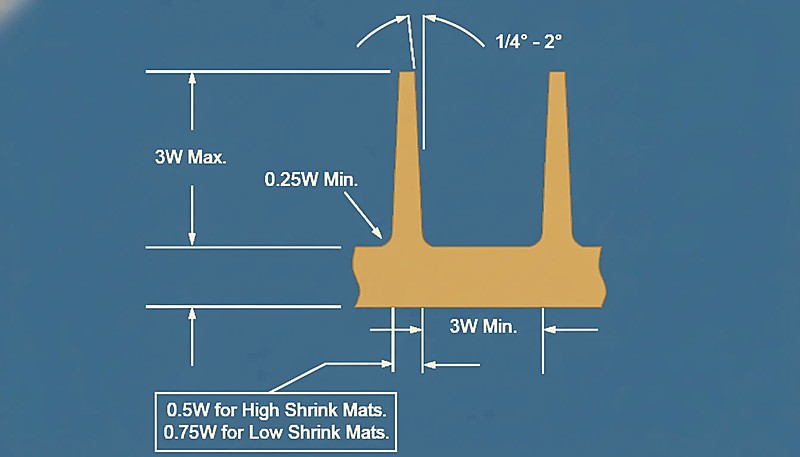
Radii and fillets prevent stress concentrations in both the part and the 型鋼. Sharp internal corners act as crack initiation sites under cyclic loading in the part, and accelerate fatigue crack growth in the mold tool. Minimum internal corner radius is 0.5 mm for EDM-finished features; the design target is 50–60% of the adjacent wall thickness. All rib-to-wall intersections must carry a base radius of at least 0.25 mm; ribs themselves must be no taller than 3× the base wall, no thicker than 60% of the adjacent wall, and spaced at least 2× the wall thickness apart so cores between ribs have adequate steel section.
Bump-offs are internal undercuts — typically radial grooves or ridges — that can be forced over the mold steel during ejection because the part flexes elastically and springs back. They work with compliant materials: TPE, PP, LDPE. The maximum interference is 0.5–2% of the feature diameter, depending on material stiffness. Bump-offs eliminate side actions and simplify the mold significantly. Shut-offs occur where mold steel on the cavity side contacts steel on the core side through a hole or window in the part. The contact angle must be at least 3–5° to avoid metal-to-metal parallel contact that would cause fretting and cracking at the shut-off face.
| # | Rule | Why It Matters |
|---|---|---|
| 1 | Wall thickness within material-specific range | Prevents sink marks and short shots |
| 2 | Adjacent wall thickness ratio ≤ 1.4:1 | Reduces differential shrinkage and warpage |
| 3 | Taper wall transitions over ≥ 3× thickness difference | Eliminates stress riser at section change |
| 4 | Draft ≥ 0.5° on smooth polished surfaces | Enables ejection without drag marks |
| 5 | Draft ≥ 1° per 0.025 mm texture depth on textured surfaces | Prevents tearing of textured skin |
| 6 | Internal corner radius ≥ 0.5 mm (EDM); ≥ 50% wall for cut steel | Reduces stress concentration in part and mold |
| 7 | Rib height ≤ 3× base wall thickness | Prevents rib-induced sink on opposite face |
| 8 | Rib thickness 50–60% of adjoining wall | Eliminates sink marks behind ribs |
| 9 | Rib base radius ≥ 0.25 mm | Reduces mold steel fatigue cracking at rib root |
| 10 | Rib spacing ≥ 2× wall thickness | Ensures mold steel section between ribs is viable |
| 11 | Boss wall thickness ≤ 60% of main wall | Prevents sink marks at boss location |
| 12 | Boss inner diameter ≥ 1.5× screw minor diameter | Ensures thread pull-out strength |
| 13 | Undercuts → bump-off (flexible) or side action (rigid) | Avoids mold lock-up and stuck parts |
| 14 | Shut-off angle ≥ 3–5° | Prevents metal-to-metal damage at shut-off faces |
| 15 | Gate at thickest wall section | Promotes fill from thick to thin, prevents hesitation |
| 16 | Weld lines away from high-stress zones | Weld lines carry 20–40% less strength |
| 17 | Core depth ≤ 3× core diameter (aspect ratio) | Prevents core deflection and dimensional shift |
| 18 | Text embossed (raised) not engraved | Embossing removes less steel; lower mold cost |
| 19 | Through-holes parallel to draw when possible | Eliminates need for side-action core pins |
| 20 | Wall thickness consistent around holes and bosses | Prevents warpage and cracking post-ejection |
At ZetarMold, our DFM review catches an average of 3.2 design issues per part before any tooling begins. The most common findings: insufficient draft angle on textured surfaces (38% of cases) and wall thickness variation exceeding 40% between adjacent sections (31% of cases). Both are zero-cost to fix in CAD; in steel, a single draft correction on a textured cavity requires re-EDM and re-texturing — typically $800–2,500 per affected surface and 1–2 weeks of delay. Submit your CAD for DFM review before committing to tooling: it is the highest-ROI hour in your product development timeline.

How Do Gate Design and Location Affect Part Quality?
Gate design and location are the single most influential tooling decisions after wall thickness — they determine fill pattern, weld line placement, visible gate marks, and residual stress in the finished part. Get them wrong in steel and you pay for a mold modification; get them right in design review and you pay nothing.
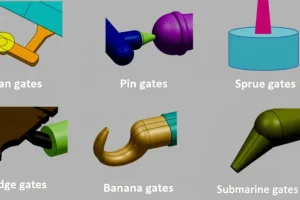
Four gate types cover the vast majority of injection molding applications. Tab gates (also called edge or side gates) are the simplest and lowest-cost option, attached at the parting line and trimmed manually or automatically after ejection. They leave a vestige of up to 0.13 mm — small enough for most functional surfaces, unacceptable on Class-A cosmetic faces.
Submarine (sub) gates feed through the mold body and self-degas automatically when the mold opens, eliminating manual trimming and leaving a smaller mark, but requiring more complex machining and restricting gate diameter. Hot tip gates — part of a hot runner system — leave a pin-point witness of roughly 1.3 mm diameter; because there is no cold runner sprue to trim, material scrap drops to near zero, making them the preferred choice for high-volume multi-cavity tools running amorphous resins. Direct sprue gating feeds straight into the part center — it is the simplest hot configuration and delivers the lowest pressure drop, but it locks in a large gate vestige at the geometric center, which limits cosmetic use to hidden faces.
| ゲートタイプ | Tooling Cost Premium | Gate Vestige | Best Materials | Cosmetic Impact |
|---|---|---|---|---|
| Tab (edge/side) | None — 1× | ≤0.13 mm, manual trim | PP, ABS, PE, POM | Low — parting line only |
| Submarine (sub) | +10–15% | Pin-point, auto-degas | ABS, PP, PC/ABS | Very low — hidden in part body |
| Hot tip (hot runner) | +$3,000–8,000 per drop | ~1.3 mm witness, no trim | PC, ABS, PETG, PMMA | Minimal — requires polishing |
| Direct sprue | None — 1× | Large center mark | PP, PE (non-cosmetic) | High — center gate scar |
Gate location follows three governing principles that apply regardless of gate type. 最初, flow should always travel from thick wall to thin wall — forcing the melt to cross from a thin section into a thick one traps air, creates jetting, and starves pack pressure in thick zones. セカンド, multi-cavity tools need balanced runner layouts so every cavity fills at the same injection pressure and at the same time — unbalanced filling causes one cavity to flash while another short-shots. サード, gate away from cosmetic surfaces: even a sub gate’s small witness mark is disqualifying on an automotive A-surface or a consumer electronics housing.
When a part cannot be filled from a single gate without creating knit lines in a structurally critical zone, multiple gates are used. Each additional gate creates a weld line where two flow fronts meet — a zone of reduced tensile strength, typically 10–30% weaker than the nominal wall. The designer’s job is to position weld lines in low-stress regions: behind a boss, at the interior of a bend, never perpendicular to a bending load.
金型流動解析 predicts weld line locations before any steel is cut, which is why gating decisions should always be validated in simulation first. Changing gate location after tooling typically costs $1,500–8,000 per gate depending on whether the modification requires steel welding or only EDM re-machining. For detailed guidance on gate placement within the broader mold design process, see our 射出成形金型設計 guide.
Gate sizing matters as much as gate type and location. Undersized gates increase shear rate and heat the melt locally, causing splay, degradation, and jetting — especially with shear-sensitive resins like PC and acetal. Oversized gates require longer freeze-off time, extending cycle time and increasing the risk of backflow during pack. A practical starting rule: gate cross-section area should be 50–70% of the part wall cross-section at the gate location. For thin-wall parts under 1.5 mm, drop to 40–50% of wall to control fill velocity.
For thick structural parts over 3 mm, a larger gate is always safer than a small one — you can always reduce gate size if freeze-off time becomes a cycle problem, but you cannot recover a degraded part.
Runner balance — the path the melt travels from sprue to gate — is the hidden variable that determines whether a multi-cavity mold fills uniformly. Naturally balanced runners (H-tree or figure-8 layouts) keep every flow path to the same length and cross-section, ensuring each cavity sees the same pressure and temperature at the gate. Artificially balanced runners use different runner diameters to achieve equal fill — simpler to machine but harder to maintain when viscosity changes with material lot variation. When a multi-cavity tool has recurring quality issues in specific cavities (always the same one shorts, always the same one flashes), the root cause is almost always runner imbalance, not process variation.

What Process Parameters Control Injection Molding Quality?
Six process parameters — melt temperature, mold temperature, injection speed, pack pressure, cooling time, and back pressure — collectively determine part quality; adjusting any one without understanding its interaction with the others is the most common source of recurring defects on the shop floor.
Most competitors list these parameters as bullet points with vague guidance. We give you the actual control windows our process engineers use, because a number without context is not actionable. The table below shows typical target ranges for four common resins — use these as starting points and tighten to your specific tool, runner geometry, and part wall thickness.
| パラメータ | PP | ABS | PC | 覗き見 |
|---|---|---|---|---|
| Melt Temperature (°C) | 200–280 | 220–260 | 270–320 | 360–400 |
| Mold Temperature (°C) | 20–60 | 40-80 | 70–120 | 160–180 |
| Injection Speed (mm/s) | 30–150 | 20–100 | 20–80 | 10–60 |
| Pack Pressure (% of injection) | 50–80% | 50–75% | 55–80% | 60–80% |
| Cooling Time (% of cycle) | 50–70% | 50–70% | 55–70% | 60–75% |
| 背圧 (MPa) | 0.3–0.8 | 0.5–1.2 | 0.5–1.5 | 0.8–1.5 |
Melt temperature is the most consequential single parameter. Running too cold increases viscosity and fill pressure requirements — the part short-shots or develops weld lines. Running too hot degrades the polymer: PP yellows and loses impact strength above 290°C, ABS generates outgassing that creates silver streaks, and PC develops brown discoloration. A melt temperature that is 10°C above the upper limit can halve a resin’s molecular weight in the barrel residence time of a slow-running press.
Mold temperature has an outsized effect on part appearance and dimensional stability that is often underestimated. PC molded at 70°C mold temperature shows surface haze and internal stress that causes crazing in solvent exposure; molded at 100°C, the same part is glossy and optically clear. Higher mold temperature increases cooling time — there is no free lunch — but the tradeoff is worth it for optical and structural applications. For the 射出成形プロセス as a whole, mold temperature is the lever that most directly trades cycle time against part quality.
Injection speed controls shear rate and determines whether the flow front is laminar or turbulent. Too slow and you get premature freezing in thin sections — short shots and weld lines. Too fast and you get jetting, shear-induced degradation, and burn marks at the end of fill where compressed air has nowhere to escape through inadequate vents. Pack pressure must transition smoothly from fill pressure the moment the cavity is 95–98% full — early switch-over starves the part and creates sink marks; late switch-over causes flash at the parting line.
Back pressure, the resistance applied to the screw during recovery, homogenizes the melt and degasses it — 0.3 MPa is the minimum to prevent splay; above 1.5 MPa, you generate excess shear heat and degrade color concentrate.
Understanding parameter-defect relationships lets you diagnose problems systematically rather than by trial and error. Sink marks → insufficient pack pressure or excessive wall thickness. Warpage → non-uniform mold temperature or asymmetric cooling time. Short shots → melt temperature too low, injection speed too low, or blocked vents. Silver streaks → excess moisture in resin or melt temperature too high. Burn marks → injection speed too high or vents clogged. Flash → pack pressure too high or mold temperature too high relative to clamping force. These are the diagnostic chains our process engineers follow — none of them require expensive equipment, just a properly maintained process log.
Cooling time deserves more attention than it typically gets in process setup. At 50–70% of total cycle time, it is the largest single lever for productivity improvement — yet most molders set it conservatively and never revisit it. The correct approach is to reduce cooling time in 2-second increments while monitoring part temperature at ejection with an infrared gun and checking dimensional stability on a CMM. When the part starts warping or the ejector pins start leaving marks, you have found the floor. In our experience, most production tools run 15–25% more cooling time than their parts actually require, simply because no one validated the minimum after initial qualification.
Back pressure is the most under-appreciated parameter in day-to-day production. It is routinely set at commissioning and never touched again, even when resin lots change or color concentrate ratios shift. Too little back pressure — below 0.3 MPa — and the screw fails to fully homogenize the melt, leaving temperature gradients that translate directly into part-to-part dimensional variation. Too much — above 1.5 MPa for most resins — and you generate excess shear heat in the metering zone, degrading heat-sensitive colors and causing cycle-to-cycle viscosity variation. Setting back pressure is a five-minute adjustment with a pressure gauge; ignoring it costs far more in quality escapes.

What Are Injection Molding Tolerances and How Do You Achieve Them?
Standard injection molding holds ±0.1–0.2 mm; precision molding reaches ±0.05 mm; ultra-precision (medical and optical) achieves ±0.02 mm — but hitting these numbers consistently requires controlling shrinkage, cooling uniformity, and mold precision simultaneously, not just buying better steel.
The reason competing guides give incomplete tolerance data is that they quote machine capability without accounting for material shrinkage variation — which is the dominant variable in real production. A mold machined to ±0.005 mm will still produce parts that vary ±0.12 mm if the process is not stabilized, because shrinkage is never a single fixed number. Shrinkage varies with mold temperature, pack pressure, gate location, and wall thickness — all of which change slightly from shot to shot.
| 素材 | 収縮率 | Standard Tolerance | Precision Tolerance | 備考 |
|---|---|---|---|---|
| PP (unfilled) | 1.5–2.5% | ±0.15 mm | ±0.08 mm | High shrinkage variability — avoid tight tolerances on large parts |
| ABS | 0.4–0.7% | ±0.10 mm | ±0.05 mm | Most predictable — preferred for precision housings |
| PC | 0.5–0.7% | ±0.08 mm | ±0.04 mm | Low shrinkage — excellent for optical and medical parts |
| PA6 (nylon) | 0.6–1.4% | ±0.15 mm | ±0.07 mm | Moisture-dependent — moisture content must be controlled at ±0.1% |
| POM (Delrin) | 1.8–2.5% | ±0.12 mm | ±0.06 mm | Predictable but high — gear-tooth tolerances require tight process control |
| 覗き見 | 0.3–0.6% | ±0.06 mm | ±0.03 mm | Best dimensional stability — standard for aerospace and medical |
Three factors determine whether you actually hit the tolerance you designed for. 最初, material shrinkage rate — the values above are ranges, not constants. Shrinkage increases when pack pressure drops, when mold temperature rises, or when gate freeze-off time is inconsistent. The practical implication: stabilize process first, measure actual shrinkage over 50 shots, then correct the mold dimensions for that specific operating point. セカンド, cooling uniformity — a temperature differential of more than 5°C between the core and cavity sides of the mold creates differential shrinkage and warpage that shows up as out-of-tolerance on coordinate measuring machines (CMM). Conformal cooling channels reduce this differential by following cavity contours; straight-drill channels cannot match them on complex geometries.
サード, mold precision — the machined mold dimensions themselves must be held to ±0.01 mm or better to leave room for the part tolerance stack. High-precision molds are built from hardened H13 steel (48–52 HRC) and finished by slow-feed EDM; prototype aluminum molds machined by conventional CNC hold ±0.05 mm at best, which is the ceiling on what their parts can achieve.
A practical approach for tight-tolerance parts: specify your functional tolerance on the drawing, ask your molder to quote with mold-flow simulation included, request a first-article inspection report (FAIR) with 30-shot Cpk data after T1 sampling, and write a process control plan that locks the three variables above. Tolerances achieved in T1 sampling do not automatically hold in production if process parameters drift — this is the most common source of tolerance non-conformance in long-running programs.
Tolerance stack-up in assemblies is where injection molding’s shrinkage variability most often causes field problems. If two mating parts are each built to ±0.10 mm, the assembled interface has up to ±0.20 mm total variation — which is fine for a snap-fit cover but can prevent proper sealing in a fluid system. For tight-assembly applications, the right approach is to design one part to a tight bilateral tolerance (±0.05 mm) and the other to a wider limit so the tighter part sets the fit. Running both parts in the same mold base — a family mold configuration — further reduces relative shrinkage variation because both cavities run identical temperatures and pressures.
Fiber-reinforced materials add an important complication to tolerance prediction. When you add 30% glass fiber to PA6, shrinkage in the flow direction drops from roughly 1.0% to 0.3%, while transverse shrinkage stays near 0.8% — creating anisotropic dimensional change that cannot be corrected by uniform mold dimension adjustments. GF-reinforced parts require mold-flow simulation to predict fiber orientation before cavity dimensions are finalized; toolmakers who skip this step produce first-article parts that are consistently out of tolerance in the transverse direction. Specifying a glass-filled material after the mold is already cut is one of the costliest changes a program manager can make post-tooling.

射出成形のコストは?
Injection molding tooling costs range from $1,500 for a simple aluminum prototype mold to $100,000+ for a complex multi-cavity production mold in hardened H13 steel — and part cost at production volume drops to $0.10–$5.00 per piece, making it the lowest per-unit cost process for volumes above 10,000 parts.
The most useful way to frame tooling cost is as a price matrix by steel grade and complexity class. These are real-world ranges from Chinese toolmakers (where the majority of global injection molds are manufactured); US and European tooling carries a significant labor premium on top.
| Mold Type / Steel | Simple Part | Medium Complexity | Complex Part |
|---|---|---|---|
| Prototype — Aluminum | $1,500–4,000 | $4,000–8,000 | $8,000–15,000 |
| Bridge — P20 steel | $5,000–12,000 | $12,000–30,000 | $30,000–55,000 |
| Production — H13 steel | $8,000–20,000 | $20,000–50,000 | $50,000–100,000+ |
Simple parts have ≤3 core pulls, uniform wall thickness, and no side actions or complex lifters. Medium complexity includes undercuts, side-action sliders (1–3), or tight tolerances on functional surfaces. Complex parts feature multiple side actions, hot runner systems, internal threading, or optical surface requirements (Ra ≤ 0.4 μm). Adding a 4-cavity configuration multiplies tooling cost by roughly 1.6–2× (not 4×, because the mold base and runner system are shared), while cutting piece-part cost by 75%.
| Country | Typical Cost Range | リードタイム | Relative Cost Index |
|---|---|---|---|
| China | $12,000–30,000 | 25–45 days | 1× |
| United States | $40,000–80,000 | 60–120 days | 3–4× |
| Germany / Western Europe | $50,000–100,000 | 60–150 days | 4–5× |
| Eastern Europe | $25,000–50,000 | 45–90 days | 2–3× |
The labor cost difference is the primary driver — not steel quality or machining precision. Chinese toolmakers use the same grades (P20, H13, S136) sourced from the same European and Japanese steel mills as US shops. The gap reflects wage rates and overhead, not metallurgical standards.
Eight proven ways to reduce injection molding cost without sacrificing quality: (1) Complete DFM review before steel is cut — each revision round after tooling starts costs $2,000–15,000 and 2–4 weeks. (2) Use aluminum tooling for prototype and bridge runs under 5,000 parts — aluminum molds cut tooling cost by 60–70% and lead time by 40%. (3) Consolidate parts — replacing three fastened components with one molded part eliminates two sets of tooling. (4) Standardize wall thickness — uniform walls eliminate cooling imbalance and allow shorter cycle times.
(5) Reduce side actions — redesigning a feature to eliminate one slider saves $2,000–8,000 in tooling and reduces maintenance risk. (6) Choose family molds for related parts in the same material — one mold base instead of two or three. (7) Increase cavity count at scale — if annual volume exceeds 500,000 parts, a 4-cavity tool pays back its premium in under 6 months of production. (8) Source tooling from China, validate with a credentialed molder — request full tool drawings, material certs, and T1 FAIR data. For a detailed cost estimator and ROI calculator, see our injection molding costs guide.
“Chinese molds cost 60-80% less than equivalent US tooling for the same steel grade and complexity.”真
The cost differential is driven by labor rates and overhead, not by differences in mold steel specification or machining equipment. Chinese toolmakers routinely use P20 and H13 sourced from German and Japanese mills, operating the same DMG Mori and Fanuc CNC centers used by North American shops. A medium-complexity P20 mold quoted at $15,000–25,000 in China runs $55,000–80,000 in the US — a 3–4× premium that reflects wages, not quality.
“A cheaper mold always means lower quality — in reality, cost differences reflect labor rates and overhead, not necessarily steel or precision standards.”偽
Material certs for P20 and H13 steel from Chinese toolmakers show the same chemistry as European-sourced equivalents — because they often use the same European or Japanese mills. The risk with low-cost tooling is not the steel grade but the process discipline: tool drawings, inspection protocols, and T1 FAIR rigor vary widely between suppliers. Auditing a supplier’s QMS and requesting material certs and CMM reports is how you separate capable low-cost toolmakers from genuinely inferior ones.

What Are Common Injection Molding Defects and How Do You Fix Them?
Eighty percent of injection molding defects trace back to three root causes — improper temperature, insufficient pressure, or uneven cooling — and most are correctable through process adjustment without touching the mold, provided you catch them early and diagnose them systematically.
The table below covers the twelve defects our process engineers encounter most frequently across thermoplastic programs. For each defect, the process fix is the first line of defense — always attempt process adjustment before considering tooling changes. Mold modification is a last resort, not a first response.
| 欠陥 | Visual Characteristic | Primary Cause | Process Fix | Design Prevention |
|---|---|---|---|---|
| Sink marks | Shallow depressions on part surface, opposite thick walls or ribs | Insufficient pack pressure; excessive wall thickness | Increase pack pressure 5–10%; extend pack time; reduce mold temperature | Keep rib width ≤60% of nominal wall; avoid wall thickness >4 mm |
| 反り | Part bends or twists after ejection; fails flatness spec | Non-uniform cooling; asymmetric shrinkage; excessive residual stress | Balance mold temperature between core/cavity; extend cooling time; reduce mold temperature | Uniform wall thickness; symmetric part geometry; avoid sharp corners |
| ショート・ショット | Part incompletely filled; missing sections, especially thin walls | Insufficient injection pressure or speed; melt temperature too low; clogged vents | Increase melt temperature 5–10°C; raise injection speed; clean vents | Add vents at end-of-fill; increase wall thickness in thin zones; move gate closer to thin sections |
| フラッシュ | Thin plastic fin at parting line, around inserts, or at vent locations | Clamp force insufficient for projected area; worn parting line; pack pressure too high | Reduce pack pressure; increase clamp force; clean and inspect parting line | Reduce projected area; add shutoff geometry; avoid vents in high-pressure zones |
| 溶接ライン | Visible line or groove where two flow fronts meet; reduced strength in that zone | Multiple gates or flow-around-obstacle geometry creating knit lines | Raise melt temperature; increase injection speed; add vents at weld line location | Reposition gate to eliminate weld line in critical zones; use mold-flow analysis first |
| Burn marks | Black or brown discoloration at end-of-fill or near vents | Compressed air unable to escape fast enough; melt temperature too high | Add or enlarge vents; reduce injection speed in final 5–10% of fill; lower melt temperature | Design vents at all predicted end-of-fill locations; avoid dead-end flow paths |
| Silver streaks / splay | Silvery surface lines running in flow direction | Moisture in resin; melt temperature too high; shear degradation at gate | Increase drying time/temperature; reduce melt temperature; reduce injection speed | Increase gate size to reduce shear; add resin drying specification to control plan |
| ジェット噴射 | Snake-like wavy line from gate into part surface | Injection speed too high relative to gate size; gate in open space (no impingement surface) | Reduce injection speed at gate; use velocity profiling (slow-fast) | Move gate to impinge on a wall; increase gate diameter; use fan gate instead of pin gate |
| Voids (bubbles) | Internal air pockets visible in transparent parts or on cross-section | Thick walls without sufficient pack pressure; moisture in resin | Increase pack pressure; extend pack time; verify resin is dry | Reduce wall thickness in void-prone areas; add internal ribbing instead of solid sections |
| Delamination | Surface peels or flakes in layers when flexed or scratched | Material contamination; incompatible regrind; melt temperature too low | Purge barrel; eliminate regrind; raise melt temperature to fully homogenize melt | Specify virgin resin for critical parts; verify regrind ratio ≤20% and is same grade |
| Warped threads / stripped inserts | Threaded features strip on first assembly; inserts pull out | Insufficient cooling before ejection; wrong insert type for resin | Extend cooling time; lower ejection temperature; use ultrasonic or heat-staked inserts | Design insert pockets with adequate knurl depth; use thermally compatible insert material |
| Crazing / stress cracking | Fine surface cracks appearing hours to days after molding | Excessive residual stress; environmental stress cracking from solvent exposure | Reduce injection speed; lower mold temperature; increase mold temperature to reduce quench rate | Avoid sharp corners (r ≥ 0.5 mm minimum); specify post-mold annealing for high-stress parts |
The most important discipline in defect management is process logging. Every defect that appears on the shop floor is a signal from the process that a parameter has drifted out of its control window. Without a baseline process record — melt temperature, mold temperature, injection speed, peak pressure, cooling time, and cycle time recorded for every production run — troubleshooting becomes guesswork. A production mold that runs identically documented process parameters shot after shot will produce consistent parts; one that is adjusted ad hoc by each shift operator will generate recurring quality escapes that are nearly impossible to root-cause.
Flash deserves a specific note because it is the most misdiagnosed defect. When flash appears at the parting line, the instinctive reaction is to order a mold repair — grinding or re-fitting the parting line steel. In most cases this is premature. Check clamp force first: is the projected part area × peak injection pressure within the machine’s rated tonnage? Check the parting line for debris: a 0.01 mm plastic chip on the parting line breaks the seal and causes flash that disappears after a thorough mold clean. Check pack pressure: has it crept up over time as operators compensated for other quality issues?
Eighty percent of flash cases we see at ZetarMold are resolved by adjusting clamp force, reducing pack pressure, or cleaning the parting line — without touching a grinding wheel.
“80% of injection molding defects trace back to just three root causes: improper temperature, insufficient pressure, or uneven cooling.”真
Systematic defect analysis across thermoplastic programs consistently shows that melt temperature out of control window, pack pressure below the pack-hold threshold, and mold temperature imbalance between core and cavity sides account for the overwhelming majority of visual and dimensional defects. Addressing these three parameters first — before modifying tooling — resolves most defects faster and at lower cost than steel-side interventions.
“Flash always means the mold needs replacement — in most cases, adjusting clamp force or cleaning the parting line resolves it without tooling changes.”偽
Flash is a pressure-containment failure, not necessarily a mold-wear failure. The parting line opens when injection pressure × projected area exceeds available clamp force, or when debris prevents full mold closure. Both causes are correctable through process adjustment or basic maintenance. Mold steel replacement or re-fitting is only warranted when the parting line shows measurable wear (>0.05 mm depression) confirmed by CMM, or when process corrections have been exhausted without resolving the flash.

Hot Runner vs Cold Runner: Which System Is Right for You?
Choose a hot runner system when annual volume exceeds 500,000 parts — it eliminates runner scrap and cuts cycle time; choose cold runner when you need frequent color changes, run small batches, or want a lower upfront tooling budget.
Hot runners and cold runners are not competing technologies — they solve different economic problems. A cold runner mold channels molten plastic through solidified runner channels that must be ejected and either scrapped or reground with every cycle. A hot runner system keeps the resin in the manifold at melt temperature continuously, so only the finished part is ejected. No runner, no scrap, no regrind decision.
| Dimension | ホットランナー | Cold Runner |
|---|---|---|
| Initial tooling cost | 30–50% higher than equivalent cold runner | Baseline |
| Operating cost per cycle | Lower — no runner disposal or regrind labor | Higher — runner handling adds $0.02–$0.15/part |
| Material waste | Near zero — resin stays molten in manifold | 5–30% of shot weight lost to runners |
| Maintenance complexity | High — heater bands, thermocouples, manifold seals | Low — sprue bushing and runner only |
| Color change capability | Difficult — purging manifold takes 200–500 shots | Easy — change between shots with minimal purging |
| Suitable materials | Most thermoplastics; avoid highly abrasive or heat-sensitive resins | All thermoplastics including PVC, LSR, and regrind-sensitive grades |
The financial crossover is driven by volume. At 100,000 parts per year, the extra tooling investment in a hot runner rarely pays back within two years. At 1 million parts per year, saving 15–30% of material cost per cycle typically recovers the premium tooling cost within six months. Run the math for your specific part weight and annual volume before deciding.
Within hot runner systems, two architectures exist. Open-tip (or thermal gate) systems use continuous melt flow and work well for unfilled resins and commodity materials such as ABS and PP. Valve-gate systems use pneumatic or hydraulic pins to control gate opening and closing with precision — they produce a cosmetically cleaner gate mark and handle filled materials like PA66-GF30 more reliably. Valve gates cost $800–$2,000 more per drop but are standard practice for automotive and consumer electronics parts with Class-A surfaces.
Decision framework in practice: if your part is a single color, annual volume exceeds 500,000 shots, and the resin is a standard engineering thermoplastic, the hot runner premium pays back within 12–18 months for most programs. If you are prototyping, running multiple colors from the same tool, or the part is a low-volume medical device component where regrind is prohibited and any manifold contamination risk is unacceptable, cold runner is the right call — simpler, lower-risk, and easier to validate.
Runner balance matters in both systems. Multi-cavity cold runner molds require geometrically balanced H-tree runner layouts to equalize fill time across cavities. Multi-zone hot runner manifolds require individual zone temperature control — typically ±1°C per zone — to prevent gate freeze or drool. Under-specified hot runner temperature controllers are one of the most common causes of first-shot fill imbalance in new tools.
Hot runner maintenance is often underestimated at the quoting stage. Heater bands fail — typically after 500,000–1,000,000 cycles — and replacement requires mold disassembly. Thermocouples drift and must be calibrated periodically. Manifold seals can leak if the mold sees thermal cycling beyond design range. Budget 15–25% of original hot runner component cost per year for ongoing maintenance. Cold runner systems, by contrast, require only periodic sprue bushing replacement and routine mold cleaning — maintenance cost is roughly 5% of tooling cost annually. Factor both into your total cost of ownership calculation, not just the initial tooling quote.
Cold runner design also has optimization levers. Runner diameter affects cycle time and material waste — an oversized runner requires more cooling time and wastes material; an undersized runner causes excessive shear heat and pressure drop. Standard runner diameters range from 3mm to 10mm depending on part size and resin viscosity. Trapezoidal and round runner profiles are most common; round runners have the lowest surface-area-to-volume ratio and thus the fastest cooling. Minimizing runner length and using naturally balanced layouts reduces fill pressure requirements and cavity-to-cavity weight variation below 1%.

Which Industries Use Injection Molding and What Do They Require?
Injection molding serves virtually every manufacturing sector, but eight industries — automotive, medical, consumer electronics, packaging, aerospace, construction, toys and consumer goods, and industrial equipment — each impose distinct material and quality requirements that drive radically different tooling and process specifications.
Understanding industry-specific requirements is not academic — it determines which tolerances your quote should specify, which certifications your supplier must hold, and whether a $5,000 aluminum prototype mold can bridge to production or whether you need H13 steel from day one.
| 産業 | Typical Parts | Key Materials | Critical Requirements |
|---|---|---|---|
| 自動車 | Bumper fascias, door panels, HVAC ducts, sensor housings | PP-GF, ABS, PA66-GF30, PC/ABS | IATF 16949 certification, dimensional repeatability ±0.1mm, UV stability, Class-A surface finish |
| 医療機器 | Catheter hubs, syringe barrels, device housings, surgical handles | PC, ABS, PEEK, medical-grade PP | ISO 13485, Class 7/8 cleanroom production, full material traceability, no regrind |
| 家電製品 | Laptop enclosures, connector housings, button assemblies, speaker grilles | ABS, PC, PC/ABS, LCP for connectors | EMI shielding geometry, snap-fit tolerances ±0.05mm, cosmetic gate mark control |
| パッケージング | Caps, closures, thin-wall containers, dispensers | PP, PE, HDPE, PET preforms | Food-contact compliance (FDA/EU 10/2011), cycle times <10s, high-cavitation tooling 32–128 cavities |
| 航空宇宙 | Duct clips, bracket inserts, interior trim, EMI housings | PEEK, PPS, Ultem (PEI), CF-reinforced grades | AS9100 traceability, flame/smoke/toxicity (FAR 25.853), dimensional stability at –55°C to +150°C |
| 建設 | Pipe fittings, conduit connectors, window profiles, cable management | PVC, PP, HDPE, Nylon | UV resistance, pressure ratings, ASTM/ISO pipe standards, large part tools |
| Toys and consumer goods | Action figures, game pieces, toy housings, appliance handles | ABS, PP, TPE, SAN | EN 71 / ASTM F963 safety standards, sharp-edge control, bright-color aesthetics, low unit cost |
| Industrial equipment | Pump impellers, valve bodies, gear housings, conveyor components | Acetal (POM), PA6, PA66-GF, PTFE-filled grades | Dimensional stability under load, chemical resistance, high cycle fatigue, MIL-spec where applicable |
The automotive sector illustrates how industry requirements reshape mold design. Dimensional repeatability of ±0.1mm across a production run of 2 million bumper clips demands H13 steel, conformal cooling, and a validated SPC plan from the first production samples. A toy part made in PP with ±0.5mm tolerances uses the same injection molding process — but a very different tooling investment.
Medical device injection molding carries the steepest compliance burden. ISO 13485 certification governs the quality management system; Class 7 cleanrooms are required for direct-contact components; and material traceability must extend to resin lot number and drying conditions for each production run. Regrind is prohibited — every runner and rejected part is scrapped. These requirements typically add 20–35% to per-part cost compared to equivalent non-medical parts.
Packaging pushes injection molding to its performance limits in a different direction: not precision but speed. Thin-wall container production runs 32- to 128-cavity hot runner tools at cycle times of 3–8 seconds. Part weight per cavity may be as low as 5 grams. The economics only work at extreme volume — a 128-cavity closure tool producing 2 million parts per day at a 4-second cycle. At this scale, a 0.5-second reduction in cycle time saves $500,000+ annually at commodity resin prices. No other manufacturing process comes close to this per-unit cost profile at packaging volumes.
ZetarMold has direct experience bridging automotive design intent with manufacturing reality. One US automotive tier-2 client was producing a dual-component assembly using two separate injection-molded parts bonded during assembly. We proposed replacing them with a single overmolded part — a rigid PP-GF30 structural substrate with a TPE interface seal molded in one shot. The result: 40% reduction in per-unit cost, one fewer assembly operation, and a stronger joint with no adhesive bond-line failure risk.

China vs. Domestic Injection Molding: How to Choose Smartly?
China-sourced injection molds typically cost 60–80% less than equivalent US or European tooling, with T1 sample lead times of 15–20 days versus 8–14 weeks domestically — but the decision depends on your volume, IP risk tolerance, and quality requirements.
This is the comparison no competing guide covers directly. Most injection molding resources are written by US or European suppliers with an obvious interest in local sourcing. We are a Chinese manufacturer, which means we can give you the honest version — including the risks — rather than a sales pitch in either direction.
| ファクター | China | USA | Europe | Southeast Asia |
|---|---|---|---|---|
| Mold tooling cost (medium complexity P20) | $3,000–$15,000 | $15,000–$60,000 | $20,000–$80,000 | $5,000–$20,000 |
| Per-part cost (100K units, ~50g PP part) | $0.08–$0.18 | $0.35–$0.70 | $0.40–$0.90 | $0.12–$0.25 |
| T1 sample lead time | 15–25 days | 8–14 weeks | 10–16 weeks | 4–8 weeks |
| Minimum order quantity | 1,000–5,000 units typical | 500–2,000 units typical | 1,000–5,000 units typical | 2,000–10,000 units typical |
| Key strength | Cost, capacity, fast tooling iteration | IP security, proximity, communication | Precision engineering, DIN/EN standards | Cost lower than West, higher than China |
| Key risk | IP exposure, quality inconsistency without oversight | High cost limits volume programs | Long lead times, highest cost base | Less developed tooling ecosystem |
The cost gap is real and structural — not a race to the bottom on quality. Chinese tooling shops benefit from a dense supplier ecosystem (steel, EDM electrodes, standard mold components), lower labor rates for skilled machining, and decades of accumulated toolmaking expertise. A medium-complexity single-cavity P20 mold that quotes at $8,000 from a well-run Chinese shop will produce parts indistinguishable from the same mold built at $35,000 in the US — if the toolmaker is properly qualified.
The risks are real too, and ignoring them is how offshore tooling projects fail. IP exposure is the primary concern for most buyers. Mitigate it with three contractual instruments: a mold ownership agreement that explicitly states the tooling is your property and may not be replicated; a non-disclosure agreement covering part geometry and material specifications; and a T1 sample acceptance protocol that holds final payment until approved first-article samples are received and inspected in your facility.
Five criteria for selecting a qualified Chinese injection mold supplier. First: ISO 9001 or IATF 16949 certification — not self-declared, but third-party audited with a current certificate. Second: English-language DFM capability — a supplier who cannot deliver a written DFM report in English cannot collaborate effectively on design changes. Third: documented T1 sample process — ask for a sample first-article inspection report from a previous program, not just marketing photos. Fourth: mold ownership clause in their standard contract — if they push back on this, walk away. Fifth: ERP-based shot count and maintenance tracking — a supplier who knows the shot count on every tool they build is a supplier with professional toolroom management.
At ZetarMold, our H13 steel molds have averaged 2.1 million shots before major refurbishment. We track shot count and maintenance history in our ERP for every tool we build — customers receive a full maintenance log with mold delivery.
For most high-volume programs — anything above 100,000 parts per year with a 3-year production horizon — Chinese tooling economics are difficult to argue against. The tooling savings alone often fund the entire first year of production. The key is structured supplier qualification, not blanket trust or blanket skepticism.
A practical sourcing model for risk-averse buyers: place the prototype and bridge tooling domestically for speed and easy communication during design iteration, then transfer production tooling to a qualified Chinese supplier once the design is frozen. This approach preserves IP during the sensitive early stages while capturing cost advantages at scale. Specify in the contract that the mold design files are your property and must be delivered with the tool — this is the foundation of any offshore tooling arrangement that protects your long-term manufacturing options.

Prototype vs Bridge vs Production Mold: What’s the Difference?
A prototype mold (aluminum, $1K–$8K, 1–50K shots) validates geometry at low cost; a bridge mold (P20 steel, $8K–$30K, 500K–1M shots) covers production ramp-up; a production mold (H13 steel, $30K–$150K, 1M–2M+ shots) is the long-run workhorse — the right choice depends on where you are in the product lifecycle.
The mold type decision is one of the highest-leverage choices in a product development program. Choose the wrong tier and you either over-invest in tooling for a product that never reaches volume, or you run a short-life mold into the ground and pay twice to re-tool during peak demand. The decision framework is straightforward once you understand what each tier actually delivers.
| ファクター | Prototype Mold | Bridge Mold | Production Mold |
|---|---|---|---|
| 金型材料 | Aluminum (7075 or P20 equiv.) | P20 pre-hardened steel | H13 / S136 hardened steel |
| Tooling cost (single cavity, medium complexity) | $1,000–$8,000 | $8,000–$30,000 | $30,000–$150,000 |
| Shot life | 1,000–50,000 shots | 500,000–1,000,000 shots | 1,000,000–2,000,000+ shots |
| Lead time (T1 samples) | 2–4 weeks | 4–6 weeks | 6–10 weeks |
| Achievable tolerance | ±0.15–0.25mm | ±0.08–0.15mm | ±0.05–0.10mm |
| Best suited for | Fit/form/function testing, investor samples, early design iteration | Bridge-to-volume during ramp, production of 50K–500K units | High-volume production, regulated industries, multi-year programs |
Aluminum molds machine faster and cost less because aluminum cuts at roughly 5–10× the speed of tool steel. The trade-off is hardness: aluminum molds wear at gate areas, develop surface scratches on Class-A faces, and cannot maintain the parting line contact pressure needed to prevent flash on high-viscosity materials like glass-filled nylon. For PP, ABS, and PE at volumes under 50,000 shots, aluminum performs well. For any fiber-reinforced grade, aluminum degrades noticeably after 10,000–20,000 cycles.
P20 pre-hardened steel (28–32 HRC) is the standard bridge and moderate-production mold material. It machines cleanly, takes a good polish, and handles most engineering resins through 500,000+ cycles without significant wear. P20 is the default choice for the majority of production molds at volumes between 100,000 and 1 million parts. When shot life requirements push beyond 1 million, or when the resin contains 30%+ glass fiber, abrasive fillers, or requires optical-grade surface quality, the upgrade to H13 (48–52 HRC after heat treatment) becomes necessary. Learn more about 型鋼 selection criteria for engineering resins.
Upgrade decision framework: move from prototype to bridge mold when design is frozen and you need production-representative parts for regulatory approval or customer qualification — typically after two or three prototype iterations. Move from bridge to production mold when annual volume projections exceed 300,000 parts or when the program has a confirmed 3-year production commitment. The cost to re-tool from P20 to H13 midstream is roughly 1.5–2× the original bridge mold cost, so if the volume signal is clear early, going directly to production steel saves money in the medium term.
One decision that trips up many product teams: treating prototype and production tolerances as interchangeable. A part that assembles correctly from an aluminum prototype mold at ±0.20mm may fail to assemble from a production H13 mold at ±0.08mm if the nominal dimensions were set incorrectly. First-article inspection of prototype parts must explicitly check that dimensions are within production-mold capability, not just within the looser prototype tolerance band.
A note on multi-cavity upgrade paths. Prototype and bridge molds are almost always single-cavity. Production molds for high-volume parts are typically 4-, 8-, or 16-cavity. The move to a multi-cavity production tool is not just a mold rebuild — it requires revalidating fill balance, cooling uniformity, and part-to-part dimensional consistency across all cavities. Budget 4–8 weeks for this validation step, and do not assume that a single-cavity approval transfers automatically to a multi-cavity production launch.

Frequently Asked Questions About Injection Molding
What is the difference between a mold and a die in injection molding?
A mold is used in injection molding to shape molten plastic; a die is used in die casting or stamping to shape molten metal or sheet metal under pressure. Both are precision tooling that define the final part geometry, but the processes and materials differ significantly. In injection molding, the mold is a closed steel cavity into which thermoplastic resin is injected at 70–140 MPa and cooled under pressure. In die casting, the die receives molten zinc, aluminum, or magnesium at similar pressures but at much higher temperatures. The terms are sometimes used interchangeably in casual conversation, but in manufacturing specifications they refer to distinct tooling types for distinct processes.
How much does a plastic injection mold cost?
Plastic injection mold cost ranges from $1,000 for a simple aluminum prototype mold to $150,000 or more for a multi-cavity hardened steel production tool. The main cost drivers are part complexity (number of undercuts, side actions, and core pulls), mold material (aluminum vs. P20 vs. H13 steel), cavity count (single-cavity vs. 8-cavity vs. 32-cavity), required tolerances, and surface finish requirements. A single-cavity P20 mold for a medium-complexity part in China typically runs $5,000–$20,000. The same mold built in the US typically runs $20,000–$60,000. Requesting a DFM review before quoting can reduce tooling cost by 20–40% by eliminating unnecessary complexity before steel is cut.
射出成形の金型を作るのにどのくらい時間がかかりますか?
A simple aluminum prototype mold takes 2–3 weeks from design approval to T1 samples. A medium-complexity P20 production mold typically takes 4–6 weeks; a complex H13 hardened steel mold with multiple side actions takes 8–12 weeks. Lead time is driven by CNC machining and EDM time for complex geometry, heat treatment (adds 1–2 weeks for hardened steel), and the number of T1 trial-and-revision cycles required. Chinese toolmakers typically deliver 30–40% faster than equivalent Western shops due to single-site machining and EDM capability, 24-hour shift schedules, and a dense local supply chain for standard mold components. Rush tooling is possible — cutting standard lead times by 30–40% — but usually means fewer testing cycles before T1.
射出成形に最適な素材は?
The best material depends on the application. For general-purpose parts where cost is the priority, PP (polypropylene) is the most widely used injection molding material — it is cheap, chemically resistant, and processes easily. For structural parts requiring higher stiffness and impact resistance, ABS and PC/ABS blends are the standard choice. For parts that need high temperature resistance or continuous load-bearing performance, PA66-GF30 (glass-filled nylon) and POM (acetal) are preferred. For medical and optical applications where transparency and biocompatibility matter, PC and medical-grade PETG are common. For the most demanding environments — aerospace, high-temperature, chemical exposure — PEEK is unmatched but costs 50–100× more than commodity resins. The material decision should be driven by the functional requirements list, not by what is cheapest or most familiar.
What is the difference between hot runner and cold runner systems?
A hot runner system keeps plastic resin in the manifold at melt temperature continuously, eliminating solidified runners and producing zero runner scrap per cycle. A cold runner system channels molten plastic through unheated runner channels that solidify with each cycle and must be ejected and either reground or discarded. Hot runner tooling costs 30–50% more upfront but saves 15–30% of material cost per cycle and typically reduces cycle time by 10–20% by eliminating runner cooling time. Cold runners are simpler, lower-risk, easier to maintain, and better suited to frequent color changes or low-volume programs where the material savings do not justify the tooling premium. For annual volumes above 500,000 parts, hot runner economics are usually compelling.
What are the most common injection molding defects?
The most common injection molding defects are sink marks, warping, weld lines, flash, and short shots — these five account for roughly 75% of production quality issues. Sink marks are depressions on the part surface caused by thick wall sections cooling at different rates; the fix is reducing wall thickness or increasing packing pressure. Warping is dimensional distortion from non-uniform cooling or residual stress; addressed by optimizing cooling channel placement and gate location. Weld lines form where two flow fronts meet and can be repositioned by adjusting gate location. Flash is excess material at the parting line from insufficient clamping force or worn mold contact surfaces. Short shots — incomplete fill — result from insufficient injection pressure, inadequate venting, or material viscosity mismatch. Most defects have both a process fix (parameter adjustment) and a design fix (geometry modification); sustainable resolution usually requires both.
How do I choose the right injection mold manufacturer?
Evaluate injection mold manufacturers on five criteria: quality certification (ISO 9001 minimum; ISO 13485 for medical, IATF 16949 for automotive), DFM capability (can they deliver a written DFM report identifying design issues before tooling starts?), shot-count tracking (do they log maintenance history per tool in an ERP system?), T1 sample documentation (can they provide a first-article inspection report, not just photos?), and communication quality (do they respond in your language, on your timeline, with technical specificity?). Request quotes from at least three suppliers and compare DFM reports — a supplier who identifies real design issues in the quoting stage is more valuable than one who quotes lowest and discovers problems after steel is cut. Visit or arrange a video audit of the actual machining floor before committing to a high-value program.
Can an injection mold be modified after it is made?
Yes — injection molds can be modified after completion, but the direction of modification matters. Adding steel (welding or insert) is more expensive and less reliable than removing steel (machining). The fundamental rule: design parts with slightly more draft angle, larger radii, and slightly thicker walls than the minimum required — these can all be corrected by removing steel from the mold, which is relatively straightforward. Designing to the absolute minimum and then needing to add material to the mold cavity is costly, sometimes impossible without scrapping the core or cavity insert, and always slower than a clean first build. Common modifications include adjusting gate size, relocating ejector pins, adding or repositioning cooling lines (within limits), and modifying parting line contact areas to eliminate flash. Major geometry changes — moving a core pull, adding an undercut, changing overall part shape — usually require replacing the affected insert or cavity, which is effectively building a new mold.
-
パーティングライン: A parting line is the seam where the two halves of an injection mold meet, dividing the mold into core and cavity sides. ↩
-
DFM: DFM (Design for Manufacturability) refers to the process of designing parts to ensure they can be efficiently and cost-effectively produced by injection molding. ↩
-
ゲート: A gate is the entry point through which molten plastic flows from the runner system into the mold cavity. ↩
-
縮み: Shrinkage refers to the dimensional reduction that occurs when molten plastic cools and solidifies inside the mold cavity, typically ranging from 0.4% to 2.5% depending on the material. ↩
-
抜き勾配: A draft angle is the taper applied to vertical walls of a molded part to facilitate ejection from the mold without damage. ↩