 Skip to content

Comparaison entre le système à buse froide et le système à buse chaude sprue1, runner2et porte3 tossed around like they mean the same thing. They do not. Getting these confused can lead to bad mold design, wasted material, and parts that never fill correctly.
After 20+ years of building molds and running production in our Shanghai factory, we have seen every runner-system mistake in the book. This article breaks down exactly what each component does, how they differ, and which design choices actually matter on the shop floor.
- The sprue is the first vertical channel from the machine nozzle into the mold.
- Runners distribute melt horizontally from the sprue to individual cavity gates.
- Gates are the narrowest point — they control flow, freeze-off, and part separation.
- Cold runner systems produce waste; hot runner systems eliminate it but cost more upfront.
- Gate type selection directly affects part quality, cycle time, and post-processing labor.
What Is a Sprue in Injection Molding?
A sprue is the first and largest channel in the feed system. It starts at the machine nozzle, passes through the mold top plate, and connects to the runner network. Think of it as the main supply line — everything flows through here first.
In a typical two-plate mold, the sprue is a tapered (conical) hole bored through the sprue bushing. The taper — usually 1 to 3 degrees per side — exists so the solidified sprue can be ejected cleanly. A straight-walled sprue would stick and jam the mold every cycle.
Les dimensions clés sont importantes. Le diamètre du gros bout de la buse à l'interface de la buse correspond généralement ou dépasse légèrement l'orifice de la buse de la machine (3–6 mm pour la plupart des moules d'usage général). Le petit bout alimente le canal de distribution. Si la buse est trop étroite, vous obtenez une perte de pression excessive dès le début du remplissage. Trop large, vous gaspillez du matériau et prolongez le temps de refroidissement.
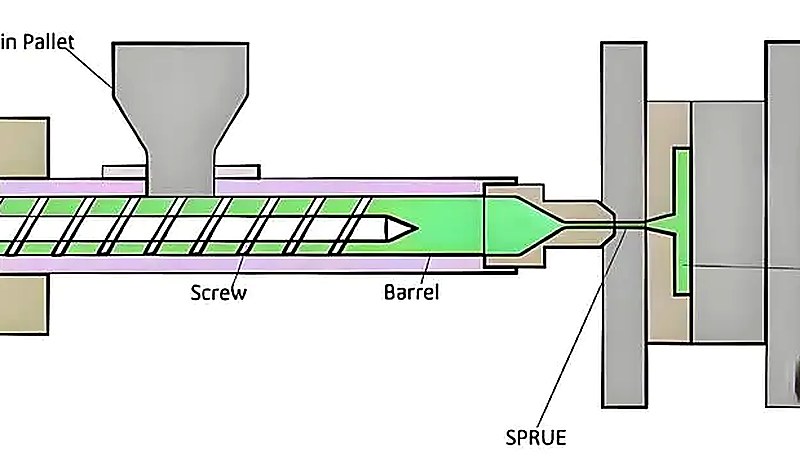
In our Shanghai factory, ZetarMold has 20+ years of injection molding and tooling experience, runs 47 injection molding machines from 90T to 1850T, and supports projects with in-house tooling. For sprue and runner design, this matters because the same mold can behave differently when it moves from trial press to production press.
What Is a Runner in Injection Molding?
A runner is the horizontal channel network that routes molten plastic from the bottom of the sprue to each cavity gate. In a multi-cavity moulage par injection mold, the runner system is the distribution backbone — it determines whether every cavity fills at the same time and pressure, or whether you get short shots in some cavities and over-packed flash in others.
Runners come in several cross-sectional profiles. The most common are:
Full-round — Circular cross-section. Best surface-area-to-volume ratio, meaning the least heat loss and lowest pressure drop. Requires machining on both mold halves, so tooling cost is higher.
Trapezoidal — Machined into one mold half only. Easier and cheaper to cut. The compromise is slightly more heat loss and pressure drag.
Modified trapezoidal (U-shape) — A hybrid that improves on the standard trapezoid with rounded corners, giving better flow characteristics while staying machinable on one side.
Runner diameter typically ranges from 3 mm to 10 mm depending on part size, material viscosity, and flow length. In our shop, we rarely go below 4 mm for anything beyond tiny micro-molding — below that, the pressure losses stack up fast, especially with high-viscosity engineering plastics.
« Le diamètre du canal de distribution dans la plupart des moules de production varie de 3 mm à 10 mm. »Vrai
True. This is the standard range. Smaller runners create excessive pressure loss, while larger runners waste material and extend cycle time.
« Les canaux de distribution sont toujours usinés sur les deux moitiés du moule. »Faux
False. Trapezoidal and U-shaped runners are machined on only one mold half. Only full-round runners require machining on both sides.
What Is a Gate and How Does It Differ from Sprue and Runner?
A gate is the narrowest constriction between the runner and the mold cavity. It is the last door the plastic passes through before entering the cavity. Gates serve four critical functions that directly determine part quality and production efficiency.
1. Flow control. The gate restricts and directs the melt. A smaller gate increases shear rate, which heats the material through viscous friction and temporarily lowers viscosity — helping fill thin sections.
2. Freeze-off seal. Once the cavity is packed, the gate is the first thing to solidify. This seals the cavity so packed material cannot flow backward into the runner when injection pressure drops.
3. Separation point. After ejection, the gate is where the part separates from the runner system. A well-designed gate snaps clean or requires minimal trimming.
4. Packing control. Gate size and freeze time directly control how much packing material enters the cavity.
Too large a gate means long packing — and possible over-packing, flash, or high residual stress. Too small, and the gate freezes before the cavity is fully packed, causing sink marks or voids.
What Is the Complete Feed Path from Nozzle to Cavity?
The complete feed path from nozzle to cavity is defined by the function, constraints, and tradeoffs explained in this section. The full journey of molten plastic through an moule d'injection follows this sequence: Machine barrel → Nozzle tip → Sprue (vertical, through top clamp plate) → Runner (horizontal, through parting surface) → Gate (narrow constriction) → Cavity.
Each stage is a step down in cross-section. The sprue is the largest channel, the runner is smaller and branched, and the gate is the smallest constriction. This tapering is deliberate — it maintains flow velocity and pressure right up to the cavity entrance.
There is also a cold slug well at the base of the sprue, opposite the sprue puller. Its job is to catch the cold, slow-moving slug of plastic that sits at the nozzle tip between cycles. Without it, that cold plug would travel down the runner and potentially block a gate or cause a visible blemish on the part.
« Le puits de refroidissement capte le plastique solidifié de la pointe de la buse entre les cycles. »Vrai
True. Without a cold slug well, the solidified nozzle tip material would enter the runner system and could block a gate or create surface defects on the molded part.
« L'entrée est le plus grand canal du système d'alimentation. »Faux
False. The gate is the smallest constriction. The sprue is the largest channel, the runner is medium, and the gate is the narrowest point between the runner and the cavity.
Which system should you use: cold runner or hot runner?
This is one of the most consequential design decisions in any mold build. The runner system type affects material waste, cycle time, part quality, and tooling cost. Understanding the trade-offs helps you make the right call for your production volume and budget.
A cold runner system is the traditional, lower-cost approach. The runner channels are unheated — they are simply machined into the mold steel. After each cycle, the runner plastic solidifies along with the parts and is ejected. That solidified runner is waste (or regrind), typically 5–30% of total shot weight depending on part geometry.
A hot runner system uses cartridge heaters, thermocouples, and manifold blocks to keep the plastic inside the runner channels molten at all times. No runner waste is ejected — only the parts. This saves material, reduces cycle time (no runner to cool and eject), and often enables faster color or material changes. The trade-off is significantly higher tooling cost and maintenance complexity.
Here is a practical comparison:
| Criteria | Cold Runner | Le coureur chaud |
|---|---|---|
| Coût de l'outillage | Faux. Même un moule à 2 empreintes peut souffrir d'un déséquilibre de remplissage si les longueurs des canaux d'alimentation diffèrent. L'équilibrage des canaux d'alimentation est important pour tout moule multi-empreintes, quel que soit le nombre d'empreintes. | Higher (heated manifold + controllers) |
| Déchets matériels | 5–30% per shot (runner scrap) | Near zero (no solidified runner) |
| Durée du cycle | Longer (runner must cool) | Shorter (no runner cooling needed) |
| Maintenance | Simple, robust | Complex (heaters, thermocouples, leaks) |
| Color Change | Easy (purge entire system) | Slower (residual melt in manifold) |
| Part Quality | Gate marks, possible vestige | Cleaner gates, thermal gate or valve |
| Meilleur pour | Low-mid volume, frequent color changes | High volume, tight tolerance, expensive resins |
{"type":"factory_insight","fact_ids":["equipment.injection_machines_47","equipment.tonnage_90_1850"],"text":"Dans notre installation de Shanghai, nous exploitons 47 machines d'injection plastique de 90T à 1850T, produisant des pièces avec des moules à distribution froide et chaude. Pour les travaux médicaux et les produits électroniques de consommation à grand volume, les systèmes à distribution chaude sont presque toujours plus rentables en coût total de possession dès que vous dépassez environ 100 000 cycles."}
What Are the Most Common Gate Types?
The most common gate types are the main categories or options explained in this section. Gate selection is not a theoretical exercise — it directly determines whether your part fills cleanly, how much post-processing it needs, and whether automated production is even possible. Here are the six gate types you will encounter most often in production tooling:
1. Direct (sprue) gate. The simplest gate — the sprue feeds directly into the cavity with no runner. Used for single-cavity molds making large, thick-walled parts like buckets or housings. Low pressure loss, but leaves a large, visible gate mark and cannot be used for multi-cavity layouts.
2. Edge (side) gate. The most versatile gate type, located on the parting surface at the edge of the cavity. Easy to machine, easy to adjust dimensions, and works with most materials. The downsides are visible gate vestige and the need for manual degating.
3. Submarine (tunnel) gate. The runner channel angles below the parting line and enters the cavity from the underside or an interior surface. When the mold opens, the angled runner automatically shears the gate from the part — enabling fully automated production with no visible gate mark on the cosmetic surface. Not recommended for brittle materials like PC or PMMA.
« Les entrées submersibles peuvent permettre une production totalement automatisée car l'entrée se détache lors de l'ouverture du moule. »Vrai
True. The angled tunnel design causes the gate to self-sever from the part as the mold opens, eliminating the need for manual degating.
« Les entrées de type point fonctionnent avec des moules standard à deux plaques. »Faux
False. Pin-point gates require a three-plate mold (double parting surface) because the gate must be stripped from the fixed side during mold opening. Standard two-plate molds cannot accommodate this gate type.
4. Pin-point gate. A very small-diameter gate (typically 0.5–1.5 mm) that leaves minimal vestige and self-severs during ejection. Requires a three-plate mold. High injection pressure loss, but excellent for cosmetic parts and multi-cavity tools.
5. Fan gate. A wide, flat gate that spreads the melt across a broad front. Ideal for thin-walled parts where you need to avoid jetting or high-shear defects. Common in flat panels and lens covers.
6. Valve gate (hot runner only). A mechanically actuated pin that opens and closes the gate orifice. Provides the cleanest gate mark, precise control over gate-open timing, and is used in high-end multi-cavity and sequential-fill applications. The most expensive option.
How Does Gate Size Affect Part Quality?
Gate size is the control point for fill speed, packing time, and separation quality. If it is wrong, defects show up quickly.
Gate too small: High shear rate through the gate causes excessive frictional heating, which can degrade temperature-sensitive resins. The gate also freezes too early, cutting off packing pressure before the cavity is fully compensated for shrinkage. Result: sink marks, voids, and under-packed parts. You also see high pressure drops that may cause short shots in multi-cavity tools.
Gate too large: Extended packing time, over-packing near the gate, and high residual stress. The gate vestige is larger and harder to remove cleanly. Cycle time increases because the thick gate section takes longer to solidify.
In practice, we start with a gate cross-sectional area roughly 50–70% of the thinnest wall section of the part, then adjust based on mold flow simulation results. Gate land length (the straight section) is kept short — typically 0.5–1.5 mm — to minimize pressure loss. Anything longer is usually wasted pressure.
What Problems Occur When the Runner System Is Poorly Designed?
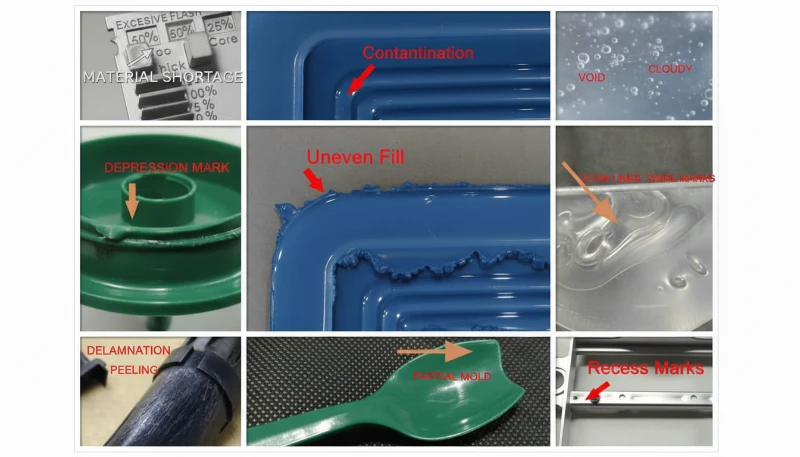
A poorly designed runner system is a direct cause of unbalanced filling, pressure loss, cold slugs, and wasted resin. In our factory, we diagnose these problems by following the melt path from nozzle to cavity before changing machine settings.
Unbalanced fill in multi-cavity molds. When runner lengths or diameters vary, some cavities fill first and others lag. The early-filling cavities get over-packed while late-fill cavities are short. The fix is balanced runner design — equal flow length and cross-section to every cavity, or flow-length compensation using different runner diameters.
Excessive pressure drop. Long, narrow runners with too many turns bleed off injection pressure before the melt reaches the cavity. If you need 120 MPa at the cavity but lose 80 MPa in the runner system, you need a bigger machine — or a better runner layout.
Cold slugs entering the cavity. If the cold slug well is missing or undersized, the solidified plug from the nozzle tip travels into the runner and blocks a gate. This shows up as intermittent short shots or surface blemishes that appear randomly.
Excessive runner waste. In cold runner molds, oversized runners (a common safety margin) waste material. In high-volume production with expensive engineering resins (PEEK, PPS, LCP), even a few grams per shot add up to thousands of dollars per year.
How Do You Optimize Runner Design for Multi-Cavity Molds?
Multi-cavity mold optimization is where experienced tool designers earn their keep. The goal is simple: every cavity fills at the same rate, at the same pressure, producing identical parts. Achieving it requires attention to three factors.
Geometric balance (naturally balanced runner). Lay out the runner so that the flow path from the sprue to every cavity has identical length, number of turns, and cross-section. An H-pattern or radial layout achieves this naturally. This is the gold standard, but it does not always fit within mold base constraints or part layout requirements.
Flow-length compensation (artificially balanced runner). When geometric balance is impossible, adjust runner diameters to equalize the pressure drop to each cavity. A cavity that is farther from the sprue gets a wider runner to compensate for the extra friction loss. This requires accurate mold flow simulation.
Gate sizing as a final trim. Even with balanced runners, small variations in cavity geometry (different part weights, wall thicknesses) can cause imbalance. Slightly adjusting individual gate sizes is the final tuning step. This is done during mold sampling — we mold test shots, measure cavity weights, and adjust gates in 0.1 mm increments.
{"type":"factory_insight","fact_ids":["facility.in_house_mold_manufacturing","company.experience_20_years"],"text":"Grâce à notre atelier interne de fabrication de moules et à plus de 20 ans d'expérience en outillage, nous concevons et ajustons régulièrement des moules multi-empreintes jusqu'à 64 empreintes pour des composants de connecteurs et médicaux à grand volume."}
« Dans un système de distribution naturellement équilibré, chaque empreinte a un chemin de flux identique depuis la buse. »Vrai
True. Geometrically balanced runners use H-pattern or radial layouts to ensure equal flow length, turns, and cross-section to every cavity, producing consistent parts.
« L'équilibrage des canaux de distribution est seulement nécessaire pour les moules avec plus de 16 empreintes. »Faux
False. Even a 2-cavity mold can suffer from fill imbalance if the runner lengths differ. Runner balancing is important for any multi-cavity mold regardless of cavity count.
runner désigne un système de canaux horizontaux qui distribue le plastique fondu de la buse d'injection vers les entrées individuelles des cavités dans un moule à cavités multiples ou à entrées multiples.
If you need a fast comparison, this table summarizes the key differences between sprue, runner, and gate:
| Fonctionnalité | Tige | Coureur | Portail |
|---|---|---|---|
| Localisation | Vertical, through top plate | Horizontal, on parting surface | Between runner and cavity |
| Fonction | Connects nozzle to runner system | Distributes melt to all cavities | Controls entry into cavity |
| Taille | Largest channel (3–10 mm dia.) | Medium (3–8 mm dia.) | Smallest (0.3–3 mm dia.) |
| Cross-section | Tapered conical | Round, trapezoidal, or U-shaped | Narrow rectangular or round |
| Solidifies | First to receive melt, slow to freeze | Solidifies with part | First section to freeze |
| Ejection | Pulled by sprue puller / undercut | Ejected with part on parting line | Severs from part on ejection |
| Design tip | Taper 1–3° per side for clean release | Full-round is most efficient | Smallest gate that fills the part |
Questions fréquemment posées
What is the Difference Between a Sprue and a Runner?
Une buse est le canal vertical qui relie la buse de la machine d'injection au système de distribution du moule, tandis qu'un canal de distribution est le canal horizontal qui distribue la matière plastique de la buse aux entrées individuelles des empreintes. La buse est le premier canal que le plastique traverse après la pointe de la buse, et elle passe par la plaque supérieure de serrage du moule. Les canaux de distribution suivent la buse et se ramifient pour atteindre chaque empreinte. En termes de taille, la buse est généralement le plus grand canal unique du système d'alimentation, tandis que les canaux de distribution sont ramifiés et légèrement plus petits en section transversale.
Can a Mold Work Without a Sprue?
Seulement dans les moules à distribution chaude avec une connexion directe buse-manifold, où la buse chauffée alimente directement le manifold sans une buse conventionnelle. Dans la plupart des moules standard à deux plaques avec distribution froide, la buse est essentielle car elle relie la buse fixe de la machine sur la partie fixe et le système de distribution de la partie mobile du moule. Sans elle, il n'y a pas de canal scellé pour transporter la matière plastique du cylindre de la machine vers les empreintes du moule. Les systèmes à distribution chaude peuvent éliminer complètement la buse en utilisant une buse chauffée ou une entrée directe.
Why Is the Sprue Tapered in Injection Molds?
The taper (1–3 degrees per side) creates a draft angle that allows the solidified sprue to release cleanly from the sprue bushing during mold opening. A straight-walled cylindrical channel would grip the steel surface through friction and thermal shrinkage, jamming the ejection system and potentially damaging the mold surface over repeated cycles. The taper ensures the sprue pulls out of the bushing smoothly on every cycle, which is critical for reliable automated production, consistent cycle times, and long mold life.
What Happens If the Runner Is Too Small?
An undersized runner creates excessive pressure drop between the machine nozzle and the cavity, which can cause short shots, high filling pressure requirements, and increased shear heating in the melt. The machine may need to operate at its maximum pressure limit, leaving no margin for process adjustments or material viscosity variations during production. In multi-cavity molds, undersized runners also make it much harder to balance cavity fill, leading to inconsistent part quality, dimensional variation across cavities, and higher overall rejection rates.
Does Every Mold Need a Cold Slug Well?
In cold runner molds, yes — it catches the solidified nozzle tip slug that forms between injection cycles. Without it, that cold plug travels into the runner system and can block a gate or create a visible surface blemish on the finished part. In hot runner molds, the melt stays molten in the heated manifold at all times, so cold slug wells are not needed because there is no solidified material to trap. However, most cold runner molds should always include a properly sized cold slug well at the base of the sprue.
How Do You Choose Between Cold and Hot Runner Systems?
Use cold runner systems for low-to-medium volume production, applications requiring frequent color changes, or when tooling budget is limited. Switch to hot runner for high-volume production (typically above 100,000 cycles), expensive engineering resins where runner waste is costly, or when cycle time reduction is critical for profitability. Most production molds producing over 500,000 parts annually use hot runner systems because the material savings and faster cycles offset the higher initial tooling investment within the first production run. Do the math before choosing. Compare annual volume, runner weight, resin price, color-change frequency, required automation, tool budget, and maintenance skill. A hot runner can be a strong investment, but only when the production savings are larger than the added complexity.
What Is Runner Balancing and Why Does It Matter?
Runner balancing ensures that all cavities in a multi-cavity mold fill simultaneously and at equal pressure, producing consistent parts across all cavities in every cycle. It is achieved through geometric layout (equal flow paths using H-pattern or radial runner designs) or by adjusting individual runner diameters to compensate for different flow lengths to each cavity. Unbalanced runners cause some cavities to over-pack (resulting in flash, high residual stress, and dimensional issues) while others are under-filled (short shots, sink marks, and voids), leading to inconsistent part quality and higher rejection rates.
Which Gate Type Leaves the Smallest Mark on the Part?
Pin-point gates and submarine (tunnel) gates leave the smallest visible vestige on the part surface, typically a dot or small dimple less than 1 mm in diameter. Valve gates in hot runner systems leave the cleanest mark of all — a small circular witness with no raised vestige, because the valve pin shears the gate flush with the part surface during closure. Direct gates and large edge gates leave the most visible marks on the molded part, which often require secondary trimming, sanding, or cosmetic finishing operations to remove before the part can be shipped.
How can ZetarMold help with your mold design?
Choosing the right sprue, runner, and gate configuration is not a textbook exercise — it depends on your part geometry, material, production volume, and quality requirements. At ZetarMold, we design and build molds in-house with 47 injection molding machines (90T–1850T) and experience across 400+ plastic materials. If you are looking for an fournisseur de moulage par injection, our engineering team can guide you from DFM through production.
Whether you need a simple cold runner mold for a short run or a precision hot runner system for million-piece production, our team can help you get it right the first time.
Request a Free Quote → Send your 3D model and we will return DFM feedback, mold design recommendations, and a production timeline within 48 hours.
-
sprue: sprue refers to a sprue is the primary vertical channel that conveys molten plastic from the injection molding machine nozzle into the runner system of a mold. ↩
-
runner: runner refers to a runner is the horizontal channel system that distributes molten plastic from the sprue to individual cavity gates in a multi-cavity or multi-gate mold. ↩
-
gate: Master Unit Die à changement rapide (MUD) vs Moule standard ↩






 EN
EN  ES
ES  FR
FR  DE
DE  PT
PT  AR
AR  RU
RU  JA
JA  KO
KO  IT
IT  NL
NL  TR
TR  PL
PL 