El moldeo por inyección reforzado con fibra de carbono produce piezas más ligeras que el aluminio y, a la vez, más resistentes que los plásticos sin reforzar. Si diseña soportes, carcasas o componentes estructurales que necesitan rigidez sin la penalización del peso, este proceso merece su atención. Esta guía aborda la selección de materiales, los parámetros de procesamiento, el diseño del molde y la resolución de defectos, a partir de dos décadas de experiencia práctica en planta.
- El contenido de fibra de carbono típicamente varía del 10–40% en peso en los compuestos de moldeo por inyección.
- Los fundidos rellenos de fibra necesitan una presión de inyección entre un 20–50% mayor que las resinas sin rellenar.
- El acero de molde endurecido (H13, S136) es esencial porque las fibras de carbono son extremadamente abrasivas.
- Grandes entradas redondeadas reducen la rotura de fibras y preservan la resistencia mecánica en el área de entrada.
- La resistencia a la tracción en la dirección del flujo puede ser 2–3 veces mayor que en la dirección transversal.
¿Qué es el moldeo por inyección reforzado con fibra de carbono?
El moldeo por inyección reforzado con fibra de carbono es el proceso de moldear termoplásticos cargados con fibras para obtener piezas ligeras y de gran rigidez. Las fibras, que suelen medir entre 0,2 y 0,5 mm después de la mezcla, refuerzan una matriz de PA6, PA66, PBT, PPS, PEEK o PC. Durante el llenado de la cavidad, las fibras se orientan en la dirección del flujo de la masa fundida, lo que crea propiedades mecánicas dependientes de la dirección. Esta anisotropía es uno de los factores más importantes que los ingenieros deben considerar durante el diseño de la pieza y del molde. A diferencia de los compuestos de fibra continua, que requieren autoclaves o RTM, los termoplásticos reforzados con fibra corta se procesan en máquinas convencionales de moldeo por inyección, con una producción escalable desde 1.000 hasta millones de piezas.
Las fibras de carbono actúan como una fase de refuerzo dentro de una matriz termoplástica — comúnmente PA6, PA66, PBT, PPS, PEEK o PC. Durante el llenado de la cavidad, las fibras se orientan a lo largo de la dirección del flujo de fundido, creando piezas con propiedades mecánicas dependientes de la dirección. Esta anisotropía es uno de los factores más importantes que los ingenieros deben considerar durante el diseño de la pieza y el molde.
En nuestra experiencia procesando miles de inyecciones de compuestos reforzados con fibra de carbono, hemos visto fibras tan cortas como 0.1 mm después de la mezcla a través de canales estrechos. La lección clave: el diseño del canal y la preservación de la longitud de fibra importan más que el porcentaje de fibra bruto en la hoja de datos.
"El moldeo por inyección reforzado con fibra de carbono puede producir piezas con una relación resistencia-peso superior a la del aluminio fundido a presión."True
El CF-PA6 con carga del 30% alcanza ~200 MPa de resistencia a la tracción con una densidad de ~1.4 g/cm3, versus ~180 MPa para el aluminio A380 fundido a inyección con 2.7 g/cm3 — lo que da a la pieza de polímero aproximadamente el doble de resistencia específica.
"El moldeo por inyección reforzado con fibra de carbono requiere equipos especializados que las máquinas de moldeo por inyección estándar no pueden manejar."False
Los compuestos CFRTP se procesan en máquinas de moldeo por inyección convencionales. Los principales ajustes son una mayor presión de inyección (20–50% más) y conjuntos de tornillo/cañón endurecidos para resistir la abrasión de las fibras — no una arquitectura de máquina fundamentalmente diferente.
¿Por qué elegir termoplásticos reforzados con fibra de carbono?
Los termoplásticos reforzados con fibra de carbono son compuestos que ofrecen alta rigidez, bajo CTE y conductividad en un solo material. Los ingenieros los eligen cuando el ahorro de peso, la precisión dimensional o el blindaje EMI justifican una prima de costo de material de 2–5 veces sobre los grados sin rellenar.
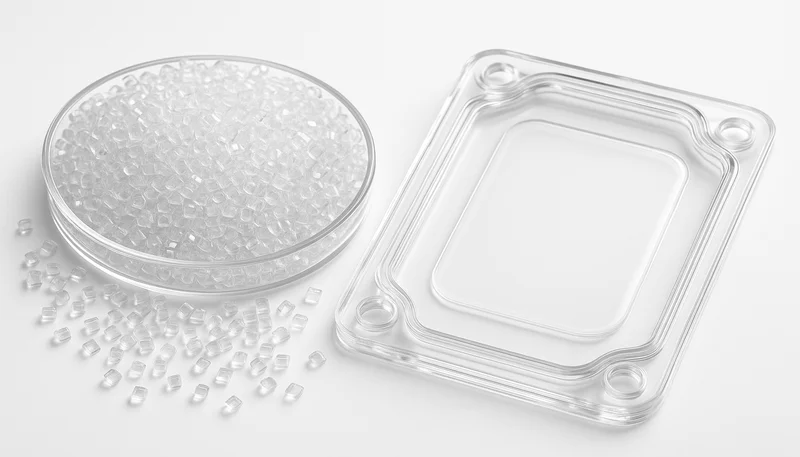
Alta rigidez específica: el módulo de flexión del CF-PA6 con un 30 % de carga alcanza unos 20 GPa, comparable al aluminio fundido a presión con un tercio de su densidad. En aplicaciones donde el peso es crítico, como soportes de baterías de vehículos eléctricos o bastidores de drones, se alcanzan los objetivos estructurales con una masa considerablemente menor.
Estabilidad dimensional: el CTE disminuye de ~80 × 10⁻/K (PA6 sin carga) a ~20 × 10⁻/K con un 30 % de CF. Esto es importante en conjuntos de precisión donde los ciclos térmicos sacarían las piezas de tolerancia.
Menor contracción del molde: la contracción total disminuye del 1,0–1,5 % (PA6 sin carga) al 0,2–0,5 % con un 30 % de CF, lo que permite tolerancias dimensionales más estrictas, aunque la contracción anisotrópica plantea sus propios retos.
Conductividad eléctrica: la fibra de carbono crea una red conductora con cargas superiores a ~15 %, lo que permite el blindaje EMI sin revestimientos secundarios ni insertos metálicos.
Desventajas: los gránulos de PA6-CF301 cuestan entre 8 y 15 $/kg, frente a 2–4 $ para el PA6 sin carga. Las fibras desafilan rápidamente las herramientas de corte durante el mecanizado secundario, y el reciclaje es más complejo porque la unión fibra-matriz se degrada con cada ciclo de reprocesado.
¿Cómo afecta el contenido de fibra al procesamiento?
Una mayor carga de fibra es una ganancia en rigidez que también aumenta la viscosidad, la presión de inyección, el desgaste de la herramienta y el riesgo de cizallamiento en la entrada. El punto óptimo práctico es una carga de CF del 20-30%, donde se capturan la mayoría de las ganancias de resistencia sin una dificultad de procesamiento excesiva.
| Carga de CF | Índice de viscosidad de fusión | Resistencia a la tracción | Módulo de flexión | Contracción del molde | Tasa de desgaste de herramienta |
|---|---|---|---|---|---|
| 0% (sin rellenar) | Referencia (1×) | aprox. 80 MPa | ~2.8 GPa | 1.0–1.5% | Insignificante |
| 10% | 1.3× | ~120 MPa | aprox. 6 GPa | 0.5–0.8% | Bajo |
| 20% | 1.8× | ~160 MPa | ~13 GPa | 0.3–0.5% | Moderado |
| 30% | 2.5× | ~200 MPa | ~20 GPa aproximadamente | 0.2–0.4% | Alta |
| 40% | 3.5× | aprox. 210 MPa | ~24 GPa | 0.1–0.3% | Muy alta |
La resistencia a la tracción se estabiliza alrededor de una carga del 30% — pasar del 30% al 40% proporciona solo un ~5% más de resistencia pero una dificultad de procesamiento significativamente mayor. En la práctica, un 20-30% de fibra de carbono es el punto óptimo para la mayoría de aplicaciones estructurales. Hemos realizado miles de inyecciones de PA6-CF30 en nuestras máquinas de 90T-1850T y ofrece consistentemente el mejor equilibrio.
"Aumentar el contenido de fibra de carbono del 30% al 40% produce rendimientos decrecientes en la resistencia a la tracción y, al mismo tiempo, incrementa considerablemente la dificultad de procesamiento."True
La resistencia a la tracción pasa de ~200 MPa con CF al 30% a ~210 MPa con CF al 40% — solo una ganancia del 5% — mientras que la viscosidad del fundido aumenta de 2.5× a 3.5× respecto a la línea base, requiriendo una presión de inyección mucho mayor y provocando un desgaste más rápido del molde.
"Una mayor proporción de fibra de carbono siempre produce piezas más resistentes, independientemente de la orientación de las fibras2."False
La orientación de las fibras importa tanto como la carga. En dirección transversal, una pieza de CF al 30% puede tener solo ~60-80 MPa de resistencia a la tracción — menos que los 80 MPa del PA6 no cargado isotrópico en algunos casos. Diseñe para la orientación real en su pieza.
¿Cuáles son los parámetros clave de procesamiento?
Los parámetros clave son la temperatura de la masa, la velocidad de inyección, la temperatura del molde, el secado y la presión de mantenimiento. Para PA6-CF30, objetivo 260-285°C de masa, velocidad de inyección de 80-120 mm/s, temperatura del molde de 80-100°C y presión de mantenimiento de 40-60% relativa a la presión de inyección. Un control más estricto que con resinas sin relleno es esencial porque las fibras aumentan la viscosidad y aceleran la transferencia de calor.
Temperatura de fusión
Las resinas rellenas de CF necesitan temperaturas del cilindro ligeramente más altas — típicamente 10–20°C por encima del grado sin relleno — porque las fibras aumentan la viscosidad de la masa. Para PA6-CF30, objetivo 260–285°C. No exceda el límite superior; la degradación térmica del agente de acoplamiento entre la fibra y la matriz debilita la pieza.
Velocidad y presión de inyección
Espere un 20–50% más de presión de inyección en comparación con la resina sin relleno a la misma temperatura del molde. Una velocidad de inyección rápida (80–120 mm/s) ayuda a llenar el molde antes de que la masa de alta viscosidad se solidifique — pero si es demasiado rápida, la orientación de la fibra se concentra en las líneas de unión. Comience a 100 mm/s y ajuste.
Temperatura del molde
Temperaturas del molde más altas (80–100°C para PA6-CF) mejoran el acabado superficial y reducen la tensión residual. Las fibras de carbono conducen el calor fuera de la masa más rápido que la matriz polimérica, por lo que el tiempo real de solidificación es más corto de lo esperado — esto puede reducir los tiempos de ciclo en un 10–15% en comparación con el material sin relleno.
Presión y tiempo de mantenimiento
Las piezas cargadas con CF se contraen menos, por lo que la presión de mantenimiento puede ser inferior (40–60 % de la presión de inyección, frente al 60–80 % para materiales sin carga). El tiempo de mantenimiento es más corto porque la compuerta se solidifica antes. Las probetas conforme a ASTM D36413 ayudan a ajustar los parámetros de forma objetiva.
¿Cómo diseñar moldes para materiales rellenos de fibra de carbono?
El diseño de moldes para aplicaciones de molde de inyección reforzadas con fibra de carbono es donde muchos proyectos se tuercen. Las fibras son abrasivas, la viscosidad es alta y la orientación de las fibras crea diferencias direccionales en las propiedades.
Selección de Acero
El acero para herramientas P20 estándar no durará mucho con compuestos de fibra de carbono. Después de aproximadamente 50.000 inyecciones de material 30% CF, aparece un desgaste medible en las superficies de la cavidad y en los insertos de la compuerta. Utilice acero para herramientas endurecido (H13 con un mínimo de 48-52 HRC, o S136 para materiales corrosivos) para moldes de producción. Para series superiores a 500.000 piezas, los recubrimientos de TiN o DLC en áreas de alto desgaste son rentables.
Diseño de puertas
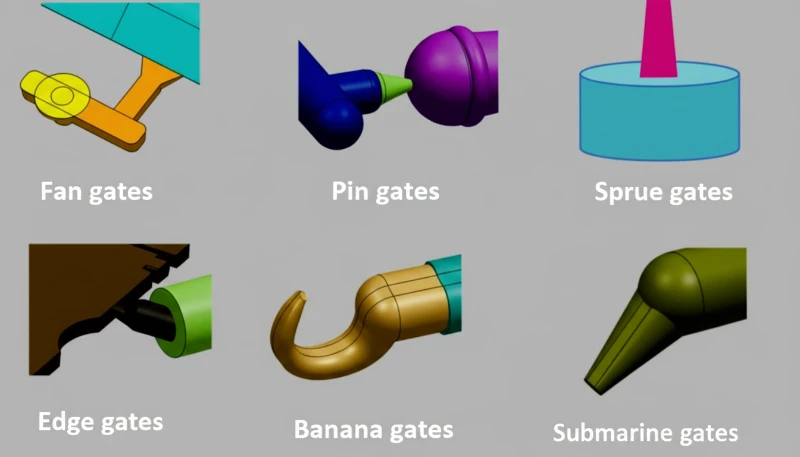
Esta es la decisión de diseño más crítica. Las compuertas pequeñas tipo punto trituran las fibras de carbono — se pierde un 30–50% de la longitud de la fibra en la compuerta. Use compuertas de borde, compuertas de abanico o compuertas de lengüeta con un espesor mínimo de 1.5 mm y largos de compuerta cortos (0.5–1.0 mm) para minimizar el cizallamiento.
Sistema de Canal y Expulsión
Los canales completamente redondos con diámetros de 6-10 mm reducen la rotura de fibras. Evite giros bruscos. Los canales calientes necesitan boquillas endurecidas. Para la expulsión, utilice un desmoldeo mínimo de 1.5-2° (frente a 0.5-1° para no cargados) y considere placas expulsoras para piezas con núcleos profundos.
¿Cuáles son los defectos comunes y cómo solucionarlos?
Los defectos comunes que encontramos en el moldeo reforzado con fibra de carbono son la exposición de la fibra, líneas de unión débiles, alabeo y piezas incompletas. Después de procesar piezas rellenas de CF en nuestras máquinas de 90T–1850T durante más de dos décadas, la exposición de la fibra y la debilidad de la línea de unión son los dos problemas que depuramos con más frecuencia en la planta de producción.
Exposición de fibras: aparecen fibras visibles en la superficie con cargas superiores al 15–20 % cuando la matriz polimérica no puede encapsularlas por completo. Aumente la temperatura del molde entre 10 y 15 °C y reduzca ligeramente la velocidad de inyección para permitir que se forme primero la capa superficial de polímero.
Debilidad de las líneas de soldadura: las fibras se alinean en paralelo a las líneas de soldadura y no pueden cruzar la interfaz. La zona soldada puede ser un 40–60 % más débil. Sitúe las líneas de soldadura en zonas no críticas mediante simulación de flujo o añada pozos de rebose para desplazar las zonas débiles fuera de la parte funcional de la pieza.
Alabeo por contracción anisotrópica: los materiales cargados con fibras se contraen más en dirección transversal al flujo que a lo largo de este. Las secciones de pared delgada que no permiten orientar libremente las fibras se contraen de forma isotrópica, mientras que las secciones gruesas adyacentes no lo hacen. Contrarreste este efecto con un espesor de pared uniforme y una colocación equilibrada de las compuertas.
Llenado incompleto en paredes delgadas: las masas fundidas cargadas con CF son de 2 a 3 veces más viscosas que la resina sin carga, lo que provoca llenados incompletos en paredes de menos de 1,2 mm. Nuestros ingenieros lo solucionan aumentando la velocidad de inyección para llenar las secciones delgadas antes de que se solidifique la masa de alta viscosidad y puliendo las superficies de la cavidad para reducir la resistencia al flujo.
"Las líneas de soldadura de las piezas moldeadas por inyección reforzadas con fibra de carbono pueden ser un 40–60% más débiles que el material circundante."True
Las fibras no pueden puentear la interfaz de la línea de unión — se alinean paralelas a ella, dejando solo la matriz polimérica para soportar la carga. Por eso la ubicación de la línea de unión debe abordarse durante el diseño del molde.
"Aumentar la presión de inyección siempre elimina los llenados incompletos en el moldeo de fibra de carbono de pared delgada."False
La presión excesiva sin ventilación adecuada causa quemaduras por destello y aire atrapado. La solución correcta combina temperatura de fusión optimizada, profundidad de ventilación adecuada y un espesor de pared mínimo de 1.0 mm.
¿Qué industrias se benefician más del moldeo por inyección de CFRP?
Cuando la relación rendimiento-peso importa, el moldeo por inyección reforzado con fibra de carbono es difícil de superar. Estos sectores son los que presentan mayor demanda.
Automotriz y Aeroespacial
Los mandatos de reducción de peso en los VE impulsan la demanda de soportes, carcasas de sensores y marcos de módulos de batería de CF-PA6 y CF-PBT. Un soporte típico para VE en PA6-CF30 pesa un 40% menos que el aluminio mientras cumple los mismos requisitos de impacto. La industria aeroespacial usa CF-PEEK y CF-PPS para soportes interiores y componentes de drones donde el ahorro de peso se traduce directamente en ahorro de combustible.
Electrónica, productos médicos y bienes de consumo
Las bisagras de portátiles, los bastidores intermedios de teléfonos inteligentes y los brazos de drones aprovechan el moldeo con relleno de CF. La conductividad proporciona blindaje EMI integrado. En dispositivos médicos, CFR-PEEK es radiotransparente y biocompatible, por lo que resulta ideal para instrumental quirúrgico y carcasas compatibles con sistemas de imagen.
¿Cómo elegir un proveedor de moldeo por inyección de fibra de carbono?
Un proveedor de moldeo con fibra de carbono se califica mediante cuatro factores: acero del utillaje, gama de máquinas, infraestructura de secado y certificación ISO. Evalúe estos criterios al seleccionar un socio de aprovisionamiento para proyectos de CFRP.
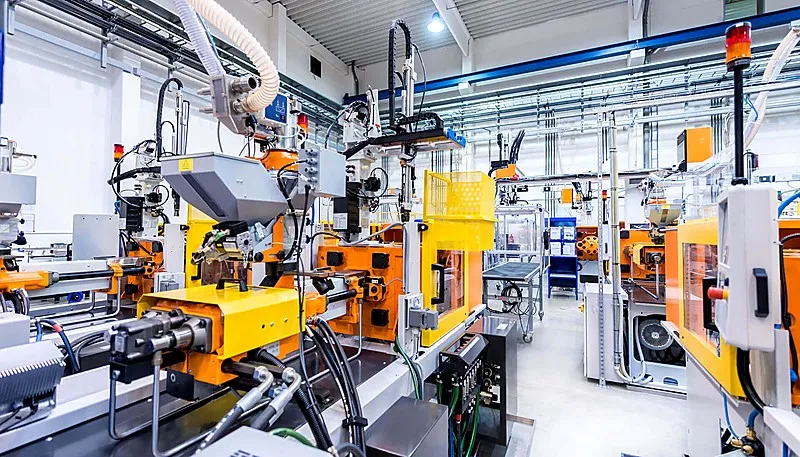
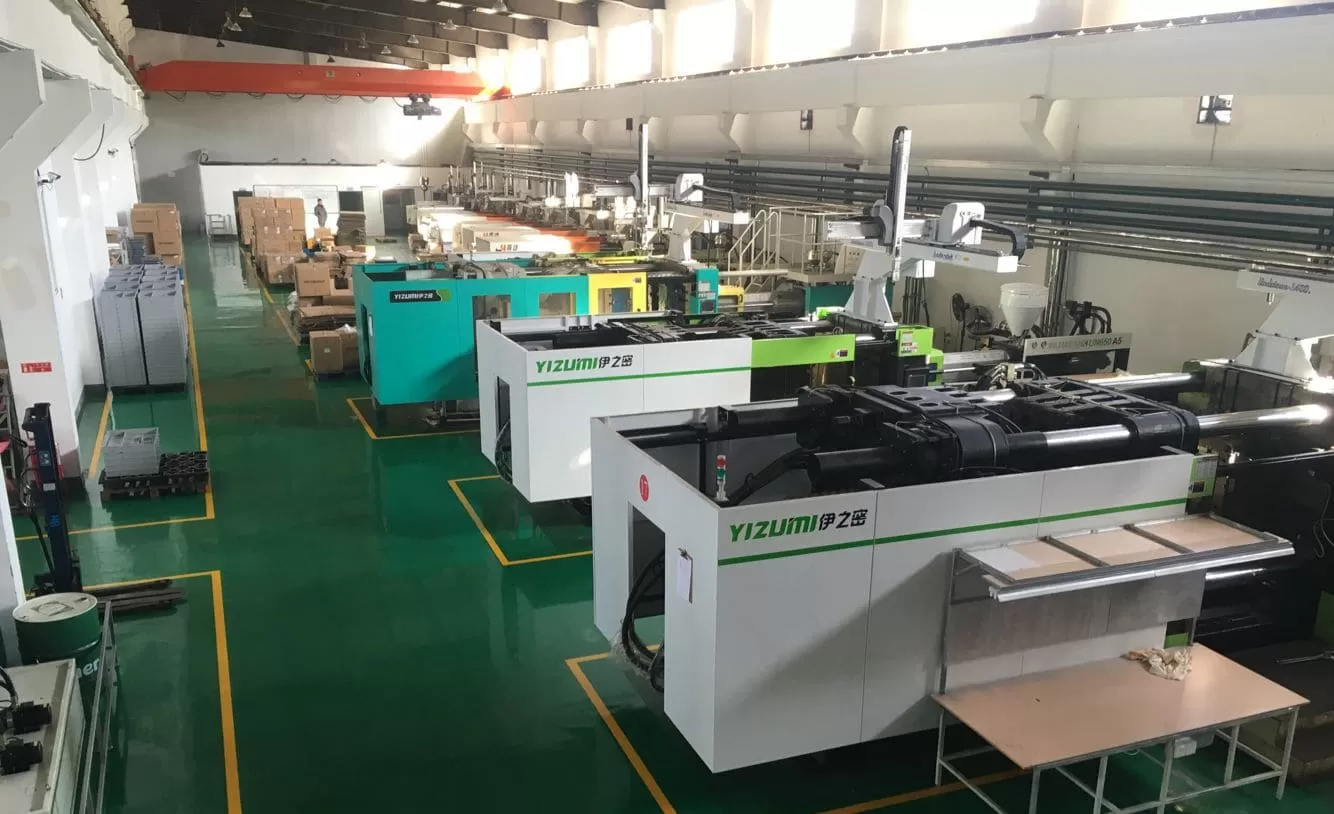
Equipos: el moldeador necesita máquinas con suficiente presión de inyección y un control preciso de la temperatura. Las máquinas con fuerzas de cierre de 90T a 1850T cubren la mayoría de las aplicaciones de moldeo con CF.
Experiencia en fabricación de moldes: su proveedor debe contar con fabricación interna de moldes y capacidad para trabajar con acero endurecido. Pregunte si H13 o S136 son los materiales estándar para moldes de producción con carga de fibras.
Manipulación del material: los compuestos con CF, especialmente los grados basados en PA, son higroscópicos. El proveedor debe disponer de secadores deshumidificadores y mantener el material sellado hasta su uso.
Sistemas de calidad: ISO 9001 es el punto de partida. Para productos médicos, busque ISO 13485; para automoción, IATF 16949. Un sistema estructurado de controles IQC → FQC → OQC garantiza la uniformidad.
Con 20+ años de experiencia en moldeo por inyección, 45 máquinas de 90T a 1850T, fabricación interna de moldes con entregas de 100+ juegos al mes y 400+ materiales en nuestra cartera de procesamiento, hemos afrontado todos los retos que plantea el moldeo reforzado con fibra de carbono. Nuestros 8 ingenieros sénior (cada uno con 10+ años de experiencia) diseñan moldes específicamente para compuestos abrasivos cargados con fibra, utilizando acero endurecido, una geometría de compuerta optimizada y una simulación de flujo validada antes de cortar el acero.
Antes de fabricar el utillaje, realice una breve revisión DFM con el proveedor: confirme la dirección de la fibra, el riesgo de desgaste del punto de inyección, la ventana de secado, la profundidad de ventilación y los criterios de aceptación. Así evitará sorpresas tardías cuando los objetivos de rigidez, las expectativas estéticas y el rendimiento productivo compitan durante la validación.
¿Cuáles son las preguntas más comunes sobre el moldeo por inyección de fibra de carbono?
Preguntas frecuentes
¿Cuál es el contenido habitual de fibra de carbono en el moldeo por inyección?
La mayoría de los grados comerciales para moldeo por inyección reforzados con fibra de carbono contienen entre un 10–30% de fibra de carbono en peso. Por debajo del 10%, el efecto de refuerzo es mínimo y rara vez justifica el sobrecoste del material. Por encima del 30%, la dificultad de procesamiento aumenta bruscamente: la mayor viscosidad exige más presión de inyección, se acelera el desgaste del molde y la rotura de las fibras en las entradas reduce la ventaja mecánica. El punto óptimo para la mayoría de las aplicaciones estructurales es una carga de CF del 20–30%, con la que se obtiene la mayor parte del aumento de resistencia y rigidez, a la vez que se mantiene una ventana de proceso manejable en equipos convencionales.
¿Se pueden sobremoldear los plásticos reforzados con fibra de carbono?
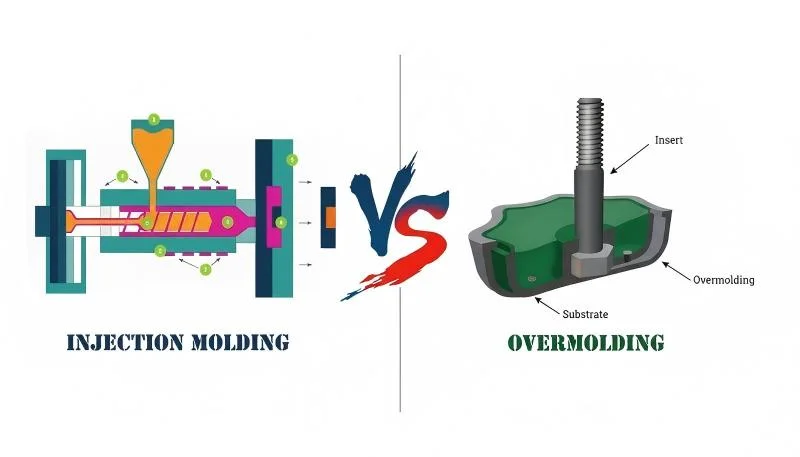
Sí, el sobremoldeo es un método habitual para piezas de CFRP en las que importan la estética superficial o el agarre táctil. El proceso típico moldea primero un sustrato estructural reforzado con CF y después sobremoldea una capa blanda de TPE o TPU en una segunda inyección. La clave es asegurar que la superficie del sustrato esté lo bastante limpia y caliente para la unión química durante la segunda inyección, lo que normalmente se consigue transfiriendo el sustrato directamente de la primera cavidad a la cavidad de sobremoldeo mientras aún está caliente. Este método de dos inyecciones permite combinar el rendimiento estructural con un acabado superficial adecuado para el consumidor.
¿Por qué las piezas moldeadas con fibra de carbono presentan fibras visibles en la superficie?
Con cargas de fibra superiores al 15–20%, la matriz polimérica no puede encapsular por completo todas las fibras en la superficie de la pieza, especialmente cuando la temperatura del molde es baja o la velocidad de inyección demasiado alta. Las fibras son empujadas hacia la superficie antes de que pueda formarse una capa exterior de polímero lisa. Aumentar la temperatura del molde en 10–15°C y reducir ligeramente la velocidad de inyección suele resolverlo, ya que proporciona al polímero más tiempo para fluir y crear una capa exterior uniforme. Para piezas con requisitos estéticos críticos cuya calidad superficial no es negociable, pintar o sobremoldear con una capa exterior sin carga es la práctica habitual del sector.
¿Es caro el moldeo por inyección reforzado con fibra de carbono?
El coste del material es 2–5× mayor que el de los grados sin carga: los gránulos de PA6-CF30 cuestan $8–15/kg, frente a $2–4/kg para el PA6 sin carga. Los costes del molde también son mayores porque el acero endurecido para herramientas (H13 o S136) sustituye al P20 estándar, lo que añade un 15–25% a la inversión en utillaje. Sin embargo, en aplicaciones donde el ahorro de peso se traduce en reducciones de costes a nivel del sistema (menos elementos de fijación, montaje simplificado y menor peso de envío), el coste total de propiedad suele ser inferior. Un soporte para EV que cuesta $0.50 más en material, pero elimina dos elementos de fijación metálicos y reduce el tiempo de montaje en 30 segundos, puede suponer un ahorro neto.
¿Qué contracción debo prever en el diseño con nailon reforzado con fibra de carbono?
El PA6 con un 30% de fibra de carbono presenta una contracción de moldeo aproximada del 0.2–0.4% en la dirección del flujo y del 0.4–0.7% en la dirección transversal. Es significativamente menor que la del PA6 sin carga (1.0–1.5%), lo que favorece la tolerancia dimensional. Sin embargo, la anisotropía —la distinta contracción en cada dirección— exige un diseño cuidadoso del molde, especialmente en piezas planas o de pared delgada propensas al alabeo. Realice siempre una simulación de flujo del molde para predecir la orientación de las fibras antes de definir las dimensiones finales de la cavidad y utilice sus resultados para aplicar una compensación direccional de la contracción, en lugar de un único valor uniforme.
¿Puede utilizarse fibra de carbono reciclada en el moldeo por inyección?
Sí, la fibra de carbono recuperada de residuos de fabricación aeroespacial o del reciclaje por pirólisis puede incorporarse a pellets para moldeo por inyección. La fibra reciclada suele ser más corta (0.1–0.3 mm frente a 0.2–0.5 mm en compuestos de CF virgen), lo que reduce aproximadamente entre 15–25% la resistencia a la tracción y el módulo. La reducción de costes es considerable —a menudo entre 40–60% menos que los compuestos de CF virgen—, por lo que los grados de CF reciclada resultan atractivos para aplicaciones estructurales no críticas, componentes interiores de automóviles y productos de consumo donde no se justifica el rendimiento superior de la fibra virgen.
¿Cómo evito el desgaste del molde al moldear piezas de fibra de carbono?
Utilice acero para herramientas endurecido (H13 a 48–52 HRC como mínimo, o acero inoxidable S136 para grados de resina corrosivos) en todas las superficies de cavidad y núcleo que estén en contacto con el fundido. Aplique recubrimientos de TiN o DLC en las zonas de alto desgaste, como los insertos de los puntos de inyección, las caras deslizantes de los elevadores y las secciones de pared delgada. Diseñe puntos de inyección con dimensiones generosas para reducir la velocidad de cizallamiento y la fuerza de impacto de las fibras sobre su superficie de apoyo. Programe mediciones periódicas de la cavidad cada 20,000–50,000 ciclos para detectar desviaciones dimensionales antes de que afecten a la calidad de la pieza. Para producciones de volumen muy alto, considere fabricar el molde con insertos para poder sustituir las zonas desgastadas de los puntos de inyección sin volver a mecanizar toda la cavidad [4].
¿Cuál es la diferencia entre el moldeo por inyección reforzado con fibra de vidrio y con fibra de carbono?
Ambas fibras aumentan rigidez y resistencia, pero la de carbono aporta un 30–40% más de rigidez con igual carga, menor densidad (1.8 g/cm frente a 2.5 g/cm), conductividad eléctrica por encima del 15% y menor expansión térmica. La fibra de vidrio es más barata: $3–6/kg para pellets compuestos GF frente a $8–15/kg para grados CF, y su mayor alargamiento hace que las piezas GF resistan mejor los impactos. Elija fibra de vidrio por coste y tenacidad; fibra de carbono cuando peso, rigidez específica o conductividad EMI justifiquen el sobreprecio.
¿Está listo para llevar a producción su proyecto de moldeo por inyección reforzado con fibra de carbono? Con 45 máquinas (90T–1850T), fabricación interna de moldes, más de 400 materiales procesados y certificaciones ISO 9001/13485/14001/45001, nuestro equipo de ingeniería puede llevar su diseño desde el prototipo hasta la producción en serie. Solicite un presupuesto gratuito y una revisión DFM de nuestros ingenieros sénior, normalmente en un plazo de 24 horas.
PA6-CF30: PA6-CF30 (nailon 6 con un 30 % en peso de fibra de carbono corta) es un compuesto de moldeo por inyección muy utilizado que ofrece aproximadamente 200 MPa de resistencia a la tracción y 20 GPa de módulo de flexión, según las fichas técnicas de los fabricantes. ↩
orientación de las fibras: la orientación de las fibras es la alineación direccional de las fibras cortas a lo largo de la trayectoria de flujo de la masa fundida durante el llenado de la cavidad, lo que hace que la resistencia a la tracción en la dirección del flujo sea de 2 a 3 veces mayor que en la dirección transversal. ↩
ASTM D3641: ASTM D3641 es una práctica normalizada para moldear por inyección probetas de materiales termoplásticos de moldeo y extrusión, y proporciona una referencia repetible para comparar las propiedades mecánicas entre grados de resina. ↩