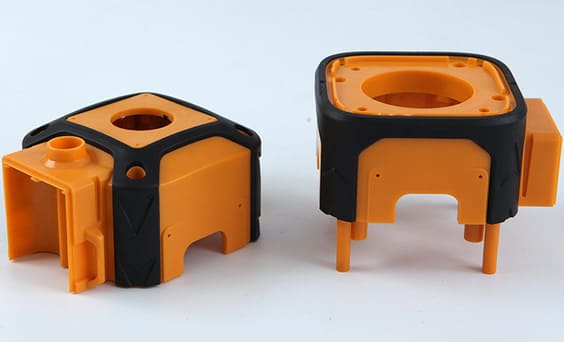
- El P20 (28–33 HRC, preendurecido) es ideal para moldes de prototipo y volumen medio hasta 500.000 disparos con resinas básicas — costo de herramienta más bajo.
- El H13 (HRC 48-52, tratado térmicamente) maneja resinas con carga de vidrio, abrasivas o de alta temperatura (PPS, PEI) y sobrevive más de 1 millón de disparos.
- El S136 (HRC 48-52, inoxidable) es obligatorio para resinas corrosivas (PVC, POM, ABS ignífugo) y para piezas ópticas o médicas que requieran superficies pulidas a espejo.
- El grado de acero determina del 30 al 40% del costo de la herramienta: mejorar de P20 a S136 generalmente agrega $3,000 a $8,000 a un molde de cavidad única.
- Ajuste el acero a tres factores: volumen de producción, química de la resina y requisito de acabado superficial — en ese orden de prioridad.
Por qué la selección del acero para moldes decide la calidad de su pieza y el costo de la herramienta
La ficha técnica parecía correcta. La resina estaba aprobada. El espesor de pared había superado el DFM1. Pero cuando salieron las primeras inyecciones de la prensa, la superficie parecía haber sido raspada con papel de lija. Descubrimos que la causa era una cavidad de P20 especificada para un trabajo con nailon reforzado con un 30% de fibra de vidrio. El taller de moldes había utilizado lo que tenía disponible. Tras tres semanas de repulido, el cliente se había marchado con un competidor. Fue la última vez que mi equipo omitió hablar del acero al iniciar un proyecto.
La mayoría de las fallas en moldes de inyección se remontan a un desajuste entre el grado de acero y la abrasividad de la resina, su agresividad química o la demanda de volumen en la herramienta. Elegir el acero incorrecto no solo afecta la calidad superficial — acelera el desgaste en las líneas de partición, obstruye los respiraderos con productos de corrosión y puede reducir a la mitad la vida útil de la herramienta. La diferencia de costo entre una decisión de acero correcta desde el principio y una reparación de adaptación posterior suele ser de 3× a 5× la prima original del acero.
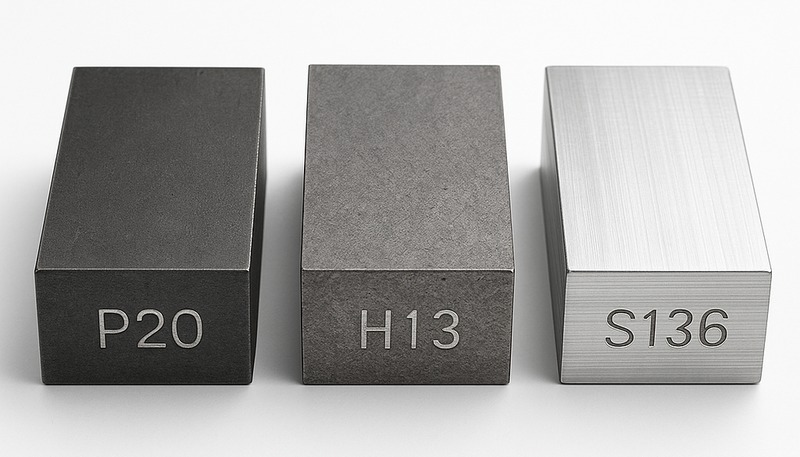 acero para moldes2 bloques comparativos” style=”max-width:100%;height:auto;” />
Acero para Moldes P20: La Mejor Opción para Presupuesto y Producción de Volumen Medio
El P20 es un acero para herramientas3 de cromo-molibdeno preendurecido, suministrado con HRC 28–33, lo que permite mecanizarlo directamente sin un ciclo de tratamiento térmico después del desbaste. Esto ahorra entre 5 y 10 días en el calendario de fabricación y elimina el riesgo de distorsión asociado al tratamiento térmico posterior al mecanizado. En nuestra fábrica utilizamos P20 en aproximadamente el 60% de los moldes para productos de consumo cuando la resina es ABS, PP o PE sin carga y el volumen anual es inferior a 500,000 inyecciones por cavidad.
La compensación es la dureza. A 30 HRC, el P20 mostrará desgaste visible en líneas de partición y áreas de compuerta después de aproximadamente 300.000–500.000 disparos con resinas ligeramente abrasivas. Para resinas básicas completamente sin relleno, la misma herramienta puede alcanzar 800.000–1.000.000 disparos antes de requerir un repulido o reparación de compuerta. El P20 también acepta acabados texturizados (grano por EDM, VDI 24–36) razonablemente bien, pero el pulido espejo por debajo de VDI 12 es difícil porque el menor contenido de carbono limita la dureza superficial alcanzable.
| Propiedad | Valor de P20 | Implicación práctica |
|---|---|---|
| Dureza (tal como se suministra) | HRC 28–33 | No requiere tratamiento térmico posterior al mecanizado |
| Resistencia a la tracción | ~1,000 MPa | Bueno para presiones de inyección estándar de hasta 1,400 bar |
| Volumen máximo recomendado | 500,000–1,000,000 disparos | Depende de la abrasividad de la resina |
| Capacidad de pulido | VDI 12–18 (satín) | No apto para acabado óptico o espejo Clase A |
| Resistencia a la corrosión | Bajo | Requiere prevención de óxido en almacenamiento; evitar PVC/POM |
| Costo relativo de la herramienta (cavidad única) | 1.0× (referencia) | Grado de acero más económico |
Un punto de decisión que toma por sorpresa a los ingenieros: el P20 suele estar disponible en una variante nitrurada (P20+Ni o P20H) donde la superficie se cementa hasta 50–55 HRC mientras el núcleo permanece blando. Esto otorga mejor resistencia al desgaste en compuertas y líneas de partición sin añadir un ciclo completo de tratamiento térmico. Especificamos esta variante en herramientas P20 que se espera ejecuten 600.000–900.000 disparos con resinas ligeramente rellenas (hasta 10% fibra de vidrio).
"El P20 puede mecanizarse y usarse sin un ciclo de tratamiento térmico posterior al mecanizado."True
El acero P20 se suministra en estado pre-endurecido a HRC 28–33, lo que significa que está listo para mecanizar y acabar sin tratamiento térmico adicional. Esto ahorra de 5 a 10 días en el tiempo de construcción de la herramienta en comparación con aceros para herramientas como H13 o S136 que requieren endurecimiento al vacío y revenido después del mecanizado.
"El acero P20 es adecuado para moldeo de PVC o ABS ignífugo a largo plazo."False
Esto es falso. El P20 tiene una resistencia mínima a la corrosión y se degradará cuando se exponga al gas ácido clorhídrico producido por la descomposición del PVC o a los compuestos de bromo en el ABS ignífugo. La superficie de la cavidad se pica dentro de las 50,000 a 100,000 inyecciones, creando defectos superficiales en las piezas. Se requiere acero para moldes inoxidable (S136 o 2316) para estas resinas.
Acero de Herramienta H13: La Respuesta Correcta para Resinas de Alta Temperatura y Cargas Abrasivas
H13 es un acero para herramientas de trabajo en caliente de cromo-molibdeno-vanadio que alcanza HRC 48–52 después del endurecimiento al vacío y revenido. El contenido de vanadio forma carburos duros que resisten el desgaste abrasivo de fibra de vidrio, carga mineral y refuerzos de fibra de carbono. Cuando un cliente viene a nosotros con una pieza de nailon 66 30% GF que necesita 2 millones de disparos, H13 es casi siempre el acero que especificamos — no porque sea la única opción, sino porque logra el mejor equilibrio entre resistencia al desgaste, tenacidad y mecanizabilidad en ese nivel de volumen.
La otra fortaleza del H13 es la resistencia a la fatiga térmica. La temperatura de moldeo para PPS, PEI (Ultem) y LCP a menudo supera los 300°C. A estas temperaturas, el ciclo térmico repetido de inyección y enfriamiento puede agrietar un acero más blando en costillas delgadas o radios de esquina afilados dentro de las 200,000 ciclos. El alto contenido de cromo y molibdeno del H13 reduce la variación del coeficiente de expansión térmica, dándole aproximadamente 3 veces mejor vida útil a fatiga térmica que el P20 en condiciones idénticas. En nuestra fábrica, usamos H13 en cualquier molde donde la temperatura de fusión supere los 280°C o el contenido de fibra de vidrio esté por encima del 15%.
| Propiedad | Valor de H13 | Implicación práctica |
|---|---|---|
| Dureza (tratada térmicamente) | HRC 48–52 | Alta resistencia al desgaste en la compuerta y línea de partición |
| Resistencia a la tracción | Aprox. 1,600 MPa | Maneja altas presiones de inyección y fuerzas de cierre |
| Volumen máximo recomendado | 1,000,000–2,000,000+ disparos | Ideal para producción de alto volumen con resinas abrasivas |
| Capacidad de pulido | VDI 6–12 (semi-brillante) | Buena pero no acabado de espejo grado óptico |
| Resistencia a la corrosión | Moderado | No adecuado para PVC; aceptable para la mayoría de las otras resinas |
| Costo relativo de la herramienta (cavidad única) | 1.5×–2.0× P20 | Costo más alto de acero + tratamiento térmico, menor mantenimiento por disparo |
Una nota práctica desde el taller: H13 requiere un ciclo adecuado de liberación de tensiones después del mecanizado preliminar y antes del endurecimiento final. Omitir este paso es la causa más común de fractura de moldes H13 que observamos en talleres de herramientas que intentan reducir el tiempo de entrega. El ciclo de liberación de tensiones (550–600°C durante 2 horas por cada 25 mm de grosor de sección) añade 2–3 días pero previene la distorsión durante el endurecimiento en vacío. Hemos visto herramientas fracturarse en las bases de nervios dentro de las primeras 50,000 inyecciones cuando se omitió este paso — una factura de reparación de $15,000+ que hace que el ahorro de tiempo parezca absurdo.
“El H13 es el acero para moldes preferido para resinas cargadas con fibra de vidrio por encima del 15% de carga.”True
H13 con HRC 48–52 contiene carburos de vanadio que resisten la acción abrasiva de corte de las fibras de vidrio contra la superficie de la cavidad. Con una carga de 30% GF, las cavidades de P20 suelen presentar un desgaste medible (>0.02 mm de profundidad en el punto de inyección) después de 200,000–300,000 ciclos, mientras que H13 mantiene la tolerancia dimensional durante más de 1 millón de ciclos en condiciones idénticas. La ventaja de H13 sobre P20 en resistencia al desgaste aumenta proporcionalmente con el contenido de relleno y la velocidad de inyección.
“El H13 y el S136 tienen la misma dureza y pueden usarse indistintamente.”False
Aunque tanto el H13 como el S136 se tratan térmicamente a HRC 48-52, están diseñados para diferentes modos de fallo. El H13 es un acero para trabajo en caliente optimizado para fatiga térmica y resistencia al desgaste abrasivo, que contiene 5% de cromo y 1% de molibdeno más vanadio. El S136 es un acero para herramientas inoxidable con 13% de cromo para resistencia a la corrosión y pulibilidad superior. Sustituir H13 donde se requiere S136 —como en moldes para PVC o piezas transparentes— resultará en picaduras por corrosión y defectos superficiales.
Acero para moldes inoxidable S136: Obligatorio para resinas corrosivas y superficies ópticas
S136 (equivalente al acero inoxidable modificado AISI 420) contiene aproximadamente 13% de cromo, lo cual proporciona protección contra corrosión por capa pasiva de óxido frente a gases ácidos de PVC, retardantes de llama halogenados, POM (acetal) y algunos poliuretanos. La resistencia a la corrosión no es solo cosmética — el ataque ácido en la superficie del cavidad crea micro-picaduras que se transfieren directamente a la superficie de la pieza, generando defectos que no pueden pulirse sin re-mecanizar la cavidad.
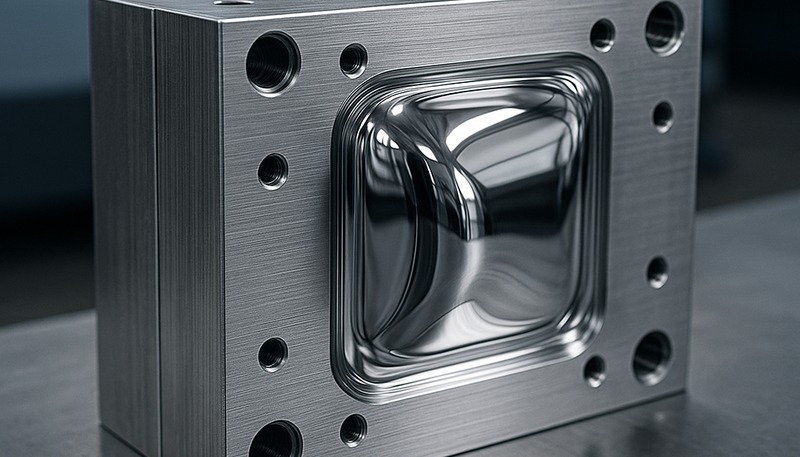
El S136 también alcanza la mayor pulibilidad de cualquier acero para moldes común, llegando a VDI 0-3 (acabado espejo, Ra 0,01-0,02 µm) cuando se procesa correctamente. Esto es esencial para lentes ópticas, guías de luz, carcasas de dispositivos médicos y cualquier pieza que requiera transparencia cosmética Clase A. En nuestra fábrica, usamos S136 exclusivamente para todas las herramientas de dispositivos médicos, piezas transparentes de PC y PMMA, y cualquier aplicación que involucre resinas de PVC o POM. La superficie pulida a espejo en una cavidad de S136 puede mantenerse durante 500.000-1.000.000 de disparos con protocolos adecuados de desmoldeo y limpieza.
| Propiedad | Valor S136 | Implicación práctica |
|---|---|---|
| Dureza (tratada térmicamente) | HRC 48–52 | Misma dureza que el H13, mejor resistencia a la corrosión |
| Contenido de cromo | ~13% | La capa de óxido pasiva resiste los gases ácidos del PVC, POM, FR-ABS |
| Pulibilidad máxima | VDI 0–3 (espejo, Ra 0,01 µm) | Requerido para lentes ópticos, guías de luz, carcasas transparentes |
| Resistencia a la corrosión | Alto (acero inoxidable) | Adecuado para PVC, POM, resinas de grado médico |
| Volumen máximo recomendado | 500,000–1,000,000 disparos | Ligeramente menor tenacidad que el H13 en altos números de ciclos |
| Costo relativo de la herramienta (cavidad única) | 2.0×–2.8× P20 | Costo de material más alto; compensado por menor frecuencia de reparación superficial |
La contrapartida del S136 es la tenacidad. Es algo más frágil que el H13 con el mismo nivel de dureza, por lo que es más susceptible de desportillarse en bordes de nervaduras finos (inferiores a 0.5 mm) o en ranuras profundas y estrechas. Diseñamos los moldes de S136 con una relación mínima entre espesor y profundidad de nervadura de 1:6 y añadimos un radio de 0.3 mm en todas las esquinas interiores agudas. Estos cambios de diseño añaden entre 2 y 4 horas de mecanizado, pero evitan la rotura frágil durante el uso. Para el equipo de diseño de moldes de inyección4, este es un punto de control DFM crítico.
Comparación de Grados de Acero: P20 vs H13 vs S136 Uno al Lado del Otro
Cuando los ingenieros nos preguntan qué acero usar, la respuesta casi siempre se reduce a tres preguntas en este orden: ¿Cuántos disparos? ¿Qué resina? ¿Qué acabado superficial? La tabla siguiente codifica nuestros 20 años de experiencia en fábrica en una comparación directa. Observe que ningún grado es universalmente superior — cada uno ocupa un nicho operativo distinto.
| Criterio | P20 | H13 | S136 |
|---|---|---|---|
| Dureza (HRC) | 28–33 (pre-endurecido) | 48–52 (tratado térmicamente) | 48–52 (tratado térmicamente) |
| Mejor para volumen | Hasta 500,000 disparos | 500K–2M+ disparos | Hasta 1 millón de disparos |
| Resistencia a la abrasión | Bajo–Medio | Alta | Medio–alto |
| Resistencia a la corrosión | Bajo | Moderado | Alto (acero inoxidable) |
| Capacidad de pulido espejo | Medio (VDI 12–18) | Buena (VDI 6–12) | Excelente (VDI 0–3) |
| Vida a fatiga térmica | Bien | Excelente | Bien |
| Resinas recomendadas | ABS, PP, PE, PS (sin carga) | Nylon con GF, PPS, PEI, LCP, PC | PVC, POM, FR-ABS, PMMA, PC óptico |
| Tratamiento térmico post-mecanizado | No requerido | Requerido (vacío) | Requerido (vacío) |
| Impacto en el plazo de entrega | El más corto (+0 días) | Moderado (+5–10 días) | Moderado (+5–10 días) |
| Índice de coste relativo | 1.0× | 1.5×–2.0× | 2.0×–2.8× |
Un error habitual: los ingenieros ven que H13 y S136 tienen el mismo intervalo HRC y concluyen que son intercambiables. No lo son. Los carburos de vanadio de H13 lo hacen superior frente al desgaste abrasivo; el 13% de cromo de S136 lo hace inmune al ataque corrosivo. Procesar PVC en un molde H13 producirá corrosión por picaduras antes de 50,000 ciclos. Procesar nailon con 40% GF en un molde S136 causará un desgaste superficial acelerado porque S136 carece de la fase de carburo de vanadio que proporciona a H13 su ventaja frente a la abrasión.
Cómo seleccionar acero para moldes en 3 pasos: Un marco de decisión práctico
Paso 1: Cualificar la composición química de la resina
El primer filtro siempre es la química. Consulte la ficha técnica de la resina para conocer los productos de desgasificación, la temperatura de procesamiento recomendada y cualquier advertencia de corrosión. El PVC, los retardantes de llama que contienen halógenos, el acetal (POM) y las resinas técnicas que absorben humedad y se descomponen a altas temperaturas producen ácidos durante el procesamiento. Cualquier resina que genere emisiones de HCl, HBr, HF o formaldehído durante el procesamiento normal requiere acero inoxidable S136 o, como mínimo, 2316. Sin excepciones: nunca hemos visto que P20 o H13 resistan 200,000 ciclos en una aplicación de PVC sin picaduras visibles en la cavidad.
Para aplicaciones ópticas o médicas, aunque la resina no sea químicamente agresiva, el requisito de acabado superficial obliga a utilizar S136. El policarbonato para guías de luz, el PMMA para lentes y el COC/COP para viales médicos requieren valores Ra inferiores a 0.025 µm, un nivel que solo puede lograrse con S136 y un pulidor cualificado que dedique 6–8 horas a la superficie de la cavidad.
Paso 2: Establecer el objetivo de volumen de producción
El volumen determina cuánta resistencia al desgaste necesita pagar. Si el programa utiliza un molde puente durante 50,000–100,000 ciclos mientras se fabrica el molde de producción, P20 es casi siempre la opción correcta: el ahorro en el coste del utillaje financia el molde de producción. Si el programa contempla 3 millones de ciclos durante 5 años, H13 o S136 son imprescindibles: reconstruir un molde P20 a los 500.000 ciclos costaría más en tiempo de inactividad y nuevo utillaje que la diferencia de precio original. En nuestra fábrica, el cálculo del umbral de rentabilidad para pasar de P20 a H13 suele favorecer H13 con volúmenes anuales superiores a 250.000 ciclos por cavidad para resinas abrasivas.
Paso 3: Adapte el acabado superficial al grado de acero
Los requisitos de acabado derivan directamente de la especificación. SPI A1/A2 (espejo) exige S136. SPI B1 (semibrillante) admite H13. SPI C1/C2 (mate) admite P20. Si el plano pide ‘brillo tal como se moldea’ sin grado SPI, solicite aclaración antes de cotizar el acero: pasar de una especificación vaga a SPI A1 puede añadir $4,000–$6,000 a un molde monocavidad. En las revisiones DFM siempre confirmamos el grado antes de elegir el acero, pues los clientes no suelen saber que una ‘pieza brillante’ implica pulido de grado óptico.
Impacto real en costo y cronograma de las elecciones de grado de acero
Los números ayudan a resolver las discusiones sobre el grado del acero con mayor rapidez que la teoría. Estos son datos reales de las recientes fabricaciones de utillaje de nuestra fábrica, anonimizados para proteger la confidencialidad de los clientes. Las cifras representan moldes familiares de una sola cavidad para piezas de consumo e industriales, con una superficie aproximada de 150 cm² por cavidad.
| Grado de acero | Coste del material (solo acero) | Coste total del utillaje | Plazos de entrega | Recomendado para |
|---|---|---|---|---|
| P20 | $400–$800 | $8,000–$15,000 | 4–6 semanas | Prototipos, bajo volumen, resinas básicas sin carga |
| H13 | $800–$1,600 | $12,000–$22,000 | 6–8 semanas | Grandes volúmenes, resinas abrasivas, plásticos técnicos de alta temperatura |
| S136 | $1,200–$2,400 | $15,000–$28,000 | 6–8 semanas | Resinas de PVC, POM, ópticas, médicas y FR |
La diferencia en el plazo de entrega refleja tanto la programación del tratamiento térmico como el trabajo adicional de EDM y pulido necesario para H13 y S136. Los hornos de endurecimiento al vacío de la mayoría de los talleres de utillaje funcionan con una programación por lotes: si su herramienta no entra en la carga semanal, se añaden 5–7 días. Por eso aconsejamos a los clientes que definan el grado de acero durante la primera semana de inicio del utillaje, no después de que el molde se haya desbastado con cualquier acero disponible en el almacén.
¿Preguntas frecuentes sobre la selección de acero para moldes de inyección?
¿Cuál es el mejor acero para moldes para piezas plásticas transparentes?
El acero inoxidable para moldes S136 es el estándar del sector para piezas transparentes moldeadas por inyección. Alcanza el acabado superficial de pulido espejo (SPI A1/A2, Ra ≤ 0.025 µm) necesario para una transparencia de grado óptico en resinas PC, PMMA y COC. El contenido de cromo del 13% también resiste las manchas de los agentes desmoldeantes que podrían enturbiar la superficie pulida de la cavidad. P20 y H13 pueden alcanzar SPI B1, pero no mantener los valores Ra de 0.01–0.02 µm necesarios para aplicaciones de lentes o guías de luz. Para piezas ópticas médicas, S136H (variante pretemplada a HRC 38–42) ofrece un plazo de fabricación más corto sin dejar de cumplir los requisitos de pulibilidad.
¿Puedo utilizar acero P20 para un molde de producción de alto volumen?
El P20 puede manejar volúmenes de producción de hasta 500,000–1,000,000 ciclos con resinas básicas sin carga (ABS, PP, PE, PS) a presiones de inyección inferiores a 1,200 bar. Por encima de estos volúmenes, o al procesar resinas con carga que contengan más de un 10% de fibra de vidrio, el P20 desarrollará un desgaste visible en las zonas de entrada y las líneas de partición, que se transferirá a las piezas en forma de rebaba o desviación dimensional. Para volúmenes anuales superiores a 500,000 ciclos por cavidad con cualquier resina abrasiva, la actualización a H13 suele amortizarse durante el primer año al eliminar reparaciones de cavidades en plena producción. Confirme siempre el tipo de resina y el volumen anual antes de fijar el grado de acero.
¿Qué acero para moldes debo usar para el moldeo por inyección de PVC?
El moldeo por inyección de PVC requiere, sin excepción, acero inoxidable S136 (o 2316) para el molde. Durante el procesamiento, el PVC se descompone ligeramente y libera gas de ácido clorhídrico (HCl), que ataca las superficies de acero no inoxidable de la cavidad en un plazo de 50,000–100,000 inyecciones, provocando corrosión por picaduras que destruye el acabado superficial y genera defectos en las piezas. El 13% de cromo del S136 forma una capa de óxido pasiva que resiste el ataque del HCl. Todas las líneas de refrigeración, los pasadores de núcleo y las correderas en contacto con la zona de PVC fundido también deben ser de acero inoxidable o estar cromados para evitar la corrosión interna. Incluso los moldes prototipo de PVC para series cortas deben utilizar S136, ya que el daño por HCl se acumula rápidamente.
¿Cómo afecta la dureza del acero de molde a la calidad del acabado superficial?
Los aceros más duros (HRC 48–52, H13 y S136) pueden pulirse hasta obtener acabados superficiales más finos que los aceros más blandos (HRC 28–33, P20), porque el alto contenido de carburos de los aceros endurecidos permite que el abrasivo produzca una superficie uniforme y sin arañazos. P20 a HRC 30 presenta regiones de matriz más blandas que se desgarran durante el pulido con diamante, lo que limita el Ra alcanzable a aproximadamente 0.05–0.10 µm (SPI B1). S136 a HRC 50 puede alcanzar Ra 0.01 µm (SPI A1) mediante pulido progresivo con diamante desde 6 µm hasta grano de 0.25 µm. H13 a HRC 50 alcanza Ra 0.03–0.05 µm (SPI A2–B1). La dureza también determina cuánto dura el acabado pulido en condiciones de producción.
¿Es mejor el H13 o el S136 para un molde de dispositivo médico?
S136 es la opción preferida para moldes de productos sanitarios en la mayoría de los casos. Las piezas médicas suelen requerir superficies pulidas a espejo para facilitar la limpieza y cumplir la inspección estética, y muchas resinas médicas —incluidos el LDPE para envases de medicamentos, el PC para carcasas de dispositivos y diversos polímeros liberadores de fármacos— pueden contener aditivos que causan corrosión en aceros no inoxidables. S136 satisface tanto el requisito de acabado superficial (VDI 0–3) como la resistencia a la corrosión necesaria en un entorno de producción médica. H13 solo se utiliza en herramientas médicas cuando la geometría de la pieza presenta nervaduras finas o núcleos profundos en los que la tenacidad ligeramente inferior de S136 crea riesgo de desconchado y la resina no es corrosiva.
DFM: DFM (Diseño para la fabricación) se refiere a un proceso de revisión de ingeniería aplicado antes de iniciar el utillaje, que identifica características del diseño de una pieza —como paredes finas, esquinas agudas o un ángulo de desmoldeo insuficiente— que podrían causar defectos de moldeo o aumentar el coste de la herramienta. ↩
acero para moldes: El acero para moldes es una categoría de aceros para herramientas utilizados para fabricar núcleos y cavidades de moldes de inyección, seleccionados según su dureza (HRC), capacidad de pulido, resistencia a la corrosión y resistencia a la fatiga térmica para el volumen de producción y el tipo de resina previstos. ↩
acero para herramientas: El acero para herramientas es una categoría de acero al carbono y aleado formulado específicamente para fabricar herramientas de corte y conformado, incluidas las cavidades de moldes de inyección. Su dureza se mide en la escala Rockwell C (HRC) y suele variar de HRC 28 a HRC 65 según la aplicación. ↩
diseño de moldes de inyección: El diseño de moldes de inyección es una disciplina de ingeniería que define la geometría de la cavidad, el sistema de compuertas, la disposición del circuito de refrigeración y el mecanismo de expulsión de un molde, y determina directamente el tiempo de ciclo, la calidad de la pieza y la vida útil de la herramienta. ↩