

Si estás especificando un material para una pieza estructural que necesita mantener su forma bajo carga, a temperatura y con el tiempo — glass-filled nylon1 probablemente esté en su lista corta. Añadir fibras de vidrio al nailon lo transforma de un plástico de ingeniería resistente pero flexible en algo que compite con el aluminio fundido a presión.
Pero el proceso de moldeo por inyección para los grados rellenos de vidrio es muy diferente en comparación con el nailon sin rellenar. Mayor viscosidad de fusión, desgaste agresivo de la herramienta, contracción anisotrópica2[^2], y la sensibilidad a la longitud de fibra significan que debe ajustar bien sus parámetros — o sus piezas se lo harán saber alto y claro.
Esta guía explica lo que realmente importa al moldear nailon relleno de vidrio, basándose en dos décadas de uso de estos materiales en plantas de producción reales. En ZetarMold, utilizamos 47 moldeo por inyección máquinas (90T–1850T) con más de 400 materiales en nuestras instalaciones de Shanghái.
- El nailon relleno de vidrio añade un 30–200% más de rigidez frente a los grados sin rellenar
- La humedad debe estar por debajo del 0,1% antes del procesamiento — secar 4–6 horas a 80°C
- Las temperaturas de fusión varían entre 260–300°C dependiendo de PA6 vs. PA66
- La orientación de las fibras causa contracción anisotrópica — diseña las entradas en consecuencia
- El desgaste del molde es 3–5× mayor que el nailon sin carga — usa acero para herramientas endurecido
¿Qué es el nailon relleno de vidrio y por qué es importante?
El nailon cargado con vidrio es poliamida reforzada con fibras de vidrio cortas, que ofrece hasta un 200% más de rigidez y una temperatura de deflexión térmica (HDT) superior a 250°C. Si está comparando proveedores, nuestro proveedor de moldeo por inyección la guía de abastecimiento cubre preparación de RFQ y calificación.
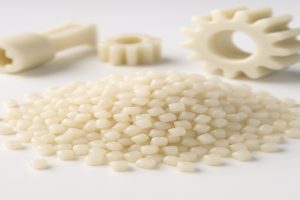
El nailon relleno de vidrio[^1] es poliamida estándar (normalmente PA6 o PA66) mezclada con fibras de vidrio cortas en cargas del 10%, 20%, 30% o 45% en peso. El resultado es un termoplástico compuesto notablemente más rígido, resistente y dimensionalmente estable que su base sin rellenar.
En nuestro taller, PA6 GF303 y PA66 GF30 están entre los cinco materiales más moldeados. Aparecen en componentes bajo el capó de automoción, carcasas eléctricas, cajas de herramientas eléctricas, accesorios industriales y soportes estructurales de grado de consumo.
La economía es clara: obtienes rigidez similar al metal a velocidades de procesamiento de plástico, y el costo total de la pieza a menudo supera al de fundición a presión o mecanizado CNC cuando los volúmenes superan el umbral de 5.000 unidades.
En ZetarMold, operamos 47 máquinas de moldeo por inyección (90T–1850T) con experiencia en más de 400 materiales; PA6 GF30 y PA66 GF30 están entre los cinco grados más moldeados en nuestra planta de Shanghái.
Pero esto es lo que las hojas de datos no te dirán — las fibras de vidrio se orientan en la dirección del flujo durante la inyección. Esto significa que tu pieza se contrae de manera diferente a lo largo del camino de flujo versus transversalmente, y esta contracción anisotrópica es el mayor desafío de procesamiento con estos materiales.
¿Cuáles son las propiedades clave del material del nailon relleno de vidrio?
Cuando se añade un 30% de fibra de vidrio al PA66, la resistencia a la tracción salta de aproximadamente 80 MPa a 185 MPa — un aumento del 130%. El módulo de flexión pasa de unos 2,9 GPa a 9,0 GPa, lo que significa que el material es tres veces más rígido.
La temperatura de deflexión por calor (HDT) a 1,8 MPa aumenta de alrededor de 75°C a más de 250°C, lo que cambia las reglas del juego para aplicaciones automotrices bajo capó y eléctricas.
Pero hay compensaciones. La resistencia al impacto disminuye porque las fibras de vidrio crean concentradores de tensión. La elongación en la rotura cae del 50% a alrededor del 3%, lo que significa que la pieza no se doblará antes de romperse. El acabado superficial también es notablemente más rugoso.
| Propiedad | PA6 Unfilled | PA6 GF30 | PA66 GF30 |
|---|---|---|---|
| Resistencia a la tracción (MPa) | 79 | 170 | 185 |
| Flexural Modulus (GPa) | 2.8 | 8.5 | 9.0 |
| HDT @ 1,8 MPa (°C) | 65 | 215 | 255 |
| Izod entallado (J/m) | 55 | 110 | 105 |
| Contracción – Flujo (%) | 1.0–1.4 | 0.3–0.5 | 0.2–0.5 |
| Contracción – Transversal (%) | 1.0–1.4 | 0.7–1.0 | 0.6–1.0 |
| Melt Temp Range (°C) | 230–260 | 260–290 | 275–300 |
| Densidad (g/cm³) | 1.13 | 1.35 | 1.37 |
Observe la diferencia de contracción entre las direcciones de flujo y transversal. En PA6 GF30, podría ver una contracción del 0.3% en la dirección del flujo pero del 0.9% a través de ella. Esta diferencia triple es lo que hace que el diseño de moldes para nailon cargado con vidrio sea una habilidad especializada.
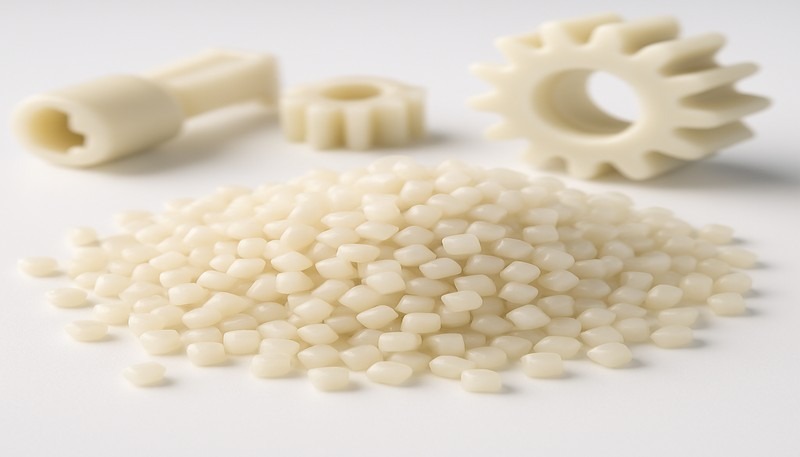
¿Qué parámetros de procesamiento controlan el moldeo del nailon relleno de vidrio?
El secado, la temperatura de fusión, la temperatura del molde y la velocidad de inyección son los cuatro parámetros que controlan la calidad del nailon GF. Estos parámetros son menos tolerantes que el nailon sin rellenar, por lo que un control estricto del proceso es esencial.
Secado: No negociable
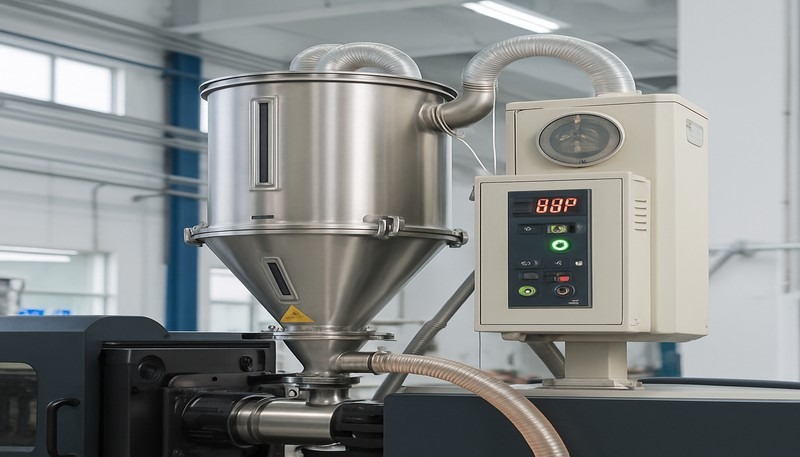
El nailon es higroscópico — absorbe humedad del aire. Las fibras de vidrio no cambian eso. Debes usar un secador desecante y secar el material a 75–85°C durante 4–6 horas para reducir la humedad por debajo de 0,1%. Si omites esto, obtendrás vetas plateadas, marcas de salpicadura y reducción del peso molecular por hidrólisis.
Hemos visto material entrante con 0,4% de humedad que parecía seco a simple vista — no lo estaba. Siempre verifica con un analizador de humedad antes de procesar.
Temperatura de fusión
Para PA6 GF30, apunta a 260–285°C. Para PA66 GF30, necesitas 275–300°C. El extremo superior proporciona mejor flujo y mojado de fibras pero aumenta el riesgo de degradación térmica.
En nuestras instalaciones de Shanghái, normalmente procesamos PA66 GF30 a 285–295°C — ese punto óptimo proporciona buen acabado superficial sin quemar el tamaño de las fibras de vidrio.
Temperatura del molde
Ejecuta la temperatura del molde a 80–100°C para grados con carga de vidrio. Temperaturas más altas del molde mejoran la cristalinidad, el acabado superficial y la estabilidad dimensional. Pero aumentan el tiempo de ciclo.
Para piezas de tolerancia ajustada, ejecutamos mínimo 90°C. Por debajo de 70°C, estás buscando deformación post-moldeo y propiedades mecánicas inconsistentes — la piel exterior cristaliza de manera diferente al núcleo.
Velocidad y presión de inyección
Glass-filled nylon has higher melt viscosity, so you need 20–30% more injection pressure than unfilled grades. Faster injection speeds help maintain fiber length and reduce weld-line weakness.
But too fast and you’ll get jetting or flash on thin-wall parts. We usually start with a moderate-fast speed profile and adjust based on short-shot analysis.
¿Cómo afecta el contenido de fibra de vidrio a la contracción y estabilidad dimensional?
This is where glass-filled nylon really earns its premium price. Unfilled PA66 shrinks about 1.0–1.4% in all directions. Add 30% glass fiber, and shrinkage in the flow direction drops to 0.2–0.5%.
For tight-tolerance parts like gear housings, sensor brackets, and connector inserts, this predictability is worth every penny of the material premium.
But transverse shrinkage only drops to about 0.6–1.0%. So your cavity design needs to account for differential shrinkage — you’re essentially building asymmetric compensation into the tool steel.
At our in-house molde de inyección manufacturing facility, our 8 senior engineers have learned to predict this behavior through years of tooling iteration. The key factors are fiber percentage, part geometry, gate location, and processing conditions.
For production parts requiring ±0.05 mm tolerances, we recommend PA66 GF30 or higher, processed with mold temperature above 85°C, and validated through first-article inspection using CMM measurement.
¿Qué pautas de diseño debe seguir para piezas de nailon cargado con vidrio?
Keep walls between 2 and 3 mm, use radii above 0.5 mm, and add 1–3° draft — these are the essential design guidelines for glass-filled nylon parts. Glass fibers increase shrinkage anisotropy and tool wear, so standard unfilled-nylon rules do not apply.
Wall Thickness: Keep It Uniform
Uniform wall thickness is always important in injection molding, but critical with glass-filled nylon. Thickness transitions create differential cooling and shrinkage rates, which create warpage. Fibers orient differently in thick vs. thin sections too.
We recommend 2.0–3.5 mm nominal wall. Below 1.5 mm, you’ll struggle with filling and fiber breakage. Above 4.0 mm, you’ll see sink marks and excessive cycle times.
Radii: Generous, Always
Glass fibers create stress concentrators at sharp internal corners. Minimum 0.5 mm internal radius, 1.0 mm preferred. We’ve seen failure rates drop 40%+ by increasing internal radii from 0.3 mm to 1.0 mm.
The fibers can’t negotiate sharp corners — they pile up and create resin-rich and fiber-rich zones, both of which are weak points.
Draft Angles: More Than You Think
Glass-filled nylon is abrasive, which means the part grabs the cavity surface during ejection. Minimum 1.5° draft, preferably 2–3°, especially on textured surfaces.
The cost of a few extra degrees of draft is nothing compared to parts sticking, scoring, or cracking during ejection.
Rib and Boss Design
Ribs should be 50–75% of nominal wall thickness. With glass-filled nylon, thinner ribs (50–60%) are safer because the material is already stiff. Bosses should follow the same ratio with coring to reduce mass.
¿Cuáles son los defectos más comunes y cómo se solucionan?
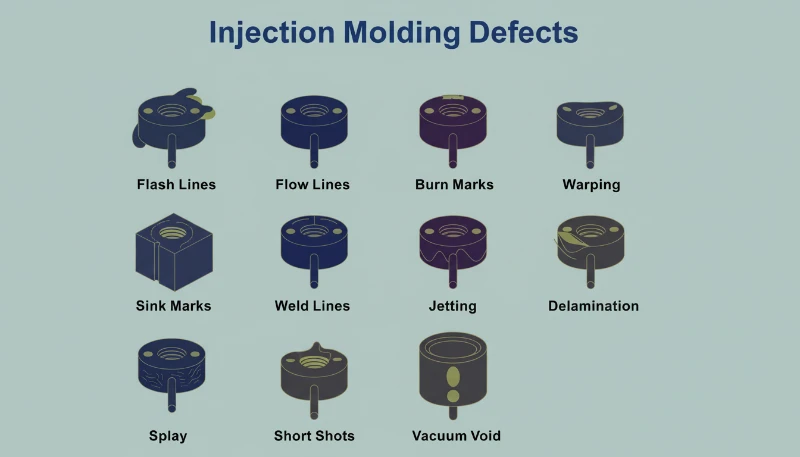
Fiber exposure, warp, weld lines, and moisture streaks are the four most common GF nylon defects — and most are preventable. Here is what causes each one and how we fix them in production.
Fiber Exposure and Poor Surface Finish
Those glass fibers poking through the surface mean the resin didn’t fully encapsulate the fibers at the cavity wall. Causes: mold temperature too low, injection speed too slow, or insufficient packing pressure.
Fix: raise mold temp to 90–100°C, increase injection speed, and ensure adequate hold pressure at 60–80% of injection pressure. For cosmetic A-surfaces, consider a polished cavity finish and a slight texture that masks the fiber pattern.
Warp and Dimensional Variation
Usually caused by differential shrinkage between flow and transverse directions, compounded by non-uniform wall thickness.
Fix: redesign for uniform walls, reposition gates for balanced flow, increase mold temperature, and consider post-mold annealing at 150–170°C for 30–60 minutes to relieve internal stresses.
Líneas de soldadura
Glass fibers don’t cross weld lines — they orient parallel to the flow front, so the weld-line area is essentially unfilled nylon with much lower strength.
Fix: minimize weld lines through intelligent gate placement, position them in non-critical areas, and use higher melt and mold temperatures to improve knit strength.
Moisture-Related Defects
Silver streaks, splay, bubbles, and reduced mechanical properties. The fix is always the same: dry the material properly to below 0.1% moisture.
At our facility, IQC verifies material moisture content before any production run. We use closed-loop hopper loaders that maintain dry air throughout the run.
¿Cómo elegir entre los grados PA6 GF y PA66 GF?
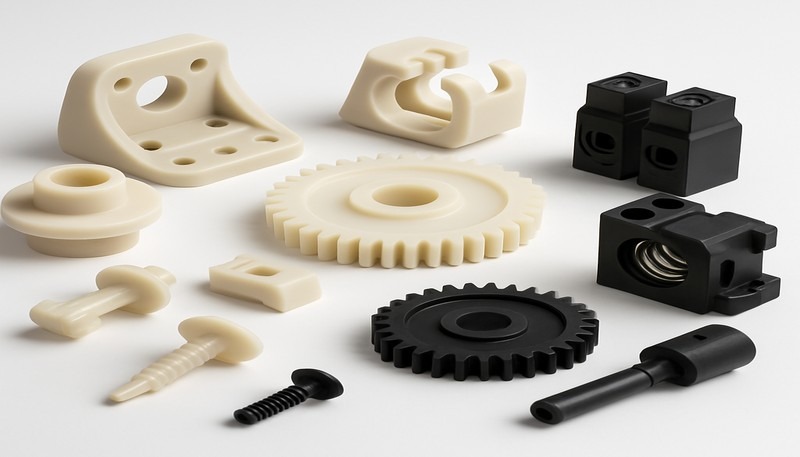
Use PA6 GF30 for cost-sensitive parts below 150°C; choose PA66 GF30 for higher temperatures or better chemical resistance. Both grades at 30% glass fiber loading deliver excellent stiffness — the key difference is thermal performance.
Choose PA6 GF30 when cost is the primary driver (PA6 resin is typically 10–15% cheaper), the part operates below 150°C continuously, or you need slightly better impact resistance. PA6 GF30 is our go-to for consumer electronics housings and non-critical structural parts.
Choose PA66 GF30 when the part operates above 150°C (automotive under-hood, electrical contact carriers), chemical resistance matters, dimensional stability at elevated temperature is critical, or you need higher tensile strength and creep resistance.
For both grades, 30% glass fiber is the sweet spot. 10–15% gives modest improvements. 40–45% maximizes stiffness but comes with poor surface finish, very high viscosity, and aggressive tool wear.
Nailon cargado con vidrio vs. Nailon sin cargar: ¿Cuándo vale la pena la mejora?
The GF nylon upgrade pays off when the part needs tensile strength above 80 MPa, operating temps above 100°C, or shrinkage below 0.4%. The material costs 20–40% more per kilogram, but the total part cost often breaks even.
The upgrade pays off when the part bears structural loads unfilled nylon can’t handle at the required deflection limit, dimensional stability across temperature ranges matters, or the part operates where unfilled nylon’s HDT of 65–75°C is insufficient.
The upgrade is a waste when the part is purely cosmetic, unfilled nylon already meets the spec, or the volume is too low to justify the tooling wear premium. We’ve talked clients out of glass-filled nylon more than once — it’s the honest recommendation.
One more consideration: tool life. Glass-filled nylon is abrasive — those fibers act like microscopic sandpaper. Expect 3–5× more cavity wear. At our mold manufacturing facility, we default to hardened steel (H13 or S7) for any GF nylon tooling, which is why our molds deliver 500,000+ shots before major maintenance.
From a sourcing perspective, glass-filled nylon is widely available from major suppliers including DuPont (Zytel), BASF (Ultramid), and EMS-Grivory. Lead times for standard PA6 GF30 and PA66 GF30 grades are typically 2–4 weeks, but specialty grades like PA66 GF45 or UV-stabilized compounds can take 8–12 weeks. Plan your material procurement early — we’ve seen projects delayed because the specified GF grade was on allocation during peak automotive season.
“Glass-filled nylon requires the same drying procedure as unfilled nylon.”Verdadero
True. The nylon matrix remains hygroscopic regardless of fiber content. Moisture can also get trapped at the fiber-resin interface. Both grades require drying to below 0.1% moisture before processing.
“Glass-filled nylon parts always have better surface finish than unfilled nylon.”Falso
False. Glass fibers create a matte, rough surface. Unfilled nylon produces a smoother, glossier finish. If cosmetics matter, unfilled grades or surface treatments are preferred.
Understanding how glass-filled nylon behaves during processing requires hands-on experience with the material across different part geometries and wall thicknesses. The fiber orientation patterns change with every gate relocation, wall thickness adjustment, or processing parameter shift. In our Shanghai facility, our engineers have documented these behavioral patterns across thousands of production runs, building an empirical database that helps us predict and prevent common defects before they occur in production.
“Glass-filled nylon shrinkage differs between flow and transverse directions.”Verdadero
True. Glass fibers orient in the flow direction during injection, creating anisotropic shrinkage — typically 0.3% in-flow vs. 0.8% transverse for PA6 GF30. This differential is the biggest challenge in mold design for these materials.
“Higher glass fiber content always produces a stronger part.”Falso
False. While stiffness and tensile strength increase with fiber content, impact resistance can plateau or decrease. At 45% loading, brittleness and processing difficulty increase significantly. 30% remains the most balanced choice for most applications.
Preguntas frecuentes
Preguntas frecuentes
What is the injection molding temperature for glass-filled nylon?
For PA6 GF30, the melt temperature range is 260–285°C. For PA66 GF30, use 275–300°C. Mold temperature should be maintained at 80–100°C for optimal crystallinity and surface finish. Always verify with the specific grade’s datasheet, as manufacturer formulations can vary by plus or minus 10°C. Running too hot degrades the fiber sizing; running too cold causes poor fiber wetting and surface defects. In our Shanghai facility, we typically target the middle of each range and adjust based on short-shot testing and first-article inspection results.
How does glass fiber content affect nylon shrinkage?
Glass fibers dramatically reduce shrinkage in the flow direction — from approximately 1.2% for unfilled PA66 down to 0.3% for PA66 GF30. However, transverse shrinkage only drops to about 0.7–0.9%, creating significant anisotropic behavior that must be accounted for in mold design. Higher fiber content reduces overall shrinkage further but increases the differential between flow and transverse directions. This means a PA66 GF45 part might shrink only 0.2% in flow but still 0.6% across, making dimensional prediction even more complex for the tool designer.
Can you overmold glass-filled nylon with TPE or TPU?
Yes, glass-filled nylon (typically PA6 GF30) is commonly used as the rigid substrate in two-shot or overmold applications, with TPE or TPU as the soft overmold material. Adhesion depends on chemical compatibility between the substrate and overmold material, as well as proper substrate surface preparation and temperature management during the second shot. The glass fiber content can reduce mechanical bond strength compared to unfilled nylon substrates because the fibers reduce the available surface area for chemical interlocking with the TPE or TPU layer.
What causes fiber visibility on the surface of glass-filled nylon parts?
Fiber exposure occurs when the resin matrix doesn’t fully encapsulate glass fibers at the cavity surface during the packing phase. Common causes include low mold temperature below 80°C, slow injection speed that doesn’t push fibers away from the cavity wall, insufficient packing pressure, and high fiber content above 30%. The most effective fixes are raising mold temperature to 90–100°C and increasing injection speed. For parts requiring cosmetic A-surface quality, a polished cavity finish combined with a subtle texture pattern can help mask the inherent fiber read-through that glass-filled grades produce.
Is glass-filled nylon suitable for food-contact applications?
Glass-filled nylon can be FDA-compliant when using food-grade base resin and appropriate fiber sizing, but not all GF nylon grades carry food-contact certification. The glass fibers themselves are inert — compliance depends entirely on the nylon matrix and any additives or colorants used in the compound. Always check the specific grade’s FDA or EU 10/2011 compliance documentation from the material supplier. If food safety is required, specify this upfront so your molder sources certified material and maintains appropriate traceability documentation throughout the production process.
How do you prevent warp in glass-filled nylon injection molded parts?
Preventing warp requires a multi-pronged approach: design for uniform wall thickness between 2.0 and 3.5 mm, use generous internal radii of at least 1.0 mm, position gates to create balanced flow patterns, maintain mold temperature above 85°C throughout the cycle, and ensure adequate cooling time before ejection. For parts already showing warp in production, post-mold annealing at 150–170°C for 30 to 60 minutes can relieve internal stresses and improve flatness. The most effective strategy is addressing warp during mold design review rather than trying to fix it through processing adjustments alone.
What tool steel is recommended for glass-filled nylon molds?
Hardened tool steels like H13 at 48–52 HRC or S7 are recommended for production molds running glass-filled nylon. The abrasive glass fibers cause three to five times more wear than unfilled nylon, which means standard P20 tool steel will show cavity erosion and dimension shift much sooner. For high-volume production exceeding 500,000 shots, consider PVD coatings such as TiN or TiCN on cavity surfaces to extend tool life. The initial investment in hardened steel pays for itself through reduced maintenance downtime and more consistent part quality over the life of the mold.
Does glass-filled nylon require a special injection molding screw?
A general-purpose screw with a compression ratio of 2.5:1 to 3.0:1 works well for most glass-filled nylon grades. Avoid very high compression ratios above 3.5:1, which cause excessive fiber breakage and reduce the mechanical reinforcement the fibers provide. Wear-resistant screw and barrel materials such as bimetallic liners or Xaloy-coated components are strongly recommended for long production runs due to the abrasive nature of the glass fibers. Replacing a worn screw mid-production run is far more expensive than specifying wear-resistant components from the start.
Need a reliable partner for your glass-filled nylon injection molding project? ZetarMold has been running GF nylon grades since 2005 across our Shanghai facility. With 47 machines (90T–1850T), an in-house molde de inyección shop, and 8 senior engineers, we mold PA6 GF30 and PA66 GF30 parts daily for automotive, electronics, and industrial clients worldwide. Get a free quote and let our engineering team review your design.
-
glass-filled nylon: glass-filled nylon refers to nylon (PA6 or PA66) reinforced with short glass fibers, typically 10–45% by weight, to improve stiffness, strength, and heat resistance. ↩
-
contracción anisotrópica: anisotropic shrinkage refers to differential shrinkage in flow vs. transverse directions caused by fiber orientation during injection, requiring careful mold design compensation. ↩
-
PA6 GF30: PA6 GF30 refers to polyamide 6 with 30% glass fiber content — a common grade balancing mechanical performance and processability for structural applications. ↩



 EN
EN  ES
ES  FR
FR  DE
DE  PT
PT  AR
AR  RU
RU  JA
JA  KO
KO  IT
IT  NL
NL  TR
TR  PL
PL 