- El cálculo del tonelaje es crítico: calcular con precisión el tonelaje de cierre es esencial para evitar defectos en las piezas, como rebabas o llenados incompletos, y proteger de daños el molde de inyección y la máquina.
- Fórmula básica: el cálculo fundamental es: fuerza de cierre (toneladas) = área proyectada (in²) × factor del material (toneladas/in²). Esto proporciona una referencia antes de considerar otras variables.
- El área proyectada es clave: el principal factor que influye en el tonelaje es el área proyectada de la pieza y de su sistema de canales, es decir, la sombra 2D que proyecta la pieza perpendicularmente a la dirección de cierre.
- Es más que una regla general: aunque una regla general (p. ej., 2-5 tons/in²) es un buen punto de partida, factores como la viscosidad del material, el espesor de pared, la longitud de flujo y la complejidad de la pieza exigen ajustes para obtener un cálculo preciso.
¿Qué es el cálculo del tonelaje del molde de inyección?
Calcular el tonelaje del molde de inyección es el proceso técnico para determinar la fuerza mínima de cierre que una máquina de moldeo debe ejercer para mantener cerrado el molde durante la inyección; suele oscilar entre 2 y 10 toneladas por pulgada cuadrada de área proyectada de la pieza.1 Esta fuerza, medida en toneladas estadounidenses, es esencial para contrarrestar la enorme presión del plástico fundido inyectado en la cavidad. En la fábrica de ZetarMold hemos comprobado que calcularla con precisión es la primera defensa frente a numerosos problemas de fabricación. Subestimarla provoca rebabas, cuando el plástico escapa por la línea de partición y genera defectos y desperdicios. Sobreestimarla puede dañar componentes delicados del molde, perjudicar la ventilación y consumir innecesariamente más energía, elevando los costes operativos. Con más de 20 años de experiencia, nuestros ingenieros combinan fórmulas contrastadas, software avanzado y datos empíricos de nuestras 45 máquinas de moldeo por inyección para seleccionar el tonelaje perfecto para cada uno de los más de 400 materiales con los que trabajamos, garantizando una calidad óptima de las piezas y una larga vida del utillaje.
“Una pieza con un área proyectada de 50 sq. in. que utilice moldeo por inyección de ABS puede requerir 250 tons de fuerza de cierre.”True
El acrilonitrilo butadieno estireno (ABS) suele tener un factor de fuerza de cierre cercano a 5 tons/in². Al multiplicar el área proyectada (50 in²) por este factor (5 tons/in²), se obtiene una fuerza de cierre necesaria de 250 toneladas. Este es un cálculo de referencia estándar utilizado en el sector.
“la calculadora de presión de inyección y la fuerza de cierre son lo mismo”.False
La fuerza de cierre es la fuerza que mantiene cerrado el molde (medida en toneladas), mientras que la presión de inyección es la fuerza que introduce el plástico fundido en el molde (medida en PSI). La fuerza de cierre debe ser mayor que la presión ejercida por el plástico dentro de la cavidad para impedir que se abra el molde.
¿Cómo funciona el cálculo del tonelaje del molde de inyección?
El cálculo del tonelaje del molde de inyección cuantifica sistemáticamente las fuerzas que actúan dentro del molde durante la inyección, un proceso que comprende 3 etapas clave. Este cálculo garantiza que la máquina seleccionada pueda proporcionar suficiente fuerza de cierre para resistir la fuerza de separación generada por la presión de inyección sobre el área superficial de la pieza. En ZetarMold, nuestro proceso combina meticulosamente el cálculo teórico y la experiencia práctica.
La primera etapa consiste en determinar el área proyectada. No es la superficie total de la pieza, sino el área de la sombra bidimensional de la pieza y sus canales vista en la dirección del cierre. Se calcula en pulgadas cuadradas (o cm²) y es la variable más importante de la fórmula. Para una pieza rectangular sencilla, basta con multiplicar la longitud por la anchura. En geometrías complejas usamos software CAD para obtener una medición precisa.
La segunda etapa consiste en seleccionar un factor de fuerza de cierre. Este valor, expresado en toneladas por pulgada cuadrada, es una constante específica del material termoplástico empleado. Representa la resistencia al flujo del material (viscosidad2) y su comportamiento bajo presión. Por ejemplo, un material de fácil flujo como el poliestireno (PS) puede tener un factor de 2-3 tons/in², mientras que uno rígido y de alta viscosidad como el policarbonato (PC) puede requerir 5-7 tons/in².
La etapa final es el cálculo: área proyectada (in²) × factor de fuerza de cierre (tons/in²) = tonelaje requerido. Sin embargo, este es solo el punto de partida. Después, nuestros ingenieros aplican factores de ajuste según la complejidad de la pieza, el espesor de pared y la relación entre longitud de flujo y espesor (L/T). Una pared muy delgada o una trayectoria de flujo larga aumenta la presión de inyección necesaria y exige a su vez una mayor fuerza de cierre para mantener sellado el molde. Este enfoque integral evita defectos y permite asignar cada proyecto a la máquina más eficiente de nuestras instalaciones.
¿Cuáles son los parámetros clave de procesamiento?
Los parámetros de procesamiento clave para calcular el tonelaje del molde de inyección son el factor de fuerza de cierre del material, que puede oscilar entre 2 y 8 toneladas/in², el área proyectada de la pieza y la viscosidad de la masa fundida del material, que puede variar más de un 100% entre distintos grados de polímero. Estos tres factores constituyen la base de cualquier cálculo preciso del tonelaje. Aunque la fórmula básica ofrece una estimación sólida, un proceso realmente optimizado exige analizar más a fondo varias variables interconectadas. En ZetarMold, documentamos y analizamos meticulosamente estos parámetros en cada tirada para crear una base de datos sólida que sirva de referencia para futuros proyectos.
La tabla siguiente recoge los parámetros más críticos que consideran nuestros ingenieros al configurar un nuevo proyecto de moldeo. Comprender cómo interactúan es fundamental para lograr un proceso estable, piezas de alta calidad y la máxima eficiencia. Por ejemplo, una temperatura de fusión mayor puede reducir la viscosidad del material y disminuir ligeramente el tonelaje necesario. Por el contrario, un diseño con secciones largas y delgadas —una relación L/T alta— eleva drásticamente la presión necesaria para llenar la pieza y exige aumentar considerablemente la fuerza de cierre para evitar rebabas.3
| Parámetro | Valor/intervalo | Notas |
|---|---|---|
| Factor de fuerza de cierre | 2 – 10 toneladas/in² | Constante específica del material. Baja para materiales de fácil fluidez (PS, PP) y alta para materiales rígidos (PC, PEEK). |
| Área proyectada | Variable (p. ej., 10 – 500 in²) | El área proyectada 2D de la pieza y el sistema de canales. El principal factor determinante del tonelaje necesario. |
| Espesor de pared | 0.5mm – 5mm+ | Las paredes más delgadas requieren una mayor presión de inyección y, por tanto, más fuerza de cierre. Una pared de 1 mm puede necesitar un 30 % más de fuerza que una de 3 mm. |
| Relación entre longitud de flujo y espesor (L/T) | De 50:1 a 400:1 | Una relación elevada indica un recorrido de llenado largo y difícil, que requiere mayor presión y tonelaje. |
| Presión de inyección | 5,000 – 30,000 PSI | La presión que empuja el plástico hacia el interior del molde. La fuerza de cierre debe contrarrestar esta presión. |
| Temperatura de fusión | 180°C – 410°C (356°F – 770°F) | Afecta a la viscosidad del material. Las temperaturas más altas reducen la viscosidad, pero pueden suponer un riesgo de degradación del material. |
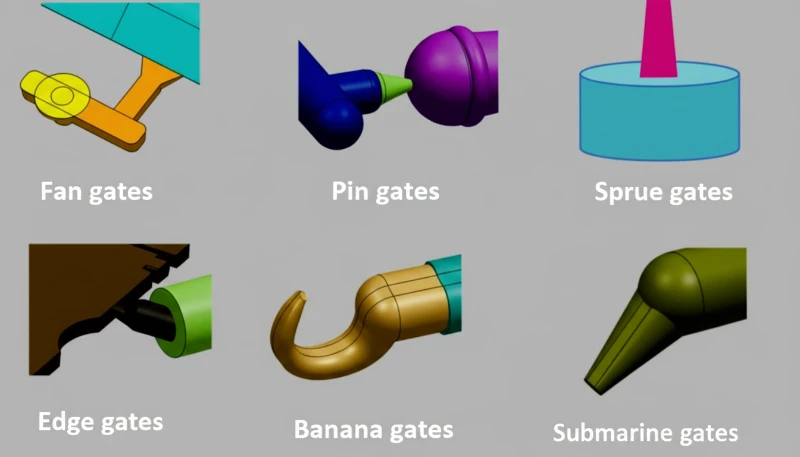
| Tipo y ubicación del punto de inyección | Ejemplo de Aplicación | Afecta a la distribución de la presión dentro de la cavidad e influye en la posibilidad de rebabas o llenados incompletos. |
Nuestros ingenieros de procesos de ZetarMold no consideran estas cifras de forma aislada. Utilizan el software de simulación Moldflow para visualizar cómo se comportará el plástico fundido en esas condiciones. Esto permite predecir la distribución de presión, identificar posibles puntos calientes y ajustar el cálculo del tonelaje antes de mecanizar el acero del molde. Este enfoque proactivo ahorra tiempo y dinero al eliminar costosos ajustes por ensayo y error en producción. Esta atención al detalle nos permite moldear con éxito piezas complejas y materiales difíciles día tras día.
¿Cuáles son las ventajas y desventajas?
La principal ventaja de calcular con precisión el tonelaje es lograr una producción constante de piezas de alta calidad, mientras que la principal desventaja es la complejidad y la posible sobredimensión, que pueden aumentar el consumo energético y el desgaste de la maquinaria. Un cálculo adecuado es un ejercicio de equilibrio. En ZetarMold, hemos comprobado que el tiempo inicial dedicado a un cálculo preciso se amortiza muchas veces al evitar problemas que detienen la producción. Es un principio esencial de nuestra filosofía de fabricación basada en procesos.
Los beneficios son tangibles e inciden directamente en el resultado económico. El primero es la prevención de defectos. Un tonelaje correcto mantiene el molde perfectamente sellado, elimina las rebabas y garantiza el llenado completo de la cavidad para evitar llenados incompletos.4 El segundo es la protección del molde y de la máquina. Una fuerza excesiva puede aplastar componentes delicados del molde, dañar las superficies de partición y someter a esfuerzos indebidos las columnas y los sistemas hidráulicos de la máquina. Usar la fuerza correcta prolonga la vida útil tanto del utillaje como de la máquina. Por último está la optimización energética. Una máquina mayor consume mucha más electricidad. Al calcular con precisión el tonelaje, podemos asignar el trabajo a la máquina adecuada más pequeña de nuestra flota de 45 equipos y minimizar el coste energético por pieza.
| Ventajas de un cálculo preciso | Desventajas de un cálculo inexacto |
|---|---|
| Evita rebabas, llenados incompletos y rechupes. | Provoca altas tasas de rechazo y desperdicio de material. |
| Protege las líneas de partición y los componentes del molde. | Puede dañar o desgastar prematuramente el molde. |
| Prolonga la vida útil de la máquina de moldeo. | Provoca una tensión excesiva en los componentes de la máquina. |
| Optimiza el consumo de energía mediante el uso de una máquina del tamaño adecuado. | Desperdicia energía y aumenta los costes operativos. |
| Garantiza la ventilación adecuada de los gases de la cavidad del molde. | Puede atrapar gas y provocar quemaduras y llenados incompletos. |
Las desventajas se deben principalmente a errores de cálculo. Un ingeniero conservador podría sobreestimar mucho el tonelaje «para estar seguro». Aunque esto puede evitar rebabas, crea otros problemas. Una fuerza de cierre excesiva puede restringir los canales de ventilación diseñados para dejar escapar el aire de la cavidad. Cuando el plástico entrante comprime este aire atrapado, puede sobrecalentarlo y provocar marcas de quemado en la pieza. También puede crear una contrapresión que impida un llenado completo. Por eso nuestro equipo no depende únicamente de una fórmula sencilla; aprovecha nuestras dos décadas de experiencia para comprender los matices de cada diseño de pieza y combinación de materiales y encontrar el punto óptimo que permite obtener piezas perfectas con la máxima eficiencia.
¿Cuáles son los defectos comunes y cómo se evitan?
Los defectos más comunes relacionados con un tonelaje incorrecto son las rebabas, los llenados incompletos y las marcas de quemado; todos pueden evitarse mediante un cálculo preciso de la fuerza de cierre y el control del proceso. Estos defectos constituyen una evidencia física directa de un desequilibrio entre la fuerza de cierre que mantiene cerrado el molde y la presión de inyección que introduce el plástico en él. Nuestro equipo de control de calidad de ZetarMold está capacitado para identificar estos problemas de inmediato, y nuestros ingenieros de procesos saben exactamente cómo rastrearlos hasta su causa raíz, que a menudo comienza con el ajuste inicial del tonelaje.
La rebaba es la señal más evidente de un tonelaje de cierre insuficiente. Aparece como una capa fina e indeseada de plástico a lo largo de la línea de partición del molde o alrededor de los pasadores expulsores. Se produce cuando la presión de inyección separa físicamente las dos mitades del molde y crea una holgura por la que escapa el plástico fundido. La prevención es sencilla: aumentar gradualmente el tonelaje de cierre hasta que desaparezca la rebaba. Sin embargo, la verdadera solución consiste en realizar el cálculo correcto desde el principio.
A la inversa, un llenado incompleto puede ser a veces síntoma de un tonelaje de cierre excesivo. Aunque su causa principal suele ser la falta de material o una velocidad de inyección insuficiente, una fuerza de cierre demasiado alta puede obturar los respiraderos del molde. Estos son canales diminutos que permiten evacuar el aire de la cavidad a medida que entra el plástico. Si quedan cerrados por la presión, el aire atrapado actúa como un cojín e impide que el plástico alcance los puntos más alejados. La solución es reducir el tonelaje de cierre hasta el nivel óptimo calculado para que los respiraderos funcionen según lo previsto.
| Defecto | Causa principal relacionada con el tonelaje | Método de prevención |
|---|---|---|
| Rebaba | Tonelaje de cierre insuficiente para la presión de inyección indicada. | Aumente el tonelaje de cierre. Recalcule la fuerza necesaria según la presión de inyección real y el área proyectada. |
| Tiro corto / Relleno incompleto | Fuerza de cierre excesiva que aplasta los respiraderos del molde y atrapa aire. | Reduzca el tonelaje de cierre al valor mínimo necesario calculado. Asegúrese de que los respiraderos estén limpios y tengan el tamaño adecuado. |
| Marcas de quemado (efecto diésel) | Sobrecalentamiento del aire atrapado debido a la compresión, causado a menudo por respiraderos bloqueados debido a un tonelaje excesivo. | Optimizar la fuerza de cierre para permitir una ventilación adecuada. Mejorar el diseño y la ubicación de los respiraderos. |
| Alabeo | Distribución no uniforme de la presión, agravada en ocasiones por un cierre excesivo y desigual. | Aplique una fuerza de cierre correcta y uniforme. Optimice la ubicación de la compuerta y los parámetros de procesamiento para lograr un llenado uniforme. |
| Componentes del molde aplastados | Tonelaje de cierre extremadamente excesivo aplicado al molde. | Respete estrictamente los valores de tonelaje calculados. Nunca supere el tonelaje nominal máximo del molde. |
«Aumentar el espesor de pared de una pieza de 1mm a 3mm puede reducir la fuerza de cierre necesaria».True
Las paredes más gruesas oponen menos resistencia al flujo y reducen la presión de inyección necesaria. Como la fuerza de cierre contrarresta esa presión, una menor presión se traduce directamente en una menor fuerza de cierre, a menudo entre un 30-50%.
«La ‘regla general’ de 4 tons/in² es aplicable universalmente a todos los materiales».False
Esta es una simplificación peligrosa. Un material de baja viscosidad como poliestireno puede necesitar solo 2 toneladas/in², mientras PEEK reforzado con vidrio puede requerir 8-10 toneladas/in². Aplicar una regla universal sin considerar el material concreto es una causa común de defectos.
¿Dónde se utiliza el cálculo del tonelaje del molde de inyección?
El cálculo del tonelaje de un molde de inyección se utiliza en todos los sectores que dependen de piezas de plástico, desde bienes de consumo de gran volumen hasta componentes críticos de automoción y médicos. La precisión del cálculo es directamente proporcional a la importancia de la aplicación de la pieza final. En ZetarMold, nuestra diversa clientela nos obliga a aplicar constantemente estos principios a un amplio espectro de productos, cada uno con sus propios requisitos de tolerancia, rendimiento del material y acabado estético. El tonelaje necesario es una especificación fundamental que determina cuál de nuestras 45 máquinas es adecuada para un proyecto, ya sea una pequeña prensa de 50 toneladas para diminutos conectores electrónicos o una gran máquina de 1.500 toneladas para parachoques de automóviles.
En automoción, por ejemplo, piezas como paneles de revestimiento interior, componentes del salpicadero y carcasas de iluminación tienen grandes áreas proyectadas y superficies estéticas. Un tonelaje preciso es vital para evitar rebabas, que supondrían un rechazo estético, y garantizar la estabilidad dimensional necesaria para un ajuste perfecto. En medicina, piezas como cilindros de jeringas o carcasas de equipos de diagnóstico suelen fabricarse con polímeros de ingeniería en salas limpias. Aquí, un tonelaje preciso es innegociable para garantizar la integridad de la pieza, evitar contaminación por rebabas y mantener la ventana de proceso validada que exige el cumplimiento normativo. La tabla siguiente muestra algunos ejemplos de aplicación del cálculo de tonelaje en distintos sectores.
| Industria | Ejemplo de aplicación | ¿Cómo se calcula la tonelaje del molde de inyección? | ZetarMold |
|---|---|---|
| Automoción | Embellecedor del salpicadero | Gran área proyectada; el acabado superficial de clase A requiere cero rebaba; estabilidad dimensional para el montaje. |
| Productos sanitarios | Puntas de pipeta o viales de ensayo | Paredes delgadas, alta relación L/T; uniformidad del proceso para la validación; suele utilizar materiales de alta fluidez. |
| Electrónica de consumo | Carcasas de portátiles y mandos a distancia | Geometría compleja con resaltes y nervios; paredes delgadas; requisitos estéticos exigentes. |
| Embalaje | Recipientes y tapas de pared delgada | Paredes extremadamente finas y tiempos de ciclo rápidos; el tonelaje debe ser suficiente para una inyección rápida, pero sin aplastar los respiraderos. |
| Sector industrial | Engranajes, carcasas y cuerpos de herramientas eléctricas | Suele utilizar materiales de alta viscosidad reforzados con fibra de vidrio que requieren factores elevados de fuerza de cierre (6-10 toneladas/in²). |
¿Cómo se compara el cálculo del tonelaje del molde de inyección con las alternativas?
Calcular el tonelaje del molde de inyección mediante fórmulas detalladas y simulación por software es muy superior a las alternativas más sencillas y mejora la precisión entre un 15 y un 25 % respecto a las estimaciones básicas por «regla práctica». Aunque las estimaciones rápidas son útiles para presupuestos iniciales, un proceso de fabricación sólido depende de métodos más sofisticados. Las principales alternativas a un cálculo manual detallado son la regla práctica básica y el análisis avanzado de elementos finitos (FEA) mediante software de simulación de flujo del molde. Cada método ocupa un punto distinto en el espectro de precisión, coste y tiempo invertido.
El método de la «regla general» es el más rápido y sencillo. Consiste en tomar el área proyectada estimada de la pieza y multiplicarla por un factor genérico, como 4 toneladas/in². Resulta útil para una estimación aproximada que determine si una pieza cabe en una máquina de 100 o 1000 toneladas, pero es demasiado impreciso para producción. Omite variables críticas como el espesor de pared, la longitud de flujo y la viscosidad del material.
En ZetarMold, nuestro proceso estándar es un cálculo manual detallado. Parte de la regla empírica, emplea factores de cierre específicos del material y aplica ajustes por la relación L/T y el espesor medio de pared. Este método ofrece un alto grado de precisión en aproximadamente el 80 % de los proyectos y un ingeniero experimentado puede realizarlo con relativa rapidez.
Para las piezas más complejas —extremadamente delgadas, con trayectorias de flujo muy largas o fabricadas con materiales exóticos— empleamos software de simulación Moldflow. Este crea un modelo virtual del molde y simula todo el proceso de inyección. Al analizar en tiempo real las presiones de toda la cavidad, predice con gran precisión la fuerza de cierre necesaria. Aunque es el método más preciso, también requiere más tiempo, software especializado y experiencia técnica.
| Método | Precisión | Velocidad | Coste | Lo mejor para |
|---|---|---|---|---|
| Regla práctica | Baja (±25-40%) | Muy rápido (segundos) | Gratis | Cotización preliminar inicial y estimación aproximada del tamaño de la máquina. |
| Cálculo manual detallado | Alto (±10-15%) | Rápido (minutos) | Bajo (tiempo del ingeniero) | La mayoría de los proyectos de producción estándar. |
| Simulación Moldflow (FEA) | Muy alto (±5%) | Lento (de horas a días) | Alto (software/conocimientos especializados) | Piezas complejas, proyectos de alto riesgo, optimización de procesos. |
Preguntas frecuentes
¿Cómo se calcula el tonelaje de un molde de inyección?
Se calcula la tonelaje del molde de inyección multiplicando el área proyectada total de la pieza en pulgadas cuadradas (incluyendo el sistema de canales) por un factor de fuerza de cierre específico del material en toneladas por pulgada cuadrada. Por ejemplo, una pieza con un área proyectada de 100 pulg.² que utiliza un material con un factor de 3 toneladas/pulg.² requeriría una fuerza de cierre base de 300 toneladas (100 pulg.² * 3 toneladas/pulg.²).
¿Cuál es la fórmula para la fuerza de cierre del molde de inyección?
La fórmula básica es: Fuerza de Sujeción (Toneladas) = Área Proyectada (in²) × Factor de Fuerza de Sujeción (toneladas/in²). Los cálculos más avanzados también incorporan factores de ajuste para la viscosidad del material (representada comúnmente por el Índice de Fluidez), el grosor de pared de la pieza y la relación longitud de flujo/grosor (L/T).
¿Qué tonelaje de máquina de moldeo por inyección necesito?
Para determinar la tonelaje de máquina que necesita, primero calcule la fuerza de sujeción requerida para su pieza y material específicos. Luego, seleccione una máquina con una capacidad máxima de tonelaje que sea al menos un 10-15% superior a su requerimiento calculado. También se recomienda utilizar una máquina donde su tonelaje requerido se encuentre entre el 40% y el 80% de la capacidad máxima de la máquina para un rendimiento y eficiencia óptimos.
¿Cuál es la regla general para la tonelaje en el moldeo por inyección?
La regla general para la tonelaje en moldeo por inyección es utilizar de 2 a 5 toneladas de fuerza de cierre por cada pulgada cuadrada de área proyectada de la pieza. Por ejemplo, una estimación rápida para una pieza de 60 pulgadas cuadradas sería de 240 toneladas (60 in² × 4 toneladas/in²). Esto es solo un punto de partida y debe ajustarse según el tipo de material, la complejidad de la pieza y el espesor de la pared.
¿Cómo afecta el área proyectada la tonelada de sujeción?
El área proyectada tiene una relación directa y lineal con la tonelada de cierre; si duplicas el área proyectada, duplicas la fuerza de cierre requerida, suponiendo que todos los demás factores se mantengan constantes. Es la variable más importante en el cálculo de tonelaje porque define el área superficial sobre la cual la presión de inyección actúa para intentar forzar la apertura del molde.
¿Cuál es la diferencia entre la fuerza de cierre y la presión de inyección?
La fuerza de cierre es la fuerza (medida en toneladas) que mantiene cerradas las dos mitades del molde. La presión de inyección es la presión (medida en PSI) ejercida por el tornillo para empujar el plástico fundido hacia la cavidad del molde. La fuerza de separación total (Presión de Cavidad × Área Proyectada) debe ser superada por la fuerza de cierre para evitar que el molde rebose.
¿Qué factores aumentan la tonelada del molde de inyección?
Varios factores clave aumentan la tonelaje requerido del molde de inyección. Estos incluyen un área proyectada de la pieza más grande, el uso de un material de mayor viscosidad (como PC frente a PP), el diseño de piezas con paredes más delgadas y tener una longitud de flujo larga en relación con el espesor de la pared (una relación L/T alta). Cada uno de estos factores aumenta la resistencia al flujo, lo que requiere una mayor presión de inyección y, en consecuencia, más fuerza de cierre para mantener el molde sellado.
Su socio para el moldeo por inyección de precisión
Calcular con precisión el tonelaje del molde de inyección no es un mero ejercicio académico, sino un pilar fundamental de una fabricación satisfactoria, eficiente y de alta calidad. Es una disciplina que combina principios científicos con experiencia práctica. Durante más de 20 años, ZetarMold ha perfeccionado este equilibrio. Nuestro equipo de ingenieros especializados aprovecha los profundos conocimientos adquiridos al trabajar con más de 400 materiales distintos y operar miles de moldes únicos para garantizar que cada proyecto se optimice desde el principio.
Al combinar esta experiencia con una sólida flota de 45 modernas máquinas de moldeo por inyección, de 50 a 1500 toneladas, podemos adaptar perfectamente los requisitos técnicos de su proyecto al entorno de fabricación ideal. No creemos en las conjeturas. Creemos en los datos, la precisión y un enfoque basado en procesos que elimina desperdicios y maximiza el valor para nuestros clientes.
Tanto si tiene un componente médico complejo, una pieza grande de automóvil o un producto de consumo de gran volumen, nuestro equipo está preparado para aplicar rigor técnico a su proyecto. Póngase hoy en contacto con ZetarMold para hablar de sus requisitos y descubrir cómo nuestro enfoque del moldeo por inyección centrado en la precisión puede dar vida a su diseño con una calidad y eficiencia inigualables.
1 Área proyectada: sombra o perfil bidimensional de una pieza y su sistema de canales vistos en la dirección de la fuerza de cierre. Es el área principal sobre la que actúa la presión de inyección para separar las mitades del molde. ↩
2 Viscosidad: resistencia de un fluido a fluir. En el moldeo por inyección, un material de alta viscosidad, como el policarbonato, es más «espeso» y requiere más presión de inyección que otro de baja viscosidad, como el poliestireno. ↩
3 Rebaba: defecto habitual de moldeo en el que una película fina de plástico sobrante escapa de la cavidad por la línea de partición, alrededor de los pasadores expulsores o por los respiraderos. Su causa más frecuente es una fuerza de cierre insuficiente. ↩
4 Llenado incompleto: defecto en el que el plástico fundido no llena por completo la cavidad del molde y produce una pieza incompleta. Puede deberse a varios factores, incluido el aire atrapado cuando una fuerza de cierre excesiva aplasta los respiraderos. ↩
Un cálculo preciso del tonelaje reduce directamente el coste por pieza del moldeo por inyección: las máquinas demasiado pequeñas provocan rebabas y rechazos; las sobredimensionadas desperdician energía.
Para conocer toda la capacidad de ZetarMold en la fabricación de moldes de inyección, visite nuestra página del servicio de moldes de inyección, donde encontrará especificaciones del utillaje, plazos y precios.
¿Necesita un presupuesto para su proyecto de moldeo por inyección?Obtenga precios competitivos, comentarios de DFM y un calendario de producción del equipo de ingeniería de ZetarMold.
Solicite un presupuesto gratuito → Consulte nuestra Guía completa de moldeo por inyección para obtener una visión integral.