 Zum Inhalt springen

What Is 3D Printed Metal Casting and How Does It Work?
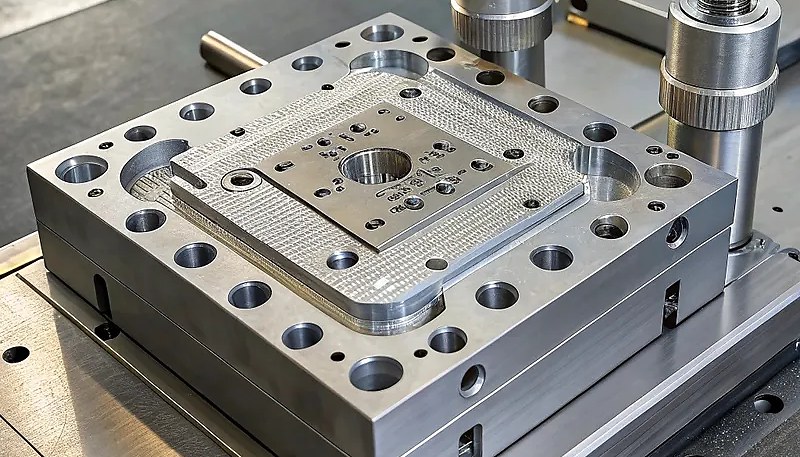
Präzisionsgefertigte Metallform für Werkzeugvergleich1 decisions for printed casting molds should start with RFQ prep, qualification, and commercial risk checks. If you are comparing vendors or planning procurement, our injection molding supplier sourcing guide covers the buyer-side checks in more detail.
For a broader view of Spritzgießen, our pillar guide covers process fundamentals, material behavior, and production decisions.
3D printed metal casting2 combines additive manufacturing with traditional casting processes. Instead of spending weeks making wooden patterns or machining metal mold tooling, engineers 3D print the mold or pattern directly from a CAD file. The 3D printed piece then serves as the mold, core, or sacrificial pattern for pouring molten metal.
- 3D printed casting molds are strongest for prototypes, bridge production, and complex internal passages where traditional pattern making is slow.
- The process shortens lead time, but buyers still need casting allowances, finishing stock, inspection planning, and supplier capability checks.
- For repeat production, compare printed mold cost per pour against permanent tooling before choosing the manufacturing route.
Factory Insight: ZetarMold reviews printed casting and prototype tooling projects through an engineering lens before quoting. Our 8 senior engineers, in-house mold manufacturing capability, and 100+ mold sets per month tooling capacity help us compare fast prototype routes against durable injection mold tooling instead of pushing every project into the same process.

Bei ZetarMold verwenden wir diesen Ansatz hauptsächlich für Prototyp-Metallteile und Überbrückungsproduktion, wenn Kunden funktionale Metallkomponenten benötigen, bevor sie sich für permanente Werkzeuge entscheiden. Die Technologie funktioniert für Aluminium, Bronze, Eisen, Stahl und sogar Titan-Guss – praktisch jedes Metall, das traditionell gegossen werden kann. In der Praxis hängt die Entscheidung, 3D-gedruckte Gussformen zu verwenden, von drei Faktoren ab: wie viele Teile Sie benötigen, wie komplex die Geometrie ist und wie schnell Sie das Erstteil benötigen.
Which 3D Printing Methods Are Used for Casting Molds?
Dieser Abschnitt behandelt die 3D-Druckmethoden, die für Gussformen verwendet werden, und deren Einfluss auf Kosten, Qualität, Zeitplan oder Beschaffungsrisiko. Die Haupt 3D printing integrating with injection molding methods for casting molds are binder jetting, SLA burnout patterns, FDM sacrificial patterns, SLS patterns, and DMLS/SLM metal inserts. Each method serves a different balance of mold size, surface finish, accuracy, and production intent.
| 3D Printing Method | What It Produces | Casting Process | Am besten für | Genauigkeit |
|---|---|---|---|---|
| SLA (Stereolithography) | Wax-like burnout patterns | Investment casting | Small, detailed parts | ±0.1–0.2 mm |
| Binder Jetting (sand) | Sand molds and cores directly | Sand casting | Large parts, complex cores | ±0.3–0.5 mm |
| FDM/FFF (PLA/ABS) | Sacrificial patterns | Investment casting | Larger patterns, lower cost | ±0.2–0.5 mm |
| SLS (Nylon/Wax) | Durable patterns | Sand/investment casting | Reusable patterns, short runs | ±0.15–0.3 mm |
| DMLS/SLM (Metal) | Metal mold inserts | Die casting, injection | Production tooling with conformal cooling | ±0.05–0.1 mm |
„Binder Jetting kann einen kompletten Sandform – einschließlich innerer Kernstücke – in einem einzigen Bauprozess 3D-drucken und Kernmontage komplett eliminieren.“Wahr
Binder jetting sand printers (like ExOne and voxeljet systems) build the mold and all internal cores as one integrated piece. This eliminates the traditional multi-step process of making separate core boxes, shooting sand cores, and assembling them into the mold — saving days of labor and reducing dimensional error from core assembly.
„3D-gedruckte Gussformen können nur grobe, minderwertige Metallteile produzieren.“Falsch
3D printed investment casting patterns from SLA printers achieve surface finishes of Ra 1.6–3.2 μm on the final metal part — comparable to traditional investment casting. Binder-jet sand molds produce Ra 6–12 μm, which is standard for sand casting. The casting quality depends on the printing resolution and post-processing, not the fact that it was 3D printed.
How Do You Design a CAD Model for 3D Printed Casting?
Dieser Abschnitt behandelt das Design eines CAD-Modells für 3D-gedruckte Gussformen und dessen Einfluss auf Kosten, Qualität, Zeitplan oder Beschaffungsrisiko. Ein CAD-Modell für 3D-gedruckte Gussformen sollte Schrumpfungszugabe, Bearbeitungszugabe, Zug, Wandstärke, Rundungen, Entlüftung und Anguss enthalten, bevor die Form gedruckt wird. Das Design für 3D-gedruckte Gussformen erfordert Kenntnisse sowohl des Druckprozesses als auch des Gussprozesses. Das CAD-Modell muss Schrumpfung in zwei Phasen berücksichtigen: erstens, wenn das Formmaterial gedruckt und gehärtet wird, dann, wenn das geschmolzene Metall abkühlt und sich verfestigt.
80–90%
Draft angles — For sand casting molds, add 1–3° draft on vertical surfaces, similar to traditional pattern design. For investment casting with burnout patterns, zero draft is possible because the printed pattern is destroyed during burnout.
Wandstärke — Minimum 3–4 mm for sand mold walls, 0.5–1.0 mm for SLA burnout patterns. Metal casting minimum wall depends on the alloy: 2 mm for aluminum, 3 mm for steel.
Shrinkage allowance — Add 1.0–1.6% for aluminum, 2.0–2.5% for steel, 1.5–2.0% for bronze to the pattern dimensions.
Gating system — Design the sprue, runners, and risers into the 3D model. For binder-jet sand molds, integrate the gating directly into the print.
Fillets and radii — Minimum 2 mm internal radii to prevent hot tears in the casting and reduce stress concentrations.
What Is the Step-by-Step Process for 3D Printed Sand Casting?
The binder jetting sand casting workflow is the most common industrial application of 3D printed casting molds. Here is the complete process.
Step 1: CAD preparation (2–4 hours)
Design the part with casting allowances3 (shrinkage, machining stock)
Design the mold halves (cope and drag) around the part
Add gating system (sprue, runners, gates, risers)
Integrate cores for internal features
Step 2: 3D printing (4–24 hours depending on size)
Slice the mold/core design and send to the binder jetting printer
Print layers of sand bonded with furan or phenolic resin binder
Typical layer thickness: 0.28–0.4 mm
Step 3: Post-processing (1–4 hours)
Remove loose sand from cavities and channels
Apply refractory coating if needed for surface finish
Assemble mold halves (for multi-part molds)
Step 4: Metal pouring (1–2 hours including heat-up)
Melt metal to required temperature (660°C for aluminum, 1,500°C+ for steel)
Pour into the 3D printed sand mold through the gating system
Allow solidification (minutes to hours depending on size)
Step 5: Finishing (2–8 hours)
Break away the sand mold (shake-out)
Cut off gating system
Blast, grind, and machine as needed
Inspect dimensions and quality
What Are the Cost and Time Advantages of 3D Printed Molds?
The cost and time advantages of 3d printed molds are the main categories or options explained in this section. The business case for 3D printed casting molds centers on eliminating traditional tooling lead time and cost for small quantities.
| Faktor | Traditional Pattern/Tooling | 3D Printed Mold | Savings |
|---|---|---|---|
| Lead time (prototype) | 4–8 weeks | 3–7 days | 80–90% |
| Wie verhalten sich spritzgegossene Teile im Vergleich zu 3D-gedruckten Teilen? | $2,000–$20,000 | $200–$2,000 | 70–90% |
| Design iteration | 2–4 weeks per revision | 1–3 days per revision | 80–90% |
| Complex cores | $5,000–$50,000 (core boxes) | Integrated in print ($0 extra) | 90–100% |
| Break-even quantity | - | - | 1–100 parts (3D); 100+ (traditional) |
The crossover point where traditional tooling becomes cheaper is typically 50–200 parts, depending on complexity. For quantities above this, the per-part cost of 3D printed molds exceeds that of reusable metal tooling.
What Are the Limitations and When Should You Choose Traditional Tooling?
3D printed casting molds are not universally superior. Understanding the limitations ensures you choose the right approach for each project.
Surface finish — 3D printed sand molds produce Ra 6–12 μm surfaces (vs. Ra 3–6 μm for machined metal molds). Secondary machining may be needed for critical surfaces.
Dimensional accuracy — ±0.3–0.5 mm for binder-jet sand casting vs. ±0.1–0.2 mm for precision investment casting or die casting.
Produktionsvolumen — Each 3D printed sand mold is consumed in a single pour. For 1,000+ parts, traditional reusable tooling is far more economical.
„3D-gedruckte Sandformen sind besonders wertvoll für Gussteile mit komplexen inneren Durchgängen, die mehrere traditionelle Kernstücke benötigen würden.“Wahr
Traditional sand casting of parts with complex internal channels (like manifolds or heat exchangers) requires assembling 5–20 separate sand cores, each made from its own core box. 3D printing integrates all cores into a single mold, eliminating core boxes, assembly labor, and core shift errors. This is where 3D printing delivers the highest ROI.
„3D-gedruckte Formen werden innerhalb einiger Jahre alle traditionellen Gusswerkzeuge ersetzen.“Falsch
3D printed molds are excellent for prototyping and short runs (1–100 parts), but traditional tooling remains far more economical for medium to high volumes. A reusable metal die casting mold can produce 100,000+ parts; a 3D printed sand mold is consumed in a single pour. The technologies are complementary, not competitive.
Size limitations — Binder jetting build volumes are typically 800 × 500 × 400 mm (though large-format machines reach 4,000 × 2,000 × 1,000 mm).
Mold strength — 3D printed sand molds have lower green strength than traditionally rammed molds. Very large pours may require reinforcement.
Für Spritzgussforming tooling specifically, channels designed to Verkürzung der Kühlzeit can be 3D printed in steel inserts by DMLS or SLM. This is different from disposable casting molds, but it shows where additive manufacturing can enhance traditional mold making instead of replacing it.
Möchten Sie Ihre Metallteilentwicklung beschleunigen? Kontaktieren Sie ZetarMold für Rapid-Prototyping-Services, einschließlich 3D-gedruckter Gussformen und Spritzgusswerkzeuge. Teilen Sie die Teilzeichnung, Ziellegierung, Menge, Toleranzzonen, Oberflächenanforderung und Zeitdruck, damit unsere Ingenieure gedrucktes Guss, CNC-Bearbeitung und Produktionswerkzeuge mit einem praktischen Beschaffungsplan vergleichen können. Mit über 20 Jahren Erfahrung in Spritzguss und Werkzeugbau kann unser Shanghai-Team evaluieren, ob 3D-gedruckte Gussformen, CNC aus Vollmaterial oder traditionelle Produktionswerkzeuge für das Volumen, Budget und Zeitplan Ihres Projekts geeignet sind.
Häufig gestellte Fragen
What metals can be cast using 3D printed molds?
3D printed sand molds can support aluminum, bronze, brass, cast iron, carbon steel, stainless steel, and many specialty alloys when the mold coating, binder, venting, and pour temperature are matched to the alloy. For buyer decisions, the key is not only whether the alloy can be poured, but whether the printed mold process can meet the required surface finish, dimensional allowance, post-machining stock, and inspection plan. If the part has pressure sealing, thin ribs, or high cosmetic requirements, confirm the finishing route before approving the process.
How accurate are castings from 3D printed molds compared with machined parts?
3D printed sand castings typically target casting-level tolerances such as roughly plus or minus 0.3 to 0.5 mm before finishing, while investment casting from printed patterns can be tighter on small detailed parts. CNC machining remains the better process for final precision surfaces. The practical approach is often near-net casting first, then CNC machine only the datum faces, threads, sealing surfaces, and high-tolerance features. This reduces machining time without pretending that printed casting replaces precision machining. Ask the supplier to mark which features are cast tolerance and which are post-machined tolerance.
How long does a 3D printed sand mold take to produce?
For many prototype and bridge-production parts, a 3D printed sand mold can move from checked CAD data to a ready mold in a few days rather than several weeks. Actual timing depends on build volume, wall thickness, mold complexity, coating, curing, pouring schedule, and inspection needs. The biggest time saving comes from removing separate wooden pattern making, core-box machining, and multi-step core assembly. Buyers should still reserve time for DFM review and first-article inspection before approving the casting route safely.
Can 3D printed casting molds be reused?
Most 3D printed sand molds and investment casting patterns are single-use because the mold or pattern is broken, burned out, or consumed during the casting process. Reuse is possible only for certain printed patterns or printed metal tooling inserts, not for ordinary sand molds. If the program needs hundreds or thousands of repeat parts, permanent tooling or injection molding tooling should be compared before committing to printed molds. The reusable asset is usually the validated CAD and process plan, not the sand mold itself.
When should buyers choose traditional tooling instead of 3D printed molds?
Traditional tooling becomes more attractive when annual volume is high, the geometry is stable, repeatability is more important than speed, or the part requires a surface finish that printed sand cannot economically deliver. Buyers should compare total landed cost, not just mold cost. Include printed mold cost per pour, scrap risk, machining stock, inspection, lead time, design-change probability, and the point where a permanent pattern or production mold becomes cheaper. This prevents fast prototypes from becoming expensive production bottlenecks and keeps sourcing decisions tied to volume reality.
Kernpunkte: Ist 3D-gedrucktes Metallguss die richtige Wahl für Ihr Projekt?
Dieser Abschnitt behandelt Kernpunkte: Ist 3D-gedrucktes Metallguss die richtige Wahl für Ihr Projekt und dessen Einfluss auf Kosten, Qualität, Zeitplan oder Beschaffungsrisiko. 3D-Druck hat die Wirtschaftlichkeit von Metallguss für Prototypen und kurze Produktionsläufe transformiert. Durch Eliminierung von Wochen traditioneller Modellherstellung komprimiert es den Entwicklungszyklus von Monaten auf Tage und reduziert Prototypwerkzeugkosten um 70–90%. Die Technologie funktioniert am besten für komplexe Geometrien, kleine Mengen und schnelle Designiterationen, wo innere Durchgänge oder Mehrkernmontagen traditionelle Modellherstellung prohibitiv langsam machen. Für höhere Volumen oder engerer Toleranzen bleibt traditionelle Werkzeugherstellung die ökonomischere Wahl.

-
Supplier sourcing: Supplier sourcing refers to the ZetarMold sourcing guidance that connects technical process choice with RFQ readiness, qualification checks, and commercial risk review. ↩
-
3D printed metal casting: 3D printed metal casting refers to the NIST additive manufacturing resources that explain how layer-by-layer production changes tooling, prototyping, inspection, and process-control decisions. ↩
-
casting allowances: casting allowances refers to the shrinkage, machining stock, draft, fillet, gating, and inspection adjustments required before a printed mold is approved for metal pouring. ↩



 EN
EN  ES
ES  FR
FR  DE
DE  PT
PT  AR
AR  RU
RU  JA
JA  KO
KO  IT
IT  NL
NL  TR
TR  PL
PL 