 Saltar para o conteúdo

- “Os moldes de alumínio arrefecem 20–30% mais rápido do que os moldes de aço porque o alumínio conduz o calor 8 vezes mais eficientemente.”
- Aluminum molds deliver 1,000 to 100,000 shots at a tooling cost of $2,000 to $15,000, compared to $10,000 to $100,000 or more for hardened steel production molds.
- Cost per part decreases rapidly from $5 to $50 at 100 parts down to $0.50 to $5.00 at 10,000 parts as tooling amortization spreads across larger volumes.
- Lead time from design to first parts is typically 2 to 4 weeks with aluminum tooling, compared to 8 to 16 weeks for production steel molds.
- Low volume molding uses the same thermoplastic materials as high volume production, enabling functional testing with production-intent resins before committing to full-scale tooling.
- Ideal applications include pilot production runs, bridge tooling, market testing, medical devices with limited patient populations, and custom or personalized products.
What Is Low Volume Injection Molding?
Low volume injection molding is a manufacturing process that produces 100 to 10,000 plastic parts per production run using simplified tooling—typically aluminum molds—that costs 40–60% less than conventional hardened steel production molds. The process uses the same injection molding machines and termoplásticos1 as high volume production, delivering parts with identical material properties and dimensional accuracy.
The economics of injection molding have traditionally favored large production volumes because mold tooling costs $10,000–$100,000 or more. At 1,000,000 parts, that tooling cost adds only $0.01–$0.10 per part. At 500 parts, the same mold adds $20–$200 per part—making the process uncompetitive against CNC machining or 3D printing for small quantities.
Low volume injection molding solves this cost barrier by using aluminum or soft steel molds that cost $2,000–$15,000. These molds sacrifice longevity (1,000–100,000 shots versus 500,000–2,000,000 for hardened steel) but deliver the same part quality at a fraction of the upfront investment. The result is economically viable injection molding at volumes as low as 100 parts.
The growing demand for product customization, faster time-to-market, and on-demand manufacturing has expanded the use cases for low volume molding. Medical device companies producing patient-specific instruments, consumer electronics startups validating product-market fit, and automotive suppliers running pre-production testing all benefit from the ability to produce real injection-molded parts without committing to full production tooling.
Diferente prototipagem rápida4 methods that approximate part properties, low volume injection molding produces parts from the same resin pellets used in full production. A prototype made from 3D-printed ABS-like resin has different impact strength, heat resistance, and surface finish than injection-molded ABS. Low volume molding eliminates this material gap entirely, giving engineers confidence that test results from pilot parts will match production performance.
| Parâmetro | Low Volume (100–10,000) | High Volume (10,000–1,000,000+) |
|---|---|---|
| Material do molde | Aluminum or P20 steel | H13 or S136 hardened steel |
| Tooling cost | $2,000–$15,000 | $10,000–$100,000+ |
| Mold lifespan | 1,000–100,000 shots | 500,000–2,000,000+ shots |
| Lead time (mold) | 2–4 weeks | 8–16 weeks |
| Cost per part | $0.50–$50 | $0.05–$5.00 |
| Design iterations | Easy and affordable | Expensive ($3K–$15K per change) |
| Surface finish | SPI B-2 to C-3 typical | SPI A-1 to B-1 achievable |
What Tooling Options Work Best for Low Volume Production?
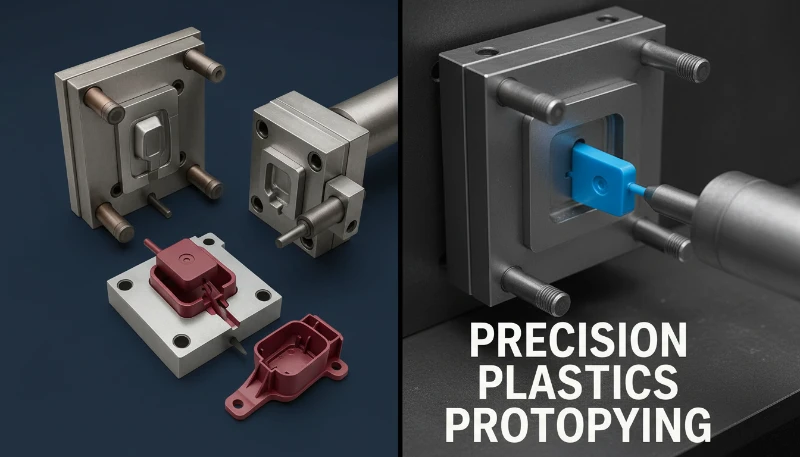
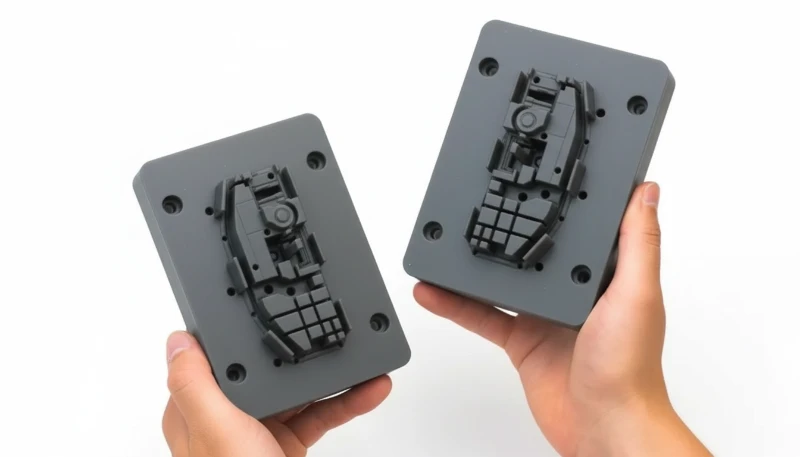
Aluminum molds are the most common tooling choice for low volume injection molding, delivering 1,000–100,000 shots at 40–60% lower cost than steel molds with lead times of 2–4 weeks. The thermal conductivity of aluminum (205 W/m·K versus 25 W/m·K for P20 steel) actually provides a processing advantage: faster cooling reduces cycle times by 20–30%, partially offsetting the higher per-part cost of small runs.
P20 pre-hardened steel molds occupy the middle ground between aluminum and fully hardened production tooling. At HRC 28–34 hardness, P20 machines faster than H13 (HRC 48–52) while lasting 100,000–500,000 shots. This makes P20 ideal for bridge tooling—molds that serve production needs while hardened steel tooling is being manufactured—and for medium-volume products that will never exceed 200,000 total lifetime units.
3D-printed molds represent the newest tooling approach for ultra-low volumes of 10–500 parts. Stereolithography (SLA) molds using high-temperature resins like Formlabs Rigid 10K withstand injection temperatures up to 238°C and pressures up to 60 MPa. Each mold costs $50–$500 and can be printed overnight, but typical mold life is only 10–100 shots before dimensional degradation exceeds acceptable limits.
Multi-cavity configurations are less common in low volume production because the tooling cost savings from aluminum diminish when adding cavities. A single-cavity aluminum mold costing $5,000 produces parts at adequate rates for most low volume applications. Adding a second cavity increases tooling cost to $8,000–$12,000 but halves cycle time per part—only justified when the per-part time savings outweigh the additional tooling investment.
The choice between aluminum and steel tooling depends on four factors: required mold life, processing temperature of the resin, surface finish requirements, and whether the mold will serve as bridge tooling with future conversion to production. For projects where the total lifetime volume is under 10,000 parts and the material processes below 300°C, aluminum is almost always the most cost-effective option.
| Material do molde | Cost Range | Mold Life (Shots) | Prazo de execução | Melhor para |
|---|---|---|---|---|
| Alumínio 7075 | $2,000–$10,000 | 1,000–100,000 | 1–3 weeks | Prototype and pilot runs |
| Aço P20 | $5,000–$25,000 | 100,000–500,000 | 3–6 weeks | Bridge tooling |
| Aço H13 | $10,000–$100,000+ | 500,000–2,000,000+ | 8–16 weeks | Production volumes |
| 3D-Printed (SLA) | $50–$500 | 10–100 | 1–3 days | Design validation (10–50 parts) |
| Soft Steel (S50C) | $3,000–$12,000 | 50,000–200,000 | 2–4 weeks | Low volume with texturing needs |
“Os moldes de alumínio arrefecem 20–30% mais rápido do que os moldes de aço porque o alumínio conduz o calor 8 vezes mais eficientemente.”Verdadeiro
A condutividade térmica do alumínio (205 W/m·K) é aproximadamente 8 vezes superior à do aço P20 (25 W/m·K). Esta extração de calor mais rápida reduz o tempo de arrefecimento—a fase mais longa do ciclo de moldagem por injeção—em 20–30%. Para uma peça típica com parede de 2,0 mm, o tempo de arrefecimento diminui de 15 segundos em aço para 10–12 segundos em alumínio, reduzindo significativamente o tempo total do ciclo.
“Os moldes de alumínio não podem produzir peças com tolerâncias apertadas porque o material do molde é demasiado mole.”Falso
7075-T6 aluminum achieves hardness of HRC 15–18 and can hold tolerances of ±0.05 mm on critical dimensions when properly machined. While softer than hardened steel (HRC 48–52), aluminum is adequate for most engineering tolerances. The limitation is wear resistance over high shot counts, not dimensional capability on initial production runs.
How Does Low Volume Molding Compare to Alternative Manufacturing Methods?
3D printing (FDM, SLA, SLS) dominates at volumes below 50–100 parts where per-part costs of $10–$100 are acceptable and no tooling investment is needed. Above 100 parts, low volume injection molding becomes more economical because the $2,000–$15,000 tooling cost amortizes below the per-part cost of additive manufacturing. The crossover point varies by part size and complexity—simple geometries favor molding at lower volumes, while complex parts with internal channels may favor 3D printing up to 500 units.
CNC machining competes effectively at 1–500 parts for materials like ABS, PC, and nylon. CNC delivers tighter tolerances (±0.025 mm versus ±0.05 mm for injection molding) and requires zero tooling investment. However, CNC costs increase linearly with volume—100 parts cost 100× the single-part price. Injection molding costs decrease per part as volume rises, creating a crossover around 200–500 parts depending on part complexity and material.
Urethane casting fills a specific niche: 25–200 parts in rubber-like or optically clear materials. Silicone molds cost $500–$3,000 and produce parts in 5–15 business days. The limitation is material selection—urethane resins approximate but do not match the mechanical properties of production thermoplastics like PA66 or POM. For functional testing where exact material properties matter, low volume injection molding with production-grade resins is the superior choice.
In our factory, we frequently see projects transition from rapid prototyping through low volume molding and into full production. A typical medical device project starts with 5 SLA-printed prototypes for design review, moves to 200 parts from an aluminum mold for clinical testing, then scales to 50,000 parts annually from a steel production mold. Planning this transition from the beginning saves 4–8 weeks and $5,000–$15,000 in redesign costs.
The decision framework ultimately comes down to three variables: total lifetime volume, required material properties, and time-to-market pressure. When all three point toward intermediate needs—hundreds to thousands of parts, in production-grade thermoplastics, needed within weeks rather than months—low volume injection molding is the clear winner. When any one variable skews toward an extreme (single prototype, exotic metal alloy, or same-day delivery), alternative methods serve better.
| Method | Ideal Volume | Per-Part Cost | Custo das ferramentas | Prazo de execução |
|---|---|---|---|---|
| 3D Printing (SLA/SLS) | 1–100 | $10–$100 | $0 | 1–5 days |
| Maquinação CNC | 1–500 | $15–$200 | $0 | Duas frentes de fusão que se encontram a baixa temperatura e pressão; soldagem insuficiente do material |
| Urethane Casting | 25–200 | $20–$150 | $500–$3,000 | 5–15 days |
| Low Volume IM (aluminum) | 100–10,000 | $0.50–$50 | $2,000–$15,000 | 2–4 weeks |
| Production IM (steel) | 10,000–1,000,000+ | $0.05–$5 | $10,000–$100,000+ | 8–16 weeks |
What Materials Work Best in Low Volume Injection Molding?
Low volume injection molding supports the full range of thermoplastics used in production molding—from commodity resins like PP and ABS to engineering grades like PA66 and POM to high-performance polymers like PEEK and PEI. This material versatility is the primary advantage over 3D printing and urethane casting, which limit material choices to proprietary formulations that approximate but do not replicate production resin properties.
Aluminum molds handle processing temperatures up to 300°C and injection pressures up to 100 MPa, which covers the vast majority of commodity and engineering resins. For high-temperature materials like PEEK (processing at 370–400°C) or PPS (processing at 310–340°C), P20 or H13 steel molds are required even at low volumes because aluminum softens above 300°C and loses dimensional stability.
Glass-fiber-reinforced grades accelerate mold wear in aluminum tooling. A 30% glass-filled nylon wears aluminum cavity surfaces 5–10 times faster than unfilled nylon, reducing mold life from 50,000 shots to 5,000–10,000 shots. For abrasive filled materials at volumes above 5,000 parts, P20 steel with a nitrided surface provides adequate wear resistance at moderate cost.
Material selection for low volume projects should match the production-intent resin whenever possible. Testing with ABS when the production material is PA66-GF30 introduces risk because the materials differ in shrinkage (0.5% vs 0.3–1.2%), mechanical properties (tensile strength 40 MPa vs 180 MPa), and processing behavior. Using the actual production resin from the start validates both part performance and processability before committing to production tooling.
Color matching and additive packages also benefit from low volume molding validation. Masterbatch color concentrates, UV stabilizers, and flame-retardant additives can affect flow behavior, shrinkage, and surface appearance in ways that material datasheets do not fully predict. Running 200–500 parts in the final color and additive formulation confirms that the production material meets both aesthetic and functional requirements before ordering bulk resin quantities.
| Material | Processing Temp (°C) | Aluminum Mold Compatible | Aplicações típicas |
|---|---|---|---|
| PP | 200–240 | Yes | Packaging, consumer products, living hinges |
| ABS | 220–260 | Yes | Enclosures, prototypes, consumer electronics |
| PC | 280–320 | Yes (up to 300°C) | Lenses, medical devices, safety equipment |
| PA66 | 260–290 | Yes | Structural components, automotive clips |
| PA66-GF30 | 270–300 | Limited (5,000–10,000 shots) | Under-hood automotive, gears |
| POM | 190–210 | Yes | Precision gears, bearings, fuel system parts |
| PEEK | 370–400 | No (requires steel) | Aerospace, medical implants |
“A moldagem por injeção de baixo volume utiliza os mesmos termoplásticos de grau de produção que a fabricação de alto volume.”Verdadeiro
Unlike 3D printing or urethane casting that use proprietary material formulations, low volume injection molding processes the same resin pellets used in production. ABS, PC, PA66, PP, and hundreds of other grades run identically in aluminum or steel molds. This ensures that mechanical properties, chemical resistance, and regulatory certifications (FDA, UL94) validated during low volume testing remain valid at production scale.
“Os moldes de alumínio podem processar qualquer material termoplástico sem limitações.”Falso
Aluminum molds have a practical temperature ceiling of approximately 300°C. High-performance polymers like PEEK (processing at 370–400°C), PPS (310–340°C), and LCP (330–350°C) require steel molds even at low volumes. Additionally, glass-fiber-reinforced materials wear aluminum surfaces 5–10 times faster than unfilled resins, significantly reducing mold life and part dimensional consistency.
Os moldes de alumínio atingem acabamentos SPI desde B-2 (semi-brilhante) até C-3 (mate médio) sem dificuldade, utilizando técnicas padrão de usinagem e polimento. Os acabamentos SPI A-1 (espelhado) e A-2 (alto brilho) são possíveis, mas exigem polimento com diamante e adicionam $500–$2.000 ao custo da ferramenta devido à mão de obra extra. Acabamentos texturizados, como a série MT-11000, são alcançáveis através de gravação química, embora o alumínio seja gravado de forma diferente do aço e possa exigir painéis de teste para corresponder exatamente às especificações desejadas. Para peças de clareza de grau óptico que requerem acabamento A-1 com imperfeições mínimas, recomenda-se a utilização de insertos de aço temperado na superfície óptica em vez de construção totalmente em alumínio.
Ângulos de saída de 1,0–2,0° são recomendados para moldes de alumínio—ligeiramente mais do que os 0,5–1,0° aceitáveis em aço endurecido—porque a menor dureza do alumínio o torna mais suscetível a arranhões superficiais durante a ejeção da peça. Superfícies texturizadas requerem ainda mais ângulo de saída: 1,5° por 0,025 mm (0,001 polegada) de profundidade de textura, ou aproximadamente 3,0° para um acabamento fosco padrão MT-11010.
Undercuts increase mold complexity and cost significantly in any tooling, but the impact is amplified in low volume production where tooling cost is a larger percentage of total project cost. A simple side-action mechanism adds $1,500–$5,000 to an aluminum mold—potentially doubling the tooling investment. Redesigning parts to eliminate undercuts through snap-fit modifications, split-line adjustments, or collapsible core alternatives often saves more than the engineering time required.
Wall thickness should remain uniform at 1.5–3.0 mm for most thermoplastics in aluminum molds. Thin walls below 1.0 mm require higher injection pressures that stress aluminum tooling and shorten mold life. Thick sections above 4.0 mm create extended cooling times and increase the risk of sink marks and voids. The 60% rib-to-wall thickness rule applies equally to low volume tooling: ribs should not exceed 60% of the adjoining wall thickness.
Gate design in aluminum molds follows the same engineering principles as steel tooling, but gate inserts made from hardened steel (H13 or S136) are recommended at the gate location. The gate area experiences the highest material velocity, temperature, and pressure in the entire mold—conditions that erode aluminum rapidly. A $200–$500 steel gate insert extends mold life by 3–5× at the wear point without significantly increasing total tooling cost.
A thorough DFM5 review before cutting the aluminum mold identifies potential issues that are far cheaper to fix in CAD than in metal. Common findings include insufficient draft on textured surfaces, wall thickness transitions that cause sink marks, and undercut features that require expensive side actions. In our experience, a 2-hour DFM session eliminates an average of 3–4 design issues per project, each of which would cost $500–$2,000 to fix after mold fabrication.
O design dos canais de arrefecimento em moldes de alumínio é simplificado pela alta condutividade térmica do material. Enquanto os moldes de aço requerem canais de arrefecimento cuidadosamente posicionados a distâncias precisas da superfície da cavidade, a condutividade 8× superior do alumínio significa que circuitos de arrefecimento mais simples, perfurados em linha reta, frequentemente alcançam uniformidade de temperatura adequada. Isto reduz conceção de moldes de injeção3 complexity and machining time, contributing to the shorter lead times that make low volume production attractive.
| Caraterísticas de design | Valor recomendado | Motivo |
|---|---|---|
| Draft angle (smooth) | 1.0–2.0° | Prevents aluminum surface scratching |
| Draft angle (textured) | 1.5° per 0.025 mm depth | Texture release without surface damage |
| Minimum wall thickness | 1.5 mm | Reduces injection pressure on aluminum |
| Maximum wall thickness | 3.0 mm | Limits cooling time and sink marks |
| Rib thickness | 60% of wall | Prevents sink marks on opposite face |
| Internal corner radii | 0.5–1.0× wall thickness | Reduces stress concentration |
| Gate insert material | H13 or S136 steel | Extends mold life 3–5× at wear point |
When Should You Choose Low Volume Over High Volume Molding?
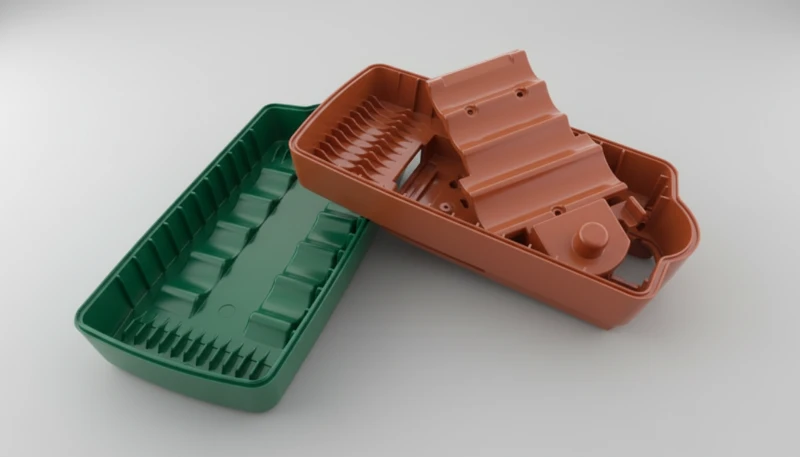
Bridge tooling is the most common use case, accounting for approximately 35% of low volume injection molding projects. When a product has been validated and orders are incoming but production steel tooling requires 8–16 weeks, an aluminum bridge mold delivers production-quality parts in 2–4 weeks. The bridge mold runs until steel tooling is ready, then serves as a backup tool for the remainder of its useful life.
Pilot production runs of 500–5,000 parts test manufacturing feasibility, supply chain logistics, and market reception before committing $50,000–$150,000 to multi-cavity production tooling. A pilot run reveals real-world issues that prototyping cannot: assembly line ergonomics, packaging fit, retail shelf presence, and customer feedback on the actual production material and surface finish.
Medical devices with limited patient populations are inherently low volume products. A surgical instrument used by 200 hospitals may require only 2,000–5,000 units over its entire product lifecycle. Investing $80,000 in hardened steel tooling for this volume makes each part carry $16–$40 in tooling amortization. An aluminum mold at $8,000 reduces that burden to $1.60–$4.00 per part—a 10× reduction that directly improves product margins.
Custom and personalized products represent a growing segment. Dental aligners, hearing aid shells, and ergonomic tool handles all require unique geometry for each end user. Low volume molding with interchangeable mold inserts—a base mold frame with swappable cavity inserts—enables cost-effective production of 50–500 units per design variant at per-part costs of $2–$15, compared to $50–$200 per part for individual 3D printing.
As peças sobressalentes de fim de vida também beneficiam de ferramentas de baixo volume. Quando o molde de aço original de um produto legado está desgastado ou sucateado, replicá-lo em alumínio custa 40–60% menos e leva 70% menos tempo. Um molde de alumínio de substituição que produza 5.000 peças sobressalentes ao longo de 3 anos satisfaz as obrigações de garantia sem o investimento total de novas ferramentas de produção.
How Does Zetar Handle Low Volume Injection Molding Projects?
A equipa de engenharia da Zetar executa análise do fluxo do molde2 on every low volume project before cutting aluminum or steel, predicting fill patterns, weld line locations, and shrinkage distribution. This simulation step—which costs a fraction of a mold modification—catches 80–90% of potential issues before any metal is machined, typically saving one full iteration of mold rework worth $1,500–$5,000.
With 47 injection molding machines ranging from 50 to 1,600 tons, Zetar matches machine size to part requirements rather than forcing small parts onto oversized presses. Running a 50-gram part on a 100-ton machine instead of a 500-ton machine reduces energy consumption by 60% and improves process control—advantages that matter more in low volume production where per-part cost optimization is critical.
A abordagem integrada da Zetar—combinando design de moldes interno, maquinagem CNC, moldagem por injeção e inspeção de qualidade—elimina os atrasos de coordenação entre fornecedores separados. Um projeto típico de baixo volume passa de CAD aprovado para primeiras peças de artigo em 15–20 dias úteis, com revisão de design do molde de injeção e feedback de DFM concluídos nos primeiros 3 dias. Este cronograma comprimido é possível porque os engenheiros de design e os fabricantes de moldes trabalham nas mesmas instalações, permitindo colaboração em tempo real nas decisões de ferramentaria.
Quality control for low volume parts follows the same protocols as high volume production. First-article inspection using coordinate measuring machines (CMM) verifies dimensional accuracy against the 3D CAD model, with all critical dimensions measured and documented in a First Article Inspection Report (FAIR). Statistical process control (SPC) monitoring begins from the first production run, establishing process capability indices (Cpk) that demonstrate dimensional consistency across the entire batch.
A estrutura de preços de baixo volume da Zetar reflete a verdadeira economia da produção em pequenos lotes. Em vez de aplicar modelos de preços de volume de produção que penalizam encomendas pequenas, o sistema de cotação considera o tempo real de configuração, o uso de material e a amortização do molde. Esta abordagem transparente ajuda os clientes a tomar decisões informadas sobre se devem avançar com ferramentas de alumínio de baixo volume ou investir diretamente em aço de produção—com base no custo total do ciclo de vida e não apenas no preço inicial da ferramenta.
For projects requiring regulatory documentation, Zetar provides full material traceability including resin lot numbers, processing parameter records, and first-article inspection reports. Medical device and aerospace clients receive documentation packages that support FDA 510(k) submissions, ISO 13485 audits, and AS9100 compliance requirements—built into the standard workflow rather than added as costly afterthoughts.

Frequently Asked Questions About Low Volume Injection Molding?
What is the minimum order quantity for low volume injection molding?
Most low volume injection molding suppliers accept orders starting at 100–500 parts when using aluminum tooling. The economic minimum depends on tooling cost and part complexity—a $3,000 aluminum mold producing $1.50 parts breaks even against 3D printing at approximately 75–150 parts. Below 50 parts, 3D printing or CNC machining is typically more cost-effective because no tooling investment is required. Some suppliers using 3D-printed molds accept orders as low as 10–25 parts for design validation purposes, though surface finish and dimensional consistency are limited compared to machined aluminum molds.
How long do aluminum injection molds last?
Aluminum injection molds typically last 1,000–100,000 shots depending on the resin being processed and part geometry complexity. Unfilled thermoplastics like ABS and PP achieve the upper end of this range, while glass-fiber-reinforced materials reduce mold life to 5,000–10,000 shots due to abrasive wear on cavity surfaces. Adding hardened steel inserts at high-wear areas like gates, shut-off surfaces, and core pins can extend overall mold life by 3–5 times. 7075-T6 aluminum is the most common grade for injection mold tooling because it combines good machinability with adequate hardness (HRC 15–18) for short to medium production runs.
Is low volume injection molding suitable for medical devices?
Low volume injection molding is widely used in the medical device industry for products with limited production volumes, including surgical instruments, diagnostic device housings, drug delivery components, and patient-specific implant guides. The process supports FDA-compliant materials like USP Class VI silicone, medical-grade PC, and PEEK for implantable applications. Aluminum molds can be validated to the same IQ/OQ/PQ protocols as steel production tooling, and the faster lead times enable medical startups to begin clinical trials 6–12 weeks earlier than traditional tooling approaches allow.
What surface finishes are achievable with aluminum molds?
Aluminum molds achieve SPI finishes from B-2 (semi-gloss) to C-3 (medium matte) without difficulty using standard machining and polishing techniques. SPI A-1 (mirror) and A-2 (high gloss) finishes are possible but require diamond polishing and add $500–$2,000 to tooling cost due to the extra labor involved. Textured finishes like MT-11000 series are achievable through chemical etching, though aluminum etches differently than steel and may require test panels to match target specifications exactly. For optical-grade clarity parts requiring A-1 finish with minimal imperfections, hardened steel inserts at the optical surface are recommended over full aluminum construction.
Piso da fábrica de moldagem por injeção de sala limpa
Aluminum low volume molds cannot be directly converted to production steel molds because the base materials and construction methods differ fundamentally—aluminum cannot be hardened like tool steel, and cavity geometry must be re-machined regardless. However, the design data, gate location, cooling channel layout, and processing parameters developed during low volume production transfer directly to production mold design, saving 2–4 weeks of engineering time and eliminating at least one iteration of design revision. Some manufacturers design modular mold bases that accept both aluminum and steel cavity inserts, allowing a seamless transition from low volume to production by swapping only the cavity block while retaining the same mold frame and ejection system.
How does low volume injection molding reduce time to market?
Low volume injection molding reduces time to market by 6–12 weeks compared to traditional production tooling approaches. Aluminum molds require 2–4 weeks from design approval to first parts versus 8–16 weeks for hardened steel production molds. This compressed timeline enables parallel activities: while production steel tooling is being manufactured, the aluminum bridge mold produces parts for regulatory testing, customer sampling, trade show displays, and initial sales orders. Companies that use bridge tooling strategies consistently report reaching market 40–60% faster than competitors who wait for production tooling to be completed before beginning any market-facing activities.
-
thermoplastics: Thermoplastics is a class of polymers that soften when heated above their glass transition or melting temperature and solidify upon cooling, allowing repeated reprocessing without significant chemical degradation. ↩
-
mold flow analysis: Mold flow analysis is a simulation technique that predicts how molten plastic fills, packs, and cools inside a mold cavity, measured in fill time (seconds), pressure distribution (MPa), and temperature uniformity across the part. ↩
-
injection mold design: Injection mold design refers to the engineering process of creating a mold tool with optimized gate placement, cooling channels, parting lines, and ejection systems to produce dimensionally accurate plastic parts. ↩
-
rapid prototyping: Rapid prototyping is a group of manufacturing techniques used to quickly fabricate a physical model or functional prototype from a 3D CAD file, typically within 1–5 business days using additive or subtractive methods. ↩
-
DFM: DFM, or Design for Manufacturability, is an engineering methodology that optimizes part geometry, wall thickness, draft angles, and feature placement to reduce manufacturing cost and defect rates during injection molding production. ↩
Need a Quote for Your Injection Molding Project?
Get competitive pricing, DFM feedback, and production timeline from ZetarMold’s engineering team.
Request a Free Quote → See our Supplier Sourcing Guide for a comprehensive overview. See our Supplier Sourcing Guide for a comprehensive overview. See our Injection Molding Complete Guide for a comprehensive overview.




 EN
EN  ES
ES  FR
FR  DE
DE  PT
PT  AR
AR  RU
RU  JA
JA  KO
KO  IT
IT  NL
NL  TR
TR  PL
PL 