

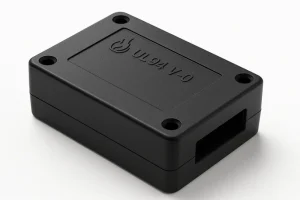
- UL 94 V-0 is the minimum required rating for most battery enclosure applications: the specimen must self-extinguish within 10 seconds after each of two 10-second flame applications.
- Polycarbonate (PC), PC/ABS blends, and glass-fiber-reinforced PA66 are the three most common UL 94 V-0 resins used in injection-molded battery enclosures.
- Wall thickness directly affects the achievable UL 94 rating: a material rated V-0 at 3.0 mm may only achieve HB at 1.5 mm—always verify the datasheet at the actual molded thickness.
- Halogen-free flame retardant systems eliminate toxic combustion gases but typically reduce impact strength by 10–25%, requiring careful DFM review.
- In our factory, we run UL 94 vertical burning tests in-house at every material lot change, confirming compliance before the first production shot.
What Is UL 94 Flame Retardancy and Why Does It Matter for Battery Enclosures?
UL 941 is the most widely cited plastics flammability standard worldwide, classifying materials from HB (horizontal burn, slowest protection) through V-2, V-1, V-0, and the highest ratings 5VA and 5VB. For battery enclosures, the UL94 flame retardancy standard is the minimum gate for product certification: without a V-0 or V-1 rating at the specified wall thickness, no major OEM or safety agency will approve the housing for use in lithium-ion or lead-acid battery packs.

Battery enclosures face a uniquely severe fire risk.
A lithium-ion cell entering thermal runaway can reach temperatures of 700–900 °C within seconds, releasing flammable electrolyte gases.
An enclosure that propagates flame can convert a single-cell failure into a catastrophic pack fire. The enclosure must act as a passive containment barrier—slowing ignition, limiting flame spread, and buying time for protective electronics to respond. Achieving UL 94 V-0 at the molded wall thickness is the first engineering checkpoint before any other design work begins. The safety margin this rating provides is not optional—it is a baseline requirement for any commercial battery product.
| Parâmetro | Value / Requirement |
|---|---|
| Publisher | Underwriters Laboratories (UL), USA |
| Applicable scope | Plastics in devices and appliances |
| Test method | Vertical and horizontal burn specimens |
| Key battery-relevant rating | V-0: self-extinguish ≤10 s, no flaming drips |
| Complementary standard | IEC 60695-11-10 (equivalent vertical flame test |
The practical significance is well documented: IEC 62133, UL 2580 (EV batteries), and IEC 60950 all reference UL 94 V-0 or equivalent flammability performance as a prerequisite for compliance. Products that fail to specify the correct UL 94 rating during the design phase routinely require expensive enclosure redesigns at the certification stage. In our factory, we have seen more than a dozen projects delayed by 8–16 weeks because material selection did not account for thickness-specific UL 94 ratings.
How Are UL 94 Ratings Defined and How Do They Differ?
UL 94 classifies six vertical/horizontal burning ratings. The critical difference between V-0 and V-1 is extinguishing time: V-0 requires self-extinguishment within 10 seconds per flame application and no dripping of flaming particles; V-1 allows 30 seconds and no flaming drips; V-2 allows 30 seconds but permits flaming drips. For battery enclosures, V-0 is virtually mandatory in consumer and industrial applications because a single flaming drip can ignite surrounding materials, accelerating pack-level thermal events.
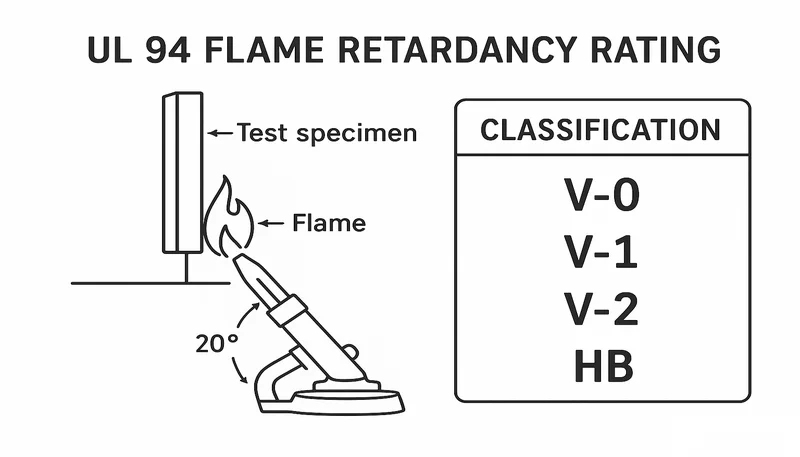
The 5VA and 5VB ratings test a 125 mm flame for five 5-second applications and are required for large electrical enclosures (over 1,000 cm³), server rack components, and high-power EV battery modules. HB—the entry-level horizontal burn rating—is inadequate for any battery application involving lithium chemistry and will be rejected by testing labs immediately.
| Rating | Max Burn Time | Flaming Drips Allowed | Aplicação típica |
|---|---|---|---|
| HB | ≤76 mm/min spread | Yes | Non-critical housings only |
| V-2 | 30 s per flame | Yes (self-ext.) | Low-risk consumer enclosures |
| V-1 | 30 s per flame | Não | General battery housings |
| V-0 | 10 s per flame | Não | Li-ion packs, EV BMS |
| 5VB | 60 s (5× flames) | No burn-through | Large EV modules, server UPS |
| 5VA | 60 s (5× flames) | No burn-through | High-power industrial packs |
Which Thermoplastic Materials Achieve UL 94 V-0 for Battery Enclosure Injection Molding?
The three primary resin families for UL 94 V-0 battery enclosures are polycarbonate (PC), PC/ABS blends, and glass-fiber-reinforced polyamide 66 (PA66-GF). Each achieves V-0 through a different mechanism: PC forms a viscous intumescent char; PC/ABS uses phosphate-based additives that quench the flame; and PA66-GF relies on glass filler to reduce polymer content per volume, often combined with halogen-free phosphorus FR systems. In our factory, we process over 30 UL 94 V-0 certified grades, selected based on operating temperature, impact requirements, and halogen-free certification needs.
Polycarbonate is the most popular choice for compact lithium-ion battery enclosures. Unfilled PC certified at 3.0 mm wall achieves V-0 intrinsically through char formation without additives, with a heat deflection temperature (HDT) of 130–140 °C. Below 2.0 mm wall thickness, however, standard PC typically drops to V-2 or HB, making the precise molded wall thickness a design-critical parameter that must be verified at the thinnest section of the enclosure. Polycarbonate injection molding requires melt temperatures of 280–320 °C and careful tool venting to avoid degradation that would reduce flame performance.
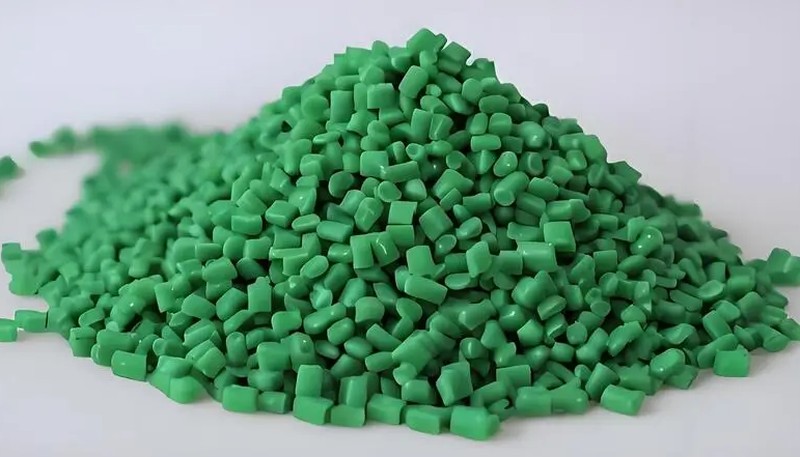
PA66 with 30% glass fiber (PA66-GF30) is preferred when the battery enclosure must withstand continuous operating temperatures above 120 °C, vibration loads, or chemical exposure to battery electrolyte. PA66-GF30 certified V-0 grades achieve V-0 at 0.8 mm wall—thinner than PC—making them attractive for space-constrained EV module designs. The trade-off is higher moisture absorption (2.5–3.5% at saturation), which can affect dimensional stability in humid operating environments. PC/ABS blends with phosphorus FR additives fill the gap between pure PC and PA66-GF30, offering V-0 at 1.5–2.0 mm with improved processing window and better surface finish than glass-filled grades. For applications requiring both thin walls and high temperature resistance, PBT-GF20 with halogen-free FR additives provides a balanced solution.
| Material | V-0 Min Wall (mm) | HDT (°C) | Impact (kJ/m²) | FR System | Key Limitation |
|---|---|---|---|---|---|
| PC (unfilled) | 3.0 | 130–140 | 65–80 | Intrinsic char | Loses V-0 below 2 mm |
| PC/ABS + FR | 1.5–2.0 | 100–115 | 40–60 | Phosphate additive | Reduced HDT vs. pure PC |
| PA66-GF30 + FR | 0.8–1.5 | 200–220 | 50–70 | Halogen-free P/N | Absorção de humidade |
| PBT-GF20 + FR | 1.0–1.5 | 175–195 | 35–50 | Halogen-free | Brittle at low temp |
| PPE/PS + FR | 1.5 | 110–125 | 30–45 | Intrinsic | Chemical sensitivity |
How Does Wall Thickness Affect UL 94 Rating in Injection-Molded Battery Enclosures?
Wall thickness is the single most underestimated variable in flame retardancy. A material datasheet rating of V-0 at 3.2 mm does NOT guarantee V-0 at 2.0 mm or 1.5 mm—these are separate UL 94 listings requiring separate burning test data. In practice, reducing wall thickness by 50% often shifts the rating by one or two levels because the polymer mass available to form a protective char layer decreases proportionally. Engineers must verify that the minimum molded wall thickness—not the nominal design dimension—still meets the required V-0 classification.
In our factory, we use análise do fluxo do molde to predict wall thickness variation across the cavity before cutting steel. Sections with gate-distal corners or thin ribs can fall 10–20% below nominal wall thickness due to shrinkage and flow hesitation. We add 0.2–0.3 mm of deliberate thickness compensation in these areas to maintain V-0 compliance. Our simulation process typically saves $8,000–$40,000 in mold rework by catching thickness-related FR compliance risks before tool fabrication.
| Material | 3.2 mm Rating | 1.6 mm Rating | 0.8 mm Rating |
|---|---|---|---|
| PC (unfilled) | V-0 | V-2 | HB |
| PC/ABS + FR | V-0 | V-0 | V-1 |
| PA66-GF30 + FR | V-0 | V-0 | V-0 |
| PBT-GF20 + FR | V-0 | V-0 | V-1 |
Weld lines present a particularly serious thickness-independent risk. A weld line where two melt fronts converge can reduce local flame retardant2 additive concentration by 5–15% compared to the bulk. Our mold flow simulation identifies all weld line locations before tool fabrication, allowing gate repositioning to move them away from areas that will be cut into UL 94 test specimens.
Material drying is another compliance variable often overlooked. Hygroscopic FR resins such as PA66 and PC/ABS must be dried to manufacturer-specified moisture levels (typically ≤0.02% for PC and ≤0.2% for PA66) before processing. Undried material causes hydrolytic degradation during injection, reducing molecular weight and char-forming ability. A 15% reduction in molecular weight from undried PA66-FR can degrade the UL 94 V-0 rating to V-1 or HB at the same nominal wall thickness.
“A UL 94 V-0 material listed at 3.2 mm may not achieve V-0 at 1.5 mm wall thickness.”Verdadeiro Maintaining an appropriate ângulo de inclinação3 on sidewalls further reduces ejection stress on flame-retardant compounds.
UL 94 ratings are thickness-specific. Each listed thickness has been independently tested. As wall thickness decreases, less polymer mass is available to form a protective char, and the specimen may burn longer than the 10-second V-0 limit. Designers must verify the datasheet rating specifically at the thinnest section of their enclosure design, not just the nominal wall dimension.
“Adding more flame retardant additive always improves the UL 94 rating of a polymer.”Falso
Flame retardant loading is subject to diminishing returns and has an upper practical limit. Exceeding the optimal loading (typically 15–25 wt%) can cause migration to the surface, degrading mechanical properties without further improving the burn rating. For some systems, over-loading can actually disrupt char formation. Proper compounding requires balancing FR level with mechanical performance, optimized through combustion calorimetry.
What Are the Key Design Rules for UL 94 Compliant Battery Enclosure Injection Molding?
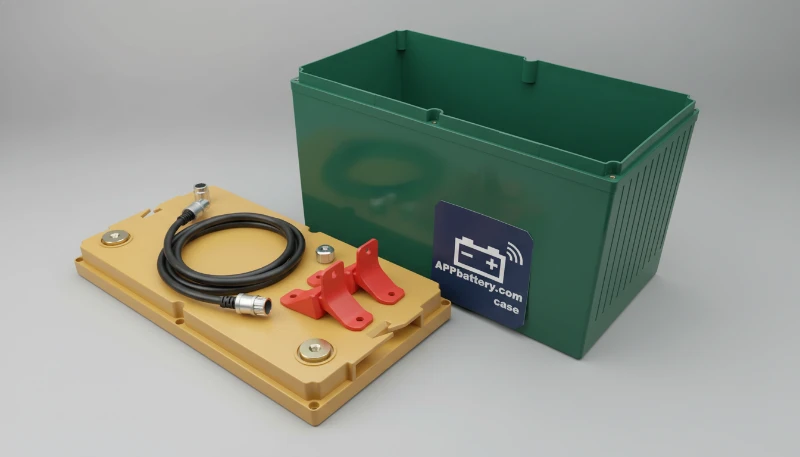
Seven design rules govern UL 94 compliance in injection-molded battery enclosures: maintain minimum wall thickness equal to or above the V-0 certified value throughout the entire part; avoid abrupt thickness transitions greater than 2:1 ratio; keep rib thickness at 50–60% of adjacent wall; design boss walls at 60% of nominal wall; place gates away from thin sections; use full-round or trapezoidal runners to minimize FR additive shear degradation; and apply minimum 0.5 mm internal corner radii to prevent stress cracking.
Gate location is especially critical for FR compounds. High shear at a poorly positioned gate can thermally degrade phosphorus or nitrogen FR additives in transit, creating a resin-rich zone near the gate that fails UL 94 even when the bulk material is certified. In our factory, we confirm gate shear rates stay below 50,000 s⁻¹ for FR-loaded compounds and specify a cold-slug well at the sprue to capture the first-filled, highest-shear melt before it reaches the cavity.
| Design Element | Rule | Motivo |
|---|---|---|
| Nominal wall | ≥ certified V-0 thickness + 0.2 mm margin | Compensate for shrinkage and flow variation |
| Wall transition | Maximum 2:1 thickness step | Prevents stress concentration and burn-through |
| Rib thickness | 50–60% of adjacent wall | Avoids thin ribs below V-0 threshold |
| Boss wall | 60% of nominal wall | Maintains consistent FR content |
| Corner radius (internal) | ≥ 0.5 mm | Prevents stress cracking and delamination |
| Gate shear rate | < 50,000 s⁻¹ for FR compounds | Prevents FR additive degradation at gate |
| Ângulo de inclinação | ≥ 1.5° min, 2° recommended for FR blends | Reduces ejection stress on brittle FR compounds |
Draft angles deserve special attention for FR-loaded compounds. Most flame retardant additives reduce impact toughness by 10–25%, making FR compounds more brittle than unfilled counterparts. Insufficient draft (below 1.5°) increases ejection force, risking cracks at the parting line. We recommend a minimum 2° draft for all vertical walls in FR-compound parts, and 3° or more for textured surfaces.
Assembly Features and Parting Line in FR-Compound Enclosures
Assembly features—snap fits, living hinges, and press-fit inserts—all introduce localized stress concentration in FR compounds. Since FR additives reduce elongation at break from 80–120% (unfilled PC) down to 10–25% (FR-PC), snap features designed for standard PC will often fracture during assembly when made in FR-PC. We reduce snap fit deflection angles by 40–50% relative to unfilled-PC baseline values when designing battery enclosure assembly features in FR compounds. Parting line placement also requires review: a parting line seam that intersects the anticipated UL 94 specimen cut plane can cause test failure at the weld-line zone.
“Gate placement can affect whether an injection-molded part passes the UL 94 vertical burn test.”Verdadeiro
High shear rates at poorly positioned gates can thermally degrade flame retardant additives in the melt stream, creating a resin-rich, FR-depleted zone near the gate. This localized area may have a higher burn rate or longer extinguishing time than the bulk material, causing the part to fail the vertical burn test even when the compound is fully certified. Gate shear rates should be kept below 50,000 s⁻¹ for FR-loaded compounds.
“Halogen-containing flame retardants always outperform halogen-free systems in UL 94 testing.”Falso
Modern halogen-free flame retardant systems based on organophosphorus, intumescent nitrogen-phosphorus, or aluminum trihydrate can achieve UL 94 V-0 at equivalent or thinner wall thicknesses compared to brominated FR systems. Halogen-free systems are increasingly preferred in battery applications because they reduce toxic combustion gas generation—a critical safety consideration during battery thermal runaway events.

How Is UL 94 Compliance Tested and Maintained During Production?
UL 94 compliance verification involves three tiers: material certification (done once per grade and thickness by the resin supplier), incoming material verification (burn test on sample plaques per lot), and finished-part audit testing. In our factory, every new material lot triggers a 5-specimen vertical burn test before it enters production. A lot that fails is quarantined and returned—we never assume certification carries forward across lot changes, since flame retardant additive concentration can vary ±10% between batches within normal manufacturing tolerances. For applications requiring IEC 60695-2 compliance, we also conduct the glow-wire test on representative specimens from the first production run.
| Tier | Who Does It | Frequency | Action on Failure |
|---|---|---|---|
| Material certification | Resin supplier (UL-listed) | Once per grade/thickness | Use different certified grade |
| Incoming lot verification | Processor (ZetarMold) | Every new material lot | Quarantine lot, retest 20 specimens |
| In-process parameter control | Process engineer | Every shift | Stop, inspect, retest 3 specimens |
| Finished-part audit | Quality team | Every 5,000 parts | Reject batch if specimens fail |
Process parameter drift can compromise UL 94 performance in production. Elevated melt temperature (beyond the FR additive’s degradation point), excessive residence time in the barrel, or regrind above 20% by weight are the three most common root causes of field failures on previously certified parts. We monitor barrel purge interval, melt temperature deviation, and regrind fraction daily on all FR compound jobs.
Barrel residence time deserves special emphasis. FR-loaded compounds—especially those using organophosphorus or intumescent systems—begin to degrade above 280–300 °C depending on the specific formulation. Production interruptions can cause material to sit in a hot barrel for 30–60 minutes, far exceeding the safe residence window of 8–15 minutes for many FR compounds.
Our production protocol requires a full barrel purge after any interruption exceeding 10 minutes on FR jobs, discarding the first 3–5 shots before resuming.
Colorant and Regrind Compliance Considerations
Colorant compatibility is a compliance variable that requires attention. Some organic pigments—particularly red and yellow pigments based on azo chemistry—can interfere with the char-forming mechanism of certain FR additives. We specify pigment compatibility testing as part of our color approval protocol for battery enclosure projects, confirming V-0 certification at the production wall thickness.
How Does ZetarMold Ensure UL 94 V-0 Compliance Across the Full Production Run?
ZetarMold achieves consistent UL 94 V-0 compliance through four stages: material qualification, mold simulation for wall uniformity, in-process SPC on melt temperature, and end-of-lot burn test auditing. With 47 machines and 35+ V-0 certified compounds, we process FR battery enclosures from 500 to 5,000,000 parts per year.
Our DFM analysis for every new battery enclosure project audits UL 94 risk zones: gate proximity, thin ribs, boss clusters, wall transitions, and anticipated weld line locations. We generate a wall-thickness heat map from mold flow simulation and verify that every region of the cavity meets or exceeds the V-0 certified minimum for the specified resin grade. Our DFM process catches thickness-related compliance gaps in approximately 1 in 5 projects, saving customers $8,000–$40,000 in mold rework costs.
| Capability | Specification |
|---|---|
| Máquinas de moldagem por injeção | 47 all-electric, 50–2000 T clamping force |
| UL 94 V-0 certified grades in stock | 35+ including halogen-free grades |
| In-house burn test equipment | UL 94 vertical and horizontal burn chamber |
| Wall thickness simulation | Moldflow mold filling + cooling analysis |
| DFM review turnaround | 48 hours for standard enclosure geometry |
| Minimum order quantity for FR grades | 500 parts (prototype to production bridge) |
Frequently Asked Questions About UL94 Flame Retardancy Injection Molding?
What is the difference between UL 94 V-0 and V-1 for battery enclosures?
The critical distinction is extinguishing time and dripping behavior. V-0 requires that each of 10 test specimens self-extinguishes within 10 seconds after a 10-second flame application, with no flaming drips. V-1 allows up to 30 seconds and still prohibits flaming drips. V-2 allows 30 seconds and permits non-igniting drips. For lithium-ion battery enclosures, V-0 is required by most OEM standards and IEC 62133 because a flaming drip from a V-1 or V-2 housing can ignite the cotton indicator beneath the test specimen—and in real-world use, ignite other materials in the battery pack. Most consumer electronics standards specify V-0 as the minimum; EV battery modules increasingly specify 5VB.
Can standard ABS be used for UL 94 battery enclosure injection molding?
Standard unfilled ABS achieves only HB (horizontal burn) classification—the lowest UL 94 rating—which is insufficient for battery enclosures. Flame-retardant ABS grades compounded with halogen-containing or halogen-free additives can achieve V-0 at wall thicknesses of 1.5–3.2 mm.
However, FR-ABS has reduced notched impact strength (typically 12–18 kJ/m² vs. 25–35 kJ/m² for standard ABS) and lower HDT. For most battery applications, PC or PC/ABS with halogen-free FR additives offers a better combination of V-0 compliance, impact resistance, and processing ease. Always verify the specific ABS grade is UL-listed at the required wall thickness.
How does the glow-wire test relate to UL 94 for battery enclosures?
The glow-wire test (IEC 60695-2-11 through -13) is a complementary ignition test that simulates an overloaded electrical connection rather than an open flame. It is required by IEC 62133 (battery safety for portable applications) and IEC 60335 (household appliances). While UL 94 tests resistance to sustained ignition, the glow-wire test evaluates ignitability from a glowing heating element at 550–960 °C. A material can pass UL 94 V-0 but still fail the glow-wire test at 850 °C—the typical IEC 62133 requirement for battery housings.
Both tests should be specified together in the material qualification for any battery enclosure design.
What is the cost premium for UL 94 V-0 injection molding resins versus standard grades?
UL 94 V-0 certified resins command a cost premium of $1.50–$6.00 per kg over unfilled commodity-grade equivalents, depending on the FR system. Halogen-free V-0 grades carry the highest premium—typically 30–50% above halogen-containing equivalents—because the phosphorus and nitrogen additive packages are more expensive to produce and compound. For a battery enclosure with a shot weight of 200 g and a production run of 100,000 parts, the material cost premium translates to approximately $30,000–$120,000 per year.
However, the cost of a product recall or liability claim from a preventable battery fire far exceeds this premium in most product categories.
Can recycled or regrind material be used in UL 94 V-0 battery enclosure molding?
Regrind from UL 94 V-0 certified material can be used with strict limits: no more than 20% by weight of the total shot weight, and only regrind from the same material lot is acceptable. Each additional thermal cycle through the barrel can degrade flame retardant additive concentration by 2–5%, so regrind from more than one reprocessing cycle should not be used.
Post-consumer recycled (PCR) resin cannot be assumed to carry the original UL 94 V-0 rating unless the PCR compound has been independently certified and UL-listed at the specified wall thickness.
Any regrind fraction change requires a full 5-specimen burn test to revalidate compliance.
Does UL 94 V-0 certification on a plaque guarantee the molded part will pass?
No. UL 94 V-0 plaque certification tests uniform specimens under controlled conditions. An injection-molded part has variable wall thickness, weld lines, residual stress, and gate-induced FR degradation zones—none of which exist in a flat plaque. Weld lines can reduce local flame retardant additive concentration by 5–15% compared to the bulk, potentially causing localized burn-through. The only way to confirm that a finished molded enclosure meets UL 94 V-0 is to cut specimens from the actual part—including sections near weld lines and thin walls—and test them independently. ZetarMold performs this finished-part validation as a standard step in our FR product qualification protocol.
-
UL 94: UL 94 is a standard published by Underwriters Laboratories that measures the flammability of plastic materials used in devices and appliances, classifying them from HB (slowest burn rate) up through V-2, V-1, and V-0 (self-extinguishing within 10 seconds) to 5VA and 5VB. ↩
-
flame retardant: A flame retardant is a chemical additive incorporated into a polymer—measured in percentage by weight—that interrupts combustion by releasing water, forming a char layer, or quenching free radicals in the flame, thereby reducing the rate of fire propagation. ↩
-
draft angle: A draft angle is a slight taper applied to vertical walls of an injection-molded part, allowing the part to release cleanly from the mold without drag marks or sticking.↩





 PT
PT  EN
EN  ES
ES  FR
FR  DE
DE  AR
AR  RU
RU  JA
JA  KO
KO  IT
IT  NL
NL  TR
TR  PL
PL 