Saltar para o conteúdo
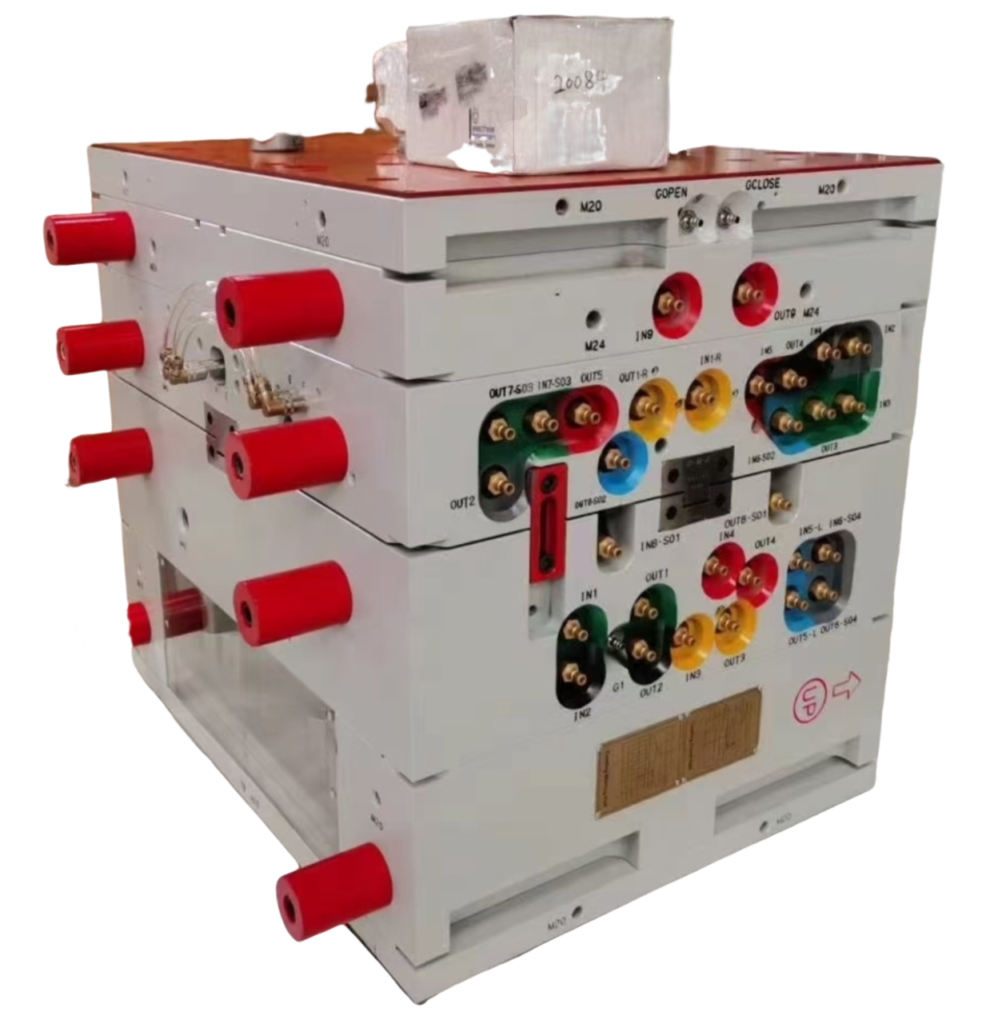
O design do gate requer atenção cuidadosa. O PPS tem uma janela de processamento estreita e alta viscosidade de fusão. Gates submarinos com diâmetro inferior a 1,2 mm criam aquecimento por cisalhamento excessivo e podem levar à degradação térmica perto do gate. Gates de borda ou gates em leque com 2–3 mm de largura são preferíveis para peças planas ou planares. Sistemas de distribuidor quente com gates de válvula são ideais para ferramentas de PPS multicavidade — eliminam o desperdício de distribuidor frio e permitem o controlo individual da pressão da cavidade.
- PPS injection molding requires barrel temperature of 300–340°C and mold temperature of 120–150°C for optimal crystallinity.
- PPS must be dried at 150°C for 4–6 hours before processing — moisture causes hydrolytic degradation and surface defects.
- PPS shrinkage is 0.6–1.4% for unfilled grades; GF-filled PPS shows anisotropic shrinkage of 0.3–0.5% flow direction vs 0.8–1.2% transverse.
- Glass-filled PPS (GF40) achieves tensile strength of 190 MPa and HDT of 270°C — comparable to many metals at one-fifth the weight.
- PPS tooling requires H13 or S136 steel due to abrasive GF content; P20 wears out 3–5× faster on high-GF grades.
What Is PPS Injection Molding?
DFM refere-se à revisão de engenharia da geometria da peça antes da ferramentagem para evitar defeitos de moldagem e reduzir o tempo de ciclo.
PPS injection molding is a high-temperature process that molds PPS resin at 300-340°C to produce heat- and chemical-resistant parts. It requires 120-150°C mold temperatures and specialized equipment due to the material’s high processing requirements.

Polyphenylene sulfide (PPS) achieves its exceptional thermal and chemical resistance through a unique molecular structure consisting of para-linked phenylene rings with sulfide linkages. This structure creates a highly rigid polymer chain that resists deformation at elevated temperatures while maintaining dimensional stability across the full operating range from -40°C to +240°C. The inherent chemical structure also provides excellent dielectric strength, making PPS a preferred material for electrical insulators and connector bodies in automotive and industrial applications.
The crystalline nature of PPS is fundamental to its performance. Semi-crystalline thermoplastics like PPS have an ordered molecular structure that develops during cooling from the molten state. This crystallinity is what gives PPS its high heat deflection temperature (270°C for GF40 grades) and resistance to creep under load. However, this same crystallinity is also what makes PPS processing challenging — the material must be cooled in a controlled manner to achieve the target 55–65% crystallinity that delivers optimal mechanical properties.
Moisture resistance is another key differentiator. Unlike nylons which absorb moisture and swell in humid environments, PPS has virtually zero moisture absorption at 0.02%. This means PPS parts maintain tight tolerances and dimensional stability regardless of humidity levels — critical for precision-fit applications like electrical connectors, pump housings, and valve components. The low moisture absorption also means PPS doesn’t require desiccant drying in storage before processing, although drying at the machine is mandatory for other reasons.
Understanding PPS in context helps explain why it’s chosen over alternatives. For applications requiring continuous service between 150–200°C, PPS GF40 typically costs $15–$25/kg versus $80–$120/kg for PEEK, delivering 70–85% cost savings while meeting the same temperature and chemical resistance requirements. For automotive underhood components where aluminum would traditionally be specified, PPS parts weigh 60–70% less while meeting the same operating temperature specifications, reducing vehicle weight and improving fuel efficiency without sacrificing performance.
What Are PPS Processing Parameters?
In practice, PPS barrel temperature runs 300–340°C, significantly higher than most engineering resins. The nozzle zone runs hottest at 320–340°C; the feed zone runs lowest at 280–300°C. Injection pressure is 100–140 MPa with a holding pressure of 50–70% of injection pressure. Screw speed is kept low — 30–60 RPM — to minimize shear degradation. Back pressure: 3–10 MPa.
Mold temperature is critical for crystallinity development. PPS crystallizes during cooling — and crystallinity directly controls mechanical properties, chemical resistance, and dimensional stability. At 120–150°C mold temperature, PPS achieves 55–65% crystallinity and maximum property performance. At 60–80°C mold temperature (often chosen to reduce cycle time), crystallinity drops to 30–40%, and the part may post-crystallize dimensionally after removal from the mold.
Cycle time for PPS is longer than for commodity resins due to the elevated mold temperature. A 2mm wall PPS part requires approximately 25–35 seconds cooling time at 130°C mold temperature versus 8–12 seconds for the same wall in ABS at 40°C. This is a known cost of running high-performance resins — the mold temperature investment in heating (not cooling) is mandatory for property development.
| Parâmetro | PPS (GF40) | PA66 (GF30) | PEEK (GF30) | PC |
|---|---|---|---|---|
| Barrel temp (°C) | 300–340 | 260–290 | 360–400 | 270–310 |
| Mold temp (°C) | 120–150 | 70–100 | 160–180 | 70–100 |
| Drying temp (°C) | 150 | 80–90 | 150 | 120 |
| Drying time (hrs) | 4–6 | 4–8 | 4–6 | 4–6 |
| Shrinkage (%) | 0.3–1.4 | 0.5–2.0 | 0.4–0.6 | 0.5–0.7 |
| HDT (°C) | 270 | 250 | 280 | 125–145 |
Drying is non-negotiable for PPS. Unlike nylon which becomes weaker if moisture is present, PPS undergoes hydrolytic degradation at processing temperatures with moisture present — breaking the molecular chains and permanently reducing properties. Dry at 150°C for 4–6 hours using a dehumidifying dryer with moisture level verified below 0.02%. Using a simple hot-air oven at 150°C without measuring dew point is not adequate for production runs.
What Mold Design Considerations Does PPS Require?
Our factory requires pps requires hot molds (120–150°c), which significantly changes thermal management strategy. standard cooling circuits become heating circuits — typically using heated water or thermal oil circulated through the mold. all mold components must be rated for continuous operation at 150°c: seals, o-rings, ejector pin bushings. temperature-sensitive components like standard hydraulic side actions may need replacement with mechanically actuated alternatives.
Steel selection is mandatory consideration. PPS is almost always compounded with 40% glass fiber (GF40) for structural applications — and glass fiber is highly abrasive. P20 pre-hardened steel (HRC 28–34) wears out 3–5× faster on GF40 PPS than on unfilled ABS. H13 (HRC 48–52) is the minimum recommendation for high-GF PPS production tools targeting 300,000+ cycles. S136 stainless (HRC 48–52) adds corrosion resistance for chemical processing applications where mold corrosion from residual resin or coolant leaks is a concern.
Mold Steel and Tooling Requirements for PPS
Gate design requires careful attention. PPS has a narrow processing window and high melt viscosity. Submarine gates smaller than 1.2mm diameter create excessive shear heating and can lead to thermal degradation near the gate. Edge gates or fan gates of 2–3mm width are preferred for flat or planar parts. Hot runner systems with valve gates are ideal for multi-cavity PPS tools — they eliminate cold runner waste and allow individual cavity pressure control.
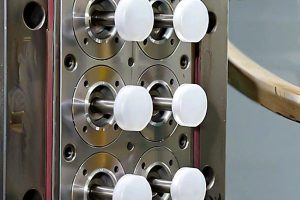
Designing the molde de injeção and selecting the right aço para moldes1 for PPS tooling is critical. GF40 PPS requires H13 hardened to HRC 48–52 for production volumes above 50,000 shots.
““PPS molds must be heated to 120–150°C to develop full crystallinity in the part.””Verdadeiro
PPS crystallizes at elevated temperatures during cooling. Mold temperatures below 100°C result in low crystallinity (under 40%), which means reduced tensile strength, lower heat deflection temperature, and potentially poor chemical resistance. Parts produced at low mold temperatures may post-crystallize after ejection, causing dimensional instability. For applications above 150°C service temperature, mold temperature should be at least 130°C.
““PPS can be processed in standard tooling used for ABS or nylon.””Falso
PPS requires mold temperatures 80–100°C higher than ABS or nylon. Standard cooling circuits cannot be converted to heating circuits without modification. Additionally, the abrasive glass fiber content requires H13 or harder steel; P20 steel used for standard production programs wears 3–5× faster with GF40 PPS. Temperature-rated seals, O-rings, and ejector pin materials must be verified for 150°C continuous operation.
The narrow processing window of PPS also affects injection speed selection. PPS melt viscosity is relatively low at processing temperatures, but it is highly shear-sensitive — excessive injection speed increases melt temperature beyond the narrow optimal window, causing thermal degradation near the gate. Recommended injection speed for PPS is 40–80 mm/s, slower than typical engineering resins. Multi-stage injection profiles are common: slow approach to gate, slightly faster fill through the cavity.
Understanding PPS processing limitations helps set realistic expectations. The material operates within a narrow thermal window — once melt temperature exceeds 360°C or residence time exceeds 15–20 minutes, thermal degradation begins and cannot be reversed. This makes screw design selection critical: use a general-purpose screw with 2:1–2.5:1 compression ratio, not a high-compression nylon screw.
““PPS GF40 achieves continuous service temperature of 200–240°C without additives.””Verdadeiro
PPS inherent thermal stability comes from its molecular structure — sulfide linkages between phenyl rings create exceptional thermal resistance. GF40 grades achieve HDT of 270°C and can operate continuously at 200–240°C. This performance is achieved without flame retardant additives, making PPS inherently UL94 V-0 rated across standard thicknesses from 0.4mm and above.
““PPS regrind can be reused in production parts at 10–25% mix ratio.””Falso
Unlike ABS, PP, or nylon where limited regrind is acceptable, PPS regrind from production runners should not be used in structural parts. Thermal degradation during processing reduces molecular weight, and the shortened glass fibers in regrind reduce mechanical properties below the virgin material specification. For applications where PPS is specified, the material investment cost ($15–$25/kg) is justified — compromising with regrind to save on material cost risks field failures.
How Does PPS Compare to Competing Materials?
PPS offers the best cost-to-performance ratio in the 200–240°C continuous service range, at 20–30% of PEEK’s price. PPS’s primary competition is PEEK for ultra-high-temperature structural applications, and PA66-GF30 for applications that can accept lower temperature ratings. PPS costs $15–$25/kg for GF40 grades — approximately 20–30% of PEEK at $80–$120/kg. For continuous service between 200–240°C, PPS is typically the cost-optimal choice when chemical resistance is also required. PEEK’s advantage lies in applications above 250°C continuous service or where radiation resistance is needed (medical sterilization).
PPS also requires special attention to machine purging procedures. At 300–340°C, residual material can degrade rapidly in dead zones of the barrel. Before running PPS, purge the barrel thoroughly with a semi-crystalline carrier resin like HDPE or PP to remove previous material. After PPS processing, purge with a high-viscosity PP or purging compound to remove PPS from dead zones before cooling the barrel. Never let PPS sit in a hot barrel without active processing for more than 15–20 minutes.
PPS vs Competing High-Performance Polymers
Runner system design has particular importance for PPS due to its fast crystallization and relatively narrow processing window. Cold runners in GF-filled PPS create significant runner scrap that cannot be reused due to glass fiber length reduction and potential degradation during the runner freeze cycle. Hot runner systems with valve gates are strongly preferred for multi-cavity PPS tools — they eliminate runner scrap and enable individual cavity pressure control to compensate for natural flow imbalance in high-GF materials.
PPS versus aluminum comparison is frequently made in automotive underhood applications. GF40 PPS achieves tensile strength of 190 MPa and density of 1.65 g/cm³ versus aluminum at 276 MPa and 2.7 g/cm³. PPS parts weigh one-fifth less than equivalent aluminum parts per unit volume. The economic comparison: injection molded PPS at high volumes achieves $2–$5 per part versus $8–$20 for die cast aluminum on equivalent complex geometries, while supporting the same operating temperatures in non-structural applications.
| Imóveis | PPS GF40 | PEEK GF30 | PA66 GF30 | Alumínio |
|---|---|---|---|---|
| Cont. service temp (°C) | 200–240 | 250–280 | 120–150 | 150–200 |
| Tensile strength (MPa) | 190 | 210 | 180 | 276 |
| Densidade (g/cm³) | 1.65 | 1.58 | 1.36 | 2.70 |
| Material cost ($/kg) | $15–$25 | $80–$120 | $5–$8 | $4–$6 |
| Flame rating | UL94 V-0 | UL94 V-0 | HB (unfilled) | N/A |
| Chemical resistance | Excelente | Excelente | Justo | Justo |
What Are Common PPS Injection Molding Defects and Solutions?
In our experience, Brittle parts are the most common PPS defect. The root causes in order of frequency: (1) insufficient drying — moisture above 0.02% causes hydrolysis, reducing molecular weight and creating brittle parts even at correct processing temperatures; (2) excessive residence time — PPS degrades at temperatures above 360°C or with extended residence time; (3) low mold temperature — insufficient crystallinity leaves the material in a semi-amorphous state; (4) incorrect gate location creating weld lines in high-stress areas.
Flash is common on PPS due to its low melt viscosity at processing temperatures. Causes: excessive injection pressure, worn parting line, or incorrect clamping force calculation. PPS flow easily into 0.01mm parting line gaps — requiring tighter mold tolerances than typical engineering resins. For tools transitioning from ABS to PPS production, inspect and regrind the parting line before the first PPS trial shot.
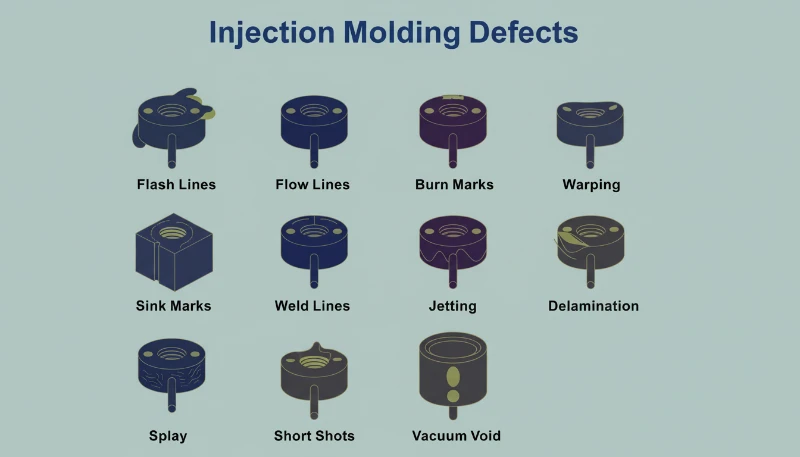
Warping occurs when cooling is non-uniform or when glass fiber orientation is high in one direction. GF40 PPS has significant anisotropic shrinkage — flow direction shrinkage (0.3–0.5%) is lower than transverse shrinkage (0.8–1.2%). This differential shrinkage in complex parts can produce 0.5–2mm warp without balanced cooling and optimized gating. Injection molding process analysis2 before tooling is mandatory for any PPS part with asymmetric geometry or multiple gating points.
A formal DFM3 review is particularly valuable for PPS parts. The combination of high mold temperature requirements, anisotropic shrinkage in GF grades, and narrow processing window means that design errors cost significantly more to fix after tooling than with standard engineering resins. For buyer-side risk control, use a supplier sourcing guide to verify PPS tooling experience, dryer capacity, H13 steel standards, and trial documentation before sending an RFQ.
Frequently Asked Questions About PPS Injection Molding?
What temperature does PPS injection molding require?
PPS injection molding requires barrel temperatures of 300–340°C (nozzle zone hottest at 320–340°C, feed zone at 280–300°C) and mold temperatures of 120–150°C. Mold temperature is critical for crystallinity development — lower mold temperatures reduce crystallinity below 40% and compromise mechanical properties, heat resistance, and dimensional stability. Compared to engineering resins like PC (mold at 70–100°C) or PA66 (mold at 70–100°C), PPS requires significantly more mold thermal energy investment. Thermal oil circulation or electric cartridge heaters are typically used rather than water circuits at this temperature range.
How long does PPS need to be dried before injection molding?
PPS must be dried at 150°C for 4–6 hours using a dehumidifying dryer with dew point control to below -30°C. Unlike nylon where moisture causes surface defects, PPS undergoes irreversible hydrolytic chain scission at processing temperatures when moisture is present — permanently reducing molecular weight and creating brittle parts. A hot-air oven without dew point monitoring is not adequate for production. After opening the dryer hopper, PPS must be processed within 1–2 hours or re-dried. Regrind from PPS should not be used due to thermal degradation risk.
What are the advantages of PPS injection molding?
PPS injection molding offers five key advantages for high-performance applications: (1) continuous service temperature of 200–240°C without significant property loss, (2) inherent UL94 V-0 flame retardancy without additives, making it suitable for electrical and electronics applications, (3) near-zero moisture absorption (0.02%) giving excellent dimensional stability in humid environments, (4) broad chemical resistance — PPS resists virtually all organic solvents below 200°C and many acids and bases, and (5) excellent dimensional precision with glass-filled grades achieving ±0.05mm tolerances in production. PPS GF40 achieves 190 MPa tensile strength at one-fifth the weight of equivalent aluminum components.
What type of mold steel should be used for PPS injection molding?
PPS injection molding requires H13 tool steel (HRC 48–52) minimum for production volumes above 50,000 shots, due to the abrasive content of glass fiber grades (typically GF20–GF65). P20 pre-hardened steel wears 3–5× faster with GF40 PPS versus unfilled ABS, requiring polishing at 80,000–100,000 shots instead of the 300,000+ shots achievable with H13. For chemically aggressive environments or molds used in clean room/medical applications, S136 stainless steel (HRC 48–52) provides corrosion resistance in addition to wear resistance. The H13 premium adds $8,000–$15,000 to single-cavity tooling cost but pays back within 150,000 shots through reduced maintenance.
What is the shrinkage rate for PPS injection molding?
PPS shrinkage is highly anisotropic due to glass fiber orientation. For GF40 PPS: flow direction shrinkage is 0.3–0.5% and transverse direction shrinkage is 0.8–1.2%. Unfilled PPS shrinks 0.6–1.4% isotropically. This anisotropy is critical for mold design — cavity dimensions must account for different shrinkage rates in different directions. Mold flow analysis before tooling is strongly recommended for complex geometries with GF-filled PPS to predict fiber orientation and calculate differential shrinkage across the part, preventing costly warp corrections after T1.
What applications are best suited for PPS injection molding?
PPS injection molding is best suited for: (1) automotive underhood components — thermostat housings, coolant connectors, electrical connectors operating above 150°C continuously, (2) electrical and electronics — connector bodies, lamp sockets, circuit breakers requiring UL94 V-0 flame rating without halogen additives, (3) chemical processing equipment — pump impellers, valve bodies, filter housings exposed to aggressive chemicals at elevated temperatures, (4) industrial equipment — bearing housings, gears, fasteners requiring dimensional stability in high-heat environments, and (5) aerospace and defense — lightweight structural brackets replacing aluminum where weight reduction above 150°C service temperature is required.
-
mold steel: mold steel refers to tool steel grade used to machine mold inserts, selected based on volume and material abrasiveness. ↩
-
Injection molding process analysis: Injection molding process analysis refers to simulation and process review that predicts plastic fill behavior, cooling balance, and gate placement before tooling. ↩
-
DFM: DFM refers to engineering review of part geometry before tooling to prevent molding defects and reduce cycle time. ↩




 EN
EN  ES
ES  FR
FR  DE
DE  PT
PT  AR
AR  RU
RU  JA
JA  KO
KO  IT
IT  NL
NL  TR
TR  PL
PL