 콘텐츠로 건너뛰기

What is injection mold productivity and why does it matter?
사출 금형 생산성은 다음 이후 시간당 양호 부품의 출력입니다 주기 시간1, 가동 시간, 스크랩, 노동, 유지보수 손실이 계산됩니다. 이를 개선하면 부품당 비용을 낮추고, 납기 일정을 보호하며, 장기 생산 과정에서 안정적인 품질을 유지할 수 있습니다.
- 사이클 시간 단축은 금형 생산성을 위한 가장 큰 단일 레버리지입니다
- 컨포멀 냉각 채널은 기존 드릴링에 비해 사이클 시간을 20-40% 단축할 수 있습니다
- 과학적 성형은 반복 가능한 생산 품질을 위해 데이터 기반 매개변수를 사용합니다
- 핫 러너 시스템은 러너 폐기물을 제거하고 부품당 사이클 시간을 단축합니다
- 실시간 모니터링은 예방적 유지보수와 공정 최적화를 가능하게 합니다
Why does this matter so much? In the competitive world of manufacturing, every second and every gram of plastic counts. Improving mold productivity has a direct and powerful impact on the bottom line. It lowers the cost per part, allowing us to offer more competitive pricing to our clients. It increases factory throughput, meaning we can fulfill larger orders on tighter deadlines without compromising quality. High productivity also reduces energy consumption per part, contributing to more sustainable manufacturing practices. Ultimately, a productive mold is the heart of a successful and scalable injection molding operation, turning raw material into value with maximum efficiency.
Consider two molds producing the same part. Mold A runs a 30-second cycle with a 2% scrap rate. Mold B runs a 25-second cycle but has a 10% scrap rate due to quality issues. While Mold B appears faster on paper, its effective productivity is significantly lower because a tenth of its output is unusable. This is why our focus is always on net good parts. In our factory, every project begins with a deep dive into how we can design and operate the tooling for maximum, sustainable productivity from the very first shot.
How does optimizing cycle time boost injection mold productivity?
사출 금형 생산성에 가장 큰 영향을 미치는 단일 요소는 사이클 시간입니다. 대량 생산 금형의 사이클에서 줄어든 매 초는 프로젝트 기간 동안 수천 달러의 절감과 수백 시간의 추가 생산 능력으로 이어질 수 있습니다. 사출 성형 사이클은 여러 단계로 구성됩니다: 금형 폐쇄, 용융 플라스틱 충전, 수축 보상을 위한 압축 및 보압, 부품이 고체가 될 때까지 냉각, 금형 개방, 부품 배출. 우리의 공정 엔지니어는 최적화 기회를 찾기 위해 이 각 단계를 분석합니다.
While filling and packing are critical for part quality, the cooling phase typically consumes the most time—often 50-80% of the entire cycle. This is where the part transitions from a molten state to a solid, stable shape that can be ejected without warping. The faster we can remove heat from the plastic, the shorter the cycle time can be. Therefore, a significant portion of our productivity enhancement efforts are laser-focused on optimizing the cooling process. This can involve everything from adjusting coolant temperature and flow rate to fundamentally redesigning the mold’s cooling system, which we’ll explore next.
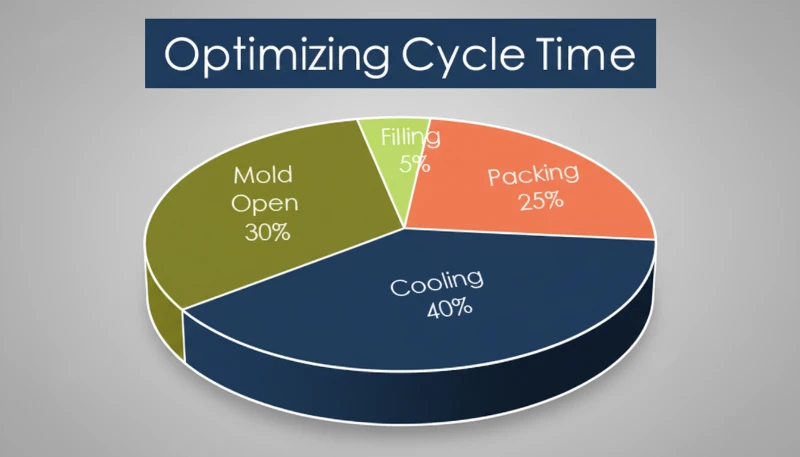
Beyond cooling, we also scrutinize other parts of the cycle. Can the mold open and close faster? Can the robot or operator remove the part more swiftly? We’ve found that even seemingly minor adjustments, like optimizing the ejector stroke or fine-tuning the robot’s path, add up. When a mold is running millions of cycles, a half-second saved is a monumental achievement. It’s a game of inches, or rather, tenths of a second, and our team is relentlessly driven to win it.
What role does mold cooling system design play in productivity?
If cycle time is the king of productivity, then the cooling system is the kingmaker. The ability of a mold to efficiently and uniformly extract heat from the molten plastic dictates not only the cycle time but also the final quality of the part. A poorly designed cooling system leads to long cycles, warping, sink marks, and internal stresses. In our experience, investing in advanced cooling design upfront pays for itself many times over in increased productivity and reduced scrap rates.
전통적인 방법은 금형 베이스에 직선 냉각 채널을 드릴링하는 것입니다. 제작이 간단하고 경제적이지만, 이러한 채널은 특히 복잡한 형상의 부품에 대해 최적의 냉각을 제공하지 못하는 경우가 많습니다. 중요한 핫스팟에서 너무 멀리 떨어져 있거나 부품의 다른 부분을 일정한 속도로 냉각할 수 없을 수 있습니다. 여기서 더 진보된 접근 방식인 conformal cooling2, 게임 체인저가 됩니다. 3D 금속 프린팅(DMLS)과 같은 기술을 사용하여, 재킷처럼 부품의 정확한 윤곽을 따라가는 냉각 채널을 만들 수 있습니다. 이는 접근하기 어려운 영역에서도 놀라울 정도로 균일하고 빠른 열 제거를 보장합니다.
The results are dramatic. We’ve implemented conformal cooling on projects and seen cycle time reductions of 30-50% while simultaneously improving part straightness and dimensional stability. The key is to ensure turbulent flow within the channels, as it’s far more effective at transferring heat than laminar (smooth) flow. Our engineers use advanced fluid dynamics simulation software to design and validate cooling circuits, optimizing channel diameter, path, and coolant flow rate to achieve maximum turbulent flow and thermal efficiency. The design of the cooling system is one of the most powerful levers we can pull to supercharge a mold’s productivity.
““컨포멀 냉각 채널은 복잡한 부품에서 사이클 시간을 30% 이상 단축할 수 있습니다.””True
This is true. By following the part’s geometry, conformal cooling channels provide more uniform and efficient heat extraction compared to conventional straight-drilled lines. This leads to significantly faster solidification, shorter cooling times, and as a result, reduced overall cycle times, often exceeding a 30% improvement.
““금형 냉각에 냉수수를 사용하는 것이 항상 가장 경제적이고 효율적인 방법입니다.””False
This is false. While seemingly cheap, tap water contains minerals that cause limescale buildup inside cooling channels. This scale acts as an insulator, drastically reducing cooling efficiency, increasing cycle times, and requiring costly and frequent descaling. We use closed-loop systems with treated, chilled water to ensure consistent temperature and prevent buildup, which is far more effective and economical in the long run.
The impact of mold productivity optimization extends beyond just faster cycle times. When injection molds operate at peak efficiency, manufacturers benefit from reduced scrap rates, lower energy consumption per part, and more predictable maintenance schedules. A well-maintained, properly designed injection mold consistently outperforms a neglected one — often producing 20–40% more parts per shift with the same machine investment.
How does regular mold maintenance prevent downtime and improve output?
An injection mold is a high-precision piece of equipment that operates under immense pressure and temperature. Thinking you can run it for millions of cycles without regular care is a direct path to catastrophic failure and costly downtime. At ZetarMold, we treat mold maintenance not as a chore, but as a core productivity strategy. A well-maintained mold runs more reliably, produces higher-quality parts, and lasts significantly longer. Proactive maintenance is always cheaper than reactive repair.
Our maintenance program is tiered based on the number of cycles a mold has run. After a set number of shots, a mold is pulled for Level 1 maintenance. This involves a thorough cleaning of the parting line surfaces, vents, and cavities by our skilled toolmakers. They inspect for any signs of wear, damage, or residue buildup (outgassing) that could cause flash or cosmetic defects. Ejector pins, slides, and other moving components are cleaned and re-lubricated. This simple procedure, performed regularly, prevents a host of common molding problems and ensures the mold is ready to run at peak efficiency.
For more extensive Level 2 or Level 3 maintenance, the mold is completely disassembled. Every single component is inspected, measured against its original specifications, and cleaned. Any worn or damaged parts—like gate inserts, leader pins, or ejector sleeves—are replaced with new ones from our spare parts inventory, which we establish at the beginning of every project. This preventative approach ensures that a worn-out pin doesn’t break mid-production, which could cause major damage to the mold cavity and lead to days or even weeks of unplanned downtime. For our clients, this commitment to maintenance translates directly to reliability and on-time delivery.
What material and process parameter adjustments enhance mold efficiency?
Beyond the physical mold and machine, the materials and process parameters are the dynamic variables we can adjust to unlock further productivity. The choice of plastic resin itself has a significant impact. Some materials, like high-flow polypropylene or ABS, are formulated to fill the mold more easily and at lower pressures. Using these materials can sometimes allow for faster injection speeds and shorter fill times. However, material selection is almost always dictated by the part’s end-use requirements, so our primary focus is on optimizing the process for the specified material.
여기서 Scientific Molding3 come into play. Instead of relying on guesswork or “tribal knowledge,” our process engineers use a data-driven approach to establish a robust and efficient process window. We systematically decouple and optimize each phase of the process. For example, we conduct rheology studies to determine the ideal melt temperature and injection speed to fill the part without causing degradation or shear stress. We perform pressure-loss studies to understand how much pressure is needed to move the plastic through the nozzle, runner, gate, and cavity.
Once the mold is filled, we optimize the packing phase. By carefully controlling pack pressure and time, we ensure enough material is forced into the cavity to compensate for shrinkage as the part cools, preventing sinks and voids without creating flash or internal stress. We fine-tune back pressure during screw recovery to ensure a homogenous melt without adding excessive time to the cycle. This methodical, scientific approach results in a highly stable, repeatable process that maximizes the production of good parts while minimizing scrap and cycle time. It transforms molding from an art into a science, which is essential for peak productivity.
How does automation technology improve injection molding productivity?
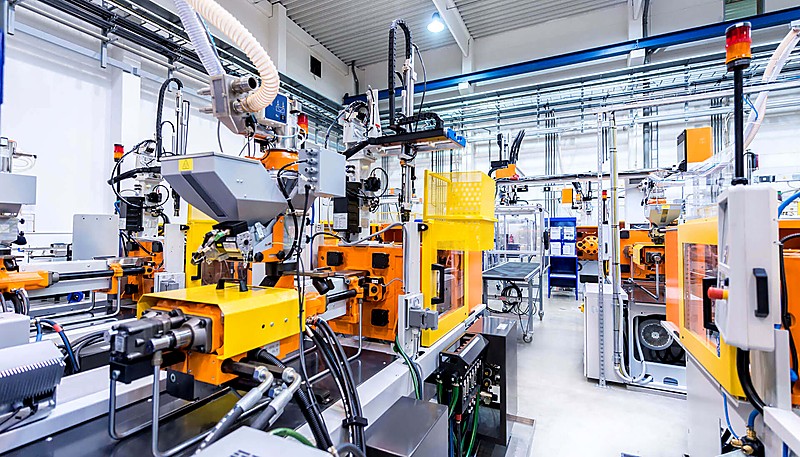
In a modern injection molding facility, automation is not a luxury; it’s a fundamental component of a productive and competitive operation. The most common form of automation is the use of robots, or “pickers,” to remove parts from the mold. This alone provides a huge productivity boost over manual operation. A robot moves with perfect consistency every single time, enabling a more stable and often shorter cycle. It also eliminates the risk of damage to the mold that can occur during manual part removal and improves operator safety.
However, the impact of automation extends far beyond simple part removal. We leverage “downstream” automation to perform tasks that would otherwise require manual labor, increasing throughput and consistency. For example, a six-axis robot can take a part from the mold and present it to a vision system for automated quality inspection. It can then move the part to a station for gate trimming, place it in an assembly, or even stack it directly into its final packaging. This integration of post-molding operations creates a seamless, efficient production cell, reducing labor costs, minimizing handling damage, and freeing up our skilled technicians to focus on more complex tasks.
““6축 로봇은 복잡한 성형 후 작업에 대해 3축 로봇보다 더 큰 유연성을 제공합니다.””True
This is correct. While a three-axis (Cartesian) robot is excellent for simple pick-and-place tasks, a six-axis (articulated) robot can mimic the motion of a human arm. This allows it to perform intricate tasks like rotating a part for inspection, precise trimming, inserting it into an assembly at an angle, or complex palletizing, offering far greater value in a fully automated cell.
““최적화되지 않은 사출 성형 공정을 자동화하면 자동으로 그 비효율성이 해결될 것입니다.””False
This is a common misconception. Automation simply executes a process faster and more consistently. If the underlying process is inefficient—for example, if it produces a high scrap rate—automation will just produce bad parts at a faster rate. The process must be optimized first using principles of Scientific Molding, then automation can be applied to lock in and amplify those efficiencies.
Another powerful application is in-mold automation. Techniques like in-mold labeling (IML) or in-mold decorating (IMD) use a robot to place a decorative film or label into the mold before injection. The plastic is then shot over the label, permanently fusing it to the part. This eliminates an entire secondary operation, saving time and labor while producing a more durable and high-quality finish. By strategically implementing automation, we transform the injection molding machine from a standalone unit into the heart of a highly productive, integrated manufacturing system.
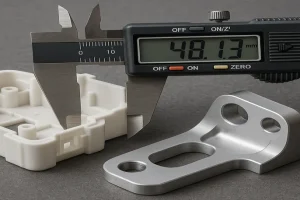
최적화된 금형으로 제작된 고품질 사출 성형 부품
의 생산성은 사출 금형 는 근본적으로 설계 단계에서 결정됩니다. 첫 번째 강철이 절단되기 훨씬 전에, 우리의 엔지니어와 금형 설계자는 최대 생산량과 장수명을 위해 금형 설계를 최적화하기 위해 고객과 협력합니다. 견고한 설계는 더 빠르게 운전될 뿐만 아니라 유지보수가 덜 필요하고 수백만 사이클 동안 고장 가능성이 적습니다. 이 공정은 종종 생산성을 위한 설계(DFM)라고 불리며 매우 중요합니다.
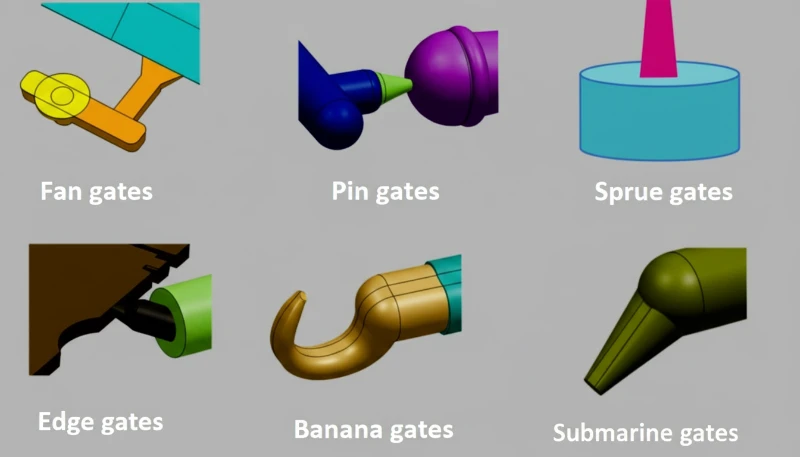
생산성에 영향을 미치는 가장 중요한 설계 선택 중 하나는 핫 러너 시스템과 기존의 콜드 러너 사용 여부입니다. 콜드 러너는 플라스틱을 캐비티로 전달하는 금형 내 채널입니다. 이 러너는 부품과 함께 고화되어 폐기물로 배출됩니다(그 후 재분쇄 및 재활용됨). 반면, 핫 러너 시스템은 게이트까지 플라스틱을 용융 상태로 유지하는 내부 가열 매니폴드입니다. 이는 러너를 완전히 제거하여 재료를 절약하고, 이차 재분쇄 단계를 피하며, 냉각해야 할 부피 큰 러너가 없기 때문에 종종 더 빠른 사이클 시간을 가능하게 합니다.
초기 비용은 더 높지만, 대량 생산의 경우 핫 러너 시스템이 거의 항상 더 생산적이고 경제적인 선택입니다.
Other design elements we focus on include the number of cavities, the ejection system, and the materials used for the mold itself. A multi-cavity mold increases output per cycle, but it’s crucial to ensure all cavities fill and cool uniformly, a challenge we solve with advanced flow simulation software. The ejection system must be robust enough to push parts out reliably for millions of cycles without sticking or causing damage. We also strategically use different steel types and coatings. For high-wear areas like gates or shut-offs, we use hardened tool steels. For high-thermal-load areas, we might use inserts made from highly conductive beryllium-copper alloy to pull heat out faster. These design-level decisions are the foundation of a truly productive mold.
How can real-time monitoring and data analysis optimize injection mold performance?
실시간 모니터링은 기계 및 금형 센서 데이터를 활용하여 출력이 저하되기 전에 사이클 시간, 냉각, 압력, 유지보수를 조정하는 것입니다. 이는 생산 신호를 더 빠른 문제 해결, 낮은 스크랩률, 예측 가능한 금형 성능으로 전환합니다.
Our strategy is to capture this data and turn it into actionable intelligence. We use specialized Manufacturing Execution Systems (MES) to monitor the performance of every machine in our factory in real-time. This system tracks key metrics like cycle time, uptime, downtime, and scrap rate. If a machine’s cycle time deviates from the established standard by even a fraction of a second, an alert is triggered, allowing a process technician to investigate immediately. This prevents small issues from escalating into major problems that could cause hours of downtime or a batch of bad parts.
우리는 금형 내 센서를 사용하여 이를 한 단계 더 발전시킵니다. 압력 및 온도 센서를 금형 캐비티 내부에 직접 배치함으로써, 충전, 압축 및 냉각 단계 동안 플라스틱이 정확히 어떤 경험을 하는지 볼 수 있습니다. 이 데이터는 공정 최적화와 품질 관리에 매우 귀중합니다. 예를 들어, 부품의 캐비티 압력 곡선이 우리가 양호하다고 알고 있는 '골든 부품'의 곡선과 동일하다면, 측정조차 하지 않고도 부품이 모든 품질 사양을 충족한다고 매우 확신할 수 있습니다. 이는 실시간 품질 보증을 가능하게 하고 예측적 유지보수를 가능하게 합니다.
데이터 추세를 분석함으로써, 벤트가 막히기 시작하거나 부품이 마모되기 시작할 때를 예측하고, 고장을 유발하기 전에 유지보수를 예약할 수 있습니다. 이러한 데이터 기반 접근 방식은 사출 금형 생산성 극대화의 미래입니다.

사출 금형 생산성에 관한 자주 묻는 질문?
What is the single biggest factor affecting injection mold productivity?
While many factors are important, the most significant is almost always the cycle time. The cooling portion of the cycle typically offers the greatest opportunity for improvement. Every second saved on the cycle time for a high-volume part has a massive cumulative effect on total output and cost-per-part.
How often should a high-volume injection mold be maintained?
이는 금형의 복잡성, 사용되는 재료(일부는 더 마모되거나 부식성이 강함), 그리고 총 사이클 수에 따라 달라집니다. 일반적으로, 우리는 8-24시간의 가동 시간마다 기본적인 프레스 내 청소 및 검사(레벨 1)를 수행합니다. 더 철저한 예방 유지보수(레벨 2)로서 금형을 프레스에서 분리하는 작업은 일반적으로 25,000에서 100,000 사이클마다 예정됩니다. 완전한 분해 및 정밀 검사(레벨 3)는 250,000에서 1,000,000 사이클마다 이루어질 수 있습니다.
Is a hot runner system always more productive than a cold runner?
대량 생산의 경우, 핫 러너 시스템은 거의 항상 더 생산적인 선택입니다. 이 시스템은 러너에서 발생하는 재료 낭비를 없애고, 재분쇄의 필요성을 피하며, 냉각 및 배출해야 할 고체 러너가 없기 때문에 종종 더 빠른 사이클을 가능하게 합니다. 그러나 소량 생산, 프로토타이핑 또는 특정 온도에 민감한 재료의 경우, 콜드 러너 시스템의 단순성과 낮은 초기 비용이 더 적합할 수 있습니다.
Can a family mold (molding different parts in the same mold) increase productivity?
Yes, a family mold can increase productivity by producing a complete set of related parts in a single cycle. However, it presents significant design challenges. The parts must be of similar size and volume, and the runner system must be carefully balanced to ensure all cavities fill at the same rate and pressure. If not balanced correctly, it can lead to quality issues like shorts, flash, or warping in some of the parts, which would negate any productivity gains.
What is the difference between productivity and efficiency in injection molding?
While often used interchangeably, they have distinct meanings in our factory. Productivity is a measure of output over time (e.g., good parts per hour). 효율성 is a ratio of output to input (e.g., good parts per kilowatt-hour of energy or gram of material). Our goal is to maximize both: we want to make as many high-quality parts as possible (productivity) while using the minimum amount of resources to do so (efficiency).
사출 금형의 생산성 향상은 단일 묘책이 아니라 설계, 금형 제작, 공정, 유지보수를 통합하는 지속적이고 종합적인 노력입니다. 초기 DFM 분석부터 실시간 데이터 모니터링의 최종 구현까지, 모든 단계는 최적화의 기회를 제공합니다. 우리 자신의 공장에서 본 것처럼, 고급 냉각 설계를 통한 사이클 시간 단축, 엄격한 예방 유지보수 일정 수립, 데이터 기반 과학적 성형 원칙 활용과 같은 핵심 영역에 초점을 맞추는 것이 기초입니다. 이러한 것들이 핫 러너 시스템, 전략적 자동화, 데이터 분석과 같은 현대적 발전과 결합될 때, 처리량 증가, 비용 절감, 품질 향상의 잠재력은 엄청납니다.
궁극적으로, 생산적인 금형은 경험 있는 제조 팀과 잘 설계된 도구 간의 협력 관계의 결과로, 최대 가치를 달성하기 위해 조화롭게 작동합니다.
Need a Quote for Your Injection Molding Project?
Get competitive pricing, DFM feedback, and production timeline from ZetarMold’s engineering team.
무료 견적 요청 → 사출 성형 완전 가이드를 통해 포괄적인 개요를 확인하세요.
-
주기 시간: 사이클 시간은 단일 사출 성형 샷에 대해 금형 폐쇄부터 금형 개방까지의 총 경과 시간으로 정의되며, 열가소성 부품의 경우 일반적으로 15~60초입니다. ↩
-
conformal cooling: 컨포멀 냉각은 금형 캐비티의 3D 윤곽을 따라가는 냉각 채널을 의미하며, 기존의 직선 드릴 채널에 비해 20–40%의 사이클 시간 단축을 제공합니다. ↩
-
Scientific Molding: 과학적 성형(디커플드 성형이라고도 함)은 데이터 기반 방법론으로, 충전, 압축 및 보압 단계를 분리하여 반복 가능한 고품질 생산을 달성합니다. ↩




 EN
EN  ES
ES  FR
FR  DE
DE  PT
PT  AR
AR  RU
RU  JA
JA  KO
KO  IT
IT  NL
NL  TR
TR  PL
PL 