 콘텐츠로 건너뛰기
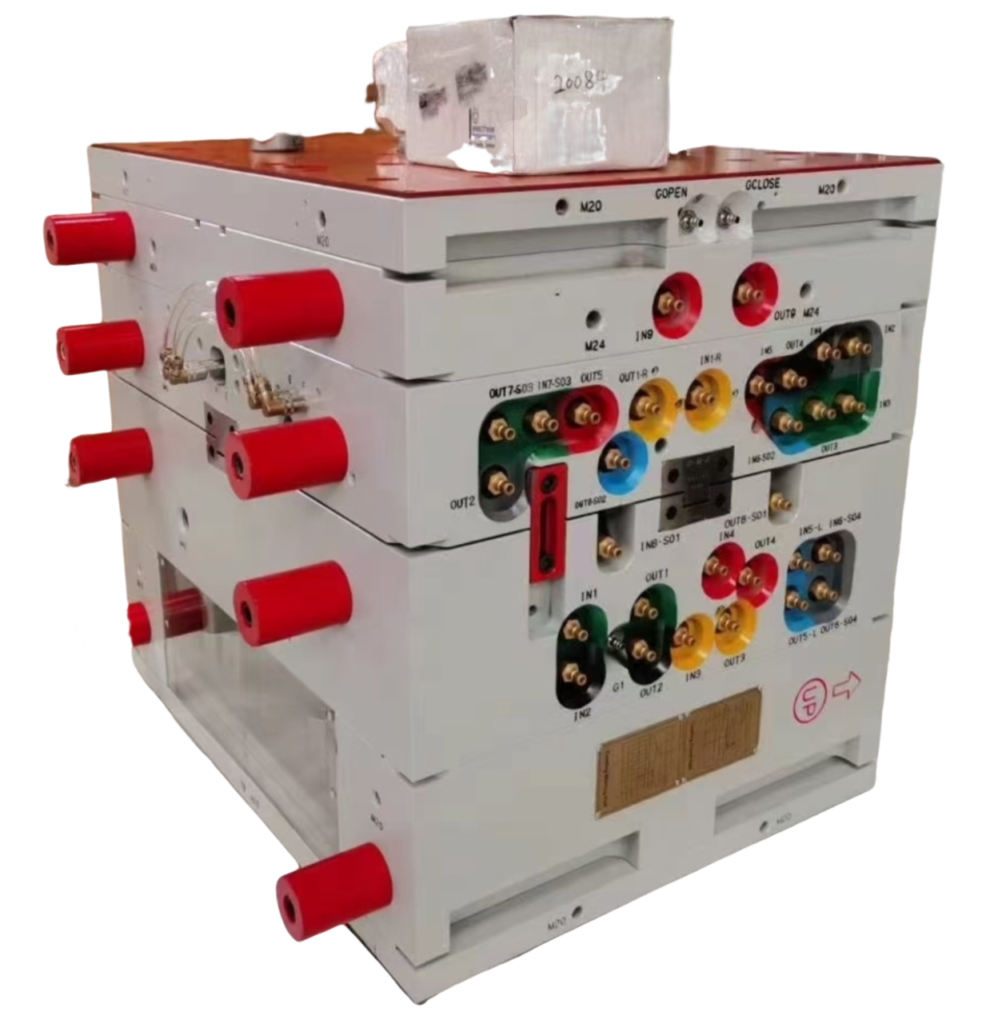
- P20는 대부분 생산 금형(최대 400,000 주입)의 기본 선택입니다 — 가공 비용이 저렴하고 용접 수리가 쉬우며 대부분 열가소성 수지에 충분합니다.
- H13은 고마모 응용 분야(유리 섬유 강화 나일론, POM)에서 P20보다 3배 우수하며, 300°C 이상의 온도에서도 연화 없이 견딥니다.
- PVC, POM 같은 부식성 수지와 투명 광학 부품에는 S136 (420 스테인리스)가 필수입니다 — HRC 50–52 마감으로 미러 폴리싱을 유지합니다.
- 718H bridges the gap between P20 and H13 — better than P20 without S136’s cost premium, ideal for POM and fiber-filled materials.
- ZetarMold’s selection rule: P20 for standard, H13 for abrasive/high-volume, S136 for optical/corrosive, 718H when budget is the constraint.
금형강이란 무엇이며 왜 금형 수명을 결정하나요?
금형강은 사출 금형 코어와 캐비티가 가공되는 하중 지지 재료입니다. 올바른 선택은 생산 기간 동안 공구 수명, 표면 마감 품질, 사이클 시간, 그리고 총 공구 비용을 결정합니다.
Your mold steel choice is locked in before anyone touches the CNC machine. Once the steel is ordered and roughed out, changing grades means scrapping the block and starting over — typically a $3,000–$15,000 mistake. Engineers who get it wrong pay once. Engineers who get it right don’t think about mold steel for the next 500,000 shots.
핵심 절충점은 간단합니다: 더 단단한 강은 수명이 더 길고 내마모성이 더 좋지만, 가공 및 수리 비용이 더 많이 듭니다. 예경강1P20 같은 예경강은 HRC 28–36 범위입니다 — 빠르게 밀링할 수 있을 정도로 충분히 연하고 대부분 열가소성 수지에 충분히 경합니다. H13과 S136 같은 완전 경화 강재는 열처리 후 HRC 45–55에 도달하며 더 많은 3 time and care, but they’re the only viable option for abrasive resins or optical transparency.
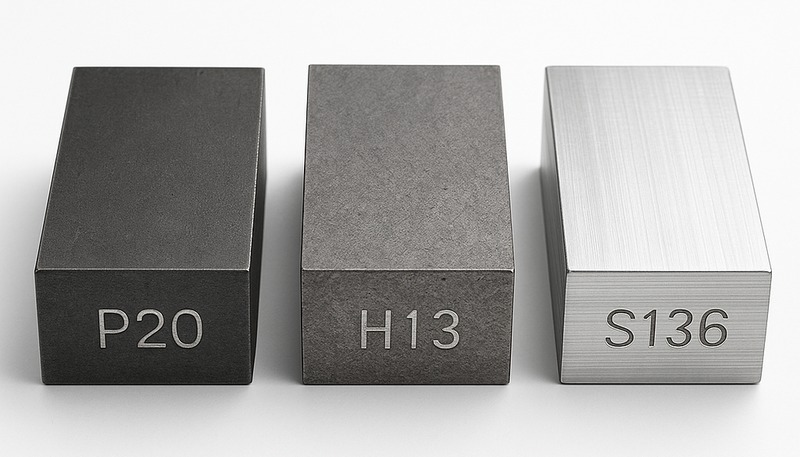
금형강 선택을 결정하는 네 가지 특성: 2 (내마모성), 인성(균열 저항성), 4 (수지와의 화학적 호환성), 그리고 가공성(캐비티 가공 및 수리 실행 비용)입니다. 단일 강철이 이 네 가지를 모두 극대화하지는 않습니다 — 모든 선택은 특정 수지, 생산량, 표면 마감 요구 사항에 맞춰 조정된 절충안입니다.
P20: 일반 목적 금형의 산업 기본값
P20 is a pre-hardened, low-alloy steel delivered at HRC 28–36, ready to machine without additional heat treatment. It covers approximately 60% of all production injection molds worldwide — not because it’s the best steel in every category, but because it’s good enough in all of them.
P20는 대부분 상용 열가소성 수지를 문제 없이 처리합니다: ABS, PP, PE, PC 및 표준 나일론 등급 모두 강재를 손상시키지 않고 작동합니다. 예경강 상태는 표준 카바이드 도구로 직접 CNC 밀링할 수 있고, 블록을 파손하지 않고 작은 손상을 용접 수리할 수 있으며, 특별 폴리싱 없이 Ra 0.4–0.8 µm 범위의 표면 마감을 얻을 수 있습니다. 최대 400,000 주입까지 P20는 비용 최적 선택입니다.
| 속성 | 값 / 범위 | 실질적 의미 |
|---|---|---|
| 경도 (제공) | HRC 28–36 | 즉시 가공; 열처리 필요 없음 |
| Tensile strength | ~900–1050 MPa | 최대 200 MPa의 표준 사출 압력 처리 가능 |
| 5 | 29–36 W/(m·K) | 보통; 냉각 채널을 ≤25mm 간격으로 추가 |
| Weldability | Good | 블록을 어닐링하지 않고 캐비티 수리 가능 |
| Surface finish | Ra 0.4–0.8 µm (연마됨) | 반광澤 부품에 적합; 광학 등급은 아닙니다 |
| 일반적인 사이클 수명 | 300,000–500,000 shots | 강철 교체 없이 중간 규모 생산 |
| 수지에 가장 적합 | ABS, PP, PE, PC, 표준 PA | Not for PVC, POM above 50% cycle share, glass-filled >20% GF |
Where P20 fails: abrasive resins with glass content above 20–30% will wear P20 cavities noticeably by 200,000 shots, producing dimensional drift and surface degradation. If you’re running PA66-GF30 or PEEK, P20 is not the answer. And P20 has zero corrosion resistance — PVC’s hydrochloric acid off-gas will pit the cavity surface within weeks of production.
718H (also called P20+Ni) is a nickel-modified variant that improves on standard P20 in two ways: better polishability (Ra down to 0.2 µm) and slightly higher toughness. If you’re running clear ABS or want better surface consistency across a high-cavity tool, 718H at an ~8–12% cost premium over P20 is worth considering.
H13: 대량 생산 및 마모성 수지에 최적의 선택
H13은 진공 담금질과 템퍼링 후 HRC 46–54에 도달하는 열간 작업용 공구강입니다. 이 경도에서 유리 섬유 강화 수지로 인한 마모에 대한 저항성이 P20보다 약 3배 더 우수합니다 — 이는 PA66-GF30과 POM을 사용하는 당사의 자체 생산 프로그램에서 검증된 관찰 결과입니다.
H13’s key advantage is thermal stability. Its chromium-molybdenum-vanadium alloy composition resists softening at elevated temperatures — critical for high-speed cycles and heat-sensitive resins that demand barrel temperatures above 280°C. Unlike P20, H13 maintains its hardness throughout continuous multi-shift production without creep or cavity deformation.
At ZetarMold, H13 steel outlasts P20 by 3× for glass-filled nylon at >30% GF. On a 16-cavity PA66-GF30 automotive connector tool, we switched from P20 to H13 after the first production run showed cavity wear at 180,000 shots. The H13 tool exceeded 600,000 shots before first regrind — saving the customer two full cavity rebuilds worth roughly $18,000.
H13의 단점은 가공 비용입니다. 강재는 연화 상태(HRC ~18–22)에서 가공 후 진공 열처리를 위해 보내야 하므로 제조 순서가 더 길고 비용이 높습니다: 조 CNC → 세미 마무리 → 열처리 → 마무리 연삭 → 정밀 디테일 EDM. 동급 P20 금형보다 도구 비용이 25–40% 더 높을 것으로 예상됩니다.
H13 is the right call when: (1) the resin contains >20% glass or mineral filler, (2) expected production volume exceeds 500,000 shots, (3) cycle temperatures are consistently above 280°C, or (4) the part requires tight dimensional tolerance that P20 cannot maintain over long runs.
“H13 is the correct default for glass-filled engineering resins above 20% GF.”True
유리 섬유는 캐비티 벽에 대해 연마 입자 역할을 합니다. HRC 30의 P20은 PA66-GF30으로 200K 샷에서 눈에 띄게 마모되는 반면, HRC 50의 H13은 동일한 수지로 600K 샷 이상을 측정 가능한 치수 변동 없이 처리합니다.
“금형 수명을 극대화하려면 모든 사출 금형에 H13을 항상 사용해야 합니다.”False
H13은 P20보다 가공 및 열처리 비용이 25~40% 더 높습니다. 500K 샷 미만의 표준 ABS, PP 또는 PE 부품의 경우, P20은 상당히 낮은 초기 비용으로 충분한 이상의 금형 수명을 제공합니다. 과도하게 고강도 강종을 선택하는 것은 더 나은 냉각 설계나 DFM 최적화에 투자할 수 있는 예산을 낭비합니다.
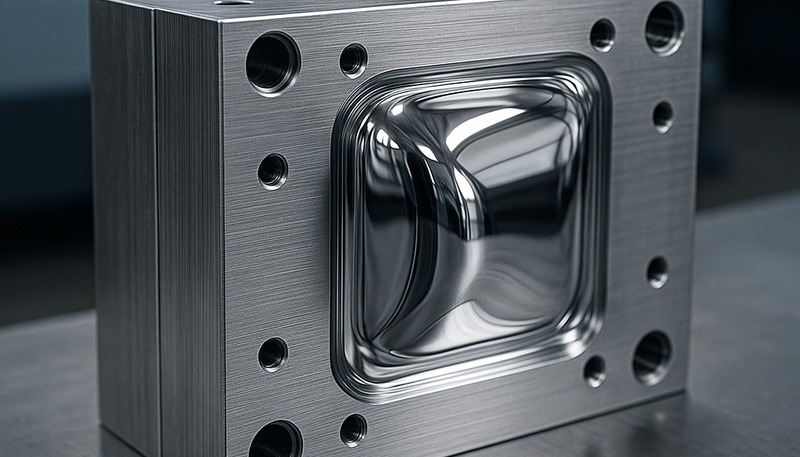
S136 및 420 스테인리스: 부식이나 표면 결함을 허용할 수 없는 경우
S136 (AISI 420 스테인리스와 동급, Uddeholm 명칭)은 13.6% 크롬 함량을 가진 마르텐시틱 스테인리스 도구강으로 열처리 후 HRC 50–52를 제공합니다. 주 기능은 부식 저항성입니다 — 작업장 습도뿐만 아니라 PVC, POM 및 난연성 수지 분해 시 생성되는 산에도 저항합니다.
S136이 필수인 세 가지 상황: PVC 처리 (배럴 온도에서 염산 발생), 210°C 이상에서 POM-C 또는 POM-H 운전 (포름알데히드 가스가 일반 강재를 공격), Ra ≤ 0.025 µm 미러 폴리시가 필요한 광학급 투명 부품 생산. S136은 미세한 카바이트 구조가 고광택 연마를 받고 유지할 수 있어 그 미러 마무리를 달성할 수 있습니다 — P20과 H13은 불가능합니다.
| 속성 | S136 (Uddeholm) | 420 스테인리스 (일반) |
|---|---|---|
| Chromium content | 13.6% | 12~14% |
| 경도 (열처리 후) | HRC 50–52 | 추천 수지 |
| 미러 폴리시 가능성 | Ra ≤ 0.025 µm | Ra ≤ 0.05 µm |
| 내식성 | 우수 | Good |
| P20 대비 가공성 | 가공 난이도 약 40% 증가 | 가공 난이도 약 35% 증가 |
| Weldability | 예열/후열 필요 | 예열/후열 필요 |
| P20 대비 일반적인 비용 추가 | 50–70% | 35~50% |
S136은 P20보다 킬로그램당 50–70% 비용이 더 들며 엄격한 가공 프로토콜이 필요합니다: 용접 전 예열, 열처리 후 제어된 냉각, 그리고 미세 균열 방지를 위한 전용 EDM 파라미터. 그러나 240°C에서 PMMA를 사용하며 광학 투과율 >92%가 필요한 렌즈 금형에는 다른 선택지가 없습니다. 비용은 선택 사항이 아닙니다 — 사양의 가격입니다.
한 가지 중요한 차이점: S136은 염욕 방식보다 진공 경화를 선호합니다. 진공 경화는 더 깨끗한 표면 산화물과 더 나은 치수 안정성을 제공하여 열처리 후 마무리 가공 여유를 줄입니다. 구매 발주서에 진공 경화를 지정하는 것은 꼼꼼함이 아닙니다 — 최종 미러 표면 품질에 직접 영향을 미칩니다.
718H 및 NAK80: 복잡한 형상에 대한 예비 경화 대안
718H(718 또는 P20+Ni로도 표기)와 NAK80(P21 등급)은 표준 P20과 완전히 심부 경화된 등급 사이의 간극을 채우는 사전 경화 강종입니다. 둘 다 HRC 33~38 상태로 도착하며, 추가 가공 후 열처리가 필요하지 않아 리드 타임을 1~2주 단축하고 복잡한 형상에서 열처리 변형 위험을 제거합니다.
718H는 니켈 함량(약 1%)으로 인해 표준 P20보다 더 나은 광택 성능을 달성하며, 이는 결정 구조를 미세화합니다. 투명 ABS, 투명 PC/ABS 혼합물 또는 SPI A3–B1 마감이 필요한 부품의 경우, 718H는 사전 경화 처리된 선택 옵션입니다. NAK80는 Al, Cu, S의 첨가로 더 나아가 시효 경화 능력과 우수한 텍스처링 성능을 제공합니다 — 텍스처 처리된 표면 또는 입자 에칭된 자동차 내장 패널에 이상적입니다.
“718H은 정밀 공차 복잡 금형 인서트에서 열처리 변형 위험을 제거합니다.”True
718H는 제조소에서 사전 경화 처리되므로, 캐비티 가공은 최종 강철에서 수행됩니다 — 담금질과 템퍼링으로 인한 치수 변화가 없습니다. 복잡한 측면 작동, 슬라이더 및 허용 오차가 ±0.02mm보다 엄격한 인서트의 경우, 이 예측 가능성은 완전 경화 등급에 비해 진정한 장점입니다.
“NAK80과 718H은 기계 가공 변경 없이 P20에 바로 적용 가능한 업그레이드입니다.”False
NAK80의 시효 경화 반응과 718H의 약간 더 높은 경도는 표준 P20에 비해 조정된 절삭 속도와 이송 속도를 필요로 합니다. 동일한 매개변수에서 공구 마모는 약 15–20% 증가합니다. 이는 관리 가능하지만, 이를 무시하면 표면 진동과 조기 공구 파손을 유발합니다.

Steel Selection Decision Framework: How to Choose the Right Grade
강종 선택 결정은 두 가지 입력에서 파생됩니다: 성형하는 수지와 예상 생산량. 예산, 리드 타임, 표면 마감 등 다른 모든 요소는 이 두 기준을 중심으로 조정됩니다.
| Resin Type | 생산량 | Recommended Steel | 이유 |
|---|---|---|---|
| ABS, PP, PE, PC (무충전) | < 500K 샷 | P20 / 718H | 비용 최적; 우수한 가공성 |
| ABS, PP, PE, PC (무충전) | > 500K 샷 | H13 (HRC 48+) | 경도는 수명을 1M 샷 이상으로 연장 |
| PA66-GF30, POM, PBT-GF30 | 어떤 양이든 | H13 (HRC 48+) | 유리 연마; P20 빠른 마모 |
| PVC, POM (부식성) | 어떤 양이든 | S136 (HRC 50+) | 필수 내식성 |
| 광학 PMMA, PC 렌즈 | 어떤 양이든 | S136 (HRC 50+) | 미러 폴리시 Ra ≤ 0.025 µm 필요 |
| PA66, ABS/PC (반투명) | 200K~800K 샷 | 718H 또는 NAK80 | 완전 열처리 없이 P20보다 우수한 표면 |
| PEEK, PPS, LCP | 어떤 양이든 | H13 or S136 (case-by-case) | High process temperatures + abrasion |
A common mistake is selecting steel grade in isolation from the cooling system design. P20’s thermal conductivity of 29–36 W/(m·K) is already adequate for most cycle time targets — but if you’re switching to H13 (32–34 W/(m·K)) or S136 (24–28 W/(m·K)), review your cooling channel placement. S136’s lower thermal conductivity can increase cycle time by 5–10% versus P20 if channels are not relocated closer to the cavity wall.
A second factor engineers overlook is lead time. P20 is widely stocked at mold steel distributors across China, the US, and Europe — typical delivery is 3–5 business days. H13 in large block sizes (above 200mm thick) may require 10–15 days from Daido or Finkl. S136 (Uddeholm) has the longest lead time: 2–4 weeks for custom-cut blocks. If your project timeline is tight, confirm steel availability before finalizing the grade specification. Switching from S136 to 718H due to lead time adds 20–25% cost but can save 2–3 weeks of schedule.
Volume projection accuracy is the most underappreciated risk in steel selection. Customers who specify P20 based on a 200K shot estimate and then extend the program to 800K shots will face a mid-production cavity regrind or replacement. If there is real uncertainty about final production volume, bias toward H13. The incremental cost is 25–40% higher upfront, but it eliminates the risk of a $15,000–$40,000 cavity rebuild at year two of the program when demand unexpectedly grows.
At ZetarMold, our steel selection review is part of every DFM sign-off before T0 authorization. We’ve seen customers spec P20 for a POM bushing tool — a combination that generates formaldehyde pitting within 30,000 shots. Switching to S136 mid-production is a full cavity rebuild. The 5-minute conversation at DFM stage saves four figures in rework.
Budget pressure often pushes engineers toward P20 when S136 or H13 is the right call. A decision framework that acknowledges real cost: if the mold is expected to run more than 800,000 shots and the resin is even mildly abrasive, the incremental cost of H13 over P20 typically breaks even at 300,000 shots through reduced regrind and rework costs. Model the total cost of ownership, not just the upfront tooling quote.

One more steel selection variable engineers undervalue: weld repairability. P20 can be welded with standard MIG or TIG process without preheat above 150°C. H13 requires 300–400°C preheat, careful interpass temperature control, and post-weld temper — each repair step adds cost and extends tooling downtime. S136 requires even more precise thermal management to avoid martensite cracking. For molds expected to undergo frequent engineering changes or cavity repairs, the weld repair protocol matters as much as the base hardness specification.
Cavity surface area also influences steel cost more than most engineers realize. A 300×200mm cavity block in S136 can cost $2,000–$4,000 in raw steel before a single tool path is run. At P20 pricing, the same block runs $600–$900. On a 32-cavity hot runner tool, that $3,000 difference per block compounds quickly. For high-cavity tools where only a subset of cavities are high-wear, consider using S136 for the first few cavities while running P20 on the remainder — a hybrid approach that reduces total tooling cost by 20–30% while maintaining surface quality where it matters.
Mold steel selection also interacts with the cooling system design. Conformal cooling channels machined by metal AM (additive manufacturing) or gun-drilling are only economical in P20 and H13; S136’s high chromium content makes it more challenging for deep-hole drilling with standard equipment. If your cooling design requires channel diameters below 6mm at depths beyond 150mm, verify your toolmaker’s equipment capability against the specified steel grade before committing to the design.
Surface Treatment Options: Nitriding, PVD, and Hard Chrome
Surface treatment extends the working life of any mold steel by adding a wear-resistant layer without changing the bulk material. The three most common treatments in injection mold practice are gas nitriding, PVD (Physical Vapor Deposition) coating, and hard chrome plating.
Gas nitriding penetrates 0.1–0.3mm into the steel surface, creating a nitrogen-diffused case hardness of HRC 65–70 without dimensional change. It works on P20 and H13; it does not work well on stainless grades because the chromium oxide layer blocks nitrogen diffusion. Nitriding adds approximately $200–$800 per cavity set and extends P20 tool life in mildly abrasive conditions by 40–80%.
PVD coatings (TiN, TiAlN, CrN) apply a 2–5 µm hard layer at temperatures below 500°C, preserving the base steel’s temper. TiN is gold-colored, HRC 80+, and improves wear and release simultaneously. CrN provides better corrosion resistance than TiN. PVD is the preferred treatment for slides, cores, and other moving inserts that experience cyclic contact stress — it reduces galling risk and can be reapplied 2–3 times before the insert must be replaced.
Hard chrome plating (0.02–0.1mm thickness) is the legacy option — cheaper than PVD, but it’s being phased out in regulated markets due to hexavalent chromium toxicity. In applications where PVD is not available locally, hard chrome remains viable but requires more frequent inspection for micro-cracking under cyclic load.
ZetarMold’s Steel Sourcing and Quality Standards
ZetarMold sources mold steel exclusively from verified mills: Uddeholm (Sweden) for S136, ASSAB for 718H and 718S, and Daido (Japan) or Finkl Steel (USA) for H13. P20 is sourced domestically from Baoshan Iron & Steel (Baosteel) with incoming material inspection on each batch.
Every steel block goes through incoming hardness verification (±2 HRC tolerance) and ultrasonic testing for internal inclusions before being released to the CNC department. Steel that fails ultrasonic inspection is returned — regardless of lead time pressure. A cavity that cracks from an inclusion at 50,000 shots costs more than the three-day delay of getting a clean block.
Our heat treatment is performed in-house or at a certified partner using vacuum furnaces to avoid decarburization. Temper temperature and cycles follow Uddeholm and ASSAB’s published datasheets — not approximations. For S136, we verify final hardness via Rockwell testing at three cavity zones (gate area, end-fill, and parting line) and document the results in the mold data pack provided to the customer.

For customers who supply their own steel, we require mill certificates with heat number traceability, incoming hardness verification, and ultrasonic certification. We’ve declined to proceed with un-certified customer-supplied steel on three occasions in the past two years — in each case, the customer later discovered inclusions in the block during machining. The inspection overhead is not bureaucracy; it is loss prevention.
자주 묻는 질문
사출 금형에 가장 적합한 강은 무엇인가요?
P20 is the best default for general production molds running standard thermoplastics (ABS, PP, PC) up to 400K shots. H13 (HRC 46–54) is the right choice for glass-filled engineering resins or volumes above 500K shots, where P20 wears too fast. S136 (420 stainless) is mandatory for optical-grade parts requiring mirror polish and for corrosive resins like PVC or POM. 718H fills the gap between P20 and H13 for complex geometries that cannot tolerate heat treat distortion. There is no single best — match the steel to the resin, volume, and surface finish specification.
P20와 H13 몰드강의 차이점은 무엇인가요?
P20 is pre-hardened at HRC 28–36, delivered ready to machine with no heat treatment required. It is cost-effective, easy to weld-repair, and adequate for most unfilled thermoplastics up to 500K shots. H13 is a hot-work tool steel that must be vacuum-hardened to HRC 46–54 after roughing — a process that adds 1–2 weeks lead time and 25–40% cost. In return, H13 delivers roughly 3× better wear resistance against glass-filled resins and maintains dimensional stability well past 1 million shots. Choose P20 for standard volume; choose H13 when abrasion or longevity demands it.
주사 금형에 S136 스테인리스강은 언제 사용해야 하나요?
S136 is required in three situations: processing corrosive resins that generate acidic off-gas during molding (PVC releases HCl, POM releases formaldehyde), producing optical-grade transparent parts that need Ra ≤ 0.025 µm mirror polish (lens molds, display covers), and molds stored in humid environments without consistent preventive maintenance. Its 13.6% chromium content provides corrosion resistance that P20 and H13 cannot match. Expect to pay 50–70% more in raw steel cost and 35–40% more in machining time versus P20, but for these use cases, S136 is not optional.
금형강의 경도가 표면 마감 품질에 어떤 영향을 미치나요?
Higher steel hardness allows finer polishing and holds that finish through more production cycles. P20 at HRC 30 is polishable to Ra 0.4–0.8 µm (SPI B2 range), suitable for semi-gloss consumer parts. H13 at HRC 50 reaches Ra 0.1 µm (SPI A3) with careful bench polishing. S136 at HRC 52 achieves Ra ≤ 0.025 µm (SPI A1, mirror grade) — required for PMMA lenses and optical PC parts. Each step finer requires progressively finer diamond abrasive sequences and 2–4× more polishing labor, adding $500–$3,000 per cavity depending on cavity size and geometry.
질화 또는 PVD 코팅이 더 단단한 몰드강으로의 업그레이드를 대체할 수 있을까요?
For mildly abrasive resins (10–20% GF) and moderate production volumes under 300K shots, gas nitriding a P20 cavity can extend service life meaningfully — it adds HRC 65+ surface hardness for $200–$800 per cavity set versus $3,000–$8,000 to upgrade to H13. PVD coatings (TiN, CrN) work similarly for sliding components. However, these surface treatments are 2–5 µm thick and 0.1–0.3mm deep respectively. For heavy abrasion with >30% GF content, or for volumes above 500K shots, the treatment layer wears through and the softer base steel erodes underneath. Surface treatments complement good steel selection; they do not replace it.
ZetarMold는 표준 생산 도구에 어떤 몰드 강재를 사용하나요?
ZetarMold defaults to P20 (Baosteel certified) for standard production molds running unfilled thermoplastics at volumes up to 500K shots. For glass-filled engineering resin programs including PA66-GF30, POM, and PBT-GF30, we specify H13 sourced from Daido or Finkl Steel with vacuum hardening to HRC 48–52. Optical and corrosion-sensitive applications receive Uddeholm S136 with in-house hardness verification and ultrasonic inspection before cavity machining begins. All incoming steel batches undergo hardness spot-check and ultrasonic testing for internal inclusions — regardless of supplier certification documents provided.
금형강 선택이 사출 성형 사이클 시간에 어떤 영향을 미치나요?
Thermal conductivity is the key variable linking steel grade to cycle time. P20 conducts heat at 29–36 W/(m·K); H13 at 32–34 W/(m·K) is roughly comparable. S136, however, runs at 24–28 W/(m·K) — about 15–20% lower than P20. On a thin-wall part where cooling time accounts for 60–70% of total cycle time, switching from P20 to S136 without repositioning coolant channels can increase cycle time by 5–10%. Compensate by reducing coolant channel-to-cavity wall distance from the standard 15mm to 10–12mm, maintaining adequate channel diameter to prevent flow restriction.
-
pre-hardened steel: Pre-hardened steel is a mold steel that has been heat-treated to a working hardness (typically HRC 28–40) before delivery, eliminating the need for post-machining heat treatment. ↩
-
hardness: Hardness is a material property measured on the Rockwell C (HRC) or Brinell (HB) scale that indicates resistance to permanent surface deformation; higher HRC values mean greater wear resistance but reduced toughness. ↩
-
EDM: EDM (Electrical Discharge Machining) refers to a manufacturing process that removes material from a workpiece using controlled electrical discharges, commonly used to machine hard mold steels into precise cavity shapes. ↩
-
corrosion resistance: Corrosion resistance is defined as a material’s ability to withstand oxidation, chemical attack, and moisture-induced degradation; measured by weight-loss tests or salt-spray hours in mold steel contexts. ↩
-
thermal conductivity: Thermal conductivity is measured in W/(m·K) and refers to a material’s ability to transfer heat; higher values in mold steel result in faster cycle times by improving heat extraction from the molded part. ↩


 EN
EN  ES
ES  FR
FR  DE
DE  PT
PT  AR
AR  RU
RU  JA
JA  KO
KO  IT
IT  NL
NL  TR
TR  PL
PL 