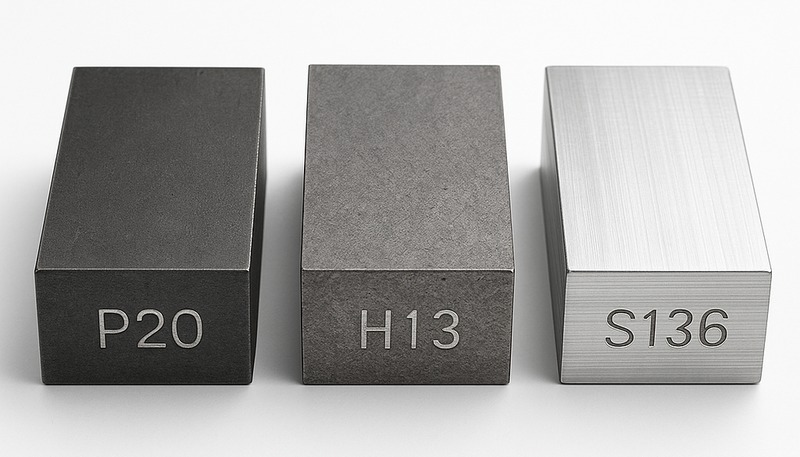
- P20 is the default choice for most production molds (up to 400,000 cycles) — cheap to machine, easy to weld-repair, good enough for most thermoplastics.
- H13 outperforms P20 by 3× in high-wear applications (glass-filled nylon, POM) and handles temperatures above 300°C without softening.
- S136 (420 stainless) is mandatory for corrosive resins like PVC, POM, and transparent optical parts — its HRC 50–52 finish holds mirror polish.
- 718H bridges the gap between P20 and H13 — better than P20 without S136's cost premium, ideal for POM and fiber-filled materials.
- ZetarMold's selection rule: P20 for standard, H13 for abrasive/high-volume, S136 for optical/corrosive, 718H when budget is the constraint.
What Is Mold Steel and Why Does It Determine Tool Life?
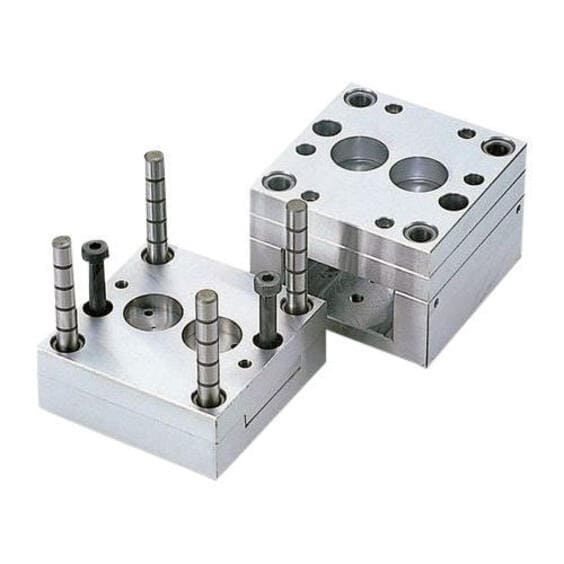
Mold steel is the load-bearing material from which injection mold cores and cavities are machined. The right choice determines tool life, surface finish quality, cycle time, and total tooling cost over the lifetime of a production run.
Your mold steel choice is locked in before anyone touches the CNC machine. Once the steel is ordered and roughed out, changing grades means scrapping the block and starting over — typically a $3,000–$15,000 mistake. Engineers who get it wrong pay once. Engineers who get it right don’t think about mold steel for the next 500,000 shots.
The core trade-off is simple: harder steels last longer and resist wear better, but they cost more to machine and repair. pre-hardened steel1s like P20 sit around HRC 28–36 — soft enough to mill quickly, hard enough for most thermoplastics. Through-hardened steels like H13 and S136 reach HRC 45–55 after heat treatment, requiring more 3 time and care, but they’re the only viable option for abrasive resins or optical transparency.
Four properties drive mold steel selection: 2 (wear resistance), toughness (crack resistance), 4 (chemical compatibility with the resin), and machinability (cost to machine cavities and run repairs). No single steel maximizes all four — every choice is a trade-off calibrated to your specific resin, volume, and surface finish requirements.
P20: The Industry Default for General-Purpose Molds
P20 is a pre-hardened, low-alloy steel delivered at HRC 28–36, ready to machine without additional heat treatment. It covers approximately 60% of all production injection molds worldwide — not because it’s the best steel in every category, but because it’s good enough in all of them.
P20 handles most commodity thermoplastics without issues: ABS, PP, PE, PC, and standard nylon grades all run without attacking the steel. The pre-hardened state means you can CNC-mill it directly with standard carbide tooling, weld-repair minor damage without cracking the block, and achieve a surface finish in the Ra 0.4–0.8 µm range without exotic polishing. For runs up to 400,000 shots, P20 is the cost-optimal choice.
| Property | Value / Range | Practical Meaning |
|---|---|---|
| Hardness (delivered) | HRC 28–36 | Machine immediately; no heat treat needed |
| Tensile strength | ~900–1050 MPa | Handles standard injection pressures up to 200 MPa |
| 5 | 29–36 W/(m·K) | Moderate; add cooling channels at ≤25mm spacing |
| Weldability | Good | Repair cavities without annealing the block |
| Surface finish | Ra 0.4–0.8 µm (polished) | Suitable for semi-gloss parts; not optical grade |
| Typical cycle life | 300,000–500,000 shots | Medium-volume production without steel change |
| Best for resins | ABS, PP, PE, PC, standard PA | Not for PVC, POM above 50% cycle share, glass-filled >20% GF |
Where P20 fails: abrasive resins with glass content above 20–30% will wear P20 cavities noticeably by 200,000 shots, producing dimensional drift and surface degradation. If you’re running PA66-GF30 or PEEK, P20 is not the answer. And P20 has zero corrosion resistance — PVC’s hydrochloric acid off-gas will pit the cavity surface within weeks of production.
718H (also called P20+Ni) is a nickel-modified variant that improves on standard P20 in two ways: better polishability (Ra down to 0.2 µm) and slightly higher toughness. If you’re running clear ABS or want better surface consistency across a high-cavity tool, 718H at an ~8–12% cost premium over P20 is worth considering.
H13: The Go-To for High-Volume and Abrasive Resins
H13 is a hot-work tool steel that reaches HRC 46–54 after vacuum quench and temper. At this hardness, it resists abrasive wear from glass-filled resins roughly 3× better than P20 — a validated observation across our in-house production programs using PA66-GF30 and POM.
H13’s key advantage is thermal stability. Its chromium-molybdenum-vanadium alloy composition resists softening at elevated temperatures — critical for high-speed cycles and heat-sensitive resins that demand barrel temperatures above 280°C. Unlike P20, H13 maintains its hardness throughout continuous multi-shift production without creep or cavity deformation.
At ZetarMold, H13 steel outlasts P20 by 3× for glass-filled nylon at >30% GF. On a 16-cavity PA66-GF30 automotive connector tool, we switched from P20 to H13 after the first production run showed cavity wear at 180,000 shots. The H13 tool exceeded 600,000 shots before first regrind — saving the customer two full cavity rebuilds worth roughly $18,000.
The trade-off with H13 is machining cost. Because the steel must be machined in annealed condition (HRC ~18–22) and then sent for vacuum heat treatment, the manufacturing sequence is longer and more expensive: rough CNC → semi-finish → heat treat → finish grind → EDM for fine details. Expect tooling costs 25–40% higher than equivalent P20 tooling.
H13 is the right call when: (1) the resin contains >20% glass or mineral filler, (2) expected production volume exceeds 500,000 shots, (3) cycle temperatures are consistently above 280°C, or (4) the part requires tight dimensional tolerance that P20 cannot maintain over long runs.
"H13 is the correct default for glass-filled engineering resins above 20% GF."True
Glass fibers act as abrasive particles against cavity walls. P20 at HRC 30 wears visibly by 200K shots with PA66-GF30, while H13 at HRC 50 handles the same resin past 600K shots without measurable dimensional drift.
"You should always use H13 for every injection mold to maximize tool life."False
H13 costs 25–40% more to machine and heat-treat than P20. For standard ABS, PP, or PE parts with volumes under 500K shots, P20 delivers more than adequate tool life at significantly lower upfront cost. Over-engineering steel grade wastes budget that could fund better cooling design or DFM optimization.
S136 and 420 Stainless: When You Cannot Afford Corrosion or Surface Defects
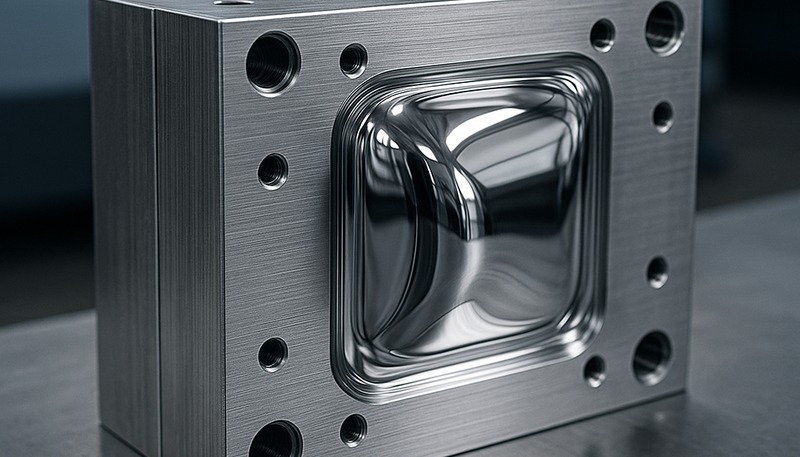
S136 (equivalent to AISI 420 stainless, Uddeholm designation) is a martensitic stainless tool steel with 13.6% chromium content, delivering HRC 50–52 after heat treatment. Its primary function is corrosion resistance — not just to shop humidity, but to the acids generated by PVC, POM, and flame-retardant resins during decomposition.
Three scenarios mandate S136: processing PVC (which releases hydrochloric acid at barrel temperatures), running POM-C or POM-H above 210°C (formaldehyde off-gas attacks standard steel), or producing optical-grade transparent parts that require mirror polish at Ra ≤ 0.025 µm. S136 can achieve that mirror finish because its fine carbide structure takes and holds high-gloss polishing — P20 and H13 cannot.
| Property | S136 (Uddeholm) | 420 Stainless (generic) |
|---|---|---|
| Chromium content | 13.6% | 12–14% |
| Hardness (heat treated) | HRC 50–52 | HRC 48–52 |
| Mirror polish capability | Ra ≤ 0.025 µm | Ra ≤ 0.05 µm |
| Corrosion resistance | Excellent | Good |
| Machinability vs P20 | ~40% harder to machine | ~35% harder to machine |
| Weldability | Requires pre/post-heat | Requires pre/post-heat |
| Typical cost premium over P20 | 50–70% | 35–50% |
S136 costs 50–70% more per kilogram than P20 and requires strict machining protocols: pre-heat before welding, controlled cooling after heat treatment, and dedicated EDM parameters to avoid micro-cracking. But for a lens mold running PMMA at 240°C with a required optical transmittance of >92%, there is no alternative. The cost is not optional — it’s the price of the specification.
One important distinction: S136 prefers vacuum hardening over salt-bath methods. Vacuum hardening produces a cleaner surface oxide and better dimensional stability, reducing finish-machining allowance after heat treatment. Specifying vacuum hardening on your PO is not pedantic — it directly affects the final mirror surface quality.
718H and NAK80: Pre-Hardened Alternatives for Complex Geometries
718H (also written 718 or P20+Ni) and NAK80 (P21 grade) are pre-hardened steels that fill the gap between standard P20 and fully through-hardened grades. Both arrive at HRC 33–38 and do not require post-machining heat treatment — reducing lead time by 1–2 weeks and eliminating heat treat distortion risk on complex geometries.
718H achieves better polishability than standard P20 due to its nickel content (about 1%), which refines grain structure. For clear ABS, transparent PC/ABS blends, or parts requiring SPI A3–B1 finish, 718H is the pre-hardened option of choice. NAK80 goes further with additions of Al, Cu, and S that create age-hardening capability and excellent texturability — ideal for textured surfaces or grain-etched automotive interior panels.
"718H eliminates heat treat distortion risk on tight-tolerance complex mold inserts."True
Because 718H is pre-hardened at the mill, the cavity machining is done on the final steel — no dimensional change from quench and temper. For complex side actions, sliders, and inserts with tolerances tighter than ±0.02mm, this predictability is a genuine advantage over through-hardened grades.
"NAK80 and 718H are direct drop-in upgrades to P20 with no machining changes needed."False
NAK80's age-hardening response and 718H's slightly higher hardness require adjusted cutting speeds and feed rates compared to standard P20. Tool wear increases approximately 15–20% at the same parameters. This is manageable, but ignoring it causes surface chatter and premature tooling breakage.
Steel Selection Decision Framework: How to Choose the Right Grade
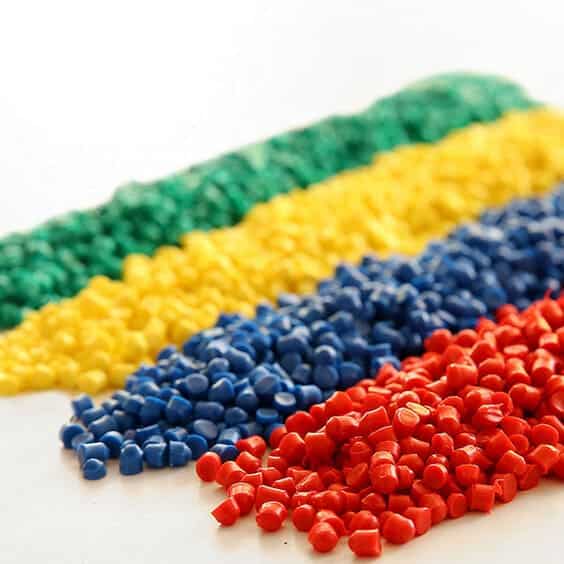
Steel selection decisions cascade from two inputs: the resin you’re molding and the volume you expect. Everything else — budget, lead time, surface finish — adjusts around those two anchors.
| Resin Type | Production Volume | Recommended Steel | Reason |
|---|---|---|---|
| ABS, PP, PE, PC (unfilled) | < 500K shots | P20 / 718H | Cost-optimal; good machinability |
| ABS, PP, PE, PC (unfilled) | > 500K shots | H13 (HRC 48+) | Hardness extends life past 1M shots |
| PA66-GF30, POM, PBT-GF30 | Any volume | H13 (HRC 48+) | Glass abrasion; P20 wears fast |
| PVC, POM (corrosive) | Any volume | S136 (HRC 50+) | Mandatory corrosion resistance |
| Optical PMMA, PC lens | Any volume | S136 (HRC 50+) | Mirror polish Ra ≤ 0.025 µm required |
| PA66, ABS/PC (semi-clear) | 200K–800K shots | 718H or NAK80 | Better surface than P20 without full heat treat |
| PEEK, PPS, LCP | Any volume | H13 or S136 (case-by-case) | High process temperatures + abrasion |
A common mistake is selecting steel grade in isolation from the cooling system design. P20’s thermal conductivity of 29–36 W/(m·K) is already adequate for most cycle time targets — but if you’re switching to H13 (32–34 W/(m·K)) or S136 (24–28 W/(m·K)), review your cooling channel placement. S136’s lower thermal conductivity can increase cycle time by 5–10% versus P20 if channels are not relocated closer to the cavity wall.
A second factor engineers overlook is lead time. P20 is widely stocked at mold steel distributors across China, the US, and Europe — typical delivery is 3–5 business days. H13 in large block sizes (above 200mm thick) may require 10–15 days from Daido or Finkl. S136 (Uddeholm) has the longest lead time: 2–4 weeks for custom-cut blocks. If your project timeline is tight, confirm steel availability before finalizing the grade specification. Switching from S136 to 718H due to lead time adds 20–25% cost but can save 2–3 weeks of schedule.
Volume projection accuracy is the most underappreciated risk in steel selection. Customers who specify P20 based on a 200K shot estimate and then extend the program to 800K shots will face a mid-production cavity regrind or replacement. If there is real uncertainty about final production volume, bias toward H13. The incremental cost is 25–40% higher upfront, but it eliminates the risk of a $15,000–$40,000 cavity rebuild at year two of the program when demand unexpectedly grows.
At ZetarMold, our steel selection review is part of every DFM sign-off before T0 authorization. We've seen customers spec P20 for a POM bushing tool — a combination that generates formaldehyde pitting within 30,000 shots. Switching to S136 mid-production is a full cavity rebuild. The 5-minute conversation at DFM stage saves four figures in rework.
Budget pressure often pushes engineers toward P20 when S136 or H13 is the right call. A decision framework that acknowledges real cost: if the mold is expected to run more than 800,000 shots and the resin is even mildly abrasive, the incremental cost of H13 over P20 typically breaks even at 300,000 shots through reduced regrind and rework costs. Model the total cost of ownership, not just the upfront tooling quote.
One more steel selection variable engineers undervalue: weld repairability. P20 can be welded with standard MIG or TIG process without preheat above 150°C. H13 requires 300–400°C preheat, careful interpass temperature control, and post-weld temper — each repair step adds cost and extends tooling downtime. S136 requires even more precise thermal management to avoid martensite cracking. For molds expected to undergo frequent engineering changes or cavity repairs, the weld repair protocol matters as much as the base hardness specification.
Cavity surface area also influences steel cost more than most engineers realize. A 300×200mm cavity block in S136 can cost $2,000–$4,000 in raw steel before a single tool path is run. At P20 pricing, the same block runs $600–$900. On a 32-cavity hot runner tool, that $3,000 difference per block compounds quickly. For high-cavity tools where only a subset of cavities are high-wear, consider using S136 for the first few cavities while running P20 on the remainder — a hybrid approach that reduces total tooling cost by 20–30% while maintaining surface quality where it matters.
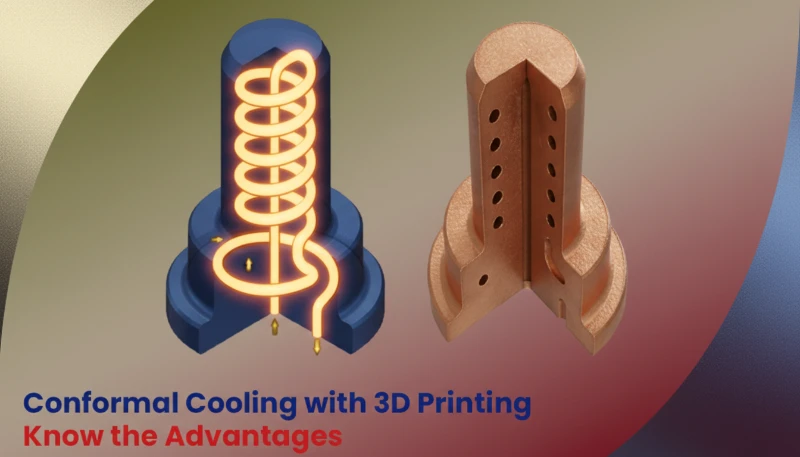
Mold steel selection also interacts with the cooling system design. Conformal cooling channels machined by metal AM (additive manufacturing) or gun-drilling are only economical in P20 and H13; S136’s high chromium content makes it more challenging for deep-hole drilling with standard equipment. If your cooling design requires channel diameters below 6mm at depths beyond 150mm, verify your toolmaker’s equipment capability against the specified steel grade before committing to the design.
Surface Treatment Options: Nitriding, PVD, and Hard Chrome
Surface treatment extends the working life of any mold steel by adding a wear-resistant layer without changing the bulk material. The three most common treatments in injection mold practice are gas nitriding, PVD (Physical Vapor Deposition) coating, and hard chrome plating.
Gas nitriding penetrates 0.1–0.3mm into the steel surface, creating a nitrogen-diffused case hardness of HRC 65–70 without dimensional change. It works on P20 and H13; it does not work well on stainless grades because the chromium oxide layer blocks nitrogen diffusion. Nitriding adds approximately $200–$800 per cavity set and extends P20 tool life in mildly abrasive conditions by 40–80%.
PVD coatings (TiN, TiAlN, CrN) apply a 2–5 µm hard layer at temperatures below 500°C, preserving the base steel’s temper. TiN is gold-colored, HRC 80+, and improves wear and release simultaneously. CrN provides better corrosion resistance than TiN. PVD is the preferred treatment for slides, cores, and other moving inserts that experience cyclic contact stress — it reduces galling risk and can be reapplied 2–3 times before the insert must be replaced.
Hard chrome plating (0.02–0.1mm thickness) is the legacy option — cheaper than PVD, but it’s being phased out in regulated markets due to hexavalent chromium toxicity. In applications where PVD is not available locally, hard chrome remains viable but requires more frequent inspection for micro-cracking under cyclic load.
ZetarMold’s Steel Sourcing and Quality Standards
ZetarMold sources mold steel exclusively from verified mills: Uddeholm (Sweden) for S136, ASSAB for 718H and 718S, and Daido (Japan) or Finkl Steel (USA) for H13. P20 is sourced domestically from Baoshan Iron & Steel (Baosteel) with incoming material inspection on each batch.
Every steel block goes through incoming hardness verification (±2 HRC tolerance) and ultrasonic testing for internal inclusions before being released to the CNC department. Steel that fails ultrasonic inspection is returned — regardless of lead time pressure. A cavity that cracks from an inclusion at 50,000 shots costs more than the three-day delay of getting a clean block.
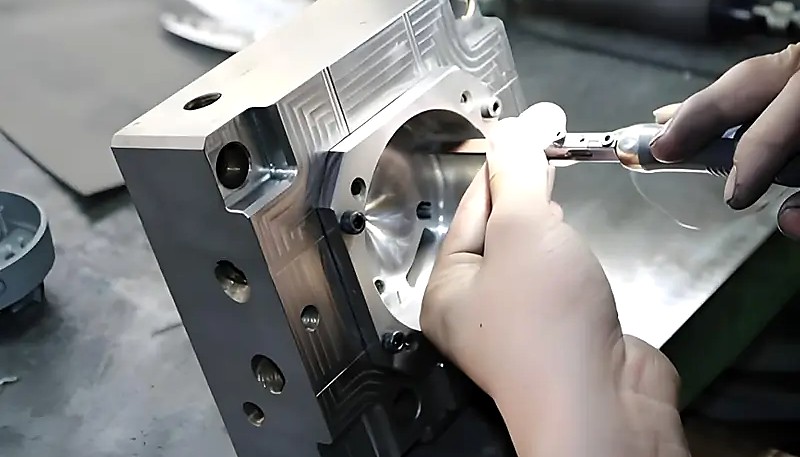
Our heat treatment is performed in-house or at a certified partner using vacuum furnaces to avoid decarburization. Temper temperature and cycles follow Uddeholm and ASSAB’s published datasheets — not approximations. For S136, we verify final hardness via Rockwell testing at three cavity zones (gate area, end-fill, and parting line) and document the results in the mold data pack provided to the customer.
For customers who supply their own steel, we require mill certificates with heat number traceability, incoming hardness verification, and ultrasonic certification. We’ve declined to proceed with un-certified customer-supplied steel on three occasions in the past two years — in each case, the customer later discovered inclusions in the block during machining. The inspection overhead is not bureaucracy; it is loss prevention.
Frequently Asked Questions
What is the best steel for injection molds?
P20 is the best default for general production molds running standard thermoplastics (ABS, PP, PC) up to 400K shots. H13 (HRC 46–54) is the right choice for glass-filled engineering resins or volumes above 500K shots, where P20 wears too fast. S136 (420 stainless) is mandatory for optical-grade parts requiring mirror polish and for corrosive resins like PVC or POM. 718H fills the gap between P20 and H13 for complex geometries that cannot tolerate heat treat distortion. There is no single best — match the steel to the resin, volume, and surface finish specification.
What is the difference between P20 and H13 mold steel?
P20 is pre-hardened at HRC 28–36, delivered ready to machine with no heat treatment required. It is cost-effective, easy to weld-repair, and adequate for most unfilled thermoplastics up to 500K shots. H13 is a hot-work tool steel that must be vacuum-hardened to HRC 46–54 after roughing — a process that adds 1–2 weeks lead time and 25–40% cost. In return, H13 delivers roughly 3× better wear resistance against glass-filled resins and maintains dimensional stability well past 1 million shots. Choose P20 for standard volume; choose H13 when abrasion or longevity demands it.
When should I use S136 stainless steel for injection molds?
S136 is required in three situations: processing corrosive resins that generate acidic off-gas during molding (PVC releases HCl, POM releases formaldehyde), producing optical-grade transparent parts that need Ra ≤ 0.025 µm mirror polish (lens molds, display covers), and molds stored in humid environments without consistent preventive maintenance. Its 13.6% chromium content provides corrosion resistance that P20 and H13 cannot match. Expect to pay 50–70% more in raw steel cost and 35–40% more in machining time versus P20, but for these use cases, S136 is not optional.
How does mold steel hardness affect surface finish quality?
Higher steel hardness allows finer polishing and holds that finish through more production cycles. P20 at HRC 30 is polishable to Ra 0.4–0.8 µm (SPI B2 range), suitable for semi-gloss consumer parts. H13 at HRC 50 reaches Ra 0.1 µm (SPI A3) with careful bench polishing. S136 at HRC 52 achieves Ra ≤ 0.025 µm (SPI A1, mirror grade) — required for PMMA lenses and optical PC parts. Each step finer requires progressively finer diamond abrasive sequences and 2–4× more polishing labor, adding $500–$3,000 per cavity depending on cavity size and geometry.
Can nitriding or PVD coating replace upgrading to harder mold steel?
For mildly abrasive resins (10–20% GF) and moderate production volumes under 300K shots, gas nitriding a P20 cavity can extend service life meaningfully — it adds HRC 65+ surface hardness for $200–$800 per cavity set versus $3,000–$8,000 to upgrade to H13. PVD coatings (TiN, CrN) work similarly for sliding components. However, these surface treatments are 2–5 µm thick and 0.1–0.3mm deep respectively. For heavy abrasion with >30% GF content, or for volumes above 500K shots, the treatment layer wears through and the softer base steel erodes underneath. Surface treatments complement good steel selection; they do not replace it.
What mold steel does ZetarMold use for standard production tools?
ZetarMold defaults to P20 (Baosteel certified) for standard production molds running unfilled thermoplastics at volumes up to 500K shots. For glass-filled engineering resin programs including PA66-GF30, POM, and PBT-GF30, we specify H13 sourced from Daido or Finkl Steel with vacuum hardening to HRC 48–52. Optical and corrosion-sensitive applications receive Uddeholm S136 with in-house hardness verification and ultrasonic inspection before cavity machining begins. All incoming steel batches undergo hardness spot-check and ultrasonic testing for internal inclusions — regardless of supplier certification documents provided.
How does mold steel selection affect injection molding cycle time?
Thermal conductivity is the key variable linking steel grade to cycle time. P20 conducts heat at 29–36 W/(m·K); H13 at 32–34 W/(m·K) is roughly comparable. S136, however, runs at 24–28 W/(m·K) — about 15–20% lower than P20. On a thin-wall part where cooling time accounts for 60–70% of total cycle time, switching from P20 to S136 without repositioning coolant channels can increase cycle time by 5–10%. Compensate by reducing coolant channel-to-cavity wall distance from the standard 15mm to 10–12mm, maintaining adequate channel diameter to prevent flow restriction.
pre-hardened steel: Pre-hardened steel is a mold steel that has been heat-treated to a working hardness (typically HRC 28–40) before delivery, eliminating the need for post-machining heat treatment. ↩
hardness: Hardness is a material property measured on the Rockwell C (HRC) or Brinell (HB) scale that indicates resistance to permanent surface deformation; higher HRC values mean greater wear resistance but reduced toughness. ↩
EDM: EDM (Electrical Discharge Machining) refers to a manufacturing process that removes material from a workpiece using controlled electrical discharges, commonly used to machine hard mold steels into precise cavity shapes. ↩
corrosion resistance: Corrosion resistance is defined as a material's ability to withstand oxidation, chemical attack, and moisture-induced degradation; measured by weight-loss tests or salt-spray hours in mold steel contexts. ↩
thermal conductivity: Thermal conductivity is measured in W/(m·K) and refers to a material's ability to transfer heat; higher values in mold steel result in faster cycle times by improving heat extraction from the molded part. ↩