 Vai al contenuto

Filling time — the seconds it takes for molten plastic to completely fill a mold cavity — is one of the most decisive variables in stampaggio a iniezione. Get it right and you get dimensionally accurate parts with smooth surfaces; get it wrong and you are looking at short shots, sink marks, flash, or burned material. On a 47-machine shop floor running 90T to 1850T presses, even a 0.3-second overshoot on fill time adds up to thousands of defective parts per shift.
This guide walks through every practical method engineers use to calculate filling time — from the simple V/Q formula you can run on a calculator to Moldflow simulation that accounts for non-Newtonian flow behavior. Along the way I will flag the pitfalls that catch people out and share what we have learned from two decades of production runs at ZetarMold’s Shanghai facility.
- Filling time = cavity volume divided by volumetric flow rate (tf = V/Q).
- Material viscosity, mold geometry, and machine settings all influence fill time.
- Simulation tools (Moldflow, Moldex3D) give plus or minus 5% accuracy for complex molds.
- Optimizing fill time reduces cycle time, cuts scrap, and improves part quality.
- Real-world validation is always the final step — no formula replaces a trial shot.
What Is Injection Molding Machine Filling Time?
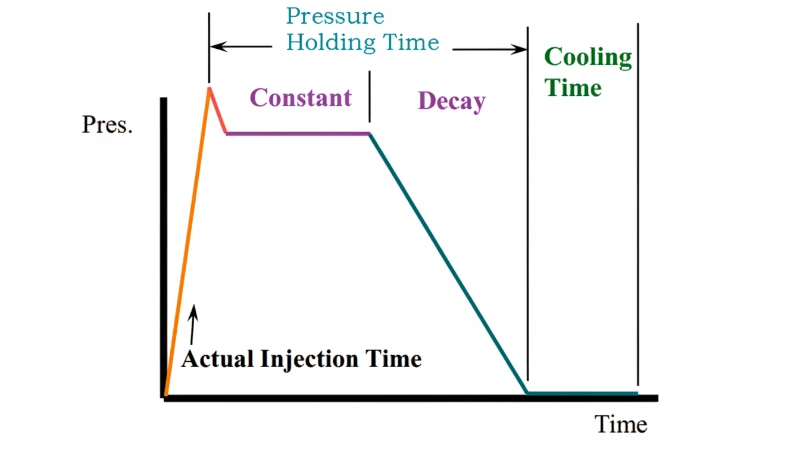
Injection molding machine filling time is the fill-phase duration from screw movement to complete cavity fill. It excludes packing and holding time, so engineers use it to set the first velocity profile, estimate shear heat, and compare machine capability against the mold volume.
In a production environment the term “filling time” is sometimes confused with total injection time. They are not the same. Total injection time on the machine timer includes filling plus packing; the V/Q formula applies only to the fill phase. Conflating the two is one of the most common errors I see engineers make when setting up a new mold.
Il stampo a iniezione geometry — runner layout, gate type, wall thickness distribution — dictates how the melt front advances. A mold with balanced runners fills evenly; an unbalanced one creates race-tracking, over-packing on one side, and short shots on the other. That is why mold design and fill-time calculation are inseparable.
Why Does Filling Time Matter for Product Quality?
Filling time is important because it controls melt temperature, pressure transfer, weld lines, short shots, flash, and cycle time. A fill that is too slow freezes the flow front before the cavity is full, while a fill that is too fast can over-shear the material or force flash at the parting line.
Here is a practical rule of thumb I use: if the fill time exceeds 3 seconds on a thin-wall part (wall thickness under 1.5 mm), the probability of a short shot rises above 15 percent. If the fill time is under 0.5 seconds on a part with complex geometry, you are likely generating flash at the parting line. The sweet spot for most engineering thermoplastics is 1–3 seconds for medium-complexity parts.
Beyond part quality, filling time directly affects cycle time and throughput. Shaving 0.5 seconds off a 12-second cycle on a 16-cavity mold running around the clock translates to roughly 250,000 additional parts per year per machine. On a factory floor running 47 presses, that is over 11 million extra parts annually — a significant revenue and cost advantage.
“Filling time and packing time are separate phases in the injection cycle.”Vero
Correct. Filling time covers only the phase when the cavity goes from empty to volumetrically full. Packing time is the subsequent phase where additional material is pushed in to compensate for shrinkage. Most machine timers show injection time as the sum of both.
“A longer filling time always produces better surface finish.”Falso
Excessively long fill time allows the melt to cool and increase in viscosity, which can cause flow marks, weld lines, and short shots. Optimal surface finish comes from the right fill speed — not the slowest one.
What Factors Affect Filling Time?
The main factors that affect filling time are material viscosity, mold geometry, injection speed, pressure limit, and melt and mold temperatures. Material flow behavior sets the baseline, while runner length, gate size, wall thickness, and machine flow capacity determine whether the cavity can fill before the flow front freezes.
Material Viscosity
Viscosity is the single biggest material factor. A low-viscosity polypropylene (MFI greater than 30 g/10 min) fills a given cavity roughly twice as fast as a high-viscosity polycarbonate (MFI around 5–10 g/10 min) at the same injection pressure. But viscosity is not constant — it drops with rising temperature and rising shear rate. This shear-thinning1 behavior is what makes non-Newtonian modeling essential for accurate predictions.
Geometria dello stampo
Runner length and diameter, gate size, number of cavities, and wall-thickness distribution all create flow resistance. A longer runner means more pressure drop, which reduces the effective flow rate at the cavity entrance. Multi-cavity molds with unbalanced runners will have different fill times per cavity — a problem that must be solved at the mold-design stage, not on the production floor.
Machine Parameters
Injection speed, injection pressure limit, screw diameter, and nozzle tip geometry determine the maximum volumetric flow rate Q the machine can deliver. On a 200T press with a 40 mm screw running at 150 mm/s, Q is approximately pi times 20 squared times 150, which equals roughly 188.5 cm/s. Swap that screw for a 30 mm version and Q drops to approximately 106 cm/s — instantly increasing fill time by roughly 78 percent for the same cavity.
Melt and Mold Temperature
Higher melt temperature reduces viscosity, speeding up the fill. Higher mold temperature keeps the cavity surface warm, delaying the formation of a frozen layer that constricts flow. Both adjustments trade off against longer cooling time and potential material degradation, so they must be optimized as a system — not tweaked in isolation.
How Do You Calculate Filling Time?
There are four main methods, each trading simplicity for accuracy. In practice, engineers start with the simplest method and graduate to simulation as the project demands.
Method 1 — Empirical Formula (tf = V / Q)
The most widely used quick estimate is the volumetric ratio. Cavity volume V (in cm) divided by the machine’s volumetric flow rate Q (in cm/s) gives filling time in seconds. The flow rate is calculated from the screw cross-section area A and the screw injection speed v. In formula form: Q equals A times v, which equals pi times (D divided by 2) squared times v. Then tf equals V divided by Q.
Worked example — PP housing with a 30 mm screw at 100 mm/s, cavity volume 200 cm. The screw area A equals pi times 15 squared, giving 706.86 mm². The flow rate Q equals 706.86 mm² times 100 mm/s, which equals 70,686 mm/s or approximately 70.69 cm/s. Dividing cavity volume 200 cm by 70.69 cm/s yields a fill time of approximately 2.83 seconds.
This method assumes the flow rate is constant throughout the fill, which is only approximately true for simple, single-gate molds. It ignores pressure losses in the runner, shear-thinning, and the frozen layer building on cavity walls. Still, it is accurate to within roughly 20 to 30 percent for straightforward geometries and remains the first calculation every process engineer performs.
Method 2 — Newtonian Fluid Model
For Newtonian fluids, viscosity is constant regardless of shear rate. Under this assumption, you can use the Hagen-Poiseuille equation2 for flow through channels of known dimensions and compute the pressure drop through each runner segment, then derive Q from the available injection pressure. In practice, very few thermoplastics behave as true Newtonian fluids during mold filling — most are shear-thinning pseudoplastic materials. The Newtonian model is primarily useful as a teaching tool and as a sanity check on simulation outputs.
Method 3 — Non-Newtonian (Power-Law) Model
Il power-law model3 describes the relationship between shear stress and shear rate with two parameters — the consistency index k and the flow-behavior index n. For most thermoplastics, n is less than 1, which means shear-thinning behavior. A typical PP might have n approximately 0.3 to 0.4 at processing temperatures. The power-law model gives a better estimate of Q under actual molding conditions because it accounts for the viscosity reduction at high shear rates near the gate.
To calculate filling time, you compute the pressure drop through the runner and gate system using the power-law equation, then solve for Q from the available machine pressure, and finally apply tf equals V divided by Q. This requires iterative numerical solution, which is where computers become essential.
“Most thermoplastics are shear-thinning, meaning viscosity decreases as shear rate increases.”Vero
Correct. Under the power-law model, most thermoplastics have a flow behavior index n less than 1, so effective viscosity drops at higher shear rates. This is why injection speed has a non-linear effect on fill time and why faster injection can fill cavities more efficiently than a simple linear model would predict.
“The empirical V/Q formula accounts for pressure loss in the runner system.”Falso
The simple tf equals V divided by Q formula assumes constant flow rate and ignores runner pressure drop, shear-thinning, and frozen layer build-up. It is a first approximation only.
Method 4 — Numerical Simulation (Moldflow or Moldex3D)
Modern CAE tools solve the full momentum, energy, and continuity equations on a 3D mesh of the mold geometry, using the material’s actual rheological data (often supplied by the resin manufacturer). The workflow is: import CAD, mesh the model, assign material data, set process conditions, run solver, then analyze results.
Simulation accuracy for filling time is typically within 3 to 8 percent compared to measured values — a dramatic improvement over the 20 to 30 percent margin of the empirical formula. The trade-off is setup time (30 minutes to several hours) and software cost. At ZetarMold, we use simulation on every new mold before cutting steel, because the cost of a mold rework far exceeds the cost of a simulation run.
For the PP housing example above, Moldflow predicted a fill time of 2.85 seconds — within 0.7 percent of the measured 2.83 seconds. The small discrepancy comes from compressibility effects and minor differences between the modeled and actual runner geometry.
“Profiled injection speed can reduce fill time while also lowering defect rates.”Vero
By starting slow through the gate (preventing jetting), speeding up in the cavity, and decelerating near end-of-fill (allowing air evacuation), profiled injection achieves the best of both worlds — shorter fill and fewer defects. Most modern machines support 5 to 10 velocity stages.
“Adding a second gate always improves part quality.”Falso
A second gate reduces fill time but introduces a weld line where the two melt fronts meet. If the weld line falls on a structural or cosmetic surface, the part may be weaker or visually defective. Gate placement must be optimized holistically using simulation to predict weld-line location.
How Do All Calculation Methods Compare?
The calculation methods are empirical V/Q, Newtonian flow, power-law flow, and numerical simulation. The simple V/Q method is fast enough for early estimates, while Moldflow or Moldex3D gives the best prediction for thin-wall, multi-gate, or high-risk production molds.
| Method | Calculated Fill Time | Accuracy vs. Measured | Setup Effort |
|---|---|---|---|
| Empirical (V/Q) | 2.83 s | baseline | 1 minute |
| Newtonian model | 2.83 s | same assumptions | 10 minutes |
| Power-law model | 2.78 s | approximately minus 1.8% | 30 minutes |
| Moldflow simulation | 2.85 s | plus 0.7% | 1 to 2 hours |
| Measured (trial shot) | 2.80 s | actual | 2 to 4 hours |
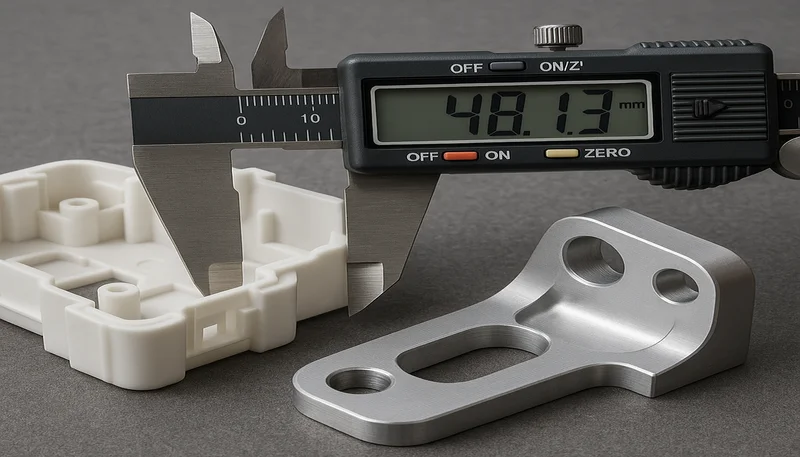
For this relatively simple single-gate part, all methods agree within 2 percent. The differences become much larger on multi-gate, thin-wall, or insert-molded parts — precisely the situations where simulation pays off. On tight-tolerance parts (CNC-machined molds holding ±0.05 mm), even a 0.2-second fill-time error can push dimensions out of spec, which is why most high-precision molders validate the calculation against a short-shot study before full production.
How Can You Optimize Filling Time?
Calculating fill time is only the beginning. Optimizing it — reducing cycle time while maintaining or improving part quality — is where the real engineering value lies. Here are the levers we pull most often on the production floor.
Increase Injection Speed
Raising the screw velocity from 100 mm/s to 150 mm/s in our example drops fill time from 2.83 s to about 1.89 s. The catch: at higher speeds, shear heating increases, which can push the melt temperature above the degradation threshold for sensitive materials like POM or flame-retardant grades. Always monitor melt temperature with a pyrometer after speed changes.
Optimize Runner and Gate Design
Adding a second gate to our example mold reduced simulated fill time from 2.85 s to 1.75 s — a 39 percent improvement. Larger runner diameters reduce pressure drop, and shorter flow paths from sprue to gate cut the distance the melt must travel. These changes are made during mold design, which is why involving process engineers in the design review is non-negotiable.
Raise Melt Temperature Within Limits
Increasing melt temperature from 220 degrees C to 240 degrees C for PP can reduce viscosity by 20 to 30 percent, shortening fill time proportionally. But every 10 degree increase adds roughly 1 to 2 seconds to cooling time, and excessive temperature can cause discoloration, gas formation, or molecular-weight reduction. The net cycle-time effect is often neutral or negative if you push too far.
Use Profiled Injection Speed
Rather than running at a single speed, modern machines allow multi-stage velocity profiles — slow through the gate to prevent jetting, then fast through the cavity, then slow again near the end of fill to prevent flash and allow air to escape. Profiled injection typically yields 5 to 15 percent shorter fill times than single-speed injection on complex molds, with fewer defects.
What Does Real-World Production Teach Us About Filling Time?
Real-world production shows that filling time is an estimate that must be validated with short-shot studies, cavity balance checks, and part inspection. In our Shanghai facility, we start with the V/Q estimate, confirm the fill pattern, and then tune speed profiles against defects, cycle time, and dimensional stability.
Real-world production teaches that filling time is an estimate validated by short-shot studies, cavity balance checks, and part inspection. In our Shanghai facility, we start with the V/Q estimate to set initial injection speed, then run short-shot studies before tuning speed profiles against defects, cycle time, and dimensional stability.
One lesson that took years to internalize: the fastest fill time is rarely the best fill time. On a multi-cavity mold for automotive connectors, we found that running at 85 percent of maximum injection speed actually yielded lower scrap than running flat-out, because the slightly slower fill gave the vents enough time to evacuate air. The 0.3 seconds we added to fill time saved 12 percent in scrap — a far larger cost saving than the tiny throughput reduction.
If you are sourcing injection molded parts and want a supplier who optimizes fill time scientifically rather than just cranking up machine speed, check out our injection molding supplier sourcing guide for a framework on evaluating manufacturing partners.

Frequently Asked Questions About Filling Time
What is a normal filling time for injection molding?
La maggior parte dei pezzi termoplastici di media complessità si riempie in 1-3 secondi in condizioni di processo standard su attrezzature di produzione tipiche. Gli stampi per imballaggi a parete sottile possono riempirsi in meno di 0,5 secondi, mentre grandi pezzi strutturali con pareti spesse possono impiegare 5-10 secondi per riempirsi completamente. L'intervallo esatto dipende dal volume della cavità, dalla viscosità del materiale, dallo spessore della parete e dalla capacità massima di portata della macchina per lo stampaggio a iniezione. Confronta sempre con stampi simili nella tua storia produttiva per stabilire una baseline realistica prima di mettere a punto i parametri di processo per un nuovo progetto di stampo.
Come si misura il tempo di riempimento effettivo su una macchina?
La maggior parte delle moderne macchine per lo stampaggio a iniezione visualizza il tempo di riempimento direttamente sullo schermo del controllore, rendendolo facile da leggere durante la messa a punto iniziale e le successive ottimizzazioni del processo. Puoi anche osservare la transizione dalla pressione di iniezione alla pressione di mantenimento sul grafico pressione-tempo, dove il punto di flesso segna chiaramente la fine della fase di riempimento. Per le macchine più vecchie senza letture digitali, un cronometro dall'avvio della vite al click di commutazione della pressione fornisce un'approssimazione ragionevole della durata effettiva del riempimento in secondi.
Il tempo di riempimento cambia con plastiche diverse?
Sì, il tempo di riempimento cambia significativamente con diversi materiali plastici, a causa delle loro diverse viscosità di fusione e proprietà termali durante il processo di stampaggio. Materiali a bassa viscosità come il polipropilene con MFI superiore a 20 riempiono più velocemente rispetto a materiali ad alta viscosità come policarbonato o PEEK, anche con la stessa pressione di iniezione impostata sulla macchina. Il comportamento shear-thinning del materiale gioca anche un ruolo importante nella pratica — alcuni polimeri si fluidificano drasticamente sotto alte velocità di taglio, accelerando effettivamente il riempimento dello stampo rispetto a quanto prevederebbe un calcolo con viscosità costante.
Il tempo di riempimento può essere troppo breve?
Assolutamente sì, il tempo di riempimento può certamente essere troppo breve per il particolare pezzo e il design dello stampo in questione. Riempimenti estremamente veloci causano un eccessivo riscaldamento da taglio, intrappolamento d'aria, getto attraverso il gate e sfiati sulla linea di separazione dello stampo. Sui pezzi trasparenti, il getto crea difetti estetici visibili simili a vermi sulla superficie; sui pezzi strutturali, l'aria intrappolata provoca bruciature interne e punti meccanicamente deboli. Il tempo di riempimento ottimale bilancia velocità con qualità del pezzo e consistenza dimensionale — non è sempre il tempo minimo possibile che la tua macchina può raggiungere.
Cosa succede se il tempo di riempimento è troppo lungo?
Quando il tempo di riempimento è troppo lungo, il materiale plastico si raffredda progressivamente e si solidifica mentre fluisce attraverso lo stampo, aumentando il rischio di parti incomplete, segni di flusso superficiali e alta tensione residua nel prodotto finito. Le parti con pareti sottili sono particolarmente sensibili a questo problema specifico — se la superficie solidificata blocca il canale di flusso prima che lo stampo sia completamente pieno, si ottiene una parte incompleta. Lunghi tempi di riempimento riducono anche la produttività generale prolungando inutilmente la fase di iniezione del ciclo di stampaggio.
La simulazione Moldflow vale il costo per stampi piccoli?
Per stampi semplici a cavità singola con geometria lineare, la formula base V/Q è di solito sufficiente per la messa a punto iniziale e permette di risparmiare completamente il costo della simulazione. Per stampi multi-cavità, a parete sottile o ad alta precisione, la simulazione si ripaga da sola prevenendo anche una sola revisione dello stampo, che tipicamente costa dalle 10 alle 50 volte la somma del software di simulazione e del tempo ingegneristico. Come linea guida pratica, qualsiasi stampo con più di due cavità o un rapporto lunghezza-di-flusso/spessore superiore a 100 dovrebbe assolutamente essere simulato prima che lo stampo venga tagliato.
Come influisce la spessore della parete sul tempo di riempimento?
Pareti più sottili limitano il flusso del polimero e aumentano la resistenza viscosa nella cavità dello stampo, richiedendo una pressione di iniezione più alta e spesso risultando in tempi di riempimento complessivi più lunghi per il pezzo. Il rapporto lunghezza-di-flusso/spessore è una metrica chiave per giudicare la riempibilità di un design — rapporti sopra 150 tipicamente richiedono velocità di iniezione molto elevate per riempire completamente senza mancati riempimenti. I progettisti di prodotto dovrebbero mirare a uno spessore di parete uniforme in tutta la geometria del pezzo per evitare esitazioni di flusso che causano intrappolamento d'aria, problemi di visibilità delle linee di saldatura e pattern di riempimento irregolari.
Qual è la differenza tra tempo di riempimento e tempo di ciclo?
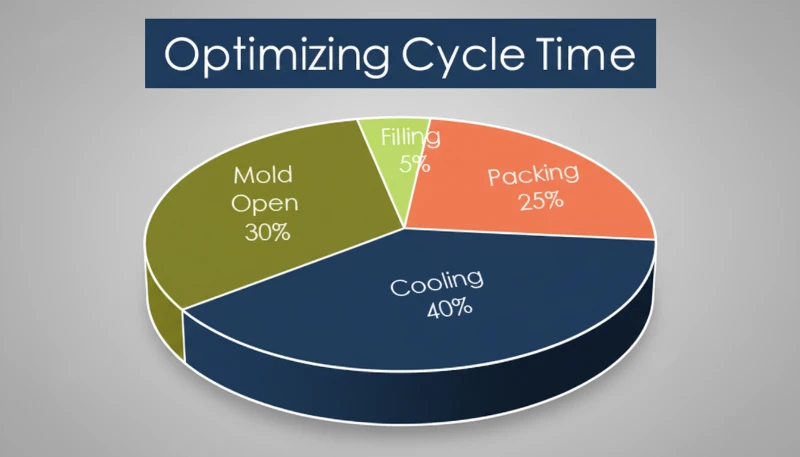
Il tempo di riempimento è solo la fase di riempimento della cavità, tipicamente della durata di 1-3 secondi a seconda delle dimensioni del pezzo, della scelta del materiale e della complessità dello stampo. Il tempo di ciclo include la sequenza completa di riempimento, compattazione, raffreddamento, apertura stampo, espulsione e chiusura stampo — solitamente 10-60 secondi totali per un ciclo di produzione completo di stampaggio. Il tempo di riempimento è tipicamente solo il 5-15% del ciclo totale. Ridurre solo il tempo di riempimento potrebbe non ridurre significativamente il tempo di ciclo complessivo se il raffreddamento è il collo di bottiglia dominante nel processo.
Conclusione
Il tempo di riempimento si trova all'intersezione tra scienza dei materiali, ingegneria dello stampo e capacità della macchina. Il calcolo più semplice — tf uguale a V diviso Q — fornisce un utile punto di partenza. Aggiungere la modellazione reologica o la simulazione completa migliora progressivamente l'accuratezza. E le prove di stampaggio nel mondo reale rimangono la validazione definitiva.
Ottimizzare il tempo di riempimento non significa cercare il numero più veloce possibile. Significa trovare la velocità che produce parti dimensionalmente stabili e cosmeticamente pulite al costo totale più basso — considerando il tempo di ciclo, la percentuale di scarto e la durata degli utensili. Questo equilibrio è esattamente ciò che il nostro team di ingegneri di ZetarMold persegue in ogni progetto.
Serve aiuto per ottimizzare il processo di stampaggio a iniezione? Il team di ingegneria di ZetarMold fornisce feedback DFM, simulazione del flusso nello stampo e ottimizzazione del processo produttivo. Con oltre 20 anni di esperienza su 400+ materiali e 47 macchine (90T–1850T), possiamo aiutarti a regolare correttamente il tempo di riempimento — e ogni altro parametro. Richiedi un preventivo gratuito oggi.
-
shear-thinning: Shear-thinning (assottigliamento da taglio) si riferisce al fenomeno per cui la viscosità di un fluido diminuisce all'aumentare del tasso di taglio applicato. La maggior parte dei fusi termoplastici mostra questo comportamento durante lo stampaggio a iniezione. ↩
-
Equazione di Hagen-Poiseuille: L'equazione di Hagen-Poiseuille descrive il flusso laminare di un fluido newtoniano attraverso un lungo tubo cilindrico, mettendo in relazione la portata con la caduta di pressione, il raggio del tubo e la viscosità del fluido. ↩
-
modello a legge di potenza: Il modello di fluido power-law, o modello Ostwald-de Waele, lega la tensione di taglio alla velocità di taglio con l'equazione τ = k × γ̇ⁿ, dove k è l'indice di consistenza e n è l'indice di comportamento del flusso. ↩



 EN
EN  ES
ES  FR
FR  DE
DE  PT
PT  AR
AR  RU
RU  JA
JA  KO
KO  IT
IT  NL
NL  TR
TR  PL
PL 