Ha presupuestado un proyecto IML y el coste del molde resulta un 30–40% mayor que el de un utillaje estándar. Su cliente quiere saber por qué. La respuesta sincera es que el etiquetado en molde adhiere una película preimpresa dentro del molde durante cada ciclo de inyección, y cada paso añadido —preparación de la película, colocación robotizada, vacío en la cavidad y activación de la capa de unión1— aumenta el coste y la complejidad. Sin embargo, cuando el volumen de producción justifica la inversión, el IML elimina por completo la decoración secundaria y genera gráficos que resisten lavavajillas, disolventes y años de exposición a rayos UV sin despegarse. Esta guía recorre todo el proceso de moldeo por inyección IML, desde la selección de la película hasta la prevención de defectos, basándose en nuestra experiencia con la producción IML en las instalaciones de ZetarMold en Shanghái.
- El IML une la etiqueta durante el moldeo — no se necesita decoración posterior al moldeo.
- El coste de la película y la integración del robot aumentan un 20–40% el precio por pieza en volúmenes bajos.
- El polipropileno es el sustrato IML dominante; PC y ABS requieren capas de unión especiales.
- La colocación estática y el vacío en la cavidad del molde evitan que la etiqueta se desplace durante el llenado.
- El IML supera ampliamente a la tampografía y a las etiquetas de transferencia térmica en durabilidad.
¿Qué es el moldeo por inyección IML?
El moldeo por inyección IML es un proceso en el que se coloca una película de polímero preimpresa dentro de la cavidad del molde antes de cada ciclo. Durante la inyección, el plástico fundido derrite la capa posterior de la película, fusionando la etiqueta y el sustrato en una sola pieza. No hay adhesivo, impresión secundaria ni laminación posterior al proceso. El gráfico queda integrado en la pared de la pieza.
La tecnología surgió en la industria de envases alimentarios para tarrinas de margarina y vasos de productos lácteos en la década de 1990. Desde entonces se ha extendido a la electrónica de consumo, los revestimientos interiores de automóviles, las carcasas de dispositivos médicos y los envases cosméticos. Si alguna vez ha despegado una etiqueta de una tarrina de mantequilla y ha observado que la impresión estaba incrustada en la pared de plástico, se trataba de IML.
Frente al moldeo por inyección tradicional seguido de tampografía2 o etiquetado por transferencia térmica, el IML produce una superficie permanente y resistente a los arañazos en un solo ciclo. La contrapartida es un mayor coste inicial del utillaje y un control más estricto del proceso. En ZetarMold utilizamos IML en moldes multicavidad para clientes de productos de consumo que necesitan más de 100,000 unidades por tirada: el volumen a partir del cual el coste por pieza empieza a favorecer al IML frente a la decoración secundaria.
"El IML une la etiqueta y el sustrato en una única pieza inseparable sin adhesivo."True
La resina fundida activa la capa de unión en la superficie posterior de la película y crea un enlace químico más fuerte que cualquier capa adhesiva. La etiqueta no puede despegarse, formar burbujas ni separarse durante el uso normal.
"Las etiquetas IML pueden retirarse y sustituirse después del moldeo si el diseño gráfico contiene errores."False
Cuando la capa de unión se adhiere al sustrato inyectado durante el ciclo, la etiqueta queda permanente. No puede retirarse ni sustituirse sin destruir la pieza. Por eso el diseño gráfico debe aprobarse y verificarse antes de cualquier serie.
¿Cómo funciona paso a paso el proceso IML?
El proceso IML añade dos pasos antes de la inyección y modifica la secuencia de cierre frente al moldeo estándar. Este es el desglose completo de lo que ocurre dentro de la máquina en cada ciclo, desde la carga de la película hasta la expulsión.
Paso 1: impresión y troquelado de la película
La decoración se imprime primero en huecograbado o flexografía sobre una película multicapa en rollo. Una estructura típica de película IML incluye una capa superior imprimible (normalmente PP o PET), una capa de tinta, una capa barrera en algunas aplicaciones alimentarias y una capa de unión posterior que se adhiere a la resina fundida. Tras imprimir, la película se troquela en etiquetas individuales adaptadas a la geometría de la cavidad. Las tolerancias dimensionales suelen ser ±0.15 mm: si son demasiado amplias aparecen huecos y, si son demasiado estrechas, la etiqueta se arruga al colocarla en la cavidad.
Paso 2: colocación robotizada dentro del molde
Antes de cada inyección, un robot de entrada lateral o superior recoge una etiqueta troquelada, le aplica una carga electrostática3 y la introduce en el molde abierto. La carga estática mantiene la película plana contra la pared de la cavidad. Algunos moldes complementan este sistema con canales de vacío: pequeños orificios detrás de la superficie de la cavidad que mantienen la etiqueta pegada. Sin una carga estática o un vacío adecuados, la etiqueta puede desplazarse o arrugarse cuando entra la masa fundida.
Paso 3: cierre del molde e inyección
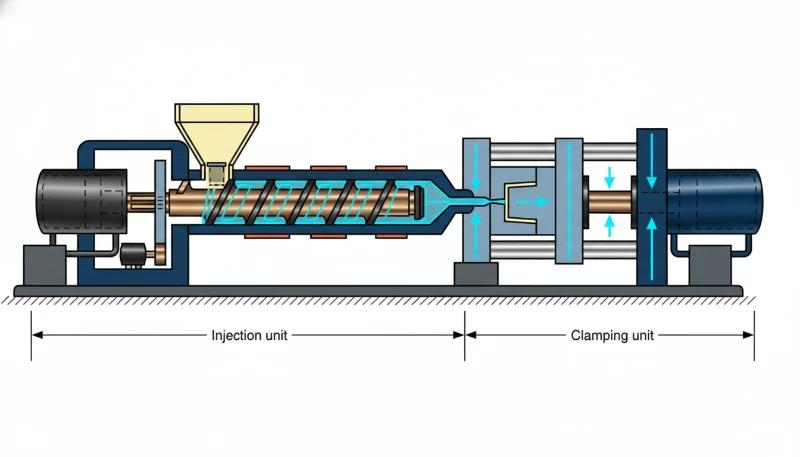
El molde se cierra y la unidad de inyección llena la cavidad. La temperatura de la masa fundida (normalmente 200–240 °C para IML basado en PP) activa la capa de unión, que se adhiere al sustrato en segundos. La velocidad de inyección es crítica: si es demasiado alta, el frente de fusión desplaza la etiqueta; si es demasiado baja, la capa de unión no se activa por completo y deja riesgo de delaminación.
Paso 4: Compactación, refrigeración y expulsión
Tras llenar la cavidad, la presión de mantenimiento compacta material adicional para compensar la contracción. La fase de enfriamiento solidifica tanto el sustrato como la unión entre la etiqueta y la pieza. Los ciclos de las piezas IML duran entre un 10 y un 25 % más que los de la inyección estándar porque la película actúa como un ligero aislante térmico y ralentiza la extracción de calor de la pared de la cavidad. Una vez enfriado, el molde se abre y el robot extrae la pieza acabada y decorada.
En la práctica, toda la secuencia desde la colocación de la etiqueta hasta la expulsión de la pieza tarda entre 1.5 y 3 segundos más que un ciclo estándar con el mismo molde. En una línea de embalaje de alta velocidad que utiliza moldes de 8 cavidades con ciclos de 8 segundos, esa penalización se acumula. Sin embargo, la clave económica es que se elimina toda la etapa de decoración posterior al moldeo — tampografía, secado, inspección y retrabajo — que normalmente añade entre 3 y 5 días y entre $0.03 y $0.08 por pieza.
| Parámetro | Moldeo por inyección estándar | IML IM |
|---|---|---|
| Tiempo de ciclo (PP, pieza de 500 g) | 12–15 s | 14–18 s |
| Sobrecoste del molde | Línea base | +25–40% |
| Coste de decoración por pieza | $0,03–0,08 (tampografía) | $0.01–0.04 (película IML) |
| Capa de unión no completamente activada | 2–5 años (desgaste/decoloración) | Más de 10 años (integrado) |
| Nivel de automatización | Robot estándar | Robot de etiquetado + robot de piezas |
¿Qué materiales y películas funcionan con IML?
La compatibilidad de materiales es la principal limitación en IML. La resina del sustrato y la película deben unirse químicamente mediante la capa de unión, por lo que la capa posterior de la película debe estar formulada para la familia específica de polímeros que se moldea. Una selección incorrecta provoca delaminación, el defecto de IML más frustrante porque a menudo no aparece hasta semanas después de la producción, durante ciclos térmicos o ensayos de caída.
Polipropileno (PP): la opción predeterminada
Más del 70% de la producción mundial de IML utiliza PP. Las razones son claras: el PP se adhiere de forma fiable a las películas IML basadas en PP sin necesitar una química exótica de capas de unión, es económico y domina las aplicaciones de envases alimentarios, donde el IML está más extendido. Si la pieza puede diseñarse en PP, el IML es sencillo y el coste de la película se mantiene bajo, normalmente entre $0.005 y $0.015 por etiqueta según el tamaño y la complejidad de la impresión.
Poliestireno (PS) y ABS
El PS y el ABS requieren formulaciones de película específicas con capas de unión modificadas. La adhesión es posible, pero menos tolerante: las ventanas de proceso para la temperatura de la masa fundida y la velocidad de inyección son más estrechas. Hemos producido carcasas de ABS mediante IML para clientes de electrónica, pero todos los proyectos necesitaron ensayos con muestras de película antes de comprometerse con el utillaje de producción. Cabe prever entre 2 y 4 semanas adicionales de cualificación del material frente al IML basado en PP.
Policarbonato (PC) y resinas de ingeniería
El IML con PC es posible, pero poco habitual, porque la alta temperatura de procesamiento (280–320 °C) puede degradar las películas IML estándar. Existen películas especiales para alta temperatura, pero cuestan 2–3× más que las destinadas a PP. Salvo que la aplicación exija la resistencia al impacto y la transparencia del PC, suele ser más práctico moldear la pieza con una resina de menor temperatura y aceptar las concesiones de diseño.
En nuestras instalaciones de Shanghái operamos 47 máquinas de moldeo por inyección de 90 T a 1.850 T y mantenemos una biblioteca de más de 400 materiales para ensayos IML con PP, ABS y sustratos de ingeniería. Con más de 20 años de experiencia en moldeo por inyección y 8 ingenieros sénior, hemos visto fallar al menos una vez la mayoría de las combinaciones de material y película, y sabemos cómo evitar los errores comunes.
¿Qué diferencia a un molde IML de un molde estándar?
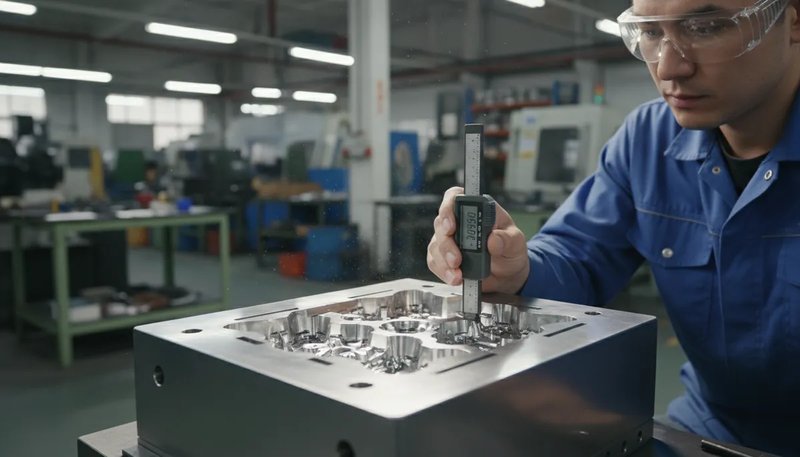
Un molde de IML es un molde estándar modificado con canales de vacío, compuertas reposicionadas y eyección del lado del núcleo. Estas características evitan el desplazamiento de la etiqueta, las arrugas y el daño por perforación durante la producción.
Canales de vacío detrás de la cavidad
La mayoría de los moldes IML de producción incluyen una red de pequeños orificios de vacío (0.3–0.5 mm de diámetro) detrás de la superficie de la cavidad del lado de la etiqueta. Estos orificios se conectan a un circuito de vacío que mantiene la película plana durante el cierre del molde y la inyección. Sin asistencia de vacío, la carga estática por sí sola puede fallar a altas velocidades de inyección o con etiquetas de gran superficie. Los canales de vacío aumentan el tiempo y el coste de mecanizado del inserto de cavidad — esto representa una parte importante de la prima de coste del molde del 25–40% que mencionamos anteriormente.
Ubicación y geometría modificadas de la compuerta
La posición de la compuerta debe dirigir el flujo de la masa fundida para que recorra la etiqueta de un borde al otro sin crear pliegues ni arrugas. En un molde estándar, la ubicación de la compuerta optimiza el patrón de llenado y la posición de las líneas de soldadura. En un molde IML, también debe evitarse que la masa fundida incida directamente sobre la cara de la etiqueta, ya que esto causa marcas de quemado visibles o desplaza la etiqueta. La ubicación del vestigio de la compuerta también importa: siempre que sea posible, debe quedar en una superficie no decorada para que la marca no interrumpa el gráfico impreso.
Holgura del sistema de expulsión
Los pasadores expulsores no pueden atravesar la zona de la etiqueta. Si perforan la película, dejan marcas visibles y rompen la unión entre la etiqueta y la pieza. Esta limitación obliga al diseñador del molde a realizar toda la expulsión por el lado del núcleo (el lado sin etiqueta) o a utilizar placas extractoras y expulsión por aire. El diseño puede resolverse, pero requiere una planificación deliberada durante la fase de diseño del molde de inyección. Hemos visto proyectos en los que esta limitación obligó a rediseñar por completo el sistema de expulsión después de la prueba inicial del molde: una costosa lección sobre por qué el proveedor de la decoración debe participar en el diseño del molde IML desde el principio.
"Los moldes IML requieren canales de vacío y una expulsión modificada para evitar dañar la etiqueta durante la producción."True
Los canales de vacío mantienen la etiqueta plana contra la pared de la cavidad durante la inyección, mientras que la expulsión debe realizarse por el lado sin etiqueta para evitar que las marcas de los pasadores atraviesen la película. Ambas características son requisitos estándar de cualquier molde IML de producción.
"Puede convertir un molde de producción estándar a IML simplemente añadiendo un robot de colocación de etiquetas a la máquina."False
Un molde estándar carece de los canales de vacío, la ubicación de compuertas y las modificaciones del sistema de expulsión necesarios para un IML fiable. Intentar realizar IML en un molde sin modificar provoca una alta tasa de residuos por desplazamiento de etiquetas, arrugas y daños causados por los pasadores. La conversión es técnicamente posible, pero a menudo cuesta casi tanto como construir un molde IML nuevo.
Estas tres diferencias del molde —canales de vacío, geometría de la compuerta y recorrido de la expulsión— no son negociables. Si su fabricante de moldes propone omitir alguna para reducir el coste del utillaje, opóngase. Hemos visto demasiados proyectos en los que el ahorro inicial en utillaje quedó anulado por tasas de rechazo superiores al 15 % durante la producción.
Con una capacidad mensual de más de 100 juegos de moldes y un equipo de 8 ingenieros sénior que supervisan el diseño de cada herramienta IML, incorporamos estas características desde el primer día, porque añadirlas más tarde siempre cuesta más que hacerlas bien desde el principio. Nuestros más de 120 operarios de producción y más de 30 directores de proyecto angloparlantes evitan que la comunicación sobre las modificaciones de los moldes se pierda en la traducción, un problema sorprendentemente habitual cuando la selección de proveedores se realiza sin equipos especializados en negocio internacional.
Una consideración adicional que muchos compradores primerizos de IML pasan por alto es la frecuencia de mantenimiento del molde. Los canales de vacío de un molde IML son pequeños (0.3–0.5 mm) y pueden obstruirse con residuos de resina con el tiempo, especialmente al procesar materiales cargados o reforzados con vidrio. Planifique una limpieza más frecuente de las cavidades, normalmente cada 50,000–100,000 ciclos según la resina. Esto no es un defecto de diseño, sino el coste de mantenimiento previsto de operar una herramienta IML de precisión.
¿Qué parámetros del proceso son más importantes en el IML?
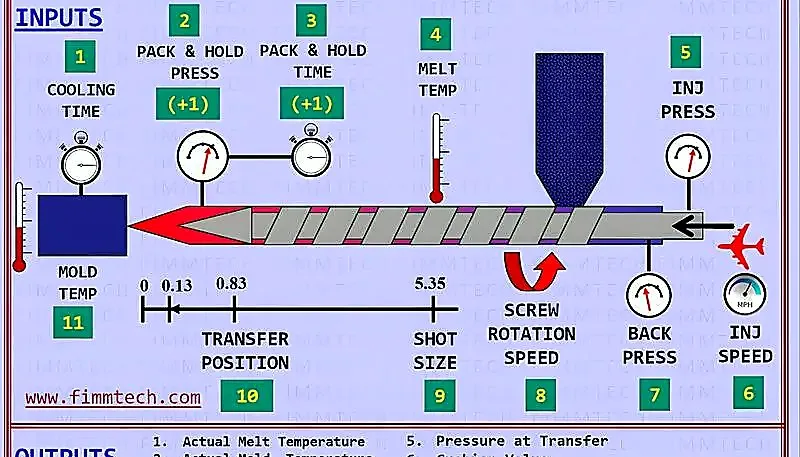
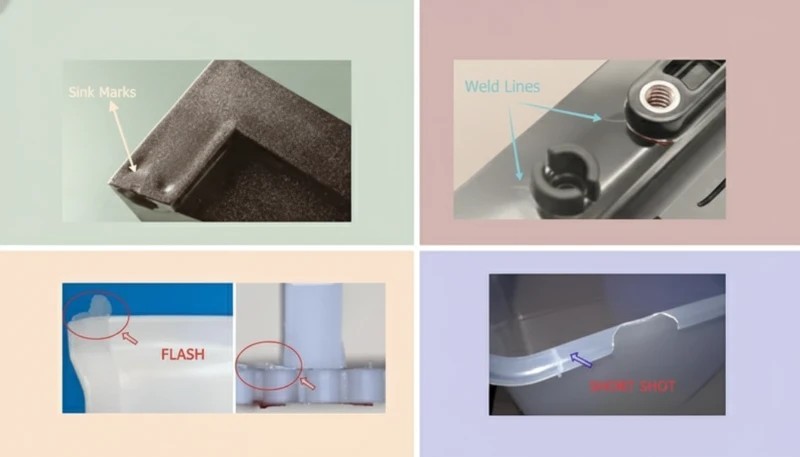
Los cuatro parámetros más importantes son la velocidad de inyección, la temperatura de fusión, la presión de mantenimiento y la temperatura del molde. Incluso pequeñas desviaciones fuera de la ventana del proceso causan defectos como marcas de hundimiento, rebabas y marcas de quemado en la etiqueta.
Velocidad de inyección y perfil de llenado
La velocidad de inyección es el parámetro con más probabilidades de causar defectos en la etiqueta. Si es demasiado rápida, el frente de masa fundida separa la etiqueta de la pared de la cavidad; si es demasiado lenta, la capa de unión no se funde por completo y deja una adhesión débil. La mayoría de los procesos IML utilizan un perfil de llenado multietapa: más lento al principio para establecer el flujo sobre la etiqueta y luego más rápido una vez estabilizado el frente de masa fundida. Normalmente fijamos como objetivo el 60–80% de la velocidad de llenado estándar para el primer 30% de la inyección y después aumentamos hasta la velocidad máxima.
Temperatura de fusión
La temperatura de fusión debe ser lo bastante alta para activar la capa de unión sin degradar la superficie impresa de la película. Para PP IML, trabajamos a 210–230 °C. Superar los 240 °C implica riesgo de imagen fantasma: una leve transferencia de imagen de la tinta a la superficie de la cavidad que contamina las piezas posteriores. La imagen fantasma es uno de esos defectos que no aparece en las primeras 50 inyecciones, sino que se acumula progresivamente con cada ciclo, por lo que es esencial supervisar la limpieza de la cavidad durante la producción.
Presión y tiempo de mantenimiento
La presión de mantenimiento garantiza que la etiqueta permanezca comprimida contra la pared de la cavidad mientras se solidifica la capa de unión. Con una presión insuficiente, la etiqueta puede delaminarse en los bordes; con demasiada, la presión puede forzar la masa fundida a atravesar la película en las secciones delgadas. Para IML solemos utilizar entre el 60 y el 80 % de la presión de mantenimiento estándar, con un tiempo de mantenimiento algo mayor para compensar. La métrica clave es la adhesión de los bordes: si puede despegar la etiqueta por una esquina con la uña, la presión de mantenimiento fue insuficiente.
Temperatura del molde
El lado de la cavidad (lado de la etiqueta) debe funcionar 5–10 °C por debajo de la temperatura estándar para proteger el brillo superficial de la película. El lado del núcleo funciona a temperatura normal. Esta diferencia favorece la adhesión de la etiqueta sin perjudicar el tiempo total de ciclo. En nuestra planta comprobamos que mantener esta diferencia de temperatura constante en un molde de múltiples cavidades es uno de los controles de proceso más eficaces para reducir los desperdicios de IML.
¿Cuáles son los defectos más comunes del IML y cómo se previenen?
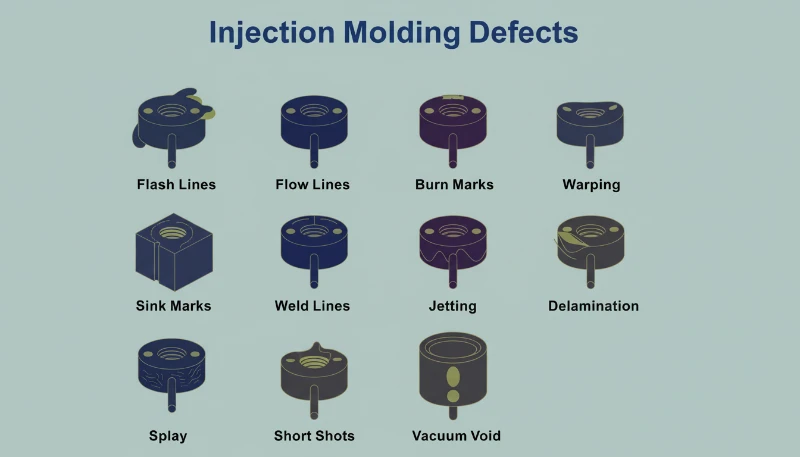
Los defectos comunes de IML incluyen arrugas, desplazamiento, delaminación de bordes, fantasmas y marcas de quemado, todos causados por problemas de colocación, flujo o unión. Esto es lo que vemos en el piso de producción y cómo solucionar cada uno.
| Defecto | Causa raíz | Corrección |
|---|---|---|
| Arruga en la etiqueta | Exceso de película o activación lenta del vacío | Ajustar la tolerancia de troquelado de la etiqueta a ±0.1 mm; verificar la sincronización del vacío |
| Desplazamiento / desviación de la etiqueta | Carga estática insuficiente o velocidad de inyección elevada | Aumente el voltaje estático; reduzca la velocidad inicial de llenado |
| Delaminación en los bordes | Capa de unión no activada por completo | Diagrama que muestra el proceso de etiquetado en molde en cuatro pasos para el moldeo por inyección, resultando en un producto plástico etiquetado. |
| Imagen fantasma de tinta en la cavidad | Temperatura de fusión demasiado alta | Reduzca la temperatura de la masa fundida por debajo de 240 °C para PP |
| Marca de quemado en la cara de la etiqueta | Compuerta dirigida directamente hacia la etiqueta | Reubicar la compuerta o añadir un deflector de flujo |
| Bolsa de aire bajo la etiqueta | Orificios de vacío obstruidos o insuficientes | Añada orificios de vacío cerca de la zona donde queda aire atrapado |
En nuestra fábrica de Shanghái, detectamos la mayoría de los defectos de IML en la etapa de inspección en proceso utilizando nuestro flujo de trabajo de calidad de 6 pasos (desde IQC hasta OQC). Bajo nuestros sistemas ISO 9001 e ISO 13485, cada producción de IML se somete a una inspección de primera pieza antes de que se libere el lote.
Los defectos anteriores representan aproximadamente el 90% del desperdicio de IML. La mayoría puede eliminarse en las primeras tres corridas de producción ajustando la velocidad de inyección, el tiempo de vacío y la posición de la compuerta.
¿Preguntas frecuentes sobre el moldeo por inyección IML?
¿Cuál es la diferencia entre IML e IMD?
IML (etiquetado en molde) coloca una película preimpresa dentro de la cavidad del molde, uniéndola al sustrato durante la inyección. IMD (decoración en molde) es la categoría más amplia que incluye IML más técnicas como pintura en molde y moldeo por inserción de película donde la decoración puede no unirse completamente con la pieza.
¿Cuánto cuesta el utillaje IML en comparación con los moldes estándar?
La herramienta de IML típicamente cuesta un 25-40% más que un molde estándar de tamaño equivalente. La prima cubre canales de vacío, características de registro de etiquetas y un sistema automatizado de manejo de etiquetas. El mayor costo inicial se compensa eliminando la mano de obra de decoración posterior al moldeo en volumen.
¿Es el IML apto para alimentos y reciclable?
Sí. El IML basado en PP se usa ampliamente en envases de contacto directo con alimentos y cumple con la FDA 21 CFR y el Reglamento de la UE 10/2011. Debido a que la etiqueta y el contenedor son del mismo polipropileno, la pieza terminada es completamente reciclable en flujos de residuos estándar de PP sin separación de etiqueta.
¿Puedo cambiar el diseño de la etiqueta sin cambiar el molde?
Sí: esta es una de las mayores ventajas operativas del IML. Como la cavidad del molde no cambia, solo necesita solicitar un nuevo lote de etiquetas troqueladas con el diseño actualizado. El tiempo y el coste de preparación son mínimos frente a los cambios de placas de serigrafía o tampografía.
¿Cuál es el volumen mínimo de producción para que IML sea rentable?
IML se vuelve rentable aproximadamente a 50,000 a 100,000 unidades por corrida de producción. Por debajo de ese umbral, la prima de la herramienta y el costo por película de etiqueta no se compensan con los ahorros de eliminar la decoración secundaria. Si su volumen anual es inferior a 50,000 piezas, la tampografía o el etiquetado por transferencia térmica generalmente ofrecen un costo total menor por pieza decorada. Sin embargo, para electrónica de consumo y empaques premium donde la apariencia de la marca justifica un mayor costo unitario, IML aún puede tener sentido en volúmenes más bajos.
capa de unión: Capa adhesiva coextruida dentro de una película IML multicapa que une químicamente la superficie decorativa con la resina del sustrato inyectado. ↩
tampografía: Proceso de decoración secundaria que transfiere tinta desde una placa grabada hasta la superficie de una pieza mediante una almohadilla de silicona; se utiliza habitualmente para logotipos y textos en piezas moldeadas por inyección. ↩
carga electrostática: Tensión estática que se aplica a una película IML para que se adhiera a la superficie metálica del molde durante la inserción robotizada y no se desplace al llenar la cavidad. ↩