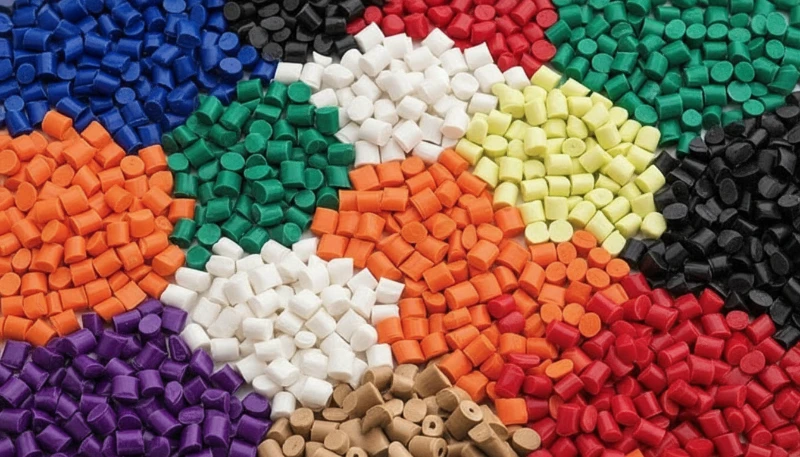
El diseño de nervaduras no es solo una regla geométrica del moldeo por inyección; es un problema de comportamiento del material. ABS, PC, PP, nylon, POM y las resinas reforzadas con fibra de vidrio se contraen, enfrían y resisten las tensiones de forma distinta, por lo que una misma nervadura que funciona con un polímero puede causar rechupes, alabeo o daños durante la expulsión con otro. Por ello, el espesor y la altura de la nervadura, el radio de la raíz, el ángulo de desmoldeo y la posición de la entrada deben comprobarse con respecto a la familia de resina antes de mecanizar el acero del molde y realizar correctamente el muestreo, los ensayos y la validación.
Para compradores e ingenieros, el objetivo es sencillo: usar nervios para aportar rigidez sin crear una masa gruesa en la intersección con la pared. En las revisiones DFM identificamos si la resina es amorfa, semicristalina, elastomérica o reforzada, y adaptamos la relación nervio-pared y la refrigeración. Este artículo explica cómo las propiedades cambian las decisiones de diseño y cómo evitar los defectos más comunes.
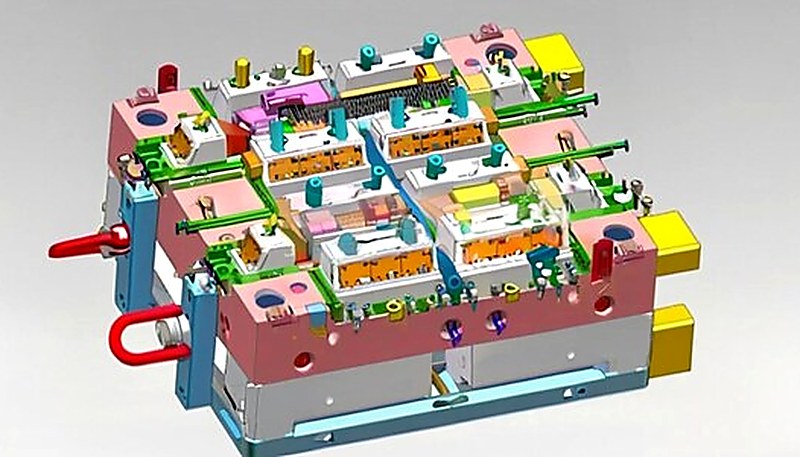
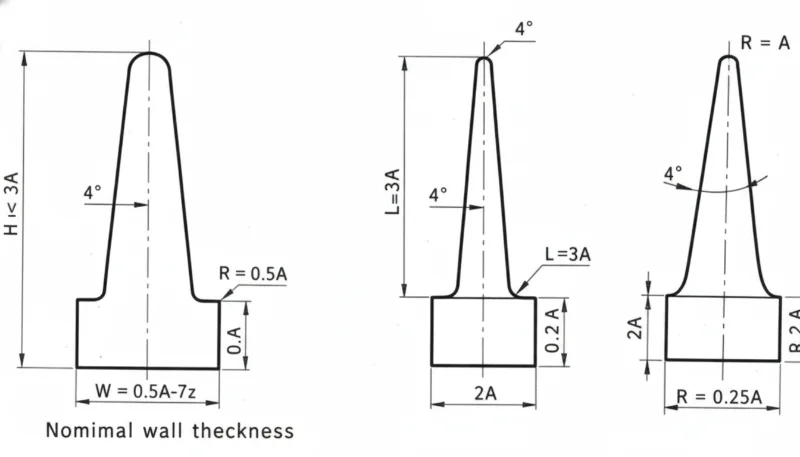
- El espesor de las nervaduras debe ser del 40-75% del espesor nominal de pared, según el tipo de polímero
- Los materiales semicristalinos requieren nervaduras más delgadas debido a sus mayores tasas de contracción
- Los polímeros reforzados con fibra de vidrio permiten nervaduras más gruesas, pero plantean problemas de contracción anisotrópica
- La gravedad de los rechupes depende de la masa en la intersección y del comportamiento de enfriamiento del material
- Los ángulos de desmoldeo de 0,5–1,5° por lado son esenciales para expulsar limpiamente los nervios
¿Cuáles son las restricciones de material para la geometría de los nervios?
Las restricciones del material para la geometría de las nervaduras son la tasa de contracción de la resina, el perfil de enfriamiento, el objetivo de rigidez, la fricción de expulsión y el riesgo de rechupes estéticos.
En el moldeo por inyección, una nervadura es un refuerzo delgado que sobresale perpendicularmente de una pared nominal para aumentar la rigidez sin el peso ni el mayor tiempo de ciclo de una pared uniformemente más gruesa. El reto fundamental es que toda nervadura crea una acumulación localizada de masa donde se une a la pared, y esa masa adicional provoca defectos estéticos relacionados con la contracción.
Cuando el polímero fundido se enfría en la intersección entre nervadura y pared, la sección más gruesa permanece líquida durante más tiempo que la capa circundante. Al solidificarse y contraerse finalmente el núcleo, tira hacia dentro de la superficie exterior ya congelada y produce una marca de hundimiento visible en la superficie de clase A opuesta. La gravedad del defecto no es constante: depende casi por completo de la estructura interna y del comportamiento de contracción del material.
En nuestra fábrica de Shanghái operamos 47 máquinas de moldeo por inyección de 90T a 1850T y hemos procesado más de 400 materiales plásticos diferentes. Esa amplitud de experiencia nos permite haber comprobado directamente que una nervadura diseñada para ABS puede fallar de forma catastrófica en PP si no se ajusta la relación de espesores: la misma geometría nominal puede producir un rechupe apenas visible en un material y una ranura profunda en otro.
Los polímeros amorfos (ABS, PC, PMMA) presentan una contracción baja y casi isotrópica (normalmente 0.2-0.8%). Su disposición molecular aleatoria hace que se contraigan de manera relativamente uniforme. Esto ofrece algo más de margen: las nervaduras pueden medir entre el 50-70% del espesor de pared sin hundimientos graves.
Los polímeros semicristalinos (PP, PE, PA6, PA66) se comportan de otra forma. Al enfriarse, sus moléculas se pliegan en estructuras cristalinas ordenadas y más compactas, lo que genera una contracción mucho mayor, a menudo del 1.0-3.0%. Esto exige nervaduras más finas (40-50% de la pared) y entradas mejor estudiadas para controlar la orientación inducida por el flujo.
"Los nervios aumentan considerablemente la rigidez de la pieza con un incremento mínimo de peso, en comparación con aumentar el espesor de toda la pared."True
Las nervaduras aumentan el momento de inercia y aportan refuerzo localizado sin el coste de material, penalización de refrigeración ni riesgo de rechupes de una pared uniformemente más gruesa.
"Puede diseñar con seguridad nervaduras del mismo grosor que la pared nominal para maximizar la resistencia estructural."False
Las nervaduras con el mismo espesor que la pared crean un enorme punto caliente térmico en la intersección, lo que garantiza rechupes en la superficie estética y puede generar vacíos internos.
¿Cómo difieren las tasas de contracción según la familia de materiales?
La relación entre la contracción del material y la geometría de las nervaduras no es lineal: constituye una restricción de todo el sistema. Siguiendo las directrices DFM1 establecidas y las normas internacionales de contracción2, la tabla siguiente recoge los parámetros de diseño recomendados por familia de polímeros. Estos valores son puntos de partida; compruébelos siempre mediante una simulación Moldflow3 para la geometría y ubicación de entrada concretas de su pieza.
| Parámetro | Amorfo (PC, ABS) | Semicristalino (PP, PA6) | Reforzado con fibra de vidrio (PA66-GF30) |
|---|---|---|---|
| Relación nervio/pared | 50-70% | 40-50% | 55-75% |
| Índice de contracción | 0.2-0.8% | 1.0-3.0% | 0.2-0.8% (anisotrópico) |
| Ángulo de calado | 0.5-1.0 por lado | 0.5-1.5 por lado | 1.0-2.0 por lado |
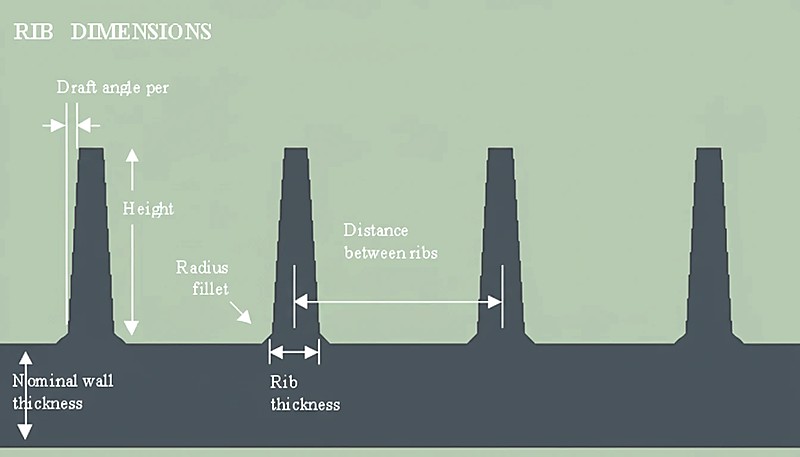
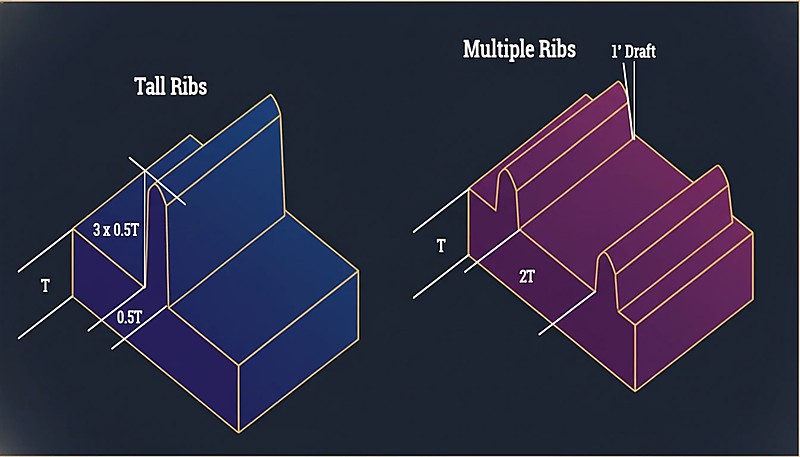
| Radio de la base | 0.25 × t(pared) | 0.20 × t(pared) | 0.25 × t(pared) |
| Altura máxima de nervadura | 3 × t(pared) | 2.5 × t(pared) | 3 × t(pared) |
| Riesgo de hundimiento | Bajo–medio | Alta | Bajo (pero con riesgo de alabeo) |
Observe la columna de material reforzado con fibra de vidrio: las fibras de vidrio reducen drásticamente la contracción volumétrica en la dirección del flujo, pero apenas afectan a la contracción transversal. Este comportamiento anisótropo significa que la pieza puede no presentar hundimientos, pero puede deformarse considerablemente si la disposición de los nervios no tiene en cuenta la contracción direccional. En la práctica, siempre ejecutamos una simulación de llenado + compactación + deformación para materiales reforzados con fibra de vidrio antes de comprometernos con el acero del molde.
¿Por qué los polímeros amorfos y cristalinos necesitan estrategias de nervaduras diferentes?
Los polímeros amorfos y cristalinos requieren estrategias de nervaduras distintas porque se solidifican, contraen y retienen la presión de compactación de manera diferente. Los materiales amorfos pasan gradualmente de líquido a sólido, sin un cambio de fase abrupto. Esta solidificación gradual da más tiempo a que la presión se iguale en la unión entre nervadura y pared, lo que reduce la contracción diferencial. El espesor de la nervadura puede acercarse al 70% del de la pared sin consecuencias estéticas graves.
Los polímeros semicristalinos experimentan un evento de cristalización brusco a una temperatura específica. Cuando se produce la cristalización, el material se contrae de forma pronunciada. Si la base del nervio es demasiado gruesa, la contracción por cristalización en esa zona localizada supera la presión de compactación que mantenía plana la superficie. Resultado: una marca de hundimiento profunda y visible que ninguna presión de compactación puede corregir después de que se congele la compuerta.
Con más de 20 años de experiencia en moldeo por inyección y una planta interna de fabricación de moldes, hemos aprendido a ajustar las proporciones de los nervios antes de cortar el acero. Un error habitual que detectamos en las revisiones de DFM es aplicar a una pieza de PP las proporciones de nervios propias del PC. La pieza parece correcta en CAD, pero la primera inyección muestra profundas marcas de hundimiento en cada nervio.
"Aumentar únicamente la presión de compactación no puede eliminar las marcas de hundimiento causadas por nervios sobredimensionados en materiales cristalinos de alta contracción."True
Una vez solidificado el punto de inyección, no llega presión adicional a la sección gruesa. La única solución eficaz es reducir la relación de espesor entre nervadura y pared para adaptarla a las características de contracción del material.
"Los materiales reforzados con vidrio siempre producen mejores nervios porque su contracción global es menor."False
Aunque las fibras de vidrio reducen la contracción total, crean fuertes efectos anisotrópicos. Es posible que las nervaduras no produzcan rechupes, pero la contracción diferencial entre las direcciones longitudinal y transversal al flujo puede causar un alabeo considerable.
¿Cuáles son las reglas prácticas de diseño para cada material?
La teoría es útil, pero en planta los diseñadores necesitan reglas aplicables. Esto es lo que usamos en nuestras revisiones DFM según el polímero específico elegido por el cliente:
Para ABS y PC (amorfos): Espesor de nervadura = 50-70% de la pared nominal. Ángulo mínimo = 0.5 por lado. Radio de base = 0.25 × el espesor de pared. Estos materiales son tolerantes: puede acercarse al 70% si la superficie opuesta no es estética.
Para PP y HDPE (semicristalinos, sin carga): Espesor de nervadura = 40-50% de la pared. Ángulo mínimo = 1.0 por lado. Radio de base = 0.20 × la pared (un radio menor reduce la acumulación de masa). Estos materiales mostrarán hundimientos si se supera el 50%: ningún truco de procesamiento corrige una nervadura sobredimensionada en PP.
Para PA66-GF30 (reforzado con vidrio): Espesor de nervadura = 55-75% de la pared. Ángulo = 1.0-2.0 por lado (las fibras de vidrio aumentan la fricción de expulsión). La menor contracción permite nervaduras más gruesas, pero la entrada debe minimizar la variación de longitud de flujo entre ellas; de lo contrario, el problema será el alabeo en vez del hundimiento.
Para diseños de moldes de inyección que emplean mezclas PC/ABS: Trátelas como materiales amorfos, pues el componente PC domina la contracción. La proporción ideal de nervadura es del 55-65% del espesor de pared. Estas mezclas son habituales en carcasas de electrónica de consumo donde importan tanto la resistencia como la calidad superficial.
¿Cómo debe ejecutar paso a paso el proceso de diseño de las nervaduras?
El proceso de diseño de nervaduras es una secuencia controlada de DFM: definir cargas, bloquear datos de resina, dimensionar nervaduras, verificar espaciado, simular y luego revisar con el moldeador. Este es el flujo de trabajo que seguimos para cada pieza nueva con nervaduras estructurales:
Paso 1 — Defina los requisitos estructurales: Determine los objetivos de rigidez y los casos de carga. Calcule el momento de inercia necesario y, a partir de él, estime la altura y separación de las nervaduras en lugar de adivinarlas.
Paso 2 — Seleccione el material y fije los datos de contracción: Obtenga de la ficha técnica los valores reales de la calidad y espesor de pared específicos. No use valores genéricos: la contracción del PA66-GF30 de distintos proveedores puede variar entre un 0.2-0.4%.
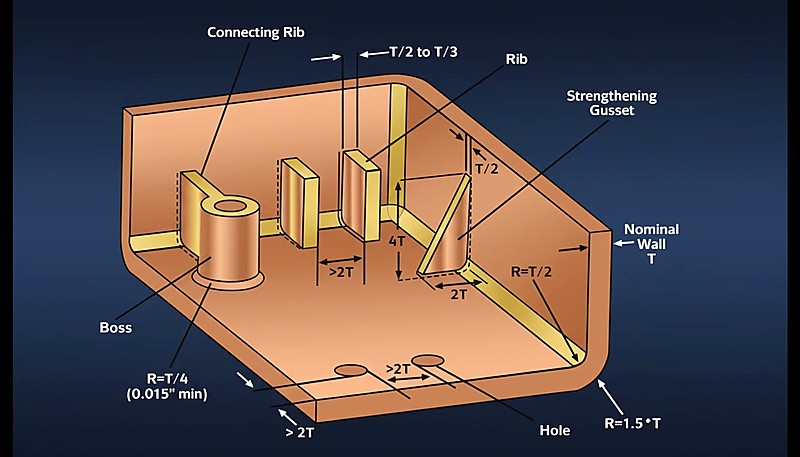
Paso 3 — Calcule las proporciones de las nervaduras: Aplique la relación nervadura/pared específica del material indicada en la tabla. Si la pared mide 2.5mm y usa PP, la base debe medir 1.0-1.25mm (40-50%). Establezca un ángulo de 1.0 por lado y un radio de base de 0.5mm.
Paso 4 — Compruebe la separación: Mantenga al menos 2× (preferiblemente 3×) el espesor de pared entre nervaduras adyacentes. Una separación menor causa problemas de llenado de paredes finas y amplifica el enfriamiento diferencial.
Paso 5 — Ejecute una simulación Moldflow: Simule el llenado, la compactación y el alabeo. Examine específicamente la contracción volumétrica en la intersección entre nervadura y pared y los resultados de deformación. Así detectará problemas antes de gastar cinco cifras en utillaje.
Paso 6 — Revise el DFM con su moldeador: Comparta los resultados de la simulación con su socio de moldeo por inyección. Un buen moldeador cuestionará la disposición de las nervaduras según su ventana de proceso: la capacidad de presión de compactación, el acceso de los canales de refrigeración y la estrategia de expulsión condicionan su funcionamiento real.
¿Qué aplicaciones reales demuestran el diseño de nervios específico para cada material?
Las aplicaciones reales de nervaduras son útiles porque cada familia de materiales revela un modo de fallo distinto: hundimiento, alabeo, rozamiento durante la expulsión o desequilibrio térmico. Soportes interiores de automóviles (PP + talco): Producimos habitualmente soportes de salpicadero en PP con talco. Este reduce ligeramente la contracción respecto al PP sin carga, pero su naturaleza cristalina aún exige nervaduras del 40-45% de la pared. Una pared típica de 2.0mm lleva nervaduras de 0.8-0.9mm con un ángulo de 1.0 por lado.
Carcasas de portátiles (PC/ABS): La electrónica de consumo exige superficies de clase A sin hundimientos visibles. La mezcla amorfa PC/ABS permite nervaduras del 60% de una pared de 2.2mm (unos 1.3mm en la base), y usamos secciones localizadas de pared fina detrás de las zonas estéticas para reducir aún más su visibilidad.
Carcasas industriales (PA66-GF30): Las carcasas de nailon reforzado con vidrio soportan cargas estructurales elevadas. Gracias a su baja contracción, las nervaduras pueden medir el 65-70% de la pared, pero el verdadero enemigo es el alabeo. Empleamos entradas equilibradas y simulación de orientación de fibras para mantener planas las superficies.
Cajas para manipulación de materiales (HDPE): Las cajas embutidas de HDPE usan redes intensivas de nervaduras. La elevada contracción del HDPE (2.0-3.0%) exige nervaduras finas, normalmente del 40% de la pared, pero como estas piezas no son estéticas se admite un hundimiento moderado y puede aumentarse ligeramente la proporción.
Preguntas frecuentes
¿Cuál es la altura máxima permitida para un nervio en el moldeo por inyección?
Eliminar por completo las marcas de hundimiento es extremadamente difícil en materiales semicristalinos cuando las nervaduras superan el 45 % del espesor de pared. En polímeros amorfos como PC y ABS, mantener las nervaduras en el 50 % del espesor de pared o por debajo suele evitar hundimientos visibles en la superficie estética. Los ajustes de proceso, como una mayor presión de compactación, un tiempo de mantenimiento prolongado y más refrigeración, pueden reducir la gravedad del hundimiento, pero no compensan una geometría de nervadura esencialmente sobredimensionada. El enfoque más eficaz y fiable consiste en diseñar correctamente el espesor de la nervadura desde el principio según la familia específica del material utilizado.
¿Se pueden eliminar por completo las marcas de hundimiento sobre las nervaduras?
Los materiales reforzados con fibra de vidrio permiten nervios más gruesos, equivalentes al 55 a 75 por ciento del espesor de pared, debido a la gran reducción de la contracción volumétrica que proporcionan las fibras. Sin embargo, introducen riesgos importantes de alabeo anisótropo porque las fibras se orientan en la dirección del flujo y reducen la contracción en ese eje, pero apenas influyen en la dirección transversal. Los materiales semicristalinos sin carga requieren nervios más finos, del 40 al 50 por ciento, para evitar rechupes, aunque su comportamiento de alabeo es más predecible. En piezas reforzadas con fibra de vidrio, sitúe siempre la compuerta para reducir al mínimo la variación de la longitud de flujo por la red de nervios y ejecute una simulación específica de alabeo antes de realizar modificaciones costosas en el utillaje.
¿Cómo difiere el diseño de las nervaduras entre los materiales con fibra de vidrio y los materiales sin carga?
El radio de base de la nervadura cumple dos funciones. Reduce la concentración de tensión en la unión, mejorando rendimiento y fatiga bajo cargas repetidas, y controla la acumulación de masa. Se recomienda un radio de 0.20 a 0.25 veces el espesor nominal. Uno mayor añade material y rechupes; uno menor crea un concentrador que puede iniciar grietas y fallos prematuros bajo carga.
¿Qué función desempeña el radio de la base en el diseño de las nervaduras?
En la mayoría de las aplicaciones prácticas, los nervios perpendiculares proporcionan la mayor relación rigidez-peso y son la opción predeterminada para el refuerzo estructural. Sin embargo, a veces se usan nervios inclinados o curvos para integrarlos estéticamente en productos de consumo o para seguir las trayectorias naturales de tensión en geometrías complejas sometidas a carga, como los soportes de automoción. La restricción crítica sigue siendo la misma con independencia de la orientación: el espesor transversal en la intersección entre el nervio y la pared debe respetar la relación específica del material entre el espesor del nervio y el de la pared para evitar rechupes y garantizar que la pieza cumpla los requisitos estéticos y estructurales.
¿Las nervaduras deben ser siempre perpendiculares a la pared nominal?
El vaciado y el diseño de nervaduras funcionan conjuntamente como una estrategia combinada para optimizar el peso de la pieza y su rendimiento estructural. El vaciado elimina secciones gruesas e innecesarias de una pieza y las sustituye por una pared más fina, reforzada después mediante una red de nervaduras ubicadas estratégicamente. Esta combinación reduce el consumo de materia prima, acorta considerablemente el tiempo de refrigeración y mejora la estabilidad dimensional general. El principio clave consiste en establecer primero el espesor de la pared vaciada y dimensionar después cada nervadura como una proporción de esa nueva pared más fina, en lugar de usar la sección gruesa original eliminada.
¿Cómo funcionan conjuntamente el vaciado y el diseño de nervaduras?
Las fibras de vidrio situadas en la superficie de la pieza moldeada o cerca de ella generan una fricción extremadamente alta contra la pared pulida del molde durante la expulsión. En las nervaduras, este problema se intensifica porque la nervadura forma una cavidad profunda y estrecha con poco alivio de desmoldeo. Sin ángulos de desmoldeo suficientes —normalmente de 1.0 a 2.0 grados por lado para materiales reforzados con fibra de vidrio frente a 0.5 a 1.0 para grados sin carga— las nervaduras pueden rozarse, doblarse o fracturarse durante la expulsión. Esto no solo daña la pieza estética y estructuralmente, sino que también puede degradar la superficie del molde durante miles de ciclos de producción.
¿Por qué los materiales reforzados con fibra de vidrio requieren mayores ángulos de desmoldeo en las nervaduras?
Cómo las Propiedades del Material Influyen en el Diseño de Nervaduras en el Moldeo por Inyección
¿Necesita una revisión DFM experta para el diseño de sus nervaduras? El equipo de ingeniería de ZetarMold puede analizar la geometría de su pieza, recomendar proporciones de nervaduras específicas para el material y ejecutar simulaciones Moldflow antes de que invierta en utillaje. Con 20+ años de experiencia en 400+ materiales, detectamos los problemas de diseño a tiempo, lo que le ahorra tiempo y costes de utillaje.
Solicite una cotización y un análisis DFM gratuitos →
Directrices DFM: Son guías de diseño completas que abordan el espesor de pared, las nervaduras, los resaltes y los ángulos de desmoldeo para garantizar la fabricabilidad mediante moldeo por inyección. ↩
Normas de contracción: ISO 294-4 es la norma internacional que especifica métodos para determinar la contracción de los materiales termoplásticos de moldeo. ↩
Simulación Moldflow: El análisis Moldflow es un software de simulación estándar del sector que permite predecir patrones de llenado, contracción, alabeo y posibles defectos antes de fabricar. ↩