Zum Inhalt springen
Wichtigste Erkenntnisse
- SpritzgussformWenden Sie diese einfache Regel an: Wenn Ihr Teil massiv ist, verwenden Sie Spritzgießen. Wenn Ihr Teil hohl ist und Flüssigkeit oder Luft aufnimmt, verwenden Sie Blasformen. Wenn Ihr Teil hohl ist, aber komplexe externe Merkmale oder präzise Dimensionen benötigt, ziehen Sie spritzgegossene Halbteile mit Ultraschallschweißen in Betracht. Kontaktieren Sie uns mit Ihren Design-Dateien, und wir geben Ihnen innerhalb von 24 Stunden eine kostenfreie Prozessempfehlung mit Kostenvoranschlägen. Sehen Sie unsere
- Blow molding inflates a hollow plastic tube inside a mold with compressed air — designed exclusively for hollow containers like bottles.
- Injection molding delivers tighter tolerances (±0.05 mm vs ±0.3–0.5 mm) and far greater design complexity.
- Blow molding offers lower per-part costs for hollow consumer packaging at high volumes.
- Part geometry is the primary decision factor: solid parts → injection molding; hollow containers → blow molding.
Jede Woche kommen Produktentwickler mit einer Variante derselben Frage zu uns in die Fabrik: „Sollte ich für dieses Teil Spritzgießen oder Blasformen verwenden?“ Es klingt einfach, aber die Antwort bestimmt die Werkzeugkosten, die Bauteilleistung, die Produktionswirtschaftlichkeit und die Lieferzeit. Machen Sie es falsch, und Sie zahlen für Werkzeuge, die nicht das produzieren können, was Sie benötigen. In diesem Leitfaden gehen wir beide Verfahren von den Grundprinzipien aus durch und geben Ihnen den Rahmen, den wir intern bei ZetarMold verwenden, um die Entscheidung zu treffen.
Was ist Spritzgießen und wie funktioniert es?
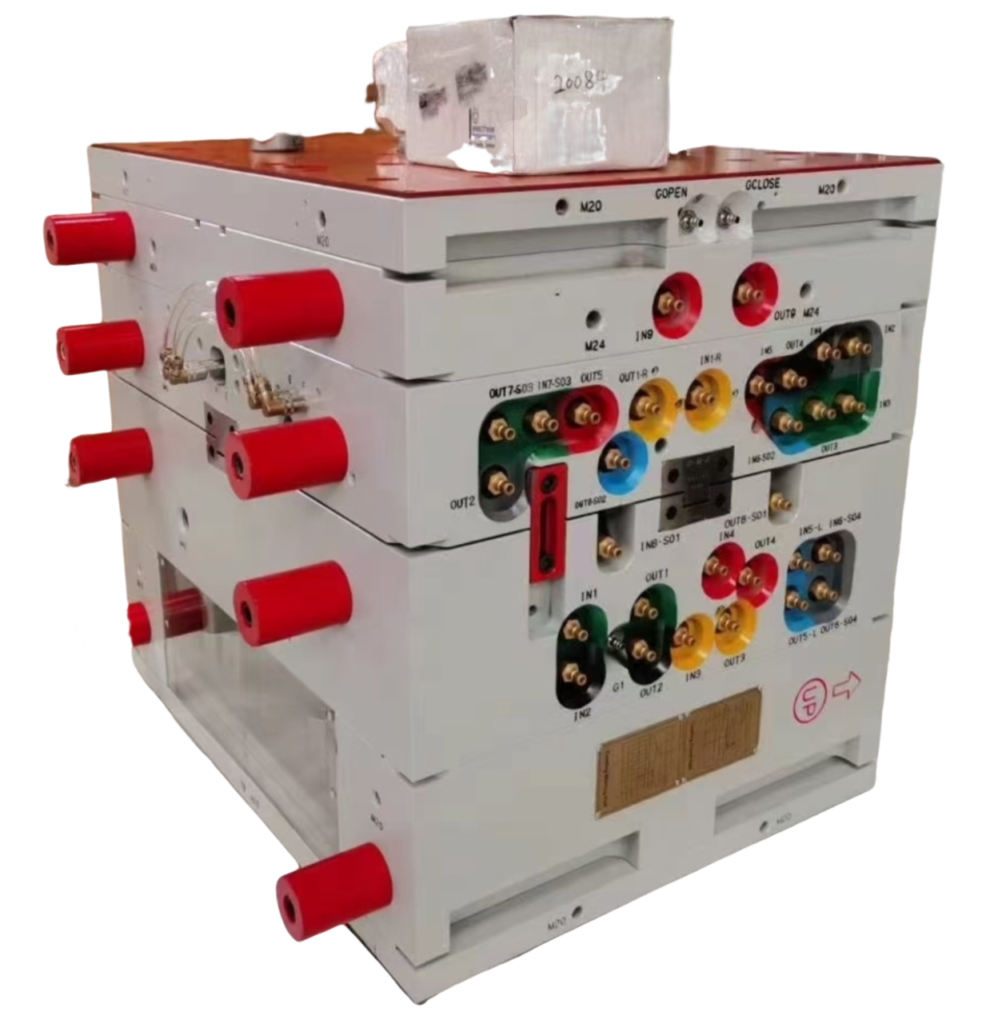
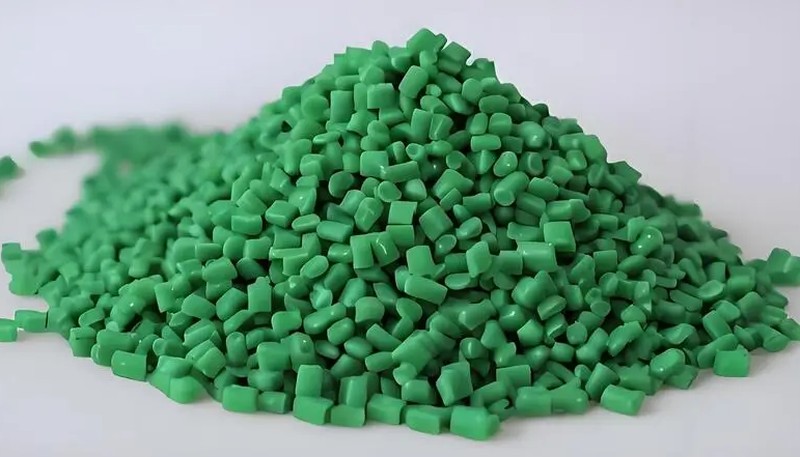
Injection molding is a manufacturing process in which thermoplastisch1 pellets are melted in a heated barrel, then forced under pressure of 10,000–30,000 psi through a gate into a closed steel mold cavity. The plastic fills the cavity, cools against the mold walls, solidifies into the exact shape of the cavity, and is ejected as a finished solid part. The cycle then repeats — often in under 30 seconds for small consumer parts.
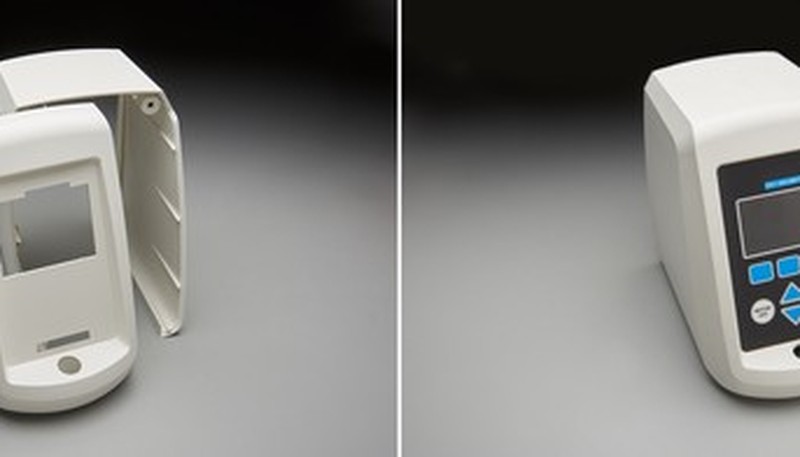
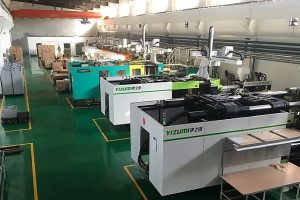
In our factory, injection molding machines range from 50 to 850 tons of clamping force. The process is extraordinarily versatile: we mold parts as small as 0.1 g and as large as 500 g using the same fundamental principle. The key characteristic that defines injection molding is that the finished part is solid — the plastic fills the cavity completely and takes the shape of every interior surface feature, including bosses, ribs, snap fits, and living hinges.
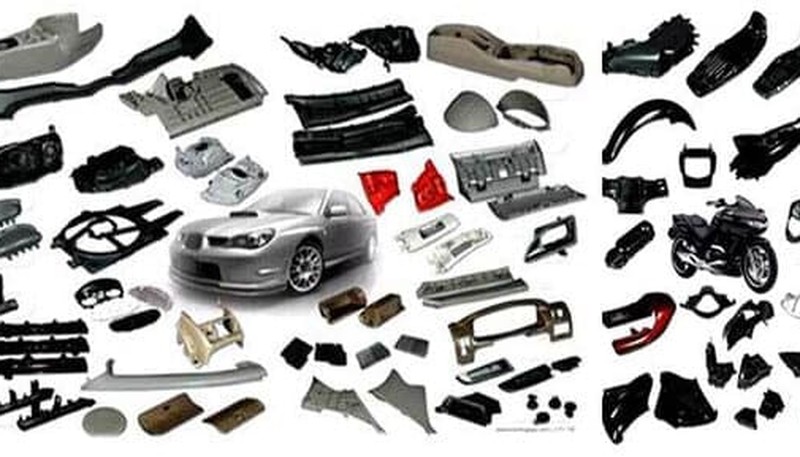
Spritzgießen ist das Verfahren der Wahl, wenn Sie enge Maßtoleranzen benötigen (±0,05 mm sind routinemäßig erreichbar), komplexe Geometrien mit Hinterschneidungen, die durch Schieber und Auswerfer verwaltet werden, Oberflächenbeschaffenheiten von spiegelglatt (SPI A1) bis zu starker Textur (SPI D3) und Produktionsmengen von einigen tausend bis zu mehreren zehn Millionen Einheiten pro Jahr. Wir haben es verwendet, um chirurgische Instrumentengriffe, Automobilsteckergehäuse und Gehäuserahmen für Unterhaltungselektronik herzustellen – alles aus demselben grundlegenden Prozess.

What Is Blow Molding and How Does It Work?
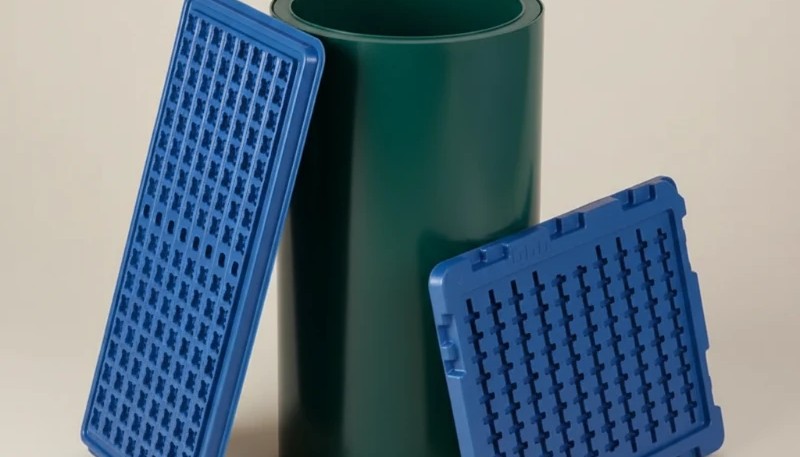
Blow molding is a fundamentally different process designed for one specific type of part geometry: hollow containers with thin, uniform walls. The process starts by extruding or injecting a hollow tube of molten plastic called a parison or preform. This tube is clamped inside a mold, and compressed air is blown into it, expanding the plastic against the cavity walls. The plastic cools, the mold opens, and the hollow part is ejected.
There are three main variants of Blasformen2: extrusion blow molding (EBM), injection blow molding (IBM), and injection stretch blow molding (ISBM). EBM is the simplest and most common, used for industrial containers and automotive fluid reservoirs. IBM produces precise small pharmaceutical bottles. ISBM — the process used for PET beverage bottles — stretches the preform both axially and radially to achieve exceptional clarity and barrier properties.
When clients bring us hollow parts — especially anything that holds liquid — blow molding is almost always the right answer. The process produces wall thicknesses as uniform as 0.5 mm across complex curved surfaces, something injection molding simply cannot replicate for closed hollow geometries without welding two halves together.
How Does Part Geometry Determine Which Process to Use?
Part geometry is the single most important factor in process selection. Understanding where each process can and cannot go saves engineers from expensive tooling mistakes.
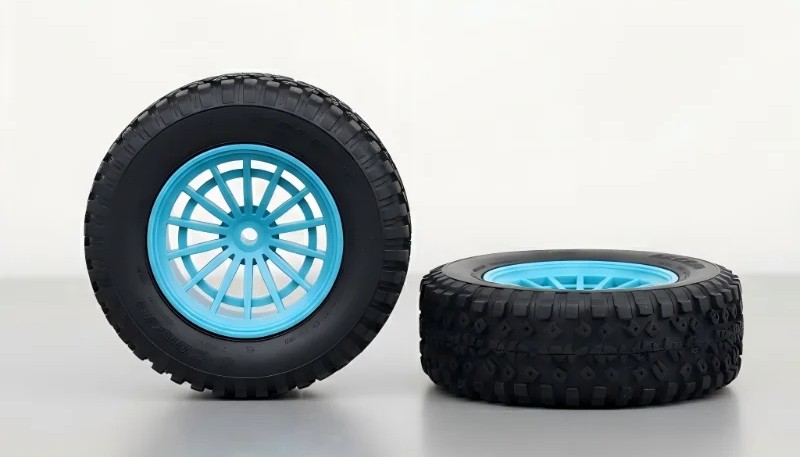
Injection molding handles almost any solid geometry with an open or complex interior — undercuts via slides and lifters, internal threads from unscrewing cores, multi-material constructions via two-shot or insert molding, and surface details as fine as 0.02 mm. The only constraint is that the mold must open and the part must eject cleanly, which requires careful draft angle design and undercut planning.
Blow molding is geometrically limited to hollow closed forms. You cannot blow mold a solid part, a part with a flat bottom without a pinch-off seam, or a part with complex external features like fine threads or precision bosses. However, within its domain — bottles, tanks, containers, and hollow structural parts — blow molding can produce geometries that would be impossible or prohibitively expensive in injection molding.
„Blasformen ist das einzige standardmäßige Ein-Schritt-Verfahren für nahtlose hohle Kunststoffbehälter.“Wahr
Producing a hollow seamless container by injection molding requires molding two halves and welding them together — adding cost, a visible weld line, and potential leak points. Blow molding expands the plastic against the mold interior in one step, producing seamless hollow parts economically. This is why virtually every plastic bottle in the world is blow molded, not injection molded. This distinction matters for product designers choosing the right process.
„Blasformen hat immer niedrigere Werkzeugkosten als Spritzgießen.“Falsch
While basic extrusion blow molds are less expensive than equivalent injection molds, injection stretch blow molding (ISBM) tooling for precision preforms costs as much as or more than comparable injection molds. Furthermore, for parts with complex geometry, the total cost including secondary operations often makes blow molding more expensive than injection molding. Tooling cost comparison must always be done part-by-part, not as a blanket rule.
How Do Tooling Costs and Lead Times Compare Between the Two Processes?
Tooling cost is often the deciding factor at the start of a product development project. Here is how injection molding and blow molding compare on initial investment and lead time.
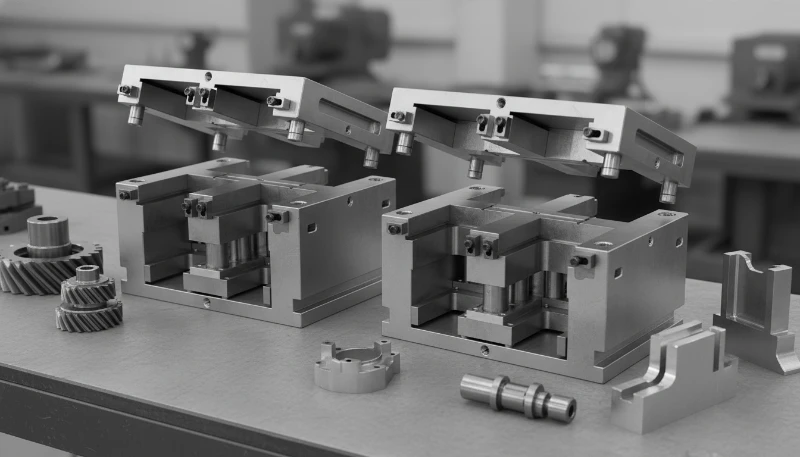
Injection molds are precision steel tools with polished cavities, conformal cooling channels, runner systems, and ejector mechanisms. A simple single-cavity injection mold for a small consumer part costs $5,000–$15,000. Complex multi-cavity production tools can exceed $100,000. Lead times typically run 4–8 weeks for standard tools built to DIN 16901 specifications.
Blow molds are generally less expensive than injection molds for equivalent part sizes. An extrusion blow mold for a standard container costs $3,000–$10,000 with a 3–5 week lead time. However, ISBM tooling for precision preforms can cost as much as a comparable injection mold. The lower average blow mold cost reflects simpler cavity geometry — smooth interior surfaces without ribs, bosses, or complex features.
Wir haben festgestellt, dass, wenn Kunden die gesamten Projektkosten und nicht nur die Werkzeugkosten vergleichen, Spritzgießen bei massiven Teilen für jede Menge gewinnt, während Blasformen bei hohlen Teilen bei den meisten Produktionsmengen über 10.000 Einheiten pro Jahr gewinnt. Wir erstellen detaillierte Kostenmodelle vor jeder Werkzeugverpflichtung, um sicherzustellen, dass die Wirtschaftlichkeit mit dem Geschäftsfall übereinstimmt.
Which Process Delivers Better Dimensional Accuracy and Surface Finish?
Dimensional control is a critical differentiator, especially for parts that must fit into assemblies or meet regulatory specifications for medical or automotive use.
Injection molding delivers the tightest tolerances achievable in plastic manufacturing. Standard commercial tolerances are ±0.2 mm; with precision tooling and controlled processing, we regularly achieve ±0.05 mm. The reason: both mold halves precisely constrain the plastic on all sides during solidification, with minimal opportunity for dimensional variation.
„Spritzgießen erreicht bei gleichen Bauteilgrößen engere Maßtoleranzen als Blasformen.“Wahr
Injection molding constrains the plastic between two precisely machined mold halves during solidification, enabling tolerances of ±0.05 mm with precision tooling. Blow molding relies on air pressure to push plastic against the cavity, with no control over the interior surface — resulting in typical tolerances of ±0.3–0.5 mm and wall thickness variations of ±20–30%. For any application requiring precision fit, injection molding is the correct choice.
„Blasformen ist pro Teil immer günstiger als Spritzgießen für gleichwertige Kunststoffteile.“Falsch
Per-part cost depends on geometry, material, volume, and cavitation — not process alone. Injection molding at 100,000+ units with multi-cavity tooling can achieve lower per-part costs than blow molding for solid parts. Blow molding is cost-effective for hollow containers, but it is not a universal cost winner. The correct comparison must be done part-by-part at the target production volume.
Blow molding tolerances are inherently looser — typically ±0.3–0.5 mm. The air pressure that expands the parison cannot precisely control wall thickness distribution, especially in corners, shoulders, and areas with complex curvature. Wall thickness variation of ±20–30% is common and acceptable in most blow molded applications, since these parts are used for liquid containment rather than precision assembly.
Die Oberflächengüte folgt demselben Muster. Spritzgießen repliziert die Formoberfläche sowohl an den Innen- als auch an den Außenwänden, was spiegelglatte Oberflächen (Ra < 0,025 μm) oder kontrollierte Texturen auf jeder Oberfläche ermöglicht. Blasformen erzeugt eine ausgezeichnete Außenoberflächengüte, wo der Kunststoff die Form berührt, aber die Innenoberfläche ist unkontrolliert – was für einen Behälterinnenraum akzeptabel ist, aber für präzise mechanische Schnittstellen ungeeignet.
What Materials Can Each Process Use?
Both injection molding and blow molding work with thermoplastics, but material options differ significantly due to different processing requirements at melt and forming stages.
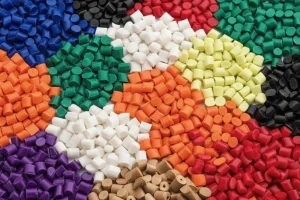
Injection molding is compatible with virtually every thermoplastic — from commodity resins like PP, PE, and ABS to engineering grades like PEEK, PEI, and LCP. We process over 50 different materials in our factory. The process handles highly filled compounds (30–50% glass fiber, carbon fiber, mineral filler) and materials with complex rheology that would be impossible to blow mold.
Blow molding is more material-selective. The most common materials are HDPE, PP, PET, and PVC. The material must have sufficient melt strength to form a stable parison that holds its shape without draping or tearing before the mold closes. This requirement limits blow molding to materials with relatively high melt viscosity during parison formation. Engineering plastics and highly filled compounds are generally unsuitable.
PET deserves special mention: it is the dominant beverage bottle material, processed almost exclusively by ISBM — a two-stage process where an injection-molded preform is reheated and stretch-blown to its final shape. This hybrid combines injection molding precision for the preform with blow molding economics for the final container.
: Die Gesamtdauer, die für einen Spritzgießzyklus benötigt wird, einschließlich der Phasen Einspritzen, Abkühlen und Auswerfen. Die Verkürzung der Zykluszeit verbessert direkt den Produktionsdurchsatz und senkt die Kosten pro Teil.
Production economics ultimately determine which process wins for a given project. Zykluszeit3 is the most important economic variable alongside tooling cavitation.
Injection molding cycle times range from under 10 seconds for small thin-walled parts to several minutes for large thick-walled components. Multi-cavity molds with 8, 16, 32, or up to 128 cavities multiply output per machine hour dramatically. In our factory, high-volume closure production runs at over 10,000 parts per hour on 48-cavity tools.
Blow molding cycle times are generally longer for equivalent part sizes, ranging from 10–60 seconds for EBM and 20–40 seconds for ISBM. Multi-cavity blow molds can run many cavities simultaneously. For simple containers, blow molding output per machine-hour can match injection molding output, especially when multi-cavity tooling is used on both sides.
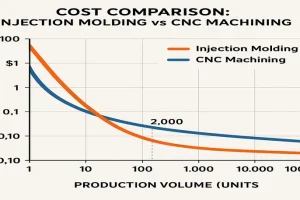
The economic crossover point depends on part complexity and volume. For hollow consumer packaging above 50,000 units annually, blow molding almost always offers lower total cost. For solid precision parts above 5,000 units, injection molding wins consistently. Below 5,000 units for either process, tooling amortization makes both expensive relative to alternatives like machining or casting.
Frequently Asked Questions About Injection Molding vs Blow Molding
Can injection molding produce a bottle?
Not in a single step — a bottle requires a hollow closed form that cannot be ejected from a conventional injection mold. However, injection blow molding (IBM) uses an injection-molded preform as the starting point for a blow-molded bottle, combining both processes in one production line.
Which process is better for food-contact applications?
Both are used extensively in food-contact applications and both can use FDA-compliant materials. Blow molding dominates for liquid food packaging (bottles, jugs, containers); injection molding dominates for solid food-contact parts (utensils, caps, lids, cutlery). The choice depends on geometry, not regulatory compliance.
Can blow molded parts achieve good surface finish for branding and decoration?
Yes — blow molded parts can be decorated by in-mold labeling (IML), hot stamping, pad printing, and screen printing. Exterior surface quality is good because it contacts the mold. However, fine raised lettering, sharp feature edges, and mirror finishes are better achieved by injection molding.
What is the minimum wall thickness for each process?
Injection molding can produce walls as thin as 0.4 mm for small parts, with 1.0–3.0 mm being the practical range for most applications. Blow molding typical walls are 0.5–3.0 mm with inherent thickness variation across the part. For very thin uniform walls in a hollow part, injection-molded halves with ultrasonic welding is sometimes preferred.
How do I decide between injection molding and blow molding for my project?
Wenden Sie diese einfache Regel an: Wenn Ihr Teil massiv ist, verwenden Sie Spritzgießen. Wenn Ihr Teil hohl ist und Flüssigkeit oder Luft enthält, verwenden Sie Blasformen. Wenn Ihr Teil hohl ist, aber komplexe externe Merkmale oder Präzisionsmaße erfordert, ziehen Sie spritzgegossene Hälften mit Ultraschallschweißen in Betracht. Kontaktieren Sie uns mit Ihren Konstruktionsdateien, und wir werden Ihnen innerhalb von 24 Stunden eine kostenlose Verfahrensempfehlung mit Kostenschätzungen geben. Sehen Sie sich unsere Injection Molding Complete Guide for a comprehensive overview.
-
Thermoplastisch: a polymer material that softens when heated above its glass transition or melting point and solidifies when cooled, making it processable by both injection molding and blow molding and recyclable at end of life. ↩
-
Blasformen: a manufacturing process in which a hollow plastic parison or preform is expanded inside a mold cavity using compressed air, producing seamless hollow parts such as bottles, containers, and fluid reservoirs. ↩
-
Zykluszeit: The total duration required to complete one injection molding cycle, including injection, cooling, and ejection phases. Reducing cycle time directly improves production throughput and lowers per-part cost. ↩
Need a Quote for Your Injection Molding Project?
Get competitive pricing, DFM feedback, and production timeline from ZetarMold’s engineering team.




 EN
EN  ES
ES  FR
FR  DE
DE  PT
PT  AR
AR  RU
RU  JA
JA  KO
KO  IT
IT  NL
NL  TR
TR  PL
PL