

- Taiwan-based suppliers typically charge $8,000-$25,000 for injection molds; Chinese suppliers like ZetarMold offer comparable quality at 30-50% lower tooling cost.
- ZetarMold holds ISO 9001 and ISO 14001 certifications and maintains a 92% first-pass quality rate across 47 injection molding machines.
- Lead times from China: DFM review in 24 hours, prototypes in 15 days, production tooling in 25-35 days.
- Taiwanese buyers typically prioritize RoHS compliance, CE marking, and MOQ flexibility — all standard at ZetarMold.
- ZetarMold has served 20+ Taiwanese electronics and medical device companies since 2005.
What Makes Taiwan a Major Market for Injection Molding?
Taiwan’s electronics and hardware sector generates over $150 billion in annual exports, with a significant share requiring precision plastic enclosures, connectors, and structural components. Walk through any factory in Tainan’s Science Park or Hsinchu’s industrial zone and you’ll see injection-molded parts everywhere — in servers, EV chargers, medical monitors, and drones. The question isn’t whether Taiwanese companies need injection molding. It’s where they get it done at competitive cost without sacrificing quality.
Local injection molding companies in Taiwan are capable but expensive. A single P20 steel mold that costs $6,000-$10,000 in Shenzhen or Dongguan can run $15,000-$30,000 in Taichung or Tainan. For product teams launching a new SKU or running validation builds, that cost difference directly impacts go-to-market speed. This is why over 60% of Taiwan’s OEMs and ODMs source molds and production runs from mainland China — not because of lower standards, but because of better value per dollar.
Why Do Taiwan Companies Choose Chinese Injection Molding Suppliers?
Chinese injection molding suppliers dominate the Taiwan supply chain for three concrete reasons: tooling cost, capacity, and lead time. On tooling cost, a class-101 hardened steel mold in China averages 35-50% less than equivalent work in Taiwan, even after factoring in shipping and tariffs. This is primarily due to lower labor rates for mold machinists ($8-$12/hr in Dongguan vs. $25-$40/hr in Taichung) and higher equipment utilization at large-scale Chinese mold shops.
Capacity is the second driver. Top Chinese injection molding factories run 40-100+ machines, enabling parallel tooling and production schedules that few Taiwanese shops can match. When a Taiwanese brand needs to launch three product variants simultaneously, a single Chinese supplier can run all three molds concurrently — a schedule compression that local options often cannot deliver.
Lead time is the third factor. With DFM1 review in 24 hours and T1 samples in 15 days, Chinese suppliers consistently beat local alternatives by 1-2 weeks on prototype cycles. For Taiwanese startups and established OEMs competing in fast-moving electronics markets, every week of lead time advantage is measurable in revenue.
“Chinese injection molding suppliers typically offer 30-50% lower tooling costs than Taiwan-based shops.”Verdadeiro
Labor rates for mold machinists in Dongguan average $8-$12/hr, compared to $25-$40/hr in Taichung. Combined with higher equipment utilization and volume economies, Chinese mold shops consistently deliver equivalent tool quality at significantly lower cost — a difference confirmed by Taiwanese OEM procurement teams who have dual-sourced across both markets.
“Sourcing from China means accepting lower quality or less reliable delivery than Taiwan suppliers.”Falso
ISO 9001-certified Chinese injection molding suppliers follow the same international quality management standards as their Taiwanese counterparts. Companies like ZetarMold maintain 92% first-pass quality rates and ship on-time to 98% of committed delivery dates. The key is supplier qualification — auditing certifications, visiting facilities, and requesting PPAP documentation — not geography.
The cross-strait manufacturing relationship has matured considerably over the past two decades. Taiwan’s hardware sector has developed well-established logistics corridors, banking frameworks, and supplier audit practices for sourcing from mainland China. Customs clearance for injection-molded plastic parts between Taiwan and China typically takes 1-3 business days under standard commercial import procedures.
Taiwan’s Customs Administration classifies most injection-molded plastic parts under HS Chapter 39 (plastics and articles thereof), with import tariff rates between 0% and 7.5% depending on material and end use. For Taiwan buyers with Bonded Factory or Free Trade Zone status, duty drawback mechanisms further reduce the landed cost differential versus local sourcing. Understanding total landed cost — tooling amortization, unit price, freight, duties, and inspection costs — is the correct framework for comparing Chinese versus Taiwanese injection molding suppliers.

ZetarMold’s Core Capabilities for Taiwan Customers
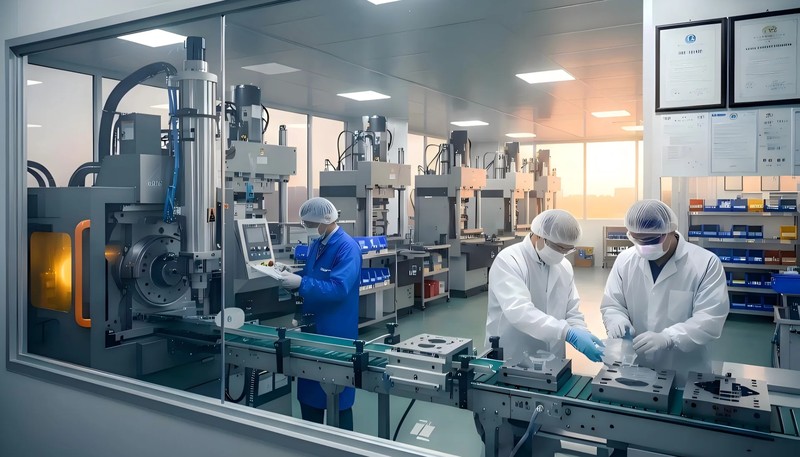
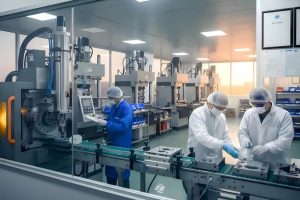
ZetarMold has operated since 2005 and serves over 20 Taiwanese companies in electronics, medical devices, and consumer hardware. Our Dongguan facility runs 47 injection molding machines ranging from 60-ton to 1,200-ton clamping force, covering part weights from 1 gram to 10 kilograms. The machine fleet includes Haitian, Engel, and Sumitomo units, with clean-room capability (ISO 8) for medical and optical components.
Our in-house mold shop operates 15 CNC machining centers and 8 EDM machines, all running on a 24/5 schedule. This vertical integration means we control the entire cycle from tool design to T1 samples — no subcontracting, no scheduling conflicts between mold shop and molding floor. For Taiwan customers, this translates to a single point of accountability and faster response when revisions are needed.
ZetarMold holds ISO 9001:2015, ISO 14001:2015, and IATF 16949 certifications. Our quality lab includes CMM measurement, optical comparator, and spectral colorimetry. All molds are validated with full PPAP packages including dimensional reports, capability studies (Cpk >= 1.33), and material certification documents — documentation standards familiar to Taiwan’s electronics procurement teams.
| Parâmetro | ZetarMold Specification |
|---|---|
| Founded | 2005 |
| Máquinas de moldagem por injeção | 47 units, 60-1,200 ton |
| First-Pass Quality Rate | 92% |
| DFM Review Turnaround | 24 hours |
| T1 Sample Lead Time | 15 days |
| Production Mold Lead Time | 25-35 days |
| Certifications | ISO 9001, ISO 14001, IATF 16949 |
| Clean Room | ISO 8 (Class 100,000) |
| Taiwan Customers Served | 20+ |
What Taiwan Buyers Typically Require From Injection Molding Suppliers
Taiwan’s electronics OEMs and medical device manufacturers operate under strict compliance requirements inherited from their end customers in Europe, North America, and Japan. Understanding these requirements is the first step to a successful supplier relationship. The most common mandates from Taiwan procurement teams include RoHS 2.0 compliance (no restricted hazardous substances), CE marking support documentation, and REACH substance declarations for materials used in EU-bound products.
MOQ flexibility is a consistent priority, particularly for product teams managing multiple SKUs or running pilot production ahead of full commercial launch. Taiwan hardware startups frequently need 500-2,000 parts for beta testing and investor demos before committing to production volumes. ZetarMold accommodates MOQs starting at 500 units using aluminum prototype tooling, with a clear upgrade path to hardened P20 or H13 steel molds when volumes justify it.
Communication and responsiveness are also frequently cited concerns among Taiwan buyers sourcing from mainland China. ZetarMold maintains a dedicated Taiwan account management team with Mandarin-speaking engineers available in GMT+8 business hours. All project updates, DFM reports, and quality documents are delivered in English and Traditional Chinese formats.
“RoHS 2.0 and REACH compliance documentation is standard practice at ISO-certified Chinese injection molding suppliers.”Verdadeiro
EU-facing supply chain requirements have made RoHS and REACH documentation a baseline expectation at any serious Chinese mold shop. ZetarMold provides material certification documents with every shipment, including supplier declarations of conformity (SDoC) for RoHS restricted substances and REACH SVHC screening reports — the same documentation Taiwan exporters need for their European customers.
“Taiwan buyers must accept high MOQs when sourcing injection molded parts from China.”Falso
MOQ flexibility depends on supplier strategy, not geography. ZetarMold’s low-volume service starts at 500 units with aluminum tooling, enabling Taiwan product teams to run market validation builds without committing to mass production. The tooling investment scales — aluminum molds at $1,500-$5,000 for prototyping, hardened steel molds at $6,000-$25,000 for production — allowing buyers to match spend to commercial risk.
Intellectual property protection is another concern frequently raised by Taiwan hardware companies when evaluating Chinese suppliers. ZetarMold addresses this through legal-grade NDAs governed by Hong Kong law (enforceable in international arbitration), mold ownership agreements that explicitly assign tooling title to the customer, and physical security measures including access-controlled mold storage and visitor log requirements.
Currency and payment risk management is also simpler than many Taiwan buyers expect. ZetarMold accepts payment in USD (wire transfer / TT), with tooling invoices denominated in USD to eliminate CNY exchange rate exposure. For customers with Taiwan dollar receivables, the USD invoicing structure aligns with standard Taiwan export billing practices.
Industries ZetarMold Serves for Taiwan Customers
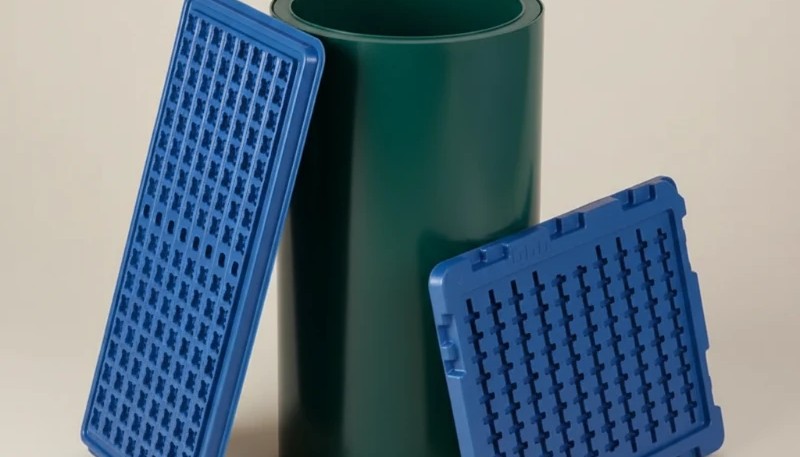
ZetarMold’s Taiwan customer base spans five primary industries: consumer electronics, industrial automation, medical devices, automotive electronics, and smart home hardware. Each sector brings distinct material and tolerance requirements that our engineering team addresses at the DFM stage.
Key Considerations for Taiwan Buyers
Consumer electronics projects from Taiwan typically involve ABS, PC/ABS, or glass-filled nylon for enclosures, buttons, and structural frames. Tight cosmetic requirements (Class A surface, Ra <= 0.8 um) are standard, along with snap-fit features requiring dimensional tolerances of +/-0.05 mm or tighter. ZetarMold's mold design team uses Moldex3D simulation for análise do fluxo do molde2 to optimize gate locations and cooling channel layouts before cutting steel, reducing revision cycles by an average of 1.3 rounds per project.
Medical device components require biocompatible materials (PC, PEEK, medical-grade PP) and clean-room molding under ISO 8 conditions. ZetarMold’s clean room operates with HEPA filtration, positive pressure differential, and gowned operators — standard requirements for Class II medical device supply chains. All medical molds are validated with IQ/OQ/PQ protocols and documented in the project quality plan.
Industrial automation components present a different challenge: structural integrity and dimensional repeatability over large production volumes. Taiwan’s automation sector produces collaborative robots, vision systems, and precision actuators that incorporate injection-molded housings and brackets with tight GD&T requirements. ZetarMold serves this sector with glass-filled PA66, POM, and PEEK materials, delivering Cpk >= 1.67 on critical dimensions as required by automation OEM quality plans.
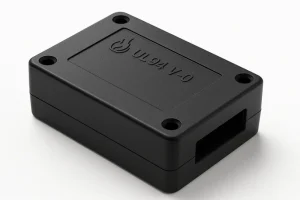
Smart home hardware is the fastest-growing segment of ZetarMold’s Taiwan customer base. Products including smart switches, sensor nodes, gateway devices, and USB chargers all require compact enclosures with precise snap-fit and living hinge features. Wall thicknesses often range from 0.8 to 1.5 mm, requiring careful gate design and fill simulation to avoid short shots and warpage.
Drone and UAV hardware is an emerging segment. Taiwan produces a growing share of the world’s commercial drone frames, motor housings, and payload mounts. These parts require lightweight engineering resins (glass-filled PA12, CF-PEEK, or PPS) with tight dimensional control for assembly fit. ZetarMold has tooled over 15 drone component molds for Taiwan customers in the past three years, with production runs ranging from 2,000 to 50,000 units per year.
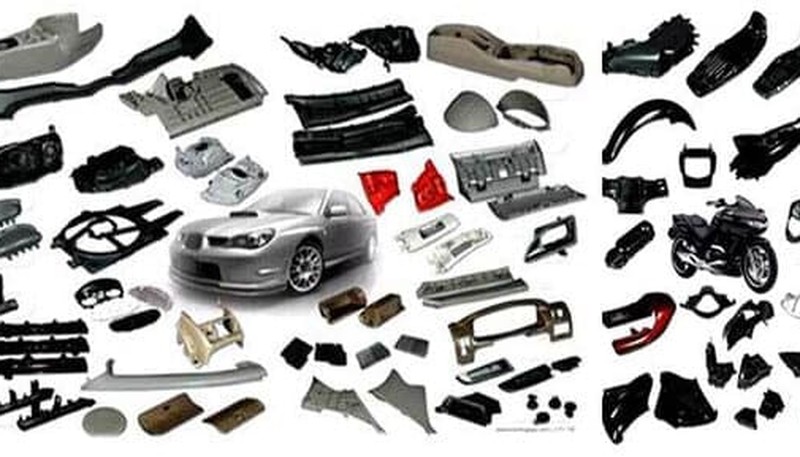
Automotive electronics parts — sensor housings, connector bodies, ECU brackets — require IATF 16949 compliance and material traceability from resin lot to finished part. ZetarMold’s ERP system links each production batch to its material certification, machine parameters, and QC inspection records, providing the traceability documentation that Tier-1 automotive suppliers expect from their injection molding partners.
How to Start Working With ZetarMold From Taiwan
Starting a project with ZetarMold from Taiwan follows a streamlined four-step process designed to minimize friction and get you to T1 samples as fast as possible. The process begins with a free DFM review — submit your 3D CAD files (STEP or IGES format) and ZetarMold’s engineering team returns a detailed manufacturability report within 24 hours, flagging wall thickness issues, draft angle problems, undercuts, and material recommendations.
Step two is quotation and tooling agreement. ZetarMold provides itemized quotes covering mold steel grade, number of cavities, runner system, and unit pricing at your target volume. Payment terms for Taiwan customers typically follow a 50% deposit on tooling order, 40% on T1 sample approval, and 10% on first production shipment — standard terms that align with Taiwan’s LC and TT banking practices.
Step three is tooling fabrication and T1 sampling, which takes 15-25 days depending on part complexity. ZetarMold provides weekly photo and video updates during mold construction, and ships T1 samples via DHL Express to Taiwan in 2-3 business days. Step four is production, with lead times of 15-25 days from order confirmation for established molds. Shipments to Taiwan go by air freight (3-5 days) or sea (6-8 days), with full export documentation.
For Taiwan customers who prefer factory visits before committing to a supplier, ZetarMold welcomes on-site audits at our Dongguan facility. Our factory is a 90-minute drive from Hong Kong International Airport, accessible via the Hong Kong-Zhuhai-Macau Bridge or ferry connections. We provide standard supplier audit packages including facility walk-through, machine list, quality system documentation review, and reference customer contacts.
Remote qualification is also available for customers who prefer not to travel. ZetarMold conducts structured video factory tours via Teams or WeChat video call, covering the mold shop floor, injection molding area, quality lab, and clean room. We provide a virtual audit checklist that mirrors the SGS and Bureau Veritas supplier audit frameworks familiar to Taiwan’s quality teams. Remote qualification typically takes 2-3 hours and can be scheduled within 5 business days of request.

Get a Free Quote from ZetarMold today. Submit your 3D CAD files and receive a DFM review within 24 hours, with T1 samples in 15 days. Our Mandarin-speaking engineering team is available in GMT+8 business hours to answer your questions and guide your project from design to production.
Frequently Asked Questions About Injection Molding Companies in Taiwan?
How much does injection mold tooling cost when sourcing from China vs. Taiwan?
A class-101 production steel mold (P20, single cavity) for a typical electronics enclosure costs $6,000-$12,000 at ZetarMold, compared to $15,000-$30,000 at equivalent Taiwan mold shops. Multi-cavity molds for high-volume parts show even larger absolute cost differences. Aluminum prototype molds start at $1,500-$3,000 for simple parts, enabling low-risk pilot runs before committing to production steel. The total landed cost from China — including freight, duties, and inspection — typically still comes in 25-40% below Taiwan-sourced equivalents, even for small MOQs where per-shipment logistics costs are proportionally higher.

Does ZetarMold support RoHS and REACH compliance for Taiwan exporters?
Yes. ZetarMold provides material certification documents with all shipments, including supplier declarations of conformity for RoHS 2.0 restricted substances (lead, mercury, cadmium, hexavalent chromium, PBB, PBDE, DIBP, DBP, BBP, DEHP) and REACH SVHC screening reports. We use only certified resin suppliers and maintain full material lot traceability in our ERP system. For Taiwan companies exporting to the EU, we can provide documentation in English and Traditional Chinese, and our quality team is familiar with CE marking support requirements for electronics, medical devices, and machinery directives.
What is the minimum order quantity for injection molded parts from ZetarMold?
ZetarMold accepts orders starting at 500 units using aluminum prototype tooling, which is suitable for product validation, beta testing, and investor demos. For production steel tooling (P20 or H13), MOQ is typically 1,000-5,000 units depending on part complexity and pricing targets. There is no maximum order quantity — ZetarMold’s 47-machine fleet supports both low-volume pilot runs and high-volume production at 50,000-500,000+ parts per month. Taiwan hardware startups frequently use our staged tooling approach: start with aluminum at 500 units, upgrade to steel when commercial volumes are confirmed.
How does ZetarMold handle quality control and documentation for medical device parts?
Medical device projects at ZetarMold follow IQ/OQ/PQ validation protocols with full documentation packages. Production runs in our ISO 8 clean room with HEPA filtration and positive pressure control. Each batch includes dimensional inspection reports (CMM), material certificates, and process parameter records. ZetarMold supports FDA 21 CFR Part 820 and ISO 13485 documentation requirements for Taiwan medical device manufacturers exporting to the US and EU. Our quality team has experience with Taiwan FDA (TFDA) registration requirements and can provide technical file support for Class II medical device submissions.
Can ZetarMold provide prototypes before committing to production tooling?
Yes. ZetarMold offers two prototype paths: CNC-machined prototypes from solid resin stock (3-5 day lead time, no tooling cost), and injection-molded prototypes from aluminum soft tooling (15-day lead time, $1,500-$5,000 tooling). The CNC path is ideal for early form-fit-function validation; the aluminum tooling path produces parts with production-representative surface finish and material properties, suitable for functional testing and pre-production approval. For complex assemblies, ZetarMold can produce matched multi-part prototype sets in a single run, accelerating Taiwan product teams’ validation timelines by 2-3 weeks.
What are the shipping options and lead times from ZetarMold to Taiwan?
ZetarMold ships to Taiwan via DHL Express (2-3 business days from Dongguan), FedEx (2-3 days), and sea freight (6-8 days for FCL or LCL). Air freight is standard for prototypes and urgent production runs. Sea freight is cost-effective for high-volume production shipments over 500 kg. Export documentation includes commercial invoice, packing list, certificate of origin (Form E for ASEAN-China FTA rates), and material certificates. ZetarMold’s export team handles all Dongguan Customs procedures and can arrange door-to-door delivery to any Taiwan address.
-
DFM: DFM (Design for Manufacturability) refers to the engineering practice of designing parts to minimize production complexity and cost during injection molding. ↩
-
mold flow analysis: Mold flow analysis refers to simulation software used to predict how molten plastic fills a mold cavity, identifying potential defects such as weld lines, sink marks, and short shots before tooling is cut. ↩



 PT
PT  EN
EN  ES
ES  FR
FR  DE
DE  AR
AR  RU
RU  JA
JA  KO
KO  IT
IT  NL
NL  TR
TR  PL
PL 