...

射出成形金型冷却システム:種類、設計&最適化ガイド

• ZetarMold Engineering Guide
• Plastic Injection Mold Manufacturing Since 2005
• Built by ZetarMold engineers for buyers comparing mold and molding solutions.

要点
  • Cooling accounts for 50-70% of total injection molding cycle time; optimizing it is the fastest way to reduce cost.
  • The six main cooling channel types are: straight-line, baffle, bubbler, spiral, conformal, and thermal pin.
  • Water cooling at 10-25 degrees C is the industry standard for most thermoplastics; oil cooling is used above 80 degrees C.
  • Conformal cooling channels reduce cycle time by 20-35% compared to conventional straight channels.
  • Channel diameter, pitch, and distance from cavity wall directly determine cooling uniformity and warp risk.
  • In our factory, we use mold flow analysis on every new mold to verify temperature uniformity before cutting steel.

What Is an Injection Mold Cooling System?

An injection mold cooling system is a network of channels, passages, and temperature-control devices machined into the mold that remove heat from molten plastic after injection, reducing サイクルタイム1 by 50-70% and ensuring dimensional accuracy. Without a properly designed cooling system, parts warp, sink marks appear, and production throughput collapses. The cooling system is not an afterthought — it determines whether your mold is profitable or a liability.

Cooling works by circulating a temperature-controlled medium — most commonly water at 10-25 degrees C — through channels drilled or printed into the mold plates surrounding the cavity. Heat from the molten plastic (injected at 180-320 degrees C depending on material) transfers into the coolant, which carries it away to an external chiller or cooling tower. The part reaches ejection temperature (typically 40-80 degrees C below the material glass transition temperature) and is removed.

In our factory in China, we run 47 injection molding machines across 3 workshops. Every mold we build receives a dedicated cooling circuit layout during DFM2 review, and we use 金型流動解析3 to simulate temperature distribution before any steel is machined. This discipline is why our first-pass approval rate exceeds 92%.

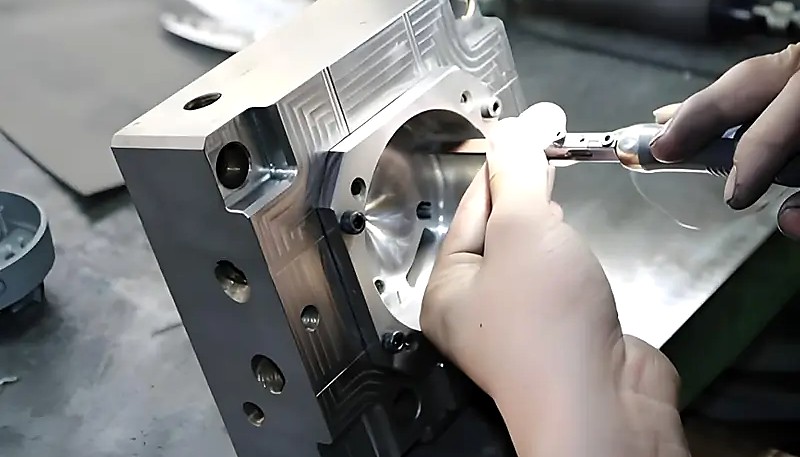
射出成形金型冷却チャネル配置図
Injection mold cooling channels

Why Cooling System Design Matters: The Numbers

Cooling phase accounts for 50-70% of total cycle time in standard thermoplastic injection molding. A 10-second reduction in cooling time on a 30-second cycle translates to a 33% increase in throughput — producing hundreds of thousands more parts per year on the same machine with zero capital investment. That is the single highest-ROI optimization available in injection molding.

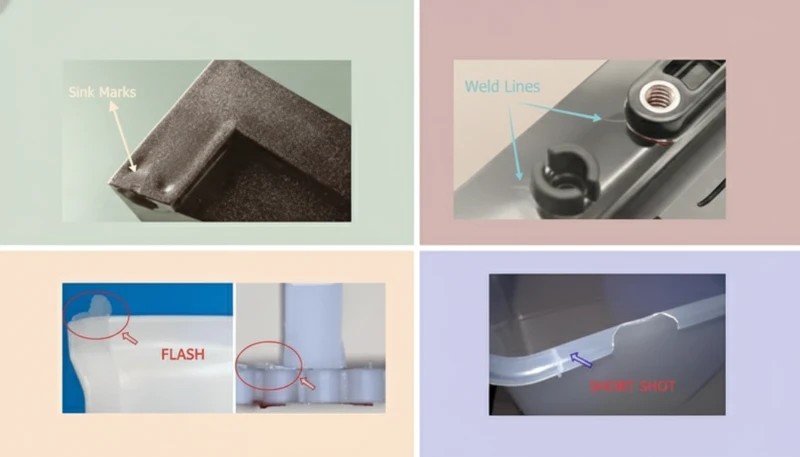
Poor cooling design creates five interconnected problems: warping and dimensional deviation from uneven temperature gradients above 5 degrees C across the cavity surface; sink marks from insufficient cooling time causing premature ejection; internal residual stress from rapid or uneven solidification; surface defects including gloss variation and blush; and extended cycle times from conservative cooling settings to compensate for poor channel placement.

All five problems cost money — either through scrap, rework, slow cycles, or failed customer inspections. In our experience reviewing hundreds of mold projects, poor cooling design is the most common root cause of first-article failures. Customers often attribute failures to material or machine settings when the actual cause is a cooling circuit that was never properly designed.

Cooling System Impact on Cycle Time and Quality
パラメータ Poor Cooling Optimized Cooling Improvement
サイクルタイム 35 sec 22秒 -37%
Temperature uniformity >10°C delta <3°C delta 3x better
Warp (typical ABS part) 0.8 mm 0.15 mm 81% reduction
Sink mark depth 0.3 mm <0.05 mm 6x better
Annual throughput (1 cavity) 825,000 shots 1,310,000 shots +59%

These figures come from our engineering team’s internal benchmarking data across 200+ mold projects. The exact numbers vary by material, wall thickness, and part geometry — but the directional impact is consistent: every second of cooling time saved translates directly to cost reduction and capacity increase.

6 Types of Injection Mold Cooling Systems

Injection molds use six primary cooling channel configurations, each suited to different part geometries, precision requirements, and budget constraints. Understanding when to use each type is foundational to mold design.

1. Straight-Line Cooling Channels

Straight-line (or drilled) cooling channels are the standard for flat or simple-geometry parts, created by drilling 6-14 mm diameter holes through mold plates in a grid or parallel pattern. Channel-to-cavity distance is typically 15-25 mm for P20 steel molds, with 1.5 times channel diameter as minimum wall thickness to the cavity surface. Coolant flow rate targets turbulent flow (Reynolds number above 10,000), which transfers heat 3-5 times more efficiently than laminar flow.

Straight channels are the most cost-effective option — drilling costs $50-200 per circuit versus $500-5,000 for conformal channels — and are fully appropriate for flat lids, panels, housings with uniform wall thickness, and commodity parts. Their limitation is geometric: they cannot follow curved or complex cavity surfaces, leaving hot spots in corners and ribs where the channel is necessarily further from the cavity wall.

2. Baffle Cooling

Baffles are thin metal plates inserted into drilled channels that force coolant to flow down one side and back up the other, converting a single straight hole into a U-shaped flow path. They are used in narrow cores, pins, and areas where two parallel channels cannot be drilled side by side. A typical baffle doubles the cooling surface area in a restricted zone without requiring additional channel ports.

Baffle effectiveness depends on plate clearance (0.05-0.15 mm on each side) and coolant flow velocity. We typically specify baffles for any core diameter between 16 and 40 mm. Below 16 mm, thermal pins or bubblers are more effective; above 40 mm, spiral channels become the preferred option. The combination of baffle geometry and proper flow rate is what makes the difference between adequate and excellent core cooling.

3. Bubbler Cooling

Bubblers (also called fountain cooling) use a small-diameter inner tube inserted into a blind hole: coolant flows down the inner tube and returns up the annular space between the tube and hole wall. This creates a spray effect at the tip of the core — the hottest zone — achieving very high local heat transfer coefficients. Bubblers are standard for cores under 16 mm in diameter and deep pin features with aspect ratios above 4:1.

In our shop, we use bubblers on every core pin above 25 mm height, regardless of diameter. The additional machining cost of $30-80 per bubbler port is consistently recovered in cycle time reduction at the mold trial. For cores that are too small for bubblers, beryllium copper inserts provide passive heat conduction to nearby water channels.

4. Spiral (Helix) Cooling Channels

Spiral cooling channels wrap a helical path around cylindrical cores or circular cavities, providing uniform cooling over 360 degrees of the feature. For threaded closures, round containers, medical vials, and any rotationally symmetric part, spiral channels reduce peak-to-average temperature differential from more than 8 degrees C (with straight channels) to less than 2 degrees C.

Pitch and lead angle are tuned to the coolant flow rate — typically 4-8 mm pitch with a 45-degree helix angle for water cooling. Spiral inserts can be machined as separate components and pressed into mold cores, making them replaceable when worn or when geometry changes require a redesign.

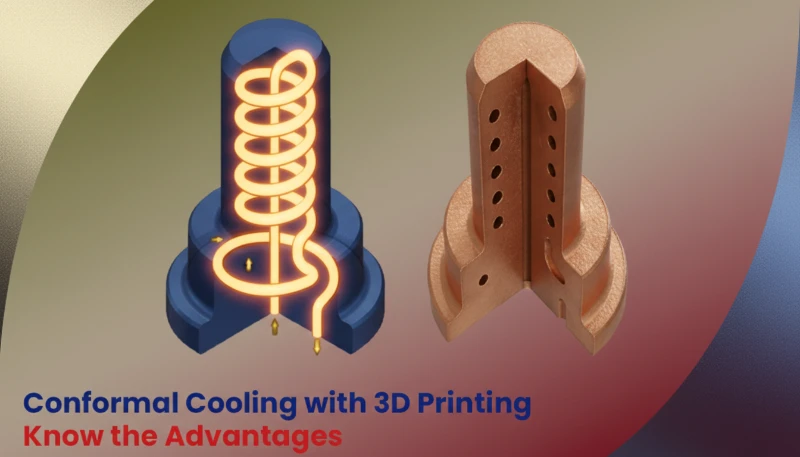
射出成形金型内のバッフルおよびバブラ冷却チャネル断面図
Baffle and bubbler cooling inserts

5. Conformal Cooling Channels

conformal cooling4 channels follow the exact 3D contour of the mold cavity wall at a uniform standoff distance (typically 5-12 mm), made possible by metal additive manufacturing (DMLS or SLM). Where conventional drilled channels leave hot spots on curved surfaces and sharp corners, conformal channels maintain cavity-to-channel distance within plus or minus 1 mm across the entire surface — delivering 20-35% cycle time reduction and dramatically more uniform cooling.

The trade-off is cost and lead time: a conformal-cooled insert produced by DMLS from H13 tool steel costs $3,000-15,000 versus $500-2,000 for a conventionally machined insert. The break-even point is typically reached at 50,000-100,000 shots for high-volume parts, where cycle time savings translate to machine-hour savings that exceed the tooling premium. For medical devices, automotive trim, and consumer electronics at high volume, conformal cooling is the standard of practice.

6. Thermal Pins and Heat Pipes

Thermal pins (heat pipes) are sealed copper or beryllium copper components charged with a phase-change fluid. They passively transfer heat from hot spots — sharp corners, ribs, thin features — to a water-cooled heat sink with no active coolant flow. Heat pipe thermal conductivity reaches 10,000-100,000 W/m·K, compared to 20-50 W/m·K for P20 steel.

Thermal pins are ideal for features too small or inaccessible for active cooling channels, such as ribs under 3 mm wide or ejector pin areas. They require no plumbing connections and can be retrofitted into existing molds without major rework. In our factory, thermal pins have eliminated hot-spot sink marks on several medical device molds where ribs could not otherwise be adequately cooled.

Cooling Medium Comparison: Water, Oil, and Air

The cooling medium choice — water, oil, or air — determines heat transfer capacity, operating temperature range, maintenance requirements, and cost. Each medium fits a specific window of mold temperature requirements, and choosing the wrong medium creates quality problems that are surprisingly difficult to trace back to their root cause.

Cooling Medium Comparison for Injection Molding
ミディアム Temp Range Heat Transfer 最適 メンテナンス
Water (chilled) 10-60°C High (3,000-10,000 W/m2K) Most thermoplastics (PE, PP, ABS, PC) Scale/corrosion control
Water (tower) 25-35°C 高い High-volume commodity parts Algae and mineral control
Oil (thermal) 60-200°C Medium (500-2,000 W/m2K) High-temp materials (PEI, PEEK, PPS) Fluid replacement every 12 months
空気 Ambient Low (50-200 W/m2K) Thin walls, elastomers, foam parts Minimal — filter cleaning only
Beryllium copper Passive Very high (conduction) Thin ribs, micro features None

In our factory, 90% of molds run water cooling at 15-25 degrees C using a closed-loop chiller system. For engineering resins processed above 120 degrees C (PEI, PEEK, PPS, POM), we switch to temperature-controlled oil circuits that maintain mold temperature at 80-160 degrees C. Air cooling is reserved for simple silicone and thin-wall foam applications where water channel proximity would cause surface condensation.

Water chemistry management is a critical and often overlooked aspect of mold cooling. We use deionized water with pH 7-8 and a corrosion inhibitor package in all production chiller loops. Tap water causes progressive scale buildup that reduces heat transfer by 15-25% per millimeter of deposit — an invisible performance degradation that shows up as gradually increasing cycle times over 12-18 months of production.

True or False: Injection Mold Cooling Myths

“Cooling time accounts for more than half of total injection molding cycle time.”

In most standard thermoplastic applications, cooling accounts for 50-70% of total cycle time. A 30-second cycle typically breaks down as: injection 3-5 sec, pack/hold 5-8 sec, cooling 15-22 sec, and ejection/mold-open 3-5 sec. Optimizing the cooling phase is the single highest-leverage action in cycle time reduction. Even a 20% improvement in cooling efficiency on a 20-second cooling window saves 4 seconds — a 13% cycle time reduction with no other changes.

“Using colder water always produces faster, better results in injection mold cooling.”

Dropping coolant temperature below the dew point causes condensation on the mold surface — forming water droplets that transfer to part surfaces as cosmetic defects, accelerate mold surface rust, and cause short shots. For hygroscopic materials like nylon and ABS, mold temperature must stay above 15 degrees C to prevent moisture-related defects. The optimal coolant temperature depends on material, wall thickness, ambient humidity, and surface finish requirements — not simply the lowest achievable temperature.

These two principles — that cooling dominates cycle time and that coolant temperature must be carefully controlled — form the foundation of effective injection mold cooling system engineering. Misunderstanding either one leads to wasted machine time or cosmetic defects that fail customer inspection. The next two myths address more advanced design decisions around coolant flow dynamics and cooling technology selection. Both are frequently misapplied in practice: engineers either accept laminar flow as unavoidable or invest in conformal cooling for parts that do not justify the premium. Getting the analysis right saves both time and money.

“Turbulent coolant flow transfers heat significantly more efficiently than laminar flow.”

Turbulent flow (Reynolds number above 10,000) achieves convective heat transfer coefficients of 3,000-10,000 W/m2K, compared to 500-1,500 W/m2K for laminar flow — a 3-5 times improvement in heat transfer rate. Achieving turbulence requires minimum flow velocities of 0.5-1.0 m/s for 8 mm channels. We specify flow rate requirements on every mold cooling circuit drawing and verify turbulent conditions at the mold trial using digital flow meters on each circuit port.

“Conformal cooling channels always justify their higher cost over conventional straight channels.”

Conformal cooling is a premium solution justified only by high production volumes and geometrically complex parts. For flat panels, lids, and simple boxes running under 50,000 shots annually, the $10,000-30,000 DMLS tooling premium will never be recovered through cycle time savings. The break-even analysis must account for machine hourly rate, cycle time delta, annual volume, and tool life. For low-volume specialty parts, optimized straight channels deliver 90% of the benefit at 10% of the cost.

Key Design Parameters for Injection Mold Cooling

Five engineering parameters govern cooling system performance. Getting these right at the design stage prevents expensive rework after mold trials. These numbers are not arbitrary — they emerge from decades of empirical testing and thermal simulation validation.

Channel Diameter

Standard cooling channel diameters range from 6 mm (small precision molds) to 16 mm (large structural molds). The most common sizes in our shop are 8 mm and 10 mm, which balance drilling cost, flow resistance, and heat transfer surface area. Channels below 6 mm are prone to blockage from scale and corrosion and require filtered deionized water; channels above 16 mm reduce structural mold strength and increase the risk of channel-to-channel breakthrough during drilling.

Channel-to-Cavity Distance

Channel centerline-to-cavity surface distance should be 1.5-2 times the channel diameter for balanced thermal and structural performance. For an 8 mm channel in P20 steel, the target distance is 12-16 mm. Closer placement increases cooling rate but risks stress cracking and core breakthrough; greater distances reduce cooling efficiency and create hot spots between channels where the thermal gradient is not adequately controlled.

Channel Pitch (Center-to-Center Spacing)

Pitch between parallel channels affects temperature uniformity across the cavity surface. The standard recommendation is 3-5 times the channel diameter. For 10 mm channels, a pitch of 30-50 mm balances thermal uniformity against drilling cost. Wider pitch produces temperature ripple between channels; tighter pitch is structurally challenging and increases the mold plate cost.

射出成形金型冷却チャネル設計パラメータ図
Cooling channel design parameters

Coolant Flow Rate and Reynolds Number

Flow rate must achieve Reynolds number above 10,000 for turbulent flow. For an 8 mm channel, this requires flow velocity above 0.7 m/s, corresponding to approximately 2.6 liters per minute per circuit. Our standard practice is to verify flow rate at the mold trial using digital flow meters installed on each circuit port, and record actual Reynolds numbers in the mold setup sheet for future production reference.

Inlet and Outlet Temperature Differential

Coolant inlet-to-outlet temperature rise should stay below 3-5 degrees C per circuit. A larger delta indicates insufficient flow rate — the coolant is absorbing too much heat per pass — and creates a temperature gradient along the channel length that results in non-uniform cooling from one end of the part to the other. We target a delta below 3 degrees C as our standard and adjust flow rate at trial until this is achieved.

Step-by-Step Cooling System Design Process

Our engineering team follows a structured seven-step process for every new mold cooling system, from initial CAD review through mold trial validation. This process eliminates most cooling-related first-article failures before they happen.

Step 1 is thermal load calculation: estimate heat input from the injected plastic mass, material enthalpy, and cycle time target to define required cooling capacity in watts. Step 2 is channel type selection: match channel geometry to part shape — straight for flat parts, spiral for cylindrical features, conformal for complex 3D geometry, baffles and bubblers for narrow cores. Step 3 is layout design: position channels at 1.5-2 times diameter standoff, 3-5 times pitch, with adequate steel bridges between channels.

Step 4 is circuit planning: design series and parallel circuits to balance flow and avoid dead-leg zones where coolant velocity drops to zero. Step 5 is mold flow simulation: run thermal analysis in Moldex3D or Moldflow to verify temperature uniformity, identify hot spots, and predict warp — iterating the layout until peak-to-average temperature delta falls below 5 degrees C. Step 6 is DFM review: check for drilling interference with ejector pins, leader pins, lifters, and slides. Step 7 is mold trial validation: measure circuit flow rates, inlet/outlet temperature differential, and part temperature at ejection using infrared thermometry, then compare against simulation predictions.

Common Cooling System Problems and Solutions

Even well-designed cooling systems develop problems over time. The three most frequent issues we encounter in our factory are channel scale buildup, hot spots from design blind areas, and coolant leakage into the mold cavity. Each has clear diagnostic indicators and proven remedies.

Cooling Problems, Root Causes, and Solutions
問題 Root Cause ソリューション
Warping / dimensional drift Non-uniform cavity temperature (>5°C delta) Add channels to hot zones; verify flow balance
Scale/clogged channels Hard water mineral deposits Use deionized water; annual acid flush
Coolant leakage into cavity Cracked channel wall (insufficient steel thickness) Redesign with >10 mm wall; use O-rings at inserts
Extended cycle time Insufficient flow rate (laminar flow) Increase pump pressure; reduce circuit length; resize channels
Surface condensation/rust Coolant below dew point Raise coolant temperature; use moisture barriers
Hot spots on ribs/thin walls Channels too far from feature Add bubblers, baffles, or thermal pins in affected zones

Scale buildup is the number one long-term cooling killer in our experience. A 1 mm scale layer on a channel wall reduces heat transfer by approximately 15-25%. We mandate quarterly cooling circuit inspections on all production molds, with acid descaling every 6-12 months depending on water hardness. Molds running on city water require more frequent maintenance than those on deionized water loops.

Coolant leakage into the mold cavity is less common but catastrophically disruptive when it occurs — production stops immediately and the mold requires repair. The primary cause is insufficient wall thickness between the cooling channel and the cavity surface, typically from a channel drilled too close during production or a crack that propagated from a pre-existing surface defect. We verify minimum wall thickness during DFM review and re-verify with CMM measurement after machining, before any mold trial.

射出成形金型冷却回路のトラブルシューティングと保守
Cooling system maintenance checklist

Conformal Cooling vs. Conventional Cooling: When to Choose

Conformal cooling is not always the right answer. The decision framework is straightforward: compare the tooling cost premium against the value of cycle time savings over the planned production volume. Getting this analysis wrong in either direction costs money — either by overspending on premium tooling for a low-volume part, or by leaving significant cycle time savings on the table for a high-volume part.

Conformal vs. Conventional Cooling Decision Criteria
ファクター Choose Conventional Choose Conformal
Part geometry Flat, uniform wall thickness Complex 3D, variable wall thickness
Annual volume <50,000 shots >100,000 shots
Cycle time target No aggressive constraint 20%+ reduction required
Warp tolerance +/-0.5 mm acceptable <+/-0.2 mm required
金型予算 標準予算 20-50%プレミアム許容
素材 PE、PP、ABS(許容性が高い) PC/ABS、ナイロン、エンジニアリング樹脂(敏感)

当社の工場では、外観基準が厳格で、肉厚が大きく変動し、年間生産量が100,000ショットを超える自動車外装部品、医療機器筐体、および民生用電子機器部品に対して、コンフォーマル冷却を推奨しています。包装材、汎用品筐体、および試作金型では、最適化された従来の冷却方式が、コストを大幅に抑えながら必要な品質を達成します。この判断はDFMレビューで行われるべきであり、最初の金型試作でサイクルタイムの問題が明らかになった後ではありません。

コンフォーマル冷却技術の進化するコスト

コンフォーマル冷却の経済性は、過去5年間で大きく変化しました。DMLS(直接金属レーザー焼結)機械のコストが40-60%低下し、納期が8週間から2-3週間に圧縮されたためです。2020年には、コンフォーマル冷却は主に自動車および医療用途で正当化されました。今日では、肉厚変動が2:1以上で年間生産量が75,000ショットを超える部品に対して、ますます推奨されています。現在、ブレークイーブンの計算は、わずか数年前まで従来のチャネルが標準であった用途でも、頻繁にコンフォーマル冷却を支持します。

コンフォーマル冷却の過小評価されている利点の一つは、速度だけでなく部品の一貫性への影響です。温度分布が2-3度C以内で均一になると、ショット間の寸法変動が大幅に減少します。これは、Cpk要件が1.67以上が標準である医療機器製造や精密自動車部品において非常に重要な要素です。当社の工場では、3つの医療機器金型を従来式からコンフォーマル冷却に切り替えたことで、寸法プロセス変動が35-45%減少し、顧客レベルでの検査不良の重要な原因を排除しました。
DMLS金属積層造形によって製造されたコンフォーマル冷却インサート
コンフォーマル冷却DMLSインサート

Frequently Asked Questions About Injection Mold Cooling Systems

射出成形における冷却時間はどのくらいにすべきですか?

冷却時間は肉厚、材料の熱伝導率、金型温度、および必要な離型温度に依存します。経験則では:冷却時間(秒)は肉厚(mm)の平方にほぼ等しく、非晶性樹脂(ABS、PC)では材料係数1.5-2.5を乗じ、半結晶性樹脂(PP、PA、POM)では2.0-4.0を乗じます。3 mmのABS肉厚の場合、冷却時間は9-13秒;3 mmのPP肉厚の場合、18-36秒と予測されます。当社のエンジニアリングチームは、DFMレビュー時に熱シミュレーションツールを使用して必要な冷却時間を計算します — 経験則だけではありません — 単一部品内の肉厚変動により、異なる部分で非常に異なる冷却時間が必要になる場合があります。

射出成形部品の反りは何が原因で発生しますか?

ワーピングは、不均一な冷却によって生じる部品全体の収縮差によって引き起こされます。一方の表面が反対側の表面よりも速く冷却されると、より多く収縮し、部品を冷却側に向かって曲げます。キャビティ側とコア側の温度勾配が5-8度Cを超えることが最も一般的な根本原因です。その他の要因には、非対称な肉厚、不十分な保圧圧力、ゲート位置、ガラス充填材における繊維配向効果などがあります。主な対策は、冷却回路レイアウトのバランス調整です。これは、鋼材を切削する前に熱シミュレーションを用いた金型流動解析によって確認されます。根本原因が冷却設計にある場合、保圧圧力調整のみでワーピングを修正しようとしても、ほとんど成功しません。

冷却チャネルの直径と間隔はどのように計算しますか?

冷却チャネル設計の標準的な業界ガイドライン:チャネル径は6-16 mm(一般的な金型では最も一般的に8-10 mm);チャネル中心線からキャビティ表面までの距離はチャネル径の1.5-2.0倍;チャネルピッチ(中心間間隔)はチャネル径の3-5倍。10 mm径のチャネルの場合、キャビティからの距離目標は15-20 mm、ピッチは30-50 mm。これらの初期パラメータは、Moldex3DまたはMoldflowを用いた熱シミュレーションで検証され、鋼材が加工される前に、完全な生産条件下でキャビティ表面全体のピークから平均温度変動が5度C以下であることを確認します。

シリーズ冷却回路とパラレル冷却回路の違いは何ですか?

直列回路では、冷却液はすべてのチャネルを通って単一の連続した経路を流れ、金型から排出されます。これは配管が簡単ですが、冷却液の温度が入口から出口で大幅に上昇し、温度勾配を生み出し、部品長さ全体で不均一な冷却を引き起こします。並列回路では、冷却液の流れは複数のチャネルに同時に分割され、出口マニホールドで再結合され、金型全体でより均一な温度分布を維持します。ほとんどの生産金型では、組み合わせアプローチを使用します:個々のゾーンに対して短い直列回路を用い、金型全体の並列マニホールドを通じてバランスを取ることで、すべてのゾーンで均一な冷却液入口温度を達成します。

なぜ冷却システムがあるのに、私の金型にホットスポットが発生するのですか?

ホットスポットは、冷却チャネルがキャビティ表面から離れすぎている場合、流量が不十分で層流条件が生じる場合、スケールの堆積によりチャネルが効果的な熱伝達を妨げられる場合、または特定の形状(薄いリブ、鋭い角、小さなコア)に従来のチャネルが届かない場合に発生します。解決策には、アクセス困難な形状へのバブラーやサーマルピンの追加、デジタル流量計による試運転時の乱流条件の確認、全回路の年間酸洗浄、および取り出し後の赤外線部品温度マッピングで特定された慢性的な高温領域へのコンフォーマル冷却インサートへのアップグレードが含まれます。

  1. cycle time: サイクルタイムは、射出、冷却、離型の段階を含む、1回の完全な射出成形サイクルの総時間であり、秒単位で測定されます。

  2. DFM: DFM(製造適合性設計)は、製造プロセスの効率とコスト効果を改善するために製品設計を最適化するエンジニアリング手法です。

  3. mold flow analysis: 金型流動解析は、溶融プラスチックが金型キャビティを充填する方法を予測するコンピュータシミュレーションプロセスであり、冷却挙動、ワープ、および収縮を含みます。

  4. conformal cooling: コンフォーマル冷却とは、チャネルが金型キャビティの輪郭に沿って設計される金型冷却技術であり、複雑な部品形状に対して均一な熱除去を可能にするものです。

最新の投稿
フェイスブック
ツイッター
LinkedIn
ピンタレスト
Mike Tangの写真
マイク・タン

Hi, I'm the author of this post, and I have been in this field for more than 20 years. and I have been responsible for handling on-site production issues, product design optimization, mold design and project preliminary price evaluation. If you want to custom plastic mold and plastic molding related products, feel free to ask me any questions.

私とつながる

クイック見積もり

図面および詳細要件を下記までお送りください。 

Emial:[email protected]

または下記のお問い合わせフォームにご記入ください:

クイック見積もり

図面および詳細要件を下記までお送りください。 

Emial:[email protected]

または下記のお問い合わせフォームにご記入ください:

クイック見積もり

図面および詳細要件を下記までお送りください。 

Emial:[email protected]

または下記のお問い合わせフォームにご記入ください:

クイック見積もり

図面および詳細要件を下記までお送りください。 

Emial:[email protected]

または下記のお問い合わせフォームにご記入ください:

クイック見積もり

図面および詳細要件を下記までお送りください。 

Emial:[email protected]

または下記のお問い合わせフォームにご記入ください:

ブランドのクイック見積もり

図面および詳細要件を下記までお送りください。 

Emial:[email protected]

または下記のお問い合わせフォームにご記入ください:

Спроситебыструюцитату。

Мы свяжемся с вами в течение одного рабочего дня, обратите внимание на письмо с суффиксом "[email protected]".

クイック見積もり

図面および詳細要件を下記までお送りください。 

Emial:[email protected]

または下記のお問い合わせフォームにご記入ください:

クイック見積もり

図面および詳細要件を下記までお送りください。 

Emial:[email protected]

または下記のお問い合わせフォームにご記入ください: